Friday, August 9, 2019

Sonic the Hedgehog: Issue 285


Sonic the Hedgehog: Issue 285
Publication Date: August 2016

To anybody who has been reading the book since at least the reboot started, we already know how important the “Panic in the Sky” story arc is. It’s finally wrapping up a story arc that has lingered, lingered so hard the Cranberries could’ve written a song about it. Just in case we didn’t realize the momentousness of this occasion, Archie threw together a four-part connecting cover. It’s been a while since we’ve had one of those, so it’s pretty cool... even if Dan Schoening, who still hasn’t quite gotten the grasp of these characters, is the one drawing it. What, Spaz wasn’t available?


“Panic in the Sky: Part 2 — Falling into Place” — aw, nice pun there, Flynn — begins by giving our heroes a last minute reprieve. Before the Sky Patrol plummets to the Earth below and everyone dies, Nicole gets one of the engines back online. The Freedom Fighters are still alive but they are beaten and exhausted. Nevertheless, Sally has to rally the limited resources she has to save the day. Especially after Eggman captures the most important Gaia Gate and begins his plan to keep the world shattered and feed off Dark Gaia’s energy forever.

Much like 283’s “The Mission,” “Falling Into Place” is a story largely about getting all the narrative clockwork to line up just right. (This is even reflected in its title.) Yet there’s a big difference between the two. While “The Mission” was largely set in a tension-less void, things are very serious this time. Time is definitely running out, as Eggman is closer than ever before to achieving his goal of complete global domination. The Freedom Fighters are basically getting ready to make a suicide run, Sally assuring everyone that they make not be coming home this time. That’s a considerably heavier emotional stakes than the last time Flynn devoted a whole issue to narrative structure work.


What makes this especially effective is how badly the Freedom Fighters got their asses beat last time. It’s rare that we see our heroes so exhausted, so beat down by their journeys. Sally is especially hit hard. Early on, she and Tails discover Nicole’s burned out handheld form. There’s a panel, a few minutes, where Sally thinks her best friend/lover(?) is dead. And it’s pretty sad. Even after Nicole is revealed as not dead, Sally never quite emotionally recovers. She is totally exhausted in this issue, struggling to keep going. But she does, formulating a decent counterattack as quickly as possible. And that’s why we love Princess Sally.

In fact, this issue does a good job of getting at why we love the Freedom Fighters in general. Among the many things that bug me about the reboot is that the Freedom Fighters are just about on equal footing with Eggman. We rarely get a sense of them being rebels, working underground to disrupt tyranny. (This could also be a fair criticism against Flynn’s preboot work as well, except we had seen the struggles that lead to that comfort before, which makes a big difference.) Well, in this issue, you definitely feel the Freedom Fighters are underdogs. Their resources are low, time is against them. It’s thrilling to be reminded why these are guys are so heroic, to see that need to protect the innocent and stand-up to tyranny, even when the odds are against them.


But that’s enough about the good guys. What about the bad guys? Eggman is having a lot of fun in this issue. When he carries Chip to the Gaia Gate, he gloats happily about how close he is to victory. How sweet it feels to being close to coming out on top. Naturally, this scene also gives the audience more insight into what exactly Robotnik is planning. But, honestly, just seeing the guy so pleased to be so close to enslaving the entire world, controlling a mad god and having an infinite energy source for his war fleet, is justification enough. While I tend to prefer my Eggman on the calculating and vicious side, I do enjoy seeing him ham it up from time to time too. We see that side of him when he steps into the Gaia Colossus, marveling at the controls, or when he ambushes Sonic at the end with the Egg Dragoon. (Though I honestly think of all of Eggman's potential catchphrases, it's weird to me that "Get a load of this!" is the one that has stuck.)

While I have been very critical of Flynn's decision to spend three goddamn years adapting "Sonic Unleashed," roping so much fucking baggage into the book, the game's mythology does lead to a cool moment here. When Eggman activates the final sequence to unleashed Dark Gaia, the Gaia Temples from all over the globe pull themselves from the ground and fly to his spot, to assemble themselves into the Gaia Colossus. The montage of characters watching huge stone buildings levitate into the air and fly off is both funny and surreal, tapping into a vein of cosmic weirdness that has been lacking from the book for some time. It doesn't make up for all that senseless, bullshit MacGuffin chasing, but it is a fun moment. (And it also allows Flynn to reference many of the new characters and locations he introduced here, reminding us what is at stake as the world spins towards total destruction.)


So it's a pretty good comic book! Diana Skelly's artwork continues to be loose and energetic in a likable, even if her character work veers towards the flat and underdrawn in a few panels. I'm also really glad the book finally introduced a decent design for Speedy, one heavily inspired by Drawerlala's excellent fan re-design. Thank god he's not wearing a diaper anymore. So "Panic in the Sky" continues to work very well as a grand finale but actually putting its heroes in a very difficult spot. [7/10]

Wednesday, August 7, 2019

Sonic Universe: Issue 88


Sonic Universe: Issue 88
Publication Date: August 2016

I’ve got a lot of thoughts so let’s jump right into the plot synopsis this time. “Shattered: Part Two — Lies and Half-Truths” continues with Knuckles, Amy, and Team Dark exploring the crystalline Hidden Palace Zone, closing in on the remaining Master Emerald shards. Amy and Rouge are quickly captured by attacked crystal spires, forcing a precarious escape. Afterwards, they are attacked by Omega, who has been corrupted by crystalline magic, forced to attack his teammates. Meanwhile, Knuckles journeys off with Nixus, who appears to be another echidna. However, he soon discovers it's Naugus in disguise, who plans to use the soon-to-be reassembled Master Emerald to recharge his own magic.


When the preview images for “Sonic Universe: Issue 88” came out, fans were very intrigued. The cover showed Knuckles walking up to what appeared to be another echidna, much like himself. By this point, Archie fans were well aware that one of Sega’s corporate mandates was that Knuckles is the last surviving echidna. So how could another echidna be in the comic? Some people wondered if the shadowy figure on the cover was beefy “Sonic Boom” Knuckles, which it does resemble to a degree. My personal hope and theory was that Flynn subverted Sega’s own rule without breaking it, by bringing one of the Knuckles Clan echidnas out of the past and into the present.

Imagine the story potential in those ideas! Knuckles encountering his ancestors’ crimes but also his own loneliness as the last surviving echidna. Since the Knuckles Clan were war-like assholes, it’s easy to assume that Knuckles’ potential friend quickly becomes an enemy. That would’ve been a juicy dramatic arc! Even a “Boom” crossover had potential for some multi-verse spanning fun. (After all, Archie did say that they weren’t done with the “Boom” cast after that book’s cancellation.)


Of course, neither of these ideas turned out to be true. By the end of “Sonic Universe: Issue 87,” it was already apparent who this mysterious Nixus character actually was. The last issue featured a ton of foreshadowing that the second echidna was simply Naugus in disguise. Which is, without a doubt, the least interesting way Flynn could’ve resolved that particular idea. Not just because it wastes a pretty decent character design — Nixus is like Thrash the Devil reincarnated as a echidna — but because it takes a new idea and just makes it a variation on another old idea. It’s like that time Elon Musk promised us crazy new travel technology and just presented a worst version of metro trains instead.

The disappointment surrounding Nixus’ true identity certainly isn’t helped by how Flynn handles it. Aside from the gratuitous foreshadowing already making it obvious Nixus is simply Naugus in disguise, the character’s “introduction” derails the story in a real way. Suddenly, a story about Knux, Amy, and Team Dark fighting a boring old wizard is awash in the possibility of Knuckles discovering he’s not alone. Yet half of Nixus’ page time is spent assuring the heroes he’s not a fink... But he is, which makes the good guys eventually look like dumb-asses. And only a few pages after that, Nixus reveals himself and everything suddenly interesting about this idea is over. It just harshes my mellow in so many ways.


The one interesting thing about the Nixus sequence is how it allows Flynn to expand the rebooted comic’s history and lore more. As Nixus takes Knuckles deeper into the cave, he pontificates on the great troll society that existed on Mobius “Sonic’s world” long ago. The country was called Pancardia and the trolls fancied themselves scholars and scientists, even though their casual use of mind-control and slavery suggests some pretty ugly things about their society. (There’s something clever about that, Naugus/Nixus’ words presenting one view of this lost world while the actual images presents another.) In those flashbacks, we also see a mysterious but massively powerful figure bringing that civilization to an end.

This scene also further suggests Ixis, the mysterious source of Naugus’ power, is some sort of Lovecraftian elder god that was locked away eons ago. All of these are really interesting ides and I wish Flynn would’ve had a chance to expand on them more. See, that’s the sort of world-building that’s actually interesting. I also wonder what the story was behind whoever destroyed the troll civilization. Were the trolls an Always Chaotic Evil race of assholes who deserved that smashing? Or was the responsible party an equally dangerous force, one that might still exist in some form? It kind of feels like Flynn was possibly setting up something like Enerjak but without the Penders baggage. But knowing Ian, it would’ve taken him another three years to get back around to this stuff.


Aside from all the interesting stuff in this issue that was squandered or cut short, I don’t have too many thoughts about “Shattered Part Two.” I wish we got more out of the scenes of Amy and Rouge working together. Rouge describes the opening scene - restrained by crystals as more crystals close in - as something she’s dreamed about in a more pleasant context. This was probably meant to reference Rouge’s all-abiding love of shinny rocks but instead seems to confirm she’s as kinky as we all think she is. Omega turning into a crystal minion for Naugus is less interesting, as it’s just leading into another mindless fight fest. The usually reliable Adam Bryce Thomas’ art is also slightly off, as the characters’ faces look kind of weird in a few panels.

I guess I’m rating this issue more on what it is than what it isn’t. It’s not the comic’s fault that all of the fans came up with more interesting ideas than the actual writer did. But, come on, Flynn, you’re spinning your wheels. Don’t tease cool stuff and then just do the same old shit all over again. Here, take a look at Diana Skelly’s really cute variant cover that has nothing to do with the actual issue. [5/10]


Monday, August 5, 2019

Sonic the Hedgehog: Issue 284


Sonic the Hedgehog: Issue 284
Publication Date: July 2016

My opinion on Flynn deciding to stretch the Shattered World Crisis out for nearly three years is probably well known around here. I mean, I’m pretty sure I’ve bitched about it in almost every review I’ve posted since last December. But I will give this ridiculously long-winded build-up one thing: It made it easy to get hyped for the ending. When I read that the “Panic in the Sky” four-parter would finally bring the Shattered World Crisis to an end, I got far more excited than the book had made me in years. Granted, probably not for the exact reasons Flynn hoped — my reaction was less “So cool and exciting!” and more “Thank god it’s finally ending” — but still, excitement is excitement.


At the beginning of “Panic in the Sky - Part One: Best Laid Plans,” the Freedom Fighters are celebrating. They feel so confident in their plan to patch up the world, that Sonic is having the victory party before the victory. This proves to be premature. Tails Doll has allowed Phage into the Sky Patrol’s computers, crippling the ship’s systems. While Nicole attempts to wrestle back control, the Battle Bird Armada lays siege to the ship. Despite Sally’s best efforts, Speedy makes off with Chip. The ship’s engines are blown and it begins to fall through the sky. Meanwhile, Nack and the Hooligans break into Mobotropolis. With Metal Sonic distracting Gemerl, and the Witchcarters distracting the other forces, they successfully grab the Chaos Emeralds and Gaia Keys from the royal vault.

As I’ve observed in the past, watching our heroes get beat is often more interesting than watching them win. In “The Best Laid Plans,” the Freedom Fighters are caught completely off-guard. They are totally overwhelmed by their enemy’s striking so hard and so suddenly. Sally gets slammed into bars, Sonic can’t keep up, Bunnie’s strength is matched. Everyone is getting their asses beat. It’s a humanizing moment but also exciting to read, because it makes the book feel like it has some really big stakes for the first time in forever. It feels like the good guys might actually loose, that the heroes might come close to dying. This is, you’ll notice, the basic dramatic narrative tension of most action/adventure stories.


What makes this loss so meaningful is that the heroes put up a really good fight. Look at the siege of Mobotropolis, for example. Gemerl, who still hilariously acts like a perturbed stepdad, matches Metal Sonic blow-for-blow. It’s only after the villainous robot calls in the support of dozens of Badniks that Gemerl is overwhelmed. King Acorn, in one of the issues most delightful moments, bust out his own beam-sword and shield. He beats back the Hooligans before a sucker punch from Bark takes him down. The good guys tried their best... and they still lost. That’s some well earned tension there.

And “The Best Laid Plans” isn’t just a series of fantastically grim action beats. Flynn manages to find time for some quirk and humanity. Sally is trepidatious  about celebrating so early, which isn’t foreshadowing but Sally just being the thoughtful tactician she’s always been. Sonic’s cocksure reassurances to her are also totally in character. Showing how empathy drives him, Chip willingly gives himself up to Speedy rather than watch Sally get hurt. When Sonic spies Chip being snatched, he goes into a full-on panic which we rarely see from the hedgehog. There’s even a cute moment that nearly justifies T-Pup’s entire wretched existence. He hunts down Tails Doll in the ventilation shaft, like a terrier excitedly grabbing a rat.


So the cast aren’t just action figures being sent through the motions. They actually act like people, with thoughts and emotion. But not every action scene is that strong. Nicole’s encounter with Phage is definitely my least favorite of the subplots. It largely plays like a rematch of their fight at the end of “Spark of Life,” Nicole even going Overclocked again in an attempt to stop the taunting virus. While of course we care about Nicole, she does seem a little impervious in the digital setting. Especially when compared to the very physical threat her friends are dealing with at the same time. My favorite bit involving this story is how Phage growls out of a giant Tails Doll head, probably the first time an attempt to make Tails Doll creepy has actually worked.

Which brings me to my next point: I really like the artwork here! The illustrations are from Diana Skelly. Skelly’s style is very cartoony, which you’d think would be best for comedy. And her drawings are funny, such as when Sonic munches into a chili dog as that Sky Patrol is attacked. Or the goofy way Bean attempts to sneak past King Acorn. Yet her style is also hugely expressive, which really helps tell a story where our cast is panicking the whole time. Skelly’s work is also very loose and energetic, which further helps convey how fast and unexpected this strike is.


As tedious as the build-up to this has been — the long, long build-up — at least the end of the Shattered World Crisis is off to a good start. It’s good to know that Flynn can bring all the pieces together in a satisfying fashion when the situation calls for it. Will he be able to keep it up over the next three issues? Well, I guess we’ll find out soon enough. For now, I’m feeling good enough about this one to give it a positive score. [7/10]

Friday, August 2, 2019

Sonic Universe: Issue 87


Sonic Universe: Issue 87
Publication Date: July 2016

I’m pretty sure that I’ve said before that “Sonic Universe” recovered from the reboot a little better than the main book. Most of my favorite post-Genesis Wave stories appeared in the companion book. I recall the last year of “Sonic Universe,” in particular, being pretty good. “Eggman’s Dozen” and the Chaotix’s pirate adventure, that proved to be the book’s unintended finale, were both stories I enjoyed. However, the Knuckles and Shadow-centric stories from “Universe’s” last few years of life proved to be a real drain on the series. Sandwiched between those two enjoyable arcs was yet another Knuckles/Shadow team-up. I remember this one being pretty bad so let’s see if my opinion has evolved.


“Shattered, Part One: Closing In” sees Knuckles and Amy continuing their quest to gathered the missing Master Emerald shards. After grabbing another shard from inside a volcanic fissure, Knux senses the remaining pieces on Westside Island, where the Kingdom Of Acorn resides. Amy insists they ask for King Acorn’s approval. As they arrive at the castle, they discover Team Dark are also in the Kingdom, trying to seek out Eclipse. Knuckles is reluctant to work with Shadow again, following the events of “Shadow Fall,” but the two are talked into forming a truce. They head into a mysterious underground cavern full of fabulous jewels but trouble is afoot.

The last time Knuckles and Shadow met, they spend the majority of their time together homoerotically beating on one another. It got boring to read pretty quickly. Here, Flynn finds a slightly more interesting dynamic. Let's force these two guys that hate each other to work together. It's a set-up that has launched a thousand buddy cops movies and a fairly rewarding formula. This is an issue all about set-up and watching these two be hostile towards each other, forced into a relationship that challenges both of their comfort zones, is a relatively rewarding read.


Another thing that elevates this issue slightly is that, for one of the first times during the Shattered World Crisis, the characters actually feel some pressure. The Freedom Fighters are close to restoring the world. The only thing keeping the Master Emerald-free Angel Island afloat has been the planet's weird gravitational state. If that is fixed, the Island will fall – possibly on a populated area, Knuckles grimly notes. So while the Freedom Fighters have seemingly been fucking around for the last two and a half years, competing in fighting contest and crossing over with Mega Man,  Knuckles' quest actually has a time limit. And that window is getting smaller. Granted, we don't feel a lot of this tension – most of this issue is spent forcing Knuckles into rooms with Team Dark – but at least there's something here to make it feel more like an actual story.

Teaming up Knuckles and Amy was always kind of a weird choice. While the two have very different personalities that could've led to an interesting dynamic, we haven't seen much of it up to this point. However, “Shattered, Part One” does give us something to chew on. Amy's sincerity and sweetness gives her the unique ability to see right through Knuckles and Shadows' macho bullshit. When Knuckles is being stubborn about asking King Acorn for permission, Amy immediately picks up that he's just anxious. When Shadow is being gruff about the Freedom Fighters' adventure, Amy points out that he's just jealous. Both time, both men are stunned into silence. It's a good use of Amy's womanly intuition.


It's also, I must stress, a small character moment that helps flesh out an issue otherwise preoccupied with just putting pieces into place so the plot can function. (In other words, it's the exact kind of thing Flynn should have utilized more of during issue 283's “The Mission.”) Another example of this is seen in Rouge. Naturally, she has to flirt with Knuckles, the echidna still clearly uncertain how to react to that. (But also clearly aroused by it.) What I like even more are the scenes that follow once Rouge is in the cavern. Her reaction to seeing a giant Master Emerald-looking jewel is pure ecstasy. It adds nothing to the plot but it makes the characters seem more alive, more relatable, and that's why I read this stupid comic book.

And there's an interesting bit of world-building in here too. While aboard the GUN transport ship, on their way to the mysterious cavern, Amy and Shadow get to talking about what his employers have been up to during the Shattered World Crisis. Apparently G.U.N. Has been patrolling the world, providing care and relief when it's needed, and stepping in when the Dark Gaia monsters threaten citizens. They are, I suppose, acting as guardian units of the nation. Yet this is pretty at odds with everything we've seen of G.U.N. up to this point, which has operated more like a shady and excessively violent military organization, committed to espionage, power seeking, and giant robots. Maybe (probably) it's just my innate distrust of authority but there is something kind of funny-weird not funny-haha about this reveal. I'm sure Flynn didn't mean anything deeper by it.


Right out of the gate, I will say “Shattered” is better than I remembered right now. The issue ends on a big cliffhanger, the reveal to which has already been prematurely foreshadowed, but I think I better save my thoughts on that until next time. I seem to recall this collapsing into disappointing fight scenes and tedious narrative wheel-spinning soon afterwards but we'll see. Sometimes my memory is wrong. Anyway, I'm going to tentatively give this a [7/10] largely because Rogue's jewel-induced joy-gasm is too fucking cute for me not to love it. Brace yourself because I won't be this nice next time.

Wednesday, July 31, 2019

Sonic: Mega Drive


Sonic: Mega Drive
Publication Date: July 2016

2016 saw the 25th anniversary of the entire “Sonic the Hedgehog” franchise. It is pretty impressive “Sonic” was still a viable thing two and a half decades after its creation, considering the series never recaptured its early nineties peak popularity. Honestly, it’s nothing short of a miracle that “Sonic” has suffered so many indignities and failures and still survives. (Or refuses to die, depending on how you look at it.) Sega was obviously aware of this and treated the anniversary as a big deal.


Mainly, they commissioned a bunch of “Sonic” fan game programmers to create “Sonic Mania.” This was basically the game long-time “Sonic” fans had been begging Sega to make for years: A continuation of the 2D platformer style seen in the original Genesis games. The announcement of the game in July of 2016, and the accompanying teaser footage, sent ripples of massive excitement through the “Sonic” fandom and the wider video game world. It was the first time Sonic had been perceived as cool and interesting by regular humans since at least 1999, probably earlier. When “Sonic Mania” was finally released the next year, it was hailed as the first unequivocally good “Sonic” game in many, many years. Sega being Sega, they immediately squandered this good will by releasing another mediocre 3D title a few months later. (And some fans still hated “Mania” because the “Sonic” fandom is terrible.)

I suspect Ian Flynn and the other people working on Archie’s “Sonic” comics were aware of “Mania’s” development, or at least the decidedly retro direction Sega was taking the 25th anniversary in. The same month “Mania” was officially announced, they would release “Sonic: Mega Drive.” A one-shot done in the Genesis-era style, it would be drawn by Tyson Hesse, the closest Archie “Sonic” had to a super star artist. It was a fun idea to celebrate the 25th anniversary with. And as a long time comic reader, I got a kick out of Archie publishing another “Giant-Sized 48-Page Special” No. 1 issue. (The previous one was “Sonic Blast,” released exactly twenty years before “Mega Drive.”)


Chronologically, “Mega Drive” places itself after “Sonic & Knuckles” and “Sonic CD,” seemingly taking the place of the much-loathed “Sonic 4” in Archie continuity. After rescuing Tails from a giant crab robot, Sonic learns that Eggman is hunting a new MacGuffin called the Ancient Gears, in service of a new doomsday device called the Mega Drive. The Gears are located on Eastwatch Island. Sonic runs into a new friend on each island, teaming up with them to wreck Eggman’s latest weapons and grab the Gears first.

Flynn pitched “Mega Drive” as if it was an adaptation of a lost classic “Sonic” game. This is a fun idea, conceptually. Flynn certainly gives the reader an exact idea of what this game, that exist only in his imagination, would look like. We begin in the Green Seaside Zone, a classical “Sonic” starter zone but with a heavily-wooded Pacific Northwest look. Next is the Flower Park Zone, a colorful garden zone that seems comparable to bumper heavy acts like “Casino Nights” or “Carnival Nights.” We conclude in the Cascade Temple Zone, which seems similar to the Labyrinth Zone but with more of a mineshaft aesthetic. Flynn includes Badniks, mini-Bosses, and Eggman encounters too. Flower Park has the best ones, with its gardener revamp of ”Sonic & Knuckles’” Hei Hou and Eggman’s giant snake Egg-Mobile.


However, “Mega Drive’s” plot construction is also too beholden to that classic game structure. Things get repetitive almost immediately. The same thing happens three times in this book. Sonic enters a new zone, meets an old friend, and teams up with them to easily defeat Robotnik’s new gimmick. The thin plot, involving Eggman gathering more old and super-powerful plot devices, is hardly inspired. “Mega Drive” would probably be a fun video game to play. But we’re reading a comic book, not playing a video game. This book sometimes feels like someone describing a video game to us, which is considerably less fun than playing one.

The similarly structured “Genesis” didn't have this problem. So what's different about “Mega Drive?” I would argue tone has a lot to do with it. While not without its goofy moments, “Genesis” was a relatively serious story. “Mega Drive,” on the other hand, represents the “Sonic” franchise in one of its aggressively wacky moods. Any time there's any sort of mildly serious moment – Tails gets attacked by a giant crab, a room slowly fills with water – Sonic and the other characters react with a quip. Including an obvious reference to the ancient “Giant enemy crab” meme. Or Sonic bitching about how traveling via bubble is too slow. Eggman is never a threat and is easily defeated by the heroes every time they encounter him, in increasingly goofy manners. The humor just drains the stakes.


Now, I'm not saying the jokes in “Mega Drive” aren't occasionally funny. There's a cute gag where, when trying to explain to Amy they don't need her around, Sonic runs right into a spike and looses some rings. (The book never tries to justify how the game mechanic of Sonic loosing rings when injured fits in with the comic's established lore, where that doesn't usually happen.) By far the best joke in the issue occurs when the gang meets Knuckles. Once again, as in the past, Knux has been fooled by Eggman. The echidna's highly biased memory of the events are depicted through scribbled crayon drawings, a hilarious touch that gives us a peek into Knuckles' slightly childish worldview.

That moment and other little background events, like Tails flailing in pain, heavily recalls Tyson Hesse's popular “Sonic” fan strips. Hesse's artwork is, naturally, excellent. Most of the jokes land strictly because of the artist's strength for goofy facial expressions. Like Sonic bouncing back from a blow, arms crossed sternly, face blank, big goose egg on his head. Hesse's panels are incredibly energetic. All the action scenes feature a lot of moving parts, debris spinning around Sonic as he tears apart his robotic foes. You can tell Hesse really relish the opportunity to draw these characters in the classic Sega style. What an asshole.


Still, for all its pluses, I was disappointed in “Mega Drive” when it was new. This was another moment where I felt really isolated from the rest of the Archie “Sonic” fandom, as this issue received unanimous praise from most readers. It's a fun idea but the script feels like it was written in ten minutes, overly reliant on humor and with a repetitive plot. And despite being advertised as a one-shot, “Mega Drive” ends on a cliffhanger and promises to be followed by a sequel, “Mega Drive – The Next Level,” in the fall. [6/10]
Monday, July 29, 2019

Sonic the Hedgehog: Issue 283


Sonic the Hedgehog: Issue 283
Publication Date: June 2016

We are headed into the home stretch, guys. Archie’s “Sonic the Hedgehog” comics would be rebooted in September of 2013. Though heavily foreshadowed over the next few issues, the Shattered World Crisis wouldn’t officially begin until the end of issue 256, published in January of 2014. Two years and six months later, we are finally approaching the end of that particular story arc. Issue 283 is the buffer issue in between the rest of the Shattered World Crisis and the four part arc that would conclude it once and for all. (And, of course, the comic would end shortly after that, meaning this retrospective is heading into the home stretch too.)


But before we can get around to that, this situation calls for some set-up. “The Mission” sees Sonic and Sally aboard the Sky Patrol. They broadcast a message to all the world’s Freedom Fighters teams. They have all the Gaia Keys and Chaos Emeralds. Big and Cream have secretly relocated them to the vault under Castle Acorn. Eggman is still unaware of the significance of the Gaia Temples. The plan is to have all the Freedom Fighters coordinate a massive attack on Eggman’s bases, distracting him while Chip performs the ritual necessary to restore the world. It’s a great plan... Except Tails Doll is hiding inside the Sky Patrol, broadcasting the entire thing to Eggman.

Do you know what “The Mission” is? It’s a fucking Skype conference call. Sally, Sonic, and Chip are broadcasting a prepared speech to their various associates over the world, about their next course of action as a corporation worldwide net of radical tyranny fighters. This has got to be one of the most blatant examples of Flynn taking a whole issue to set the stage for the next event storyline. There’s no action and next to no character development. It’s all pure narrative construction. That, in and of itself, isn’t really what bugs me. In fact, there’s even something to be said for making sure the proverbial table is set before you have your metaphorical dinner. It’s just so fucking blatant and that annoys me. This is essentially an entire cover story devoted to the characters saying “Get hyped! This nearly three year long plot is finally going to end soon!”


And let’s be real here. There’s a good reason Flynn had to take a whole issue to catch the readers up on everything that’s happened. The lore behind the Shattered World Crisis is so needlessly convoluted that even the writer has trouble keeping track of it. I know this is a point I’ve harped on in the past but, seriously: That’s what happens when you translate stuff directly from a video game to a comic book. In between the Chaos Emeralds, Gaia Keys, and Gaia Temples, this entire bloated arc has been overflowing with plot devices. I couldn’t remember what role each of these things had to play and I doubt I was the only one. So it’s only natural Flynn took a whole issue to touch on everything again and get the details straight. But it’s frustrating things were allowed to get to that point.

I don’t know if Flynn realized you can’t publish an inventory rundown and call it a story or if Aleah nudged him in the shoulder and told him to include some actual personality in here. Because there are a few attempts to make “The Mission” more than just the heroes detailing their plan. It actually starts with a really cute moment, of Sally suffering from some stage fright before going on-camera. Awww, ya see, royals are just like us. In Yurashia, Dulcy has to quietly agree to the plan because Cinders is asleep in her arms. While in Knothole, Cream and Gemerl have some amusingly dad/daughter like interactions. The broadcast ends with Chip thanking everyone for showing him the beauty of the world, a moment that would be touching if it wasn’t sandwiched between so much boldfaced exposition. These tiny character-driven moments are not enough to make this story actually good but at least some attempt was made to inject life into this.


“The Mission” is really only one half of this “plot” and the back story of issue 283, “Zero Hour,” is devoted to showing us the second half. In the Death Egg, Eggman has managed to hunt down Phage, who he is quite annoyed with him. Before he can unleash his full wrath on the sentient virus, Orbot interrupts. Eggman watches Tails Doll’s pirated broadcast of Sally’s announcement. He quickly mobilizes a counter strike to the Freedom Fighters’ master plan.

“Zero Hour” has a lot of the same flaws as “The Mission.” Both stories are long dialogue scenes devoted to characters detailing their plan to their underlings. Eggman even refers to it as a conference call. What makes this even more irksome is that part of “Zero Hour” is even devoted to Eggman watching Sally’s broadcast, essentially in live time. Kind of feels like Ian was just trying to fill page space there, doesn’t it?


However, I do slightly prefer “Zero Hour” over “The Mission.” Flynn wouldn’t have his characters detailing his plans if both of them weren’t destined to go awry. That creates a bit of suspense, in seeing how Eggman will counteract the Freedom Fighters’ plans. Mostly, this one is more enjoyable because of how angry Robotnik gets upon hearing he’s been played. He stews in his rage for a few panels before that genius intellect kicks in, and he starts to strategize. (Also, his chat with Phage includes a Nigerian prince joke, which made me laugh.)

The artwork is nice, by the way. Jamal Peppers, on the cover story, and Jennifer Hernandez, on the back-up, do fine work. Ultimately, there’s only so much I can say about this issue. I suppose an extended first act like this makes sense, when heading into a four-parter that concludes a three year long story. But, geez, I can’t help but assume there was a smoother way to present this information to the reader. Issues like this do little to change the “let's get this over with attitude” I’ve been approaching most of the reboot with. [5/10]


Wednesday, July 24, 2019

Sonic Universe: Issue 86


Sonic Universe: Issue 86
Publication Date: June 2016

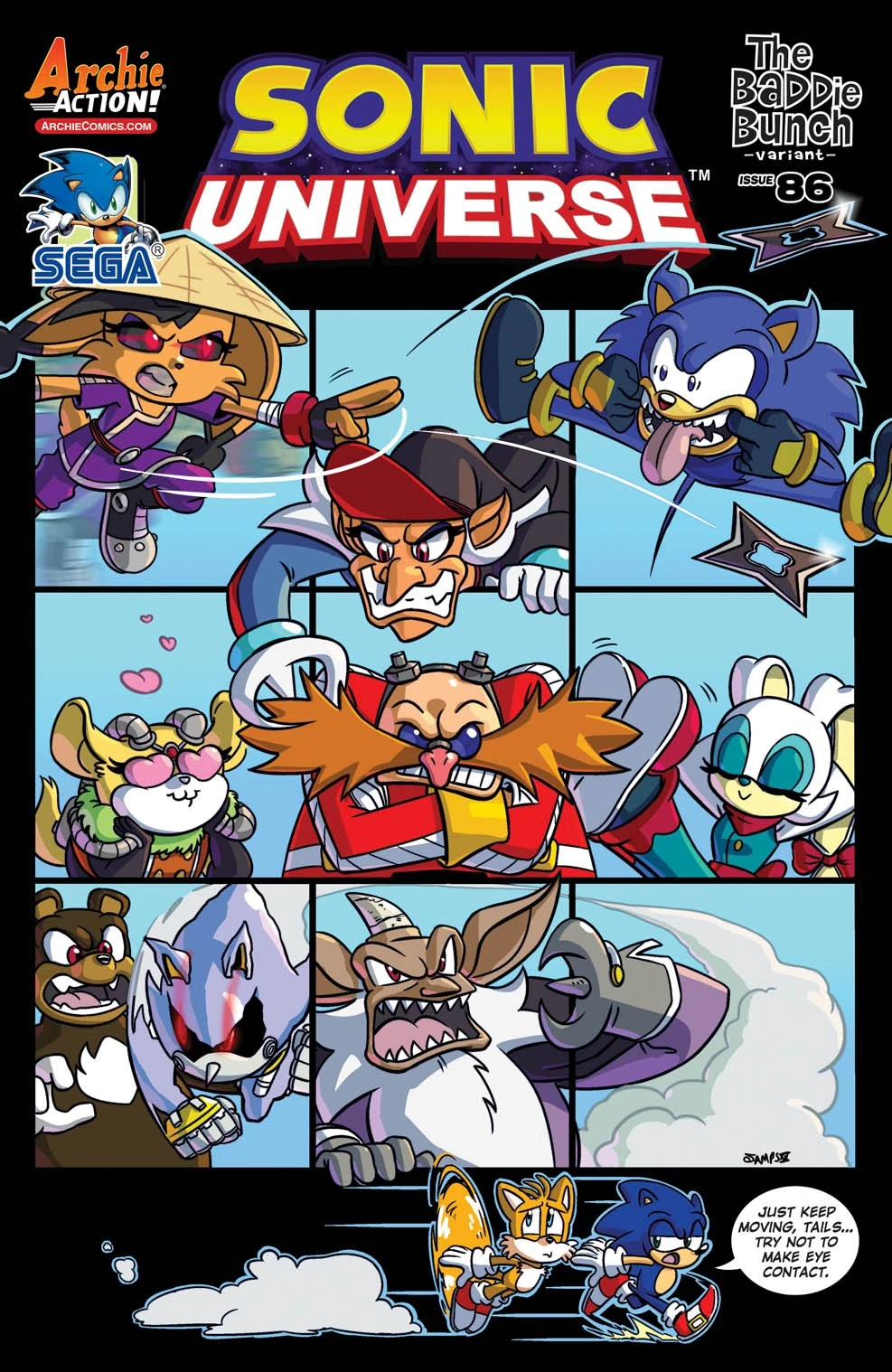
During the weird hiatus that afflicted Archie’s “Sonic” titles at the start of 2016, preview images were still coming out for upcoming issues. While fans waited for the latest comics to actually come out, all they had to go on were new covers, occasional peeks at interior art, and plot synopses in solicitations. I was especially confused by the shots of Falke Wulf we got on these covers. (He also shows up on the “Brady Bunch” inspired variant cover for this issue.) Who was this OC-looking purple wolf motherfucker? And the sight of Eggman in transparent green battle armor made some wonder if the Chaos Emeralds would play a role in the final part of “Eggman’s Dozen.” I don’t know about you guys but I think it’s kind of cute when nerds are wrong about shit.


Given the rather opulent name of “Eggman’s Dozen: Finale - Synergizing,” the issue begins with Eggman’s team of bosses and the Naugus siblings’ forces facing off. The Egg Bosses proves more than able to take down the Badniks while Lord Hood’s hypnosis renders the Witchcarters useless again. Eggman himself takes on the crystallized Metal Sonic, subduing him with his spiffy hard light energy armor. The trolls defeated and his refinery regained, the Dozen return to their corners of the globe while Eggman plots his next move.

I know I constantly bitch about Ian Flynn’s over-reliance on action sequences, especially towards the end of a story arc. But I actually like it here! “Eggman’s Dozen” wraps up on a fittingly action-packed note. So why is it okay this time? As previously noted, Flynn has done a good job of building up the characters throughout the four-parter. You actually care about whose butts are being kicked here. More pressingly, this entire arc has been building towards this confrontation. We’ve been waiting to see Eggman, his team, and the Naugus twins throw down. The issue pays off nicely on those expectations.


And, yeah, Eggman gets a cool power-up here. In the long history of Archie’s “Sonic” comics, we saw Robotnik or Eggman fight a foe hand-to-hand three or four times, I think. He’s more of a thinker than a brawler. Nevertheless, there is a certain fun novelty in seeing the rotund one use his fists and his brain at the same time. The Hard Light Armor is a pretty cool sight, as holographic weaponry like that is always a neat visual. After using a big ass laser cannon to burn away the corrupting crystals on Metal Sonic, Eggman says the armor can never be used again. I can see why Flynn would make this choice. It would kind of take away Eggman’s main gimmick if he did stuff like this all the time. But it does seem like something of a shame to toss such a cool gadget after one use. (Similarly, one of the few other times Robotnik went hand-to-hand with an enemy. the “Sonic Quest” mini-series, also had him donning a cool battle armor that was used once and never again.)

Interestingly, the story’s central conflict is resolved about halfway through. Eggman drives off Naugus. Wendy is captured and Clove is ordered to decapitate her, when the witch convinced the fat man to make her an Egg Boss instead. After that, we get a long series of pages devoted to the Bosses returning home. Some of these set up plot points that have already happened: Thunderbolt having Master Emerald shares, Axel chasing Sonic around Efrika, the business with the Dark Phoenix Spirit.


Mostly, I like to think Flynn wanted to keep developing these new characters. Some are exhilarated by the adventure, Abyss rallying her troops and Ahklut ready to crush his rival again. Others, like Clove and Nephytes, are more concerned with their friends back home. (How Cassea greets her sister is pretty cute.) A scene where Tundra admits the losses of this war are starting to weigh on him is also very effective. It’s nice that the character development doesn’t end when the storyline does.

Naturally, Flynn uses these extra scenes at the end to set up some future plot lines too. Wendy’s first job as Egg Boss is to track down some unseen object relating to the Zetis, presumably that weird conch shell trumpet thingy. Maw is apparently tasked with testing out a new Roboticezer, with poor Tassel Boy as his subject. Nephthys also reveals that her gold mask covers a hideously robotic face, a Doctor Doom-esque attribute that would’ve presumably been further explained in future story. All of this set-up would be squandered by the book’s in-coming cancellation. I definitely would’ve liked to have seen some of these play out. (Probably not the Zeti one.)


Thus concludes “Eggman’s Dozen,” one of my favorite post-reboot story lines. I like the story so much probably due to my aforementioned fondness for “men on a mission” stories. Yet I also think this one is tightly plotted, balances character development and action excellently, and is generally fun to read. Ah, what the hell? I’ll crack out an [8/10.]