Showing posts with label lamar wells. Show all posts

Monday, December 7, 2020

Sonic the Hedgehog (IDW): Annual 2020


Sonic the Hedgehog (IDW): Annual 2020
Publication Date: July 8th, 2020

IDW seems committed to the “Sonic” franchise and has continued to expand the line pass the main book. 2020 has seen the release of the second “Sonic” related mini-series and the continuation of the annual one-shot. As with the first annual, this contains several short stories set in Sonic’s world. Yet, with 2020’s weirdness even seeping into “Sonic” comics, this annual presents side stories from the Metal Virus outbreak. Which, oddly enough, means Sonic himself only has cameo appearances throughout this book. In fact, Eggman is the only “star” character to headline any of these stories. This is either an interesting creative choice or Sega’s bizarre mandates forcing the comic to get creative.


Our first story, “Big’s Big Adventure,” is Ian Flynn’s sole contribution to the Annual. And, yes, it’s about Big the Cat. It chronicles the rotund feline’s quest to reunite himself with his perpetually missing amphibian friend, Froggy. It turns out that the fat cat has been following his frog buddy through every major adventure of the comic’s first two years. Turns out, Big the Cat was always just off-panel, eavesdropping on every important event that has happened in Sonic’s world since the end of “Forces.” Big is finally reunited with Froggy but this story has an unhappy ending... Because Froggy is infected with the Metal Virus and Big is cluelessly being consumed by it, as he sits and pets his pal. 

“Big’s Big Adventure” seems like a joke story. After all, Big is basically a walking meme at this point, only surviving in the “Sonic” franchise because some people find him amusing for whatever reason. Turning the dopiest of characters into the comic’s Forest Gump, wandering into historical events through his own simpleton logic, is obviously a joke. In execution, this doesn’t act as much more than a summary of the book’s first two years. Big’s simple-minded interpretations of what’s happening is, I guess, meant to be humorous. Jon Gray’s typically cartoony artwork and garish colors makes this intent clear. 

But there’s not much too it... Until the end that is. That panel of Big, totally unaware that he’s becoming a Zombot as he pets his infected frog, is suitably tragic. Big is so child-like, that he can’t even wrap his head around the pandemic. His naivety has unknowingly led him to his own doom. Jeez, that’s pretty grim. Even Gray’s artwork takes a step-up in the surprisingly sinister final few panels. 


The second story has 2020’s Annual’s embracing its horror status. “Darkest Hour,” both written and drawn by Evan Stanley, follows two new characters. Nite the Owl is the late-night DJ at the radio station outside Sunset City. Don the Rooster is the grouchy station janitor and Nite’s only company. What starts as a normal night soon takes a grim turn. Listeners start calling in with reports of Zombots attacking, frightening and confusing Nite and Don. Soon, the humble radio station becomes the only source of public information in the chaos-stricken city. And it’s only a matter of time before the Zombots start to close in...

“Darkest Hour” has a pretty bitchin’ premise. Showing a zombie apocalypse story from the perspective of a humble public broadcaster, who went in expecting a normal night and instead got wrapped up in history, is an idea I’ve seen before. Watch the 2008 Canadian flick “Pontypool” for something similar. Applying this idea to the “Sonic” universe is something new, that’s for sure. Stanley manages to capture something like a sense of panic, as Nite and Don attempt to grapple with the information they are receiving. The new characters are likable enough. However, Don’s arc — going from caring only about himself to helping others — isn’t given much room to grow. This one honestly probably needed more than five pages to really work but Stanley does a decent job with it.


The third story is “Reflections,” written by Caleb Goellmer with art by Aaron Hammerstrom. It’s an almost totally dialogue-free story, depicting Metal Sonic wandering the halls of Eggman’s base. Surrounded by images of his organic counterpart, Metal comes across a vat of Metal Virus slime in an obscure corner. He dips his finger in and seems shocked that he’s not affected. Starline then shows up and tells the robot to scram, yet clearly some sort of thought is stirring in his computerized mind. 

I’ve had largely negative things to say about Goellmer’s previous contributions to IDW’s “Sonic” books. “Reflections” manages to be his first good story, though Hammerstrom’s atmospheric pencils do most of the heavy lifting. We already know Metal Sonic is self-aware but this seems to be the first time the robot is made cognizant of his artificial nature. After seeing the flesh-and-blood Sonic be infected, he attempts to infect himself but find he can’t do it. It’s yet another way he is different, maybe even inferior, to his inspiration. And that seems to really chap his shiny metal ass. 

At least that’s the way I interpret it. Considering the deliberate contrast Hammerstrom’s artwork creates between the hard, cold metal robot and the reflections of living things, I think that’s the message we’re suppose to take away. That Goellner of all people got me to think about Metal Sonic’s interior monologue is surprising and impressive. I hope this is a plot point that’ll go somewhere, not just be left as a moody one-off.


Story four is “Eggman’s Day Off,” from newcomer Sarah Graley and artist Lamar Wells. It follows Starline, being a huge nerd about working for Eggman. When he leaps towards his idol, thinking he's in trouble, he instead finds Eggman is also a huge nerd. Deep within the Faceship, Eggman has a secret man-cave. This is where he comes to unwind, devoting himself to his hobby of making small toy robots of himself, his various creations, and his enemies. That's right, Eggman collects action figures too. Among the various toys, Starline finds a toy of himself... Or, at least, a toy of himself as a machine. Eggman decides the platypus has seen more than enough and ejects him from the room, leaving his assistant with more questions than answers. 

I don't know if “Eggman's Day Off” is meant to set up future plot points, by further suggesting that there's some animosity between Eggman and Starline, or if this is just a look into Eggman's psychology. Is the toy of Mecha-Starline meant to imply that Eggman eventually plans to turn his organic partner into a robot? Or is it merely suggesting that Eggman sees everyone around him as toys to play with, machines he can boss around and command? The latter is certainly the more interesting idea and would build-up the conflict between the two doctors more. For the most part, “Eggman's Day Off” is mostly played for laughs. Yes, the comic is pulling a “Spaceballs” by showing the bad guy playing with dolls. It didn't make me chuckle much, though seeing Robotnik be so enthusiastic about toy collecting is pretty cute.  


The fifth story in this jam-packed annual is “Flock Together.” This is also written by a first-timer, Samantha King, but drawn by long-time “Sonic” artist Jamal Peppers. The story depicts how Vector retrieved Charmy Bee after he was infected with the Metal Virus. While on a Restoration rescue shuttle, Vector and Espio wonder how they can retrieve their friend. That is when the ship is bombarded by a horde of zombot flickies. Among them is Charmy. Vector and Espio climb atop the Shuttle and, after a brief scuffle with the robotic birds, manage to cram their insect friend inside a glass globe. 

These annuals always have one dud and this is 2020's. On a narrative level, “Flock Together” offers very little. Vector and Espio immediately chancing upon Charmy, after just talking about rescuing him, is contrived. The attempts to make adorable Flickies into threatening creatures falls flat. Bizarrely, the moment Vector shoves Charmy into the capsule happens entirely off-panel. Espio clouds Vector in smoke during what one assume is the most dramatic moment in the story. Speaking more generally, King's dialogue is incredibly stiff, with Espio's word balloons coming off as especially technical. While Peppers is an experienced “Sonic” artist, his work here is slightly flat and unexpressive. I think he might've been a bit rusty.


We wrap up with “The Catalyst.” Gigi Gutreix, who inked one of the earlier stories, does writing duties while Abigail Bulmer handles pencils. The story centers on Jewel. The president of Sonic's fan club, introduced in the previous annual, comes running into Spiral Hill. He informs her that the other members of the Fan Club are missing. The two roam the countryside until the Vice President is found, isolated on a pile of hay surrounded by Metal Virus goo. She's rescued but neither of the youths are aware of how dangerous this stuff is, having already come into contact with it. Afterwards, the Faceship looms overhead...

“The Catalyst” is a little better than “Flock Together” but still feels like a story I'm not sure needed to be told. I support bringing back the Sonic Fan Club kids, if only because IDW's unique cast needs to grow. However, we don't really learn much about either kid here. It's nice to spend more time with Jewel, especially her briefly mentioned memories of a childhood with Tangle. Yet the story mostly feels like an exercise in inevitability. It merely depicts how Jewel got infected, a rather downbeat tale that probably didn't need to be elaborated upon much. Bulmer's artwork is fine though she doesn't really distinguish herself among the “Sonic” artist crowd.


2020's Annual sure is an odd one, as the focus on the Metal Virus means almost all these stories have a dour feeling to them. That's not necessarily bad though. It starts off pretty strong and I'm pleasantly surprised this comic book got me to care about non-entities like Big and Metal Sonic. The quality dips a little in the second half, with more unremarkable-to-bad stories. Yet it's an oddball, interesting collection, that's for sure. I'm glad IDW is taking more risk like this. If nothing else has come out of this overlong Metal Virus Saga, at least the comic has been pretty willing to try out other moods. The daring means I have to give this a [7/10.]

Friday, November 29, 2019

Sonic the Hedgehog (IDW): Issue 21


Sonic the Hedgehog (IDW): Issue 21
Publication Date: October 2, 2019

Something that’s starting to disappointment about the Metal Virus saga is that it’s so urban thus far. Just going from the games, Sonic’s world is one full of diverse locations. We are talking dessert, beaches, mountains, polar icecaps, enormous casinos, etc. instead of dropping a Zombot horde into the surreal spiraling landscape of the Green Hill Zone, the saga has mostly been content to display the Mecha-zombies overtaking various, nearly identical looking cities. I get this, from a narrative perspective. Eggman is focusing on densely populated areas, to spread the Infection more. That’s where the most people, that need protecting by the good guys, are gathered. But, as issue twenty-one touches upon the exact same set-up as the last few issues, it’s starting to get boring.


This is “The Last Minute, Part One.” The city — that looks like all the other cities — this time is Central City. That’s where Tails’ workshop is located. Eggman jizzes another dollop of grey goop from his Faceship and soon the city is overrun with Zombots. As the zombies spread, Tails toils away in his laboratory on a cure. He finally cracks a cure but just as the infected make it inside, forcing a speedy retreat that looses him his research. Tangle and Whisper also arrive to do what they can, save people, and contain the outbreak. But soon another city has fallen to the shiny tide.

You might notice that synopsis above doesn’t mention Sonic at all. Yes, Flynn gives the titular hero a break in this one. He’s out running as fast as he can, providing Tails with the data needed to engineer a cure, and only appears in one panel. So Tails, Tangle and Whisper are our heroes this time. That’s kind of cool. Even if this zombie outbreak is getting increasingly same-y, it is sort of cool that Flynn is giving us peeks at other corners of the world during this apocalyptic time. Now how about we see what the fuck Knuckles and Angel Island are doing during all of this, Ian? Just standing back and watching his friends suffer?


Anyway, this issue also has Flynn returning to one of his more peculiar characterization. That of Tails as a hyper-capable bad-ass. After the Zombots break in to his workshop and smash the hard drive containing the newly designed cure, Tails jumps into the Tornado 2 from “Sonic Adventure 2.” Instead of using this airplane to, ya know, fly above the encroaching zombie masses, Tails blasts his way out with machine guns and races through the city streets. He then has to self-destruct, tearfully one must add, to make his final escape. On one hand, I guess this makes sense. (Tails being an action hero, not Flynn’s insistence and adding a shoot-out and car chase to this issue.) He can fly, is as fast as Sonic, and also a super-smart engineer. But does someone who talks to his airplane/car/death-bot like it’s a person and cries when he abandons it also need to be a super-cool hero? Isn’t this kid like ten?

Despite potentially being an intimate story about what folks are doing to survive during the zombie outbreak, “The Last Minute” mostly exist to further push the plot ahead. Tails might loose his research but that he invented a cure once suggests he can probably do it again. Meanwhile, a sequence in the middle of the book has Starline recruiting the Deadly Six, in his plan to take control of the Zombots behind Eggman’s back. The Zetis, of course, plan on betraying him as soon as possible. It’s all machinations to move this arc into its next phase. Which is fine but I do wish Flynn had saved room for a little more character interaction, considering these events are so heated, instead of focusing mostly on plot and action.


While I’ve overall applauded the darker direction this comic has taken in 2019, I’m starting to get a little exhausted with this increasingly dire situation. Tails has a cure in his grasp but then it’s yanked away at the last minute. He’s rescued by Amy Rose and an airship, only to learn that Restoration HQ has fallen. (The events of which will be depicted in the next issue.) Maybe only one or the other should’ve happened. This is starting to feel less like natural story developments and more like contrivances to keep the plot, that should be heading into its last act by now, going on longer. Considering we already know the Metal Virus arc will last into the next year,  the 25th issue, that’s really what I’m expecting.

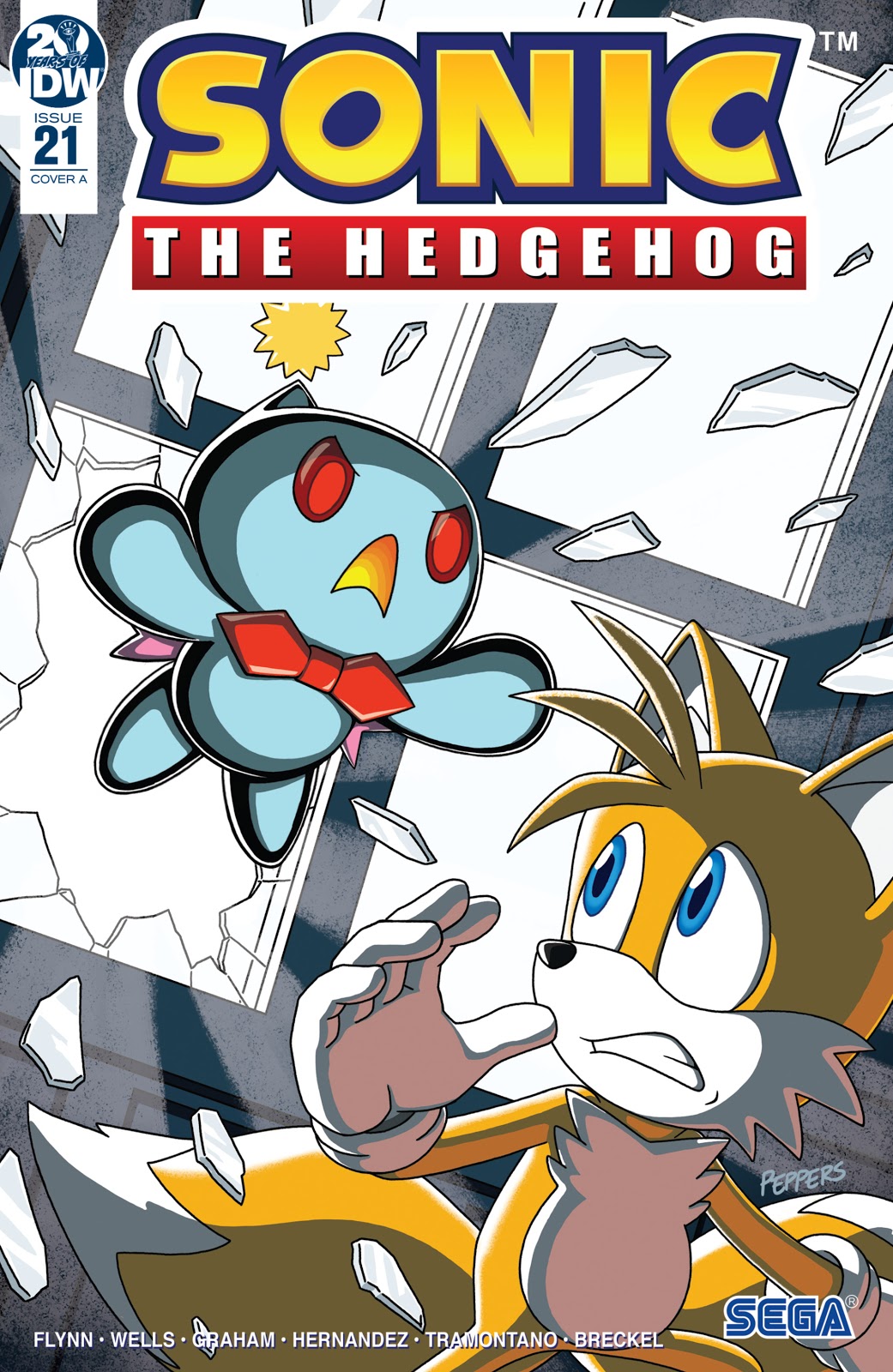
Another odd thing about issue 21 is that the art situation. I recently learned that Tracy Yardley will be taking an extended break from the “Sonic” books. This required a last minute artist change for this issue... Or artists change, I should say. Three people had to be brought in to make up for Yardley’s sudden absence. Archie vet Lamar Wells teams with someone named Reggie Graham to pencil the first ten pages. Wells and Graham do fine, though their work isn’t as kinetic as what we’ve gotten use to. The action is slightly stiffer and characters aren’t as expressive, with weirdly thick lines. Jennifer Hernandez handles most of the rest of the book, her work having slightly more personable faces. (Tails’ reaction to the Zombots getting into his workshop is funny.) Weirdly, two random pages — depicting Tails’ escape and the Tornado blowing up — are handled by Priscilla Tramontano, who has mostly done covers up to this point. Tramontano’s work is slightly looser than Hernandez or Wells but also a little more dynamic, which might be a fair trade-off.


So I think it’s fair to say the Metal Virus saga is officially in a rut now. Instead of exploring the horror and tension inherent in the zombie outbreak situation, Flynn has fallen back on repetitive plotting and action. With some questionable plotting decisions, issue 21 is maybe the weakest edition to the arc yet. [5/10]

Friday, April 19, 2019

Sonic Super Digest: Issue 11


Sonic Super Digest: Issue 11
Publication Date: March 2015

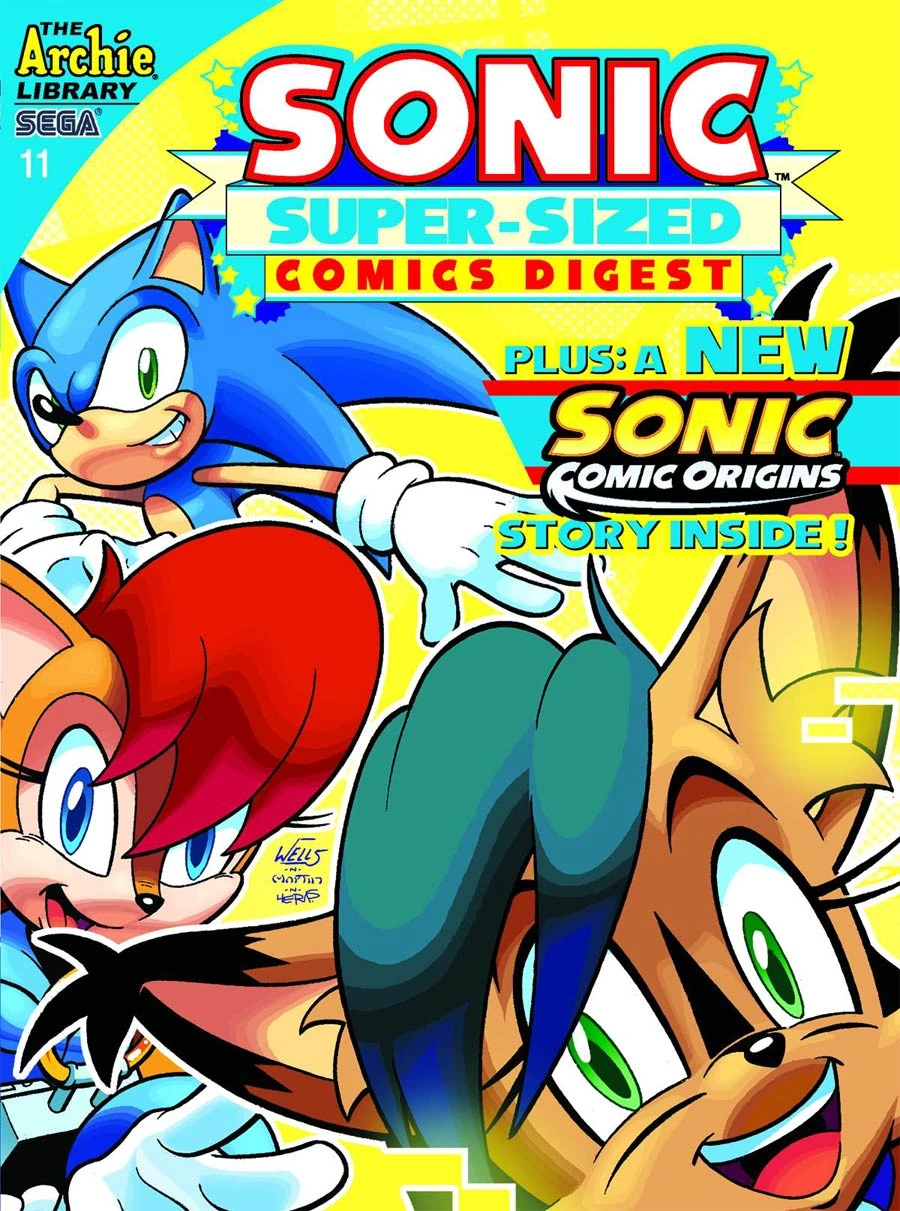
It’s time to talk about another one of those wacky digest again. Perhaps to coincide with the then-running “Spark of Life” arc, Nicole would be the next Freedom Fighter to get the Sonic Comic Origins treatment. But we’ll talk about the story in a minute. Instead, let’s look at the digest’s cover. It sure looks like a generic piece of Spaziante art, the kind of thing he could’ve scribbled in a few minutes, doesn’t it? I was certain it was a piece of Spaz stock art Archie had lying around and, indeed, that’s exactly what it is. It’s a cropped image of Sonic from “Sonic Universe: Issue 76’s” cover.


I just assumed Archie was being lazy but there’s evidence to suggest this was a last minute replacement. The original solicitation said issue 11 of the Digest would have a Lamar Wells cover. You can find it online. It’s a fitting image of Sonic, Sally, and Nicole posing in front of a supernova. I can only assume Archie got cold feet at the last minute about featuring comic exclusive characters on the cover of the mass-market digest. Or, worst, about putting female characters on the cover of a book partially aimed at seven year old boys. Or maybe they just didn’t want to pay Lamar that week. So they threw a somewhat awkward Sonic image Spaz drew in his sleep on there instead. I have no actual evidence that any of this is true but, knowing what a slapdash business Archie is, it wouldn’t surprise me.

Anyway, “Sonic Comic Origins: Nicole” concludes the loose story arc that began in the previous year’s Free Comic Book Day Special. Apparently Sonic and the Freedom Fighters weren’t the only ones running through Nicole’s “Sonic Spinball” themed training simulation. Team Rose  – Amy, Big, Cream and Cheese  – are about to take on the Machine Zone boss. As the action goes down, Nicole reflects on her early years as a handheld computer. She thinks about how her friends made her more human than she originally was.


Nicole’s tale is definitely the thinnest of the thus-far published origin stories. Despite the title, “Sonic Comic Origins: Nicole” doesn’t actually get into how the holo-lynx came to be. This is presumably because the “Spark of Life” arc, the last part of which would be published two weeks after this digest, actually details the A.I.’s backstory. Instead of spoiling the ending to his own story, Flynn focuses on character development. We see Nicole watching the Freedom Fighters grow, growing along with them. Apparently, observing her furry friends helped Nicole realize her own humanity. (Furmanity?) Only being five pages long, this story can only hint at the loneliness Nicole felt at first, being unable to truly interact with anyone. It doesn’t even have the page room to show how Nicole developed the hard-light hologram technology that makes her physical form possible.

It’s fairly thin stuff but Flynn does include some substance. We learn that both of Antoine’s parents are dead in this timeline, thanks to a chilly panel were Bunnie and Antoine cry in his bed, while Nicole’s screen displays the death announcement. We see Sonic and Tails appreciate a sunset, Rotor and Tails joking around, Nicole present as a silent observer. These colder moments are contrasted with what we see on the next page, where Nicole actually interacts with her friends: Playing chess with Sally, rocking out with Sonic, cooking with Antoine, putting a blanket over a napping Rotor. It conveys a lot of emotion in just two pages.


Lamar Wells’ artwork is up to the task of conveying this emotion. Admittedly, Nicole looks a little odd in his style. He always draws her at an angle that causes her feet to taper off to a smaller point. However, his command of mood and expression is strong, helping to sell the emotional flashbacks. I also like the especially cute way he draws Sally. Wells’ version of the Princess always looks extra fluffy and cuddly. His action scenes are squeezed into small panels, which does them a disservice. (His original cover is fine too, even if Sonic, Sally, and Nicole all look a little like melting ice cream bars.)

The rest of the digest is, of course, filled with reprints. We’re long past the point when Archie could actually pull from their history of back issues, for fear of angering Ken Penders' or anyone else’s lawyers. So all the reprints are from the comic’s very recent past. The only preboot content here is “Sonic Generations” from issue 230 and the first two parts of “Treasure Team Tango.” The themeing is weak, as the only stories here to feature Nicole are 267’s “The Grand Tour” and all of “A Light in the Dark.” (Including “Consequences.”)  Otherwise, we get all four parts of “Total Eclipse,” part four of “Waves of Change,” “Knuckleduster” from issue 2 of “Sonic Boom,” “A Nice Day to Start Again” from 264, and a very random appearance from the “Sonic Dash” adaptation.


The only bonus content is a few pin-up illustrations and one coloring page, most of which are reused cover art. In other words, aside from the Origin story, there’s no reason for Archie Sonic fans to track this digest down. I would never suggest anyone resort to piracy but, if you really want to read the Nicole story and have no interest in owning a bunch of random reprints, it’s probably the best option. Anyway, the cover story gets a [7/10], mostly for being so darn cute.

Wednesday, March 6, 2019

Sonic Super Digest: Issue 9


Sonic Super Digest: Issue 9
Publication Date: October 2014

Here we are, once again, talking about the Sonic Super Digest. In the handful of times when I’ve talked about this series and the Sonic Comic Origins exclusive to it, I guess I haven’t mentioned something: Unlike most of the comics I’ve talked about on this blog, I’ve never read these stories before. I was actually totally unaware of their existence for a long time. When I discovered what the digests contained, I looked them up and skimmed them. So this retrospective is the first time I’m actually getting some insight into the new origins for many classic characters. I’ve found my opinions have frequently changed upon a re-read but I guess you’ll just have to take these fresh.


Ian Flynn continues to work his way through the revamped histories of the classic SatAM cast. “The Belle in the Machine” focuses on Bunnie. Continuing where the last “Sonic Comic Origins” story left off, the Freedom Fighters are still working their way through a training simulation occupied by “Sonic Spinball” bosses. While waiting for a signal from Sally, Bunnie reflects on her past. She remembers how she was injured during Eggman’s takeover of Mobotropolis, how Uncle Chuck used his experimental Roboticizer to heal her, and the struggles – and eventual victories –  she endured adapting to this change.

Most of the Freedom Fighters’ post-reboot origins have not differed that much from their preboot histories. Most of the ideas were general enough – exiled princess turned resistance leader, cowardly would-be soldier turned hero, genius inventor separated from his family for whatever reason – that the book didn’t have to change them too much. Bunnie’s origin is probably the most different. SatAM never answered where Bunnie’s robotic came from while the comic did. Even though Mike Gallagher would never sue Archie, the company clearly still wanted to distance itself from any plot points introduced by previous writers. So now Bunnie, instead of being a random farmer abducted by SWATBots and rescued by Sonic mid-Roboticization, is a victim of Robotnik’s coup and Uncle Chuck is responsible for her cybernetics.


Perhaps a more vital difference is how Bunnie’s transformation affected her here versus how it did in the original continuity. Way back in issue 3 of “Sonic,” Bunnie takes about a page to recover from being partially Roboticized. She immediately embraces her new limbs, karate kicking and disabling giant robots before the story’s end. In the reboot, the healing process clearly takes much more time. Bunnie is shown wobbling around on her new limbs, unsteady and uncertain. Now, the support from the Freedom Fighters and Antoine’s love helps Bunnie grow into the strong, confident woman she is now. Which is very different from Bunnie’s original conception as someone who hides her insecurities with a confident exterior. But it also emphasizes how much the Freedom Fighters depend on each other, which is nice too.

I don’t know if Lamar Wells drew all of these stories at once and they were just published sporadically or if they were drawn as they were commissioned. I assumed the former at first, considering this is essentially one story arc being regularly interrupted by lengthy flashbacks. However, now I wonder if the latter is true. Wells is clearly having an off day with “The Belle in the Machine.” The earliest flashbacks, showing Bunnie as a child either frolicking with friends or being crushed by a collapsing house, are very flat in appearance. It’s a clear difference between the more action packed scenes in the present, like a cool panel of Sonic and Sally tearing up some chains. Those moments are up to Wells’ usual standards. But, whatever, we all have off days. It’s fine.


Proving that gimmickry never really died at Archie, this issue is promoted as a Special Edition of Sonic Super Digest. The special part manifests in a few bits of bonus content. Such as a Top Ten list counting down “Our Favorite Things About the New Sonic Comic Universe,” and brief articles about the Freedom Fighters’ new looks and the Shattered World Crisis. All of this stuff, but the top ten list especially, emphasizes how great the new continuity is supposed to be. In other words, these bonuses are propaganda from Archie. It’s painfully insincere corporate belching about how you should totally love the super great new universe, the previous timeline might as well not exist, and we have always been at war with Eastasia. I ain’t buying it but a lot of Archie Sonic fans actually think this way.

There's also a difference in which reprints are included in this digest. The last digest we covered featured some deep cuts, going all the way back to the comic's early years. This digest features stories exclusively written by Ian Flynn, from the last ten years or so. (And most more recent than that.) The reason for this is pretty obvious. In between the eighth and ninth digest, Archie got the memo that you can't republish old stories and art without paying the writers/artists residuals. That's probably common sense for most companies but not Archie, a company determined to be the sketchiest motherfuckers in an industry heavily populated by sketchy motherfuckers.  Though several stories are completely unrelated – like the still very new “Damage Control” from “Sonic: 257” and “Waves of Change: Part 1” from “Sonic: 260 – there was at least an attempt to theme some of these to Bunnie. She's a main character in parts 3 and 4 of “Trouble in Paradise” and “Thicker Than Water: Part 1.”


So what else can I say about that? Bunnie's rejiggered origin is fine, a decent take on the character that also fits in more with the revamped universe. The rest of the digest's content just sort of makes me laugh at how hard it was trying to promote a reboot that clearly saw some blowback. I maintain that the Sonic Comic Origins definitely should have been included in the main book, instead of shuffled over to an easily overlooked side publication like this. [6/10]

Friday, February 22, 2019

Sonic Super Digest: Issue 8


Sonic Super Digest: Issue 8
Publication Date: August 2014

With issue 8 of the “Sonic Super Digest,” Archie would begin the habit of periodically inserting new Sonic Comics Origins into the book. This move, I suspect, was probably done to drive some faithful readers to the largely reprint filled digest series. If that was the plan, I’m gonna say it was successful. The Digest series ran for another two years, an additional eight issues, which is a pretty good run for a quickie cash-in series made mostly of old content. It probably would’ve continued to, if all Archie “Sonic” content hadn’t mysteriously ceased publication at the end of 2016.

This move might’ve been good for the “Sonic Super Digest” series but, for me personally, it was fucking annoying. When it was first published, I never read the Digests, assuming they would just always be made up of reprints. So I totally missed the Origins stories when they were new. As someone invested in these characters, learning about their revamped history was fairly important to me. To have that shuffled over to some side book, when it should’ve been in the main line, was baffling to me. You’re telling me Flynn couldn’t cut “The Great Chaos Caper” or “Champions” or some bullshit like that short so we could learn where our heroes actually come from? It’s just another way how it’s obvious to me that the reboot’s priorities were all fucked up.


So, ahem, anyway... “Little Lost Soldier” details Antoine’s origins. While the Freedom Fighters continue their way through Nicole’s digital training simulation, battling the weird first two bosses from “Sonic Spinball,” Antoine reflects on his past. We see how he came to the Kingdom of Acorn as a child. How he began life as a coward and became infatuated with Sally. And how, eventually, he would meet Bunnie, develop feelings for her, and see his life completely change.

Of the comic’s original cast, I’ve always said that Antoine underwent the most character development. This guy started out as comic relief, someone who acted like he was big shit but was actually a giant jack-ass. He was essentially there to be Sonic’s friendly foil, which amounted to him getting teased and picked-on by the blue hedgehog. Over time, he would become a brave soldier, a vital member of the team, and even be allowed to marry his love interest. (Not to mention gaining a robot dad, being replaced by an evil doppelgänger for a while, and almost dying tragically.) That would be a lot to cover in only five pages.


Surprisingly, “Little Lost Soldier” actually does a pretty good job with this. Flynn manages to reduce Antoine’s history down to its most essential elements. His ridiculous accent is explained as being sent to the Kingdom of Acorn by an unseen father from another country, to be trained as a royal guard. Antoine’s original status as a coward is explained by him only being a child, and only into the beginning of his training, when Eggman’s coup occurred. This immaturity is nicely tied in with his crush on Sally, another symptom of him being a kid who didn’t know any better. Flynn thankfully skips Sonic bullying Antoine too, as the Freedom Fighters and the blue hedgehog have largely separate childhoods, in order to maintain Sega’s bizarre mandate of never revealing Sonic’s origins.

The only element of Antoine’s new origin to slightly rub me the wrong way is the importance Bunnie plays in it. Now, don’t get me wrong, Bunnie was a huge part of Antoine’s progression from coward to hero. But in the original continuity, their relationship and Antoine’s strength grew gradually and naturally over time. Now, it looks like the coyote saw the cyborg rabbit once, was immediately crushed on her, and decided then-and-there to stop being such a jerk-ass. Their growth is tied directly into each other in a way that doesn’t feel natural. But I guess this is a side effect of showing someone’s history in five pages, versus showing it over more than one hundred comic books.


Lamar Wells continues to draw the Sonic Comics Origins five-pagers. I suspect he probably drew these back-to-back over a short period of time, as the artwork is very consistent. I like how cute he makes the Freedom Fighters as kids. Little Antoine looks adorable with his small red cap. Wells also excelled at character expressions. The shot of a distraught Antoine, walking in the rain after he gets friend-zoned by Sally, is fittingly pathetic. I also like a little gag at the end. After detailing his evolution into a brave man, Sally startles Antoine, causing him to react in a very comical way. It’s a good moment, showing that Antoine hasn't totally changed, and Wells’ art is a big reason why it works.

A digest being what it is, the rest of “Sonic Super Digest: Issue 8” is filled with reprints. Compared to the magazine, which is full of all sorts of bonuses and extras, the Digest just throws in a few “pin-ups” and “coloring” pages, all of which are made up of old cover art. At least the editors saw fit to theme most of the reprints around Antoine and Bunnie. There’s some classic stories reprinted here, like issue 10’s “Twan in the Wind” (the first half-decent Antoine story), issue 23’s “Vol-Ant-Tier,” and issue 37’s “Bunnie’s Worst Nightmare.” Newer and fitting stuff like 232’s “Fragile” and the first two parts of “Tails’ Adventure” are also included. The book even throws in some really old, random shit, like the one-pager gag “Antoine’s Vain Refrain” and “Bugged Bunnie,” from issue 4 and the “Sonic Blast” one-shot respectively.


But let’s not give whoever put this thing together too much credit, as both parts of the “Sonic Riders” adaptation and issue 167’s “Hedgehog Day” are included for no particular reason. Then again, I can’t blame them too much as there hasn’t been that many Antoine themed stories over the years (especially once you exclude anything Ken Penders had a hand in) and 119 pages is a lot to fill. Anyway, this digest remains a mandatory read for hardcore fans due to its first story, which is solid enough. [6/10]

Monday, February 4, 2019

Sonic Free Comic Book Day 2014


Sonic Free Comic Book Day 2014
Publication Date: May 2014

In 2014, Archie would begin to publish short comic stories called Sonic Comic Origins. These would detail the backstories of the established cast members, as they exist in the rebooted universe. (Pointedly, characters that originated in the video games would be left out of this, as Sega refuses to let Sonic and his friends have an actual origin, as this would interfere with his status as a highly marketable corporate mascot.)

Despite this being fairly vital information, that informs this world and its characters, Archie and Ian Flynn did not see fit to include these stories in the actual on-going comic book. I guess they didn't want to interrupt the flow of the narrative, which is obviously much more important than knowing who these characters actually are and what they're about. Right? Sure. Anyway, the first of these Origins stories were published in 2014's Free Comic Book Day special. The second one would later be re-published soon afterwards in issue 7 of the “Sonic Super Digest.”


The first story is called “Sally – The Exiled Leader” and, obviously, revolves around Sally, the exiled leader. While the Freedom Fighters are working through a training simulation on the Sky Patrol, Sally thinks back on how the team was formed. She remembers her happy childhood days in the Acorn Castle, with her father. How he and Naugus were exiled to the Special Zone during Eggman's coup. How she fled to the Wood Zone, found Knothole Village. How Sonic inspired her to form her own team and fight back. How they've been fighting for years, rescuing her dad, winning the kingdom back, but still going forward to save the world and defeat Eggman forever.

Sally's backstory, as presented in “The Exiled Leader,” is not too different from the previous continuity. However, there's one really big difference. King Nigel Acorn is much less of a prick than King Max Acorn. The flashbacks emphasizes how much Sally loves her Dad, showing them playing when she was tiny. After rescuing Nigel and reinstating him as King, Sally asks her dad if she can forego her royal duties and continue to lead the Freedom Fighters. The King gives her his enthusiastic support. It's hard to imagine the old King Max doing either of those things. The preboot constantly mined Sally's struggle to balance her life as a Freedom Fighter with her life as a Princess. So that's one obvious way the reboot 'verse is superior to its predecessor. This is a King Acorn you can imagine people actually being invested in enough to want to rescue.


The training simulation set-up continues with “Rotor – The Exiled Inventor.” While building a rocket launcher to take down their digital adversary, Rotor recalls his own childhood. He grew up among a warrior walrus tribe in the frozen north. Unlike the rest of his family, he was more interested in technology than anything else. This caused him to run away from home and head towards the Kingdom of Acorn, supposedly a technological wonderland. Instead, Rotor arrived to find a conquered city. He soon met up with Sally and the Freedom Fighters, who quickly found a use for the walrus' inventive mind.

In the old continuity, Rotor's family were enslaved by the various Robotniks for more than a decade. Flynn switches this up a bit by having Rotor willingly leave his home. Being rejected by a distant father for being more intellectual than physical is a classic source of teenage angst. It's an okay origin but what's more interesting is the probably accidental connotations. In the old continuity, Ken Penders would reveal that he always wrote Rotor as gay. Assuming Rotor's double-secret closeted status is still true in the new timeline, the scene of the walrus coming out to his dad as a tinkerer, and being harshly rejected, reads very differently. And we already know Rotor's dad is now an Egg Boss. Flynn probably planned for the two to have a confrontation eventually but, naturally, was too busy with this Shattered Earth bullshit.


This issue also gives us a better look at the new continuity's history. It seems Flynn basically came to the same conclusion I did: That combining SatAM with the classic games is a solid decision. So there's lots of little images here that will be instantly recognizable to longtime Sonic fans. Such as the Princess Jasmine costume Sally wears as a little girl. Or the presence of Rosie, who was still her nanny. As a child, Rotor resembled his pudgier animated counterpart, even wearing the yellow baseball cap. And it would seem Eggman assumed power over the Kingdom of Acorn in more-or-less the same way, though the local countryside now features more marbled loops. At the same time, now it's evident Sonic began fighting Eggman before meeting the Freedom Fighters, presumably to make room for the events of the first few Sega games. Still, it works and I wish Flynn had led with this, instead of just dropping us into the middle of the action.

The artwork is by Lamar Wells. Wells previously did the pencils for issues 253 and 254, supposedly working off Tracy Yardley's outlines, in addition to providing a few covers here and there. Wells, working alone this time, does just fine. His Sally looks especially bouncy and cool. He draws good dramatic poses, which works for the highly static flashbacks, and dynamic action scenes, which work for the training simulation presence. He has a good balance of cute and gritty, that this series has always run on. 


I also like the little throwbacks and in-jokes in here. Such as the reveal that Rotor apparently invented the spikes throughout the Green Hill Zone as a trap for Eggman's Badniks. Or the bit of flirty banter Sonic and Sally get at the end of the first story. Most notably, the training simulation also has the Freedom Fighters battling Scorpius, the memorable first level boss from “Sonic Spinball.” The stories are solid enough and will probably make me a little more invested in these new versions of the established cast members going forward. Which makes me really wonder why Archie didn't include these in the main book. This seems like the kind of important information readers would want to know.

Instead, these Sonic Comic Origins were stuck into 2014's Free Comic Book Day release, where they would have to share half a comic book with Mega Man reprints. Not really caring about the adventures of Mega Man X or whatever, I didn't read that half of the book. (Spaz drew that story, so it at least looks snazzy.) Archie would continue to shove the Comic Origins into various Digests and Magazine releases, leaving them out of the regular book for some baffling reason. That makes this Free Comic Book Day release one of the most essential. [7/10]

Friday, December 28, 2018

Sonic the Hedgehog: Issue 254


Sonic the Hedgehog: Issue 254
Publication Date: November 2013

Welcome to another installment of the “Bitching About the Archie Sonic Reboot Hour.” In all seriousness, I think even fans of the reboot would admit it got off to a rough start. The last two issues have been scattered, unfulfilling affairs. I’m far from done complaining about the new continuity but I will say that issue 254 is the first post-reboot issue I’ve enjoyed. We’ll get back to bitching and moaning soon enough.


Part two of “Countdown to Chaos” is subtitled “The Soldier,” so take a good guess about who will be reintroduced this time. After visiting the reformed Knothole, Sonic and Tails track down Uncle Chuck. Along with his assistant, Ben Muttski, he’s been studying the strange earthquakes that have started to affected the planet. Antoine has been functioning as their bodyguard. Sonic and Tails restore Antoine’s memories and then rescue everyone when another tremor causes them to fall into a big ass crack in the earth. Meanwhile, Eggman continues his explosion filled journey back to the Death Egg.

Issue 254 brings some much needed heart to the reboot. Upon seeing Uncle Chuck, Sonic lifts him up into a big hug. He’s nearly brought to tears by the sight, that his uncle has survived the universal reshuffling more or less untouched. When Antoine’s memories of the old ‘verse are restored, he actually gets a minute to absorb this info, instead of the plot immediately marching onward. (Which is good, since his old memories are among the more traumatic.) Antoine provides another nice moment at the comic’s end. After we learn Bunnie is undercover in Megaopolis, he tells Sonic and Tails to inform his wife how much he misses her. Aww, ain’t that sweet.


Let’s talk about rebooted Antoine. Of the original five Freedom Fighters, Antoine was one of the few better served by the reboot. After all, the coyote’s personality has already changed considerably from his original portrayal in SatAM and the earliest comics. (Though his early status as the team coward is nodded to in a cute way.) He’s more action oriented, now able to perform spin dash-like attacks. His role as an honorable soldier and romantic has superseded his goofier elements, at least for now. His redesign is mediocre – befitting most “Sonic” males, he’s naked, save for his boots and a weird bandolier thing to hold his sword on – but it doesn’t actively offend the way Rotor’s new appearance did.

Antoine is not the only SatAM cast member to get a new look in this issue. For years, Muttski has been Sonic’s pet dog, creating an odd Goofy/Pluto situation that the comic would take years to clarify. The Genesis Wave has seemingly removed the distinction between the intelligent, bipedal Mobians and the more classically animal-like Mobini. Muttski is now Ben Muttski, an upright, talking funny animal like everyone else Sonic knows. I’m generally a fan of this decision, as it made the comic’s universe a little more consistent. (It also leads to a pretty funny reaction from Sonic and Tails.) Sadly, the new Muttski would be another example of Flynn adding to the rebooted comic’s cast without actually developing anyone. I think Ben made two or three more appearances before the book was canceled.


Issue 254 also sets up one of my least favorite aspects of the reboot. We already know this unnamed world that is definitely not called Mobius is cracking up following the Genesis Wave. We’ll be talking about earthquakes and huge chasms in the ground a lot over the next year. While rescuing Uncle Chuck’s research, Sonic inhales a little black cloud of what will soon be called Dark Gaia Energy. I won’t devote too much word space this time to how much I despise the Werehog. Believe me, there will be plenty of time for that soon enough. Needless to say, I find the setup for this plot twist to be pretty silly. I guess black smoke can do anything, including turning people into fucking werewolves.

While this issue is more focused on emotion than action, it still has to deliver the boom-boom. After Chuck and Muttski fall into the crack in the earth, Sonic, Tails, and Antoine have to leap around some logs to rescue them. It’s an okay, if slightly awkwardly framed, action sequence. Better is Eggman’s assault on a G.U.N. aircraft carrier. There’s a certain glee to the mad doctor improvising an Egg Walker and going hog wild on some random military guys.


Oh, by the way, Lord Hood and Bow the Sparrow are back too. As lame as those guys are, I can’t blame Flynn for utilizing them again. He had to salvage what he could from the old universe. While many of my complaints about the reboot still stand, part two of “Countdown to Chaos” is better than the previous two issues. Its focus on emotion and more than superficial world building is a welcomed change. It’s good to know Flynn still actually cares about these guys. [7/10]

Friday, December 21, 2018

Sonic the Hedgehog: Issue 253


Sonic the Hedgehog: Issue 253
Publication Date: October 2013

Issue 253 of Archie’s “Sonic the Hedgehog,” the second issue in the reboot, would begin the Shattered World Crisis. This crisis would go on for nearly three years. A mere two issues after that story arc wrapped up, the comic would be abruptly canceled. So I hope you like Sonic and his friends running a world that’s literally falling apart, because we’re going to be talking about that for pretty much the reminder of this retrospective.

The first part of “Countdown to Chaos,” subtitled “The Builder,” begins with Sonic and Tails running through the jungles around the Ancient Ruins. They’re looking for Rotor, the first Freedom Fighter they’ve gotten a lead on. He’s been building a secret project, a flying base called the Sky Patrol. The happy reunion is interrupted by a group of Badniks, led by a Silver Sonic. Luckily, Big is there to help. Meanwhile, Eggman is rescued by his own army in the plains of Efrika. He soon discovers that something is wrong with the planet.


There’s a totally bogus plot thread running through this issue and the next few. Nicole’s functions are still scrambled. Upon handing her to Rotor, as happened to Sonic and Tails last time, he is overwhelmed by a flood of memories from the old timeline. This restores Nicole somewhat. Sonic realizes that in order to fix Nicole, he must locate all the remaining Freedom Fighters and have them undergo a similar process.

Let me tell you why this is bullshit. This plot point sure makes it seem like the old continuity is going to have some sort of effect on the new one, doesn’t it? Perhaps the Freedom Fighters will maintain their original memories? But, as Flynn would be forced to clarify repeatedly, the old continuity is gone forever, never to return. Sonic and Tails mention that their old memories are slowly being absorbed by new ones. Eventually, they’ll forget everything. So why tease us? Why have any remnants of the old world survive at all? It’s just an awkward attempt to bridge the reboot to the old continuity. It will have no further effect on the story once it’s completed. And that’s bogus.


As the subtitle indicates, this issue introduces the rebooted Rotor. The comic has struggled for years with what to do with Rotor, writing him out for stretches or sticking him on the Council of Acorn. His original role of mechanic has largely been filled by Tails and Nicole. Despite that, Flynn returns Rotor to this role. The walrus’ specialty now seems to be weapons and vehicles, which seems to differentiate him from Tails’ slightly more computer oriented skills. But it’s Rotor’s attitude that gets the biggest overhaul. He’s tougher and more action-oriented. This is reflected in his new design, which ditches the potbelly for a brawny, barrel-chested physique.

I don’t like this. Yeah, Rotor has been building weapons for years now. He even got increasingly involved in the action recently. Yet something rubs me the wrong way about making him into a more generic tough guy, the kind that quotes “Kung-Fu Panda” while blasting enemy robots. It’s hard to imagine Cam Brainard’s gentle voice coming out of this guy. I also dislike the new design. Old Rotor was pudgy and cute. New Rotor has a stock parts "big guy" look, which is a lot less charming. It’s not surprising that my favorite Rotor moment in this issue is the panicked vulnerability that overcomes him after receiving his old memories, the only time he feels like the character we know, instead of a stranger.


That moment, by the way, is quickly tossed aside so Rotor can introduce Sonic to his new objective. That’s because this issue is not really about characters. It’s about establishing the new status quo. It introduces the soon-to-launch Sky Patrol, a mobile base that will largely overtake Mobotropolis as the Freedom Fighters’ headquarters. Eggman discovers he still has an army of loyal/terrified followers. (Including Axel the Water Buffalo, one of about a hundred new characters Flynn would introduce in the next year that seemed important but actually weren’t.) He also learns that interrupting Sonic’s Chaos Control at the end of “Worlds Collide” seriously fucked up the planet too. The rules of this new world, and the plot points going forward, are clearly more important to Flynn than the cast we’ve been reading about for twenty years.

This is most apparent in the characters Flynn did salvage from the old ‘verse. This issue confirms that Big the Cat and T-Pup survived the reboot. Oh boy. Flynn emphasizes Big’s strength, when he easily tosses the massive Silver Sonic into the air. This is a trick to make the typically vacant and monosyllabic cat seem more useful than he actually is. Rotor is now also a big, strong guy so I can assume Flynn included Big more out of desperation more than anything else. As for T-Pup? He does nothing, besides sitting around and being a crime against nature. Seriously, man, you brought back fucking T-Pup but couldn’t find some way to resurrect Julie-Su? Flynn’s priorities are all fucked up, is my point.


At least the issue looks nice. Lamar Wells, who previously provided the cover for issue 147, makes his in-comic debut here. The credits say he’s working from Yardley’s outlines but Wells’ work clearly owns this issue. He owes more to Steven Butler’s gritty, detail oriented pencils than Yardley’s loose and cartoony work. This is most obvious in the pages devoted to a ragged, battle damaged Eggman wandering the plains. His action is decent too, though a little stationary. Still, Wells is a welcomed addition to the Sonic family.

I guess it makes sense for Flynn to focus more on setting up the new universe over anything else. But, this early in the game, so much about the reboot rubs me the wrong way. There’s little heart. The emotional investment we had in the old timeline and its cast is essentially being used as a false lead to keep us reading the rebooted comic, a move that really fucking annoys me. Upon re-read, it’s more apparent than ever that the reboot was a slapped together affair. [5/10]