Friday, September 16, 2016

Sonic the Hedgehog: Issue 61


Sonic the Hedgehog: Issue 61
Publication Date: May 1998

Just as Mike Gallagher previously returned to his much unloved Horizont-Al and Verti-Cal concept, the same writer revisited another favorite creation of his in issue 61. Unlike the gravitationally challenged twins, the Downunda Freedom Fighters arguably deserve more love. Considering one of the points of the post-“Endgame” story arc is Sonic and Tails exploring their world, traveling back to Downunda even makes sense. Despite the Australia inspired characters getting the front cover, there are two other stories in issue 61.


The poorly titled “Outback Gut Check” begins with Guru Emu and Wombat Stu in a cage, surrounded by angry platypuses. Luckily, Sonic, Tails, and the other Downunda Freedom Fighters arrive to rescue them. Except for Duck Bill, that is. Apparently the platypus went power mad following Crocbot’s defeat in “Endgame” and led a revolt among his species against the other Fighters. Now, Sonic and the rest have to figure out what’s up.

You never really know what you’re getting when Mike Gallagher’s name is on the script. Though he’s delivered mini-epics like the “Mecha Madness” saga, even his best work has a goofy streak. “Outback Gut Check” is not Gallagher’s proudest moment. The story follows a dull construction. Sonic and the gang rescue Guru and Stu, Walt Wallabe explains what’s up, the heroes have another encounter with the hostile platypus on a river, before they wander into Bill’s headquarters. The reveal is disappointing as well. Turns out, Crocbot is behind it. He slipped a mind-control chip on Bill’s head at some point. Crocbot’s disembodied torso has been delivering orders to the platypus ever since. That’s a sloppy explanation. It also doesn’t explain how Bill successfully rallied the other platypuses into revolution.


The emotional heart of the story, how the other Downunda Freedom Fighters feel about Bill’s betrayal, is shoved into the margins of the story. The other element of heart involves Barby and Tails’ growing feelings for each other. Many fans find the romance between Tails and the much older Barby to be gross, Ian Flynn among them. It’s never bothered me. Sonic and his friends are all technically kids anyway. Tails has always acted a lot older than his canonical eleven years too. Besides, Barby’s affection is never anything more than some hugs and kisses. It’s more cute than anything else. If the series actually allowed its characters to grow up, Tails and Barby could’ve had a serious relationship in a few years. Though potentially interesting, this aspect of the story occupies a few word bubbles at best.

Another problem with “Outback Gut Check” is the artwork. Long time inker Harvey Mercadoocasio draws this story. Harvo’s art has varied in the past from awful to passable. Issue 61 is also not one of his better days. The characters are gangly, angular and pot-bellied. The character’s limbs are often out of proportion with the rest of their body. Harvo frequently draws Barby with a body befitting a human female, instead of a furry creature. The platypus gang gets it the worst, all of them looking like indistinct blobs of bills, beaver tails, and jagged bodies. Even the colors are ugly, blurred and washed-out.


The first of the two back-up stories also focuses on Sonic and Tails’ travels around Mobius. In “Total Turbulence,” the Winged Victory runs into a rough storm cloud… That just happens to be control by Ixis Naugus. Though the sorcerer attempts to scuttle the heroes with the turbulent weather, Sonic and Tails survive by flying the plane right into his face. That’s it.

What purpose does this story serve? Mostly, it’s to remind us that Ixis Naugus is still out there. Sonic’s’ journey around the world was technically about tracking the wizard. Admittedly, this hasn’t come up much recently. Considering Sonic and Tails will be fighting the wizard again in two issues, Bollers probably felt it necessary to remind us of his existence.

The other reason this brief four pager ran was to introduce us to Steven Butler. Butler would become the regular illustrator of the book for a while after this. While not everyone is a fan, I’ve always loved Butler’s work. He had a grasp on the character’s designs while bringing his own style to it. There was also a certain gritty, sexy quality to his work that I like. That isn’t shown off to much in this story. Truthfully, Naugus looks pretty silly. However, the four-pager does show off how good Butler is at action and dynamic frame layout.


The last story continues the “Tales of the Freedom Fighters” back-up. After nearly getting blown up by a still lingering Robotnik trap, Geoffrey St. John’s partner Fleming tells him he’s ready to retire. Geoffrey decides to round up a new team. He travels to the Floating Island and recruits a chameleon, finds Wombat Stu in Downunda, and recruits Hershey the Cat from his own office.

I wish more insight into St. John’s choices were made. Valdez the Chameleon isn’t even named in this story. He doesn’t get a proper introduction, appearing in two whole panels. Why Stu is chosen boils down to St. John liking his youth. Considering Downunda is in a transitional state, you’d think he would want to stick around. Hershey doesn’t even get that much. It’s kind of a bummer of a story. At least Art Mawhinney’s art is nice.

All of the above combine to make issue 61 underwhelming. [5/10]

Wednesday, September 14, 2016

Knuckles the Echidna: Issue 14


Knuckles the Echidna: Issue 14
Publication Date: May 1998

After an excellent first issue, the “Chaotix Caper” story arc stumbles significantly in its second part. Issue 14 of “Knuckles” suffers from the same problem that has plagued many of the series’ stories. It tries to do too much, juggling too many storylines and concepts. The juggling not only distracts the reader from the captivating mystery the last issue was built on but it also prevents the plot from building up a decent momentum.


For example: Issue 14 splits its time between five or six different plots. While the rest of the Chaotix recover from the Lemonade Sunshine Dandelion dosing they received last issue, Julie-Su and Constable Remington attempt to track down the center of the conspiracy. Meanwhile, Renfield T. Rat and Ebony Hare argue about how much of the drug the rat should be slipping into Happyland’s food. Around the same time, the Chaotix begin to wake up in the hospital. The psychedelic effects of the drug has Charmy Bee reflecting on his recent life choices. Furthermore, Locke and Sabre continue to spy on Knuckles as he journeys back home to the island. ALSO, Harry and General Stryker have a meeting in his cab.

This is probably Ken Penders’ biggest problem, more so than his wooden dialogue or tendency towards self-adsorbed myth making. Most comic writers see a story arc as something akin to a TV episode. The arc can build on what came before, and add more to the world, but it should also be satisfying as an individual entity. Penders, meanwhile, sees his comic series as a very long, convoluted novel, always on-going and never truly ending. Dozens, maybe hundreds, of storylines are happening simultaneously. As a writer, he’s constantly juggling the different threads, making sure none of them fall too far behind the others. Instead of saying “Maybe I should save some of this shit for another time and focus on the pertinent information,” he has to keep all the plates in the air constantly. As exhausting as it is to read, I bet it’s more exhausting to write.


What’s most disappointing about issue 14 is how the crime story escalates. Julie-Su and Constable Remington do not come across as competent detectives. They head over the Happyland, asks Renfield T. Rodent some questions, and then leave. Since the amusement park is obviously the center of the poisonings, you’d think they’d investigate more thoroughly. As the constable of Echidnopolis’ police force, Remington should have various services at his disposal, to aide the investigation. Instead, he talks Harry into driving them over to Ebony Hare’s warehouse. There, Julie-Su finagles her way into a conversation with the bad guy. Hare immediately recognizes her as a narc and tosses her off the building’s roof, leading to our cliffhanger.

Instead of digging up evidence, our heroes bumble around desperately, cluelessly grasping at leads. It’s not satisfying to read. It makes Julie-Su and the Constable look like idiots. Mostly, it creates the impression that Penders was making shit up as he went along.


Also weirdly incompetent: The criminal conspiracy the story revolves around. Ebony Hare and Renfield T. Rodent are working together. Hare supplies the drug and Renfield laces the park’s food with it. How this benefits either of their operations isn’t clear to the reader. Why would Renfield want to poison his customer base? How does Hare profit from such an arrangement? Is the Mobian L.S.D. addictive, making the entire scheme a way to hook the island’s kids on drugs? Like Joe Pesci in "Moonwalker?" If so, that isn’t clearly explained either. The two can’t even agree on anything. A good portion of issue 14 is devoted to them arguing and fighting among themselves.


Probably the best part of issue 14 doesn’t focus on the poisoning conspiracy at all. The first part of “The Chaotix Caper” ended with Charmy embarking on a bad, psychedelic trip. Here, we get a glimpse into his memories. The backstories of the Chaotix are still undefined, so that’s fertile ground worth exploring. We discover that Charmy Bee is actually a prince of his local bee colony. Shaken by the responsibilities of being royalty, he flew away from home, eventually landing on the Floating Island.

Considering Charmy Bee has always been the most care-free and childish of the Chaotix, this information certainly characterizes his behavior in a new context. It also reveals why the death of Mello, his only friend in his old life, affected him so deeply. Manny Galan’s illustrations of Charmy’s flashbacks are appropriately creepy. (All of this is certainly more interesting than the slapstick comedy of the Chaotix waking up in the hospital.)


Since this is a “Knuckles” comic, the titular character is contractually obligated to appear. In the desert, a gang of bear bikers ride pass Knuckles. Even though they don't appear to be bothering him, he still spins into a cyclone, tossing the bikers into the air. Locke and Sabre watch, intoning gravely about Knuckles’ growing power.

The Brotherhood of Guardians stuff is always a bore. These few pages foreshadow one of the lamest aspects of Knuckles’ adventures. Yes, the Guardian has some great powers and a great destiny to go along with it. We’re going to spend the next eighteen issues of his solo series (and then some) hearing about it. As always, if Locke would just tell his son what the hell is going on, it would save everyone a lot of trouble. This stuff is lame on a good day and more so during a story where we’re more invested in what Julie-Su and the Chaotix are doing.


None of this mentions Harry’s encounter with General Stryker, which doesn’t contribute to the main plot in any way. It’s frustrating because issue 13 was easily my favorite issue of Knuckles’ solo series thus far. Maybe Ken can tie it all together for a compelling finale. But I kind of doubt it. [5/10]

Monday, September 12, 2016

Sonic Super Special: Issue 5 - Sonic Kids


Sonic Super Special: Issue 5 – Sonic Kids
Publication Date: April 1998

Readers who grew up in the late eighties or early nineties may remember “Muppet Babies.” Spun off from a sequence in “The Muppets Take Manhattan” which showed Jim Henson’s famous felt creatures as toddlers, the show was a big hit. Big enough that other studios tried to spin their own properties into “baby” versions. That’s how we got “Flintstone Kids,” “Tiny Toon Adventures,” “A Pup Named Scooby-Doo,” “Tom and Jerry Kids,” “Jungle Cubs,” and even “James Bond Jr.!” Archie Comics might have pioneered this kind of thing with “Little Archie,” which has been published in various forms since the sixties. Considering all of the above, maybe “Sonic Kids” was an inevitability. Despite the gimmicky concept, the two Sonic Super Specials devoted to this concept are actually fairly well regarded.


The first story, “When You and I Were Young, Sally,” was written by Mike Gallagher and illustrated by Manny Galan. As kids, Rosie raised the future Freedom Fighters in Knothole. Tails is feeling insecure about his lack of special abilities, especially when compared to Sonic’s super-speed. Sonic gives the young fox the idea to spin his tails like a helicopter, defying logic and sailing into the sky. Being new at this, Tails quickly looses control of his new abilities. The gang track him to a hollowed-out tree stump and the cave below. That’s right. This story is the secret origin of Tails’ flying ability, his nick-name, and the future location of Freedom HQ. Accordingly, it ends with Sally naming the group the Freedom Fighters and deciding to battle Robotnik’s regime.

The above description probably makes the story sound really trite and silly. It’s actually surprisingly good, though. The Freedom Fighters don’t act like the heroes they are now. Instead, they’re kids. Sonic shows off and brags. (So, you know, not too much has changed.) Though a pretty serious kid, Sally is still happy to play when Julayla gives her permission. Rotor uses big words, as if he’s trying to impress his friends with his big brain. There are also cute nods to future history. “Boomer” is revealed to be a childhood nickname of Rotor’s. Sally, in as diplomatic a fashion as possible, acknowledges that Antoine wouldn’t be useful for a while. Though an energetic kid, Sonic is still willing to help out his pal, by encouraging Tails. The story concluding with the discovery of the future Freedom HQ and the team taking a vow to fight tyranny is satisfying.


It’s cute but not syrupy. It sets up future events but isn’t overly self-referential. It’s fun without being goofy. In other words, it’s one of the best things Mike Gallagher has ever written for this series. Unlike his uneven work in issue 60, Manny Galan’s artwork is very good here. The “kid” designs look like younger versions of the character we’re used too. Their cuteness is not overly emphasized. Galan’s expressive faces also really help this story out, since it’s mostly about the kids reacting to the world in the hyped-up, exaggerated way kids do.


The second story continues the “kids” theme. The embarrassingly entitled “Stop… Sonic Time!” was written by Karl Bollers and drawn by Art Mawhinney. In the present day, Sonic regales a group of kids with the story of how Tails got his sneakers. The flashback starts on Tails’ birthday. Sonic rushes into Robotropolis and buys a specialized pair of sneakers from a shifty individual, who readers may recognize as Tails’ uncle Merlin. Around the same time, Robotnik deploys a new weapon, a beam that can freeze time. He targets a random patch of the Great Forest, sending in soldiers to capture the frozen denizens. Sonic, being out of town, avoided the weapon’s range. So it’s up to him to save the day.

“Stop… Sonic Time!” feels a lot like a left-over “SatAM” script. A time freezing ray definitely seems like something Robotnik would have cooked up on that show. The long-forgotten Cluck even puts in an appearance. Sonic’s role in the story as a smart-ass hero who uses his cunning as much as his speed to defeat the villain recalls his characterization on that show. Sonic’s strategy involves him pretending to be frozen, being brought into Robotnik’s HQ, yanking on the villain’s mustache and getting the SWATBots to blow up the bad guy’s own device. Aside from a few comic-exclusive concepts, such as Merlin Prower or Crabmeat as Robotnik’s number one toady, this easily feels like it could’ve aired on ABC back in the day.


Furthering this feeling is Art Mawhinney’s pencils. Whahinney, of course, started out as a storyboard artist for the cartoon and, even this far into the book’s existence, he maintained that connection. The young versions of the Freedom Fighters look especially adorable in Mawhinney’s already cartoon-like style. He even manages to make Tails’ feet not look monstrously weird! Having said that, Art occasionally goes a little off-model. His Crabmeat looks more like an actual crab than a robotic facsimile.

The last story in the book doesn’t feature younger versions of the main cast, though it continues the theme of “memory.” In “Total Re: Genesis,” Sonic, Sally, and Antoine have barely survived a confrontation with the last remaining ComBot, which suddenly activated. As Uncle Chuck asks for a report on what happened, each Freedom Fighter gives their recollection of the events that just transpired. Each character’s version varies wildly from the other. Finally, using Nicole’s previously unmentioned satellite hook-up, Uncle Chuck observes the objective version of the truth. In other words, this is the Sonic version of Akira Kurosawa’s classic “Rashomon,” a reference the readership for this book surely understood.


What’s really cool about “Total Re: Genesis” is that it gives us a peak into each of the character’s heads. In Sally’s version of events, she’s extra confident. While her teammates are knocked unconscious, she stays in the action, defeating the robot with her quick thinking and enduring toughness. Antoine’s version has him as a dashing hero, single-handedly taking down the robot with his swashbuckling skills. When Sonic recalls things, he’s portrayed as a pun-sweeping action hero. He effortlessly defeats the villain with his super abilities, cracking lame jokes all the while. The objective truth shows that each of these stories are slightly true and, ultimately, teamwork is what took the bad guy down. This is a nice way to show us that the characters truly do depend one each other. The individual memories give us a concise idea of everyone’s personality. It’s a fun read.

A defining gimmick for “Total Re: Genesis” is that each memory is drawn by a different artist. Newcomer Nelson Rebeiro handles the framing device. I wonder if Nelson Rebeiro and Nelson Ortega are actually the same person, as their styles are very similar. The artwork is moody and features heads and hands that are slightly exaggerated. Yet it’s also consistent, with a good sense of motion. Sally’s flashback is drawn by Art Mawhinney. Mawhinney’s work is typically excellent though, it must be said, his ComBot looks a little blocky and uninspired.


Sam Maxwell draws Antoine’s flashback. Maxwell is an acquired taste, as his work is extremely expressionistic, frequently approaching action scenes from off-beat angles. I’m on record as being a fan and his work here is pretty great. I especially like his use of shadows, which emphasizes how melodramatic Antoine’s recollection is. Sonic’s flashback is drawn by John Herbert, last seen in issue 54 and credited as John Hebert here. Herbert’s action is a little stiff and his Sonic looks a little goofy. Yet his detailed ComBot is awfully creepy. Rebeiro returns for the epilogue, drawing most of it as a hyper-contrasted “hologram.” Though undeniably a gimmick, I like the different artists approach and it helps bolster a fun story.

“Sonic Kids” might be the best of the Sonic Super Specials thus far. It doesn’t have the plot holes or overdone writting of “Battle Royal” and “Return of the King.” While there’s nothing here matching the emotion of “Brave New World,” the artwork is much, much better. In other words, Archie managed to turn a potentially awful idea into a pretty solid comic book! Cherish moments like this because they didn’t happen very often. [8/10]
Friday, September 9, 2016

Sonic the Hedgehog: Issue 60


Sonic the Hedgehog: Issue 60
Publication Date: April 1998

During my previous “Sonic” review, I mentioned how the new format provided writers an oppretunity to revisit old concepts or try out new ones. Sonic and Tails traveling the world, having adventures, allowed the heroes to run into all sorts of scenarios. Instead of using this blank slate to explore untested concepts, the Archie writers seemed to be trotting out characters nobody was that eager to see again. Mike Gallagher yanked Horizont-Al and Verti-Cal out of blissful retirement. With issue 60, writer and artist Frank Strom returns. Unsurprisingly, that means Monkey Khan – a character he created that no one else, including the audience, was interested in – returns too.


Sonic and Tails, on their travels, come upon the land of Leung West. The first thing they notice is a giant, burning mountain. Soon, the heroes encounter local residents Li Moon and Li Yuen. They inform the hedgehog that the villainous Iron King and Iron Queen have set the mountain on fire using magic. Only a magical fan, stored in the Iron King’s arsenal, can put out the flames. Being general do-gooders, Sonic and Tails decide to help out. At that point, the Iron Queen sends Monkey Khan, who is under her control, to prevent the good guys from accomplishing their mission.

Like I said, Frank Strom was clearly only interested in his own ideas and concepts. Not only does the hyper-lame Monkey Khan return, a vaguely Chinese setting comes along with him. There’s a new supporting cast, in the form of Li Moon and Li Yuen. Despite Yuen obviously being a lion, Moon looks more like a raccoon with a tiger tail randomly stuck on.


Monkey Khan gets his own rogue gallery, with the Iron King and Queen. None of these new characters are particularly interesting. Both are takes on the generic “big dumb bruiser” and “cackling witch” archetypes. Since Khan is clearly Strom’s baby, he nearly defeats Sonic in combat. The story ends with Khan discovering that he’s a literal king, a prophesied hero of the area. More than once, it feels like Sonic has stumbled into some other comic book. And not a good one either.

Moreover, Strom’s artwork is incredibly off-putting. He draws everyone with these huge heads and eyes that vary in gigantism from panel to panel. Strom attempts perspective shots, by changing the size of the hands and feet depending on their position on the page. Truthfully, he can’t pull this off, so it looks like every one’s limbs are shifting size as well.


The Iron King and Queen are fairly bland designs. For some reason, Storm always draws the Queen with black shadows around her eyes. Strom’s action is incredibly flat as well. Sonic’s fight with Monkey Khan is incredibly static. The Iron Queen floats around on a magical disc, meaning she never truly interacts with anyone. When Sonic blows the Iron King away with the magical fan, it looks like Strom cut out a previous picture of the King and pasted him on another page.

As underachieving as the artwork is, Strom’s writing may actually be worse. Like I said, the plot is an uninspired fetch quest, facing Sonic and Tails against a dull duo of generic baddies. As bland as it is, that’s fine. More routine plots have been utilized to decent ends in this book before. But for some reason, Strom sticks hopelessly dopey dialogue into the character’s mouths.


Here’s just some of the cliché or distracting expressions utter in this issue: “Holy mackerel! Easier said than done! Bingo! I spy with my little eye! Little dickens? Crud! Recess time is over? Oh, puh-leeze! Cowabunga! Darn your socks! Don’t have a cow! Cheezit! Blast you! It’s a cakewalk! Curses – foiled again!” When the dialogue isn’t hokey, it’s repetitive. At one point, Tails uses the word “staff” twice in one sentence. Amateur mistakes like this make the story a struggle to get through.

After that shitfuck, even a mediocre back-up story looks decent in comparison. “The Ultimatum” is the latest in the “Tales of the Freedom Fighters” story arc. In it, King Acorn summons Sally to his chamber. He reveals the Source of All to her. He says it's pass time for her to bathe in the weird, magical liquid, taking on her birthright as future ruler of Mobius. Sally is surprisingly okay with this before the King reveals she’ll have to be married first. The Source will choose her mate and it definitely will not be Sonic. The Princess is certainly not okay with this and she and her dad separate on bad terms.


My problems with the entire Source of All concept were aired in a previous review. I’m not a huge fan. “The Ultimatum” unfortunately presents several other aspects I also dislike. Despite King Max being exorcised of Ixis Naugus’ spirit, he still acts like an unreasonable dick. Romance drama also rears its ugly head, as the King disapproves of Sally and Sonic’s relationship. Both of these are story threads the comic would stretch out for years. Both of them are tiring. We all know Sonic and Sally are destined to be together, despite whatever suitors the book may cook up for her. After fighting for so many years to get him back, it was always a disappointment that King Acorn would be a jerk for so long.

Still, as underwhelming as “The Ultimatum” is, at least it’s about characters we care about, as opposed to Monkey Khan. At least there’s some honest emotion at work here, as contrived as it can be. Things are changing in Knothole. The question of whether or not Sally will be able to handle being royalty is a genuinely interesting dilemma. The artwork, from Manny Galan, is decent. It’s not his best work, as Sally and her dad go off-model a few times but it’s still pleasant to look at.


I don’t know why Archie keeps letting Frank Strom work on the book. Penders’ work may be incredibly uneven and subject to his bizarre, frustrating creative quirks. But at least he’s done good work before. Strom clearly has no interest in the “Sonic” verse. That hella’ lame cover story paired with a weak back-up makes issue 60 a very disappointing read. [4/10]

Wednesday, September 7, 2016

Knuckles the Echidna: Issue 13


Knuckles the Echidna: Issue 13
Publication Date: April 1998

As I’ve mentioned any time the topic has come up, I wasn’t a regular reader of “Knuckles” solo series when it was new. But one day, probably around April of 1998, my book store was sold out of the new issue of “Sonic.” What it did have in stock was the 13th issue of “Knuckles the Echidna.” I guess I really wanted to head home with a comic book, so I grabbed “Knuckles.” The issue captivated me enough that I picked up the other two parts of the story line. My preference for Julie-Su and the Chaotix can probably be traced back to this, as “The Chaotix Caper” has Knuckles’ frequently sidelined supporting team taking over the lead role.


Harry the cab driver, a dingo that has integrated himself into Echidna society, stumbles upon someone crying for help while driving through the city. Charmy Bee’s friend Mello has suddenly fallen ill. Despite rushing the kid to the hospital, Mello still dies. Constable Remington brings the rest of the Chaotix in on the case. Turns out, Mello’s death is the latest in a series of poisonings that have gripped the city’s youth. Before Mello became sick, the bees were at the newly reopened Happyland. The Chaotix investigate, stumbling onto a criminal plot centered in the amusement park.

I’ve mentioned before that “Knuckles” has always been the edgier series than “Sonic.” This is simply because Sega didn’t give a shit about Knuckles at the time and would approve any crazy idea Ken Penders had. Which is why issue 13 opens with a child dying. That’s not a complaint.


“The Chaotix Caper” forgoes the mythology-heavy, mystic world-building that had characterized the book up until now. This arc is essentially a crime story. The Chaotix aren’t fighting super villains like the Dark Legion or Enerjak. Instead, they're facing down petty crooks. The adversaries here are Renfield T. Rat, the sketchiest motherfucker on the Floating Island, and a would-be crime boss named Ebony Hare. The Chaotix are acting, not as sidekicks to the Island’s empowered protector, but as private investigators working with the city’s police force. (Weirdly, Sega would actually make the Chaotix P.I.s years later. Except, when they did it, it was awful.) In other words, just as “Knuckles” threatened to disappear up its own ass, here comes a grounded, gritty storyline. It’s exactly what the doctor ordered.

The crime story tone is established immediately. Harry the dingo narrates in a slightly hard-boiled fashion, announcing his disinterest in the Dingo Regime and how Echidnaopolis is not as squeaky clean as the Guardians would like people to think. By affecting a film noir-esque style, Ken Penders creates some of the most natural-sounding, honest dialogue of his entire career. Who would’ve thought?


Harry is mostly a cynic and doesn’t want to get involved. Despite that, he can’t look away from a dying kid. He’s getting ready to leave the hospital just as Charmy gets the news, the bee crying on his canine shoulders. Later, when the Chaotix need a ride to Happyland, Charmy convinces the cabbie to help them out. It’s not the focus of the story but it’s nice that Ken is sneaking in a subplot about a jaded person discovering he still has a heart.

The grittiness continues with the nature of the poisoning. In flashback, we see Mello get sick suddenly, hallucinating, before he collapses in a heap. It’s the strongest, most unnerving imagery we’ve seen in an Archie book since Sally’s fall in the first part of “Endgame.” The difference this time is Mello doesn’t recover. He’s dead. Later, Remington clarifies that “Lemon Sunshine Dandelion” is the name of the poison that’s been affecting the island’s kids. That’s right, you guys, Penders just introduced L.S.D. into a children’s comic and then had a ten year old O.D. on it.


That subversive quality continues when we see that the men behind the crime aren’t comic book super villains. Instead, it’s a sleazy salesman and a common thug. Later, Penders has the Chaotix get a dose of the same drug. (In the words of future “Sonic” artist Tyson Heese, they “legit trip balls at a carnival.”) God bless Sega’s overseers for not paying attention and letting the writer get away with this shit. The book would never be allowed to go to dark places like this in its current form.

We also get to see the Chaotix acting as a team, something that’s been far too rare here of late. Mighty and Espio, unfortunately get slightly side-lined, but it’s in favor of my favorite thing about the team dynamic. Vector is a totally useless asshole. In the course of the story, he complains about having to share a vehicle with a woman and that he doesn’t feel like walking a long distance. Julie-Su, meanwhile, is the only member of the team that calls him on his bullshit. Later, Julie-Su makes up for the rest of the team being kind of bad at detectiv-ing. This is a showcase for her personality and how strong it is. In short, she’s tough, doesn’t take any shit, and has a natural ability to sniff out trouble. And that’s why we love her.


Since his name is on the book, Knuckles does put in an appearance. Locke and Sabre observe the Guardian wandering through a desert. Suddenly, Knuckles is besieged by deafening noise and chased by glowing lights. Who gives a shit. Though the villain’s motive has yet to be seen, the first part of “The Chaotix Caper” is, by far, the best story to ever run in “Knuckles.” Hopefully, it can keep it up. [9/10]

Monday, September 5, 2016

Sonic the Hedgehog: Issue 59


Sonic the Hedgehog: Issue 59
Publication Date: March 1998

With issue 57, Archie’s “Sonic” series promised to re-focus, since the heroes’ primary antagonist was newly dead. There was probably a handful of reasons for this. The publisher obviously wanted to keep the brand alive in the years after SatAM’s cancellation. The book would have to change in order to survive. There was another reason, I suspect. With the launch of the “Knuckles” spin-off, head-writer Ken Penders was pre-occupied with his pet series. Other people started to juggle the main “Sonic” series. A modified format would allow new writers to try new ideas. Or old writers to re-visit old ideas, as is the case with issue 59’s “Opposites Detract.”


While traveling across Mobius, Sonic and Tails spot a dimensional anomaly. A weird portal has cropped up in the middle of nowhere. While investigating, Sonic and Tails are drawn inside. The dimension belongs to Horizont-Al and Verti-Cal, the gravity-and-physics ignoring goofballs Sonic had encountered twice before. The effects of the Ultimate Annihilator have warped the formerly care-free demi-gods. Now war-like madmen, they battle for control of their pocket universe. After spotting Sonic and Tails, Al and Cal possess the heroes, forcing them to carry on their combat.

Issue 59 is probably the best example of how Archie’s “Sonic” series has changed since its inception. When last seen all the way back in issue 2, Verti-Cal and Horizont-Al were very silly guys. Goofy, bald, squat, and comically dressed, the duo used their unlimited power to play games with each other and play harmless pranks on anyone who stumbled into their zone. Now, Al and Cal have transformed into huge, armored entities that are covered in guns and cannons, locked in eternal combat with each other. It’s a startling change and shows how far the book has come from its cartoonish roots.


There’s one problem though. Previously voted the worst new characters of 1993 (by me), there’s a reason Verti-Cal and Horizont-Al have been rarely used since then. Though writer Mike Gallagher has written some good stories, even his best work tends to have a goofy edge. Turning his silliest creations into armored, war-crazed madmen seems like Gallagher is overcompensating. It doesn’t help that, even as weapon-wielding robots, Al and Cal are still awfully silly looking.

The book leans on the after effects of the Ultimate Annihilator once again, a plot device I was happy not to see for a while. Worst yet, the story ends without any definitive conclusion. Sonic and Tails escape the pocket dimension. Al and Cal are still all fucked-up but Sonic is just happy to be out of that pickle. Jeez.


It’s all a round-about way of getting to the story’s actual point. Sonic and Tails fight each other. The natural order of comic books dictates that fans like to see people fight. Despite being best pals, how many times have Superman and Batman fought? How often due the Avengers scuffle among themselves? Sonic and Tails, being hetero life partners, would never fight under normal circumstances. Yet fans were surely curious to see who would win between the two. Friends turning against each other is good drama too.

Of course, also under normal circumstances, Sonic would crush Tails in minutes. I don’t know if Gallagher could’ve thought up an easier way to get the heroes to both fight and fight as equal. When Al and Cal choose the fox and hedgehog as their combatants, both are transformed. Both wear metallic armor. Sonic gains a pointed head-piece. Tails gets a metallic headband and both get stabbing implements. If this was a comic book that had action figures, you’d almost think the story was a round-about way to introduce some new toys. Even with the help of Art Mawhinney’s excellent pencils, the designs are a bit odd looking. There’s a reason Sonic and Tails don’t hang out in battle armor very often. It doesn’t suit them.


The fight fares decently. Tails using his newly bladed tails as a saw is a clever inversion of Sonic’s usual shtick. I also like how easily the hedgehog defuses this maneuver. Sonic bending his spear into a boomerang is kind of neat too. Even when both wear extra-dimensional battle armor, Sonic still bests his sidekick with ease. The actual scuffle, not counting the pre-fight posing or the heroes’ coming to their senses, only lasts three pages.

That conclusion is another weak element of the issue. The power of Sonic and Tails’ friendship is what prevents them from destroying each other. There’s no logical reason for this to happen. It just does. It’s a cheesy moral and a weak conclusion to the tale.


Archie is smartly continuing with the Tales of the Freedom Fighters back-up series. This time, we see what Sally is up to while Sonic and Tails are traversing the globe. Story-wise, not too much happens in “The People’s Princess.” Sally, Rotor, Lupe, Hamlin, Hershey, and some new guy named Erik go sky-diving. Presumably, this is a training exercise. The team land in different locations, Sally befriends a possum family living on the outskirts of the forest, and later they return to Mobotropolis. That’s it.

However, a slow-paced tale like this allows for some much needed character development. While parachuting, Sally is actually seen having fun. That’s something she hasn’t done in a while. The meeting with the hillbilly family shows Sally that the people see her as a hero, even if she sometimes doesn’t. We also see how much of a natural leader Sally is, helping her team out of a minor jam. There’s not much to it but I like it anyway. Manny Galan, whose Freedom Fighters usually look off-model, does excellent work here. The facial expressions are great, the action is dynamic. He makes the cast his own without straying from their established looks.


A low-key but likable back-up story doesn’t quite make up for the lame cover story. Still, it counts for something and probably bounces this issue up from “skipable” to “worth owning.” [6/10]

Friday, September 2, 2016

Knuckles the Echidna: Issue 12


Knuckles the Echidna: Issue 12
Publication Date: March 1998

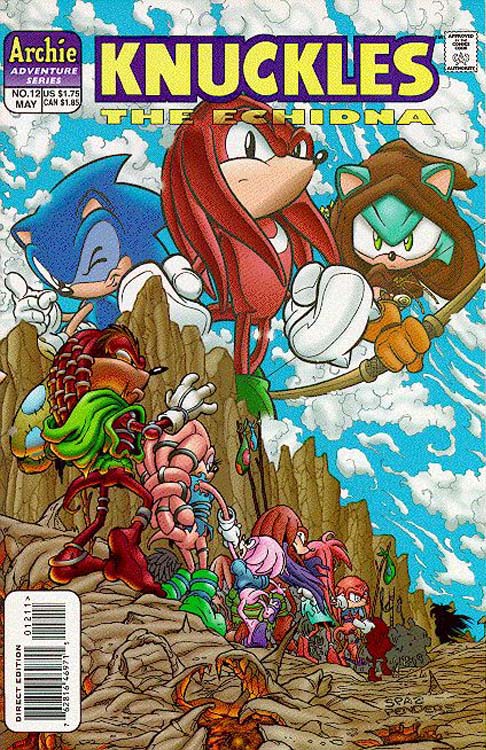
Like most issues of “Knuckles the Echidna,” issue 12 seemingly has a lot of business to deal with. Picking up where “Sonic No. 58” left off, Knuckles and his group of friends have to rescue Yanar from his execution by the High Sheriff. After a big action scene that concludes with a giant explosion, Sonic and Tails swiftly exit the story. Afterwards, Yanar informs Knuckles that his near-death experience left him with a vision. Turns out, Rob O’ the Hedge is the man that will lead the Forgotten Tribe to their echidnan Israel. The lost city is just over the hill, an ancient echidna colony called Albion, that welcomes the weary travelers with open arms. Meanwhile, Locke and Sabre observe Hawking’s failing health, Remington see the Chaotix reluctantly accept their new job, and Lara-Le continues to feel isolated from her ex-husband and her son.


Got all that? As double-stuffed as “The Forgotten Tribe: Part Three – Journey’s End” is, it also proves to be a satisfying read. This story arc has been one stuffed full of information, answering some questions while providing plenty more. Though it’s only been spread out over four issues, the reader feels like we’ve been tagging along with the Tribe nearly as long as they’ve been walking the Earth. While it’s as inelegant as most of Penders’ myth-making, finally seeing the resolution to this plot is rewarding. Yanar, still an undefined character, having a plot-resolving near-death vision is awkward. Rob O’ the Hedge being the person who leads the Tribe home comes out of nowhere. Furthermore, Albion being right over there the whole time definitely feels like a cheat.


Having said that, Penders’ mythic bullshit occasionally works in his favor. Rob’s reaction when told of a white cliff is nicely dumbfounded. I like the idea that he’s been watching Albion for years, totally unaware of its significance. Knuckles being able to walk across the water brings up a bizarre Christ metaphor but there’s something nicely magical about it. The reveal that Albion is the original homeland of the echidnas could have, and for all reasons should be, a heaping load of exposition. Yet somehow it works, that the culture is older than the Floating Island and that they’ve been out there for years, secret and concealed. (It’s certainly in line with the species’ apparently bred-in tendency towards secrecy.) And, like I said, just seeing the damn storyline resolved counts for a lot.


As an action story, “Journey’s End” functions decently as well. The varied cast is used well. Rob gets to fire off some arrows, including those with burning and dumbbell-equipped tips. Sonic gets to race around, Tails gets to fly, Knuckles gets to punch, and Mari-An swings a sword. There’s plenty of heroic diving and swinging on ropes.

Once again, there’s another narrative cheat though. Rob discovers a cache of dynamite and blows it the fuck up, seemingly taking the castle with him. Not only does the hooded hero escape the blast, he manages to sneak Mari-An’s missing brothers out with them. The final fate of the High Sheriff and his cohorts are left unresolved. Furthermore, Ken’s script makes Sonic seem like a prick. He and Tails collectively decide not to tell Antoine about his robotic dad. In short, the entire Deerwood Forest story arc is left up in the air.


It wouldn’t be a “Knuckles” comic without the script jumping around a bunch of times. Once again, the business on the Floating Island seems like an afterthought. Locke and Sabre continue to look over Hawking, who somehow still hasn’t expired. They argue a bit with the Fire Ants, for reasons I can’t remember. Remington pages Locke, letting him know the Chaotix have been deputized but they still don’t trust Julie-Su. Maybe pushing the characters we actually care about to the margins isn’t such a bad idea, this time. Since the Chaotix and Julie-Su aren’t actually seen, we don’t miss them so much. Though the story having to distract itself with Hawking’s continued comatose state is a problem. Meanwhile, Lara-Le continues to be defined by crying about what her son and husband are up to. As always, Knuckles’ mom has potential as a compelling character but is always reduced to a wounded matriarch, pining for the more important cast members.

For all the narrative juggling “Journey’s End” does, it’s saved by actually having an emotional heart. It comes from an unexpected place too. Rob O’ the Hedge and Mari-An’s relationship proves surprisingly sweet. When the Tribe heads towards Albion, Mari-An decides to stay with the man she loves. Yes, they’ve only met an issue ago. With all the Important Events happening, it’s nice that the comic pauses long enough to acknowledge that there’s still people with feelings involved here. That last page counts for a lot too. Knuckles delivers the Forgotten Tribe to their motherland. The victory can’t help but feel hollow for him. He wants to return home, to be back on the Floating Island with his family and friends. The reader does too, so that’s an important, sweet image to end on.


Like seemingly all of “Knuckles’” story arcs, “The Forgotten Tribe” has been uneven. It built up some interesting mythology and then choked on it, loosing its heart in the process. A brief crossover with Sonic might have saved it though, as it injected some fun and – more importantly – some character development into a story that could’ve been too stuffy. Hopefully, with Knuckles returning to the Floating Island, we can finally resolve what’s been up with Julie-Su and the Chaotix. One hopes. [6.5/10]