Wednesday, September 15, 2021

Sonic the Hedgehog (IDW): Issue 44


Sonic the Hedgehog (IDW): Issue 44
Publication Date: September 15th, 2021

It's time for another monthly installment of "Zack Describes His Relationship with IDW's "Sonic" Series." By now, I think the new comic is officially beloved by the "Sonic" fandom, to a degree that maybe eclipses the Archie series. My Twitter feed is packed with fan art of Surge and Kit, two characters who haven't even debuted yet, and the announcement of the Whisper plush was met with orgasmic glee from many corners of the fandom. While I'm fairly invested in certain elements of the book, it still feels compromised in a way that bugs me. Which we'll discuss more as I talk about the brand new issue today. 

Part four of "Zeti Hunt" features very little of the Zetis. The Deadly Six is in custody at the issue's beginning. Sonic and Tails load them into a rocket, Gamera style, and shoot them back to their home world. Most of the issue is devoted to Belle being kidnapped by Dr. Starline. He intentionally provokes an emotional response in the puppet, so his computers can analyze the way her advanced robotic/wooden brain works. The Chaotix bust in and rescue her but Starline already has what he needs and gleefully escapes. 


Remember how I wondered aloud in my last comic review if bringing the Deadly Six back was just a way for Ian Flynn to occupy the Sega heroes, while he laid the groundwork for the upcoming "Imposter Syndrome" mini-series in the background? It brings me absolutely no joy to report that this hunch was one hundred percent correct. The final part of this story arc constitutes nothing but a brief epilogue. Zavok and his gang are already defeated by the first page and are quickly brushed off-panel, so the comic can focus on the shit it's actually interested in. There's a brief denouncement, where the Zetis land back on Lost Hex and promise they will return, stronger than ever, but that feels totally obligatory. It's Flynn's way of saying the Zetis will return someday but they are not a going concern for the present. And that's exactly what it feels like, the author patting us in the head and saying "Yeah, don't worry about these guys for a while."

In fact, Sonic himself has almost nothing to do in this issue. He explains the circumstances of Zavok's defeat and mocks the bad guys a little. There's one meaty moment in this entire exchange. When Zavok realizes Sonic is deporting them, instead of executing or empoisoning them, he laughs. Being a part of a proud warrior race, Zavok thinks mercy is a weakness. He promises he will return, worst than ever, and make Sonic regret this decision. This causes the hedgehog to reflect on the previous times this exact same thing has happened to him: When he let Eggman remain as Mr. Tinker, which eventually beget a world-swallowing apocalypse. How Metal Sonic returned from defeat to vex the good guys again. And how Shadow and Espio both chastised Sonic for allowing these things to happen. 


This seems to be an element of Sonic's personality Flynn has been building on. That his heroic qualities mean he always sees the best in people, even though this attitude has repeatedly bit him in the ass. This could lead to an interesting dilemma down the line, where Sonic questions his own tactics, his own morality, and wonders if he has the guts to make the hard decisions... But that's feeling increasingly unlikely. Sonic simply dismisses Zavok's taunting by saying he won't "sacrifice his principals out of fear." Instead, I'm beginning to suspect that this is Flynn's half-assed way to justify the Joker Conundrum: Where obviously dangerous villains stick around because of the rules of comic book plotting. Because they have to return eventually, because the comic can't just introduce a new bad guy every month. 

And I hate to keep bringing this up – complaining about these nebulous "Sega Mandates" is the worst cliché of Sonic comic fandom now – but it really does feel like something being imposed on Flynn. Insisting Sonic always be an ultra-good Good Guy, and that his enemies are never defeated forever, feels like something Flynn's corporate paymasters would do. The people of Mobius "Sonic's world" are never going to turn on Sonic because he keeps letting the villains walk away. Flynn will keep returning to this plot point, of Sonic wondering if he's doing the right thing, because he has to in order to keep his job. It's never going to pay off or resolve. It's the author trying to create depth out of the crumbs he's forced to work with.


And that represents my real problem with IDW "Sonic." It's chained to what Sega wants the "Sonic" franchise to be. Archie's "Sonic" was allowed, partly through corporate negligence, to become a completely unique version of Sonic. It's why, no matter how hard Flynn tries, no matter how many exclusive characters or decent stories are contained inside it, IDW "Sonic" can never be its own thing. It's always destined to be a spin-off to the video games, an ancillary product to the part of the franchise we're supposed to care the most about. And since most "Sonic" fans are invested in the video games, first and foremost, they're not going to complain about this. But I am, because I'm an old man. 

Flynn is obviously frustrated by these limitations too, which is why he's so clearly more interested in his own characters, that he can do pretty much whatever he wants with. Belle's story is allowed to have pathos, when Sonic's can only fake it. In this issue, we finally see Belle's backstory, how Mr. Tinker built her as an assistant. How she loved him and was beloved, in turn, by the villagers. And how they turned on her after the Metal Virus Crisis and dismantled everything Mr. Tinker built. We see how Belle's identity crisis is rooted in everything she thought she was being soundly rejected by those around her. This ties in with her function as a "fixer," because she even wants to fix the things that can't be mended, like her father figure letting her down or people being bigoted against robots. 
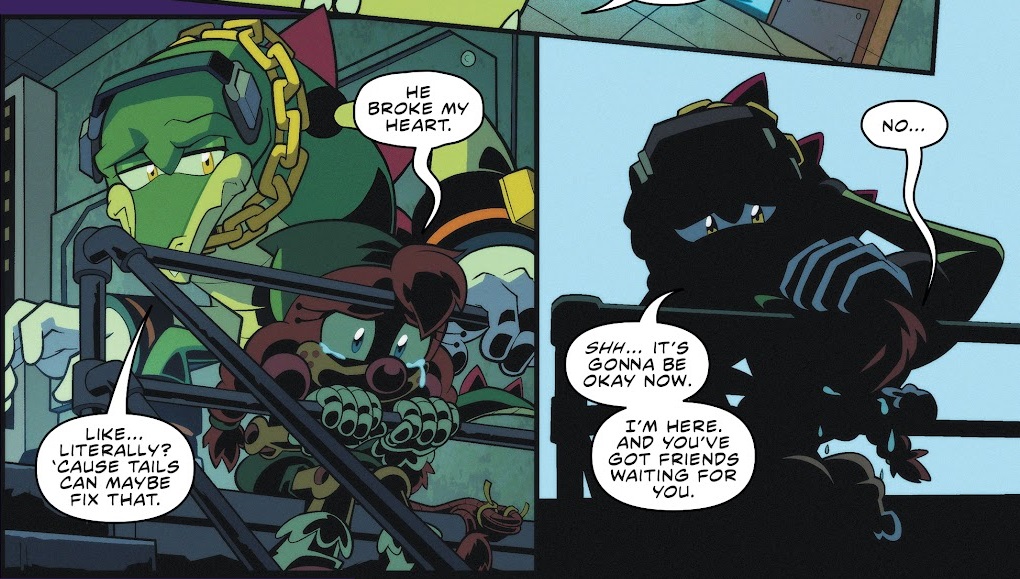


This stuff is good and I really feel for Belle in these scenes. When she lashes out in anger at Starline or cries softly in the corner, your heart goes out for this little wooden girl. And the way Vector caresses her head and tells her that she has friends here for her, that being around people who actually value her is the only way to "fix" these wounds, it's very touching. Yes, it is surreal to me to see Vector – who I'm so used to seeing written as a meatheaded galoot or buffoonish comic relief – play a role in an emotionally meaningful moment. In fact, Flynn also has Vector be the straight man to Belle's comedic overreaction earlier. So I guess the "Computer room!" meme is now a responsible adult in this comic book. Feels weird but I can roll with it. 

Since solicitations have already told us what is coming, there's not much suspense in what Starline is up to in this issue. Obviously, the information on Belle's brain will help him build the evil clones that are going to star in a mini-series in six weeks. Yet Flynn clearly still enjoys writing Starline. His type of villainy – ridiculously self-assured, refined and intellectual and more than a little flamboyant – is something the "Sonic" franchise doesn't quite have right now. He uses "gracious" as an interjection, says "my dear child" to Charmy, gingerly places Belle's cute little hat back on her head, and sails gracefully through the air while using his superpowers. Dr. Starline is the kind of guy who talks with his hands a lot. That's why, in my brain, he now sounds like Bill Hader's impression of Vincent Price. The point is Starline really enjoys being a bad guy, Flynn clearly enjoys writing that, and the reader picks up in that joy. 


So issue 44 is one I have a lot of mixed feelings about. Tracy Yardley's art is strong. He even does some cool things with the lay-out, when he has a page of Starline talking about his past with Eggman and Belle talking about her past with "Mr. Tinker" mirror each other. Starline's campy villainy is enjoyable and Belle's arc remains the most compelling thing the series has going right now. Yet this issue so sharply defines the limitations of this comic book and makes the last three issues feel like a fucking waste of time. I don't know, I guess that evens out to a [6/10]. I will definitely continue to bitch and moan about this shit so get used to it. 

Monday, September 13, 2021

Sonic Underground, Episode 1.35: The Big Melt


Sonic Underground, Episode 1.35: The Big Melt
Original Air Date: October 15th, 1999

While enjoying some downtime at the beach, Sonia receives news that Robotnik is planning some bad shit at the North Pole. Sonic and his siblings head to the frozen north, were they see that Robotnik is melting the ice caps. The trio is separated following one such glacier breaking apart. Sonia is taken in by a trio of penguins, who believe her to be their prophesized queen. Sonic and Manic are captured by Sleet and Dingo. The siblings have to regroup to save the day and destroy Robotnik's melting mechanisms. 

Here in 2021, it is apparent that man-made global warming represents the biggest threat to human civilization and its future. While some people – most backed or brainwashed by billionaire industrialists – claim this isn't so, every creditable scientist agrees. Since "Sonic" is an ecologically themed series, it's not surprising that it was tackling that threat as early as 1999. Unfortunately, as you've probably guessed, "Sonic Underground" did not have the most nuanced take on the topic. Here, Robotnik is melting the polar ice cap not because he's a cartoonishly evil capitalist who only cares about short-term profit and couldn't give less of a shit if poor people are left in an ecological doomsday scenario. He wants to flood the planet strictly to kill the hedgehogs. This Robotnik is so nihilistic, he is willing to literally destroy the entire world just to smite his enemies. This would be frightening if it wasn't so absurd. Flooding the entire planet, killing untold millions, just to get at three measly hedgehogs is a tad over-the-top, don't ya think?


Since it's obviously incapable of tackling the political and sociological reasons behind the global warming problem, "The Big Melt" simply presents a narrative challenge. After the dramatic scene of the glacier breaking apart, the siblings are separated. Considering how much of this show is built around the relationship between the triplets, splitting them up is not a bad idea for an episode. Especially sending them adrift in an inhospitable location like the frozen north. This could've been a survival story, of our heroes left disoriented by having to be self-reliant and also having to navigate some very rough terrain. 

Instead, Sonic and Manic are quickly captured by Sleet and Dingo, quickly escaping with ease, while Sonia is embroiled in a bizarre subplot. A trio of penguins – one sounds like Marlon Brando, one sounds like Curly Howard, and one sounds like Garry Chalk doing his Grounder voice – find her and immediately assume she's their prophesized Queen Sauna, who is supposed to bring warmth and prosperity to the Arctic. They even have an elaborate underground lair, decorated with hieroglyphics and a large statue devoted to their promised queen. The statue does indeed look just like Sonia and, for a single scene, she is sucked into being pampered by the locals. She insists she's not the messiah, Haile Selassie style, even though her appearance does coincide with the ice caps getting warmer. (Why the penguins would want the arctic to get warmer, I'm sure I don't know.) The implications of this, if Sonia really is the messiah to some penguins, is never addressed. Neither is why animals like penguins would even know what a hedgehog is. How many hedgehog-related prophecies on Mobius are there?


If this entire subplot seems like a bizarre digression from the rest of the episode, that's because it is. After Sonia leaves the penguins' lair, they are never brought up again. Sonia never mentions how the local people believe her to be a god. In fact, this entire sequence has no effect on the rest of the story at all. I was really assuming that the penguins would help Sonia and her siblings stop Robotnik. That these events would either shatter their belief in her or further confirm it. Instead, the hedgehogs defeat the bad guy all on their own, simply with a well-placed bomb. The penguins and their devotion to Queen Sauna is never mentioned again. It really feels like Len Janssen had two different ideas for an episode and randomly mashed them up. 

In fact, "The Big Melt" has a third premise baked inside. The first scene has the triplets chilling on the beach, suggesting this will be another vacation themed episode. Before the plot swerves, the episode gets the musical number out of the way. "Fun in the Sun" is a pretty lame Beach Boys riff, though the writers at least did an okay job of mimicking Mike Love's particular lyrical style. More interesting is the bizarre images that accompany the song. Sonic and his siblings are imagined as ice cream cones or hot dogs cooking in a pan, while the other siblings attempt to eat them. There's also a scene where the triplets turn into dolphins and Sonic and Sonia give their brother a sensual, beachside back massage.


That's weird but more unsettling is the focus on everyone's feet. Yes, Sonic and Manic are barefoot on the beach. Which wouldn't be weird if their oversized, colorful tootsies and soles weren't so lovingly detailed. At the episode's end, as the heroes enjoy the suddenly sauna-like conditions at the north, there's more shots of their feet. Even though Sonia was depicted earlier with dainty feet, this scene has her growing enormous feet that are pointed, sole first, directly at the camera. (Yes, she's wearing a bikini in these scenes too.) Ya know, just once I'd like to get through an episode of this show without feeling like I'm being exposed to someone's jerk-off fantasy. It was funny when "AoStH" did it but there's just something incredibly unsavory about "Underground's" not-so-subtle fetishism. 

An out-of-balance plot, barely concealed perversion, and dumb-ass prophecies that don't make any sense: Oh look, it's a typical episode of "Sonic Underground." At this point, all I can really do is be thankful that I'm almost done with this retrospective. [5/10]

Friday, September 10, 2021

Sonic Underground, Episode 1.34: Sonia's Choice


Sonic Underground, Episode 1.34: Sonia's Choice
Original Air Date: October 14th, 1999

"Sonia's Choice" begins with the royal triplets running through the woods from a laser-spewing flying drone. They eventually defeat it and meet up with Trevor (last seen in "Harmony or Something") and a woman named Renee. Renee is from the country of Annes, where Robotnik is about to auction off a number of priceless relics from the hedgehog royal family. Sonic, Sonia, and Manic sneak in and avoid several traps to grab the goblet... But this, itself, is a trap. The floors were laced with highly traceable Mega Muck. Soon, Sonic and Manic are captured. Robotnik places them in Roboticizers on opposite ends of the city, with both machines programmed to activate at the same time. Sonia is forced to choose between which of her brothers to rescue.

"Sonia's Choice" takes its inspiration from Alan J. Paluka's grim 1982 drama, "Sophie's Choice." If you don't know, that's the tale of a Holocaust survivor recalling the time the Nazis forced her to choose which one of her children would live and which would die. Not exactly light-hearted viewing and a weird thing to see referenced in a shitty children's cartoon. Nevertheless, the idea of Sonia having to choose between her brothers is one rich with drama. Siblings (and parents too) don't like to admit this but they usually have a "favorite." Being forced to choose, to tactilely admit that one is loved over another, is a horrible predicament. And exactly the kind of sadistic shit you'd expect a villain like Robotnik to pull. Beyond that, it's just good writing. The protagonist is pulled between two hard decisions, with a time limit in place no less. Will our hero find a way to save both before it's too late?


Unfortunately, "Sonia's Choice" does almost nothing with this dynamite set-up. The actual "choice" part doesn't occur until the last third of the episode. This gives the episode no time at all to focus on Sonia's angst over the choice. There's no chance to show how she deliberates over choosing, to see how this horrible game weighs on her. The plot immediately switches into problem solving, which is not that compelling. That's because "Sonia's Choice" is no choice at all. She simply goes to one location while Renee goes to the other, rescuing both brothers. Essentially, Sonia is presented with a choice and finds a way not to make it. Which kind of undermines everything that's interesting about this premise in the first place! (By the way, Sonia personally rescues Sonic and sends Renee to save Manic, which seems to give us an answer to the question of which of her brothers she prefers.)

The episode actually goes even further to deflate any tension or dramatic potential. Sonia releases some sort of electric pulse, which shorts out the machines around Sonic and allows her to rescue him. Renee tries the same thing with Manic and it doesn't exactly work, leaving him stuck in a tube. That's when an aircraft outfitted with lasers swoops in, blasts away all of Robotnik's troops, and saves Manic. Queen Alena, despite appearing nowhere else in this episode, is immediately revealed to be behind the wheel. This is not the first time Ben Hurst has used a shitty deus ex machina to get his heroes out of a climatic jam but it might be the most egregious. The implication that the Queen is always watching out for her kids, ready to jump into action whenever she's needed, really keeps this show from being exciting. (And draws attention to the times she chooses not to get involved.) 


Worst yet, it's a totally unneeded plot device. Renee could have successfully saved Manic on her own. The episode presented a totally normal solution to its own problem. There was no need to have the Queen rush in and dramatically save the day. It's a contrivance introduced for no reason other than to remind the viewer that Queen Alena is constantly monitoring her children... Which just furthers the impression that the Queen doesn't actually want to raise her fucking kids. She just wants to play hero to them. She wants the brownie points from rescuing her kids, to further this image that she's an infallible superhero that's always there for them. But she doesn't put in the actual day-to-day work of being reliable. Hey, mom, where the fuck were you when Sonia was learning to ride her bike or when Manic was forced to steal in order to survive? It's very similar to Penders' fixation on Locke. What the fuck is with boomer "Sonic" writers idolizing emotionally distant and manipulative parents that care about their children in broad terms but can't be brother to actually parent them? 

Uh, sorry, I kind of went on a rant there. You know another thing that sucks about this episode? Most of it is devoted to a very underwhelming heist. There's a long scene of the triplets breaking into the museum, avoiding the various traps Robotnik has set up, and getting the treasure. It unfolds in a shockingly dull manner, with little in the way of humor or excitement. We already know that Robotnik wants Sonic and the others to grab the goblet, so trying to turn this foregone scenario into an exciting action set piece is a serious miscalculation. It seems the focus was on some very odd elements, like a scene of Sonic walking on the ceiling with his magnet shoes while Sonia and Manic dangle from a harness. Or the reptilian gargoyle-like sentries guarding the vault. 


Before we go, I've got to comment on two trademark elements of this show. First off, Sonic, Sonia, and Manic spend the first eight minutes of this episode smeared with mud for absolutely no reason at all. So there's that. Secondly, there's the required song. It's a solo from Sonia, hilariously inserted right after she learns Robotnik has forced her into a sadistic game. I know I've said in the past that Sonia's singing voice is the most tolerable one on the show. But the vocals here quickly become whiny and annoying. It doesn't help that the main refrain of the song is "why is it never easy for us?" Which makes the number feel even more like a spoiled rich girl (which we can't forget Sonia basically is) complaining about the petty inconveniences in her life. The very cheap, tinny sounding instrumentation of the sing also furthers this feeling. 

Anyway, there's two points to this review: First off, I loved ya, Ben, but you had some very flawed quirks as a writer. (And, I know, he would not claim this show as his best work anyway.) Secondly, I fucking hate Queen Alena. Only six of these left, thank god. [4/10]

Wednesday, September 8, 2021

Sonic Underground, Episode 1.33: Healer


Sonic Underground, Episode 1.33: Healer
Original Air Date: October 13, 1999

As we headed into the final stretch of "Underground" episodes, I glanced at each of their plot synopses. If the last three episodes – involving such uninspired ideas as weddings, hillbillies, and hairdressers – represented the "we're out of ideas" phase, a handful of episodes near the end are providing me with some dim hope. Before we're done, we have a couple of Ben Hurst/Pat Allee episodes with premises that aren't completely terrible. This is no guarantee they'll be good, as Hurst and Allee have out their names on some real stinkers over the course of this show, but I guess I'm trying to be positive. 

First up is another bluntly entitled episode, "Healer." Bartleby receives an invitation to a private event hosted by a man named Titus. He claims to have invented a machine that can reverse the Roboticization process or even inoculate someone against Roboticization. After seeing the mechanical Lady Windermere on a mission, Sonia is eager to believe Titus. Sonic remains skeptical. After the demonstration, which was being spied in by Dingo, Robotnik attacks. The captured Titus immediately reveals that the whole thing is a sham. In exchange for his freedom, he agrees to turn his "Roboticization inoculator" into a regular Roboticizer. And his first client is Sonia. 


"Healer" is an episode that really feels of its time. Scammers that take advantage of people's religious faith, desire for a cure, or need to belong are as old as time itself. Yet the nineties was a moment when these topics were really in the spotlight. The early part of the decade was awash in scandals involving television evangelists, several of which were revealed as greedy con artists or sexual predators. The decade also brought a renewed awareness of cults, where manipulators like David Koresh or Marshall Applewhite eventually led people in need of answers to their deaths. These ideas were in the air circa 1999 and I suspect they might've influenced Ben Hurst when writing this episode. Titus' gaunt appearance and robed attire resembles Applewhite slightly. His machine produces a rainbow of colors, which reminds me of the rainbow lettering in the Heaven's Gate cult logo. 

In a very simple way kids could understand, "Healer" attempts to tackle the idea of why people are drawn in by scamming faith healers and cult leaders. Seeing Lady Windermere, her actual mother figure, reduced to a robotic slave reawakens Sonia's trauma. Titus provides the key to resolve this pain, to heal Sonia's psychological wounds by providing an easy cure... In exchange for a sizable donation. This is a message kids actually need to hear: That anyone providing miraculously easy answers to difficult problems probably just wants your money. 


This premise also sets up some good tension between Sonic and his sister, as he remains skeptical the entire time. Hurst manages to pull off that thing he's really good at, where he mines the schism between siblings without making either one into the bad guy. Sonia's need to believe in Titus' magic solutions is so obviously rooted in her pain. Sonic being the skeptic matches his "cool dude with 'tude" persona but it also works another way: He's just worried about his sister falling victim to an obvious hoaxer. (I wish Sonic was this skeptical of the bullshit the Queen and the Oracle puts them through.) 

Unfortunately, because it's a twenty-minute installment in a very dumb cartoon series, "Healer" neither has the time nor the intelligence to explore the emotional ideas in its premise. After a (relatively speaking) decent first fifteen minutes, the episode falls apart in the final minutes. Just as he's about to Roboticize Sonia, the amoral conman Titus has a completely unexplained change of heart. He pushes Sonia out of the way and is then Roboticized himself. It's the sloppiest, most unsatisfactory conclusion to that story that the writers could've thought of, as it goes against everything we know about Titus up to this point. The episode then collapses into totally uninvolving action theatrics, as Sonic and Sonia spin together into a tornado to destroy some airplanes. How and why can Sonia do that? It's lame. 


A completely disappointing ending is all too typical of "Sonic Underground's" brand. Also typical of this show: Uncomfortable weirdness that isn't obviously sexual but feels like it probably secretly is. The show's reoccurring gunge fetish is indulged when Sonic and Sonia emerge from a dumpster, covered in trash and gray slime. Later, Dingo is transformed into a fly and hides in Sonia's hair, leading to a very disturbing close-up of him handing onto giant hair follicles while sitting in a fleshy pink scalp. Also typical of this show: Ugly character designs! Titus is a skinny humanoid with a vaguely animal-like nose who towers over the "Sonic" gang. He kind of looks like a Peter Chung character, which is not a compliment. His partner in crime is another one of the hideous alien creatures we see in the background of this show all the time. 

Thankfully, the "Sonic Underground" music team did not attempt to squeeze this episode's moral about predatory scammers into a sixty second pop ditty. Instead, the obligatory song is "We're the Sonic Underground." The upbeat rock number simply has our heroes stating what they are all about. While no less clumsy than any other of this show's songs – the title is rhymed with "listen to our freedom sound" – at least it's not about friendship or never giving up or some other trite motto. It's a simple mission statement for our characters and that's honestly preferable. While playing the song, Sonic and his siblings kick around large balloons shaped like Robotnik. The song is placed randomly midway through the episode, revealing it as a generic number that was rammed in because it had to be. 


Oh yeah, one more thing: Maurice LaMarche voices Titus, doing a not-bad Rod Serling impersonation while playing him. Because, when this show didn't know what else to do, it let LaMarche impersonate a dead celebrity. "Healer" is one of the better episodes of "Sonic Underground" I've reviewed so far. It tackles some big ideas in an only somewhat half-assed manner. I'd be willing to forgive the rushed ending if this was a different show that wasn't held down by so many bad aesthetic and narrative choices. It's hard for me to forgive "Underground's" overwhelming "Underground"-ness, which means even a halfway decent episode still gets a [5/10].

Monday, September 6, 2021

Sonic Underground, Episode 1.32: Haircraft in Space


Sonic Underground, Episode 1.32: Haircraft in Space
Original Air Date: October 12th, 1999

Before we go any further, I have to ask: Seriously, what the fuck does the title mean? As I mentioned last time, we are officially into "Sonic Underground's" "completely out-of-ideas" stage, which is why this episode revolves around a salon and people getting their hair styled. This explains the "hair" part title but what about the rest of it? It seems to be a pun on the phrase "aircraft in space..." Or, at least, it would be if that was an actual phrase people used. But it's not! It's just a string of words! Moreover, the rest of the episode has nothing to do with aircrafts or space. It's maddening! Is this a mistranslation of a pun that only makes sense in French? What the fuck is happening? 

"What the fuck is happening?" is, in fact, not an unreasonable reaction to this episode at all. To start, royal princess Sonia is getting tired of cohabiting with two teenage boys. She runs off to a salon to be pampered. She is unaware that the robot that runs the salon, named Doo-bot, is a Robotnik spy. She hypnotizes people and then records their confessions. When Sleet and Dingo realize Sonia is in the salon, they attack. Sonia takes Doo-bot, unaware of her powers, back to their secret lair. As soon as Sonic and Manic discover this, they try to return Doo-bot, unaware that their own confessions are already recorded. It becomes a race to get to the machine before Sleet and Dingo do. 


"Haircraft in Space" is the sole "Sonic" related credit of Tracy Berna, a veteran television cartoon writer. She's worked on shows like "House of Mouse," "Timon and Pumba," "Fairly OddParents," "Sam and Max: Freelance Police," and many others. I like some of those cartoons but they're all comedies. Which might explain why Berna's "Underground" episode focuses more on humor than action. And it's not especially good humor. The early scenes, of Sonia being increasingly exasperated by her filthy brothers' antics, are pretty sigh-inducing. A segment in which Sonic attempts to cook a chili dog with a hairdryer really baffles. Moreover, building an entire episode around a robot hairdresser that sounds like the halfway point between Arleen Sorkin and Fran Drescher is not a premise that really lends itself to super fast hedgehog action. 

Most of the humor here is of the unintentional variety. A lot of the plot just doesn't make much sense. Doo-bot's whole purpose is to record people speaking ill of Robotnik, information he can use later against them. When they've got Sonia, one of the regime's most wanted fugitives, under Doo-bot's sway... They attack, giving her a chance to fight back and escape! If Sleet and Dingo had just waited, let Doo-bot record Sonia's vital information, and grabbed it later... That would've been the end of the series. And I realize this is a kids' cartoon and the villains are supposed to be idiots. But when the bad guys are so actively undermining their own schemes, it really breaks immersion. (The attack scene also includes a moment of Sleet being covered with shampoo, because this show can't go a single episode without covering someone in a slimy, viscous fluid.)


Also, there's the issue of the technology here. Doo-bot doesn't record people as they mindlessly gossip with their hairdresser. No, that would've made too much sense. Instead, the machine actively hypnotizes people into a state where they share their secrets. If Robotnik can build a machine capable of doing that, why not use it to hypnotize the masses into being his willing slaves? Mind control of that level would be incredibly valuable to a dictator and this guy uses it to mine petty gossip. 

Additionally, there's some humor in the fact that Doo-bot records... On tape. So much of this episode revolves around tapes! Robotnik can build an advanced A.I. with mind control powers and it records on tapes! Not discs or floppies or Mini-DV, all technology that existed in 1998, but regular ol' cassette tapes. Why not broadcast the information back to Robotnik via radio waves? Radios existed in 1999! I guess Robotnik really loves the warm hum of the cassette format. What a quint and retro futuristic totalitarian state. 


All awkward and dumb writing aside, this episode doesn't work because the audience doesn't care about Doo-bot. She's more annoying than anything else and I do not understand why Sonia is so immediately attached to her. The show also undermines its own moral here. Obviously, the lesson that we should learn is that gossiping is bad. Yet the people under Doo-bot's spell have no control over what they are saying. They are being manipulated into revealing this information. Even Doo-bot is unaware of what she's doing, as her memory is wiped every time her tape is changed. And dissident information in a dictator state is not really comparable to gossip anyway. The moral, in execution, is that "mind control is bad" which is something kids probably don't need to be taught. 

Yet the show runs with this message anyway. The song is "Don't Be a Backstabber" and is explicitly about how no one will like you if you gossip about them. Though the lyrics also include the couplet "Don't be the bearer of bad news/When it comes to your friends, mind your business," a message I'm not entirely sure how to interpret. The music actually isn't too bad. It sounds a bit like some Robert Palmer/Huey Louis-style synth pop... Or rather, the Weird Al version of that style of music. Which is funny, as Tracy Brena worked on the short-lived "The Weird Al Show." Though I genuinely don't know if the episode writers had any influence on the sound or content of the episode's songs. 


More amusing is the music video sequence accompanying the song. For some reason, it depicts Sonic, Sonia, and Manic as either game show hosts or TV pitchmen, I'm not sure which. They snap their fingers and speak directly to the viewer. They wear monster masks, baseball caps, and are chased by ambulatory letters while random numbers float around on-screen. A giant note with the words "You are stupid" on it appears briefly. Making all of this stranger is the in-universe suggestion, just before the song, that Manic is making the entire song up in the spot. Which raises far more questions than I'm willing to ask right now. 

"Haircraft in Space" is another junk episode, though it is bad in a sort of amusing way. Especially when compared to so many episodes that are bad in a merely tedious way. Oh, by the way, the title makes even less sense in different languages. The French title is "Minute de coiffeur" – "Hairdresser minute" – which I'm assuming is some sort of French pun that doesn't work in English. Most of the foreign titles translate as the nonsensical "Hairdresser in space." The Italian title translates as "Coma in Space," which makes even less sense. Only the German title, which translates as "A Hairy Affair," actually works. I never would've guessed that the Germans would be the ones to actually understand what humor is... [4/10]

Friday, September 3, 2021

Sonic Underground, Episode 1.31: Country Crisis


Sonic Underground, Episode 1.31: Country Crisis
Original Air Date: October 11, 1999

Last time, I referenced the "Sonic Underground" writers being completely out of ideas by this point. That continues to hold true with "Country Crisis," even if this was writer Laren Bright's first "Sonic" related credit. After performing an act of domestic terrorism in Robotropolis, Sonic and his siblings come across a note written by their mother. It informs them that Robotnik is building a dam in "Southern Mobius." The local Freedom Fighters could destroy it but are too busy feuding amongst themselves, a tradition that goes back to a visit from the Queen decades earlier. The royal triplets go about trying to patch over this schism and save the day. 
 
Divorced completely from its actual premise, "Country Crisis" has a good idea. More than one group of revolutionaries have been broken up by ideological differences within their own camps. In fact, it almost always happens. The idea of Freedom Fighters getting distracted from their fight against Robotnik, to fight each other, is an intriguing premise. (And one the Archie comic would touch on from time to time.) Sonic teaching an isolated resistance groups that there's more that binds them than separates them could produce a totally solid twenty-minute cartoon, even one with a nice moral. 


But that's not what "Country Crisis" is actually about. Instead, it explores the underwhelming premise of "Sonic, Sonia, and Manic meet the hillbillies." The episode is, obviously, inspired by the legendary backwoods feud between the Hatfields and McCoys. This includes the details of the youngest members of both families secretly falling in love. As many Appalachian stereotypes are touched upon as possible. Overalls, straw hats, mangy beards, shotguns, and bare feet are accounted for. There are numerous references to hoedowns and jugs. "Y'all" and other bits of Southern dialect are abused. The episode stops just shy of including moonshine and incest. As a resident of Appalachia myself, I'd be offended by these portrayals if I wasn't completely numb to seeing them in pop culture by this point. 

It's uninspired backwoods grotesquery and that extends to the character designs. The Valley Folk and Mountain Folk – as they are called even though they all seem to live in the valley – represent yet more unappealing design work from the "Sonic Underground" team. Granny, the leader of the Mountain Folk, has preposterously bad posture. Zeb, leader of the Valley Folk, is a hideous revival of every hillbilly cliché, including protruding teeth and a foot long beard. Jerod, the speedy raccoon type thing, wears bright green pants, a yellow shirt with a giant collar, and red suspenders. Which makes him look more like a New Romantics reject than a redneck. It's all ugly as fuck and is paired with some extremely shaky animation. A scene of Sonic running while holding his guitar makes it seem like his head is detached from his body, while I'm pretty sure the triplets' eyes never move in the first scene. 


Honestly, what insults me the most about this episode is not the reliance on long-since-outdated stereotypes about "mountain folk." Rather, it's the half-assed laziness of the entire script. The primary antagonist of the episode is an enormous robot guarding the dam. That's cool but the machine is never utilized in an interesting way. The episode seems to be building towards the neat visual of the robot smashing through the dam. Instead, the machine accidentally blows up Sleet and Dingo's aircraft and it's up to Manic's drumming to destroy the structure. Lame. Very little imagination was expended on this script. 

This is far from the only questionable writing. The feud between the two clans is based on a gift from the Queen, a medallion split in two, going missing. Each side blames the other for the theft. The actual answer – Granny lost it in her jug and never thought to look there in all this time – is one of the biggest ass-pulls this show has attempted. Moreover, it really says a lot about Queen Alena that she never once stepped in to resolve this conflict herself, even though she's well aware of it and is wandering around Mobius all the time. Instead, she gives orders to her kids to clean up her messes, her children never once asking why this is their responsibility. This is because, I guess, the completed medallion contains a map to some location. What are the odds this show will ever revisit that plot point? What do you think? 


Other than just laziness, why would the writers of a "Sonic" show stick the hedgehog in the very Earthly realm of squabbling hillbillies? Because this is a musical show and bluegrass is one of the genres "Underground" hasn't abused yet. "How You Play the Game" is an embarrassing riff on "Dueling Banjos," between Sonic's guitar and Sonia's keyboard on the banjo setting. It's about as lame as you'd expect, with both singers attempting weak southern accents. It's more forgettable than bad, which really tells you more about this show's standards for badness than anything else. Granny pulls out a washboard throughout the song, which is an instrument not actually associated with bluegrass music but I wouldn't expect the creators of this show to know that. 

Oh yeah, remember when I said kissin' cousins is one of the few Appalachian stereotypes this episode doesn't indulge in? I lied. But it doesn't come in where you'd expect. At the concluding hoedown, Sonia asks Sonic for a dance. Which is only mildly weird, I guess, but becomes way weirder when the hedgehog makes a point to dance with his brother instead. After all, royalty makes more of a habit of fucking their siblings than hillbillies ever did. Anyway, this episode is bad. [4/10]

Wednesday, September 1, 2021

Sonic the Hedgehog (IDW): Issue 43


Sonic the Hedgehog (IDW): Issue 43
Publication Date: September 1st, 2021

One of the various "Sonic" fan corners I hang out in features a person who complains loudly and obnoxiously every time an issue of IDW's "Sonic" comic is delayed. I blocked him a while ago but, before that, I would futilely attempt to explain that delays are common in the comic industry. IDW, in particular, is notorious for missing deadlines. This is the very grown-up and mature perspective I try to take but, I'll admit, IDW's fucked-up release schedule threw me for a loop today. I turned on my PC, ready to review an episode of an old cartoon, when I saw a notification that the new issue of IDW "Sonic" was out today. Issue 43's release date has been shifted so many times I forgot it was actually coming out on September 1st. So I got out of my comfy office chair, grabbed my tablet, booted up Comixology, and here we are now. 


Sorry, each of these recent comic reviews have opened with me complaining what an old man I am. Anyway, issue 43 is devoted to "Zeti Hunt, Part 3." We pick up where we last left off, with Sonic locked in a small room with the entirety of the Deadly Six. The hedgehog brawls with the six Zetis but eventually finds himself overwhelmed by their raw brute strength. Whisper helps out and Tails, with his electronic Zeti stopping devices, eventually arrives to help. Even after beating the monsters into submission, the trouble isn't over. Sonic is informed that Starline has kidnapped Belle. 

Almost this entire issue – as in 19 out of 20 pages – is devoted to the fight between Sonic and the Deadly Six. I like action in my action comics as much as the next guy. Flynn and his team find some novel moments to include in this lengthy brawl. Such as Zaz getting increasingly unhinged as he takes more of a beating from Sonic. Or Zavok picking up Zor, when he refuses to participate in the fight, and literally throwing him at Sonic. Still, there's only so much novelty to watching cartoon characters wail on each other for page after page. I wish there was a little more dramatic meat on this issue's bones. 


In fact, I didn't find myself becoming involved in this issue at all until Sonic started to loose the fight. Sonic is mostly able to handle the big colorful monsters but, after Zavok lands a lucky sucker punch on him, the tide of the fight starts to turn. I've said this before and I'll probably say it again, as it's a fact the "Sonic" franchise has trouble remembering sometimes: Fights are way more compelling when it looks like the hero might actually loose! When Zavok has his hand around Sonic's head, squeezing it like a stress ball, that's a compelling image. The issue needed more stuff like that. 

However, one thing remains consistent no matter how bad of a beating Sonic is taking: He's always a smart-ass. Some people complain about this too and it can definitely drain the dramatic tension from situations sometimes. However, here it is used well, I think. Sonic mocks Zavok's tendency to monologue about his grand, grim purpose by referring to it as failed poetry or rambling. It shows Sonic's tenacity, his unwillingness to give up, that he's still cracking jokes even when getting the shit beat out of him. It is what is commonly referred to as a "personality trait" and it helps enliven a fight-fest issue like this. 


Something else that keeps the pep up in this issue is when Sonic's pals help him out. Tangle goatses a hole in the steel door, whacking any Zeti that wanders by with her tail until Zavok yanks back. Whisper, always so whispery, fires some Wispon bolts into the room before Zavok uses his technopathy to scramble her mask. When Tails drops in, we get a good moment where he saves Sonic's ass by spindashing into Zavok's chest. It's nice to be reminded that Tails isn't just the tech guy but can do all the same special moves as Sonic. Again, brief moments like this add some color to an issue otherwise totally devoted to fisticuffs. (Also, the Chaotix get stuck in traffic and that made laugh while also raising some questions about the infrastructure on Sonic's world.)

In the past, we've seen multiple artist work on a single story, which I frequently suspect is to help lighten the work load of whoever the primary artist was supposed to be. This issue is split evenly between three different artists. And the shift in style is a bit jarring. Jamal Peppers does the first ten pages. I used to love Peppers' work on the Archie series but have been underwhelmed by his contributions to IDW so far. It seems Peppers has dropped the slightly sketchy pencil lines from his work, which always invoked a somewhat gritty feel. Without that, his art comes off as overly smooth and stationary. Or maybe he's just bad at drawing the Zetis. The Deadly Six come off as especially weightless, with wide-eyed and blank facial expressions, on his pages. 


When Bracardi Curry takes over on page eleven, it's really obvious. Curry's art has a fantastic sense of motion. His character work is stylized, and a little more jagged than the traditional "Sonic" artwork, which makes his action sequences even more distinctive. After five pages of excellent art from Curry, Thomas Rothlisberger takes over. After doing impressive work on the 30th Anniversary special and this year's FCBD issue, this is Rothlisberger's debut in the regular series. His talent really lies in facial expressions. Which is probably why panels devoted to Sonic and Tails being defiant while Zavok squishes them, or the clear masochistic pleasure on Zor's face after getting zapped with Tails' gizmo, really shine. It's a good looking book but having three people, each with such distinctive art styles, work on one issue does make for a slightly disorientating read. 

As we reach the end of the "Zeti Hunt" story arc, I do have to wonder what the point of all this was. Did Flynn just want to remind readers the Deadly Sox where still out there, doing zeti shit? Did he bring the colorful monsters back simply to occupy the main cast while setting up the upcoming "Imposter Syndrome" mini-series in the background? That really feels like where this is going but I guess we still have more issue in this arc for it to justify itself. This isn't a totally useless issue and the script does what it can to spruce up a story devoted totally to a fight scene... But it's still just an extended fight scene and only so much can be done with that. [6/10]