Wednesday, January 15, 2025

Sonic Mania Adventures: Papercraft Edition


Sonic Mania Adventures: Papercraft Edition
Original Release Date: January 19th, 2019 / February 14th, 2019

In today's hyper-online world, when we live so much of our lives through social media and our phone screens, the question must truly be asked: Where does an advertisement end and everything else begin? There is now an industry of "influencers" and "content creators" who are paid by companies to shill their products, usually while disguising it as their honest opinion or as a regular post. Shockingly, many of their young followers then go out and buy these products. It's gotten so bad that YouTube actually forces uploaders to specify if their videos contain paid advertisements. Unavoidably, we have reached a point where, when looking at anything we see on the internet, we have to wonder if something is trying to be sold to us. We are constantly inundated with advertisements, trying to influence our opinions and sway our wallets, to the point that it's hard to distinguish them from everything else.

This raises some complicated questions of its own: When do advertisements end and art – an expression of something from inside the person making it – begin? To say that "commercials can't be art" is demonstratively false at this point. Corporations have hired critically acclaimed filmmakers like David Lynch or Jonathan Glazer to run wild and make weirdo short films out of sixty second spots. A case can be made that some of the great documentarian Errol Morris' most iconic works are fucking Apple commercials. We live in a society, a capitalistic one, and that infects everything we do. Drawings, paintings, sculptures, songs, books, movies: We sell them for money. Does that mean that everything, no matter how sincerely made by the artist for its own sake, is an advertisement for itself? If that is the case, then surely it cuts both ways. Something made simply to sell a product can also be art. 


Don't you love it when I open a review for a stupid "Sonic" meme video with a philosophical discussion? The truth is that most beloved pop culture franchises exist to sell something. That is the nature of the beast. "Transformers," "He-Man," "Ninja Turtles," and "Power Rangers" were all shows created to sell toys and that has done little to stop them from developing die-hard fan bases who are touched, moved, and inspired by them. The creation of fan work – art made strictly for its own sake, with no intention of monetary compensation, inspired by commercial work! – suggests that this conversation is much stickier than it seems. "SatAM" was a cartoon made to sell "Sonic the Hedgehog" video games but its stories, characters, and themes resonated with me so deeply that it still influences my life thirty years later. If you are immersed in any fandom, this is probably the case. Maybe artistic expression is such a fundamental part of the human soul that we can't help but sneak something of ourselves, a feeling or thought that we hold deeply about life and the world, into the most mercenary of work. Are the burger flippers, house painters, plumbers and trashmen not artists in their own ways? Idunknow. 

I bring this up because, after the success of "Sonic Mania Adventures" in 2018, somebody at Sega's advertising department realized they still had some copies of "Sonic Mania Plus" to move. In order to push the title back into people's timelines, perhaps reaching some dedicated Sonic fan who didn't yet own it, they commissioned two short animations to post on their YouTube channel. Tyson Hesse was busy I guess, so someone else – uncredited, as far as I can tell – was hired to make some much cheaper, quicker, far less elaborate animations. While "Sonic Mania Adventures" immediately became a beloved classic among fans, nobody has said much about "Papercraft Mania Adventures" since its two episodes were posted in the early months of 2019. I've got nothing better to do today so let us try and examine why this is the case. 


The first episode of the "Papercraft Edition" of "Sonia Mania Adventures" is called "Snow Sculpting Contest." It involves three teams – made up of Mighty and Ray, Sonic and Tails, and Amy and Knuckles – having a snow sculpture contest. They each use their special skills to build sculptures. The viewer is then asked to decide who the winner is. The second installment, called "Valentine's Day," is a little more narratively driven. For unexplained reasons, Eggman has disguised himself as a jewelry store owner and seems to be selling the Chaos Emeralds as enormous rings. Sonic grabs them, because he wants to become Super Sonic. Knuckles and Amy both see the hedgehog carrying around all seven Dragonballs and draw their own conclusions from it. Knuckles thinks Sonic has stolen his EMEROWDS and Amy thinks they are gifts for her. A chase ensues, ending with the reveal that the jewels were never real to begin with. Knuckles and Amy take matters into their own hands. 

While "Sonic Mania Adventures" told a story, invoked emotions, and contained thematic ideas, it's much easier to dismiss these "Papercraft Editions" as nothing but commercials. The first one especially. The way it presents a series of events simply to ask the viewer to respond makes it, in the parlance of our times, engagement bait. We don't know why Sonic and friends are building these snow sculptures. We don't know who wins. There's no rising action, plot twist, or climax. I spent too much time on Letterboxd and there's a lot of debate over there about what a "film" actually is. Is a TV show, a music video, or a YouTube video essay a "film?" The debate rages on with no end in sight. However, it's difficult for me to classify "Snow Sculpting Contest" as a movie. I guess we get some reflection into everyone's personalities from what they build and how they do it. But it's not really telling a story or making a point, is it? 


At least "Valentine's Day" is telling a story. Not a good one, mind you. What did Eggman hope to accomplish by dressing up as the proprietor of a jewel store – which looks more like a hot dog cart – and selling Sonic bogus Chaos Emeralds? The hedgehog does not trade money or services for these artifacts, so it wasn't to make a profit. Does it make Sonic look like a fool? Yeah, I mean, I guess. To what end though? Why does the mere sight of Sonic holding the regular Emeralds, not the Master Emerald mind you, awaken Knuckles from his slumber and enrage him? And why does he smash Eggman's cart afterwards? Why does he need Amy's hammer to do it? Knuckles is perfectly capable of smashing things on his own! Are both of them simply expressing the anger they feel about being duped? As vague as "Valentine's Day" is... At least it is telling a story of some sort. There is a degree of dramatic tension here. It does more than merely exist and distract the eyes with some bright colors for a few minutes. 

Truthfully, I think "Valentine's Day" functions primarily to do something Sega loves: Give Sonic/Amy shippers some hope that the pretend romance between these two cartoon hedgehogs they are very invested in actually exists without confirming anything one way or another. Amy is obviously enamored of Sonic and, seeing him carrying a butt load of rings with big rocks on them, brings obvious connotations to mind. At the very least, she imagines them receiving them as gifts at a romantic gesture, if not thinking of them as engagement rings. Sonic isn't interested though. He's so not interested that, the minute he sees Amy behind him, he willingly gives Knuckles the rocks. Sonic is so disinterested in making Amy think he has any feelings for her that he immediately concedes to his brawny rival rather than have the girl get any ideas. Despite that, certain audiences will use this cartoon as evidence that the fast blue hedgehog truly, deeply loves the little pink one. So it goes. 


What value is there to these "Papercraft Editions?" They certainly don't feature the lovingly rendered hand drawn and painted animation of the proper "Mania Adventures" shorts. This so-called papercraft is much, much cruder. That's by design, obviously. The charm of animation like this – ostensibly assembled by arranging specifically cut paper into various shapes and photographing it in sequence – is that it has a handmade, simplistic quality that reminds us of playing with constructed paper in kindergarten. I kind of doubt that these shorts were made with real papercraft, the old fashion way. One assumes it was all done digitally. However, it does look cute. There is certainly a charm to these images, despite the unavoidable feeling that this format was chosen more so because it's a lot faster to produce than regular animation. 

These two videos also carry on the gimmick of the first five "Sonic Mania Adventures" episodes by using music and sound effects from the games. That continues to strike me as an extremely fun, entertaining choice. However, while the series these two cartoons spun off from was undoubtedly an achievement, it's much harder to consider these "Papercraft Editions" as anything but cute little commercials. Harmless, sure. Eggman wearing a fake mustache over his real mustache in the second one is a good joke. Stuff like this, however, truly straddles the line between a creation worthy of in-depth conversation and a thing that pops up on your phone, you chuckle at and give a heart or thumbs-up to, before immediately scrolling onto the next distraction. (Though that didn't stop me from writing an in-depth examination of them... Good God, what am I doing with my life?) Is it art or is it merely "content?" I guess you can argue about that but I know I'm never going to think about these again after I finish typing these words. [5/10]


Monday, January 13, 2025

Sonic Mania Adventures, Episode 6: From A. Rose


Sonic Mania Adventures, Episode 6: From A. Rose
Original Release Date: December 25th, 2018

I've pointed this out before but it bears repeating. Sonic the Hedgehog, for whatever reason, has a strong association with Christmas. The most evident reason for this is not hard to figure out: This is a cutesy franchise for kids, designed to sell video games and consoles. Exactly the kind of thing an eager child would ask Santa Claus for once December draws near. It probably doesn't hurt that the Japanese love the secular visuals of the holiday, incorporating red and white hats, evergreen trees, colorful lights, and snowy vistas into the kawaii mascot culture the country is deeply enamored of. This is so common that cute anime girls in a "Santa Skirt" outfit has become a trope onto itself. Since Sonic is also a huggable mascot, it makes sense that his creators would often stick a Santa hat on his head and have him delivering presents. That ice themed levels are common features in the games, tying in closely with the areligious Japanese version of the celebration, furthers the connection. I'll let you know if I ever come across official art of Sonic and friends having a festive KFC feast or of Blaze being compared to day old cake. 

Obviously, a "Sonic" Xmas special is not without precedence, as I've explored in the past. Because of this – and also, I imagine, a desire to drum up some more sales during the holiday buying season – "Sonic Mania Adventures" would have one more episode tagged on in late December, several months after its main run seemingly concluded. This final episode would also spotlight the fourth corner of the Classic Sonic series' heroic cast that had, up to this point, been excluded from the YouTube animations. I guess Tyson Hesse isn't a totally despicable monster and felt he owed it to the Amy Rose fans to focus an episode on her, after leaving the pink hedgehog out of "Mania Adventures'" main narrative. In that sense, this extra installment operates as a two-fold treat: A holiday bonus and a chance to see a long-time character in animation again. 


"From A. Rose" actually picks up right where the previous episode left off, with Eggman and Metal Sonic thrown a great distance by Knuckles' fist. They land in the jungle and, disgusted by his latest defeat, Eggman leaves Metal Sonic laying on the ground there. The seasons past and winter arrives. Soon, the mechanical minion is buried in a heavy layer of snow. That's when Amy Rose stumbles across the robot, buried in the frosty layer. At first, she's frightened by his appearance. However, after pulling out of the path of a falling tree, Amy grows a little fond of the machine. She patches Metal Sonic up, slaps a bow on him, and delivers him right to Eggman's door step. It is a gift that the doctor, after a minute of consideration, accepts. Aww, ain't that sweet? 

The "Sonic" series has never been the best at female representation. Being a relic of nineties "no girls allowed!" childish sexism, the series didn't have any real female characters for its first two installments. When the first prominent heroine in the games was introduced, she still only filled the role of a helpless damsel in distress, like so many princesses and captured babes before her. Attempts have been made over the years to correct this oversight. More women have appeared in the games. (Though whether you consider sexy femme fatale, a mom and a toddler, and Token Girls on otherwise all male teams to be forward thinking or not is up for debate.) The comics and cartoons have added more diverse women to the cast, though the movies still aren't there yet. The biggest way Sega has addressed the "Sonic" series' gender imbalance was making Amy Rose more of an independent character in her own right in "Sonic Adventure," who didn't need a blue hedgehog to fight her battles for her. By the time we got to "Sonic Boom," Amy was mostly allowed to exist without the baggage of being defined solely as "Sonic's girlfriend."


This is a development that the Classic branch of the "Sonic" series has struggled to incorporate. Modern Amy hardly defies gender roles, still being extremely pink and classically girly in most ways. Her tendency to smash shit with an oversized hammer is born largely out of negative stereotypes about feminine rage, after all. Classic Amy, with her frilly skirt and short stature and perfect little bows on her shoes, continues to exist in mostly a supporting roles. She's been playable in the weird spin-off racing and fighting games – where she gained her mallet for the first time – but wouldn't be playable on a mainline "Sonic" until last year. Tie-in media has attempted to expand this version of the character beyond her crush on Sonic. Her status as a friend to the animals, dabbling in divination, and generally a loving and kind person have been focused on more lately. This has done little to move Amy past her role as The Chick in the classic corners of the franchise. That she got left out of "Mania" all together, when obscurities like Ray and Mighty were included, maybe didn't make for the best optics either. 

I can't help but I imagine that this was a factor in making the "Mania Adventures" holiday special about Amy. She is, in fact, the protagonist here. She discovers Metal Sonic and it is her kindness and love of all sentient life – something Sonic would not be expected to show towards this particular foe – that drives what little story exists here. That Amy cleans up Metal Sonic and returns him to his "family" of sorts certainly doesn't defy her conforming to feminine archetypes of being a nurturer and a caregiver. At the same time, that she protects a deadly enemy from harm, when anyone else would immediately spin-dash him, does show us what Amy can do that her bro-y teammates can't. After all, this is the same Metal Sonic who threatened her and the kindness she shows him proves what a big-hearted individual she is. In other words, this episode does not stray from the somewhat reductive role Amy has always had in the classic games while also giving her more to do than get captured, fawn over Sonic, and be a prop for him to rescue at the end of the game. 


It is also, one must point out, extremely cute. Avoiding the difficult question of how Sonic and friends know what Christmas is, "From A. Rose" favors generic seasonal signifiers like snow and gift-giving. Amy dragging Metal up to Eggman's base, and leaving him gift-wrapped for the big bad, makes her into something of a Santa Claus figure. It brings themes like unconditional kindness and giving with no thoughts of receiving to the forefront, solidifying the holiday special status. Making Metal Sonic into a blankly staring straight man, forced to endure Amy's adorable antics, is also a good joke. That Eggman, ruthless villain that he is, is also seemingly moved by this selfless act of kindness certainly also matches the Christmas-y mood of this entire production. Such a sentimental tone means this final episode of "Mania Adventures" lacks most of the action and laughs of the previous parts. I definitely still chuckled a few times. There's a good joke involving a Flicky and Hesse still gets a chance to incorporate the glib, highly expressive faces he's so good at a few times. (Especially during Sonic's contractually obligated cameo at the end of the episode.) This one is definitely designed more to warm your heart than tickle your funny bone. 

This is also apparent in how the episode sounds. "From A. Rose" is as beautifully animated as the rest of the series. However, it foregoes the use of music and sound effects from the classic games. I guess because Amy wasn't playable in "Mania?" It does make this episode stick out when watched in a row with the other ones, not quite having the infectious energy as the rest of the series. But, hey, we all deserve to slow down and relax a bit during the holidays. "From A. Rose" isn't much more than a bonus, a little Christmas gift Sega and Sonic Team handed to fans at the end of 2018. When taken in that light, it's cute enough. "Sonic Mania Adventures" works perfectly fine – and maybe better – without it but who can complain about something this harmless and good natured existing? If nothing else, the end credits do present us with some postcard worthy festive images of Sonic and the gang celebrating the season. At the risk of damning this three minute program with faint praise, I'm definitely more inclined to rewatch this around December than "Sonic Christmas Blast." [7/10]


Friday, January 10, 2025

Sonic Mania Adventures, Episode 5: Metal Mayhem


Sonic Mania Adventures, Episode 5: Metal Mayhem 
Original Release Date: July 30th, 2018

"Sonic Mania Adventures" has never been a plot heavy series, on account of mostly being made up of short, comedic-centric scenarios. In the final regular episode, the time for plot has passed and the time for ass-kicking has arrived. Sonic and Tails run to Eggman's base. Some sneaky traps freeze them in place long enough for Metal Sonic to grab the last two Chaos Emeralds. The super-charged robot takes control in the battle but the arrival of Mighty and Ray evens the fight out. It's still a struggle and only a little clever thinking on Tails' behalf defeats Metal.... Eggman still has the Master Emerald though, a fact very much of interest to a particular echidna we all know.

I've often spoken of the environmental message present in "Sonic" media, especially the early games. While the U.S. produced comics and cartoons tended to be a lot more upfront about it, this element was always present. The cold, hard, smoke-belching machines Eggman creates are intruding on green, lush earth. In "Sonic CD," you see factories pumping oil into the seas behind Sonic. Subtle enough that some dumb-asses refuse to see it but not exactly hard to find. "Sonic Mania Adventures," as a homage to that era, continues this trend. Compared to the verdant jungles of the rest of the island that we've seen in the previous episode, this one starts with Sonic and Tails running towards Eggman's base. It's a harsh, metallic shell protruding from the land, an inorganic structure that clearly has forced itself into their area. There's no life around this building, only sparks and steam from harsh machinery. When Sonic and Tails step inside, it's an entirely alien atmosphere, floating geometrical shapes above a smooth, segmented floor. Not anything you would find in nature. Potent imagery, exactly the kind that brainwashes little gentile children into become left-wing, anti-corporate, pipeline bombing wokesters... But I digress. 


Those first two scenes are also, notably, without any music. Which is especially noticeable, since music has been played such a prominent role in this series. This is all by design, of course, helping to further emphasize that Sonic and Tails are in real danger now. When Metal Sonic literally slams down into frame, he's accompanied by the final boss music from "Sonic 3" coming to life on the soundtrack. Obviously, for old timers like me, music like this activates a powerful feeling of nostalgia and recognition. However, even if I had never heard this song before, it would still be a powerful moment. I can say that for sure because, once Mighty and Ray arrive and the heroes organize, the "Sonic Mania" main theme kicks in. Which is a newer piece of music I have little nostalgia for and it rocks just as hard, making that moment equally as impactful as the one before it. The "Sonic" games have always had great music but "Mania Adventures" careful usage of familiar tunes aides it in being a fantastically entertaining cartoon.

In the last review, I talked about the obvious influence comics and manga had on the look and feel of "Mania Adventures," based in director/head story boarder Tyson Hesse's history in that field. That becomes all the more apparent in this climatic episode. There's a montage here, where all four heroes attack Metal Sonic simultaneously. This is shown by the screen breaking into four panels, each one depicting a different one of the gang attacking Metal. This is then followed by a similarly set-up shot, showing the robot countering each attack. This technique serves a few purposes. First off, it saves time in a cartoon with a three minute runtime, showing us all the action at once, instead as one lengthy battle. It also emphasizes the team effort of Sonic and his friends working to take this guy down and the sheer power their enemy is now imbued with, that he can throw all four of them back with such ease. It looks cool, obviously, while also serving the themes and flow of the narrative. 


Teamwork may, in fact, be the driving principal behind this whole show. So many of the episodes have revolved around characters meeting and meeting again: Sonic reuniting with Tails, Mighty reuniting with Ray, Knuckles shot putting Ray into the sky. When Mighty and Ray first show up at Eggman HQ, the looks they share with Sonic and Tails suggests they don't recognize each other. Or at least weren't expecting to see one another. This does not stop them from immediately teaming up and bringing the hurt down on Metal Sonic together. What we see here is a group of many standing against one, very powerful foe that would easily crush any of them alone. It's like the Justice League forming for the first time to battle Starro, man. Or, uh, I don't know, I guess this is why people like sports too? Humans are social animals, after all. Perhaps seeing many come together for a good cause, working together to solve a problem, tickles some deep need within our brains. I suppose what I'm saying is... Kids media so often featuring the message of "team work makes the dream work" isn't there only to teach impressionable babies lesson about the world. Perhaps it speaks to something primordial about the human condition. Even when it's a hedgehog, a fox, an armadillo, and a squirrel doing it. 

It's not brute force alone that saves the day. Tails using his brain – and Eggman's little handheld computer – to hack into the base and deploy the villains' own trap against them is what ultimately turns the tide of the battle. That's not something Sonic or the others could have done. If you look at "Mania Adventures" as nothing but a cynical extension of the marketing department for a video game – sure, fair enough – the show has existed primarily to showcase what characters are in the game and what their gimmicks are. Sonic runs, Tails flies, Knuckles punches, Mighty is strong, Ray glides, and Metal and Eggman are assholes to everyone. "Please buy this game you probably already own to experience this new content!" However, I do think this structure serves another master as well. It shows what everyone can do, what their skills and talents are. Each hero functions as part of the team, each bringing something new. As cheesy as the message of "Be a team player!" is, the show organically incorporates it in a meaningful way. 


If I'm going to complain about something, I could point out that this message of teamwork is totally undermined by the end. After Sonic and the gang have successfully softened up Metal Sonic, Knuckles marches in. The echidna punches both the robot and his creator through a wall. All by himself and all on his own, walking away with his Emerald without any help at all or a word to the other characters present. I, however, can excuse this. Because it's funny. Honestly, the final images of this episode – basically the end of the series, kind of – are Sonic and the others standing around, arms limp at their sides, before a hard cut to them all sitting by the Tornado and eating chili dogs. It's like a "Peanuts" comic, man. By which I mean it's perfect, showing an expert execution of timing, deadpan stares, and combining the commonplace with the unexpected.

Honestly, Sonic simply hangin' with his bros while snacking on his favorite junk food, the iconic victory theme playing over the whole thing, is about as ideal an ending to a "Sonic" story as I could imagine. Once again, the mastery of wacky faces go a long way towards selling the comedy. Tails making spinning spirals, Mighty's little smirk, Eggman's slack-jawed stare of disbelief, and many other examples all say so much without saying anything at all. Whether enjoyed as five separate episodes or watch in one solid chunk, "Sonic Mania Adventures" is an utter delight. I can't say it's my favorite piece of "Sonic" animation but it's certainly one of the best pieces of "Sonic" animation that Sega gas approved in a very long time. "Metal Mayhem" is a hilarious and perfectly satisfying conclusion to the simple little story being told here. (Even if it's not the conclusion of this mini-series but more on that next time.) Six years out, it remains a classic and with good reason. [9/10]


Wednesday, January 8, 2025

Sonic Mania Adventures, Episode 4: Mighty And Ray


Sonic Mania Adventures, Episode 4: Mighty And Ray
Original Release Date: June 30th, 2018

Mighty and Ray are two "Sonic" characters who have devoted cult followings despite not having the legacy or obvious charisma as other fan favorites. You can look at Shadow – like Sonic but dark – or Rouge – big tiddy bat GF – and immediately understand why people love them. Mighty and Ray, meanwhile, look very similar to Sonic and Tails. When I first saw a pic of Mighty as a kid, on a cover of a gaming magazine advertising "Knuckles' Chaotix," I thought he was a new super form for Sonic. The two also mirror Sonic and Tails' mentor/sidekick dynamic. They are also two characters who have, comparatively speaking, made little impact on the series overall. Ray's only game appearance, for over two decades, was an arcade game that has never been given a console release. Mighty, meanwhile, only had that title plus one more for a flop Genesis peripheral. Sonic Team couldn't be bothered to bring them back for "Sonic the Fighter," a game where a super-strong brawler like Mighty would have fit right in. Yes, the comics kept them alive. The comics kept so many forgotten characters alive without a big slice of the "Sonic" fandom pie noticing or caring. 

Despite their relative obscurity, these two are still – as far as B-tier "Sonic the Hedgehog" characters go – kind of popular. Certainly more beloved than the similarly long-neglected Bark and Bean. I can only speculate on why this is. The armadillo and flying squirrel supposedly have their origins as prototype designs for Sonic himself, the kind of deep cut in-joke that this fandom adores. The duo's status as forgotten classics has been further bolstered by being cut content in a number of unmade or heavily altered titles. "Sonic" fans are notorious for cherishing obscure supporting players that Sega themselves have forgotten about, simply due to our collective predilection for franchise minutia, which is probably explanation enough for the two's cult status. Still, nobody at Sega seems interested in reviving Tiara Boobowski or Sharps the Parakeet. I suppose that Might and Ray resurfaced in "Sonic Mania Plus" is another example of how this project was molded by die hard "Sonic"-heads. That their inclusion was met with thunderous applause shows that those hardcore hedgehog devotees clearly understand what the wider fandom wants. (And I do know people who would definitely lose their shit if Tiara Boobowski showed up as DLC for a future game.)


All of this is to say that Mighty and Ray's appearance in "Mania" is a testament to what a love letter it is to this series' history. Likewise, them showing up in "Sonic Mania Adventures" wasn't only corporate synergy but born out of the creative team's genuine desire to see these guys again. Which brings us to "Ray and Mighty," the fourth episode of the YouTube program. After Knuckles made him see the curvature of the globe last time, Ray continues his search for his missing buddy. Instead, he stumbles upon Metal Sonic. It seems like lights out for our squirrelly friend when Mighty finds him first, saving his bushy tail from the killer robot. Mighty is carrying a Chaos Emerald and Metal eventually uses the armadillo's affection for his BFF as a bargaining chip to get that magic rock. As the mechanical menace flies off towards Eggman's lair, Mighty and Ray take chase, only to see that the rest of the heroes are headed in that direction too. 

Last time, I pointed out that Ray the Squirrel isn't the most defined character. I know so little about the guy that I assumed the stutter he had in the Archie books was from the Sega-approved checklist of traits and not just some shit Ken Penders threw in. Mighty, on the other hand, actually does have a built-in personality. Like most "Sonic" animals, his primary gimmick is right there in his name. As Sonic is super-fast, Mighty is super strong, able to toss huge boulders through the air despite his noodly arms. While such traits usually lend themselves to brutish characters, Mighty's mightiness goes hand-in-hand with his gentleness. The "Knuckles' Chaotix" manual refers to him as a pacifist, driven to retaliation only to protect his beloved friends. This is always a good way to give your team strongman, to make him more than merely brawn. 


This aspect is front and center in "Sonic Mania Adventures" episode four. The first thing Mighty does when he jumps on-screen is use his armadillo shell – his exterior toughness – to protect Ray. That sets up immediately that, no matter how many big ass rocks he can unearth, Mighty is a big softie at heart. That prepares us for the climatic moment where he hands over the Chaos Emerald he's carrying for some reason so Metal will spare Ray's life. (This risks making Ray look like the team load but the short runtime of these episodes keep you from thinking about that too much.) This also makes a good contrast with Metal Sonic. Mighty believes in the intrinsic value of life. His connection to other living things makes him a better person. Metal is a cold, emotionless robot with no such values, happy to endanger a curly-headed squirrel buddy to fulfill his objective. The way "Sonic Mania Adventures" clearly defines what makes its heroes honorable and its villains jerks, strictly through visuals and the natural narrative flow, proves that the son-of-a-bitch running this show truly knew what he was doing.

The fact that Metal Sonic got a good moment like that is surprising. I've maintained that, in his blanket form, I don't find Metal to be an especially compelling villain. Sure, he looks cool but his status as Eggman's brutally efficient enforcer and a literal robot means he doesn't have much variance or depth. "Sonic Mania Adventures" runs with that though. The way the machine is animated is – at the risk of being repetitive here – mechanical. His head swivels around on his shoulder like an owl, uncaring about how fucking weird that looks. His motions are always sure and rigid, his limbs snapping into place with an inhuman preciseness. It reminds me of Arnold Schwarzenegger's underrated acting abilities in the original "Terminator," a totally physical performance meant to emphasize the villain's otherness, his single-minded focus on a goal that he pursues with inhuman brutality. It makes for a properly intimidating antagonist, a much better use of Metal Sonic than having him bark "HEDGEHOG-PRIORITY-ONE" while obeying Eggman's whims. 


"Mighty & Ray" represents "Mania Adventures" moving into its endgame. There's only one episode after this. The bad guys have all the MacGuffins they need for whatever their evil scheme is. We wrap up with Sonic, Tails, Knuckles and now Mighty and Ray taking the fight right to Eggman. That also means this episode doesn't have time for as much screwing around and goofing off as the previous three. It's not quite as much fun.... While still managing to be extremely entertaining. Aside from the writing being good, the animation continues to be aces. You can tell Hesse came at these storyboards like a comic artist. The force of the physical blows during the action scenes are shown with splash page like visuals. Metal slashing at Ray, Mighty clobbering the machine with a boulder: Both are followed by dramatic pauses, to show the power at play here and act as visual exclamation marks. Somehow, this trick almost always creates dynamic action. The trademark Hesse-ian faces are present too. Mighty's rage at Metal threatening his friend, Ray squinting to search the skyline, or a super cute comedic moment where the armadillo fist bumps his friend too hard 

Truthfully, I only have one minor complaint about this episode. At the end, there is a shot of Metal Sonic flying towards Eggman Central that is seemingly done in CGI. It sticks out quite obviously, especially compared to the lovingly rendered animation of the rest of the episode. Oh, also, Mighty seemingly has the Emerald tucked inside his person somewhere, an odd moment we are clearly not meant to think too hard about. Earthly armadillos don't have pouches but earthly armadillos also don't look anything like Mighty, so who's to say what pockets are around his body. Otherwise, the animation, writing, art direction, music, and sound design all continue to be top-of-the-line. I mean, that scene where Mighty appears, via a hard cut-to-black after a frantic zoom in on Ray's panicked face? That's cinema, baby! "Sonic Mania Adventures" continues to pack in more depth, fun, and love for the source material than "Sonic Prime" did over its entire run. [8/10]


Monday, January 6, 2025

THE 2024 SONIC THE HEDGEHOG COMIC BEST/WORST LIST!


Another year has come and gone. During that time, the “Sonic the Hedgehog” franchise certainly kept on rolling. It was, to this outside observer, quite a successful year for Sega's little blue hedgehog. The year opened with the final third of “Sonic Prime” episode hitting Netflix. This was shortly followed by the debut of the “Knuckles” mini-series on Paramount+ which, love it or hate it, at least started a lot of conversation. The latter third belonged to Sonic's dark-furred rival, as a remaster of “Sonic Generations” was completely overshadowed – if you will – by a new game starring the so-called Ultimate Lifeform being packaged with it. That, of course, proceeded the release of the third big budget live action revolving around the same antihero. As I write this, the news that the film's box office success has pushed the live action “Sonic” series pass 1 billion dollars grossed has just broke. 

In other words, as a multimedia pop culture franchise, “Sonic the Hedgehog” is probably more popular now than he's ever been. While the comic book industry remains always on thin ice, as far as sales go, IDW isn't showing any signs of showing down with their “Sonic” books. The mainline comic crossed 75 issues this year, with another mini-series and three one-shots also gracing shelves in that time. While the series is certainly successful, it is far more debatable whether the quality has kept up in that time. In fact, if you listen to this grouchy old man, it wasn't a great year for the comic! But perhaps I'm getting ahead of myself. Let's look back at what came out and determine what was the best and worst in “Sonic” comic books in the last twelve months.

The issues covered in this retrospective are:

Sonic the Hedgehog (IDW): Issue 68-75
Sonic the Hedgehog: Fang the Hunter 1-4
Sonic the Hedgehog: Spring Broken!
Sonic the Hedgehog Annual 2024
Sonic the Hedgehog: Knuckles' 30th Anniversary Special


BEST COVER STORY:
Evan Stanley, “Clean Sweepstakes: Part Two” (Sonic the Hedgehog (IDW): Issue 70)

Let me preface the rest of this retrospective by pointing out that I'm going to be doing extensive bashing of the “Clean Sweepstakes” story arc that occupied the last seven months of IDW “Sonic” content. That may be true but... The second part, in issue 70, was actually good. This can mostly be attributed to featuring one of the most delightful moments in the comic all year: Surge's realization that she's an actual hero now and that she loves it! While the arc was quickly consumed by a tangled mess of subplots, everything progresses smoothly here. Sonic going undercover as the Phantom Rider and his rivalry with Jet would quickly become tumors but both ideas are made compelling. Either way, Stanley's utterly adorable depiction of Surge's hero moment is what kept me going through the rest of this plot line and that starts here.


WORST COVER STORY:
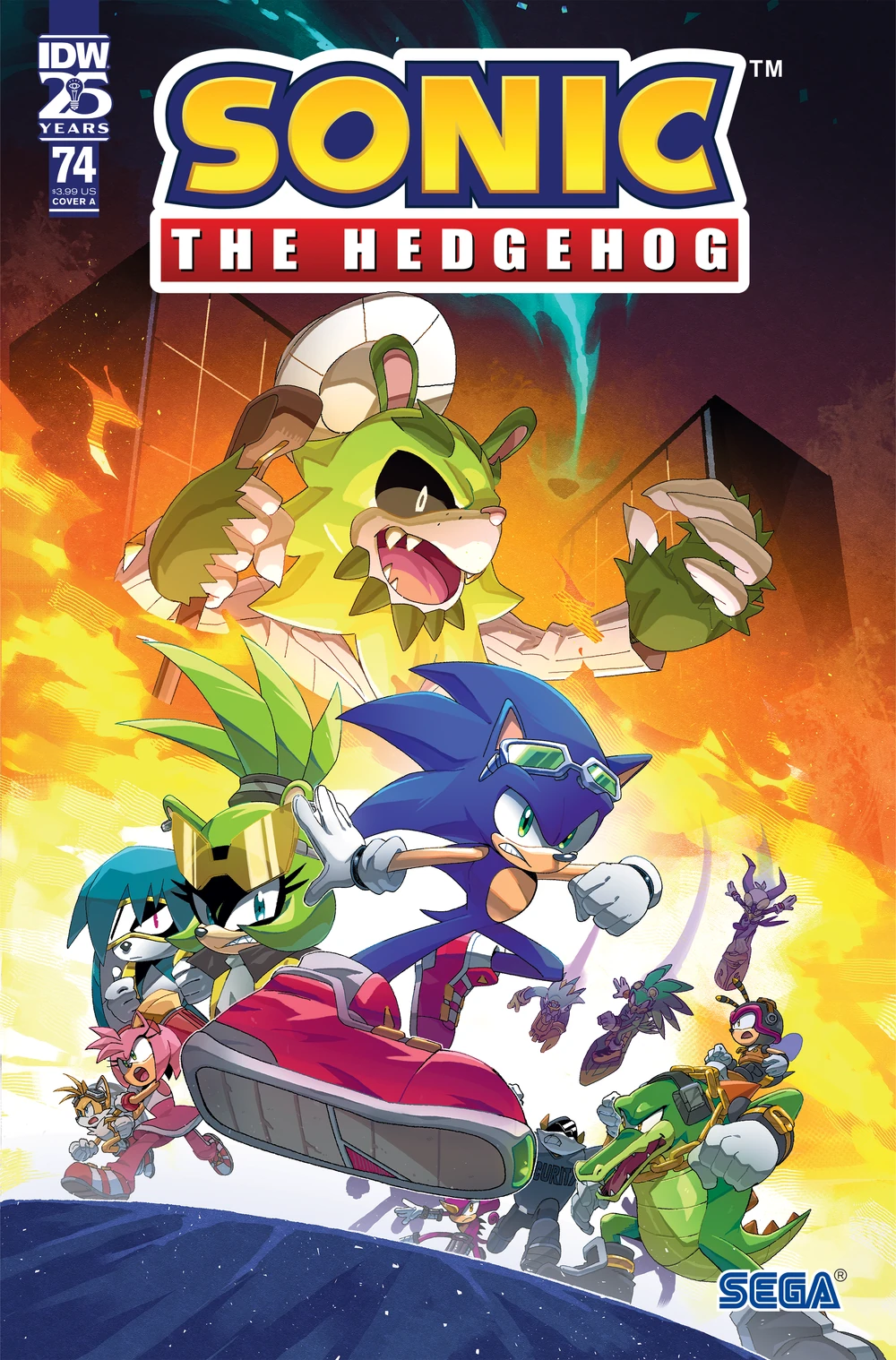
Evan Stanley, “Clean Sweepstakes Part Six” (Sonic the Hedgehog (IDW): Issue 74)

If the second part represents the Clean Sweepstakes arc at its best, the sixth part is its absolute worst. This issue represent the storyline collapsing into a tangled collection of subplots, the story spread over far too many locations and ensembles. More and more plot twist and major reveals where thrown at the reader, piling one atop the other until they all felt meaningless. Shoved in the middle is an odious moment where Lanolin gets mad at Tangle and Whisper over some of this stupid bullshit, a scene that made me take a break from the comic for a few seconds. I did not like this one, you guys. 


BEST BACK STORY:
Gigi Dutreix, “Shattered Diamonds” (Sonic the Hedgehog Annual 2024)

The 2024 Annual was a breath of fresh air, if only because it was a break from all that hoverboard racing stuff. The stories contained within where mostly good too. The clear stand-out was Gigi Dutreix's “Shattered Diamonds,” detailing Mimic's backstory. I already liked the deceptive octopus, as a strictly ruthless villain. This short story manages to bring a lot more context to Mimic's history of betrayals, showing him as sympathetic to a degree without losing sight of what a monster the guy is. It makes the character a lot more fleshed out and also a bit scarier, as we can understand where the murderer is coming from now. We need more thoughtful character work like this in the comic book.


WORST BACK STORY:
Ian Flynn, “Hero's Calling” (Sonic the Hedgehog Annual 2024)

IDW's “Sonic” series doesn't feature back-up stories the way the vintage Archie “Sonic” books did, as I'm sure you know by now. That means the back story category has to cover the selection of shorter stories from the Annuals. They're all basically back stories, despite “Hero's Calling” being the first one in the issue. Now, I don't think “Hero's Calling” was terrible. It's something of a stiff story though, devoted largely to Surge and Kit talking and their interior thoughts during this conversation. The development the story points towards is not promising either. It's clearly the weak link in an Annual that was otherwise quite good, meaning it claims this category by default. 


BEST STORY ARC:
Ian Flynn, “Fang the Hunter Mini-Series” (Sonic the Hedgehog: Fang the Hunter: Issue 1-4)

On the heels of promoting the December 2023 release of “Sonic Superstars” – damn, that game got forgotten fast – IDW took four months off from the mainline book to publish a mini-series about Nack the Weasel Fang the Hunter. Like most of the Classic Sonic stories IDW has publish thus far, it was a lot of fun. Four whole issues devoted to Fang and the gang on the verge of breaking up, fumbling upon a scheme by the Hardboiled Heavies and tussling with Knuckles, while Sonic and Tails kind of hang out on the margins. A smidge of pathos was mined out of Fang's strained relationship with his co-workers but mostly the washed-up villain's attempt to prove himself was the most compelling thing about this arc. Lots of good comedy bits too. I enjoyed myself!


WORST STORY ARC:
Evan Stanley, “Clean Sweepstakes” (Sonic the Hedgehog (IDW): Issue 69-75)

The “Fang the Hunter” mini-series was also one of two complete story arcs published in IDW “Sonic” material this year. Aside from a one-off issue at year's beginning and the various one-shots, the rest of 2024 was devoted to the “Clean Sweepstakes” saga. As I admitted above, the second installment of this series was good... The rest of it was a fucking disaster. By the time things finally wrapped up in December, I had been ready to move on for at least three months. Building almost a year's worth of stories around a “Sonic Riders'” reference was not a good idea, it turns out! You could also feel some irksome executive meddling further stretching an already belabored plot out, making sure this arc wrapped up in the 75th issue. Can we please do something else in 2025, Evan? 


BEST MAIN COVER:
Sonic the Hedgehog (IDW): Issue 71 – Min Ho Kim

I've said lots of negative things about the story featuring him and everything surrounding the “Phantom Rider” contrivance... But Sonic dressed up like a “Kamen Rider” villain looks cool. Min Ho Kim created a lovely image built around that dynamic design with issue 71's cover. The simple visual of the Rider stepping up on his hovercraft while bracing himself against a wall is further elevated by vague images of the comic's other cast member in the edges and areas around the star character. When IDW's various covers sometimes try to shove in too many characters, this is a clever way to include more faces without sacrificing the stylish central image. Good stuff!


WORST MAIN COVER:
Sonic the Hedgehog Annual 2024 – Jack Lawrence

There were a few covers this year that I felt where kind of ugly or overly busy at the very least. I found the action movie poster style seen on issue 74 to be displeasing to the eyes. The usually reliable Adam Bryce Thomas contributed a muddled and confusing image to the “Spring Broken!” one-shot. However, at least some interesting things were happening on those covers, despite being poorly arranged. Jack Lawrence's cover for the Annual might as well be for any “Sonic the Hedgehog” comic. It shows Sonic and Tails racing through a snowy mountaintop area. Does that relate in any way to the contents of this book? Nope! It's not a badly drawn cover. It's fine. It's also about as generic as a “Sonic” cover could get, showing a serious lack of effort and thought on someone's behalf. 


BEST VARIANT COVER:
Sonic the Hedgehog (IDW): Issue 71 – Cover RI – Natahlie Fourdraine

I didn't plan to give both of the Best Cover Art awards to issue 71 but, well, here we are. I thought long and hard about it, looked at all the other images for a while, and still couldn't move pass how much this particular image charmed me. Natahlie Fourdraine depicts Surge kneeling at her hover-bike and spray painting it, while Kit reclines on top. Both are staring back at the reader, as if they've been intruded upon by the viewer. This cover tells a story in its own right, making you feel like you've stumbled into Surge's personal business and she's about to kick your ass if you don't skedaddle out of there. It also conveys the juvenile delinquent type of energy that radiates around these two. I love it. 


WORST VARIANT COVER:
Sonic the Hedgehog (IDW): Issue 69 – Paper Hero's Comic Retail Exclusive – Jay Kerrick

May of last year must have been the start of convention season. That month's issue of IDW “Sonic” had two additional covers exclusive to two specific comic shops. The first of which was a cover for Big Time Collectables, which appears to be a digital store that gets a lot of exclusive comics. It featured Shadow the Hedgehog and didn't have anything to do with the story inside but wasn't bad by any means. The second exclusive cover was only available at Paper Hero's Comics, a shop in Bouquet Canyon, California. That image was drawn by someone named Jay Kerrick. It features Sonic and a whole bunch of his friends depicted as enormous eyed kewpie dolls, wandering around a weird looking rendition of the Master Emerald Shrine. If I saw this on DeviantArt or whatever, I would dismiss it as the work of a developing artist, trying to define their personal style and still learning how to draw environments, how to color in a way that isn't flat and bland. As a cover for a professional comic book... It simply feels like something that shouldn't have been approved. I'll leave my criticism at that, as I don't want to hurt the feelings of the fifteen year old who clearly drew this.


BEST STORY ART:
Adam Bryce Thomas, “For My Destiny” [Sonic the Hedgehog Annual 2024]
When Adam Bryce Thomas is given some time to truly perfect his artwork, the results are often stunning. The Knuckles centric story from this year's Annual was stunningly pretty. Including a single page spread in the middle that could have passed for a Patrick Spaziante cover back in the day, it's a detailed, emotional, lovingly drawn and painted story that simply looked better than anything else IDW published this year. 


WORST STORY ART:
Thomas Rothlisberger, “Hero's Calling” [Sonic the Hedgehog Annual 2024]

Thomas Rothlisberger contributed a lot of nice art to IDW's “Sonic” titles last year. In fact, his work on the “Fang” mini-series was fantastic, cartoony, fun, and emotive in a way that stuck in my memory. I nearly gave it the above award. Rothlisberger also drew “Hero's Calling” in the Annual and it is assuredly not his best work. I honestly suspect that this might have been a last minute rush job for Rothlisberger. The posing in the story is bland, the colors are flat, the characters are ever so slightly off-model. It's not hideously ugly or anything. However, it's loose and slapdash enough to win this dishonor. 


BEST NEW CHARACTER:
Trip the Sungazer

Trip the Sungazer was “Sonic Superstar's” big contribution to the wider world of “Sonic” lore. “Superstars” might have been a bit of a disappointment that didn't make the impact “Sonic Mania” did. However, it'll never be totally forgotten because it's where Trip debuted. Somewhere, in the fandom, she is someone's favorite character now and will remain treasured by them forever. Because IDW had its hands full with other stuff for most of 2024, it didn't have time to properly adapt “Superstars'” story or anything like that. Considering the weird back-and-forth the comic has with the game continuity, elements from “Superstars” simply popped up in the book, introduced with little warning. That's how Trip made her debut in the “Knuckles' 30th Anniversary” one-shot... 

Luckily, Trip made a good first impression. “Sonic,” as a series, doesn't want for well-meaning but slightly clumsy young women who are still trying to prove themselves. However, this story made the smart decision to play youthful, mistake-prone Trip off the serious, sturdy Knuckles. The result was a delightful story that, most importantly, gave Trip a lovable introduction. She seems nice! I like her. I hope we see more of this little lizard in future installments. 


WORST NEW CHARACTER:
“The Phantom Rider”

Obviously, the Phantom Rider is not a “new” character, strictly speaking. It is merely an alternate identity that Sonic assumes as part of a convoluted plot to get to the bottom of Clutch's criminal dealings. On the surface, the idea of Sonic going undercover as a supervillain that looks like a Japanese superhero isn't a terrible idea. This could have been fun and was, once or twice. Unfortunately, the Phantom Rider soon became representative of the entire arc's problems. The Phantom Rider would do almost the same thing in each appearance, appearing to throw the race into chaos, prompting lots of rushing around from the various factions as part of an on-going scheme that grew blurrier with each new installment. By the end of 2024, I was quite happy to see Sonic discard this alter-ego, the pursuit of the Rider by various people becoming an increasingly stupid plot point in an already overstuffed story. 


BEST IDEA:
Surge Sees the Light

Surge the Tenrec rocks. We love her. She's great. The electric bad girl has been compelling for a while, her broken bird personality growing more vulnerable and sympathetic the more we found out about her. Surge's character arc seemingly came to a turning point in 2024, as her going undercover with the Restoration made her realize she actually likes doing good. Several specific moments – her sheer joy at being received as a hero, her reaction to a little kid praising her as a hero – touched this cold, grey heart of mine. These scenes where the best the comic had to offer in 2024. If we can spin this off into a larger theme, the Mimic centric story that expanded greatly on his personality showed that adding complexity to the adversaries was the best idea this comic's staff had in 2024. 


WORST IDEA:
The Desire to Utilize Every Single Character in the Cast All the Time

I had a lot of problems with the Clean Sweepstakes arc. Please refer to my individual reviews to see my bitching in more detail. However, the longer the plot went on, the more apparent its main issue became. Those critical of the “Sonic” franchise often point out that Sonic has too many friends, too many supporting cast members that strike the casual fan as unneeded. I have never agreed with that assessment... Until Evan Stanley started writing her epic story lines for IDW, each one shoving in as many fucking characters as possible. After a while, it almost felt like the comic was under some pressure to include nearly every member of its cast in this arc. Did the Chaotix need to be involved in these events? Did Don the Rooster and Nite the Owl? Why were Amy, Belle, and Tails off on their own side story for almost the entire arc? Why was so much page space devoted to Lanolin in-fighting with the other Diamond Cutters? What happened to brevity being the soul of wit? 

Friday, December 20, 2024

REVIEW: Sonic the Hedgehog 3 (2024)


I was fourteen years old when “Sonic Adventure 2” came out. This means I was right in the target demographic to find Shadow the Hedgehog appealing. In retrospect, it's tricky to overlook how calculated a character Shadow was. The “Sonic the Hedgehog” fandom was already full of original characters that were barely anymore than different colored versions of Sonic. This was an official character with almost the exact same gimmick... Except he was also an edgy antihero with a tragic backstory and a plethora of superpowers. In other words, Shadow the Hedgehog felt a lot like a cheesy original character except he was one hundred percent official. Ashamedly, this strategy worked exactly as planned. Shadow immediately became the second most popular character in the franchise, launching a hundred other O.C.s. When Sega gave him his own game, allowing him to shoot a gun and ride around on a motorcycle, it almost felt like self-parody. 

I wasn't above being caught by this. I too loved Shadow when he first debuted. However, at some point, I woke up to the blatant corporate manipulation at play here and turned on the character. However, Shadow has now been an established part of the “Sonic” universe for over two decades. I've long since made my peace with the character. I would go so far as to call myself a fan of Shadow the Hedgehog, when he's written well. However, how would the character be integrated into the cinematic “Sonic the Hedgehog” universe? That was the question on my mind as I sat down to watch “Sonic the Hedgehog 3,” somehow the third big budget theatrical adaptation of the beloved series. The latest sequel, and Shadow's much-hyped debut, has been well received by fans. What would I, an ever-shrewd old man, think of this?

Sonic, Tails, and Knuckles' peaceful lives with the Wachowski is interrupted again when G.U.N. specifically recruits the furry alien heroes. A black hedgehog from the same world as Sonic, but far more powerful, is on a rampage in Tokyo. Kept on ice by G.U.N. for fifty years, this Shadow has a grudge against the organization. He proves too powerful for Sonic, Tails, and Knuckles to defeat on their own. This leads them to forming an uneasy alliance with their greatest enemy, Dr. Robotnik. The new team soon are led to the secret base of Dr. Gerald Robotnik, the villain's grandfather and the scientist who studied Shadow fifty years ago. He recruits his grandson and Shadow into a plot to activate the Eclipse Cannon, a planet killing weapon he designed. Sonic races to stop villains new and old, the fight quickly getting personal. 

To utilize the inevitable pun, “Sonic the Hedgehog 3's” script hits the ground running. Within the opening minutes, we are being presented with Shadow's back story. Not long after that, Sonic and his friends are already dueling against the new threat. By the half-way point, we've already had alliance switches and betrayals and dramatic revelations, heroes teaming up with villains, villains teaming up with villains, and then breaking apart again. The movie breathlessly races from one plot point, and accompanying set piece, to the next. MacGuffins come and go, heroes chasing after access cards and the Master Emerald. The script looks like it's going to shove in the “Sonic Adventure 2” plot point of G.U.N. chasing Sonic before going in a wholly different direction, which then set-up dramatic heist and confrontations between the good guys. “Sonic the Hedgehog 3” rarely slows down, trying to squeeze as much into its 110 minute run time as possible. I guess this is what happens when you're attempting to tell a blockbuster worthy script but keep it within the runtime restraints of a traditional kid's flick.

Part of why “Sonic the Hedgehog 3” feels stuffed to the brims has to do with a problem that is often encountered in this franchise: There's a lot of characters here. In the returning column, we have Sonic, Tails, Knuckles, Tom Wachowski, Maddie, Robotnik, Agent Stone, plus the Olive Garden guy and cameos for Wade Whipple, Maddie's sister, and the undercover G.U.N. Agent she nearly married in the last movie. To this already considerable cast, the film adds Shadow, Gerald Robotnik, Maria via the power of flashbacks, and Krysten Ritter as a new antagonistic G.U.N. commander. If the studio is going to pay recognizable actors like James Marsden and Ritter to be in the movie, it better give them things to do too. All of this must co-exist alongside the story of Shadow and Maria that the fans are truly here to see, as well as new additions these adaptations always feel the need to make. 

Part of why Hollywood struggled so long to adapt video games is because of the wildly different structural needs of both mediums. This has mostly been resolved by movies and games becoming a lot more like each other. The first two “Sonic” movies mostly invented their own narratives, drawing from the extensive back stories of the games, which probably was the best approach to take. “Sonic 3,” meanwhile, is the first movie to truly be adapted one of the game's plots, directly pulling a lot of ideas from “Sonic Adventure 2.” That doesn't mean only Shadow's backstory, as I expected. In the middle section of the film, both the good guys and villains seek access cards, the kind of fetch quest you'd fully expect from a video game. The sequel goes so far as to include the gravity switching gimmick that was so prominent in “Adventure 2's” later levels. One gets the impression that this is the movie Jeff Fowler and his team have really been wanting to make all along, rather than grafting bits and pieces of established “Sonic” elements on traditional kid movie set-ups. 

Fidelity to the source material is a lot less important to me than honoring the characters as we know them. The “Sonic” cinematic universe has increasingly revolved around the idea of family. Sonic finding his new family with the Wachowski defined the first movie, while the second was about him learning responsibility when faced with a sidekick that looked up to him and an equally powerful rival. Family continues to be a heavily touted theme, the script emphasizing Sonic's connection to Tom and how it compares to Shadow being treated his whole life as a science experiment. Robotnik ends up aligning with Gerald largely because his similar want for a bloodline. However, that is secondary to the theme the movie flatly states again and again: “Making good decisions,” as Tom puts it, especially when the world constantly tries to break your heart with its overwhelming awfulness. In other words: Shadow and Sonic both have great power but only one of them has learned great responsibility from a father figure. 

While this is the kind of easily grasped themes and ideas you'd expect from a kid's movie, repeated enough times for the little ones to pick up on it, I do think “Sonic the Hedgehog 3” actually pays proper tribute to its emotional center. The sequel is seriously invested in Shadow the Hedgehog, particularly how the loss of Maria weighs on him. A surprising amount of time is devoted to establishing Shadow and Maria's relationship, via lengthy flashbacks. Though hassled with the franchise's continued obvious soundtrack picks – why is a scene in the seventies featuring a Traveling Wilburies song? – these moments are genuinely adorable. When Maria is inevitably killed, the pain Shadow feels is sincere. As sarcastic as these films get, the emotional stakes remain one hundred percent serious. I didn't expect a “Sonic the Hedgehog” movie to feature a touching depiction of overcoming grief and learning to live beyond that heartache but here we are. 

When it was announced Keanu Reeves was cast as the voice of Shadow the Hedgehog, people got excited. This struck me as a little odd. I know Keanu is a beloved pop culture icon these days and I love the guy too. He's not truly a voice actor though, “Toy Story 4” aside. Much like Idris Elba as Knuckles, I can definitely feel some of that awkwardness coming through Reeves' performance. However, Keanu manages to find the heart of the character before the film is over. Ben Schwartz' take on Sonic is well established by now, the actor even getting a chance to stretch his dramatic legs a bit in this installment. I do wish Elba as Knuckles and Colleen O'Shaughnessey weren't increasingly sidelined by the story though, another side effect of the film having so many characters in it.

Following “Sonic the Hedgehog 2,” Jim Carrey announced his retirement and the character's fate in that film seemed potentially final, should the star really not come back. Well, Carrey loves money enough to return for part three, as both Robotnik and his grandfather. This means we get a double-dose of Carrey's manic comedy. The make-up effects that transform him into the 100 year old Gerald are good. In general, the illusion of one actor playing two characters that often interact is pulled off successfully. While Carrey's clownery is amusing, there are multiple moments when his buffoonery becomes difficult to sanction. A dance sequence among security laser or the increasingly nutty finale feel like moments when the star's chaotic energy take over the movie, to its detriment. Robotnik also gets a genuine character arc and I'm not sure Carrey is able to pull it off in-between all his extended mugging. 

Another reason “Sonic 3” feels a little overstuffed is because it has to make room for its human co-stars. Tom and Maddie get a sequence devoted to themselves, in which they sneak into a G.U.N. building in London. It is an inessential sequence, to say the least. Ritter, a decent actress, is given very little to work with as Rockwell. She's simply another obstacle for the heroes to run around. In general, the tension between what the fans most want to see – Sonic and his friends doing stuff – and the need for these films to be live action family-friendly comedy continue to make these unsteady affairs. Except for Lee Majdoub's agent Stone, whose role as Robotnik's loyal sidekick has expanded naturally into a full-on homoerotic will-they-or-won't-they? Majdoub and Carrey's banter continues to be a highlight of these movies.

My continued suspicion that these films would be a lot better if they were entirely animated is furthered by the last act. That's when “Sonic 3” becomes a colorfully directed action flick, the CGI hedgehogs blasting around the world and into outer space with enough verve to outclass some recent, bigger budget superhero flicks. The film also makes sure to get a prominent song on the soundtrack, once again suggesting that Fowler knew exactly what kind of fan service he had to include. I have a lot less investment in “Sonic Adventure 2's” plot than most but it was nice to see a “Sonic” movie truly push the limits of what its hero can do on-screen.

That evident desire to give people exactly what they want continues into the inevitable sequel baiting mid-credits scene. The “Sonic the Hedgehog” movies continue to exist in a bizarre space between special effects driven spectacles and goofy kid movies full of wacky comedy. The compromise agreed upon to make these movies possible continue to stick out badly. If I had seen this during the peak of my teenage Shadow fever, I probably would have loved it. “Sonic the hedgehog 3” feels like a movie primarily made for those people. The older I get, the more ambivalence I have towards franchises existing primarily to appease fans and activate nostalgia-driven dopamine rushes... From a simple factor of loyalty to the source material and on-screen flash, “Sonic 3” is easily the best entry in the series. How I'll feel about it in the future remains to be seen. But at least it beat the "Lion King" prequel at the box office... [7/10]