Monday, August 15, 2016
Knuckles the Echidna: Issue 9
Publication Date: December 1997
By the end of 1997, Archie really had established a shared universe with its “Sonic” books. Issue 9 of "Knuckles the Echidna" directly reflects the events of issue 55 of “Sonic the Hedgehog." The issue ends on a cliffhanger resolved in issue 56 of “Sonic.” This was quite confusing for people like me, as I was only reading the “Sonic” books at the time. But maybe I’m getting ahead of myself. Issue 9 wraps up the “Dark Vengeance” story arc, bringing the second proper story in the “Knuckles the Echidna” book to an end.
Convinced he’s finally banished Knuckles, Enerjak faa-vhooms over to where the Dark Legion is. Allowing this story to finally continue, he leads the army on a march to Echidnaopolis, generating a golden bridge that will take them directly to the city. There, Remington and the ESF team up with the Dingoes Army, both defending against the invaders. Yet a higher power is watching out for Knuckles. He rescues the Chaotix, left for dead, and Archimedes teleports them into the center of the fray. However, another force is at work and intervenes before either side can achieve victory.
I shouldn’t like Issue 9. It’s got so many problems and features some pretty lazy writing. Knuckles survives being de-atomizied at the end of the last issue because the Ancient Walkers save his ass. The omniscient and horribly mysterious dino-wizards stepped in and saved the day. They then zap him over to the Chaotix’s location, where Knuckles can save his friends. After that, he somehow uncovers where the Legion buried Archimedes, Dio, and Charmy Bee. (I think this is the first time Charmy has appeared in this story.) Someone –we don’t know who – left a canteen full of water so that the Chaotix can be rescued from the edge of dehydration.
The laziest story turn is the ending. Mammoth Mogul appears, points the Sword of Acorn at Enerjak, and sucks the power of eleven Chaos Emeralds out of him. The script doesn’t clarify that Mogul is the one who drew Enerjak back to Mobius in the first place. We just have to assume he did. Knuckles himself has very little direct effect on the plot. Higher beings resolve all of the major plot points.
And yet, I still kind of like issue 9. If nothing else, the resolution to “Dark Vengeance” is a lot smoother then what “The Dark Legion” or “Lost Paradise” story arcs got. The bit about the echidnas and the dingoes working together to fend off a mutual attacker is a nice touch. It shows that both species can put aside their differences in the name of the greater good. I’m not sure if this was a deliberate correction for the echidnas acting like such huge cocks but I like it anyway. I also like Enerjak finally getting his shit together and targeting Echidnaopolis. After wasting an entire issue tormenting Knuckles, it’s nice to see the villain actually have a focused, direct plan.
The book also returns the focus to Knuckles’ supporting cast but not in an entirely satisfying way either. What has Julie-Su been up to throughout this story? Presumably, after Enerjak dropped her off back at the Dark Legion camp, she pretend to go along with the group just in order to survive. Okay, that’s fine. But it would’ve been nice if Penders’ script could have clarified that. (Maybe he’ll get around to resolving this once the Mammoth Mogul plot is wrapped up.) Disappointingly, the Chaotix are once again sidelined. They spend the first half of the book chained up in the desert. Later, they join the fight against the Legion in Echidnaopolis. Basically, they spent most of this story arc outside the main plot and only appear for some brief smashy-smashy at the very end. Come on, Ken, you’ve got to utilize that ensemble a little better.
(Lara-Le, meanwhile, is not involved in this issue at all. Locke spends the whole thing deliberating over what to do before finally calling the Freedom Fighters, as shown in issue 55. That last point is totally extraneous and just exists to set-up the up-coming crossover.)
Having Enerjak drained of his powers and return to mortal, instead of merely killed off, was a nice touch. Julie-Su being taken into captivity with some other Legionnaires makes for a far more captivating cliffhanger then the business with Mammoth Mogul. Galan’s artwork is strong… Though his weird quirk of emphasizing Dimitri’s teeth continues to appear and Mogul looks awful tiny in his style. Issue 9 of “Knuckles” features some of Ken Penders’ worst tendencies as a writer. Yet I still sort of like it, if only because the story structure is way more organized then the ending of Knuckles’ last two arcs. If omniscient higher powers continue to intervene in the book, it might become a serious problem. [6/10]
Labels:
julie-su,
ken penders,
knuckles,
knuckles on-going,
mammoth mogul,
manny galan,
the chaotix
Friday, August 12, 2016
Sonic the Hedgehog: Issue 55
Publication Date: December 1997
Issue 54 of “Sonic the Hedgehog,” one of the most emotionally satisfying story that had appeared in the book in a while, ended on a cliffhanger. Issue 55 picks up right where that story left off, with Sonic, Sally, and Antoine in pursuit of Snively’s EggRobos. Instead of doing the logical thing and letting writer Karl Bollers continue the story he was obviously telling last time, Archie instead handed the reins of issue 55 to Frank Strom. I’m not really sure how Strom got this gig. According to his website – which hasn’t been updated since 2005 – his work before “Sonic” mostly included pornographic comics and a long run on an “Elvira, Mistress of the Dark” series. Not exactly the family entertainment you associate with Archie. Strom would return a few times to write and draw “Sonic,” each time mostly focusing on his own characters and settings.
For example: The trail leads the trio of Freedom Fighters to a clearing in the woods. There, the EggRobos have activated a giant driller, searching through the ground for Power Rings. Near by, Sally discovers a tomb-like containment unit. Upon opening it, a Robotnik-created cyborg calling himself Monkey Khan emerges. With his apparent ability to manipulate the weather, Khan leaps on a cloud and starts blasting robots with lightening bolts. He also kidnaps Sally, which pisses Sonic off. Antoine and the hedgehog have to work together to defeat the remaining EggRobos and rescue the princess.
Let’s talk about Monkey Khan. If you couldn’t guess from the name, Monkey Khan is yet another variation on Sun Wukong, otherwise known as the Monkey King, a character from the 16th century Chinese epic fantasy novel “Journey to the West.” The story has been loosely adapted many times over the centuries, such as the cult classic TV series “Monkey” or Stephen Chow’s 2013 feature film. Most famously, the Monkey King also inspired Goku from “Dragon Ball.” Monkey Khan has all the elements we associate with the character. Firstly, he’s a monkey, obviously. Presumably using his elementary powers, he creates a cloud to float on. He also swings a staff around, which routinely disappears from page-to-page. In short, Monkey Khan adds nothing to a character that was already well-trod literary ground in 1997.
The story, which is given the groan-worthy name “Monkey Madness,” is pretty useless too. It’s full of people acting stupidly and minor plot holes. Despite the area being full of killer robots, Sally separates from the group to investigate on her own. The EggRobos have been instructed by Snively to search for Ixis Naugus but instead dig up a power ring. Which Khan then takes for some reason. Despite Khan just destroying the robots, Sonic attacks him. Even though he saw Sally when she opened his prison, Khan is overwhelmed by her beauty when he looks at her the second time. The Princess spends the rest of the story as Khan’s hostage. The second half of the story is devoted to Sonic and Antoine overcoming their differences and working together. This ignores the fact that Sonic and Antoine have been on equal footing for a while now. Afterwards, Monkey Khan flies off on his own adventures. Basically, the on-going plot pauses for an entire issue just so Frank Strom can introduce his lame original character.
Strom also draws the story. Objectively, I guess his artwork isn’t too terrible. He tends to draw Antoine’s sword in such a way that it looks like a knife. Sonic’s jaw frequently inflates in weird ways. Monkey Khan’s head, limbs, and arms are about as twice as big as everyone else’s. Sonic looks hopelessly awkward when curled into a ball and one panel has his legs stretching on far too long. His Sally looks decent though. Mostly, Strom’s artwork just strikes me as horribly unappealing. It’s very flat and his facial expressions are cartoonish in a weird way. It seems to me that his personal style is just horribly at odds with the prevailing look of the “Sonic” book. I can’t say I’m a fan.
The back-up story is… Well, also not that hot. In “Rise of the Robians,” we finally see the oppression the Robotocized Mobians have been facing from the organic furries. A female peacock, after being spotted walking around Robotnik’s old laboratory, is cornered by a mob of torch-wielding Knothole residents. Uncle Chuck intervenes, in hopes of instilling some order. The mob is equally antagonistic towards him. That is, until he takes this issue to the Princess. However, Sally is out of town, getting manhandled by Monkey Khan. Instead, King Acorn steps in. As he has been for a few issues now, the King acts like a massive asshole and declares the Robian peacock be put to death. He then smacks Geoffrey St. John around, collapsing afterwards. Whatever momentum the story might have had is derailed when Sonic and Sally waltz back in. Knuckles’ appears on a monitor, saying the Floating Island is in a danger. And where off to a crossover in issue 9 of “Knuckles.”
“Rise of the Robians” at least resolves two issues. Since “Brave New World,” the Robians have been talking about how fearful the fleshies are of them. Despite the repeated references, this is the first time we see anything of this nature. Secondly, the story confirms that King Acorn has been acting like a dick not because he’s just a dick. Instead, he clearly has some mental condition, a side-effect of half his body being turned to crystal. The rest of the story is a mess though. The crowd of angry villagers are cartoonish. The victimized Robian comes off as a bubble-brained victim. King Acorn’s behavior comes off as pointlessly mean-spirited. Him smacking St. John around is more likely to cause unintentional laughter then gasps.
The artwork, from an entity calling itself “Andy Underwood and Edward Artistic Studios,” is bad. The rioters look generic. The peacock looks weirdly proportioned. In the second half of the story, everyone grows massive heads and tiny bodies. In the final panel, Sonic’s hand twists in a horrible way while his head balloons to massive side. It’s bad.
The whole issue is bad. The cover story is lame, introducing a character nobody would care about until Ian Flynn gave him some personality 147 issues later. The back-up story is needlessly melodramatic. All the artwork is awkward. What a lame way for “Sonic” to close out 1997. [4/10]
Wednesday, August 10, 2016
Sonic Super Special: Issue 3 - Sonic Firsts
Sonic Super Special: Issue 3 – Sonic Firsts
Publication Date: November 1997
These days, it’s very common for popular comic series to collect their issues in trade paperbacks. For a while there, the comic industry was counting on the popularity and sales of trade collections to save the industry. This is a habit that really picked up in the nineties, right around the peak of Sonic’s popularity. Despite this, Archie was very slow to catch onto this trend. They released the original “Sonic the Hedgehog” mini-series in trade in 2003. It wasn’t until 2006 that Archie started publishing the series in collected, chronological releases, with the “Sonic Archive” series. These days, there’s at least three on-going series of paperback collections, printing stories in color, black and white, from the distant past and the recent present. All of this is excluding digital reprints, which is the real future of comic book publishing.
Today, those older stories are very easy to find. When I first started reading the series, the only way to read those older “Sonic” stories was to dig up the original comics. That’s why the publication of “Sonic Firsts” was a big deal to me, back in 1997. Originally released as a proper trade paperback, loaded up with extras and goodies, the release was slimmed down for the third Sonic Super Special. It included the first appearances of Sonic the Hedgehog and the Freedom Fighters, Bunnie Rabbot, Super Sonic, and Knuckles the Echidna. In other words, stories from issue 0 of the original “Sonic” mini-series and issues 3, 4, and 13 of the on-going series. “Sonic Firsts” is how I first read these stories.
“Sonic Firsts” is not a perfect re-print. A few minor changes are made. Sally’s hair, blonde or brunette in the original printing, have been re-colored to the canonical red. Rotor, referred to as “Boomer” at the time, is called by his correct name. Other then that, things are the same. Instead of retracing familiar ground, writing new reviews of stories I covered just a few months back, let me take a different approach. Let me instead chronicle how these characters and their world changed between when these stories first appeared and when they re-appeared in 1997.
In “Don’t Cry for Me, Mobius!,” Sonic’s world is so much brighter and simpler then it was in 1997. Just the other day, when reviewing issue 54, I was noting how moody and complex Sonic had gotten. In this first appearance, he’s still a total joker, cracking puns at every oppretunity. Sally comes off as a comical straight woman, honestly a bit on the bitchy side. This is in contrast to the concentrated but conflicted leader she was, post-“Endgame.” Antoine, developing into an honorable solider, was the butt of Sonic’s pranks and jokes, remaining a wet blanket. Robotnik, a comic relief villain who posed little in the way of serious threats, was dead by '97. Rotor and Tails haven’t been changed too much, though everyone’s less sarcastic then they were back then. The story is awfully goofy. Though dated, Scott Shaw’s artwork is still appealing.
In “Rabbot Deployment,” Bunnie was mostly characterized by bad jokes about wanting to be a hairdresser. Thankfully, the book would drop that aspect of her personality quickly. Disappointingly, Bunnie still remains underutilized in the main book. She’s developed a romance with Antoine and has gotten a few stories to herself. Yet the defining Bunnie story still hadn't come along. Though a rightly beloved member of the Sonic’s universe, it would take a while longer for Archie to truly do anything with Bunnie. As for “Rabbot Deployment,” it’s still a very silly but mildly fun story. That scene of Bunnie dropping the BurroBot on its head remains amusing.
I’m not sure why Archie felt the need to high-light Super Sonic’s first appearance. Since “Lizard of Odd” first ran in issue 4, Super Sonic had only appeared one more time, in the “Super Sonic vs. Hyper Knuckles” one-shot. (Though his third appearance was just around the corner in issue 56.) In later years, Super Sonic’s appearance would signal that shit had gotten really bad. He was the nuclear option, a form so powerful that he was only called on when essential. UniverSalamander is such a silly threat that it’s hard to get too worried. Nevertheless, I still kind of like “Lizard of Odd,” just because its silliness is rather endearing. Super Sonic does boost Sonic’s already smug behavior to almost unmanageable levels.
Maybe the character that had grown the most since his first appearance is Knuckles the Echidna. In the time since “This Island Hedgehog,” Knuckles has gone from the sole echidna on the planet to having a girlfriend, a mom and dad, a bunch of grandfathers, an army of arch-enemies, and an entire city populated with his own species. Knuckles had also lost much of the gullibility that defined him at the time. Now, he’s far more cunning and confused about his world, though still pretty hot-headed. It’s not a high compliment but “This Island Hedgehog” is probably the best story in “Sonic Firsts.”
These days, “Sonic Firsts” is a truly antiquated artifact. If people want to read the first appearances of Sonic, Bunnie, or Knuckles, they can find the digital downloads on an app and have them on their computers, game systems, or phones in seconds. Back then, we relied on reprints like these to find the older stories. Are the older stories truly worth seeking out, for anyone but Sonic completest like me? Well, probably not. Yet just for nostalgia points, I have to give “Sonic Firsts” a [7/10.]
Monday, August 8, 2016
Knuckles the Echidna: Issue 8
Publication Date: November 1997
The first part of the “Dark Vengeance” arc concluded with Knuckles in a tight place. Enerjak had grown to giant size and had Knuckles and Julie-Su literally in his grasp. Proving that Kragok got his sadistic side honestly from his greatx14-grandfather, Enerjak doesn’t just crush Knuckles right then and there. Instead, he teleports the Guardian around Mobius, from the surface of the moon, to the depth of the seas, to hundreds of feet above the Floating Island. Julie-Su, meanwhile, was left at the Dark Legion camp. She appears to blend right back in with her old comrades, confirming Vector’s suspicions. Meanwhile, Lara-Le attempts to contact Locke. Also, the Brotherhood at Haven have their hands full.
After an interesting start, “Dark Vengeance” moves most of its story lines forward. The most interesting one to me involves Julie-Su seemingly rejoining the Dark Legion. These days, we obviously know that Julie-Su didn’t betray Knuckles and friends. Back in 1997, her alliances were less clear. She throws herself on Kragok’s mercy and immediately gets back to work. The Chaotix are shown to be captured by the Legion and Vector is happy to announce that Julie-Su wasn’t trustworthy. (He continuously calls her a “witch,” the first letter begging to be changed to a B.) After they attempt to escape, Julie-Su blasts them with a gas pallet, seemingly confirming how duplicitous she is. Of course, the reader can probably figure out that Julie-Su isn’t a traitor. She herself seemingly doesn’t understand what she’s doing. It’s an interesting way to keep the readers on their toes.
As for Knuckles’ parents, that shit is less satisfying. Lara-Le has yet to be established as a truly strong character. From her introduction, all the character has done is weep about her son. At least this time, she takes some action. Desperate to contact Locke, she looks up Constable Remington. We get a brief glimpse into Remington’s history. His predecessor told him that the Guardians are probably left alone to their own business. There’s some conflict, as he wonders if he should break that vow and help Lara-Le. This isn’t super-compelling stuff – truthfully, it’s a bit convoluted – but at least the book remains focused on its cast’s emotions. That’s better then Locke’s subplot. He’s more concerned with Hawking, a man two-hundred years older then him, then what’s happening to his son. As always, Locke remains an evasive ass hat.
And what is Knuckles up to? This is the part of the book that I’m not sure how to feel abut. Enerjak spends all of issue 8 torturing Knuckles. Not in the fun way, with thumbscrews or jumper cables. As much as Penders would like to push this book into a more mature area, he can’t go that far. Instead, Enerjak uses his vast power to pettily fuck with Knuckles. He zaps him to the moon for a minute and gloats. He then zaps him to the bottom of the ocean. This leads to some alright action beats, like Knuckles avoiding a shark or punching a one-eyed monster in the face. After escaping that, Enerjak teleports the Guardian high into the atmosphere. Enerjak says he’s done toying with him and drops him. (The villain seemingly ignores Knuckles’ ability to glide.) Except he’s not done toying with him. He stops his fall inches from the ground. Enerjak then does what he probably should have done in the first place, by dismantling Knuckles on an atomic level.
On one level, this stuff is sort of fun. It’s amusing to watch the book jump around all these different locations and Knuckles’ journey to the bottom of the sea is a fun, pulpy element. However, Enerjak continues to not understand his own limitless power. He obviously can do just about anything, including changing sizes, unlimited teleportation, and molecular manipulation. Instead of just squashing Knuckles out of existence, he toys with him for an extended amount of time. I know he’s a bad guy, and that this is a children’s book, but Enerjak seems consumed by revenge. I mean, couldn’t he have just stuck the Guardian in a death trap and continue on his plans for world domination?
Still, issue 8 is still alright. Manny Galan’s artwork continues to be strong, if you can get use to his weird obsession with mouths and teeth. I like the entire subplot with the Dark Legion. I just wonder if the villain’s time could be better spent. Still, it’s already a more solid, focused story arc then the last one. That counts for something. [7/10]
Labels:
archie,
comics,
julie-su,
ken penders,
knuckles,
knuckles on-going,
manny galan,
the chaotix
Friday, August 5, 2016
Sonic the Hedgehog: Issue 54
Publication Date: October 1997
The “Brave New World” one-shot set a new tone, more introspective and realistic, for “Sonic the Hedgehog,” post-“Endgame.” Issue 53, thanks to new head writer Karl Bollers, brought Ixis Naugus into the fold, providing a new enemy for Sonic and friends. However, issue 54’s sole story, “Running to Stand Still,” makes it clear that things are not going to relax into a familiar pace. This world will remain brave and new.
Since Knothole Village remains trapped inside a pocket dimension, three hours in the future and accessible only by tunnel, many Mobians have moved into the newly rechristened Mobotropolis. Sally appoints herself, Rotor, Dr. Quack, Geoffrey St. John, and Sonic as members of a council designed to make the city livable again. Sonic, however, isn’t too keen on the new position. He wonders what role a warrior like him can play in a world without Robotnik. Also weighting on Sonic’s mind is how his Uncle kept his parents’ lives a secret from him. Meanwhile, Snively schemes from inside his prison cell.
Like everything connected to Sonic, Karl Bollers remains a controversial figure among the fandom. In some circles, he’s actually even more hated then the widely loathed Ken Penders. Bollers’ style is no doubt different then the previous writers to work on the book. He utilizes a lot more comic book narration. His dialogue is a little more stylized, different the the broad exposition and lame one-liners of Penders. Yet for a story like “Running to Stand Still,” the narration actually works pretty well. Sonic spends most of the story wrapped up in his own thoughts, considering his place in a rapidly changing world. While Bollers’ prose borders on the cheesy at times, it’s well utilized in this context.
Sonic is acting unusually moody. While sitting around during one of Sally’s meetings, he fights off sleep. Rotor asks Sally if he can take some time to pursue his missing family, a plot point abandoned back in issue 32. She vetoes the idea, saying that Rotor’s technological know-how is needed at home. When Sonic asks again on the walrus’ behalf, she gives the same answer. When the Robians raise the idea of moving into the mostly abandoned Knothole Village, to escape the persecution by the fearful public, King Max denies the idea. (His reasoning isn’t expounded on. King Acorn is just a jerk.) Sonic doesn’t seem suited to politics and he makes his feelings known to Rosie. The plot point isn’t quite resolved but Sonic comes to a realization: That he has to make a difference. Thus, he needs to go wherever a difference needs to be made.
Yet something is bothering Sonic closer to home. For years, Uncle Chuck was the only connection to his presumed lost family for years. Over the last month, Sonic has discovered that not only are his parents alive but Chuck’s been keeping their existence a secret from him for years. This provides the main emotional conflict throughout this issue, as Sonic continues to snipe at his uncle, his resentment showing. Eventually, the two resolve their problem, walking through a wooded area. Chuck explains his actions, that Sonic’s pain from missing his parents would cripple him too much. I’m not sure if I agree with that but Sonic and Chuck hug it out.
Honestly, it’s kind of ballsy of Bollers to build an entire story around emotional stakes. There’s truly no action in issue 54 at all. Uncle Chuck is testing Sonic’s speed in a variety of locations, across the treetops, the ocean waves, the desert plains, and a giant hamster wheel. That’s the closest this issue comes to an action sequence. While imprisoned in Devil’s Gulag, Snively activates a device hidden under his fingernail. This awakens a stashed-away collection of Egg-Robos (referred to as Eggbots here), presumably hidden away back in “Battle Royal’s” “The Map.” What Snively is up yet isn’t revealed, as the comic ends just as the machines fly overhead.
Last time we saw Nelson Ortega’s work in issue 46 and 50, it was pretty shaky. He’s improved a lot since then. Sonic still goes off-model on two occasion, he’s head developing into a weird shape. Otherwise, the artwork is good. The opening page of Sonic bouncing through the treetops of Knothole or hydroplaning across the ocean waves are quite impressive. Ortega’s obviously been taken some lesson from Patrick Spazinate, as Nelson’s take on Sally is clearly influenced by Spaz’. He also does some good work with facial expressions, focusing on Sonic’s face as he’s lost in thought. A different artist, newcomer John Herbert, illustrates the interludes of Snively in prison. Herbert’s work is incredibly moody, full of shadows and detail. His one-pager of the Eggrobos emerging from their eggs looks great. I’m not sure why two artists worked on the book but issue 54 is mostly a good looking one.
Though not quite perfect, “Running to Stand Still” easily represents Bollers’ best work on the book thus far. [9/10]
Wednesday, August 3, 2016
Knuckles the Echidna: Issue 7
Publication Date: October 1997
After a somewhat messy first story arc, the “Knuckles the Echidna” series begins to find its footing with its seventh issue. At least for now. Following the re-establishment of Echidnaopolis on the Floating Island, Knuckles is feeling conflicted about his family. His mom is similarly uncertain about what to do. Julie-Su, likewise, isn’t integrating that well with the new society. The Dingoes, meanwhile, continue to formulate their uneasy truce with the echidnas. As the Dark Legion begins to reform after their most recent defeat, a visitor greets them from the skies. Enerjak has returned from his space-bound exile. He immediately sets about taking revenge on the Guardian who banished him, who has even more to loose now.
The “Lost Paradise” story arc eventually spiraled into two many story-lines, messily competing for page space. The first part of the “Dark Vengeance” arc also splits its attention across multiple locations but does so more orderly. After all, there was plenty left unresolved last time. Probably the most pertinent question was what happened with Hawking and could the dingoes coexist with the echidnias? For the first question, we see he has had a near-fatal heart attack and now resides in a coma. (I’m really not sure why Ken couldn’t have told us that last time.) Locke and Sabre, Knuckles’ previously hinted-at grandfather, watch over him. After Hawking suffers another heart attack, Locke uses his Guardian magic juju nonsense to enter his mind and communicate directly with his spirits. The mystic aspect of “Knuckles’” book continues to be slightly goofy but this is at least visually interesting.
As for the Dingoes, we get a page plus one panel of General Stryker talking with the city’s council of leaders. For the first time, Penders actively communicates with his characterization of the echidnas as assholes. After suddenly occupying the same continent with them, the dingoes are complaining about a lack of housing. The council address the issue reasonably, suggesting the dingoes give up their weapons in exchange for better housing, something the General agrees too. Of course, this is all undermined by the last panel, where Stryker crosses his fingers behind his back. But at least this gives us as a peak at how echidnan politics function, while humanizing a species that has made plenty of mistakes.
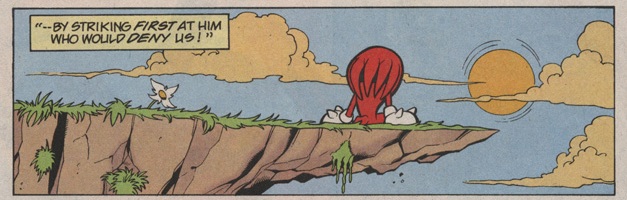
What makes issue 7 most compelling is that it finds the story’s emotional core quickly. Julie-Su finds Knuckles dangling his legs off the edge of the island, contemplating his newfound family. He’s annoyed that his dad and horde of various grandparents have kept so much for him, forcing him on an invisible path of destiny. Julie-Su does her best to relate while sharing her own angst: As a former Dark Legionnaire, the citizens of Echidnaopolis have rejected her. It’s a touching moment, showing the two teens relating to each other’s personal sadness. When Julie-Su says she’s looking for her family’s old home, Knuckles snaps into problem solving mode. Aww, see, they do care about each other!
These pages are certainly better then the two pages devoted to Lara-Le and Wynmacher, which basically rehashes her scenes from the last story. Lara-le continues to bemoan how the Guardian’s path forced her apart from her son. Wynmacher’s attempt to comfort her, which boils down to him saying “That’s what you signed up for when you married Locke!,” could’ve been better handled.
The book is actually invested enough in its characters and the environment that the plot seemingly takes a backseat. Enerjak has returned, you guys. Seemingly drawn back to Mobius from his satellite prison by a shadowed Mammoth Mogul, the immortal echidna immediately meets up with the Dark Legion. That makes sense, as the organization was founded upon Dimitri’s memory. What makes more sense is how Enerjak immediately goes about handing his enemy. After being bested twice by them, he firstly uses his god-like powers to scoop up Archimedes and Dio. Later, he disappears the Chaotix. During his last appearance, Enerjak constantly boasts about his abilities while repeatedly underestimating his enemy. At least this time, he’s preparing a little. It certainly makes him seem like a better villain.
I’m still not a fan of the Chaotix once again being reduced to the part of captured friends-in-distress. Considering the team was totally sidelined in the previous story arc, I’m hoping they’ll play a bigger role in this one. It’ll probably spin out of control like all of Penders’ stories seem to do but “Dark Vengeance” is already off to a better start. [7/10]
Labels:
julie-su,
ken penders,
knuckles,
knuckles on-going,
manny galan,
the chaotix
Monday, August 1, 2016
Sonic the Hedgehog: Issue 53
Publication Date: September 1997
The Saturday morning cartoon show that spawned Archie’s “Sonic the Hedgehog” comic book ended on a cliffhanger. Robotnik was defeated by his own doomsday device being turned against him, similar to how the “Endgame” arc played out. The last image of the series was a pair of ominous eyes looking from the shadows on Robotnik’s fallen empire. The late head writer Ben Hurst was very open about who those eyes belonged too. Ixis Naugus was a traitorous sorcerer, somehow associated with the former Court of Acorn, that appeared in one episode, “The Void.” Hurst’s plan was that Naugus would be the primary villain of the unmade third season, Robotnik taking a backseat role. Despite the series ending, the comic book decided to loosely adapt these plans for its post-Robotnik story arc.
Issue 53 is evenly broke between the kind of low-key drama that made up the “Brave New World” one shot and all sorts of action-packed chaos. The book begins with “Unfinished Business,” its back story appearing first. It’s a small story, about Sally’s reconstruction of Mobotropolis being interrupted by Knuckles and Julie-Su dropping in for a quick visit. Plot wise, this story exists to pick up the abandoned plot line of King Acorn’s sword. Sally discovers that the sword Knuckles retrieved is a fake, Mammoth Mogul switching out the real deal with a copy. Sally asks if Knuckles can take on that quest again but he makes it clear that he’s got a solo series of his own now and doesn’t have time.
However, this short story serves another purpose. Penders continues to establish the post-Robotnik world. Sally makes it clear during her chat with Knuckles that there’s still more work then they can manage left to be done. It also introduces Sally to Julie-Su, Knuckles’ newest love interest. If Knuckles/Sally shippers existed, this story buries that one. Knuckles also points out that he has a family for the first time, a mom suddenly in his life. Sally points out that Sonic is facing a similar dilemma. Instead of busting each other heads, Knuckles and Sonic talk as friends. Wow, that’s kind of nice! Also kind of nice is when Jules appears, calling Sonic “Maurice.” Yep, our hedgehog hero has an embarrassing first name. (Maurice is still a lot better then Ogilvy, which is what Ken wanted Sonic’s birth name to be initially.) It’s another cute, humanizing moments. With Art Mawhinney’s fabulous pencils, which even manages to make Jules’ design appealing, “Unfinished Business” is a cute, touching tale.
It’s a shame that “Sound of Silence,” the cover story, couldn’t match that. After Sonic and Sally have a heart-to-heart about her new responsibilities, an explosion breaks out in the former location of Robotnik’s lab. Rotor’s attempt to study the Zone of Silence has freed Ixis Naugus, along with his lackeys, Kudos and Uma Arachnis. There’s several big fights, a talk with the King that clarifies some dangling plot points, and a confusing conclusion.
Karl Bollers is still getting his legs as a “Sonic” writer. Bollers got his start with Marvel and has a more traditionally comic book-y style to his writing. This includes some dramatic narration boxes and some occasionally very silly dialogue. However, Boller is capable of creating powerful emotional moments. The conversation Sonic and Sally have at the beginning is nice, the young girl starting to crack under all her new responsibilities. Sonic makes it clear to Sally that he’ll be there for here. It’s a nice moment, showing that these characters are still young but depend on each other a lot.
Unfortunately, Naugus’ entrance shifts the story. There’s a lot of chaotic action, Sonic and friends zipping around, fighting the wizard and his henchmen. The story ends in an especially confusing way. Naugus can turn stuff to crystal with his wand. Sure. Sonic somehow deduces that this ability only works on inanimate objects. When Sonic gets blasted, only his gloves and shoes become crystal. I’m not sure how he figures this out. Furthermore, this doesn’t explain how, just a page earlier, Naugus transformed Kudos and Arachnis into crystal. Apparently, they’re meant to be Naugus’ pawns but the wording is still confusion. Sonic apparently smashes Naugus’ staff and the wizard skedaddles.
Maybe some of the confusion is Sam Maxwell’s fault. I’ve defended Maxwell’s artwork before. It’s stylish and energetic. He’s especially gifted at action scenes, providing a chaotic energy to the sequences that really make them pop. However, Maxwell is uneven. His work in issue 51 wasn’t so hot, as Sonic’s head frequently looked weird. Sonic looks fine this time. The hedgehog’s scenes with the Princess early on are actually pretty good. However, Maxwell’s handling of the later action scenes can be difficult to follow. The indistinct script and the abstract artwork makes issue 53 one of the harder “Sonic” comics to follow.
Bollers is tossing his own mythology into the mix. In the Zone of Silence, Naugus gave King Acorn the ability to turn into crystal in order to survive the zone’s harsh conditions. While in the Zone, he could willingly shift between organic and crystal. After stepping outside, he’s lost the ability to control the changes. Okay, sure, why not? Kudos is threatening looking and Uma Arachnis is a spider ninja, an irresistible combination. Still, Bollers’ writing eventually unwinds. Issue 53 starts out promisingly but ends in chaos. Oh well. [5/10]
Subscribe to:
Posts (Atom)