Showing posts with label aleah baker. Show all posts

Monday, September 2, 2019

Sonic Universe: Issue 93


Sonic Universe: Issue 93
Publication Date: December 2016

We are getting dangerously close to the end here, guys. After today, there’s exactly one issue each of Archie’s main “Sonic” book and “Sonic Universe.” And it is sort of interesting that “Sonic Universe” is ending things on a more low-key arc. Instead of the fate of Angel Island or grand struggles between heroes and villains, we’ve gotten a largely comedic and character-based story focused on developing an established ensemble and a newly introduced group. Of course, I’m sure if Flynn and co. knew this was the end, they would have planned things differently.


“The Case of the Pirate Princess, Part 3: Strangers on a Ship” continues the incredibly vague and poorly thought-out Hitchcock references in the subtitle. No, Vector does not make an agreement with a total stranger to murder someone. What the plot does involve are the Chaotix trying to formulate a plan to get themselves, Echo, and Princess Undina off Shellbrraker’s boat. The crew soon arrives at the island they are seeking. Soon, Shellbreaker and Undina come across ancient ruins warning a great weapon is hidden on the island. Shellbreaker can’t wait to seize this but everyone else is increasingly nervous.

Aleah Baker’s work continues to be character based. “Strangers on a Ship” is another issue with pretty much no action sequence. Instead, this is an issue all about the interplay between the cast. Razor and Blade’s relationship remains a large focus of the script. While on the island, Blade expresses a disinterest in treasure hunting and a preference for raids. This escalates into an argument with Razor, his sister showing how her childhood wounds have made her resentful of the world. It’s juicy stuff and probably could’ve evolved into something really interesting. Unless these problems are resolved and Razor started some healing, Blade might’ve headed down a path of greater villainy. Sure would’ve been nice to see that play out.


What really struck me about this issue was the development done on the pirates. Aside from his tendency to slip otter puns into his dialogue, we hadn’t learned much about Captain Shellbreaker. (We see him drink from a “Good Morning, Beautiful” mug here, which is pretty funny.) Here, he emerges as a charismatic leader who can rile up his crew... That also has a dark side, a thirst for power the veers towards the tyrannical. We also see more of Opal, who has a breezy sexiness that makes her immediately my type. Bratty goth girls are my weakness and, yes, she sounds like Tara Strong’s Raven in my head.

However, it might be said that Baker is a little too focused on banter. There’s a page devoted to Opal, Blade, and Charmy arguing about what flavor of porridge to have for breakfast. (Much to the confusion of resident stoner, Dive, who is doing the actual cooking.) It’s a funny moment but it feels extraneous. The same can be said of a page devoted to Undina recognizing Espio, from his humiliating defeat by Bean during Breezy’s tournament. I get what Aleah and Ian were going for but, when a comedy scene goes on so long you forget what the plot of the comic actually is, maybe things have gone a bit too far.


The focus is so much on Shellbreaker and his crew that the Chaotix themselves fade a little into the background. Vector is making up the plan as he goes along, causing the reader to get a little lost on what his objective actually is. Echo only appears in one scene, where she tells Espio how hurt she is by this turn of events before he tells her that it’s all part of the plan. Espio largely plays the part of comedic straight man, though he seems to have something sort of going on with Undina, which is kind of cute. Charmy, as Charmy too often has been since the reboot, is reduced to just shouting goofy and childish shit.

Of course, the pirates being largely delightful becomes disappointing in retrospect, what with this being the penultimate issue of the entire series. At least we actually got to know them a little. The issue also sets up ideas clearly meant to be explored at another time that were left hanging due to the “Sonic” line’s cancellation. The mysterious ruins the pirates find on the island are merely one of many such relics. Clearly, Flynn was hinting at another lost society full of lingering magic, perhaps connected to Naugus and the trolls.


I can’t blame the writers for this, as nobody clearly anticipated the series’ abrupt death. While still a fun and interesting read, “The Case of the Pirate Princess” lags a little in its third installment, Baker and Flynn a little too in love with their batch of quirky adventurers. Still, it’s way more memorable than half of the shit that happened during the Shattered World Crisis. [6/10]

Wednesday, August 28, 2019

Sonic Universe: Issue 92


Sonic Universe: Issue 92
Publication Date: November 2016

“The Case of the Pirate Princess” seems to be mixing its references some. As with the last issue, this one opens with Vector imagining himself as a cool, film noir detective embroiled in an exciting, sexy adventure. Which is actually a pretty funny idea, as it draws attention to how different Vector’s idea of himself and what he’s actually like are. Instead of running with that and making the entire arc a film noir parody, the rest of this comic book is about pirates, a totally separate genre of pulp adventure literature. It’s not a big problem or anything but I’m just sayin’, it’s a weird mixture.


Picking up where we left off, the Chaotix, Echo, and Razor are abducted into the ship of a fiendish pirate named Captain Shellbreaker. In order to avoid being stabbed to death, Vector talks Espio and Charmy into joining this band of merry pirates. Princess Undina is among their ranks but totally willingly. She was bored with royal life and her polyglot abilities were useful to the pirates. Echo ends up being taken captive though. As the Chaotix plot out how they are going to get out of this pickle and complete their assignment, Razor has more personal matters on his mind.

This issue is officially the work of both Flynn and Aleah Baker but it’s pretty clear who was captaining this particular ship, as it were. The inelegantly subtitled “The Princess Was Shanghaied!” is an issue with almost no action beats in it at all. Save for a brief scuffle between the Chaotix and the pirates when they are first brought aboard, there’s no fighting in this particular comic book. Instead, this is an issue devoted entirely to character interaction. And, holy cow, it actually works really well! Flynn isn’t incapable of doing this stuff well but, without Baker’s guiding hand, I’m betting there’d be more fighting and less hanging out.


Baker knows that letting the cast bounce off each other is compelling enough. Seeing Vector try to think his way out of this pickle, instead of just punching his way out, is pretty interesting. I know brains isn’t Vector’s strong suit but he cares enough about his friends to want a peaceful situation to this conflict. Espio’s reaction to being forced to be a pirate, which he has some sort of grudge against, is funny. Princess Undina is quickly established as a flighty teenager most concerned with having fun. (Peppering her dialogue with “likes” is a nice touch.) This seriously confuses Echo, who believes more in duty and honor. She doesn’t quite know how to process the person she’s been trying to rescue not wanting to be rescued.

The juiciest interpersonal conflict in this issue is between Razor and Blade, his — bum-bum-BAH-bum!!! — sister. See, Razor and his sister grew up among these pirates. When Razor got tired of stealing for a living — a particular incident where medicine was withheld from the sick until they paid up is mentioned, so Razor supports free healthcare — he abandoned his pirating family. It’s a betrayal Blade still hasn’t forgiven him for. Considering Meropolis hasn’t exactly greeted him with open hands (fins?), Razor clearly wonders if he made the right decision. The two sharks don’t settle this disagreement with their fists because they ultimately still love each other. Their issue is more complex than hitting can resolve. Again, this is clearly the work of Baker and her broken siblings fixation.


Most surprising about this issue is how immediately endearing Shellbreaker’s crew are. Throughout the Shattered World Crisis, a ton of new characters were introduced and, let’s face it, not all of them were that interesting. If “Eggman’s Dozen” was any indication, team settings bring out the best in Flynn’s character development skills. (Again, assuming we can’t give his wife all the credit...) Opal, the sexy and slightly gothy jellyfish lady, immediately strikes up a friendship with the child-like Charmy, which is a nice change-of-pace from what you expect from gothy characters. Mr. Bristles may be a large, intimidating yeti crab but he clearly has a softer side, as he’s a parental figure to Razor and Blade.

The captain himself and Dive the Lemming are clearly the least interesting of this lot. Shellbreaker cracks some otter jokes and acts with the finesse you’d expect of a pirate captain. Dive, meanwhile, is a space cadet with a weird fixation on the ocean. Still, I’m immediately interested in all these guys and want to know more about them, which is really the best reaction to new characters you can hope for.


Flynn is still laying the bricks for future stories he’ll never get to tell. We quickly learn that Abyss, Eggman’s treasure-hoarding giant squid sub-boss, was also a former member of Shellbreaker’s crew. In fact, apparently a lot of the pirates jumped ship to the Eggman Empire, suggesting some enmity exists between the two factions that would’ve been grist for a future story. A flashback also introduces a mysterious former member of the crew — judging from their silhouette, possibly a female lionfish — that we presumably would’ve learned more about at some point. Alas.

While the previous part of this story was good, it’s humor was its main attribute, by emphasizing the various strengths of the cast, part two of “The Case of the Pirate Princess” is a considerable improvement over the first. Ya know, it’s a bummer this comic is about to be canceled. It’s already apparent that being free of the Shattered World Crisis is a huge boost to its creative staff. [8/10]

Wednesday, August 21, 2019

Sonic Universe: Issue 91


Sonic Universe: Issue 91
Publication Date: October 2016

In the past, I’ve bitched about how much I disliked the changes Sega made to the Chaotix in “Sonic Heroes” without really expounding on why they bug me. Since we are coming up in the end of the comic, and the last “Sonic Universe” arc starred the Chaotix, now seems like a good time to discuss this. Like the majority of people, I didn’t own a Sega 32X and didn’t play “Knuckles’ Chaotix” until years later. In my brain, the Chaotix always included Mighty and were always Knuckles’ supporting cast. So cutting the team down to a trio, and casting Mighty into the void, felt intrinsically wrong to me.

It didn’t help that the re-characterization of the remaining Chaotix were so half-asses. Archie’s Chaotix were never that well defined. However, Sega reduced each one to childish, ridiculously simplistic archetypes. Espio was now a broad ninja stereotype. Charmy was now an annoying little child. (His comic counterpart was married by this point.) Vector was now the team’s buffoonish leader and they were acting as detectives... Goofy, cartoon version of detectives anyway. Not a lot of thought was put into these changes and that was obvious to me, even as a teenager playing “Sonic Heroes.”


The change reduced characters I was fond of to highly marketable concepts that they had next-to-no relation to previously. Worst yet, the team was frequently treated as no more than comic relief. Making the team detectives also became a lazy way for the writers to involve them in the plots of various games and cartoons. Since this iteration of the Chaotix was how most fans got introduced to them, the comic eventually had to adapt to this change. The comic still largely favored the Chaotix’s status as Knuckles’ oldest friends, usually, but started to play up the detective element more and more. (And incorporated all the personality changes over time.)  After the reboot, this became the standard mode for the Chaotix. And, yes, it still bugs me.

And now that my opening rant is done, we can get down to the business of reviewing issue 91 of “Sonic Universe.” The-Chaotix-as-Private-Detectives concept is very much a part of “The Case of the Pirate Princess: Part One — Dial C for Chaotix.” (Why pick that subtitle? Is Vector going to blackmail somebody into murdering his adulterous wife?) Lt. Echo, the previously introduced dolphin member of Meropolis’ army, steps into Vector’s office. Apparently, Meropolis’ princess, Undina, was kidnapped by pirates some time ago. Yet no one appeared to claim the ransom money. Though Echo has followed a trail of clues, she now needs help. Eager for the paycheck, Vector immediately jumps at the offer. The Chaotix are soon underwater, meeting up with Razor the Shark along the way, but Princess Undina and her pirate “captors” find them first instead.


“Dial C for Chaotix” is characterized by a largely comedic tone. While the Chaotix’ are operating in the comic relief mode I usually dislike, Ian Flynn and Aleah Baker present a series of fairly funny gags. The issue opens with Vector attempting, and failing, to do some film noir style narration. Vector is aghast at the flyer that brought Echo to their office, as Charmy drew it in crayon. Upon finding the dock worker that seemingly knows something about the pirates, Vector intimidates him... With evidence that implements the shipper in insurance fraud. He immediately cracks and spills his guts at length, a solid chuckler of a sequence. My favorite joke in the comic is its most surreal. Echo has been traveling the world in a car on-loan from Meropolis’ tourism department. Yes, I said the “world,” as the vehicle is amphibious. The car maintains its humble, Volkswagen-like appearance even while underwater, a likably absurd sight. I even like the shout-out to the ancient “pirates vs. ninjas” meme. Flynn did decent comedic work on “Sonic Boom” but I’m giving Baker credit for these jokes, as the last time Flynn wrote the Chaotix, it was pretty miserable.

The humor goes a long way towards selling an issue that’s otherwise devoted to brass-tack plot construction and exposition. When Echo enters the Chaotix’ office, she has to explain her journey thus far. This triggers a lengthy series of flashbacks, Vector increasingly annoyed by how much research the dolphin has already done. After the group rather literally bumps into Razor, the shark also delivers a long flashback. (Which further hints at Razor’s crush on Coral, which remains adorable.) While delivering all this story in such a direct manner is distracting, covering it up with some funny jokes makes it all go down a lot easier.


“The Case of the Pirate Princess” is also the first (and second-to-last) post-Shattered World Crisis story in the reboot. This allows the comic to actually build on the groundwork Flynn has been laying for the last three years. Sharp-eyed readers will recognize Princess Undina, as she’s had several background cameos in the past. Echo herself is a minor player now being upgraded to starring status. Over the course of her flashback, Honey and Rouge put in appearances. When Razor shows up in the book’s back half, it’s only natural. After taking so long to painstakingly set up all his toys, it’s good to know Flynn actually intended to use them.

And what of Echo? We didn’t get much of a peek at her personality during her previous, brief appearance. Here, she emerges as a young woman that is determined to do a good job, to be perceived as a serious professional, but struggles with her self-confidence and lack of real world experience. At the same time, she’s more resourceful than she realizes, which is apparent in how she has already done lots of investigating by the time she comes to Vector. She’s cute. I like her. Another quality Aleah Baker created female cast member.


The end may be neigh but “Sonic Universe” at least seems determined to get out of the Shattered World Crisis’ shadow as quickly as possible. (I don’t think the world recently being restored is mentioned at all in this issue.) The issue ends on an intriguing high note, the Chaotix and friends being scooped up by the pirates they are searching for. The kind of ending that makes you eager to pick up next month’s installment. This is an amusing comic book and I enjoyed reading it. [7/10]

Wednesday, July 10, 2019

Sonic Universe: Issue 83


Sonic Universe: Issue 83
Publication Date: March 2016

When I first started reviewing “Sonic Universe,” my memories of the series certainly overvalued its quality. I recalled “Universe” being a light in the Archie Sonic books even when the main line was lacking. The truth is, “Universe” was an incredibly uneven publication. Its highs were very high but its lows were pretty damn low, especially right after the reboot started. “Sonic Universe” would start to find its footing again with “Spark of Life” and the series’ last year featured two story lines I’m especially fond of. In fact, “Eggman’s Dozen” might be my favorite story out of everything in the reboot.


A couple of stories recently have ended with Eggman summoning some of his generals for a previously undisclosed mission. Part one of “Eggman’s Dozen,” “Hostile Takeover,” provides the reason for that. Eggman and Metal Sonic arrive at Eggmanland, his amusement park/power refinery, only to see it encased in magic crystals. He immediately realizes the Naugus siblings – Wally and Wendy – must be responsible. Empowered by some Master Emerald shards, Naugus quickly takes out Metal Sonic. Robotnik realizes he needs a team of organic henchmen if he hopes to retake Eggmanland.

“Hostile Takeover” is basically a comedy issue about Eggman being increasingly flummoxed by the events happening around him. He’s annoyed to see his masterpiece covered in crystals. He bitches under his breath about Snively. When the Witchcarters – Wendy’s trio of enforcers – show up with impressive new abilities, he’s comically baffled. By the time Naugus is ruining his inventions, he’s graduated to a full-blown temper tantrum. Eggman is usually pretty cocksure so there’s definitely value in seeing him undermined and unprepared. If he can be caught off-guard or even slightly childish, it makes for a more rounded, compelling villain.


Though we got a brief look at him at the reboot’s beginning, this issue is truly our reintroduction to Naugus. Since most of his backstory was from previous writers, Flynn had to largely rework the character. Now he’s a rat-tailed troll, instead of a bat/rhino/lobster. He’s been given the humiliating first name of Wally, because Bollers invented the Order of Ixis and to give him alliteration with his new sister, Wendy. She’s based off Witchcart, the villain from obscure handheld title, “Tails’ Skypatrol.” (I guess she was different enough to skirt Sega’s “game characters can’t have blood relatives” policy. Or even Sega forgot she existed.) The video game Witchcart was a stereotypical, cackling witch in a minecart. The only personality Flynn adds to her thus far is mocking her brother and being sexually attracted to Eggman. Eww.

Witchcart brings with her a trio of henches. While the witch herself is loosely defined, Flynn slots her servants into easily understood archetypes. Bearenger is the big aggressive bruiser type, who has to be reigned in by his bosses. Carrotia reclines seductively and fires her magic fireballs as if she’s blowing kisses, putting her in the same area of Rogue as a vampy female. Fuck-Wad Focke-Wulf Falke-Wulf is yet another Flynn villain who is manic, prone to giggling to himself and goofy verbal tics, joining the ranks of Bean and Flying Frog. While their designs are a little less cartoonish than their game versions, and their flying crafts have been traded out for extreme gear hover boards, I do have to commend Flynn for digging into the more obscure corners of the games to fill out the reboot’s cast.


As much fun as this is, the first part of “Eggman's Dozen” is ultimately an act of extended set-up. The comic ends by collecting together what will be the principal players for the rest of the arc. Most of these faces are familiar. Tundra, Axel, Thunderbolt, Lord Hood, Clove, and Nephthys are all summoned. Some of these characters are even lingering cast members from before the reboot, like the Battle Kukku and Conquering Storm. There's also our first glimpse at the rebooted version of Akhlut, now a bipedal Mobian, instead of a proper orca. (A change I have issue with and will talk about more soon enough.) There's also totally new characters here, a plucky squid named Abyss and a mysterious thylacine named Maw. There's even some humor in these moments, as Eggman gets increasingly tired from having to repeat the same information to each new recruit, most of whom respond with bemusement and confusion.

It's an amusing issue overall but Tracy Yardley's artwork is a little off. His character seem just a little too loose at times, everyone's outlines bending in overly cartoonish ways. The Witchcarters seem to get it the worst, somewhat generic designs only looking more unimpressive when paired with Yardley's underwhelming pencils. The actions scenes are a little too rubbery as well. Now, once again, I'm not saying it's a bad looking book. Yardley's work is always solid. But you can tell he was either rushed or phoning it in a little with this one.


Still, “Eggman's Dozen” is off to a fun start. An issue that's fifty percent set-up probably shouldn't be this amusing but Flynn throws in lots of colorful characters and decent comic relief. That gets a plus from me. [7/10]

Monday, July 8, 2019

Sonic the Hedgehog: Issue 279


Sonic the Hedgehog: Issue 279
Publication Date: March 2016

With issues 278 and 279, the cover artists for Archie’s “Sonic” book was doing something clever. The two covers compliment each other. They show nearly identical images, except the first has Sonic in his natural state in the center. The second still has Sonic in the center but now he’s in his Werehog form. The surrounding faces in the background are different but are still contained in the puzzle pieces that make up the Shattered World. Matching covers was a clever idea... That was somewhat undermined by the books coming out three months apart, due to the mysterious delays at the start of 2016. In that time, it was easy to forget what issue 278’s cover looked like.


Luckily, the book begins with a reminder of the previous issue’s events, in case you forgot. Werehogged Sonic, Antoine, and Big, accompanied by the local Freedom Fighters team, have sneaked into the desert Gaia Temple. They are here to rescue Ehsan, a scholar who has the next Gaia Key. Upon arriving, they are ambushed by Badniks and the Egg Army, led by Nephthys the Vulture. Since it’s night, a group of Dark Gaia Monsters are also attacking. Out of this chaos, the Freedom Fighters still manage to escape with Ehsan. They leave with the Gaia Key, totally unaware of the secret the Desert Raiders are keeping from them.

As with the last issue, this is largely a fairly mediocre action story focused on grabbing the latest magical MacGuffin. Despite being ambushed by two separate groups of enemies, our heroes don’t struggle much. Big is freaked out by a monster and Antoine is startled by a Flamer but both quickly dispatch these enemies. Later on, Spike makes short work of another Dark Gaia Monster. Sonic tangos with Nephthys but is never in any real danger. You don’t really feel like the good guys earn this victory. Flynn throws in one or two cute character moments - Chip being scared, Big quickly recovering from a shock - but not much else defines this story.


She briefly appeared in the last issue but this is the true introduction to Nephthys the Vulture, a colorful Egg Boss based off the gold-crested Egyptian Vulture with a needlessly difficult to spell name. While she never attracted the following of some of the post-rebot Egg Bosses, Nephthys was fairly well received. (Most likely due to her design, which is admittedly very spiffy.) She is characterized here by the philosophical debate she has with Sonic while fighting him. The vulture believes that fighting Robotnik's reign will only lead to more death and destruction. Sonic believes that injustice must be fought everywhere. The final panel certainly suggest that she has her own reasons for believing in these things. This certainly gives her more personality than some of the other recent introductions.

The most distinguishing thing about this particular story is how it ends. After rescuing Ehsen, the Freedom Fighters leave with the Gaia Key. The Desert Raiders go off on their own ways, returning home... And reporting back to Nephthys. The enthusiastic band of Freedom Fighters are, apparently, double agents. This is an intriguing turn of events! Sadly, Flynn would never get a chance to expand on the Desert Raiders' motivations or whether their fandom of the O.G. Freedom Fighters is genuine. The most interesting plot development Flynn has introduced in a while and it would end up going to waste.


In the back pages, Aleah Baker wraps up her “Hidden Costs” story line. Cassea and some goons has Bunnie nailed down but the rabbot soon escapes, grabbing the emerald. She soon meets up with Sally, the two discussing the things they've learned about their enemies today. Immediately afterwards, while Cassea is recovering from her injuries, Clove learns just how big of a scumbag Dr. Eggman is.

Baker brings her mini-epic about understanding your enemy to a close here. Through their interactions, a mutual respect has formed between the two factions. Cassea lets Bunnie fly away at the end, even though she has the Chaos Emerald. Later, Sally and Bunnie discuss how they realize not everyone working for Eggman is bad. How they are simply good people in a bad situation. This level of nuance and gray morality is really appreciated, especially in the reboot, which has sometimes felt a little thin as far as heart goes. Everyone being a little more complex certainly makes for a more interesting comic book.


To this already appealing mixture, Baker adds a total emotional gut punch of an ending. We learn that whatever the malady affecting Cassea is, Eggman's cybernetics hasn't completely cured it. She'll need on-going check-ups and modifications if she's going to live. So Eggman has got Clove on the hook, the deer willing to do anything for him just so he'll keep her sister alive. This climaxes with the heartbreaking final panel, showing Clove hugging a hopeful Cassea, who doesn't know the true details of her situation. Shit, man, it just got dusty in here.

Helping tell this emotional story is Evan Stanley's artwork. Stanley proves especially good with facial expression here. The close-ups on Clove or Bunnie's faces helps keep the story's emotional heart in clear view. That final page works as well as it does largely because of Stanley's pencils. Adam Bryce Thomas continues to draw the cover story. This also plays to Thomas' strengths, as the actions scenes are energetic and dynamic. Take a look at the panels where Antoine swats away the Badnik or Spike successfully gets the jump on a Dark Gaia Monster.


Once again, for what feels like the twentieth time since the reboot started, I'm finding myself preferring the back story significantly to the cover story. Just like with its first part, I'll be splitting the rating again. The last part of “Hidden Costs” is the best of the three, Aleah Baker crafting an effectively emotional conclusion. It gets a [9/10.] The cover story I can not recommended as highly, as most of the interesting things about it are what it sets up, things that happen off-panel. It gets a [5/10.] Never say I wasn't consistent.

Friday, June 28, 2019

Sonic the Hedgehog: Issue 278


Sonic the Hedgehog: Issue 278
Publication Date: November 2015

Issue 278 would be the last issue of Archie’s regular “Sonic” series published in 2015. That wasn’t planned. I know I’ve referenced the mysterious delay of the “Sonic” books that happened at the end of that year. After this, the main “Sonic” wouldn’t resume publication until March of 2016. “Sonic Universe” would take off November, December, and February. Archie’s official explanation for this involves them moving to new printing facilities. Yet knowing the quagmire of bullshit that followed in the next year, climaxing with all “Sonic” titles ceasing permanently, it’s hard to take Archie at their word. I guess what I’m saying is this is truly the beginning of the end.


But it’s not like anybody actually working on the book knew that, because Archie tells its freelancers nothing. So business otherwise continues as normal. “Face of the Enemy Part One: Friends in Need” begins with Sonic, Antoine, Big and Chip arriving in Shamar, a region of Sonic’s world obviously inspired by the Middle East. They are immediately attacked by the local Egg Army. Luckily, the local chapter of Freedom Fighters - Spike the Porcupine, Sonar the Fennic, and Trevor Burrows the Mole - arrive to help. Later, the united teams decide to sneak into a local base, which Sonic suspects of being a Gaia Temple. An ambush awaits them.

I continue to feel a great sense of disconnection with the comic’s ongoing plot during this point in its history. I’ll admit, as of this writing, I’m picking up the book after taking a month off. In that time, I’ve managed to forget any and all pertinent information regarding the Gaia Temples, Gaia Keys, Chaos Emeralds, and how they all fit together to fix the world. At this point, Ian Flynn feels like he’s going through the motions as well. This is a passionless narrative, involving heroes following MacGuffins from one location to the next. About the only interesting thing in this story is the scenes of them sneaking into the temple at the end, which are mildly fun.


It’s a total wash from a narrative perspective. However, we do get some small character moments that make this issue somewhat interesting. Upon seeing that the local Freedom Fighters - who are named the Desert Raiders, the Sonic News Network tells me - have patterned themselves after him, Sonic’s ego swells. While sneaking into the temple, Antoine has to reassure himself that he’s conquered his fear of the dark. Though intended as comic relief, that moment also shows that Antoine still isn’t quite the hero he imagines himself to be. Big even gets one or two funny moments, repeatedly spoiling Antoine’s fun by bluntly explaining their mission.

So what of those Desert Raiders? Like I said, they fashion themselves after the Knothole crew. Spike is a dead ringer for Sonic, Sonar resembles Sally, and Trevor looks a little like Rotor. If Flynn was a smarter, more subversive writer, I would assume this was a jab at O.C.s and recolors. Since he’s not, the Desert Raiders’ imitative fandom of Sonic and friends characterizes them as enthusiastic youngsters eager to fight. Upcoming reveals would show that Flynn clearly had more plans for these guys but the book’s cancellation would prevent them from coming to fruition. So, as they exist now, the Desert Raiders are peppy Freddom Fighters with a secret and not much else.


In the back pages, Aleah Baker continues to tell more compelling stories. Her “Hidden Costs” story continues into its second part. Bunnie and Cassia continue their fight over the Chaos Emerald above the mysterious temple. They eventually clatter through the stone roof, Cassia twisting her ankle in the process. Bunnie takes pity on the other cyborg and carries her through the temple. Meanwhile, Sally and Clove face each other. Instead of fighting, they have a tense conversation.

Baker’s priorities as a writer remains heartfelt. “Hidden Costs” would’ve been a senseless fight story in lesser hands. Instead, Baker makes this a story about empathy. Bunnie immediately resents Cassia, assuming the deer willingly gave up her wholly organic body. After their fight is paused, Cassia explains that her mechanical parts were actually replacing broken limbs, dying eyes and ears. The two discuss their differences and similarities, eventually forming a truce. Sally and Clove’s talk has a similar effect. Clove explains that further fighting will just lead to more misery for her people, something Sally also wants to avoid. It’s a story about understanding and character development, which was sorely needed after the weaker cover story.


Artwork wise, 2015 ends on a high note. Adam Bryce Thomas contributes some highly energetic artwork to the cover story. The action scenes have a kinetic motion to them, the characters stylishly moving around the battle field. His quiet moments are good too. The absolute joy the Desert Raiders feel at meeting their heroes is keenly felt. Any suspense that’s generated in the last scene is the results of Thomas’ detailed, shadowy illustration. Evan Stanley’s work on the back-up is not as consistently strong. The fight between Bunnie and Cassia is a just a little awkward. However, the tense and emotive scenes that follow makes up for that.

Once again, I’m digging Baker’s work much more than her husband’s. While Flynn has the characters on an endless fetch quest, Baker is injecting some heart in their conflicts. So I’m going to have to give this issue a split rating. The cover story gets a [5/10] while the back-up gets a really strong [7/10]. I guess the evens out to a [6/10], which seems to be the only rating I give out anymore.

Monday, June 24, 2019

Sonic the Hedgehog: Issue 277


Sonic the Hedgehog: Issue 277
Publication Date: October 2015

When the reboot happened, the “Sonic” comic lost access to most of its history. However, a few things were still within reach. Once fans realized Flynn could still utilized elements from “AoStH” and “SatAM,” which became clear once Breezie made her debut, they started anticipating the return of certain characters. At least, I did anyway. “SatAM” had history and depth, two elements the new continuity needed more of. So it just became a question of when Flynn would find a place in the reboot for Lupe and Dulcy, if not Griff and Ari. The fan favorite wolf warrior would make her return in issue 277, a fact trumpeted on the cover.


“Thunder, Rain and Lightning” begins with Sonic and Lupe racing across the Lightning Fields Zone, pursued by the flying saucer-like E-118 Tau. After the machine gets fried by a stray lightning bolt, the heroes can converge. The Freedom Fighters have come to this area because Lupe, an old ally, is apparently the guardian of a Gaia Temple. Her Wolf Pack has been fighting Eggman’s forces and switched the locations of the Temples. At the end, Chip stumbles upon the decoy Egg Prison Eggman stuck the blue Chaos Emerald in a while ago.

There’s actually not much to “Thunder, Rain and Lightning.” (There’s no rain in it either, as far as I can tell.) It’s another stop on the road towards healing the Shattered World, the Freedom Fighters in pursuit of more Gaia Temples or Keys or whatever. The story doesn’t even end with them meeting that goal, merely being on the way towards it. Chip discovering the destroyed Egg Prison, the Freedom Fighters splitting into two groups, feels like a muted and stumbling attempt at an ending. There’s a lot of expositionary dialogue too, confirming that this is less a complete story and just a small slice of a larger event.


That’s because this issue isn’t about moving the Shattered World Crisis ahead much. Instead, this is meant to reintroduce readers to Lupe. Though beloved, Lupe has never actually played that big of a role in the Sonic-verse. It’s nice that Flynn not only brought her back but weaved her into the new world’s mythology. A large section of this issue is devoted to a flashback, depicting her first encounter with the Freedom Fighters. Apparently, Robotnik burned her village to the ground early in the war, killing her father. Sally and the gang rescued her and helped her rebuilt, which Lupe is eternally grateful for.

It’s nice for Flynn to build some emotion into Lupe’s new backstory. Honestly, it already feels like we know more about this new version of her than we ever did about the old one. I also wish he had just made that flashback the main plot, instead of shoving it into an underwhelming cover story. (The Wolf Pack is still around but they’re all new characters, as Ken invited the old ones.) Sadly, we wouldn’t see much of her before the book ended. The re-design is pretty good too, ditching the blue leotard for a more Native American-inspired skirt and shawl. Her proportions fit the Sega aesthetic better without sacrificing her immediately identifiable visual aspects.


The action sequences are not the main attraction. The fight with Tau is fairly short, Sonic and Lupe using one of those ring chains from “Knuckles’ Chaotix” to lure it into a lightning storm. I like Tau’s design, by the way. It reminds me of the Martian Warships from George Pal’s “War of the Worlds.” The flashback includes a nest moment where Lupe grabs away Antoine’s sword to slice open a Motobug. I also dig the cuter, smaller versions of the Freedom Fighters we see in these scenes.

As the end of 2015 approaches, it feels like the comic is making an effort to include more back stories. In fact, Aleah Baker's “Hidden Cost, Part 1” is longer than most back stories. It picks up right where the cover story left off. Sally and Bunnie, Nicole in tow as a handheld, go searching for the missing Chaos Emerald. After evading Eggman's parameter measures, they split up. Clove and Cassia are in charge of this area. Clove goes to investigate the irregularity, with Cassia sneaking off behind her back. Soon, Bunnie discovers the Emerald... And Cassia as well, who is itching for a fight.


Like a lot of Aleah Baker's work, “Hidden Cost” is partially about sisterhood. There's the explicit sisterhood of Clove and Cassia. Clove continues to show concern for her sister, who is eager to break free but still inexperienced. Then there's the symbolic sisterhood Sally feels with Bunnie and Nicole, displayed in the handful of cute scenes they have together. The first part of “Hidden Cost” is also built upon some cute interactions. Such as Cassia chastising a random goon, criticizing his video game skills. Or Bunnie and Sally rushing through a security checkpoint, thanks to Nicole's help. Even the concluding fight scene between Bunnie and Cassia seems more relaxed and funny than full-blown and rough.

It's another issue that looks nice too. Adam Bryce Thomas draws the cover story, expanding on the gritty style he displayed last time. The action scenes actually come off as slightly stiff, which is not like Thomas at all, but otherwise his work is pretty good. Sally and Bunnie look really cute in their panels. I like the intensity of the flashbacks. Thomas includes some nice flashy moments, like Sonic being yanked through the air away from Tau's path. Evan Stanley draws the back-up. Her work has expressive faces, conveying both comedy and pathos. Once again, the artwork in the book is of a high standard these days.


The cover story's biggest problem is that it doesn't feel like a complete story. It doesn't even feel like part of a complete story but, rather, a small clip from something larger. Otherwise, it's not too bad, if only because it gives us Lupe back. The back-up is a little more emotionally cognizant, thanks to the scenes with Clove and Cassea. Even then, it's not Aleah Baker's best work, though certainly not bad. I don't know, guys, I like it okay but, ya know, it's another reboot issue. [6/10]

Friday, May 31, 2019

Sonic the Hedgehog: Worlds Unite - Battles: Issue 1


Sonic the Hedgehog: Worlds Unite - Battles: Issue 1
Publication Date: July 2015

The second half of the “Worlds Unite: Battles,” ostensibly focused on the “Sonic” part of the cast, was only published a month after the first. Yet, in terms of story within the crossover, it sure seems like we’ve come a long ways since then. Flynn made sure to leave plenty of empty spaces in the narrative to fit in these mindless fight scenes, sometimes egregiously so. Even, having the “Sonic” half of this fight-centric mini-series come out just as the story is reaching its grimmest point, sure feels trivial. The heroes are about to be crushed by Sigma’s forces! Do we have time for this bullshit right now?


The first story chronicles Sonic’s battle with Zavok, Zeena, and Zor – otherwise known as half of the Deadly Six – that occurred at the start of the crossover, which already feels like it was ages ago. Apparently, the fight was a lot more expansive than we first thought. After the three Zetis fall out of the sky and start wailing on Sonic, the trio are tossed through several portals. They end up in Station Square, where the Zetis threaten the human citizens, before being blasted into a random Eggman junk yard. There, Zavok activates a bunch of old Badniks and quickly overwhelm Sonic.

While the “Mega Man: Battles” one-shot felt like a lively and fun extra, the “Sonic” half of the duo starts off feeling utterly mercenary and lifeless. This is a terrible story. Somebody named Joel Enos writes the script. This was his first and last contribution to Archie’s “Sonic” books. It’s easy to see why. Everybody speaks in catch-phrases. Sonic makes repeated references to his homing attack, which feels deeply unnatural. Most of the Zetis’ dialogue references their own special attack. Save for the emo Zor, who wants everyone to know how bored and listless he is. They throw out hoary lines like “Oh, brother!” or “A heap of trouble!” Sonic’s defeat is humiliating, taken down by the reanimated corpses of Badniks he crushed when he was a child. The final insult is that this story doesn’t connect with the first part of “Worlds Unite.” There, Sonic was abducted from the green field. Here, he’s carried off from the scrap heap.

The artwork is similarly uninspired, breaking the trend of excellent art we’ve seen in this crossover thus far. Tracy Yardley contributes some of the worst pencils I’ve ever seen from him. The characters look weirdly blocky and undefined. The Zetis’ facial expressions are utterly lifeless. The action is routine and lacks energy. Maybe Yardley was just having an off day. Maybe he thought a half-assed script deserved half-assed art. Either way, it’s some truly disappointing work.


Luckily, things perk up quite a bit in the second story. It depicts Sticks and Roll’s fight, which we’ve see several references to. Roll is invited to the training simulation room, even though the letter is addressed to “Red.” Turns out Sticks has sprung an ambush on her, attacking with countless robots, traps, and high explosive. The humble housecleaning robot proves surprisingly adapt, surviving the attacks. Once they’re face-to-face, it becomes apparent that Sticks’ target is not Roll. Rather, the badger is convinced the robot’s broom is some sort of spy. Oh, what a hilarious misunderstanding!

Despite veering dangerously close to overbearingly zany, this story is pretty funny. It keeps up the “Sonic Boom” tradition of breaking the fourth wall, as well as adding “ka-“ to all the sound effects. It doubles down on that joke, as Sticks comments on the onomatopoeia getting her species wrong at one point. Sticks interrupts the opening page, which transforms into an overzealous, pro-wrestling style announcement. It might be too wacky but the conclusion is amusing. Sticks explains her reasoning for thinking the broom is malicious – its bolts look a little like angry eyeballs – and Roll’s decision to humor her is cute.

Artist Ryan Jampole both writes and draws this story. It’s a nice surprise that his script is pretty decent. While I’ve found his illustrations underwhelming in the past, he does a lot better here. While a few of his anime-style facial expressions are kind of weird looking, a few – such as Roll’s look of surprise when the door slams behind her – made me laugh. His action scenes are energetic and fun. There’s even a fairly impressive page, a visual montage of a Roll overcoming Sticks’ machinations. It would seem silly stories like this, which allow for looser character work, fit Jampole’s style more than straight-ahead action stories.


The last story is the most recent, chronologically speaking. It’s set during the battle on the Sky Patrol, after the Deadly Six assumed control of Mega Man and his robot pals. Break Man – who is secretly Mega Man’s brother, Blues – is firing on Knuckles, under no will of his own. Blues suggest Knuckles damages his nuclear core, causing an explosion that will wipe out Sigma’s forces. Knux is deeply disturbed by this kamikaze plot. He encourages Blues to fight the psychic manipulation and they eventually work out a plan: Knuckles beating him into unconsciousness.

Ian Flynn sat out this entire issue, handing this last story to Aleah Baker. Emotion driven plots are Baker’s trademark and she even manages to sneak some of that into an extended fight scene like this. When Break Man explains his suicidal plan to Knux, his slow realization – spreading from child-like confusion to fiery rage – is both funny and touching. See, Knuckles doesn’t give up on anyone. He tells Break Man that he barely knows him but understands what he’s going for, that he can’t give up. Break Man responds with knowing silence, signaling that he agrees. Baker manages to take a fairly hollow story and put some heart and soul onto it.

This story is also the best drawn in this book. Diana Skelly contributes some energetic artwork. The humor and pathos of that page, where Knuckles realizes what Break Man is planning, works just as much because of Skelly’s pencils as Baker’s words. She makes Knuckles’ dopey realization adorable and his fiery rage afterwards palpable. That furious energy continues into the fight scene, Skelly making Knuckles’ punches seem especially passionate. The panel of Knuckles ducking under a big energy blast is funny too.


So we have a real mixed bag here. The first story is atrocious, earning a [4/10] for its awful writing and mediocre artwork. The second story is a lot better, funny and zany with matching artwork. I’d give it a satisfying [7/10]. The last story turns nothing into something, Baker’s writing and Skelly’s artwork elevating what should’ve been a totally disposable extra. It gets a [8/10]. “Mega Man: Battles” was a trifle but an entertaining one. “Sonic: Battles” is extremely uneven but ultimately worth for that last story.

Monday, April 22, 2019

Sonic Universe: Issue 74


Sonic Universe: Issue 74
Publication Date: March 2015

I tend to consider “Spark of Life” solely the work of Aleah Baker. However, we must remember that she was still working from Ian Flynn’s outline. In issue 74 of “Sonic Universe,” I can’t help but wonder if their two styles conflicted a little. The action-packed climax of “Sparks of Life” reads very much like an Ian Flynn story. This ends up not totally meshing with Baker’s more intuitive and emotional writing. The two are still married so they obviously collaborate well in other aspects of life. But, while reading this issue, I found myself wishing that Flynn or Archie, or whoever made the decision, let Baker handle this one totally solo.


Part four of “Spark of Life” picks up with Sally in the digital world, standing in-between Phage and Nicole. Laser swords drawn, the princess does what she can to defend her girlfriend friend. The direct approach doesn’t work and the holo-lynx carries Sally to a safer location. The two devise a plan, to lock Phage out of Ellidy’s system, that might work. Meanwhile, in meatspace, the Dark Gaia monsters and Phage-controlled Badniks continue to close in on Ellidy’s lab. Outside, Tails and Big race to retrieve the Chaos Emerald before the bad guys do.

What ultimately proves most compelling about the last part of “Spark of Life” is seeing Sally and Nicole interacting. After spending most of the last issue separated, the two are together for all of this one. Throughout the story, Sally tells Nicole to flee and Nicole tells Sally to leave. Both times, the two remain by each other. That connection, sisterly or romantic depending on how you read it, is what drives the story. Seeing Sally and Nicole be so willing to protect each other grants “Spark of Life” a strong degree of emotional resonance.


Which is a good thing, as “Spark of Life: Part Four” is a little disappointing on a narrative level. Up to this point, Phage has been depicted as practically unstoppable in the digital world. She can manipulate the environment and overpower Nicole. But apparently the computer virus is not a great strategist. Sally and Nicole out-think the villain without too much effort, eventually locking her out of Ellidy’s system with some simple trickery. In her moment of defeat, Phage starts pathetically crying about how Robotnik will punish her if she fails. This might add some humanity to the villain but she was more effective as a cold, somewhat sadistic adversary. (And it turns out Nicole can hurt Phage. In another Evangelion homage, Nicole pierces Phage’s very Angel-like core with her very Lance of Longinus-style digital spear.)

What makes the conclusion more disappointing is the method Nicole uses to defeat Phage. In their moment of need, Ellidy slams the Red Star Ring into Nicole’s handheld, confirming that subplot’s status as nothing but a power-up. This transforms her into Overclocked Nicole, giving her the strength needed to lock Phage out once and for all. For a story so built around emotional needs, it’s a little disappointing that a plot device and a hastily introduced super form is what saves the day. Even if it is sort of neat to see a non-Sega female get a super transformation.


At the last minute, Baker does try to resolve the story’s emotional threads. Before leaving the island, Sally talks to both Ellidy and Nicole. The doctor admits he was an asshole to Nicole. Nicole explains how she understands that and blames herself a little for Nikki Ellidy’s death. The doctor then tells her to take the Red Star Ring with her, even though it’s the only one he has. It’s a gesture that suggests he accepts the holo-lynx. In a cute final panel, Nicole decides to ride back to Sky Patrol in her hologram form, so she can feel the wind on her face. It’s all very sweet and helps resolve some of my issues with the story’s otherwise brute force conclusion.

This issue is so focused on Sally and Nicole’s adventure online, that it’s easy to forget about what Tails and Big get up to. To Baker and Flynn’s credit, the scenes focused in this duo are pretty good too. Big is still a big dumb idiot but at least his hyper-specific super-fishing powers come in handy. It allows him to retrieve the Emerald from the lake bed just in time. Still, the ever-encroaching threat of killer robots and vicious shadow monsters makes Tails and Big’s quest feel especially time sensitive. The story probably, most definitely, could’ve survived without this subplot but it in no way distracts either. In fact, it’s pretty good.


Ultimately, “Spark of Life” is still the only universally agreed upon classic to emerge from the reboot era. I’ll admit, it’s a pretty good story. However, I found myself wishing the arc fused it’s emotional and narrative needs a little better. Was this a result of Flynn and Baker’s styles clashing? Who’s to say? Either way, despite some flaws, this was still a pretty good issue and a very good story arc all together. [7/10]

Friday, April 12, 2019

Sonic Universe: Issue 73


Sonic Universe: Issue 73
Publication Date: February 2015

By the beginning of 2015, despite my many reservations about it, the post-reboot “Sonic” comics were rolling along. I may think the two stories diverge widely in their quality, but both “Champions” and “Spark of Life” are fan favorites. I might have felt like the overarching plot was barely moving but it was at this point that most Archie Sonic fans became comfortable with the new continuity. But what’s this I see in the corner of “Sonic Universe: Issue 73’s” cover...? “Worlds Unite in 3?” Feels like a threat, doesn’t it? “That’s some nice pacing you’ve got there. It would be a shame if a Megaman crossover happened to it.”


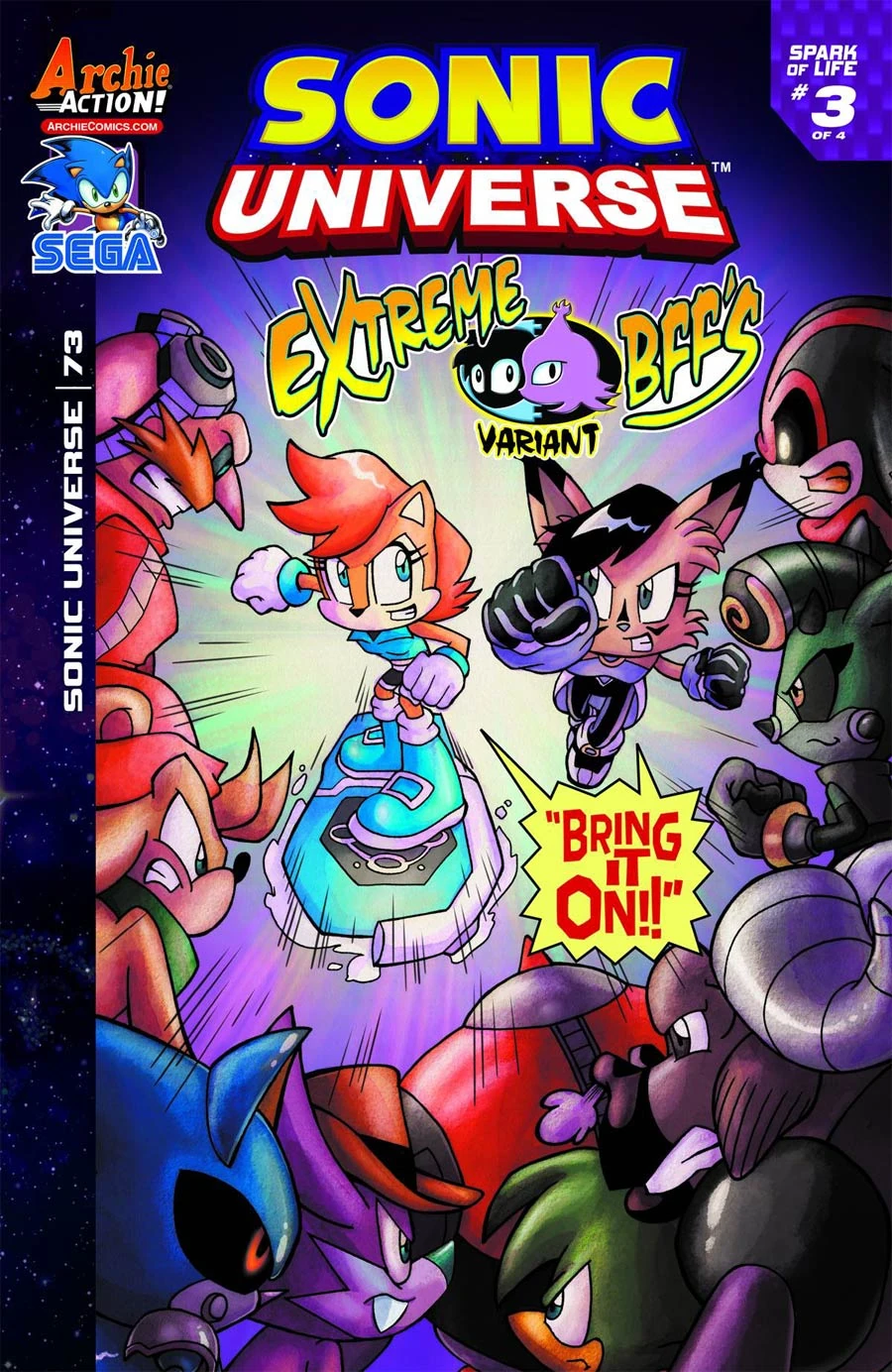
Anywho, “Spark of Life: Part Three” begins by defusing last month’s cliffhanger. Ellidy is angry with Sally because the princess has stumbled upon his shrine to Nikki, his late daughter. Apparently, Nicole began as a way to save the dying Nikki’s personality, which is why the doctor is so unnerved by her. As the argument escalates, Sally realizes the two are being influenced by Dark Gaia energy. They rush into the house before the monsters attack. Meanwhile, in the digital world, Phage reveals herself to Nicole. As the sentient computer virus threatens the A.I., Sally realizes she has to digitize herself if she hopes to save her friend.

Last time, I complained that the pacing was getting a little lackadaisical. Part three corrects that in a very serious way. The third part of “Spark of Life” gives this story two very urgent objectives. The first of which is for our heroes to survive the night, as the Dark Gaia monsters pound in their doors and windows. The second, even more pressing concern is saving Nicole from Phage. This story went from having a vague motivation to rocketing the reader into a very tense situation. Considering this story is all about establishing Sally and Nicole’s relationship, showing how far the Princess will go to save her digital BFF brings both the plot’s emotional and narrative needs together.


Issue 73 also has mysterious new enemy Phage revealing herself to the heroes. Phage isn’t much to write about on a design level, just a shape shifting blob of black pixels wearing an anime cat mask. Her desire to consume other networks and systems, to make herself more powerful, is a standard villain motivation. However, the character still proves to be effectively threatening. She has control over the digital world, putting Nicole in serious danger. Her very detached, analytical approach to everything contrasts nicely with Nicole while also making her actions seem rather sadistic. She’s a villain that works for this story, in other words. My only complaint is how quickly Phage reveals that she was sent by Robotnik. I would’ve preferred it if she was something that arose by itself, some side effect of the digital world’s existence.

I mentioned before that the reader has already figured out what’s going on with Dr. Ellidy and Nicole. However, Aleah Baker still handles the reveal very well. Ellidy was clearly so heartbroken by his daughter’s death that he never really moved on. Furthermore, he blames himself for failing to save her. Nicole doesn’t just physically remind him of his daughter. She also reminds him of that sense of failure. This really comes into focus during his argument with Sally. She points out that she understands that sense of loss, from the days when the King was gone. Ellidy points out that Sally got her father back eventually. Nikki is never coming back. The script makes us understand while Ellidy has acted like such a jerk, making him sympathetic while still clarifying his main flaw: His inability to see Nicole as a person.


Sally and Nicole are separated through most of this issue, not coming face-to-face until the very end. Yet there are two important moments where they communicate. First off, after Nicole is attacked by Phage and the Dark Gaia monsters swarm the house, Nicole sends a frenzied message, telling Sally to prioritize saving the world over saving her. (Oh yeah, there’s a Chaos Emerald on the island too.) That’s an impressive display of the A.I.’s attitude, that the needs of the many etc. Even better is a flashback, where Sally is awoken in the middle of the night by Nicole’s first attempt to create her hologram body. This scene is the first time Flynn would recreate a specific story from the old continuity in the new one, as it’s obviously based on issue 151’s “Stargazing.”  Nicole even says she wants to see the stars. It’s good to know some of the old universe’s heart is still floating around in the new one.

“Sonic Universe: Issue 73” is also the first time the Dark Gaia monsters feel like a threat. In their past appearances, the monsters were easily defeated. It rarely felt like our heroes were actually in danger. Here, the gang is attacked unexpectedly in the middle of the night. Tails and Big are awoken out of a sound sleep and immediately have to leap into panic mode. The creatures slam on the doors, trying to force their way, in a way clearly meant to invoke zombie movies. It totally works. For the first time, the comic actually leans into the reasons why hordes of weird creatures attacking at night is a frightening premise.


Once again, Aleah Baker proves that she’s got some serious chops. Part three of “Spark of Life” is a damn fine comic, nicely balancing narrative tension with the emotional concerns of the characters. Tracy Yardley’s cover and artwork is also pretty good. What isn’t too hot is the variant cover, drawn by Agnes Garbowska. It looks like it was done with colored pencils. Otherwise, this is a really good issue. [8/10]