Showing posts with label sonic comic origins. Show all posts

Friday, July 5, 2019

Sonic Super Digest: Issue 15


Sonic Super Digest: Issue 15
Publication Date: January 2016

From the moment I started talking about them, I’ve bitched about how annoying I found Archie’s decision to slot the Sonic Comic Origins stories into the Sonic Super Digest side series. Providing important information about largely pivotal characters is the sort of thing that definitely should’ve been in the main book. Well, you won’t have to hear me rehash the same complaint again after this. Number 15 is the last issue of the Sonic Super Digest I’ll be reviewing. Two more digests would be published in 2016 but they were comprised entirely of reprinted material. Like every other Archie “Sonic” title, the series would cease publication at the end of the year.


This time, the origin story is for Razor the Shark, the first exclusively post-reboot character to get this treatment. “Castaway” features no blood-smeared volleyballs but does begin with Sonic and Razor surfing, during some downtime in the Shattered World Crisis. The shark soon reveals how he came to reside in Meropis. How he was part of a crew of pirates. How some sort of disagreement led to him being stabbed and tossed overboard. How his unconscious body drifted into Coral’s temple and how she nursed him back to health. In order to repay her kindness, he decided to stay and protect this kind, young girl.

It’s pretty evident why, out of all the post-reboot characters Flynn could have written an origin for, he choose to do Razor at this time. “Castaway,” in several little ways, sets up what would be the very last “Sonic Universe” arc. That band of pirates, and Razor’s personal connection to them, will be expanded on soon enough. Meanwhile, Coral mentions the missing Princess Undina, who will provide the plot motivation for the same upcoming story. (And also had a few background cameos in the previous issues of the main “Sonic” book.) So Flynn didn’t cover Razor’s origins now because of fan demand or because the character really called out for it. It was just another step in this long-running, thought out far in advance story he’s writing here.


But “Castaway” does have some value as a narrative. I like the insight into Razor’s personality it gives us. Though he’s largely been characterized as the kind of stubborn tough guy this franchise has plenty of, he definitely has a soft side. While describing his past with the pirates, he uses misleading words. Either because he’s ashamed of his past or simply afraid people will dislike him if they knew the truth. I also like the expansion we get on his relationship with Coral. How he repaid kindness with kindness, the type of tenderness he obviously didn’t see a lot of before. Sonic picks up the romantic connotations of this, teasing the shark about it. This ends the story on a graceful note, as Razor exits by wondering out loud if Coral could care for him the way he cares for her. The character’s vulnerable side is, by far, his most endearing quality.

Art wise, Adam Bryce Thomas provides some solid pencils. There’s not much action in this story, aside from the early surfing scenes and Razor’s brief scuffle with Captain Striker’s men. Instead, it’s Thomas’s strength for personable characters that makes this a good looking story. The hurt Razor feels over his past and the clear concern he has for Coral are shown primarily through his face, which goes  along way towards establishing the story’s heart. There’s also some nice use of shadow as well, in the panel where Razor debates whether he wants to stay with Coral or not.


As always, this story only takes up the first five pages of the digest. The rest of the book is filled out with reprints. And since this is after the Pendersing, the material is largely drawn from the post-reboot material. Some of the reprints are as recent as “Sonic Universe: Issue 79’s” “The Silver Age: Part One.” We’ve also got “Sonic” 276’s “Cold Hearted,” the back-up story from the same issue, the cover story from “Sonic Boom” #4, and the third part of “Spark of Life.” The only pre-reboot material is the first part of “Babylon Rising,” a story you’ll notice features no Penders’ elements. Otherwise, this digest only offers us some “pin-up art” - textless cover art - and some coloring pages, which look like Sega stock-art.

Up until this point, the “Sonic Comic Origins” stories had provided background info on new versions of old characters. I imagine Flynn or the editors in charge started these stories to sate reader curiosity. Obviously, hardcore fans would want to know about the Freedom Fighters’ pasts in this new continuity. Or learn what’s different with the revamped version of a fan favorite like Snively. Issue 15 could’ve signaled a shift in direction, allowing Flynn to expound on the histories of the new characters he’s introduced without devoting page space in the main book to them. Presumably, Honey the Cat, the various Egg Bosses, Madonna, and Dulcy’s supporting cast would’ve been the subjects of future Sonic Comic Origins. (Along with lingering pre-boot characters, like Naugus and Conquering Storm.) Honestly, I would’ve rather seen any of those over Razor the Shark’s origin. I like Razor well enough but any of the above would’ve been much more interesting to me.


Looking back at the “Sonic Super Digest” series, it mostly frustrates me. If the series had just been a reprints collection, with the occasional out-of-continuity game adaptation thrown in, I would be utterly ambivalent to its existence. The decision to shove the Comic Origins in here, to me, exposes one of the main problems I had with the reboot. Instead of incorporating this integral information into the new on-going arc, Flynn decided to focus the main book solely on the on-going story. As if its mere existence was enough to make us invested in the gutted book.

But, whatever, it’s over now. “Castaway” is a decent expansion on a fairly minor character’s backstory. [6/10]

Friday, May 17, 2019

Sonic Super Digest: Issue 12


Sonic Super Digest: Issue 12
Publication Date: June 2015

In June of 2015, the main Archie “Sonic” books were wrapped up in “Worlds Unite.” Yet, just as that big crossover was starting to ramp up, a new Sonic Super Digest hit the newsstands and grocery store check-out lanes. The twelfth issue also included a new Sonic Comic Origins story, forcing me to acknowledge it. Lest you forget Sonic and Mega Man were interacting with each other at the moment, issue 12 of the Digest series reprints the first part of “Worlds Collide.” The Blue Bomber is also stuck up in the right corner of the cover.


The Origins story, however, deals with a humanoid character with a far longer history with this franchise. “The Traitor” is about Julian Snively, the rebooted version of Robotnik’s longest lasting lackey. The doctor is being interrogated by his new employers at G.U.N., following his sketchy behavior during the “Total Eclipse” story arc. He’s asked about the many years he spent working with Eggman, helping to overthrow the Acorn Kingdom and subjugate the world. Snively claims he was acting as a spy the entire time. His story holds up but Abraham Tower is still very suspicious.

“The Traitor” uses the visual format of comics smartly. In dialogue, Snively talks about how he only had the noblest intentions when working with Eggman. In the comic panels, we can see what he actually did during that time: Grinning devilishly when Eggman tells him about his plans for a coup, smiling while building the Chemical Plant Zone, happily helping Eggman banish the king to the Void. Snively is full of shit. This version of Snively may be a better liar and have more success with his plans but he’s still only interested in his own survival and gaining power.


While this is a very clever touch, I’m disappointed in how little we actually learn about Snively’s new backstory here. We don’t learn who his parents are, where he came from, how he ended up meeting Eggman or how he arrived in Mobotropolis. He simply describes his former uncle as a “co-worker.” Mostly, this story is devoted to showing what Snively got up to during the events of the original trilogy of games for the Genesis. Instead of a generic Egg-Robo, Knuckles now fought Snively during his boss battles. Which is a smart alteration of lore... But I would’ve preferred to learn more about Snively’s actual history.

I greatly disliked the way Mobians and humans interacted following the reboot. However, this story does introduce a human I would’ve liked to seen more. Snively is interrogated by Madonna Garnet, an Amazonian G.U.N. agent who is none too impressed with his story. The character combines two obscure supporting players from “Sonic” history. Her first name and general appearance -- supermodel physique, foxy and short blonde haircut -- is taken from Madonna. As in Sonic’s human girlfriend (yes, really) that was planned but ultimately discarded from the first game. Her last name and job in law enforcement is a reference to Topaz, Rouge’s partner/secret girlfriend from “Sonic X.” This was a good way to get Topaz, something of a fan favorite, in the comic without violating Sega’s weird rules. And, hey, I’m always up for more tough female characters in this book. Sadly, this was Madonna’s only appearance before the comic’s abrupt cancellation.


Lemar Wells takes a break from drawing the Origin stories and hands the pen over to Adam Bryce Thomas. Thomas' style adapts mostly pretty well to the more human characters in this story, though Snively's beard looks very silly in a few panels. (Which may be just because it's a lousy design.) The flashbacks look excellent. Thomas makes the interesting choice to illustrate Eggman only in silhouette, which certainly makes him seem like a more sinister figure. The action panels, whether it be King Acorn being sucked into the Void or Super Sonic wrecking the Death Egg, are very dynamic and energetic. Even if it is only a brief five-pager, Thomas at least makes it look really nice.

The digest being what it is, the rest of the book is mostly filled out with reprints. Despite his presence on the cover, Mega Man only appears in the one story, probably because Archie wanted you to buy those paperback collections. Since the pre-boot stuff is clearly off limits now, there weren't many Snively stories to draw from, preventing this from being a themed issue. We get parts three and four of “Treasure Team Tango,” part one of “Shadow Fall,” and part one of “Ambushed” from issue 266. It is not a great selection of stories. Otherwise, we get some covers re-purposed as pin-up art and coloring pages. Not much to write about.


In the past, the digests have been essential stories, because of how they expanded on the Freedom Fighters. This is probably the first truly skippable Sonic Comic Origins entry. Not because it's bad – it's a decent story that I have a few problems with – but because this version of Snively plays such a small role in the rebooted world. I think this might actually be his last appearance, unless there's a brief cameo somewhere I'm forgetting. I wish the new Snively ended up as fleshed-out as the old one.. And that he shaved that ridiculous goatee. Still, I'd probably give the first story in the Digest a [6/10] because it does do some cool things.

Monday, April 29, 2019

Sonic/Mega Man Free Comic Book Day 2015


Sonic/Mega Man Free Comic Book Day 2015
Publication Date: May 2015

Archie was frequently not great at scheduling. This was a problem when it came to their big events. Free Comic Book Day comes every May. Yet the April 2015 issues of Archie’s “Sonic” books take place after the events of that year’s FCBD special. Of course, most of these issues were all doing the same thing: Preparing the readers for “Worlds Unite,” the next Sonic/Mega Man crossover event. Yes, kids, the next five weeks or so will be taking us back to Crossover Land. Oh boy, am I excited. As they did in 2013, Archie split that year’s FCBD special between the speedy hedgehog and the Blue Bomber.


The Sonic half is devoted to “Sonic Comic Origins: Into the Unknown,” which seems to take place after the end of “Champions” but before the conclusion of “Spark of Life.” Sonic is going for a leisurely jog through a coastal area when Dr. Eggman attacks. This battle is interrupted when a massive dimensional wedgie opens up. Some sort of lava-y dragon harlequin baby pops out, causing Robotnik to flee. Luckily, Silver arrives on the scene and helps Sonic to put that thing back where it came from. Afterwards, the telekinetic explains that the events of the Super Genesis Wave has caused dimensional portals to open all throughout time. Gee, I wonder if those could allow people to jump between worlds and zones?

Before actually talking about this story, it’s time for one of my favorite activities: Needless nerd pedantry! The Sonic story contained within the 2015 FCBD is identified as a Comic Origins story. These have usually been used to expand on the new, post-reboot backstories of Sonic’s supporting cast. “Into the Unknown” gets this branding despite not being devoted to anyone’s origins. I guess we learn a little about Silver’s home world here but that’s about it. Unless the origin we’re learning here are for the Genesis Portals, which seems like a cheat. I’m just saying, Archie: Don't say this series of stories is for one thing and then use it for another thing.


Instead, “Into the Unknown” is devoted to two things: Action and exposition. Sonic and Silver refer to the monster as an ifrit, even though it doesn’t look like an Islamic fire spirit. Apparently, they fought this thing before during the events of “Sonic Rivals 2,” a video game I don’t think I knew existed an hour ago. Anyway, the action scenes are serviceable. There’s a couple of cool moments of Silver tossing Sonic through the air using his telekinesis. The fight is mildly neat but has a disappointing ending, with Sonic simply luring the monster back to its home dimension.

The second half of the story is devoted to explaining the mechanics behind the Genesis Portals. It seems you can’t just reboot an entire multi-verse without some unforeseen circumstances. It's as if the shards of the shattered universe are flying backwards and forwards through time, tearing holes in the dimensional fabric of reality. The science behind that seems... Questionable. But this is not meant to be actual ramifications of Sonic's actions during “Worlds Collide.” Instead, it's a convenient plot device to set up future crossovers and other inter-dimensional shenanigans. Under more than two minutes of scrutiny, this shaky justification for the incoming crossover is revealed as undeniably shallow.


This issue also happens to introduce one of my least favorite reboot characters. Hanging out with Silver in the future is Professor von Schlemmer. Like Breezie, von Schlemmer has is origins on “Adventures of Sonic the Hedgehog.” Like that version of the character, he's an eccentric but ultimately morally upright super-genius scientist. The comic ditches the cartoon version's more annoying attributes. However, it keeps his eye-seering visual components. For some reason, von Schlemmer has turquoise colored skin and blazing orange hair with a yellow lightning bolt through it. That kind of color palette was acceptable in a day-glo cartoon show but looks really out-of-place here. He also has oddly mechanical patches on his face and skin. It all makes him look like a half-undead corpse, some sort of weird Frankenstein monster. There's no explanation for why von Schlemmer is so viscerally unpleasant to look at.

Adam Bryce Thomas provides the artwork and, hey, it's pretty damn good. There's a fantastic sense of motion and action to Thomas' work here. Sonic always looks very sleek and fast, Thomas usually portraying the hedgehog in motion. The Ifrit looks fittingly grotesque, a giant and squirming whale baby made of bubbling magma. Yet Thomas' work is strong enough that it's visually compelling even when not focusing on the action scenes. A shot of Silver levitating Sonic, who is rather casually about the situation, gets most of its humor from Thomas' artwork.


So what about that Mega Man story? I had long since stopped reading the “Mega Man” comic by this point but figured, for the sake of professionalism, I should at least give this half of the free comic a look. “World of Payne” mostly revolves around Xander Payne, a reoccurring adversary of Mega Man's, exclusive to the comic book. The story is devoted to explaining his back story and seems to do this largely by recycling panels from previous comic books. Apparently Payne is an anti-robotics extremist, whose terrorist actions threatens both organic and mechanical beings. After an encounter with a time machine threw him into the future and back, Payne has been captured. In his cell, he rambles about future events... including another visit from a blue hedgehog.

I don't have too much to say about this one, other than the very strong pun in the title. Payne does seem to be a more compelling villain than Dr. Wily, who is primarily motivated by his ego and the petty need to humiliate his rivals. Though we don't see much of it here, I bet some of Payne's concerns about the effects robots are having on humanity are valid. So he's already way more complex than most of Mega Man's rogue gallery. I dislike using so many different artists and art-style in this story, which certainly leads to a schizophrenic appearance. And the set-up for “Worlds Unite” is as blatant and distracting here as it is in the “Sonic” half.


So it's a pretty mediocre Free Comic Book Day special. The “Mega Man” story is a glorified clip show, albeit one devoted to a fairly interesting villain. The “Sonic” story is mildly fun as an action story but offers little else, aside from rocketing us towards the next big crossover. I don't have especially strong feelings either way about this one, though they veer slightly towards the negative. [5/10]

Friday, April 19, 2019

Sonic Super Digest: Issue 11


Sonic Super Digest: Issue 11
Publication Date: March 2015

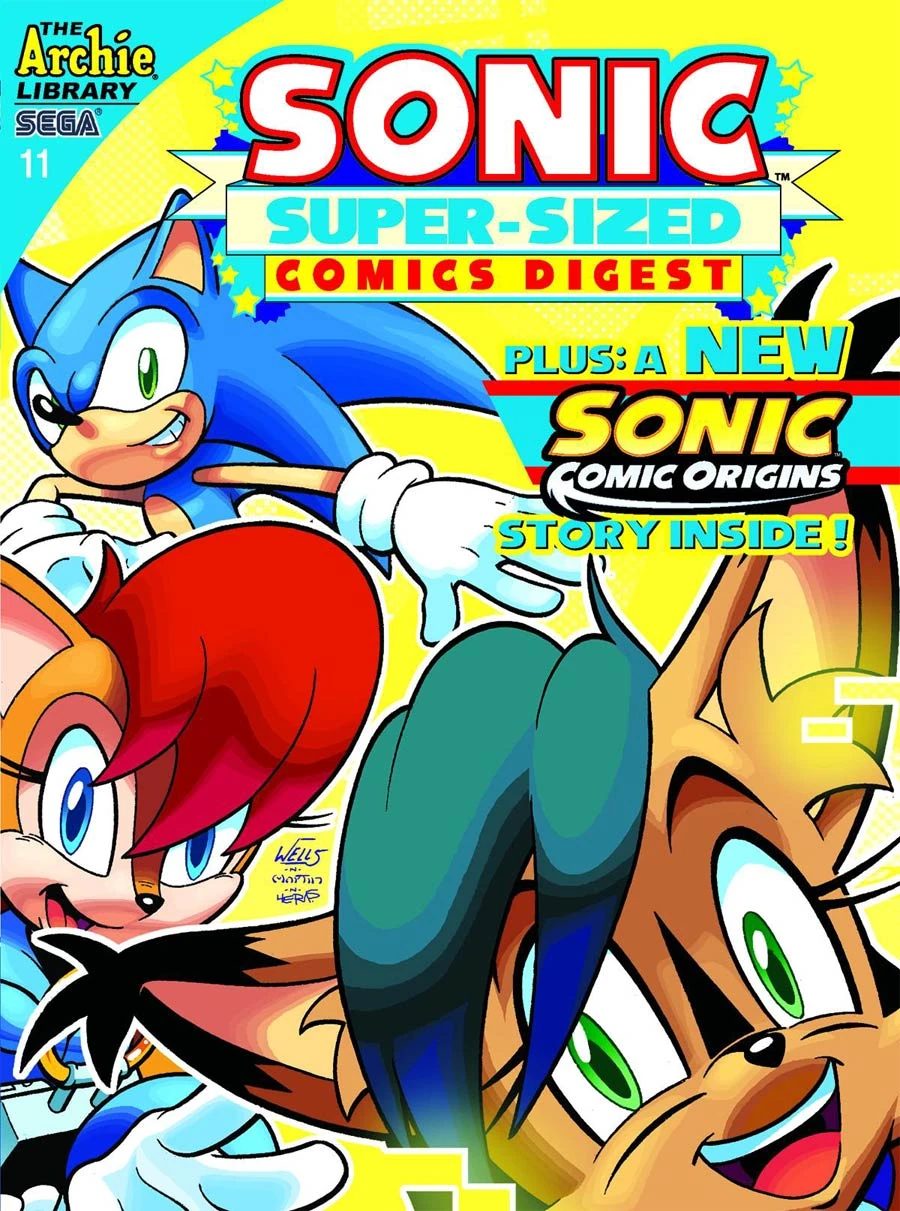
It’s time to talk about another one of those wacky digest again. Perhaps to coincide with the then-running “Spark of Life” arc, Nicole would be the next Freedom Fighter to get the Sonic Comic Origins treatment. But we’ll talk about the story in a minute. Instead, let’s look at the digest’s cover. It sure looks like a generic piece of Spaziante art, the kind of thing he could’ve scribbled in a few minutes, doesn’t it? I was certain it was a piece of Spaz stock art Archie had lying around and, indeed, that’s exactly what it is. It’s a cropped image of Sonic from “Sonic Universe: Issue 76’s” cover.


I just assumed Archie was being lazy but there’s evidence to suggest this was a last minute replacement. The original solicitation said issue 11 of the Digest would have a Lamar Wells cover. You can find it online. It’s a fitting image of Sonic, Sally, and Nicole posing in front of a supernova. I can only assume Archie got cold feet at the last minute about featuring comic exclusive characters on the cover of the mass-market digest. Or, worst, about putting female characters on the cover of a book partially aimed at seven year old boys. Or maybe they just didn’t want to pay Lamar that week. So they threw a somewhat awkward Sonic image Spaz drew in his sleep on there instead. I have no actual evidence that any of this is true but, knowing what a slapdash business Archie is, it wouldn’t surprise me.

Anyway, “Sonic Comic Origins: Nicole” concludes the loose story arc that began in the previous year’s Free Comic Book Day Special. Apparently Sonic and the Freedom Fighters weren’t the only ones running through Nicole’s “Sonic Spinball” themed training simulation. Team Rose  – Amy, Big, Cream and Cheese  – are about to take on the Machine Zone boss. As the action goes down, Nicole reflects on her early years as a handheld computer. She thinks about how her friends made her more human than she originally was.


Nicole’s tale is definitely the thinnest of the thus-far published origin stories. Despite the title, “Sonic Comic Origins: Nicole” doesn’t actually get into how the holo-lynx came to be. This is presumably because the “Spark of Life” arc, the last part of which would be published two weeks after this digest, actually details the A.I.’s backstory. Instead of spoiling the ending to his own story, Flynn focuses on character development. We see Nicole watching the Freedom Fighters grow, growing along with them. Apparently, observing her furry friends helped Nicole realize her own humanity. (Furmanity?) Only being five pages long, this story can only hint at the loneliness Nicole felt at first, being unable to truly interact with anyone. It doesn’t even have the page room to show how Nicole developed the hard-light hologram technology that makes her physical form possible.

It’s fairly thin stuff but Flynn does include some substance. We learn that both of Antoine’s parents are dead in this timeline, thanks to a chilly panel were Bunnie and Antoine cry in his bed, while Nicole’s screen displays the death announcement. We see Sonic and Tails appreciate a sunset, Rotor and Tails joking around, Nicole present as a silent observer. These colder moments are contrasted with what we see on the next page, where Nicole actually interacts with her friends: Playing chess with Sally, rocking out with Sonic, cooking with Antoine, putting a blanket over a napping Rotor. It conveys a lot of emotion in just two pages.


Lamar Wells’ artwork is up to the task of conveying this emotion. Admittedly, Nicole looks a little odd in his style. He always draws her at an angle that causes her feet to taper off to a smaller point. However, his command of mood and expression is strong, helping to sell the emotional flashbacks. I also like the especially cute way he draws Sally. Wells’ version of the Princess always looks extra fluffy and cuddly. His action scenes are squeezed into small panels, which does them a disservice. (His original cover is fine too, even if Sonic, Sally, and Nicole all look a little like melting ice cream bars.)

The rest of the digest is, of course, filled with reprints. We’re long past the point when Archie could actually pull from their history of back issues, for fear of angering Ken Penders' or anyone else’s lawyers. So all the reprints are from the comic’s very recent past. The only preboot content here is “Sonic Generations” from issue 230 and the first two parts of “Treasure Team Tango.” The themeing is weak, as the only stories here to feature Nicole are 267’s “The Grand Tour” and all of “A Light in the Dark.” (Including “Consequences.”)  Otherwise, we get all four parts of “Total Eclipse,” part four of “Waves of Change,” “Knuckleduster” from issue 2 of “Sonic Boom,” “A Nice Day to Start Again” from 264, and a very random appearance from the “Sonic Dash” adaptation.


The only bonus content is a few pin-up illustrations and one coloring page, most of which are reused cover art. In other words, aside from the Origin story, there’s no reason for Archie Sonic fans to track this digest down. I would never suggest anyone resort to piracy but, if you really want to read the Nicole story and have no interest in owning a bunch of random reprints, it’s probably the best option. Anyway, the cover story gets a [7/10], mostly for being so darn cute.

Wednesday, March 6, 2019

Sonic Super Digest: Issue 9


Sonic Super Digest: Issue 9
Publication Date: October 2014

Here we are, once again, talking about the Sonic Super Digest. In the handful of times when I’ve talked about this series and the Sonic Comic Origins exclusive to it, I guess I haven’t mentioned something: Unlike most of the comics I’ve talked about on this blog, I’ve never read these stories before. I was actually totally unaware of their existence for a long time. When I discovered what the digests contained, I looked them up and skimmed them. So this retrospective is the first time I’m actually getting some insight into the new origins for many classic characters. I’ve found my opinions have frequently changed upon a re-read but I guess you’ll just have to take these fresh.


Ian Flynn continues to work his way through the revamped histories of the classic SatAM cast. “The Belle in the Machine” focuses on Bunnie. Continuing where the last “Sonic Comic Origins” story left off, the Freedom Fighters are still working their way through a training simulation occupied by “Sonic Spinball” bosses. While waiting for a signal from Sally, Bunnie reflects on her past. She remembers how she was injured during Eggman’s takeover of Mobotropolis, how Uncle Chuck used his experimental Roboticizer to heal her, and the struggles – and eventual victories –  she endured adapting to this change.

Most of the Freedom Fighters’ post-reboot origins have not differed that much from their preboot histories. Most of the ideas were general enough – exiled princess turned resistance leader, cowardly would-be soldier turned hero, genius inventor separated from his family for whatever reason – that the book didn’t have to change them too much. Bunnie’s origin is probably the most different. SatAM never answered where Bunnie’s robotic came from while the comic did. Even though Mike Gallagher would never sue Archie, the company clearly still wanted to distance itself from any plot points introduced by previous writers. So now Bunnie, instead of being a random farmer abducted by SWATBots and rescued by Sonic mid-Roboticization, is a victim of Robotnik’s coup and Uncle Chuck is responsible for her cybernetics.


Perhaps a more vital difference is how Bunnie’s transformation affected her here versus how it did in the original continuity. Way back in issue 3 of “Sonic,” Bunnie takes about a page to recover from being partially Roboticized. She immediately embraces her new limbs, karate kicking and disabling giant robots before the story’s end. In the reboot, the healing process clearly takes much more time. Bunnie is shown wobbling around on her new limbs, unsteady and uncertain. Now, the support from the Freedom Fighters and Antoine’s love helps Bunnie grow into the strong, confident woman she is now. Which is very different from Bunnie’s original conception as someone who hides her insecurities with a confident exterior. But it also emphasizes how much the Freedom Fighters depend on each other, which is nice too.

I don’t know if Lamar Wells drew all of these stories at once and they were just published sporadically or if they were drawn as they were commissioned. I assumed the former at first, considering this is essentially one story arc being regularly interrupted by lengthy flashbacks. However, now I wonder if the latter is true. Wells is clearly having an off day with “The Belle in the Machine.” The earliest flashbacks, showing Bunnie as a child either frolicking with friends or being crushed by a collapsing house, are very flat in appearance. It’s a clear difference between the more action packed scenes in the present, like a cool panel of Sonic and Sally tearing up some chains. Those moments are up to Wells’ usual standards. But, whatever, we all have off days. It’s fine.


Proving that gimmickry never really died at Archie, this issue is promoted as a Special Edition of Sonic Super Digest. The special part manifests in a few bits of bonus content. Such as a Top Ten list counting down “Our Favorite Things About the New Sonic Comic Universe,” and brief articles about the Freedom Fighters’ new looks and the Shattered World Crisis. All of this stuff, but the top ten list especially, emphasizes how great the new continuity is supposed to be. In other words, these bonuses are propaganda from Archie. It’s painfully insincere corporate belching about how you should totally love the super great new universe, the previous timeline might as well not exist, and we have always been at war with Eastasia. I ain’t buying it but a lot of Archie Sonic fans actually think this way.

There's also a difference in which reprints are included in this digest. The last digest we covered featured some deep cuts, going all the way back to the comic's early years. This digest features stories exclusively written by Ian Flynn, from the last ten years or so. (And most more recent than that.) The reason for this is pretty obvious. In between the eighth and ninth digest, Archie got the memo that you can't republish old stories and art without paying the writers/artists residuals. That's probably common sense for most companies but not Archie, a company determined to be the sketchiest motherfuckers in an industry heavily populated by sketchy motherfuckers.  Though several stories are completely unrelated – like the still very new “Damage Control” from “Sonic: 257” and “Waves of Change: Part 1” from “Sonic: 260 – there was at least an attempt to theme some of these to Bunnie. She's a main character in parts 3 and 4 of “Trouble in Paradise” and “Thicker Than Water: Part 1.”


So what else can I say about that? Bunnie's rejiggered origin is fine, a decent take on the character that also fits in more with the revamped universe. The rest of the digest's content just sort of makes me laugh at how hard it was trying to promote a reboot that clearly saw some blowback. I maintain that the Sonic Comic Origins definitely should have been included in the main book, instead of shuffled over to an easily overlooked side publication like this. [6/10]

Friday, February 22, 2019

Sonic Super Digest: Issue 8


Sonic Super Digest: Issue 8
Publication Date: August 2014

With issue 8 of the “Sonic Super Digest,” Archie would begin the habit of periodically inserting new Sonic Comics Origins into the book. This move, I suspect, was probably done to drive some faithful readers to the largely reprint filled digest series. If that was the plan, I’m gonna say it was successful. The Digest series ran for another two years, an additional eight issues, which is a pretty good run for a quickie cash-in series made mostly of old content. It probably would’ve continued to, if all Archie “Sonic” content hadn’t mysteriously ceased publication at the end of 2016.

This move might’ve been good for the “Sonic Super Digest” series but, for me personally, it was fucking annoying. When it was first published, I never read the Digests, assuming they would just always be made up of reprints. So I totally missed the Origins stories when they were new. As someone invested in these characters, learning about their revamped history was fairly important to me. To have that shuffled over to some side book, when it should’ve been in the main line, was baffling to me. You’re telling me Flynn couldn’t cut “The Great Chaos Caper” or “Champions” or some bullshit like that short so we could learn where our heroes actually come from? It’s just another way how it’s obvious to me that the reboot’s priorities were all fucked up.


So, ahem, anyway... “Little Lost Soldier” details Antoine’s origins. While the Freedom Fighters continue their way through Nicole’s digital training simulation, battling the weird first two bosses from “Sonic Spinball,” Antoine reflects on his past. We see how he came to the Kingdom of Acorn as a child. How he began life as a coward and became infatuated with Sally. And how, eventually, he would meet Bunnie, develop feelings for her, and see his life completely change.

Of the comic’s original cast, I’ve always said that Antoine underwent the most character development. This guy started out as comic relief, someone who acted like he was big shit but was actually a giant jack-ass. He was essentially there to be Sonic’s friendly foil, which amounted to him getting teased and picked-on by the blue hedgehog. Over time, he would become a brave soldier, a vital member of the team, and even be allowed to marry his love interest. (Not to mention gaining a robot dad, being replaced by an evil doppelgänger for a while, and almost dying tragically.) That would be a lot to cover in only five pages.


Surprisingly, “Little Lost Soldier” actually does a pretty good job with this. Flynn manages to reduce Antoine’s history down to its most essential elements. His ridiculous accent is explained as being sent to the Kingdom of Acorn by an unseen father from another country, to be trained as a royal guard. Antoine’s original status as a coward is explained by him only being a child, and only into the beginning of his training, when Eggman’s coup occurred. This immaturity is nicely tied in with his crush on Sally, another symptom of him being a kid who didn’t know any better. Flynn thankfully skips Sonic bullying Antoine too, as the Freedom Fighters and the blue hedgehog have largely separate childhoods, in order to maintain Sega’s bizarre mandate of never revealing Sonic’s origins.

The only element of Antoine’s new origin to slightly rub me the wrong way is the importance Bunnie plays in it. Now, don’t get me wrong, Bunnie was a huge part of Antoine’s progression from coward to hero. But in the original continuity, their relationship and Antoine’s strength grew gradually and naturally over time. Now, it looks like the coyote saw the cyborg rabbit once, was immediately crushed on her, and decided then-and-there to stop being such a jerk-ass. Their growth is tied directly into each other in a way that doesn’t feel natural. But I guess this is a side effect of showing someone’s history in five pages, versus showing it over more than one hundred comic books.


Lamar Wells continues to draw the Sonic Comics Origins five-pagers. I suspect he probably drew these back-to-back over a short period of time, as the artwork is very consistent. I like how cute he makes the Freedom Fighters as kids. Little Antoine looks adorable with his small red cap. Wells also excelled at character expressions. The shot of a distraught Antoine, walking in the rain after he gets friend-zoned by Sally, is fittingly pathetic. I also like a little gag at the end. After detailing his evolution into a brave man, Sally startles Antoine, causing him to react in a very comical way. It’s a good moment, showing that Antoine hasn't totally changed, and Wells’ art is a big reason why it works.

A digest being what it is, the rest of “Sonic Super Digest: Issue 8” is filled with reprints. Compared to the magazine, which is full of all sorts of bonuses and extras, the Digest just throws in a few “pin-ups” and “coloring” pages, all of which are made up of old cover art. At least the editors saw fit to theme most of the reprints around Antoine and Bunnie. There’s some classic stories reprinted here, like issue 10’s “Twan in the Wind” (the first half-decent Antoine story), issue 23’s “Vol-Ant-Tier,” and issue 37’s “Bunnie’s Worst Nightmare.” Newer and fitting stuff like 232’s “Fragile” and the first two parts of “Tails’ Adventure” are also included. The book even throws in some really old, random shit, like the one-pager gag “Antoine’s Vain Refrain” and “Bugged Bunnie,” from issue 4 and the “Sonic Blast” one-shot respectively.


But let’s not give whoever put this thing together too much credit, as both parts of the “Sonic Riders” adaptation and issue 167’s “Hedgehog Day” are included for no particular reason. Then again, I can’t blame them too much as there hasn’t been that many Antoine themed stories over the years (especially once you exclude anything Ken Penders had a hand in) and 119 pages is a lot to fill. Anyway, this digest remains a mandatory read for hardcore fans due to its first story, which is solid enough. [6/10]

Monday, February 4, 2019

Sonic Free Comic Book Day 2014


Sonic Free Comic Book Day 2014
Publication Date: May 2014

In 2014, Archie would begin to publish short comic stories called Sonic Comic Origins. These would detail the backstories of the established cast members, as they exist in the rebooted universe. (Pointedly, characters that originated in the video games would be left out of this, as Sega refuses to let Sonic and his friends have an actual origin, as this would interfere with his status as a highly marketable corporate mascot.)

Despite this being fairly vital information, that informs this world and its characters, Archie and Ian Flynn did not see fit to include these stories in the actual on-going comic book. I guess they didn't want to interrupt the flow of the narrative, which is obviously much more important than knowing who these characters actually are and what they're about. Right? Sure. Anyway, the first of these Origins stories were published in 2014's Free Comic Book Day special. The second one would later be re-published soon afterwards in issue 7 of the “Sonic Super Digest.”


The first story is called “Sally – The Exiled Leader” and, obviously, revolves around Sally, the exiled leader. While the Freedom Fighters are working through a training simulation on the Sky Patrol, Sally thinks back on how the team was formed. She remembers her happy childhood days in the Acorn Castle, with her father. How he and Naugus were exiled to the Special Zone during Eggman's coup. How she fled to the Wood Zone, found Knothole Village. How Sonic inspired her to form her own team and fight back. How they've been fighting for years, rescuing her dad, winning the kingdom back, but still going forward to save the world and defeat Eggman forever.

Sally's backstory, as presented in “The Exiled Leader,” is not too different from the previous continuity. However, there's one really big difference. King Nigel Acorn is much less of a prick than King Max Acorn. The flashbacks emphasizes how much Sally loves her Dad, showing them playing when she was tiny. After rescuing Nigel and reinstating him as King, Sally asks her dad if she can forego her royal duties and continue to lead the Freedom Fighters. The King gives her his enthusiastic support. It's hard to imagine the old King Max doing either of those things. The preboot constantly mined Sally's struggle to balance her life as a Freedom Fighter with her life as a Princess. So that's one obvious way the reboot 'verse is superior to its predecessor. This is a King Acorn you can imagine people actually being invested in enough to want to rescue.


The training simulation set-up continues with “Rotor – The Exiled Inventor.” While building a rocket launcher to take down their digital adversary, Rotor recalls his own childhood. He grew up among a warrior walrus tribe in the frozen north. Unlike the rest of his family, he was more interested in technology than anything else. This caused him to run away from home and head towards the Kingdom of Acorn, supposedly a technological wonderland. Instead, Rotor arrived to find a conquered city. He soon met up with Sally and the Freedom Fighters, who quickly found a use for the walrus' inventive mind.

In the old continuity, Rotor's family were enslaved by the various Robotniks for more than a decade. Flynn switches this up a bit by having Rotor willingly leave his home. Being rejected by a distant father for being more intellectual than physical is a classic source of teenage angst. It's an okay origin but what's more interesting is the probably accidental connotations. In the old continuity, Ken Penders would reveal that he always wrote Rotor as gay. Assuming Rotor's double-secret closeted status is still true in the new timeline, the scene of the walrus coming out to his dad as a tinkerer, and being harshly rejected, reads very differently. And we already know Rotor's dad is now an Egg Boss. Flynn probably planned for the two to have a confrontation eventually but, naturally, was too busy with this Shattered Earth bullshit.


This issue also gives us a better look at the new continuity's history. It seems Flynn basically came to the same conclusion I did: That combining SatAM with the classic games is a solid decision. So there's lots of little images here that will be instantly recognizable to longtime Sonic fans. Such as the Princess Jasmine costume Sally wears as a little girl. Or the presence of Rosie, who was still her nanny. As a child, Rotor resembled his pudgier animated counterpart, even wearing the yellow baseball cap. And it would seem Eggman assumed power over the Kingdom of Acorn in more-or-less the same way, though the local countryside now features more marbled loops. At the same time, now it's evident Sonic began fighting Eggman before meeting the Freedom Fighters, presumably to make room for the events of the first few Sega games. Still, it works and I wish Flynn had led with this, instead of just dropping us into the middle of the action.

The artwork is by Lamar Wells. Wells previously did the pencils for issues 253 and 254, supposedly working off Tracy Yardley's outlines, in addition to providing a few covers here and there. Wells, working alone this time, does just fine. His Sally looks especially bouncy and cool. He draws good dramatic poses, which works for the highly static flashbacks, and dynamic action scenes, which work for the training simulation presence. He has a good balance of cute and gritty, that this series has always run on. 


I also like the little throwbacks and in-jokes in here. Such as the reveal that Rotor apparently invented the spikes throughout the Green Hill Zone as a trap for Eggman's Badniks. Or the bit of flirty banter Sonic and Sally get at the end of the first story. Most notably, the training simulation also has the Freedom Fighters battling Scorpius, the memorable first level boss from “Sonic Spinball.” The stories are solid enough and will probably make me a little more invested in these new versions of the established cast members going forward. Which makes me really wonder why Archie didn't include these in the main book. This seems like the kind of important information readers would want to know.

Instead, these Sonic Comic Origins were stuck into 2014's Free Comic Book Day release, where they would have to share half a comic book with Mega Man reprints. Not really caring about the adventures of Mega Man X or whatever, I didn't read that half of the book. (Spaz drew that story, so it at least looks snazzy.) Archie would continue to shove the Comic Origins into various Digests and Magazine releases, leaving them out of the regular book for some baffling reason. That makes this Free Comic Book Day release one of the most essential. [7/10]