Showing posts with label colleen doran. Show all posts

Monday, January 2, 2017

Knuckles the Echidna: Issue 32


Knuckles the Echidna: Issue 32
Publication Date: November 1999

Here it is, you guys. The final issue of “Knuckles the Echidna.” I’ve always suspected the series’ cancellation was sudden. Ken and company had already planned out the next story line, which would tie into the “Sonic Adventure” arc currently starting in the “Sonic” book. A proposed cover for issue 33 of “Knuckles” was reused for issue 80 of “Sonic.” I have no idea how popular the “Knuckles” book was but, considering Archie’s history of financial mishandling, sales might not have been the reason for cancellation. Whatever it was, the Guardian’s series would conclude with the final part of the “King of the Hill” story line.


In hopes of evading Hunter, Knuckles and Monk descend into the Hydro City Zone, the aquatic piping system that runs inside the island. Though the two escape the Overlander killer for a while, he eventually catches up with him. Locke and Archimedes are also on Knuckles’ trail, hoping to find him before the expert marksman does.

The uninspired three-parter comes to its conclusion with the equally uninspired “To the Death.” Knuckles and Monk heading into the sewers shows that Ken doesn’t even grasp the material he’s ripping off. In “The Most Dangerous Game,” Zaroff hunted his human prey on his own island. Hunter going after the echidna and the gorilla on the Floating Island gives the prey the home field advantage. Sending the story into the Hydro City zone also means most of the story takes place in an ugly, industrial setting. (It doesn’t help that Ken’s rendition of Hydro City does not resemble its video game counterpart at all.) Of all the “Sonic 3” levels to adapt, Hydro City is an odd choice. Why would there be an aqueduct system within the Floating Island? Ken has no answers. Instead, he gives Knuckles a line about the zone being even older then the echidnas.


Monk and Hunter continue to be aggravatingly lame characters. Maybe several hours have passed in universe but, to the reader, it seems Knuckles and Monk have progressed from worst enemies to comrades immediately. Far too much of issue 32 is devoted to the echidna and the gorilla sniping at each other. I think it’s supposed to be charming. In effect, it just makes Monk look like an idiot and Knuckles look increasingly exasperated with his forced partner. The panels devoted to the two working together are especially torturous. Knuckles, for some reason, can’t glide in the Hydro City Zone. This is blatant, bad writing, forcing two characters that otherwise have nothing in common to work together.

Hunter was already a derivative, uninteresting villain. In “To the Death,” he graduates to actively annoying. For some reason, Ken gives the guy an interior monologue. While stalking Knuckles’ footprints, or following him into the sewers, he prattles on endlessly to himself. The thought bubbles contribute nothing to the story. Hunter’s thoughts aren't interesting or revealing. Instead, he basically lays out his plans and actions before he actually does them. Even though he manages to kill two characters before the story is over, he still feels like such a weak addition to the universe. It’s like a D-list supervillian from another comic dropped in and stumbles around awkwardly, before finally being defeated.


That Monk and Knuckles fail so totally at bonding makes the story’s conclusion even weaker. Yes, the gorilla dies. After a struggle on a catwalk, Hunter shoots him. You might not get this immediately, since Ken’s shitty artwork makes it look like a ray of light burst from Monk’s neck, followed by an extremely awkward fall towards the ground. Knuckles is so enraged by the bully’s death, that his latent Chaos energy powers are unleashed. Yet nothing in the actual story points towards Knuckles caring that much about Monk. It’s a ridiculous, unearned ending. Pinning the story’s entire emotional point on characters we do not like or care about was a mistake.

Yes, I mentioned Knuckles’ superpowers. Since last issue, Locke and Archimedes have been wandering around the island, looking for the young Guardian. Knuckles’ dad and mentor continue to add nothing to the story. Several pages are devoted to them bungling around. By the time they find Knuckles, the conflict has already ended. Their role in the story is totally superfluous. Knuckles’ great powers emerging is also a cheap deus ex machina. Not to mention vague as hell. As illustrated, we see Knuckles get angry and then shoot some bumpy waves from his head. This, somehow, is enough to disable Hunter. The villain’s final fate – imprisoned in a glass bubble underwater, while wearing just his underpants – is as senseless as anything else related to him.


Because issue 30-32 of “Knuckles” containing one bad story arc wasn’t enough, “The Worst of Enemies” also concludes the Espio centric story that’s been playing out in the back pages. Espio tricks the robotocized Valdez and Liza into going to one of the Island’s many ruins. There, he confronts his former friend, tackling him into a river. Afterwards, he frees the imprisoned chameleons. Even though he’s won, Espio fears this is just the first of many attacks on the Floating Island.

Unlike “King of the Hill,” which was more-or-less doomed from conception, Espio’s story actually had potential. A friend of his has turned evil. His newly introduced love interest is robotocized right in from of him. These are dramatic stakes. Yet the execution has been so flimsy and non-involving. Valdez has not been a convincing threat. We barely know anything about Liza. The plot, meanwhile, seems tossed together. It blunders from one minor point to another before finally ending here. At the story’s end, nothing’s changed. Espio’s concerns about the Island’s future could’ve been built into something more but comes off as a tonally inconsistent epilogue. Colleen Doran’s lifeless, disproportional artwork has done nothing to make up for the shitty writing. She manages to make Espio walking away from a huge explosion – itself a cliché image – look totally lifeless.
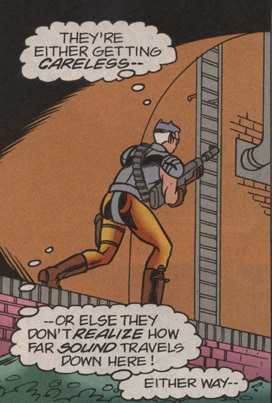

I seriously suspect “King of the Hill” was an idea Ken hadn’t really developed before tossing it into the comic. It has all the hallmarks of being filler: Characters that easily could’ve been ported over from some other story, a plot ripped off from well known material, artwork hastily provided by the writer. It contributes nothing to the universe or world. The central characters exit the plot no different then how they entered.

Good-bye, “Knuckles” solo series. You were often frustrating, as giving Ken an entire comic to play with allowed his irritating quirks to flourish. At the same time, you sometimes gave birth to good stories, solid ideas, and fascinating characters. We’d always have Julie-Su, at least until the reboot anyway. If nothing else, its definitely one of the weirdest chapters in the history of Archie’s “Sonic” universe. It’s just a bummer that the series had to conclude on such a shitty story. [3/10]

Friday, December 30, 2016

Knuckles the Echidna: Issue 31


Knuckles the Echidna: Issue 31
Publication Date: October 1999

The “King of the Hill” story arc continues with its second chapter, “The Thrill of the Hunt.” Knuckles and Monk are cornered by an Overlander calling himself Hunter. He captures Monk and talks Knuckles into coming back to his lair with him. As his name suggests, Hunter likes to pursue the most dangerous game. Knux and Monk are his next targets. Outfitted with shock collars, the two enemies are forced together to defeat their captor. Meanwhile, Locke and Archimedes try to get to the bottom of this.


Last issue, I referred to Hunter as an uninspired riff on Kraven the Hunter, a well established Spider-Man villain. There’s little doubt in my mind that Ken was ripping off Marvel, as Hunter has similar facial hair and clothes to Kraven. Yet the character’s lack of originality runs deeper. “King of the Hill” also rips off “The Most Dangerous Game,” a piece of well-trotted literary ground. Hunter has a large manservant, a detail-lacking robot called Aryu-One-Two. He considers hunting living beings a sport. While inside the lair, Knuckles discovers a series of mounted Mobian heads. (Pollo the Bear, from “SatAM,” appears to be among them.) This grisly scene is taken directly from the 1932 film version of “The Most Dangerous Game.” Ken’s not done paying “homage” to his influences. Hunter also, at one point, fires a grey version of Scaramanga’s Golden Gun.

This standard “Hunting Humans Mobians” story line is also mashed up with a standard “Enemies Forced to Work Together” story line. Monk’s bravado immediately has him stunned by Hunter. After the villain laboriously explains his modus operadi, Knuckles and Monk are tossed out into the Floating Island. As you’d expect, the two have to work together in order to survive. Hunter outfits both Mobians with shock collars, so they’ll cooperate. I’d assume Ken ripped this off from “Battle Royale” but the movie wouldn’t come out until the next year. (Oh yeah, Hunter also threatens Julie-Su. You know, that character you’d much rather be reading about.) However, Monk is still such a thin sketch of a character. He spends the majority of this issue unconscious. There’s no dynamic between the gorilla and Knuckles, meaning their force partnership lacks tension.


Because it’s impossible for Penders to write a “Knuckles” comic without forcing in the Brotherhood of Guardians, Locke appears in the story too. Inside Haven, Thunderhawk and Sabre notices that something has disrupted their signals. This is the work of Hunter, which the reader can figure out immediately. Locke and Archimedes, meanwhile, have to investigate further. I don’t know what business Locke and Archy have in this story. I’m assuming they’ll eventually save Knuckles’ ass? Otherwise, their presence drags down the pacing of a story that is already moving at a snail’s pace.


“King of the Hill” having a lame concept, weak execution, and introducing unneeded new characters isn’t enough. The story has to look like shit too. Ken’s pencils aren’t just ugly and lifeless. They’re often incoherent. An early scene has Hunter stunning Monk and I have no idea what happens in those panel. The faces of Monk, Knuckles, Archimedes, and Locke manage to be simultaneously stiff and unpleasantly stretched out. Ken flat-out does not know how to draw guns, as Hunter’s firearms often look like weird tube devices. Lastly, Hunter, Monk, and Aryu-One-Two have deeply unappealing designs. Penders makes no attempt to adapt them to the Sega/Archie house style. They do not look like they belong to this world. Ken’s writing skills may be debatable but his drawing skills are undeniably lacking.


The back-up story to “Thrill of the Hunter” is equally uninspiring. “The Best of Friends” continues Espio’s conflict with the now robotocized Valdez. The mechanical chameleon explains how he became captured by Robotnik. The dictator has sent the Robian to the Floating Island to locate Knuckles and the Master Emerald. When Espio fails to cooperate, Valdez robotocizes Liza, the female chameleon that is both men’s object of desire.

If the subplot involving the Brotherhood strips the cover story of any forward momentum, the back-up story screeches to a halt because of Valdez’ lengthy flashback. Did we really need to see the extended scenes of Robotnik capturing him, robotocizing him, and further programming him? Couldn’t that have been handled in a few panels, instead of two pages? Liza’s fate could have grafted the story an emotional heart. We discover that Valdez and Espio are both rivals for Liza’s affections. That she was working with the now robotic lizard in hopes that Espio could reach him. However, we just met this character last month. We know nothing about her. I do not care that she’s being turned into a robot. Add in Colleen Doran’s lifeless, ugly illustrations and you’ve got another dud.


I continue to wish that “Knuckles” got the axe three issues earlier. “King of the Hill” remains an uninspired story arc with a mountain of problems. Somehow, I don’t expect things to turn around in the last volume. [4/10]

Monday, December 26, 2016

Sonic Super Special: Issue 11 – Girls Rule!


Sonic Super Special: Issue 11 – Girls Rule!
Publication Date: October 1999

Here in 2016, the big comic companies have gone out of their way to introduce new major female characters or slot other women into more prominent roles. You wouldn’t think anyone would have a problem with simple inclusions like this… Actually, if you do think that, welcome to the internet! I’m very flattered you chose to visit my blog first.

Anyway, by 1999, Archie’s “Sonic the Hedgehog” series had amassed a decent sized female cast. The company had even already attempted a woman-led series, with the ill-fated “Princess Sally” mini-series. For the eleventh Sonic Super Special, Archie decided to try out a similar tactic. All five stories featured in the issue revolved around the women in Sonic and Knuckles’ lives. (No, Amy Rose isn’t featured. The comic wouldn’t give her a bigger role for a few more issues.)


The first story revolves around Sally, still the most important lady in the comic at this point. “Ascension,” set before Robotnik’s reemergence and subsequent take-over of Mobotropolis, has Sally facing her destiny as future monarch of Mobius. She crawls into the Source of All, that weird golden pool in the basement of Castle Acorn. A direct conduit with the forces behind the universe, the Source shows Sally visions of her past and her future. Afterwards, it’s her decision to accept her fate or not.

Every story in Sonic Super Special Issue 11 was written by Ken Penders. By giving Ken so many pages to express himself, we get the full run of his talents and flaws as a writer. In “Ascension,” for example, we see the Penders obsessed with self-involved mythology and cosmic malarkey. The Source of All is an especially dopey plot element I’ve never liked. Literally making the House of Acorn divinely attuned seemed like a heavy-handed attempt to justify why an advanced civilization like Mobius still has a monarchy.


Having Sally directly interact with the Source doesn’t make it seem any less pushy. It shows the Princess her past, appears as her father and brother, before showing her a glimpse of the future. That is, the same future first introduced in “Sonic: In Your Face,” where Sally and Sonic are married with kids. What purpose this has on the wider story – beyond setting up the “Mobius: 20 Years Later” story Ken had been wanting to tell – I don’t know.

Somehow, this all amounts to the Source hoping Sally becomes Queen. She decides to ignore the comics puddle and follow her own path… Which was what she wanted to do all along. So what was the point of this journey again? At least “Ascension” isn’t too visually unpleasant a story. Jim Valentino, after drawing some seriously ugly stories for Archie, finally seems to grasp these characters. Sally, who spends the whole story in the quote-unquote “nude,” is mostly on-model. The use of shadows and lightning are fairly evocative. Some of the effects are cheesy and Valentino’s work is occasionally rather flat. Still, it’s easily his best work for Archie so far.


The second story, “Solo,” revolves around Hershey the Cat. Geoffrey St. John and Hershey sneak into Robotnik’s compound. While St. John is on the look-out, Hershey investigates Eggman’s computer. After discovering that her former teammate Valdez has been robotocized, as revealed in Issue 30 of “Knuckles,” she sneaks out and sets off an explosion.

Ken also draws “Solo.” While I’ve said lots of shit about Penders’ artistic abilities, “Solo” actually doesn’t look too bad. It’s a story devoted to stealth and investigation, which means there’s none of Ken’s static action. Robotnik’s new design looks fairly awkward and Hershey’s proportions are often off-center. Still, it’s definitely one of his better illustrations. As for the story, there’s not much to it. Hershey, hardly the most loved female Freedom Fighter, hasn’t had much development since her introduction in “Endgame.” At least she actually shows some confidence in this one, managing to go the whole story without being betrayed or screwing up. (Though St. John still needs to help her.) It’s a pretty forgettable story but not terrible or anything.


The third story, “Family,” centers around Lupe and the Wolf Pack. The wolves return to their home town, to find it wrecked by the new Robotnik’s forces. Soon, the wolves are taken hostage by a team of Robians led by a still brain-washed Uncle Chuck. After robotocizing Lupe’s children and one of her teammates, Lupe herself is ushered into the robotocizing tube. With her last ounce of free will, she clears the way so the rest of the Wolf Pack can escape.

“Family” should be an upsetting story. Uncle Chuck acts out-right evil in it, making cruel and sadistic statements on the behalf of his new master, Robotnik. Lastly, the story concludes with Lupe effectively being killed off. As a character that dates back to the SatAM series, Lupe’s exit from the series shouldn’t have been made lightly. And “Family” does feature some effective, powerful moments. Lupe’s response to seeing her kids roboticize is anguished rage. Yet Lupe, a born leader, is also pragmatic, always thinking of ways out of this situation. Even after being turned into a robot, her force of will is so strong that she can hold off the process’ mind control for several minutes, allowing the rest of her family to escape.


All of these events should impact readers greatly. There’s a few problems though. First off, “Family” takes up only six pages, which is hardly enough space to properly explore the emotions at play here. The perhaps bigger problem is that Lupe and the Wolf Pack, as they exist in the comic, haven’t gotten much character development. Though Lupe is a character we’re attached to, because of the cartoon, her comic counterpart has never been well utilized. Ultimately, “Family” is well intentioned but underdeveloped. Colleen Doreen is officially credited with the pencils but I suspect Art Mawhinney performed some uncredited clean up. Several panels closely resemble his work, which is quite different from Doreen’s other art we’ve seen.

Fourth in the book is “Upgrade,” revolving around Bunnie Rabbot. While working outside in Knothole Village, Bunnie collapses. Dr. Quack quickly checks on her. He deduces that her biological body parts and mechanical robot parts are in conflict with each other. The two components are rejecting one another. Her options are limited. Her choice is a risky de-robotocization process or upgrading her parts, preventing her from ever being wholly organic again. During this difficult time, Bunnie and Antoine comfort each other.


“Upgrade” reaches the emotion that “Family” couldn’t quite grasp. Unlike Lupe, Bunnie has been thoroughly developed as a character. This is a story totally focused on characters. Bunnie is frightened by the possibility that she might loose her abilities and usefulness to the team. Or she most face the fact that she’ll never be wholly organic again. Ultimately, the heart-to-heart with Antoine is the climax of the story. He lets her known that he’ll always love her, no matter what. It’s a really sweet moment.

And one slightly undermined by the story’s conclusion, where Bunnie happily accepts her sleek, new robotic parts. For such an emotional tale, a conclusion this gung-ho strikes the reader as slightly insincere. Still, “Upgrade” is definitely the stand-out story in this collection. (James Fry’s artwork, by the way, is serviceable, if a little too loose.)


The last tale here focuses on Julie-Su, Knuckles’ much beloved but often sidelined girlfriend. “Shadows” has Julie-Su exploring her past. After riding her bitchin’ hover bike back to the Dark Legion base, destroyed all the way back in issue 3 of “Knuckles the Echidna,” she encounters a man who claims to have raised her. What follows is an extended flashback, detailing Julie-Su’s origins and her time in the Dark Legion.

“Shadows” is, if nothing else, gorgeous to look at. It’s one of the all too few times Patrick Spaziante actually drew a whole story. In his style, Julie-Su’s grace and badassery is fully illustrated. Such as the scenes devoted to her exploring the broken down base, weapon drawn. Spaz’ work is, of course, insanely detailed. Every nook and cranny of the destroyed base is shown in vivid, rich detail. The few action beats in the story are brought to life brilliantly, leaping off the page. Framing the flashbacks in pink neon lines makes the story easier to follow too.


“Shadows” looks great but I wish its script was better. The story is designed to fill in Julie-Su’s back story. The best sequence is devoted to her own recollections as a Legionnaire, as she reflects on the militaristic routine she lived through and the cruel treatment from her superiors. Once Julie-Su encounters the elderly echidna Simon, he totally takes over the story. Penders enters full-on exposition mode. We learn that Julie-Su is the half-sister of Kragok and Lien-Da, the off-spring of former Dark Legion leader Luger. Following both of her parents’ deaths, Julie-Su had her memory wiped by her half-brother. (This event perhaps explains Julie-Su’s sometimes inconsistent motivations. It’s also lazy, another example of a Penders’ protagonist being manipulated by other, grander forces.)

In other words, Ken falls back on his awful habit of telling, instead of showing. He shovels a crap ton of character information on us, loosing the emotional bead of Julie-Su learning about her past and being reunited with her foster parents. Her reunion with her foster mom, by the way, happens entirely off-panel. The story ends before she can meet her again. I really wish Ken could’ve expanded “Shadows” into a story arc in “Knuckles,” allowing more room for the emotional aspects and letting the flashbacks play out in a more natural fashion. But, no, we had to get that storyline about Knuckles fighting a gorilla instead.


By packing five stories into 48 pages, the “Girls Rule!” special becomes especially uneven. “Upgrade” is very nearly a classic while “Family” and “Shadows” both have good moments, even if they overall fall short. “Solo” and “Ascension” mostly exist to tell us things we already knew. Still, a female focused quarterly is an idea I really like conceptually. If Archie was still doing mini-series in 1999, it could’ve easily broken these five stories up into individual books, which would’ve solved some of their problems. As it is, Sonic Super Special Issue 11 is still a solid read. All the stories are compromised but the parts are greater then the whole. [7/10]

Wednesday, December 21, 2016

Knuckles the Echidna: Issue 30


Knuckles the Echidna: Issue 30
Publication Date: September 1999

The “Knuckles the Echidna” series would be over before the end of 1999, the comic wrapping up with a modest two-year-and-change run. I don’t know if the series’ cancellation was due to poor sales or industrial shifts inside Archie. Considering the “Sonic” suite of books would soon to be clipped down to just one, I suspect the latter is true. If “Knuckles” had ended three or four issues sooner, it would’ve wrapped up with low key, personal stories. Issue 29 or “The First Date” story arc would’ve been a good note to go out on. But the somewhat misguided love child of Sega and Ken Penders instead had to limp on for one more story arc.

The “King of the Hill” three-parter begins with a bizarre ape-like creature climbing aboard the Floating Island, after seemingly lassoing part of the island. This is Monk, a gorilla who used to bully Knuckles when both were younger. Monk’s abuse got him exiled from the island by the Brotherhood. Now, he’s back for revenge. Soon enough, Knuckles and his former tormentor are fighting again. Meanwhile, a mysterious and armed Overlander has also set his sights on the Guardian.


Throughout the “Knuckles” series, how often Ken Penders would indulge his Penders-ness would vary from issue to issue. Usually, the Brotherhood of Guardians and their treatment of Knuckles were the outlet for his worst tendencies. Issue 30’s cover story, “Bad to the Bone,” instead focuses on some of Penders’ other annoying quirks. The story is filled with bizarre pop culture references. Upon reaching the Island, Monk quotes “White Heat.” For some fucking reason, a whole page is devoted to Knuckles reading “2001: A Space Odyssey.” And not an echidna version either but the original book. (The same page also references Ken’s “The Lost Ones,” because of course it does.) Though only briefly glimpsed in this issue, the story arc’s main villain is a thinly veiled rip off of Kraven the Hunter. There’s also some heavy handed anti-gun imagery. It’s incredibly distracting and often annoying.

The “King of the Hill” story arc seems written to expand Knuckles’ rogue gallery. While Hunter would be focused on soon enough, Issue 30 is mostly devoted to introducing Monk. The character does not make an especially compelling entrance. The character is supposed to be a gorilla but he looks more like a purple Bigfoot. He also wears one of those sumo wrestler loincloths, which is deeply unflattering. The character has been holding an incredibly petty grudge for a decade, making him seem even more uninteresting. By the time the two meet again, Monk is so clearly out of Knuckles’ league, he seems more like a minor annoyance to the echidna then a great villain.


A part of me suspects that a heavy-handed moral about bullying is where this storyline is headed. The flashback shows a hopelessly naïve Knuckles playing with a yo-yo. Monk then steals the yo-yo, gives Knuckles a homoerotic bear hug, and tosses him from a tree. Presumably, this was not the only incident where Monk bullied Knuckles. If it is, that makes the following seem like even more of an overreaction. Because Knuckles has always had his secret granddads there to bail his ass out, the Brotherhood of the Guardians ejected Monk from the Floating Island. And not like with robots. Personally. They dressed up like Satanists, picked the gorilla up, and threw him off the Island. In other words, the bullied victim never even had a chance to stand up to his bully!

The script is pretty shitty but the artwork is much, much worst. Ken Penders provides his own pencils. Issue 30 makes a good case for why that happened so rarely. The opening pages are awkwardly constructed, seemingly showing Hunter kissing his rifle before stiffly firing it. Ken’s handle on action has only gotten worst. Monk’s climb aboard the Island features many hideous angles. Characters’ faces freeze in bizarre expression. Despite the gratuitous speed lines, the panels are utterly lifeless, lacking any sense of motion or movement. Ken has a faulty understanding of proportion, as Knuckles and his opponent frequently shift size. Lastly, Monk is just an ass ugly design. He doesn’t look like he belongs in this book.


At least Ken didn’t draw the back-up story. “Hiding in Plain Sight” stars Espio the Chameleon. After introducing Julie-Su to newly minted Chaotix Ray the Squirrel, Espio rides into a group of chameleon. An older chameleon collapses, causing Julie-Su to carry him to safety. Espio, meanwhile, is led by his former friends into an ambush. Valdez the Chameleon has been robotocized and is seemingly leading a Robotnik-sanctioned invasion of Rainbow Valley.

“Hiding in Plain Sight” is, sadly, not much of an improvement over the cover story. The opening pages make it seem like more of a Julie-Su story. The introduction of Ray is strictly a formality, as it has nothing to do with the rest of the story. The old and injured chameleon popping out of nowhere borders on the comedic. The ending reveal that Valdez has been roboticized annoys me. Ken hadn’t used the character in a while so, instead of developing him further, he just decided to turn him into a robot. That’s lazy and sloppy. (The story also features one of those stupid not-horse creatures.)


New-comer Colleen Doran’s pencils are not much better then Ken’s. Characters often go off-model, with the length of limbs or sizes of heads shifting from panel to panel. Julie-Su’s hair constantly changes. Ray the Squirrel looks like pasted-in Sega clip art. The backgrounds are all uninspired jungle scenes. At least none of the new characters are as grossly unappealing as Monk. They’re just indistinct.

Neither story line in issue 30 is very promising. Why do I have this sinking sensation that the “Knuckles” book is going to end on a whimper rather then a bang? [4/10]