Showing posts with label downunda freedom fighters. Show all posts

Monday, April 23, 2018

Sonic Universe: Issue 12


Sonic Universe: Issue 12
Publication Date: January 2010

As 2010 started, “Sonic Universe” wrapped up its first Knuckles arc. The final part of “Echoes of the Past” picks up with last issue's cliffhanger. Finnitevus has betrayed both the Chaotix and the Downunda Freedom Fighters to the Dark Egg Legion. Just when both teams look screwed, Duck Bill reveals he's a double agent, letting the heroes escape. While the Chaotix and the Downunda Freedom Fighters fight off the Legionnaires and their Wing-Dingos, Knuckles catches a ride up to the Angel Island. There, he has a seemingly final showdown with Dr. Finnitevus.


As a conclusion to “Echoes of the Past,” issue 12 of “Sonic Universe” is a bit rushed. The central crux of the story has to resolve the Floating Island being chained in the air by the Dark Legion. So it's an odd choice by Flynn to cut away from the Freedom Fighters fighting the Legion and freeing the Island. The stuff about the obscure ruins on the islands, both above and below, isn't paid off. Duck Bill's turncoat status is brushed away after the first couple pages. In the end, “Echoes of the Past” focuses on the conflict between Knuckles and Dr. Finnitevus which, I guess, was the whole point of this story arc anyway. Still, the conclusion doesn't help my general feelings that this story arc has been a little jumbled.

So what about Duck Bill joining the Legion? This reveal was suppose to play out like a big shock last issue. And it might've, if Bill hadn't already gone evil once before in the past and we actually knew way more about the character. When he reveals to his friends that he's not actually evil, Flynn tries to make it work. The script reveals that Bill joined the legion because his fellow platypuses demand he do it. I guess monotremes are susceptible to peer pressure. The sequence wraps up with the Downunda Freedom Fighters forgiving Bill, understanding why he's done this. Which attempts to put some emotional resonance on a still somewhat messy plot point.


Probably my favorite thing about the last part of this “Sonic Universe” are the little nuggets of character interaction. Throughout this story arc, Flynn has hinted that Vector has his origins in Downunda. The last issue revealed that he has some history with the Downunda Freedom Fighters. This issue concludes with Barby saying Vector's father would be proud of him. I don't think this stuff was ever resolved but it's interesting to see little hints about Vector's history. (Flynn also hints at a romance between Barby Koala and Duck Bill, which was his awkward attempt to bury the Tails/Barby ship. It didn't work, Ian, at least from where I'm sitting!)

Like I said, part four of “Echoes of the Past” isn't really about this stuff. Instead, the story finally finds some center when Knuckles faces off with Dr. Finnitevus. (By the way, how he gets back on the Floating Island is pretty neat, with Vector throwing him into the air.) When the team meet, the villains attempts to tempt Knuckles with knowledge about the echidna race. And the hints Finnitevus drops about Mobius' mythology are tantalizing. He mentions how there have been multiple Enerjaks over the year. He talks about how Albion has some dark, ugly secrets that have stayed buried. He even adds sarcastic air-quotes when referencing Aurora. Considering what we've seen from Aurora seems to characterize her as a real goddess, that's an interesting point.


(Of course, what's disappointing is that very few of these plot points would be expanded on. Soon enough, the legal issues with Ken Penders would see a lot of the echidna characters yanked from the book. Like I said, those hints about Vector and his dad would go unexplored. Before exiting the story, Thrash the Tasmanian Devil references his grudge with the echidna race again, the only one of these story ideas that would play out. Sadly, even that would be in a compromised form.)

Still, that showdown between Knuckles and Finnitevus is pretty cool stuff. The villain telling the hero that they can rule together is a cliché moment. Yet Knuckles' absolute rejection of the bad guy's offer is impressive. He rages at the villain while punching him towards the edge of the island. This leads to a pretty cool trading of fisticuffs and then, later, Chaos energy blast. The two recite different versions of the Chaos prayer thing, which neatly show the two characters' different approaches to their powers. Finnitevus then threatens to cut Knuckles in half with a warp ring, a trick the bad guy claims he's never tried before. Personally speaking, if I had access to warp rings, that's one of the first things I'd ever try. Still, it's a satisfying showdown.


Flynn zooms in for the conclusion, devoting the last page to an intimate moment between Knuckles and Julie-Su, the two declaring their devotion to each other anew. It's a sweet moment. I wish the “Echoes of the Past” storyline had more moments like that and Knux's showdown with Finnitevus in general. Overall, I found this story arc to be equal parts unfocused and a bit dull. It got off to a very slow start before rushing through more interesting stuff in the second half. Which just tells me that things needed to be balanced out a little better. [6/10]

Monday, April 16, 2018

Sonic Universe: Issue 11


Sonic Universe: Issue 11
Publication Date: December 2009

“Sonic Universe's” strategy of four-issue story arcs should've left us with three complete plots within one year. But, due to the arcane rules that govern such things, the series didn't start until February of 2009. So the Knuckles-centric “Echoes of the Past” didn't get resolved until 2010, ending Archie Sonic's 2009 on a cliffhanger. Man, don't you hate when that happens?

Anyway, the plot: After running into Dr. Finitevus last time, Knuckles is fully ready to kill the guy. Until he explains that he's not responsible for chaining down Angel Island. At that point, Vector and Ray arrive on the scene, pursued by a fleet of angry Wing Dingoes. Luckily, the Downunda Freedom Fighters arrive to turn the tide in the battle. Afterwards, we learn that a splinter Dark Egg Legion group is still operating in Downunda. The teams, including Dr. Finitevus, have to work together if they hope to stop this villainous scheme.


I haven't been feeling “Echoes of the Past” much, up to this point, but I have enjoyed angry Knuckles. Sega's default characterization of the echidna has always been as a gullible bruiser. (With the gullible part being Flanderized over the years, to the point that “Sonic Boom” portrayed him as a total buffoon.) Archie's Knuckles has always been far more thoughtful, inquisitive, and generally angsty. Recently – in between returning from the dead, loosing his powers, becoming a super villain, and his dad dying – that angst has defined the character a little too much. So to see Knux cut loose and wail on Dr. Finitevus, to do some punching and yelling, is a refreshing change of pace. This issue's opening pages, where the Guardian spends a whole page throwing the mad scientist into walls, gives the arc a nice burst of energy.

“Echoes of the Past” also gets some much needed dramatic tension in this installment. Right before Knuckles crushes Finnitevus' head, Toxic Avenger style, the villain informs him that he's not responsible for the chains hooking Angel Island into place. He wants to get to the bottom of things too and request a temporary alliance. This, of course, is a pretty obvious trap. But Knuckles is talked into going along with it. And it's good for the story too. Knuckles being forced to work alongside someone he hates so much raises the stakes a little more, making for a more compelling installment.


Sonic Universe 11 also sees the return of the Downunda Freedom Fighters. I've always had a bit of a soft spot for that team and they haven't made an appearance since issue 105 of “Sonic.” So it's nice to see Barby, Walt, and the gang again. The addition of the Downunda Freedom Fighters also changes the story arc's dynamic in a pleasant way. Instead of being another issue of Knuckles, Julie-Su, and Mighty sulking around ruins, we've got a full fledged team-up between two separate Freedom Fighter teams.

Flynn spends a lot of this issue flipping around characters. Julie-Su and Ray are quickly written out of the adventure before the comic's last third, as Knuckles has them return to Angel Island to protect the Master Emerald. (Julie-Su isn't super happy about this idea at first but quickly concedes, in yet another example of Flynn showing his clear disinterest in her.) The big difference is that Duck Bill has defected from the Downunda Freedom Fighter and seemingly started a local chapter of the Dark Egg Legion. Still, the more some things change, the more they stay the same. Guru Emu goes out of his way to announce his non-violent beliefs, further drawing attention to how useless this filthy, unwashed hippy is in the middle of a battle.


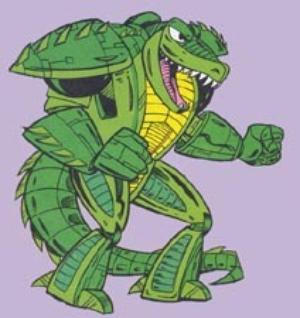
Bill going evil is a reference to issue 61 of “Sonic,” where the platypus was brainwashed by Crocbot's dismembered torso. (Amusingly, Walt Wallaby says this happened “about a year ago,” suggesting the comic has a hyper-compressed timeline.) In order to fill Duck Bill's absence, a new member has been added to the Downunda Freedom Fighters. Thrash the Tasmanian Devil doesn't look much like the real or Loony Tunes Tasmanian devil. Instead, the character trades some barbed dialogue with Dr. Finnitevus. This is setting up a storyline, about the conflict between the echidna and nearly-extinct devils, that Flynn would only get to play out in a compromised manner years later. These scenes are okay but we never get much of a bead on Thrash's personality. And knowing that his destiny would never be entirely fulfilled makes it all feel like a wasted endeavor.

Tying together these story reveals and character beats are a decent string of action sequences. That opening smackdown Knuckles lays on Vector is nicely illustrated by Yardley. The Downunda Freedom Fighters barge in by tearing apart the Wing-Dingos, which is a neat sight. When Finnitevus' inevitable betrayal comes, we get a few more of those clever warp ring gags. There's even a brief panel of Barby putting the villain in a choke hold, proving her skills at pure ownage remain intact. (Yardley's artwork is over all very strong but there is one panel where Knuckles is yelling in rage so hard, that he appears to momentarily transform into a belching toad.)


After two slow issues, “Echoes of the Past” is finally starting to pick up some steam. And Flynn only had to completely redirect the narrative flow to make it work too! There are definitely still some major bumps here, most to do with Julie-Su's weak characterization and Thrash's sudden introduction, but this one worked a little better for me than the previous installments did. And, hey, this story arc does continue to have fantastic cliffhangers. I guess that's an okay way note to end 2009 on. [6/10]

Wednesday, March 22, 2017

Sonic the Hedgehog: Issue 105


Sonic the Hedgehog: Issue 105
Publication Date: December 2001

2001 wasn’t a great year for Archie’s “Sonic the Hedgehog” series. After taking a two month break, so Mike Gallagher and Jim Valentino could indulge their in-joke, Karl Bollers was allowed to pick up where he left off. And, I don’t know, maybe the two month break gave the writer a little time to recharge. “You Say You Want a Revelation” isn’t a great story but, in a lackluster year, it still stands out as one of the better stories.


Karl continues to chop through the mishmash of story lines he’s thrown out in the last year. Sonic and the Freedom Fighters let the loss of Nate Morgan weigh on their minds. That’s when the hedgehog gets an idea. If the Sword of Acorn can restore the free will of robotocized Mobians, why can’t it restore the free will of robotocized Overlanders? Only Sally can wield the sword in this manner and talks her dad into allowing her to go on this mission. Meanwhile, in Robotropolis, Robotnik reveals his master plan – to poison the organic beings with radiation, forcing them to become his robotic slaves in order to survive – to Colin Kintobor and all the other Overlanders in the city.

How do you like your Robotnik? The villain comes in several different flavors. Some of the video games portray him as a stereotypical mad scientist. The “Adventures of” cartoon and other games draw him as a cartoonish buffoon. SatAM and “Sonic Underground” illustrated him as a cold-blooded tyrant. The comic version of Robotnik has fluctuated wildly between the three poles. My favorite version, if you couldn’t guess, is the genocidal dictator, eager to inflict his mad will on the world. This version of Robotnik returns to Archie’s pages with a vengeance in issue 105. After Hope informs her parents that Robotnik intends to roboticize them, the doctor reveals she’s right. He relishes the opportunity, actually. He happily states that he’s a robot and that every fleshy person in the city is poisoned. He joyfully robotocizes Hope’s grandmother before her eyes. I’m not sure why Robotnik waited until now to gloat evilly. But he sure is having fun doing it.


Ever since they returned to Mobius, the Kintobor family hasn’t contributed much to the book. It’s been a plot point that hasn’t gone much of anywhere. After writing Nate Morgan out last time, Karl decides to clip the rest of the Overlanders from the book this time. Hope gets away, as the book had bigger plans for her, but the rest of the family? Turned to robotic statues. About the only important detail rising from this resolution is Snively revealing how much he hates his dad. As much as we pile on the little twerp, he’s truly just as evil as Robotnik is. As for the Kintobors? Who’s going to miss them?

A plot point dragging the series down since issue 99 has been the romantic drama between Sonic and Sally. Issue 105 doesn’t resolve this, as the tiresome Sonic/Sally/Mina love triangle would stretch on for a while longer. The book finally addresses how dumb this is though. Before leaving on the mission, Sonic outright asks Sally if she’s pissed at him. Before she can respond, Mina zooms in and gives her a big hug, thanking the Princess for restoring her mom’s free will. It’s a cute moment. If it doesn’t outright negate the ridiculous love triangle, it at least goes a way towards deflating it.


We even get some action too. Sonic smashes some ShadowBots and has a face-to-face confrontation with Robotnik, something we haven’t gotten in a while. However, the issue pulls back on the action maybe when it was most important. Instead of a big exciting conclusion, the story ends with talking. Robotnik reveals another truth – that only willinging robotocized Overlanders don’t become statues – and let’s the good guys go. Moreover, the Freedom Fighters leave the Overlanders in Robotropolis, allowing themselves to become robots if they want too. It’s kind of a downer ending to what was otherwise a decent story.

In the back pages, Mike Gallagher concludes the Downunda Freedom Fighter story he’s been telling for three months. Guru Emu scales the dam he discovered last time, confirming the suspicions that it’s a leftover from CrocBot’s take-over of the continent. Below the waves, the bunyip has… Safely carried the other Freedom Fighters to an oxygen filled area? Turns out, Barby speaks the Bunyip's language. She levels with the creature, who is just angry CrocBot took away his billabong. Everyone agrees the dam has to go. The Freedom Fighters blow it up, restoring the lake, and making everyone happy.


Here’s a win for empathy, civil conversation, and peaceful resolution. Instead of another fight ensuing with the mythical animal, the Downunda Freedom Fighters instead communicate with their captor. No, it’s not a very satisfying conclusion. Barby’s ability to speak bunyip is the purest of ass pulls. Yes, Gallgher still loads his story with ungainly dialogue. As he enters the dam, Guru Emu takes the time to recap the events so far.

Still, there’s a certain novelty to the story concluding with everyone talking things out, without punching somebody in the face. It’s rare for this book, even if it doesn’t entirely work in this instance. As expected, Gallagher ends the story with another plea for the readers to request more Downunda Freedom Fighter adventures. Considering we wouldn’t see them again for a while, I’m going to say Archie didn’t get too many letters.


Ron Lim drew the cover story. Typically, it looks lousy. His robots look utterly ridiculous. Characters bend wildly off-model during the action scenes. He also has this weird habit of drawing Sally so that she always looks surprised. As for the back-up, Nelson Ribeiro takes over for Dave Manak. Ribeiro is an uneven artist. On the first page, Guru Emu’s hand twists out of shape. All the characters look slightly odd. But nobody is hideously ugly. I also like his decision to surround the first page of panels with wooden frames.

Issue 105 isn’t an A+ book but, compared to what we’ve been getting lately, still feels like a breath of fresh air. [6/10]

Monday, March 20, 2017

Sonic the Hedgehog: Issue 104


Sonic the Hedgehog: Issue 104
Publication Date: November 2001

And we’re back. Instead of devoting one issue to Mike Gallagher and Jim Valentino’s two man circle-jerk (digon-jerk?), Archie felt the need to stretch the gag out for two issues. The Freedom Fighters of the Galaxy wouldn’t be dumb joke characters tossed around for a single issue and then quickly forgotten. They were destined to be dumb joke characters tossed around for two issues and then quickly forgotten. Let’s get this over with.


At the end of the last issue, Sonic and Tailon’s acceptance into the superhero team was interrupted by some asshole called the Silver Snively. The Freedom Fighters battle him for a bit before the chrome surfer flies off. The team regroups aboard a space ship just in time for Robolactus – a planet devouring decedents of Robotnik – descends on the planet. Thus begins a tedious fight between superheroes and supervillains.

At least I actually recognize some of the characters being parodied this time. While the ‘90s version of the Guardians of the Galaxy are mostly forgotten, every person even mildly into comics knows who the Silver Surfer and Galactus are. I don’t know if the Guardians ever fought these guys but, cosmic Marvel being what it is, they’ve probably met at some point. Mashing these two characters up with Snively and Robotnik isn’t very inspired. Snively has nothing in common with the philosophical Silver Surfer. Combining Robotnik and Galactus in service of a big fat joke is such an obvious idea that Archie actually did it already. Issue 38’s terrible Fantastic Four spoof featured Robotnicus, a character who utilized the exact same lame gag.


I complained that the first installment of “Freedom Fighters of the Galaxy” barely classified as a parody, as it was very short on jokes. The second part, to its credit, at least features element identifiable as humorous. They aren’t funny at all but at least they’re jokes. For example, Robolactus digest planets with a giant juicer. When Hawkhawk flies towards space, he kicks up a cloud of smoke that makes his team members cough. Sonic mistakes mircochips for potato chips, coughing up the devices after chewing on them. Antoine’s mangling of the word “how” is mistaken for “ow,” prompting a character to ask if he hurt himself. So, yes, the jokes are terrible. But at least Gallagher was actually trying to be funny.

The blending of cosmic Marvel superheroes and Sonic the Hedgehog is still incredibly awkward. Hawkhawk is a terrible character who makes repeated references to his all-knowing nose. One panel bluntly explains what his real name is, for some reason. The dialogue is full of heavy-handed nonsense like that. Saleta mentions, in passing, that she shares some magical abilities with Hawkhawk. Later, she talks about making space suits out of light molecules for everybody. Robotlactus’ nature is explained thanks to a documentary. Tailon generates four leaf clovers at one point. It’s very apparent that these two series do not mate gently or successfully.


Not that anybody really cares but the ending sucks too. The Freedom Fighters attempt to deflect Robolactus’ attempts to eat their planet. He successfully deflects each attack, the entity proving too powerful for the team. So how do they defeat him? They, uh, don’t. Instead, the Silver Snively grows to giant size, explains that this planet isn’t worth eating, and points Robolactus towards the home world of the Sharks, the previously established evil race of aliens. The Freedom Fighters are fine with this and cheer the villain on as he commits genocide. That’s a little harsh, don’t you think?

I’m guessing Jim Valentino had more important things to do then goof on his cult classic creation for a licensed kids’ book. Valentino did not return to draw part two. Instead, penciling duties are handed over to Dawn Best. Best had been doing okay work for Ken’s Knuckles stories but her illustrations so far seemed slightly rushed and somewhat sloppy. She does much better here. Sally and Bunnie’s superhero personas look awesome as drawn by Best. She handles the action scenes alright. The characters are colorful and expressive. Even Hawkhawk, who has a deeply lame design, looks okay. Best could probably be better used somewhere else but at least she makes this really dumb story look nice.


In the back pages, we continue to get a reprieve from the on-going saga of Chaos Knuckles. Instead, the Downunda Freedom Fighters’ search for the Bunyip continues. Their quest brings them to a drained lake bed. The four gather around a campfire while Guru Emu explains that bunyip’s origin. While the bird is in a trance, the monster surfaces. The creature attacks and kidnaps the other Freedom Fighters. When Guru Emu awakens, he’s alone, tracking the creature to a near-by dam.

Mike Gallagher has really been leaning on exposition here of late. Far too much of “Sadly Myth Taken’s” second half is devoted to Guru Emu dryly detailing what a bunyip is. The dirty hippy goes on about the creature’s mythological roots. It’s as if Gallagher was really impressed with himself, drawing on actual Aboriginal mythology for his goofy story. The action scenes aren’t much to write about. The bunyip is so large that it forces Dave Manak to draw the characters very small, creating a serious lack of detail. The bunyip itself is an uninspired creation, a big, grey, and indistinct creature with trees growing out of his head.


A part of me really wants to hate this two-parter. Archie disturbing the flow of the story to goof around for two issues should be annoying. That the story itself is so lame and pointless should also frustrate me. But it doesn’t, possibly because any escape from the high-strung plotting and melodrama of the book’s Dork Age is welcomed. It’s crap but a different flavor of crap from what we’ve been getting recently. Consider that the faintest of faint praise. Click the picture above for more goofballery. [5/10]

Wednesday, March 15, 2017

Sonic the Hedgehog: Issue 103


Sonic the Hedgehog: Issue 103
Publication Date: October 2001

Archie has done it before. Their “Sonic the Hedgehog” series was heavily serialized by this point. Occasionally, Archie would interrupt the on-going plot with some ridiculous story outside of continuity. Usually, these concepts were things that had clearly been sitting on a shelf for some time, put aside for when a deadline quickly needed filling. It’s quite apparent to me that such a situation led to the two-parter that filled issues 103 and 104. Both the cover story and back-up were created by Mike Gallagher, who hasn’t written for the book for a while. Both stories hearken back to the comic’s early days, when “Sonic” was filled with silly parodies, slapstick, and sight gags.


Issue 103’s cover story is, specifically, a parody of Marvel’s Guardians of the Galaxy. When people hear that name today, they think of lovable characters like Rocket Racoon, Groot, and Starlord. They think of the hugely successful film adaptations from James Gunn. Archie wasn’t paying homage to that version of the Guardians, which wouldn’t come into existence until years later. Instead, they were goofing on the version of the team that existed in the early nineties. This particular incarnation of the Guardians has a cult following but it still pretty obscure. Even huge nerds are unlikely to be familiar with characters like Nikki or Aleta Ogord.

Why would Archie build an entire two-parter around referencing such an overlooked group of characters? The “Sonic” editors were obviously friendly with Jim Valentino, since the artists previously worked on “Sonic Super Special” and “Knuckles the Echidna.” Valentino would come to fame for his 29 issue run as writer and artist on “Guardians of the Galaxy,” which was mildly popular. And who followed Valentino as the writer of that series? None other then Mike Gallagher, who not coincidentally wrote these two issues. In other words, this dumb story is basically an in-joke between friends, inflicted on Sega’s blue hedgehog for some reason.


So, anyway, what the hell is this damn thing about? Zonic the Zone Cop presents the tale as taking place in an alternate zone. Sonic returns to Mobius, after spending a thousand years drifting in space. While he was up there, oyster-headed aliens built him a super suit that transferred his super speed into psychic, kinetic energy. Upon touching down, he sees that the planet has been transformed into a hellish wasteland. After fighting a series of robotic Knuckles, he meets a group of galactic superheroes, descendants of the Freedom Fighters he knew.

In order to find a parody amusing, one must be at least somewhat familiar with the source material being parodied. While it’s not necessary to enjoy them, “Young Frankenstein” and “Airplane!” are way funnier if you’ve seen a few Universal Frankenstein flicks or the “Airport” movies. Like the majority of people, I’ve never read Valentino’s run on “Guardians of the Galaxy.” So I don’t really get the gag. Even if I did, I suspect “Freedom Fighters of the Galaxy” isn’t the best parody. The jokes mostly extend to creating mash-ups between the Marvel and Sonic characters, with punny names like Tailon or Twan-Du.


In truth, quite a bit of the comic is devoted to painful exposition. Zonic talks about this zone. Sonic explains how he got tossed in space, how he got his new powers. Tailon explains how Robotnik destroyed Mobius during a War of the World. (Yes, they call it that.) The Freedom Fighters of the Galaxy explain their individual powers. After the fight is over, the members of the team provide their back stories, involving the Freedom Fighters traveling to other worlds and adapting to the new environments in different ways. Gallagher even indulges in some exposition of his own, by explaining that an evil race of aliens called the Sharks grew out of the Forty Fathom Freedom Fighters. (In another throwback to the book’s old days, Gallagher directly asks the reader if they want to see more of the Sharks. Considering this is their only appearance, the answer was presumably “no.”) If there are jokes here, they’re buried under the weight of countless info-dumps.

Presumably, Gallagher and Valentino’s work on the actual “Guardians of the Galaxy” was less strangled by explaining who the characters are. When not expounding on everyone’s personality, this issue features some mildly captivating action. Sonic and Tailon smash some Brass Knuckles. The Freedom Fighters of the Galaxy shoot laser beams, leap around, and display super strength. It would be more diverting if the characters didn’t have to stop and give us their life stories every other panel.


During his previous go-arounds at Archie’s various “Sonic” titles, Valentino’s artwork has been iffy. His illustrations for the Image crossover were incredibly flat. His “Knuckles” pencils were hideous. He does somewhat better here. The character designs are fairly unappealing, especially Hawkhawk, a new character that is a spoof of Starhawk. But nobody bends in horrifyingly ugly ways. Sally and Bunnie even look quite fetching, poured into their superhero suits. Valentino experiments with the page lay-out in mildly interesting ways. It’s not a great looking book but it doesn’t cause my eyes to melt out of my sockets.

Issue 103 is a Mike Gallagher two-fer. “Myth Taken Identity” revolves around Gallagher’s beloved Downunda Freedom Fighters. After Wombat Stu left the island to join King Acorn’s Secret Service, the team holds auditions for a new fifth member. The disappointing turn-out causes them to reminisce over how the team came together in the first place. Afterwards, one of the applicants is brutalized by the Bunyip, a fearsome creature from Australian mythology.


Much like the cover story, “Myth Taken Identity” is front-loaded with exposition. But at least, this time, it concerns characters we have some investment in. Most of the back story revolves around an origin story for the Downunda Freedom Fighters, something I might have wondered about in the past. It’s a bit underwhelming. Walt Wallaby literally stumbled into Guru Emu. In quick succession, the two met up with Duck Bill, Wombat Stu, and Barby Koala. Disgusted with Crocbot’s burgeoning take-over of the continent, they united to fight against him. I would’ve preferred the team coming together in a more natural way. But it is sort of neat to learn their origin.

It’s a shame that “Myth Taken Identity” is mostly devoted to goofy jokes. The first two pages focus on the applicants for the team, all of whom are goofy joke characters. Such as a kookaburra who sings badly, a mildly racist immigrant rabbit, and Ram Marino, a ram football player. Since one Marvel reference wasn’t enough for Gallagher, one of the applicants is Dare-Dingo, a dingo version of Daredevil. Befitting the jokey tone, Dave Manak draws the story. It’s clear Manak hasn’t drawn these characters in a while, as they are quite off-model.


Issue 103 isn’t very good but, you know, it doesn’t offend me. It’s a harmless joke, too dumb to be annoying. And it’s not as if the current storyline was super involving, so I don’t mind it being interrupted too much. The back-up is also very dumb but mildly interesting. Speaking of stupid in-jokes, come back next time not for the second part of this story but something entirely different instead! [5/10]

Friday, September 16, 2016

Sonic the Hedgehog: Issue 61


Sonic the Hedgehog: Issue 61
Publication Date: May 1998

Just as Mike Gallagher previously returned to his much unloved Horizont-Al and Verti-Cal concept, the same writer revisited another favorite creation of his in issue 61. Unlike the gravitationally challenged twins, the Downunda Freedom Fighters arguably deserve more love. Considering one of the points of the post-“Endgame” story arc is Sonic and Tails exploring their world, traveling back to Downunda even makes sense. Despite the Australia inspired characters getting the front cover, there are two other stories in issue 61.


The poorly titled “Outback Gut Check” begins with Guru Emu and Wombat Stu in a cage, surrounded by angry platypuses. Luckily, Sonic, Tails, and the other Downunda Freedom Fighters arrive to rescue them. Except for Duck Bill, that is. Apparently the platypus went power mad following Crocbot’s defeat in “Endgame” and led a revolt among his species against the other Fighters. Now, Sonic and the rest have to figure out what’s up.

You never really know what you’re getting when Mike Gallagher’s name is on the script. Though he’s delivered mini-epics like the “Mecha Madness” saga, even his best work has a goofy streak. “Outback Gut Check” is not Gallagher’s proudest moment. The story follows a dull construction. Sonic and the gang rescue Guru and Stu, Walt Wallabe explains what’s up, the heroes have another encounter with the hostile platypus on a river, before they wander into Bill’s headquarters. The reveal is disappointing as well. Turns out, Crocbot is behind it. He slipped a mind-control chip on Bill’s head at some point. Crocbot’s disembodied torso has been delivering orders to the platypus ever since. That’s a sloppy explanation. It also doesn’t explain how Bill successfully rallied the other platypuses into revolution.


The emotional heart of the story, how the other Downunda Freedom Fighters feel about Bill’s betrayal, is shoved into the margins of the story. The other element of heart involves Barby and Tails’ growing feelings for each other. Many fans find the romance between Tails and the much older Barby to be gross, Ian Flynn among them. It’s never bothered me. Sonic and his friends are all technically kids anyway. Tails has always acted a lot older than his canonical eleven years too. Besides, Barby’s affection is never anything more than some hugs and kisses. It’s more cute than anything else. If the series actually allowed its characters to grow up, Tails and Barby could’ve had a serious relationship in a few years. Though potentially interesting, this aspect of the story occupies a few word bubbles at best.

Another problem with “Outback Gut Check” is the artwork. Long time inker Harvey Mercadoocasio draws this story. Harvo’s art has varied in the past from awful to passable. Issue 61 is also not one of his better days. The characters are gangly, angular and pot-bellied. The character’s limbs are often out of proportion with the rest of their body. Harvo frequently draws Barby with a body befitting a human female, instead of a furry creature. The platypus gang gets it the worst, all of them looking like indistinct blobs of bills, beaver tails, and jagged bodies. Even the colors are ugly, blurred and washed-out.


The first of the two back-up stories also focuses on Sonic and Tails’ travels around Mobius. In “Total Turbulence,” the Winged Victory runs into a rough storm cloud… That just happens to be control by Ixis Naugus. Though the sorcerer attempts to scuttle the heroes with the turbulent weather, Sonic and Tails survive by flying the plane right into his face. That’s it.

What purpose does this story serve? Mostly, it’s to remind us that Ixis Naugus is still out there. Sonic’s’ journey around the world was technically about tracking the wizard. Admittedly, this hasn’t come up much recently. Considering Sonic and Tails will be fighting the wizard again in two issues, Bollers probably felt it necessary to remind us of his existence.

The other reason this brief four pager ran was to introduce us to Steven Butler. Butler would become the regular illustrator of the book for a while after this. While not everyone is a fan, I’ve always loved Butler’s work. He had a grasp on the character’s designs while bringing his own style to it. There was also a certain gritty, sexy quality to his work that I like. That isn’t shown off to much in this story. Truthfully, Naugus looks pretty silly. However, the four-pager does show off how good Butler is at action and dynamic frame layout.


The last story continues the “Tales of the Freedom Fighters” back-up. After nearly getting blown up by a still lingering Robotnik trap, Geoffrey St. John’s partner Fleming tells him he’s ready to retire. Geoffrey decides to round up a new team. He travels to the Floating Island and recruits a chameleon, finds Wombat Stu in Downunda, and recruits Hershey the Cat from his own office.

I wish more insight into St. John’s choices were made. Valdez the Chameleon isn’t even named in this story. He doesn’t get a proper introduction, appearing in two whole panels. Why Stu is chosen boils down to St. John liking his youth. Considering Downunda is in a transitional state, you’d think he would want to stick around. Hershey doesn’t even get that much. It’s kind of a bummer of a story. At least Art Mawhinney’s art is nice.

All of the above combine to make issue 61 underwhelming. [5/10]

Monday, August 22, 2016

Sonic Super Special: Issue 4 - Return of the King


Sonic Super Special: Issue 4 – Return of the King
Publication Date: January 1998

In Sonic Super Special Issue 2, Archie stole their title from Aldous Huxley. With Sonic Super Special Issue 4, Archie stole their title from J.R.R. Tolkien! Well, if you’re going to steal, steal from the best. Anyway, I have a specific memory attached to “Return of the King.” At some point, I left the comic in the bathroom as commode reading. Afterwards, my mom actually picked up the comic and read it. She really liked this story, which surprised me. I didn’t bond with my parents over Sonic the Hedgehog that often, I can tell you that.


Picking up after that ridiculous Mammoth Mogul business was resolved in issue 56 of “Sonic,” the Freedom Fighters arrive in Mobotropolis. King Acorn greets them and claims to be of sound mind. This is in contrast to the last time they saw him, when he was yelling about dismantling all the Robians. The Freedom Fighters act unusually antagonistic towards the Robians and re-convince the King to commit genocide against the robotic citizens. Later, the Freedom Fighters seemingly re-arrive in the city, which is gripped by civil war. Their plane is shot down and they find themselves targeted by soldiers of the king and Robian rebels. After Uncle Chuck is nearly killed, Sonic realizes something is up.

Too often in recent memories, the “Sonic” series has fallen back on magic and omniscient higher powers manipulating events. That doesn’t change any in “Return of the King.” Readers will immediately notice how out-of-characters the Freedom Fighters are acting. Considering Sonic and Uncle Chuck’s reconciliation in issue 54, the hedgehog continuing to blame his uncle is definitely an uncharacteristic moment. King Acorn continues to act like a huge cock, a brief talk with his daughter being all the convincing he needs to massacre the Robians.


The Mobian soldiers and Robian rebels taking shots at everyone is also explained as an act of magical manipulation. That’s right, guys. Ixis Naugus is back in town and fucking with everybody’s shit. On one hand, this nicely explains where the evil sorcerer has been since the end of issue 53. He’s been hiding inside King Acorn, possessing his body. However, as an explanation for the King’s extreme actions and a motivator for the plot, it’s undeniably lazy.

Also lazy: The role the Sword of Acorn plays. Three times, the Sword is used to heal someone in this story. After a soldier with an itchy trigger finger blows Uncle Chuck away, Sonic grabs the sword, ready to murder the guy. Luckily, the blade repairs Chuck and frees everyone from Naugus’ manipulation. After realizing Naugus has possessed the King, Sonic flashes the sword to exorcise Max’s body. The magic also saves both from falling to their deaths. On the story’s final page, the Sword reverses King Acorn’s crystallization. Gee, is there anything the Sword of Acorn can’t do? Apparently an alternate spelling for “sword” is “deus ex machine.”


For one last ass-pull, Karl Bollers remembers that the King’s magical crown was lost in the Halls of Limbo. After being de-crystalized, the Crown reappears on Acorn’s head. Get this!: the Halls of Limbo where located within his own mind.

Despite these narrative problems, “Return of the King” is still a solid page-turner. Though he has some annoying tendency, I admire Bollers’ willingness to take these characters and their world seriously. After Uncle Chuck is shot, his body has a huge hole blown through his chest. Smoke billows from his vacant eyes and opened mouth. Sonic is outright ready to kill the shooter after that, pointing the sword at his chest. Holy cow, is this still a kids’ book? What resolves this moment marks the first time Sonic’s parents have done anything since they’ve been introduced. Jules and Bernie appear and talk Sonic back from committing homicide.


Sonic isn’t the only character who re-connects with a parent. After his mind is freed from the wizard, Sally gives the King a deep hug, father and daughter truly reunited for the first time. During the fall, the Sword landed upright in a stone. In a nice mythic touch, King Max pulls the sword from the stone, the action that restores him fully.

Sam Maxwell pencils the story. While I was impressed with his debut in “Battle Royal,” Maxwell’s subsequent work has underwhelmed me. The artist is back in form with “Return of the King.” I continue to love the way he draws Princess Sally, which filters her original design through an anime lens. That style, which includes big heads and spindly bodies, takes some getting use to. I like it though, as it recalls the original game artwork. Maxwell is also really good at action, bringing a dynamic energy to the sequences, framing the panels like cinematic story boards.


The second story in “Return of the King” takes us back to “Endgame.” In “Down and Out in Downunda,” Antoine and Bunnie recount how they escaped Crocbot’s prison camp in the spaces between issues 49 and 50. Basically, Bunnie outsmarts her captive. She slips her organic hand out of her shackles, blows the explosive collar, and knocks down the cell door. The Downunda Freedom Fighters prepare to make scrap metal out of Crocbot’s robotic soldiers. While they whoop ass, Bunnie and Antoine sneak aboard Crocbot’s cargo ship. There, they defuse a plan by the reptilian mechanoid to nuke Robotnik’s city.

“Down and Out in Downunda” continues the gritty tone established by the title story. Barby and Walt Wallabe worry that Crocbot has murdered their team meets. Later, their captor out-right proclaims his desire to kill his captives. When Bunnie frees their cellmates, they are so pissed off. The Downunda Freedom Fighters may not have the most defined personality but there’s one thing they do well: Kick ass! Watching them tear apart the bad guys is so satisfying.


The business on the ship is a lot less interesting. An entire panel is devoted to a recording of Robotnik explaining what the Ultimate Annihilator is. Though Crocbot planning to betray Robotnik is definitely in character for the robotic minion, I’m not exactly sure why Bunnie and Antoine defuse this plot. You’d think they see it as a chance to take out their greatest enemy. Or did they figure that Sonic would be in town by that point?

Parts of “Down and Out in Downunda” where originally intended to appear in issue 50. Most of the story would be reprinted when the extended cut of the issue was presented as the sixth Sonic Super Special. Nelson Ortega does the artwork and it’s swell. His image of an angry Barby, showing her claws, is probably my favorite drawing of that character. His action is brutal and direct. His facial expressions are serious. His artwork both pairs well with Sam Maxwell’s work on the main story and has a gritty energy and gravitas all its own.


Truthfully, I like a lot about “Return of the King.” The artwork is good throughout, the script wraps up several story arcs, the book has a serious tone and an emotional heart. I just wish the plotting was a little less contrived. Oh well, that’s comic books, I suppose. [7/10]

Wednesday, July 13, 2016

Sonic the Hedgehog: Issue 49


Sonic the Hedgehog: Issue 49
Publication Date: May 1997

The first two parts of “Endgame” were fairly solid comic books, doing a good job of balancing emotion, action, and intrigue. The stakes had been steadily rising in the book for a while, all leading up to this four part story arc with the highest stakes yet. Princess Sally is dead! Sonic the Hedgehog is wrongfully accused! Robotnik is in Knothole! Antoine and Bunnie are captured! Drago just smacked his girlfriend in the mouth! In the third volume, Ken Penders would partner with Mike Gallagher, a writer that usually handles goofier stories, though has done well outside his comfort zone before. I’m not sure if Gallagher’s influence is to blame or if Ken’s plot just rolled over itself, but issue 49 is the weakest part of the arc thus far.


Picking up where we left off, Sonic is making a dramatic dive over a waterfall. Too weak to perform his Figure 8 Maneuver and hover to safety, he instead tries another ridiculous plan. He pulls dirt out of his sneakers, tosses it into the air, and uses it as a bridge to run to safety. Afterwards, St. John and his men take the long way around to catch up with him. Using a previously undisclosed ability, Sonic summons Dulcy, who carries him to the Floating Island for some reason. Sonic is unaware that St. John is tracking him though and the skunk ambushes him as soon as he arrives. Meanwhile, Robotnik asserts his control over Knothole while Antoine and Bunnie get acquainted with their prison cells in Downunda.

You’ll notice that plot description has the writers’ pulling a lot of crazy events out of their asses. Since this is a book starring cartoon animals, we’re willing to suspend disbelief for a while. It’s why Vector blowing out a forest fire with his headphones didn’t faze me. However, Sonic’s dramatic escape here really pushes into the ridiculous. I know the hedgehog is fast but him taking off his shoes, yanking a handful of mud out, tossing it into the air, and using his speed to run across it… All within the seconds it would take him to fall? Come on. That’s not the last startling development yanked out of thin air. A few pages later, Sonic summons Dulcy with a whistle that only dragons can hear, which he performs by vibrating his lungs at super-sonic speed. Dulcy immediately recognizes Sonic didn’t murder Sally because dragons can innately sense the truth. Gee, you’d think either of these abilities would’ve come up before hand at some point.


These shenanigans continues elsewhere in the book. In Knothole, Robotnik reveals that the King Max that invited him in with open arms is an Auto-Automaton, surprising absolutely none of the readers. Next, we learn that the real King Acorn has been kept in a secret location. Robotnik captured Dr. Quack’s family and had been blackmailing him into going along with this scheme. I guess that makes the duck the traitor, doesn’t it? Next come the reveal about who actually murdered Princess Sally. Drago coerces Hershey into cutting the rope while wearing a full-body Sonic suit. She thought she was murdering Snively because… dun dun DUN DUN! …the lens in the mask make everyone look like Snively. This makes Hershey look incredibly stupid, as you’d think she would have asked why she had to wear a Sonic costume for this mission in the first place. It’s some incredibly awkward, circular plotting and does the story a disadvantage.

Another problem arises in how over the map this comic is. Our emotions lie with Sonic’s escape and St. John pursuing him. That’s what really matters. Perhaps in hopes of making the story arc more epic, the script stretches to include other characters. Antoine and Bunnie are relocated to Downunda within minutes, it seems. There, they are thrown in a prison cell with Walt Wallaby and Barby Koala, of the Downunda Freedom Fighters. There’s actually some cute dialogue here between Antoine and Bunnie. It’s also nice to see the underutilized Walt and Barby again.


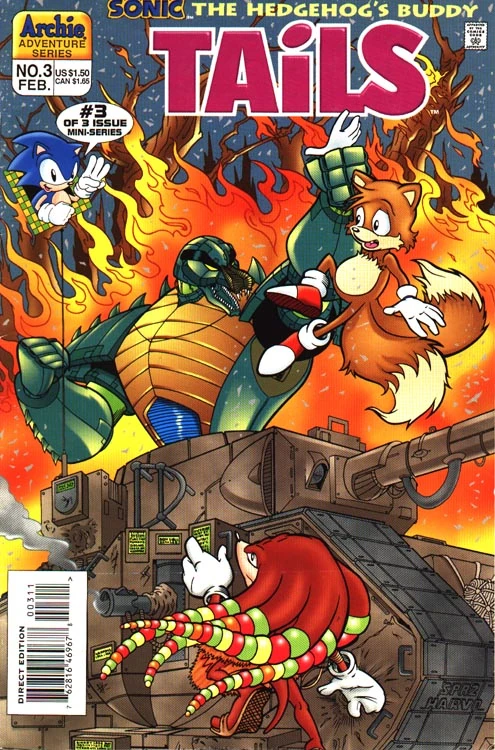
However, the story stomps all over this by bluntly reintroducing Crocbot. Instead of focusing on what’s important, the plot pauses for an entire page so Crocbot can explain how he survived his drop into the crater at the end of the “Tails” mini-series. (Mostly, this plot development seems to have happened so that Crocbot in the comic would more closely resemble how Spaz drew him on the covers of that mini-series.) Meanwhile, Sonic has Dulcy take him to the Floating Island for… Some reason? Upon landing, he immediately gets into a scrap with Knuckles. You’d think the hedgehog would realize slightly more important things are going on.

The book also continues to slide into darker territory here. We see Drago actually smack Hershey in the mouth, on-page this time. Robotnik directly threatens to murder everyone in Knothole, after exploding the robotic King Acorn. While in Downunda, Crocbot boasts about torturing the captured Downunda Freedom Fighters for his own sadistic amusement. Murder, blackmail, betrayal, death threats, torture… Gee, this shit got heavy. I’m not actually complaining, as I’m one of those assholes who have always wanted to see the book handle darker material. Yet, considering just four issues ago we had a wacky story about a caveman and gorillas, it’s a bit of a tonal whiplash.


Though the plot here is a bit of a mess, the book does have a saving grace. Sam Maxwell, last seen in the “Battle Royal” one-shot, contributes pencils again. Maxwell’s work is less abstract and experimental then what we saw in that book. The characters are a little more solid though no less expressive. What he maintains is an incredible sense of energy. Say what you will about the halting script but the drawings on the page still seem to move. Maxwell is also all for staging pages in dramatic manners. His impressive angle, including close-ups and turns, greatly help the book out.

With a mountain of absurd plot twist and a story bending in too many directions, “Endgame” stumbles a bit in its third chapter. Will things even out in time for the conclusion? I guess we’ll find out next time on “Hedgehogs Can’t Swim!” [6/10]


Friday, April 15, 2016

Tails (Mini-Series): Issue 3


Tails (Mini-Series): Issue 3
Publication Date: December 1995

Issue 3 of the “Tails” mini-series opens with exposition and more exposition. Athair confirms what we suspected in the last issue. The Great Crater is where the Floating Island, and a scientifically advanced city of echidnas, floated into the sky to avoid a white comet from striking them. Athair then explains that he’s Knuckles’ great-grandfather, thanks to some helpful illustrations on the wall of his cave. Possessed by the spirits of the Ancient Walkers, Tails then expounds on how the Chaos Emeralds fell from the sky in prehistoric times, granting a few dinosaurs immortal life… And how the gems’ great power has been abused over the years, most prominently by an echidna scientist. (Yet again, this is more foreshadowing for Knuckles’ mini-series in Tails’ comic.) Lastly, a prophecy about someone bringing all the chaos emeralds together is dropped, with Tails hinted to be that person. If Tails is going to develop into a great hero, he certainly doesn’t show it any here, since he spends the whole series getting his butt kicked.


At least Tails actually gets a little involved in the action this time. CrocBot activates his secret weapon, a giant robotic ram called... Sigh... the CD-ROM Ram. This tosses Barby Koala all the way into Tails’ lap, setting up that doomed ship. Tails flies her back into the action, distracts CrocBot enough so that Robotnik’s supply blimp pulls a Hindenburg, and helps Guru Emu take out CrocBot at the very end. Even then, Tails is only assisting the story’s real heroes save the day. You get the impression that Mike Gallagher wanted to write a DownUnda Freedom Fighters mini-series, not a Tails mini-series.


Listen, I like the convoluted mythology of the Archie “Sonic” series. Otherwise, I wouldn’t be wasting so many hours reviewing the damn things. Yet I’ve never been a super big fan of the book’s tendency to favor long-winged prophecies. Do prophecies in fiction ever actually work? All it does it build up to some big event that the story can, in no way, live up to. The Chosen One concept has become one of the most overused and stuffy plot points in modern genre fiction. Tails being a Chosen One is one of those storylines that the “Sonic” book wouldn’t be bothered to resolve for years. Forcing it into his mini-series, when he seems especially incompetent, certainly doesn’t boost the legend’s believably any. It mostly just bogs the book down in a bunch of mumbo jumbo.


What about that action? After spending two issues doing nothing but scheming, CrocBot finally gets to show off his villain credentials some. As goofy as it is, the CD-ROM Ram does wreck the Downunda Freedom Fighters’ collective shit. Yet when he has the opportunity to murder his enemies, when he leaps in a battle tank, CrocBot instead just runs away, making himself vulnerable to his defeat. The dude’s a giant robotic crocodile in a nuclear-powered murder tank. Why didn’t he make mincemeat of the Downunda Freedom Fighters, especially when they were already weakened from a previous battle?


The “Tails” mini-series ends with Tails realizing that he’s needed back in Knothole, despite currently being in a now badnik free country with a hot older koala woman who definitely wants to jump his bones. The story could’ve spun this into Tails learning a lesson. After spending three comic books being way in over his head, maybe he should’ve realized that Sonic and Sally are right to treat him with kid’s gloves. The book doesn’t really play that up. There are some tearful goodbyes before Tails jumps in the Sea Fox and heads home.

The “Tails” mini-series was seemingly built upon wasted potential. Devoting a whole book to Tails, especially when he was at his most angry and annoyed, could’ve deepened his personality considerably. The mini-series introduces a bunch of new characters but doesn’t have the time or patience to develop them much. All the mythology-building and prophecy-humping the book did would be more successfully expounded upon in other series. It’s a shame. In the post-story editorial, even Scott Fulop doesn’t seem enthusiastic about telling future stories about Tails. The best thing the book does is expand upon Sonic’s world, which probably would’ve happened any way.


It’s a bummer. The main book would continue to struggle with what to do with Tails, exactly. Eventually, Sega would decide that Tails was a kid genius mechanic. However, Rotor already held that title in the comic. It wasn’t until Rotor was slightly retired that Tails would start to find his niche. That’s a long ways off, readers. All of this is character development that could’ve been handle in this book. The weirdest thing about the “Tails” mini-series is that Tails himself doesn’t play nearly a big enough role in it. [5/10]