Showing posts with label caleb goellner. Show all posts

Friday, September 15, 2023

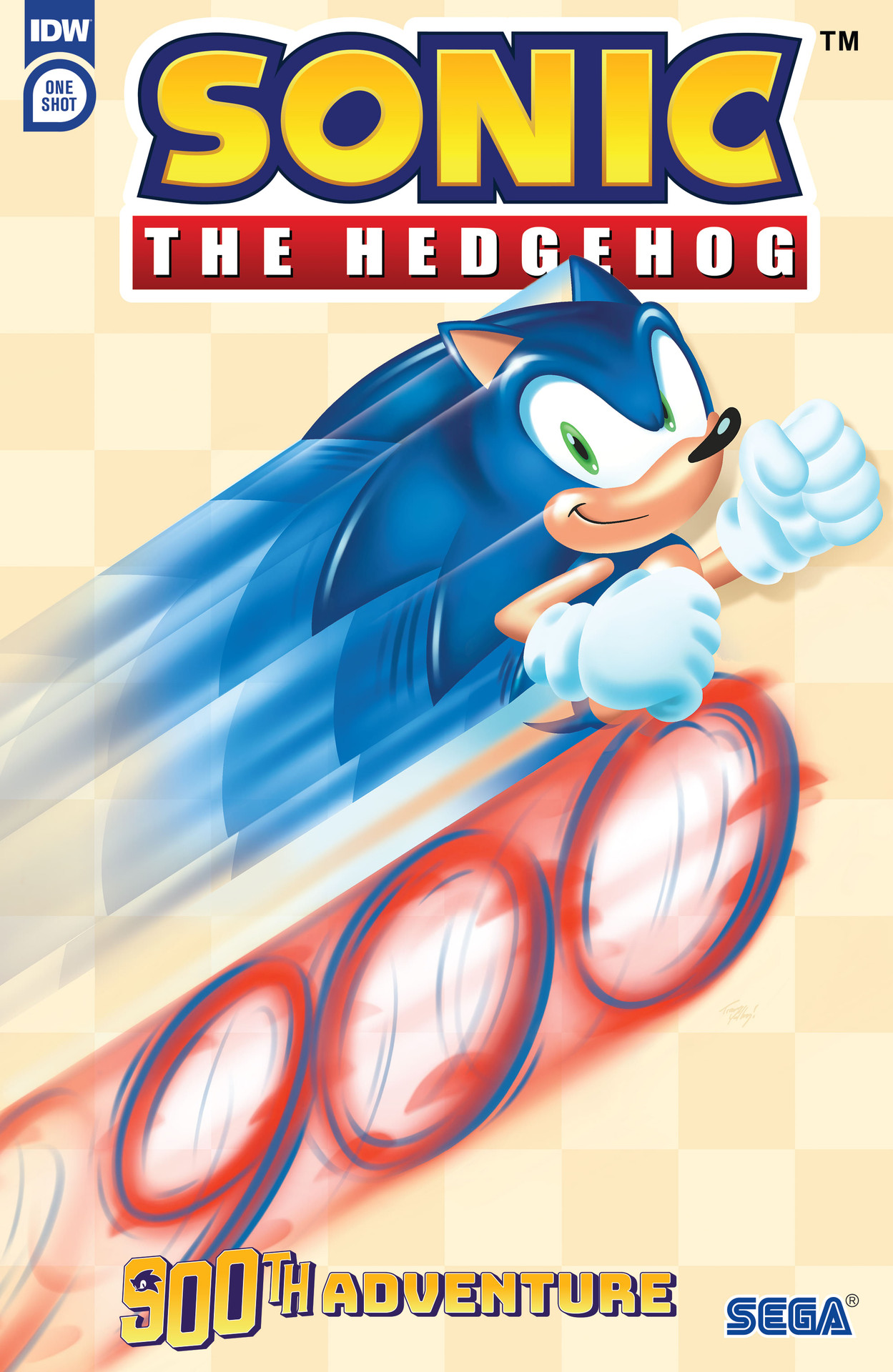
Sonic the Hedgehog's 900th Adventure


Sonic the Hedgehog's 900th Adventure
Publication Date: September 13th, 2023

How many adventures has Sonic the Hedgehog had? It's the question perhaps worth asking. In the 32 years Sega's super-fast mascot has existed, he's lint his spiny likeness to almost every piece of media imaginable. He's appeared in dozens of video games. Sonic has had long runs at three different comic book publishers and even a short-lived comic strip. Six television programs, two live action movies, one Japanese OVA, and several bits of short animation have bore his name. Hell, there's even been actual books published about the blue hedgehog! And that's only limiting our query to media published in English-speaking countries. In addition to all that, there's a handful of “Sonic” manga, a short-lived French comic book, a Russian game show featuring the hedgehog, and a Portuguese text book for some reason.

That's a lot of adventures! I'm not going to hazard a guess of how many exactly that is but IDW apparently did. The second one-shot they've published this year is called “Sonic's 900th Adventure.” They claim, in the introduction, that this comic book is in fact the 900th release centering around the hedgehog. Honestly, I'm skeptical. Just the bullshit I mentioned above makes me wager it's a lot higher than that. And how exactly is IDW defining “adventure” here? Did they count every video game he's shown up in or just starring roles, disqualifying guest appearances and cameos?  Did “Sonic's Schoolhouse” grace the IDW editor's eyes? How about the SegaLand Sydney puppet musical? Is a commercials for Korean sneakers or Australian ice cream worthy enough to be included in this total? What about a parade balloon? An amusement park ride? Is a can of Spaghetti-Os an adventure? 


Putting my needless nerdy pedantry aside, Sonic has had a metric shit-ton of adventures. However many it's actually been, IDW is seeking to celebrate them all with this one-shot. The “900th Adventure” begins with Sonic and Tails chilling around his workshop, feeling nostalgic. That's when the Warp Topaz, the teleporting bric-a-brac that Dr. Starline utilized, manifests itself on Tails' couch. Fearful of its supercharged readings, Sonic endeavors to put that thing back where it came from before it causes anymore problems. The Topaz zaps Sonic all over the world and to different locations. This brings him into contact with his various friends, enemies, and rivals, often passing the plot device off to them like a hot potato. Will the super-fast blue dude with 'tude safely return the Warp Topaz to its point of origin and survive to see his 901th adventure? What do you think?

Essentially, “Sonic's 900th Adventure” is a quick tour through Sonic's main supporting cast. Perhaps in hopes of appealing to as wide an audience as possible, this is limited strictly to Sega-created characters. Tangle and Whisper are nowhere to be seen, even though this story explicitly takes place in IDW canon. Instead, the focus remains on the most popular members of the wide “Sonic” cast. Tails, Knuckles, Amy, Shadow, Rouge, Blaze, Cream, Eggman, Metal Sonic, the Babylon Rogues, Cubot and Orbot, and the grouchy orca from “Sonic Adventure” all put in appearances. Sorry to all the fans of Tiara Boobowski and Hip and Hop, they didn't make the cut. I didn't expect any deep cuts though it is a little disappointing that a supposed celebration of Sonic's history limits itself to just the basic bitch cast members. The 30th Anniversary Special did a much better job of acknowledging Sonic's lineage, even within the boundaries of IDW's licensing contract. 


In other words, this comic isn't a whole lot more than “Sonic” characters marching on-screen, doing something vaguely plot relevant, and then the hedgehog is off to see the next guest star. There's only so much wiggle room within these constrains but the script still manages to squeak out some character beats or development. Blaze considers going on without her friends, because she's the self-sacrificing type. Cream has a big rant about how she wants to appear on this adventure, because she's a little kid always trying to prove herself. Amy gets to fawn over Sonic and even gives him a big hug, in a moment sure to be adored by shippers. Probably the best moment has Sonic tricking both Tails and Metal Sonic by pretending the Warp Topaz is draining more of his energy than it actually is. That's the wily hedgehog we know and love.

However, some of the other characters are reduced down to just a couple of quick gags. Eggman gets mocked, while trading some barbs with Sonic and his robot henchmen. Shadow and Rouge appear to belittle the Babylon Rogues, their personalities reduced down to their most simplified versions of themselves. Shadow brags about being the Ultimate Lifeform, Jet is haughty, Rouge likes shiny shit. Wave and Storm are... There, I guess. You can definitely tell which characters the writers felt they could actually do something with and which one they shoved into the issue because they had to. 
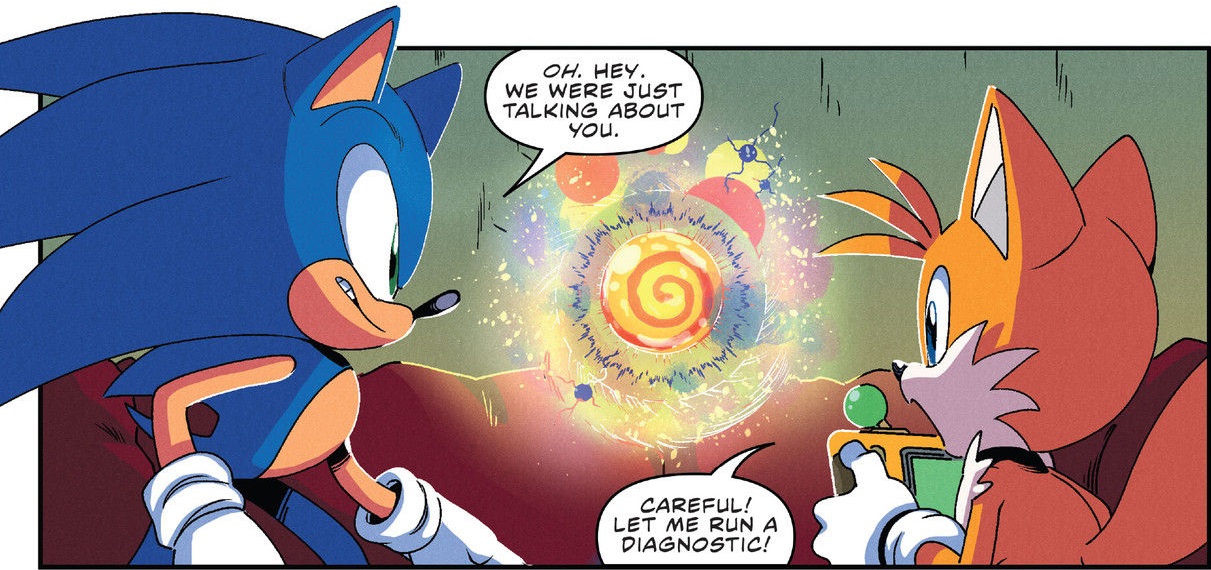

Since there's not going t be any actual character development or forward-movement of the overall arc in this one-shot, its story has to be rated on its own goals. The stakes are really high here. Tails is concerned that the Warp Topaz's out-of-control energy levels might even destroy the entire world. Despite that, the issue here is pretty light-hearted. Sonic never seems that worried, cracking jokes like always. The other characters are largely farcical too, Knuckles and Amy getting little funny panels to themselves. Moreover, the script never makes it entirely clear what exactly the Warp Topaz is doing. It's opening portals all over the place but, otherwise, there's a lot of talk about how dangerous the situation is without the reader being given total understand of what that means.

It seems to me that “Sonic's 900th Adventure” was clearly conceived as a way to spotlight as many of Sonic's friends as possible and an actual narrative second. When taken on their own, some of these sequences are fun. The bit where Sonic and Amy fight the whale is entertaining enough. So is Eggman dueling Sonic from within a Mazinger Z homage. Yet I was left wondering what exactly the point of all this is. We discover that the Warp Topaz comes from some weird cave in an obscure corner of the world, which is a contribution of sorts to the overall lore. The final scene takes the Warp Topaz out of the story while also leaving open the possibility that it could return some day. But, over all, this strikes me as an inessential story that doesn't add too much to the comic's world or stand too strongly on its own.


Another way “Sonic's 900th Adventure” was meant to be a celebration of Sonic's history is by featuring multiple different writers. I hope no one was disappointed ot see that this mostly meant established IDW “Sonic” crew members. That means Ian Flynn, Evan Stanley, Daniel Barnes, Aaron Hammerstein, and Caleb Goellner contributed to the script. It's not like any of the Archie writers were going to show up, having either moved on or simply have too much baggage to be hire-able. The one really neat addition here is Nigel Kitching, one of the main writers for Fleetway's “Sonic the Comic.” This is Kitching's first contribution to a “Sonic” project in over twenty years, making his appearance a big deal for fans of that particular branch of the franchise. 

However, six people writing one forty page story is the kind of situation that rarely produces great art. A set-up like that is either going to result in a mess of conflicting tones or everyone's styles being flatten out into a homogeneous, bland whole. The opening credits box lets us known which authors are responsible for which pages. Can you tell who wrote what pages? Flynn's pages are fairly distinctive, with Sonic cracking some one-liners that seem recognizable as his style. Evan Stanley tries to do some similarly snarky humor on her pages but it comes off as more awkward than anything else, while the relationship stuff between Sonic and Amy is more her speed. Daniel Barnes gets to write some jokey dialogue for Cubot and Orbot, including a shout-out to the infamous “Big oof” panel, but otherwise I don't think I noticed that the same guy who wrote “Scrapnik Island” wrote that sequence. 


I'm not super familiar with Kitching's style but his pages are among the least distinctive here, save for an unusually verbose word balloon from Knuckles. I suppose much the same can be applied to Aaron Hammerstrom, who has Cream practically yell a monologue. Though Hammerstrom's pages also have the clearest defined character arc in the issues, so I guess he wins. Caleb Goellner, true to form, contributes the lamest scenes here. As always, his characters speak in either extremely bland exposition or attempts at humor that are so uneven that they feel like someone who only speaks English as a second language wrote them. 

In hopes of making this division among the writers a little less awkward, the book is essentially broken up into six page segments with a different cast on each one. Yet the result is still equal parts clashing in the different approaches to the dialogue without really giving any one author a chance to shine. I think breaking this issue up into different stories would've resolved both of those problems, allowing each writer to make their stories more their own without creating an overall bland narrative that feels like it was probably designed by committee. 


The artwork is similarly split, with eight different people handling pencils and ink duties here. Gigi Butreix's painterly colors realy make Evan Stanley's pages pop in a fascinating way. Mauro Fonseca and Rik Mak's pages are nicely moody, with a very classic Sega-style looking Sonic. Min Ho Kim definitely has fun drawing that Go Nagai style Eggman robot, while also contributing some really eye-catching shading. Abby Bulmer does Goellner's pages and, unfortunately, they look kind of bad. She makes everyone look like chubby comic strip characters, with the proportions definitely seeming off to me in a few panels. Adam Bryce Thomas (who draws the very beginning and ending) and Hammerstrom do strong work in their pages as well. Both throw in lots of dynamic action and expressive faces, which is exactly what they both excel at. 

Ultimately, “Sonic's 900th Adventure” is a neat idea for a comic book that falls short of that potential. If this was going to be a true celebration of Sonic's history, it should've included more throwbacks and a more specific sense of place. By just limiting the cast to Sonic's most profitable friends, it makes the universe actually seem rather small. Splitting this story across six writers and six different supporting players also results in a rather fractured feeling special that can never quite build up tension or proper pacing. But the artwork is (mostly) pretty neat and it is fun to see Sonic interacting with different friends. I know I only ever give out [6/10]s lately but “Sonic's 900th Adventure” definitely feels like it belongs exactly at that level.


Monday, December 7, 2020

Sonic the Hedgehog (IDW): Annual 2020


Sonic the Hedgehog (IDW): Annual 2020
Publication Date: July 8th, 2020

IDW seems committed to the “Sonic” franchise and has continued to expand the line pass the main book. 2020 has seen the release of the second “Sonic” related mini-series and the continuation of the annual one-shot. As with the first annual, this contains several short stories set in Sonic’s world. Yet, with 2020’s weirdness even seeping into “Sonic” comics, this annual presents side stories from the Metal Virus outbreak. Which, oddly enough, means Sonic himself only has cameo appearances throughout this book. In fact, Eggman is the only “star” character to headline any of these stories. This is either an interesting creative choice or Sega’s bizarre mandates forcing the comic to get creative.


Our first story, “Big’s Big Adventure,” is Ian Flynn’s sole contribution to the Annual. And, yes, it’s about Big the Cat. It chronicles the rotund feline’s quest to reunite himself with his perpetually missing amphibian friend, Froggy. It turns out that the fat cat has been following his frog buddy through every major adventure of the comic’s first two years. Turns out, Big the Cat was always just off-panel, eavesdropping on every important event that has happened in Sonic’s world since the end of “Forces.” Big is finally reunited with Froggy but this story has an unhappy ending... Because Froggy is infected with the Metal Virus and Big is cluelessly being consumed by it, as he sits and pets his pal. 

“Big’s Big Adventure” seems like a joke story. After all, Big is basically a walking meme at this point, only surviving in the “Sonic” franchise because some people find him amusing for whatever reason. Turning the dopiest of characters into the comic’s Forest Gump, wandering into historical events through his own simpleton logic, is obviously a joke. In execution, this doesn’t act as much more than a summary of the book’s first two years. Big’s simple-minded interpretations of what’s happening is, I guess, meant to be humorous. Jon Gray’s typically cartoony artwork and garish colors makes this intent clear. 

But there’s not much too it... Until the end that is. That panel of Big, totally unaware that he’s becoming a Zombot as he pets his infected frog, is suitably tragic. Big is so child-like, that he can’t even wrap his head around the pandemic. His naivety has unknowingly led him to his own doom. Jeez, that’s pretty grim. Even Gray’s artwork takes a step-up in the surprisingly sinister final few panels. 


The second story has 2020’s Annual’s embracing its horror status. “Darkest Hour,” both written and drawn by Evan Stanley, follows two new characters. Nite the Owl is the late-night DJ at the radio station outside Sunset City. Don the Rooster is the grouchy station janitor and Nite’s only company. What starts as a normal night soon takes a grim turn. Listeners start calling in with reports of Zombots attacking, frightening and confusing Nite and Don. Soon, the humble radio station becomes the only source of public information in the chaos-stricken city. And it’s only a matter of time before the Zombots start to close in...

“Darkest Hour” has a pretty bitchin’ premise. Showing a zombie apocalypse story from the perspective of a humble public broadcaster, who went in expecting a normal night and instead got wrapped up in history, is an idea I’ve seen before. Watch the 2008 Canadian flick “Pontypool” for something similar. Applying this idea to the “Sonic” universe is something new, that’s for sure. Stanley manages to capture something like a sense of panic, as Nite and Don attempt to grapple with the information they are receiving. The new characters are likable enough. However, Don’s arc — going from caring only about himself to helping others — isn’t given much room to grow. This one honestly probably needed more than five pages to really work but Stanley does a decent job with it.


The third story is “Reflections,” written by Caleb Goellmer with art by Aaron Hammerstrom. It’s an almost totally dialogue-free story, depicting Metal Sonic wandering the halls of Eggman’s base. Surrounded by images of his organic counterpart, Metal comes across a vat of Metal Virus slime in an obscure corner. He dips his finger in and seems shocked that he’s not affected. Starline then shows up and tells the robot to scram, yet clearly some sort of thought is stirring in his computerized mind. 

I’ve had largely negative things to say about Goellmer’s previous contributions to IDW’s “Sonic” books. “Reflections” manages to be his first good story, though Hammerstrom’s atmospheric pencils do most of the heavy lifting. We already know Metal Sonic is self-aware but this seems to be the first time the robot is made cognizant of his artificial nature. After seeing the flesh-and-blood Sonic be infected, he attempts to infect himself but find he can’t do it. It’s yet another way he is different, maybe even inferior, to his inspiration. And that seems to really chap his shiny metal ass. 

At least that’s the way I interpret it. Considering the deliberate contrast Hammerstrom’s artwork creates between the hard, cold metal robot and the reflections of living things, I think that’s the message we’re suppose to take away. That Goellner of all people got me to think about Metal Sonic’s interior monologue is surprising and impressive. I hope this is a plot point that’ll go somewhere, not just be left as a moody one-off.


Story four is “Eggman’s Day Off,” from newcomer Sarah Graley and artist Lamar Wells. It follows Starline, being a huge nerd about working for Eggman. When he leaps towards his idol, thinking he's in trouble, he instead finds Eggman is also a huge nerd. Deep within the Faceship, Eggman has a secret man-cave. This is where he comes to unwind, devoting himself to his hobby of making small toy robots of himself, his various creations, and his enemies. That's right, Eggman collects action figures too. Among the various toys, Starline finds a toy of himself... Or, at least, a toy of himself as a machine. Eggman decides the platypus has seen more than enough and ejects him from the room, leaving his assistant with more questions than answers. 

I don't know if “Eggman's Day Off” is meant to set up future plot points, by further suggesting that there's some animosity between Eggman and Starline, or if this is just a look into Eggman's psychology. Is the toy of Mecha-Starline meant to imply that Eggman eventually plans to turn his organic partner into a robot? Or is it merely suggesting that Eggman sees everyone around him as toys to play with, machines he can boss around and command? The latter is certainly the more interesting idea and would build-up the conflict between the two doctors more. For the most part, “Eggman's Day Off” is mostly played for laughs. Yes, the comic is pulling a “Spaceballs” by showing the bad guy playing with dolls. It didn't make me chuckle much, though seeing Robotnik be so enthusiastic about toy collecting is pretty cute.  


The fifth story in this jam-packed annual is “Flock Together.” This is also written by a first-timer, Samantha King, but drawn by long-time “Sonic” artist Jamal Peppers. The story depicts how Vector retrieved Charmy Bee after he was infected with the Metal Virus. While on a Restoration rescue shuttle, Vector and Espio wonder how they can retrieve their friend. That is when the ship is bombarded by a horde of zombot flickies. Among them is Charmy. Vector and Espio climb atop the Shuttle and, after a brief scuffle with the robotic birds, manage to cram their insect friend inside a glass globe. 

These annuals always have one dud and this is 2020's. On a narrative level, “Flock Together” offers very little. Vector and Espio immediately chancing upon Charmy, after just talking about rescuing him, is contrived. The attempts to make adorable Flickies into threatening creatures falls flat. Bizarrely, the moment Vector shoves Charmy into the capsule happens entirely off-panel. Espio clouds Vector in smoke during what one assume is the most dramatic moment in the story. Speaking more generally, King's dialogue is incredibly stiff, with Espio's word balloons coming off as especially technical. While Peppers is an experienced “Sonic” artist, his work here is slightly flat and unexpressive. I think he might've been a bit rusty.


We wrap up with “The Catalyst.” Gigi Gutreix, who inked one of the earlier stories, does writing duties while Abigail Bulmer handles pencils. The story centers on Jewel. The president of Sonic's fan club, introduced in the previous annual, comes running into Spiral Hill. He informs her that the other members of the Fan Club are missing. The two roam the countryside until the Vice President is found, isolated on a pile of hay surrounded by Metal Virus goo. She's rescued but neither of the youths are aware of how dangerous this stuff is, having already come into contact with it. Afterwards, the Faceship looms overhead...

“The Catalyst” is a little better than “Flock Together” but still feels like a story I'm not sure needed to be told. I support bringing back the Sonic Fan Club kids, if only because IDW's unique cast needs to grow. However, we don't really learn much about either kid here. It's nice to spend more time with Jewel, especially her briefly mentioned memories of a childhood with Tangle. Yet the story mostly feels like an exercise in inevitability. It merely depicts how Jewel got infected, a rather downbeat tale that probably didn't need to be elaborated upon much. Bulmer's artwork is fine though she doesn't really distinguish herself among the “Sonic” artist crowd.


2020's Annual sure is an odd one, as the focus on the Metal Virus means almost all these stories have a dour feeling to them. That's not necessarily bad though. It starts off pretty strong and I'm pleasantly surprised this comic book got me to care about non-entities like Big and Metal Sonic. The quality dips a little in the second half, with more unremarkable-to-bad stories. Yet it's an oddball, interesting collection, that's for sure. I'm glad IDW is taking more risk like this. If nothing else has come out of this overlong Metal Virus Saga, at least the comic has been pretty willing to try out other moods. The daring means I have to give this a [7/10.]

Monday, November 11, 2019

Sonic the Hedgehog (IDW): Annual 2019


Sonic the Hedgehog (IDW): Annual 2019
Publication Date: May 1, 2019

Long time readers of Hedgehogs Can’t Swim might have noticed I haven’t reviewed an issue of IDW’s “Sonic” comic since May. In fact, I know some of you have noticed, as I’ve gotten several annoyed comments from readers wondering when I was going to pick up the series again. I wish I could say I had taken a deliberate hiatus from the new on-going but the truth is, as too often happens, I’ve just drifted away from the series. Right when it seemed like it was getting better too! Well, now that Halloween is over and the end of the year looms, the regular animation reviews are going on hiatus so I can catch up with IDW’s blue hedgehog adventures.

So, anyway: In the world of comic books, “annuals” are a regular occurrence. For those of you who might now know, annuals are special, double-length issues published once a year — duh — that usually contain multiple stories from different writers and artists. Annuals have separate numbering from the main book, usually just being referred to by the year they are published. The stories contained within are usually a bit detached from whatever is happening in the main series at the time too. Weirdly, in the twenty-plus year’s Archie was publishing “Sonic,” they never once did an annual, opting instead for various one-shots and specials. IDW, however, clearly has different plans. Their first “Sonic” annual rolled out this past May.


We begin the annual with “Bonds of Friendship,” from the ever-reliable Ian Flynn with art by Jennifer Hernandez. The story has Tangle the Lamar returning to her home village, with Whisper in tow. The two eventually end up at the Mineral Museum (largely filled with treasure Tangle has gathered during her adventures) which is run by Tangle’s oldest friend, a nervous beetle with a glittery shell named Jewel. After introductions, the Babylon Rogues — making their first appearance in this continuity — bust in and steal everything... Including Jewel, which the dim-witted Storm mistakes for a large gemstone. Tangle and Whisper leap into action to save their friend.

“Bonds of Friendship” is clearly a prequel to the “Tangle & Whisper” mini-series IDW would begin publishing a few months later. It establishes the lemur and the wolf as a duo, while building up Tangle’s history and home town some. The boisterous Tangle and shy Whisper are cute together. Tangle’s stretchy tail and Whisper’s versatile Wispon leads to lots of creative bounding and flipping. It seems Tangle collects nervous types as Jewel — who seems likable enough, even if we only get a glimpse at her personality here — is also rather anxious. I was apathetic about Flynn utilizing the Babylon Rogues, as I never cared for them in the Archie series. However, here Flynn characterizes the self-obsessed Jet and the principled Wave as a bickering couple, which makes the Rogues way more neurotic (and therefore way more interesting) than previous iterations. Storm is still just a big dumb guy though. In general, it’s a cute story with some fun character interactions and some okay action sequences. Its cuteness is further bolstered by Hernandez's extremely adorable artwork.


Our second story, “Jet Set Tornado,” comes from Caleb Goellner, who was invited back to write after that awful “Team Sonic Racing” one-shot for some reason. Obviously set a few issues prior, it concerns Sonic and Tails testing out a new rocket booster for the Tornado. Sonic is allowed to drive, which Tails quickly regrets. The hedgehog activated the rocket booster carelessly and threatens the structural fortitude of the plane. That’s when the duo spots a heavily modified Balkiry, hauling stolen Resistance supplies. They chase the bird-bot into a volcanic region, destroy it without the wrecking the plane, and drop the cargo into some lava which I guess isn’t a big deal.

“Jet Set Tornado” is, admittedly, slightly better than “Team Sonic Racing.” There’s a bead of emotional truth to Sonic and Tails’ decisions, as Sonic makes the choice to risk himself to save Tails’ latest invention. But the story is still pretty bad. Goellner’s dialogue remains, at best, awkward. He fills the word balloons with technical phrases like “straightaways” and “volatile” and lots of talks of unscheduled landings, volcanic vents and geysers, boosters and payloads. Goellner still seems more preoccupied with the special abilities of vehicles than the characters’ personalities or a narrative with any tension or resonance. Jack Lawrence’s energetic pencils are wasted on this nothing of a story.


“Victory Garden” sees Evan Stanley returning to the writer’s chair for the first time in a while, co-scripting with newcomer Gigi Dutreix. Blaze is looking for Silver around Resistance HQ. It seems the futuristic hedgehog has taken an interest in gardening, amazed by how green the planet is now when it’s totally desolate in his time. However, he hasn’t had any luck getting anything to grow. Blaze scorches the Earth and informs Silver on some general rules on gardening, helping a bountiful crop grow in time.

“Victory Garden” is really just as technical as “Jet Set Tornado.” Blaze spends several panels explaining the role ashes play in gardening. The difference is this technical stuff reflects the characters’ personalities and interests. Silver’s dopey attempts at garden are adorable, continuing to show what a lovable klutz he is. As is his enthusiasm at how green and fertile the present timeline is. Blaze taking the time to teach him shows she likes the kid, thinks his interests are worthwhile, and wants to help him grow, figuratively and literally. It’s a really cute story, is what I’m saying. Stanley also provides some wonderful artwork. I love how warm and painterly her work has gotten recently.


Cavan Scott, a British writer best known for his work on “Doctor Who” but new to “Sonic,” contributes “Curse of Eggman’s Pyramid.” Rough and Tumble decide to break into a pyramid Eggman built a while ago, sure it’s full of treasure. Tumble is concerned about a rumored curse though. Soon, they run into Rouge, who is also supposedly looking for treasure. A “curse” makes itself known but not everything is what it’s seems.

Rough and Tumble are characters I have nothing against but probably never would’ve thought to build a story around them myself. However, “Curse of Eggman’s Pyramid” is largely a work of goofy comedy, which is a fine fit for the dim-witted skunks. Both are repeatedly caught off-guard by the pyramid’s traps. The more superstitious Tumble slowly converting the more assured Rough is worth a chuckle. Scott thankfully keeps the rhyming to one panel. Rouge’s intrusion into the story is worthwhile. It leads a genuinely cute ending, where we discover Rouge was acting on a behalf of a community of fennecs that have taken up residence in the pyramid. (And seeing Rouge dressed as a mummy is amusing too.) Diana Skelly’s cartoony artwork is especially well suited to this material.


The annual concludes with James Kochalka and Jon Gray’s “Sonic Fan Club.” It concerns a group of enthusiastic young Sonic fans, none of whom appear to be named. The club president, a snooty blonde deer/dog?, is soon challenged for leadership by another member of the club, a red fox in a purple pillbox hat. They decide to have a contest to determine the president, based on who is the most like Sonic. They have a foot race, test their rolling skills, and end up fighting a Badnik. That’s when Tangle appears and offers to help but just ends up tangling herself in her tail.

There’s not a lot to this one. At first, you assume the condescending club president will be humbled by story’s end. When they encounter the Badnik and he is clearly intimidated, it certainly looks like that’s where we are headed. Instead, Kochalka goes for that non-sequitur of an ending. A really poor touch is that Sonic affects the story — racing through and smashing the Badnik while Tangle is distracted — without ever actually appearing on-panel. It reflects on the story’s depth that none of the characters are actually named. Instead, Gray’s artwork and character designs do most of the talking. The butterfly girl, who looks a lot like Dot Warner, is my favorite. I’m sort of hopeful they’ll bring back some of these kids, just to keep expanding the still relatively new book’s cast. I’m on record as not being much of a fan of Gray’s highly exaggerated artwork. However, he’s gotten a lot better with time and wacky comedy like this is obviously where he’s best utilized. (Though his Tangle is noticeably off-model.)


Of the five stories in the Annual, only one is truly a dud. Ironically, this is the only one that actually stars Sonic. Evan Stanley’s “Victory Garden” is definitely the best if the bunch, with the latter two leaning towards wacky comedy in an amusing way. I hope IDW continues with the Annuals, to make room for the young series’ growing supporting cast. I guess, over all, I’d give this one a fairly high score as long as you ignore that stinky Caleb Goellner story. [7/10]

Sunday, January 6, 2019

Team Sonic Racing


Team Sonic Racing
Publication Date: December 5, 2018

As someone who read Archie’s “Sonic the Hedgehog” comics from a very early point in their history, I remember the excessive number of spin-offs the company would put out in the early nineties. The comics industry was booming at the time and the “Sonic” franchise was at its peak popularity. So it only made sense that Archie was putting out a lot of “Sonic” content. Aside from several three-part mini-series, the publisher regularly put out various one shots. These were usually promoted “48 Page Special” and, believe me, that was a big deal for kid-me.


So I was happy to see IDW, the “Sonic” franchise’s new home in comics, is continuing this tradition of occasional stand-alone books. Of course, there’s a downside to this. Those Archie one-shots were usually done to promote whatever Sega’s new game was. This is also true with IDW’s new spin-offs. Except new Sega games are usually pretty shitty. Not to say that “Triple Trouble” or “3D Blast” were exactly masterpieces but they certainly provided more storytelling opportunities than another lame racing game. (For all their many, many mistakes, at least Archie knew better than to try and wring a narrative out of “Sonic R.”)

“Team Sonic Racing” hasn’t even come out yet. Originally scheduled for a Christmas 2018 release date, around the time this comic tie-in was released, the game has been pushed back to May of 2019. This is probably good, as Sega has become notorious for churning out half-finished, broken “Sonic” games. At the same time, it’s hard to get too excited about another racing game. This won’t be another “Sonic-Mania.” It’ll probably be closer in quality to “Sega All-Stars Racing” or something. If we’re lucky.


So what is the excuse plot for this new racing game? It seems a tanuki named Dodon Pa - who, disappointingly, does not have a giant, malleable nutsack - has invited Sonic and his friends to race on the Wisp’s home world. The exact reason why is never revealed, though Mr. Pa sure seems happy to have everyone there. He’s outfitted the gang with special race cars and littered the racetrack with various Wisps power-ups. Eggman, being an asshole, decides he just has to crash the party. He arrives in his own vehicle and attempts to spoil the race. Sonic and pals put aside temporary victory to crush Eggman together.

There was really one thing I was looking forward to with the “Team Sonic Racing” one-shot. The book introduced a new writer to IDW’s “Sonic” books. It’s not that I dislike Ian Flynn. While the quality of IDW’s new book wasn’t all tip-top in its first year, Flynn at least guarantees a certain degree of consistency. At the same time, it would be nice to have another writer providing input into things. (It would be nice if IDW brought Aleah Baker aboard.) So I was perfectly happy to welcome Caleb Goellner aboard the “Sonic” ship, even if I know nothing about him.


So how does the new guy do? Pretty poorly! “Team Sonic Racing” reads a lot like someone ticking off a checklist of items. The characters explain the game mechanics and various power-ups in excruciating detail. About ninety percent of this book’s dialogue is straight-up exposition. It’s exactly as clunky and unnatural sounding as you’d expect. The plot is a farce, Eggman being reduced to a buffoon and no actual motivation ever being provided for Doodah Poon. The majority of the “Sonic” characters show no personality at all. Those that do are reduced to their most basic components. Tails is the smart guy, Shadow has a rivalry with Sonic, Silver comes from a bad future. This reads less like an actual comic and more like an advertisement. Which, of course, is exactly what it is.

I would be willing to forgive a lot of that, if the book was funny. Sadly, Goellner’s skill for comedy are about as strong as his ear for dialogue. Most of the humor here is composed of a character boasting they can do one thing before being immediately humiliated. There’s exactly two decent jokes. The first is when Sonic asks Shadow if he’s cracking too many speed puns. The second comes at the end, when Dada Pooh can’t declare a winner because he can’t tell Sonic and Shadow apart. Other than that, the jokes are bad. Just like the rest of the writing is bad.


Does the book at least look good? Well, yeah. Adam Bryce Thomas provides pencils. While Thomas has created some of the best artwork to appear in the new book, it doesn’t seem his heart is in this one. (Or maybe he just does his best work when he’s his own inker.) The character details are very good. I like Knuckles’ frustrated glowers, Rouge’s looks of annoyance, Eggman’s grotesque gloating. The details on the vehicles - which Thomas, of course, didn’t design - are pretty nice. I like the Omochao piloted bubble car and Vector’s crocodile-shaped Cadillac. However, Thomas’ action scenes are a little hard to follow. The vehicles zip around each other in a way that doesn’t seem coherent. Maybe this is a result of the shaky script, as the way the vehicle’s superpowers function is never very clear.

While I barely think of them as canon, the various “Sonic” racing games have occasionally introduced enduring concepts into “Sonic” lore. That’s where the Babylon Rogues and Tails Doll got their starts and they’re sort of beloved. So what of Doodoo Pee, the mysterious founder of this race? Like I said, we learn almost nothing about the guy. He seems to have organized this race strictly for his own amusement. There seems to be something sinister about him. He’s connected to every vehicle, via a screen in their dashboards. He seems way too excited by the dangerous aspects of the trail. He just lets Eggman race, when the villain shows up unannounced. Considering he floats around in something resembling an Egg Mobile and has a mustache, I’m just going to assume he’s connected with Eggman, if not an android built by the villain. I guess we’ll have to play the game to find out for sure. (You can play it, I’ll read the Wikipedia synopsis in a few months.) Either way, Deedee Ping becoming a beloved member of Sonic’s rogues galley strikes me as unlikely.


As I said, the old Archie game adaptations were hardly great. But at least they usually added something new or interesting to the comic’s world. “Team Sonic Racing” reads more like one of Ian Flynn’s “Another Time, Another Place” stories. It’s a quickie product, thrown together presumably to appease Sega’s demands for a tie-in to a new game no one will remember in six months. While Flynn at least got those stories over with as quickly as possible, Caleb Goellner makes this incredibly tedious to read. I don’t know if the script’s quality is necessarily Goellner’s fault, as I’m sure Sega insisted certain information be included in this comic. But it certainly doesn’t make a great first impression. At least this didn’t interrupt the main book’s storyline. Here’s hoping that Annual goes better. [4/10]