Showing posts with label art mawhinney. Show all posts

Friday, August 4, 2017

Sonic the Hedgehog: Issue 156


Sonic the Hedgehog: Issue 156
Publication Date: November 2005

How many times has Archie's “Sonic the Hedgehog” series threatened to marry Sally off? Issue 18 is the first example that comes to mind for me, where Sonic and Sally were drawn as husband and wife on the cover. Even that wasn't the first time, as the two were married in a fantasy sequence in issue 16. Considering alternate futures and that period where King Acorn was demanding Sally marry Antoine, the comic has constantly dangled the idea of marriage in front of our faces. Issue 156, despite its non-indicative cover, is doing yet another matrimonial fake-out. Probably not the last either.


Before the ink is even dry on the paperwork, Sally and Antoine are marching down the aisle. Sonic is seriously upset, certain something funny is going on. He crashes the ceremony. Some help from Elias keeps him from getting thrown out, the Prince accepting his right as King. Simultaneously, Anti-Antoine plans to kill King Acorn, completing his evil plan. Luckily, Sonic can see through the impostor Antoine's treachery.

Despite working on the book for over a decade, in this story, Ken is showing a total inability to grasp these characters. Even though they've been separated for a while, Sonic declares that Sally “should be with him.” Which paints our hero as possessive and entitled. Further misunderstanding Sonic, at the end he happily walks off with Fiona, a character he still has no connection with. (I also doubt that Sonic would willfully hurt his best friend, as Tails is clearly bothered by this relationship.) Sally, meanwhile, treats Sonic very coldly, even though she's also opposed to the wedding. It's just bad writing, you guys.


Once again, in a year as shitty as 2005, even a story arc as bad as “Line of Succession” presents some positive attributes. Evil Antoine emerges as a surprisingly ruthless villain. He revels in his villainy. During his wedding reception, he leaves just so he can deliver the killing blow to the king. He delights in throwing Sonic in the dungeon. When Elias appears to take the crown, he schemes to kill him in front of everyone. It's an old fashion style of villainy, very over-the-top, only missing the twirled mustache to be complete. But it entertains. Considering before this arc, he was just another generic member of Evil Sonic's gang, he proves a compelling nasty foe.

Perhaps more importantly, “Line of Succession” wraps up the entire impostor story line, almost as an afterthought. In the final pages, quickly, Sonic punches out Evil Antoine. He quickly surmises, somehow, that Antoine was replaced by his villainous double quite some time ago. Using the device Rotor built for him a few issues back, Sonic smoothly and easily returns the Bad Antoine to his world and the Good Antoine to Mobius. It's rushed and pretty sloppy but, considering the book had been stretching out this dumb story for a while now, nevertheless satisfying. Watching Evil Antoine get punched in the gut is also pretty satisfying.
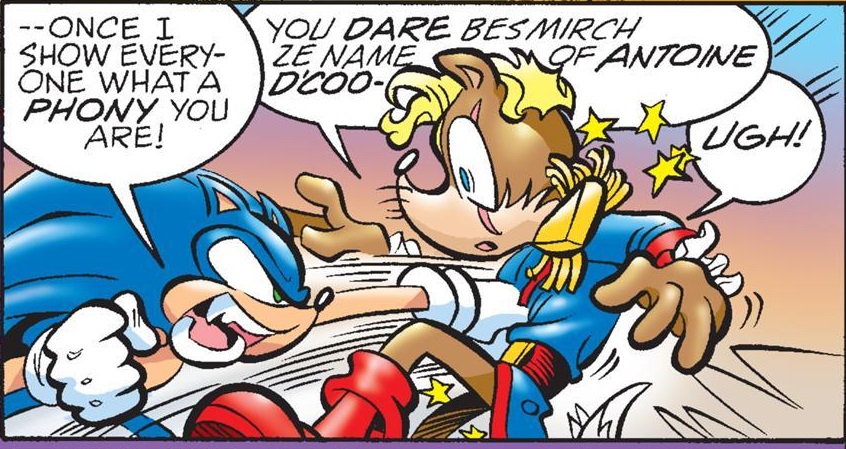


Oh yeah, Prince Elias is back too. It's another example of how poor Penders' grasp on these characters is. (Which is especially ridiculous, considering he created Elias.) Elias' previous defining characteristic has been his unwillingness to rule. How many panels did he spend whining about not wanting to be king? I really didn't mind Elias hanging out on that farm, staying out of everyone's way and out of the comic's ongoing plot. Yet in this story, he rushes back to Knothole and, within a few minute, assumes the throne. I know he does it to save his sister but it still comes off as a rash decision, one at odds with his previously established personality.

In the back pages, Dulcy's solo story “The Price of Flames' continues. Even though the underground dragon city of Vesuvio is under attack by Robotnik's roboticized dragons, the community's leader still has time to punish Dulcy for returning. She's thrown in a lava bound pit, chained by her nose ring. One of the robot dragons collide with, breaking the chain and removing the nose ring. Her fire breathing ability renewed, Dulcy leads the attack against the robots, saving the day and being accepted back into the community.


“The Price of Flames” features some serious writing problems, which I'll address momentarily, but it remains a satisfying story. After spending all of last month on set-up, Mike Gallagher gets to the point here. Within a few pages, Dulcy faces the people who rejected her, regains her fire breathing abilities, saves the day, and redeems herself in her enemy's eyes. It doesn't leave much room for character development. The other dragons in Vesuvio are loose sketches, at best. But it is satisfying to see these events play out in such a neat fashion.

I'd probably give the story high marks if it wasn't for one serious problem. After regaining her fire breath, Dulcy incinerates the Robian dragons. She tearfully points out that these Robians were once normal dragons, brain-washed and roboticized by Robotnik. In other words, Dulcy just murdered her Mom, among other innocents. But don't worry! Mike Gallagher has an ass-pull that absolves Dulcy of the crime. See, dragons have souls that live forever. They'll just be reborn in new bodies. This presumably means Dulcy's reincarnated mother will remember that time her daughter burned her to death. It's a really dumb, last minute plot turn that ruins an otherwise decent story. It feels like Gallagher forgot what Robians were exactly until the last minute, throwing in the immortal soul business to cover his ass.


Aside from making Dulcy a cold-blooded killer, “The Price of Flame” is notable for another reason. It would be Art Mawhinney's final credit on the book. I've written a lot about Mawhinney's art since beginning this retrospective. So it should be known that he's one of my favorite “Sonic” artist. As far as final bows goes, “The Price of Flame” is a decent one. The characters are expressive, the lines are crisp, and the action is dynamic. I just wish the script was up to Art's standards. As far as I can tell, Mawhinney has mostly retired from working on comics, with his most recent work being on kid's Look-N-Find books. (James Fry draws the cover story and does a decent job, by the way.)

I can't really give issue 156 a good review, considering the obvious problems both the cover story and back-up has. Mike Gallagher's work has always been full of sloppy elements while Ken's skills seriously atrophied near the end of his run. But at least that dumb Evil Antoine business is finally resolved. Just when he was beginning to become a decent bad guy too! All and all, it's another middling issue in a series clearly running out of steam. For those who own the print edition, I hope you enjoyed that five page long HeroScape ad in the middle of the book. [5/10]

Wednesday, August 2, 2017

Sonic the Hedgehog: Issue 155


Sonic the Hedgehog: Issue 155
Publication Date: November 2005

With Karl Bollers bullied out of the book, Ken Penders was allowed to claim Archie's “Sonic the Hedgehog” comic as more-or-less his own. For some reason, for his first act as sole head writer, he returned to the childish romantic melodrama that characterized the awful Anti-Sonic switcharoo. Penders' continued bumbling through the love lives of Sonic and company is baffling, for a few reasons. But mostly because the love story between Knuckles and Julie-Su was actually one of the better aspect of Ken's “Knuckles” series. Maybe Ken's obvious echidna favoritism played a role in that or, perhaps, his skills have just degraded with age? Either way, “Line of Succession,” the story arc beginning in issue 155, is another notorious stinker.


The story begins with King Acorn and Queen Alicia returning home, following their long trip abroad. Instead of doing something interesting with that, the failed diplomacy trip is brushed aside with a few lines of dialogue. Anyway, it turns out that Antoine – or rather Anti-Antoine, still masquerading as the real deal – has been poisoning the king. His health failing, the King informs Sally that the time has come for to ascend to the throne. And she can't do that unless she's married, with Antoine being chosen as her suitor. Which is all according to the villain's plan. When Sonic hears this news, he's pretty upset.

We've known Antoine's evil double has been living in his shoes for at least five issues now. Antoine's gradual asshole-ification has been going on for at least a year, inside and outside the book. After all that, the comic has finally gotten around to providing some insight to Anti-Antoine's master plan. Essentially, he's been planning to murder the king and take the crown for himself. Which is admittedly a more nuanced plan then Anti-Sonic's scheme to score with as many chicks as possible. Anti-Antoine even gets a decent action beat, when he pins Sonic with his sword and kicks him into a river. But I'm not sure why it took so long for the wicked coyote – or the writers, for that matter – to get around to doing this.


Sadly, most of “Line of Succession” is devoted to brain dead romantic melodrama. Of all the book's misbegotten love triangles, the Sonic/Sally/Antoine triangle has been dead and buried for the longest period of time. Even that bullshit about the King insisting Sally marry Antoine has been a moot point for a while. Remember when Max flat-out told Sally he was fine with her dating Sonic? That character development goes out the window here, as the King dismisses Sally's relationship with the hedgehog as a silly bit of juvenilia. At least Anti-Antoine doesn't actually feel anything for Sally, wanting to marry her strictly for the sake of power. But it's still dumb.

Give credit where it's due. At least Princess Sally gets a smidgen of agency. After her dad informs her that she'll marry Antoine, Sally is understandably aghast. After the required amount of hand-wringing and tears that has sadly become typical for Sal, she thinks the situation over. She decides to go through with the marriage, not because she's forced into it, but because it's her duty as the People's Princess and the leader of Knothole. Yes, some nudging from Antoine helps her come to this conclusion. But it's something. She's not entirely a pawn in the plot, pushed around by the whims of the writer.


Sadly, the melodramatic shenanigans do not end there. The issue opens with Tails walking in on Sonic and Fiona making out. As the fox is still crushed on Fiona, from his encounter with the robotic version so long ago, it's a harsh moment for him. The Tails/Fiona thing has been simmering for a while so it's disappointing that it ends so curtly. Especially since Sonic and Fiona have never previously been an item. Furthermore, I'm not a fan of the book continue to push Sonic as a lady's man. Later in the issue, he refers to Bunnie as “babe,” suggesting there's still some sexual tension between them. I don't know why Ken wrote Sonic as such a cad. That was Anti-Sonic that was screwing around on everybody, right? Why is the real deal still doing this?

Just as Sally and Antoine are walking down the aisle, we head to our back-up story. Dulcy the Dragon takes center stage in “The Price of Flame.” At some point in the past, the Freedom Fighters asked Dulcy to light a ceremonial fire. The dragon flies away, tears in her eyes. In flashback, Dulcy reveals her past and how she lost her ability to breath fire.


Dulcy the Dragon has long been a much neglected part of the “Sonic” supporting cast. So it's nice for her to get a story arc to herself. Further more, in all this time, we've never learned much about Dulcy's background. Mike Gallagher finally fills us in. After her family was robotocized, Dulcy lived in an underground colony of dragons called Vesuvio. Contact with the outside world was forbidden. When it was discovered that Dulcy had been sneaking out to fight Robotnik, she's punished with exile. Her fire breathing abilities are also stymied, by switching out her black “scorch ring” with a power inhibiting gold Power Ring. Now, she's returning home for the first time in years.

It's as decent a backstory as any and explains why we've met so few other dragons. But Mike Gallgher's approach could've been better. As Dulcy flies back to Vesuvio, she explains her past in detail. Which amounts to a series of panels, large narration boxes overhead. It's doesn't feel much like a story, working more like an encyclopedia listing. In other words: it's another heaping load of exposition.

Worst yet, I'm pretty sure Mike wrote this story just to clear up a minor continuity error. In the past, Dulcy's nose ring has been colored as either gold or black. This is explained as Dulcy painting her golden ring black sometimes, in shame over loosing her powers. Really, Mike, we don't care about coloring errors. You don't have to devote a whole story to justifying them.


At least there's no stinky Ron Lim or Al Bigley artwork this time. James Fry draws the cover story. Fry's artwork is confident, full of expression and anime-style movement, but he's having a bit of an off-day. He even utilizes some Jon Grey style big, cartoony emotions a few times, to mixed affect. Art Mawhinney draws the back-up story. Dulcy, being a very cute character, looks good in his style. I really love the flashbacks to Dulcy's early days with the Freedom Fighters, which really brings us back to the SatAM years. Of course, lending such a cute style to a horde of multi-colored dragons does have the side effect of making this story feel like an episode of “Dragon Tales” sometimes. That's not Art's fault. Probably.

The cover story is less outright bad then it's just mostly mediocre and unnecessary, with several really obnoxious writing flaws. The back-up shoves too much info, awkwardly, into too small a place. It's pretty lame and another example of how badly this book dragged in 2005. But let's appreciate small miracles. At least the real Antoine will be back soon. This other guy is a prick. [5/10]

Monday, July 24, 2017

Sonic the Hedgehog: Issue 153


Sonic the Hedgehog: Issue 153
Publication Date: September 2005

Issue 153 begins a story arc called “Songoose,” revolving around Mina Mongoose and her music. That songs feature prominently in this is fitting. Issue 153 would be the swan song for Karl Bollers' involvement in Archie's “Sonic” series. Once one of the book's best writers, Karl would write his share of stinkers, receiving some not-unfair blame for the comic's Dork Age. Bollers' exit is mostly blamed on increasingly common arguments with fellow head writer Ken Penders. Though I feel the book's recent dip in quality must've informed Karl's decision. Whatever the reason, “Songoose” would be the beginning of the end of Bollers' stint on “Sonic.”


Mina the Mongoose is coming to Knothole to perform a big concert. The Freedom Fighters hope it will rise the spirits of everyone around town. Instead, Nack the Weasel appears in the crowd and attempts to assassinate Mina. Once captured, he admits why. Robotnik hates the mongoose's infectiously catchy tunes and demands her head on a platter. Realizing the dictator won't stop with one failed attempt, Sally assigns Sonic to be the pop star's personal bodyguard.

The reasoning behind Robotnik wanting Mina dead is kind of cute. After the weasel gets tossed in prison, realizing his ex-partners are there and ready to kick his ass, he immediately weasels out his employer. We are then greeted to four highly amusing panels devoted to Robotnik hearing one of Mina's song, the tune getting stuck in his head, and being tormented by the number's persistent presence in his brain. This recalls the comic's earlier, goofier days, a pleasant respite the recent romantic entanglements and grimness of Bunnie being robo-raped. (Which I guess shows you how dark the book has gotten, when the attempted assassination of a pop star is actually considered a more whimsical element.)


I do wish the actual assassination was carried out a little better. Nack sneaks into Mina's concert, wearing sunglasses and a trench coat, a not exactly inconspicuous fashion choice. He shoots a fiery blast from a weird handheld blaster, missing horribly and setting a palm tree ablaze. Sonic then rushes Mina out of the way and quickly bonks Nack on the head into unconsciousness. Weirdly, three whole panels are devoted to Bunnie kicking the flaming tree into a near-by lake, as if it posed ans equal a threat as the murderous weasel. The whole sequence mostly makes Nack seem incompetent, making you wonder why Robotnik hired him in the first place.

With Mina's return to singing, the lingering attraction between her and Sonic also returns. I don't know how many times the book has buried that one – at least three times, by my count? - but it's the subplot that just won't die. Ash is clearly jealous of Sonic, while the blue hedgehog clearly continues to inspire Mina's lyrics. That's not the only tension in the air. In one panel, Tails awkwardly attempts to ask Fiona out on a date, still holding a torch for the vixen. Hoping to save the little guy's heart, Sonic instead invites the whole group to the concert. This leads to Fiona talking about how hard it was for her to forgive Sonic, for abandoning her at that Robotnik prison camp years ago. It's not a great scene but is still the most character development Fiona has gotten.


The romantic stuff is admittedly the better handled emotional aspect in this story. “Songoose: Part 1” begins with General D'Coolette watching Sonic and the Chaotix sparing. After a conversation with the King and Queen, still overseas, the old man collapses from some unspecified malady. You'd think this would to a scene of Anti-Antoine, still masquerading as the real deal, responding to this news with a cold heart. Or perhaps walking away from his dad's hospital room, unmoved? This, in turn, would raise the Freedom Fighters' suspicions about what's up with the coyote. Instead, we merely hear Bunnie and Sonic talk about how cold-hearted Antoine has become. Furthermore, these scenes don't really connect with the rest of the issue's story. The book will resolve the Anti-Antoine plot point soon and I can't wait. It's been so dumb, mismanaged so badly.

The cover story's somewhat whimsical tone continues with the back-up, entitled “Fairy Tale or the Adventures of Pirate Sally.” The orphans Sasha, Snaggle, and Rory have come down with a cold. They beg Rosie to tell them a story, to take their minds off their sickness. The nanny spins a yarn about a good pirate named Sally. After an elf version of Tails literally falls out of the sky, he tells Sally's crew a story about how one of his tails was stolen by the minion of an evil wizard. On their journey to retrieve the kid's tail, Sally will encounter a brave hedgehog knight, a dark rider, a troll, and an evil wizard.


“Fairy Tale” is silly but it's also pretty cute. The fantasy fiction spins on Sonic and friends aren't especially clever. It's weird that Robotnik is turned into the evil wizard while Ixis Naugus – an actual evil wizard – is relegated to a one panel cameo. Rouge, appearing as the Rogue Assassin, and Mogul as a troll get similarly small roles. However, the image of Sally as an eye-patch wearing pirate, having adventures with an elf Tails and a knight Sonic, is fun. The five page length, with two of those pages devoted to Rosie telling the kids the story, isn't nearly enough time to explore the fantasy setting. I do like the kids criticizing the holes in Rosie's story, a funny moment.

Adding to my enjoyment of “Fairy Tale” is some awesome pencils from Art Mawhinney. He makes Sally as a pirate look surprisingly cool. The action scenes, while brief, are well orchestrated. Art's cute style is especially well suited to this story. The orphans look adorable. So do Sally and the gang in the bed time story. After they've been broken up for a year, it touches my heart to see Sonic and Sally nearly kiss, in Art's SatAM-esque style. Even if it is in a non-canon fantasy stories. Art's excellent work is certainly a step-up from Ron Lim's work on the first tale. Though Lim does pull off a decent panel of Nack or Mina, his characters remain noodle-limbed and wide-eyed. Even this represents an improvement for Lim, as his action scenes have a little more pop to them then usual.


I suppose this issue is also the swan song for Romy Chacon, as “Fairy Tale” appears to be his final credit on the book. Chacon was a far more uneven writer then Bollers, though I suppose I'll miss him too. The cover story has its moments and the back-up is cute, meaning issue 153 is actually one of the better “Sonic” comics to be published in 2005, even if it's still just shy of mediocre. (In other news: The annoying habit of Archie including extended advertisements in the middle of the book continued with 153. Midway through the issue is a five page insert inviting you to buy “The Batman” pasta from Campbell's. Thankfully, and obviously, this is clipped from the digital version.) [6/10] 

Wednesday, July 19, 2017

Sonic the Hedgehog: Issue 151


(Yes, I've read the news today: Archie's "Sonic the Hedgehog" comics have officially been canceled. Since I've already eulogized the book on this blog, I don't have too much say. Click over to the Hedgehogs Can't Swim Tumblr for my latest thoughts about this development.)


Sonic the Hedgehog: Issue 151
Publication Date: July 2005

There’s no getting around this one: Evil Sonic switching places with his heroic counterpart primarily so he could get his dick wet is one of the worst premises for a “Sonic” story Archie would ever publish. It’s certainly one of the most embarrassing. But here’s how bad things were for the book in 2005: This is actually one of the year’s more readable arcs. Especially coming off the epic suck-fest that was “The Good, the Bad, and the Unknown,” even something as lame as Anti-Sonic’s philandering ways reads as entertaining. Let’s dissect this one a little further, shall we?

Last issue concluded with a horny Anti-Sonic getting a look at Ms. Fanservice Rouge and immediately deciding he needed a slice of that. The bat falls for the line that Sonic knows his way around the Floating Island. The two high tail it for the Chaos Chamber. While Rouge distracts Locke by making out with him, Anti-Sonic sneaks towards the Master Emerald. There, the real Sonic confronts him. The hero hedgehog defeated the Anti-Freedom Fighters in the Mirror Universe and talked them into sending him home. Inevitably, bad guy and hero trade blows. Guess who wins?


“Chaos Emeralds Are Forever” – yeah, that’s another Bond reference from Penders that barely connects – doesn’t do much with its premise. Wouldn’t it have been cool to see Sonic do the same thing to Anti-Sonic’s gang that the evil copy did to his? Sneak among them and manipulate the others towards his goal? (A story about how the evil double’s selfish actions affect the real deal would be nice too.) Instead, Sonic quickly reveals his true identity and goes about stomping the Freedom Fighters’ bad equivalents. Which, by the way, include an Anti-Bunnie, a character previously unseen.

Yet at least good ol’ action is worth a little more then undercooked soap opera antics. I know it was Evil Sonic that the previous issue focused on but, after seeing a blue hedgehog act like such a tool, this issue’s opening sequence – where the Anti-Freedom Fighters beat the shit out of Sonic – is somewhat cathartic. That opening barrage also causes the good hog to turn the tables on his attackers to be a little more satisfying. Sonic’s headbutts, flips, and discombobulating cyclone spins are old tricks but there’s something to be said for that. Half the fight also features him in just his socks, which is sort of funny.


Annoyingly, the story dangles a conclusion to the similar plot concerning Antione before ignoring it. During his fight with the reverse Mobians, we see Antoine’s thoughts bubbles, commenting on how he’s been living in his doppleganger’s place. You’d think this would set up the real Antoine’s return to Mobius. Instead, Sonic cold cocks the coyote and leaves him where he lands. It would be a few more issue before the book got around to resolving that one, even if the opportunity was right there.

The big conclusion is the Sonic-on-Sonic fight at the end. Again, you’d think this would be a good chance to do something mildly clever. What if we were watching a fight where we weren’t sure who the hero was? That would be interesting! Instead, Ken identifies which Sonic is which with some typically thudding dialogue and a few visual clues. But, again, it’s not a bad fight. I’m especially fond of the panel of Evil Sonic doing a handstand into Regular Sonic’s face.


If Archie spent several of the year’s issues forcing Shadow into the book, it seems there was some weird mandate to include Rouge the Bat in this one. Her role in the story is negligible. She essentially gets Evil Sonic onto Angel Island, so that fight can commence. (Of course, there’s no reason that showdown had to take place in the Chaos Chamber.) Otherwise, Rouge’s subplot is vague at best, the character’s objective getting pushed to the point of obscurity. I’m sticking with my theory that Penders wanted Locke to have a hot girlfriend. In this issue, the elderly echidna and the sexy bat get to second base, it appears. Rumor has it that Ken thought Rouge was a little closer to Locke’s age, though that still doesn’t change how kind of gross that particular pairing is.

After a cover story that gets a begrudging, barely passable recommendation from me, let’s move on to “Stargazing,” issue 151’s back-up feature. After awakening in the middle of the night, Princess Sally notices that Nicole’s screen is blank. She walks outside the castle to see a strangely dressed lynx looking up at the night skies. This, she soon discovers, is Nicole. After the computer got a taste of the fleshy life in issue 146’s “Circuit Me,” Nicole decided to create herself a hologram body that would allow her to interact with the physical world. Sadly, she only has the power to project the hologram for a short time. After Nicole’s Mobian form disappears, Sally is left stargazing all by herself.


“Stargazing” is a short tale that would, unexpectedly, end up being an important part of the Archie Sonic mythos. After years as simply Sally’s handheld computer, showing bits and pieces of personality at times, Nicole would soon graduate into a full-fledged characters. And it started here. “Stargazing,” written and drawn by Tania del Rio, is a sweet, quietly observant tale. Nicole’s appreciation for the simple things is touching, especially how it makes Sally regain that appreciation for the blessings she does have. I also like the story’ bittersweet tone. Nicole’s ability to project a body for herself, what it allows her to experience sensation, is wonderful. Yet it’s a short lived experience, giving it more meaning.

Art Mawhinney continues to draw the cover stories and does a pretty good job. The Anti-Freedom Fighters look fittingly comical in his style. While his Rouge still looks a little off, especially in her clashing “Sonic Heroes” outfit, Anti-Bunnie is a welcomed addition to this collection of rogues. As I mentioned, Tania del Rio draws “Stargazing.” del Rio was brought over from the then-anime inspired “Sabrina the Teenage Witch” book. It’s clear she doesn’t quite have a grasp on how to draw the “Sonic” cast. Sally and Nicole have similar, anime-esque eyes and faces, which is a bit off-putting. del Rio’s also gets Sally’s body proportions off several times. Still, it’s serviceable work and doesn’t distract from the story.


I guess “Stargazing” proves that there were a few worthwhile stories published in this book during 2005. The cover story in issue 151 is fairly weak yet I can’t entirely hate it, despite being a disposable plot over all. The back-up story is one of the more touching ones to be published in this book in quite some time. I don’t feel like figuring out what that would even out to, so I’ll split the score again. “Chaos Emeralds Are Forever” barely gets a [5/10.] “Stargazing” gets a [7/10.] I hate to do that but some times these things happens.

Monday, July 17, 2017

Sonic the Hedgehog: Issue 150


Sonic the Hedgehog: Issue 150
Publication Date: June 2005

This is it, guys. The issue of Archie’s “Sonic the Hedgehog” comic that nearly caused me to abandon the book, a series I had been reading regularly for over a decade at this point, that I consider an enormous cornerstone of my nerdiness. It’s not really the fault of issue 150, though it is a very flawed comic. Instead, I was simply fed up with the comic, coming off the super shitty “The Good, the Bad and the Unknown” arc and several years of disappointing stories. After reading this mediocre issue, I actually stopped reading for about two months before deciding life was too weird without Archie’s “Sonic the Hedgehog”  in my hand every month.


In Knothole, romance is in the air. Sort of. Sonic is hitting on Mina Mongoose, who is tempted but rejects him because of Ash being her boyfriend. He hits on Amy Rose, who is weirded out by his direct language. The hedgehog’s horny ways eventually hit pay dirt, when Tails walks in on Sonic and Bunnie making out. Moreover, Sonic is doing heroic deeds solely for rewards. There’s a reason for this: Sonic isn’t Sonic. Instead, Anti-Sonic has kidnapped the real deal and switched places with him.

I think “Hero to Zero in No Time at All” – another one of those elegant Ken Penders’ titles – reveals what an incompetent villain Anti-Sonic is. Somehow, it took the guy 139 issues to think of stealing Sonic’s identity, even though that’s the most obvious scheme an evil copy can enact. After slotting himself into the heroic hedgehog’s life, what evil act does he commit? Murder Sonic and his friends? Sabotage the Freedom Fighters? Sell Knothole out to Robotnik? Nope! Instead, he grabs free food and hits on chicks until he gets laid. (Sonic and Bunnie awake in the woods, in each other’s arms. There’s no way you can convince me they didn’t fuck.) What’s especially dumb about this is how nobody questions why Sonic is acting like a horny douchebag. Not Tails, not Sally, not any number of other people who have known him their entire lives.


This shows a serious lack of understanding of the characters. Considering Ken Penders has been the main writer on this book for a multitude of years, you’d think he would know better too. Then again, Penders seems to think that Sonic being a love-em/leave-em type is canon so I guess the others have no reason to notice how weird he’s acting. Writing like this is one of the reasons why detractors deride the comic as “furry soap opera melodrama bullshit.” Sonic, even a villainous copy of Sonic, trying to seduce nearly every woman in his life is a story that probably has no business being in this book. The hedgehog getting lucky with Bunnie of all people – who has never shown any romantic interest in him – shows a further misunderstanding of these characters Ken has lived with for a long ass time.

It’s almost as if Ken really wanted to write a story about Sonic screwing around on all the girls who like him and some that don’t. The Anti-Sonic angle is probably the laziest way to accomplish this story. By bringing up the Mirror Mobius, Ken also quickly tosses another recent plot point under the rug. You want to know why Antoine has been acting like a shit head for a while? Cause he’s also been replaced by his evil counterpart! Apparently Karl Bollers intended Antoine’s personality change to be good old fashion character development. This disagreement with Penders was one of many that would lead to Bollers’ upcoming exit from the book. To add further insult, this nugget about Antoine has no other effect on the plot.


I guess Ken figured romance should be in the air for some reason, as “Hero to Zero” features a subplot involving Rouge the Bat. Hoping to snipe Nack the Weasel’s attempt to steal Angel Island’s magical emerald, she heads for the Island. Rouge meets Locke and begins to seduce him. This plot goes nowhere, as Archimedes teleports Rouge away before the date goes too far. I have no idea where – if anywhere – this subplot is going. Christ, it’s almost as if Ken just wanted his self-insert Locke to get a hot girlfriend or something.

The back-up story concerns events of actual important. In the conclusion of “The Chosen One,” Mammoth Mogul is ready to destroy the Perpendicular Zone, wiping out the multi-verse and the ten thousand Tails contained within. The prime Tails bravely heads out to face the god-like villain. Mogul immediately attempts to de-atomize the fox. Sonic leaps in the way, taking the shot. This activates Tails’ Chosen One powers. He absorbs all of the other Tails, becoming a giant named Titan Tails. He quickly defeats Mogul, stripping him of all his powers. Using the last of his immense strength, Titan Tails restores the multi-verse.


Part two of “The Chosen One” is responsible for another notorious bit of Archie Sonic lore. I’m talking about, of course, Titan Tails. The character design is, indeed, quite unfortunate. Most of the super forms in the Sonic-verse are just like the regular characters but a different color or something. Titan Tails, meanwhile, is a giant and super-buff version of Tails. The contrast is somewhat disturbing. Seeing the normally boyish Tails have his features grafted onto “Pumping Iron” era Arnold Schwarznegger’s body is hugely off-putting.

Once you overlook the monstrosity that is Titan Tails, “The Chosen One: Part Two” is as about as satisfying as this story could be. Tails being motivated by Sonic’s pain add some minor emotion to the story. Tails’ powers, defeating a god-like Mogul in minutes and undoing all the damage he incurred, are pretty impressive. Tails giving away his powers willingly, in order to save millions of lives, is a nice touch. Pretty much no pay-off to the Chosen One arc could’ve been one-hundred percent satisfying, after so many years of build up. But Romy Chacon does alright.


Art Mawhinney draws the entire issues and, as always, it’s good work. I love how bizarre some of the alternate universe Tails are during “The Chosen One.” He does what he can with Titan Tails, a truly poor design. As for the cover story, his clean lines and expressive faces are a benefit. The flashbacks, detailing Anti-Sonic trading places with the real deal, bring some obvious humor to the proceedings. Though, I’ll admit, Art doesn’t quite have a grasp on Rouge’s design. (And considering the obvious amount of sex appeal in the story, Steven Butler probably would’ve been a better choice.)

As far as anniversary issues go, #150 is definitely underwhelming. The conclusion to the Chosen One plot point occurring in this issue was a good choice. But devoting the 150th cover story to Evil Sonic sexually manipulating some of the series’ female players? That was a weird-ass choice. I don’t even like Spaz’ cover much, which is about as generic as a “Sonic” cover can get. Still, it sucks less then “The Good, the Bad and the Unknown.” That was the metric to measure the book by in 2005. [5/10]

Friday, July 14, 2017

Sonic the Hedgehog: Issue 149


Sonic the Hedgehog: Issue 149
Publication Date: May 2005

With issue 149, “The Good, the Bad, and the Unknown” finally concludes. When this story arc was originally published, to me, it felt like the plot went on for most of the year. In truth, it only lasted four months. However, this one was enough of a clunker – combined with a general decline in quality in the series – that I nearly quit reading the book over it. I've said it before and I'll say it again: Let's get this over with.


Deep in the mysterious Kintobor's underground complex, Sonic, Shadow, and Metal Sonic continue their hyper-macho throw down/pissing contest. Their fight has unearthed a giant nuclear missile, which is about to go off. Rotor and the others continue to mill around the upper levels, looking for help. Somehow – I can't remember specifics – Uncle Chuck and Jules become aware of this strife, piloting a plane to rescue everyone. Will they make it in time? Take a guess.

The Sonic/Shadow/Metal Sonic three-way showdown – the main reason, I suspect, this entire story arc was written – concludes here. And in the most underwhelming fashion possible. Sonic defeats Metal by bopping him on the head, Bunny Foo-Foo style, and embedding him in the ground. This happens within the first few pages, ending that story line prematurely and awkwardly. Afterwards, Shadow outright admits that he doesn't know why he's fighting Sonic. In the tradition of so many comic book fights, the two immediately team up afterwards, realizing the nuclear missile about to go off threatens them both. That's the conclusion to this epic fight. What a let down.


One of many problems with this story arc has been the role the Freedom Fighters play. Tails, Rotor, Bunnie, Tommy, and Fiona have been milling about the underground facility. The whole time they haven't accomplished much, besides stumbling into a series of traps. Ken more-or-less admits how useless the gang has been because he has Chuck and Jules, out of nowhere, rescue them. About the only notable thing about their sequence is a moment when Fiona picks up a big ass gun, posing with it. Because Ken is always subtle with his commentary, Rotor immediately tells her to put it down because Mobians never use guns. Yet this single panel hints at the villainous personality Fiona would develop under Ian Flynn's pen.

Maybe the biggest sucking black hole in this story has been the character of Isaac. Ambiguously villainous but mostly just boring, he continues to croak up some of Penders' most banal dialogue ever. In the final pages of 149, Isaac reveals that the man who built him, this giant base, and the huge nuke inside is still alive. Yep, Kintobor – who brought the wrath of the Xorda down on Earth and is Robotnik's ancestor, in some way – sleeps in a stasis tube, awaiting reawakening. Of course, the subsequent writers didn't pick up on this thread. And who can blame them? Isaac and Kintobor are left buried underground after their own nuke goes off. That's where they fucking belong.


As promised last month, the back-up story finally steers the plot point of Tails being “The Chosen One” towards its conclusion. A casual game of Hide and Seek between Sonic and Tails is interrupted when Zonic the Zone-Cop pokes his head in. Sonic assumes he's the one being summoned. Instead, Zonic is after Tails. Mammoth Mogul is up to his old tricks again and everyone is hoping Tails can stop him.

Are you curious how long Archie screwed around with this “Tails is the Chosen One” bullshit? Since the first issue of “Tails” mini-series. Which was in 1995. Ten years before this issue. One of the reason I suspect this plot point sat on the shelf for so long was general disinterest. It's not like this series had a shortage of prophecies and contrived mythology. But after so many false starts and hints, it is satisfying for the comic to promise a quick conclusion to that particular prophecy.


There are one or two clever elements in the first part of “The Chosen One.” Mammoth Mogul, never as impressive he boasted about, finally becomes a credible bad guy. In this story, he graduates to a cosmic level threat. After getting a super dose of Knuckles' Chaos Power, the immortal has been going around the multi-verse, destroying alternate realities. He's powerful enough to swat a whole legion of Zone Cops away, which is mildly impressive. Zonic's solution to this problem is mildly clever as well. He knows Mogul fears Tails. So he stacks the deck, by recruiting hundreds of Tails from across the multi-verse. (Including such delightful variations as Darth Maul Tails, Benjamin Franklin Tails, Clown Tails, Buff Tails, Pregnant Tails, Care Bear Tails, and Metrosexual Tails.) It's not a bad story, even if it still spends two pages recounting prior events.

Two of Archie's most reliable artists draw both of these stories. Steven Butler drew all of “The Good, the Bad, and the Unknown” and his artwork was usually the story's sole positive attribute. But he appears to be having a slightly off-day in 149. A couple of times, Sonic, Shadow, and Metal seem to be a little flat. The action doesn't pop like it usually does. Though it's still a decent looking story. Art Mawhinney draws “The Chosen One.” Mawhinney's doubles down on the cuteness, which works with fine with the room full of Tails or the opening scene, which details a “Spider-Man” themed Sonic reality. When showing Mogul destroying whole worlds, it's less suitable. But Mawhinney always does good work so I can't complain.


The back-up story isn't bad. It manages to push the whole issue's rating up one. Not that it would've taken a lot to improve over the cover story. What should've been a one issue showdown between the hedgehogs and a hedgehog-like robot was stretched out for four tedious issues. Along the way, Penders set up some bullshit that was never going to pay off, probably even if he hadn't left the book. Another upside to this finally ending: I'm really looking forward to not having to write out “The Good, the Bad and the Unknown” again. [5/10]

Wednesday, June 28, 2017

Sonic the Hedgehog: Issue 143


Sonic the Hedgehog: Issue 143
Publication Date: December 2004

Before getting to the heart of the review, let's talk about that cover. Last time, it made sense for Sonic and Hope to be seated before a scroll depicting the Original Freedom Fighters. This time, Sonic is shown gasping in front of another scroll showing the Original Freedom Fighters' final mission. There's a disconnect between the two images and, for once, I really have to question Patrick Spaziante's design decisions. Text says Sonic will be in danger, which is hugely misleading. Sonic doesn't see any action in this story. So I'm really not sure what's up with that. Anyway, on with the review.


The previous comic ended on a cliffhanger, revealing that the Original Freedom Fighters were betrayed by one of their own. We see this betrayal play out. While journeying into Robotnik's fortress, hoping to pull the King from the Void, Robotnik corners them. He robotocizes the heroes and tosses them into the Void as well. Uncle Chuck records the events, making sure others – including little Hope, born years afterwards – know what happened to Col. Stripe and his men.

One of the reasons I regarded this story arc with such disdain, originally, is because of the identity of the traitor. As previously discussed, the Original Freedom Fighters have barely been developed, meaning any betrayal would barely affected the reader. Yet Romy Chacon finds a way to drain any power from this reveal, by going with the most obvious answer. Trey Scales, the snake, sold the group out to Robotnik. Why? Because he's a snake and treachery is in his nature. What the fuck? That's the lamest justification possible.


Moreover, the comic has to bend over backwards to justify how the Original Freedom Fighters disappeared. The five get robotocized – even Scales, because Robotnik is a bastard without honor – which is a natural decision. He then blows the Original Freedom Fighters into the Void. Which is obviously a messy way to justify why Stripe and the others weren't turned organic along with the other Robians. It also explains why the Freedom Fighters never attempted to rescue Stripe and his friends, why they've never been mentioned before. Yet other characters had to learn of their sacrifice somehow. So Uncle Chuck is awkwardly inserted into this scenario, recording their deaths. Considering he was still brainwashed at the time, I don't how he was able to do this.

Even while dealing with these issues, Chacon does manage to sneak in a few likable moments. A young Sally is visiting Stripe when Sir Peckers gives him news concerning the King's disappearance. This upsets little Sally, causing Stripe to chastise Peckers some. That's a mildly interesting moment. After news of the Original Freedom Fighters' passing, we see a few panels devoted to characters mourning. Such as Julayla and Rosie crying among themselves or others standing around tombstones.


Sonic brings us back around, his re-telling concluding with Sally's decision to form their own Freedom Fighter team. Yet, weirdly, Sonic isn't the one framing this particular story. Instead, it's an off-panel character that, at the end, is revealed to be Hope's history teacher. The teacher is also, apparently, Col. Stripe's widow. Which is a real random decision that comes out of nowhere and doesn't build on anything we saw prior.

Instead of squeezing in three stories, the entire second half of issue 143 is devoted to a new “Mobius: 25 Years Later,” entitled “Father's Day.” Knuckles disappears into the forest without telling his wife and daughter. It turns out, this day is the anniversary of his father's death. Knuckles kneels before Locke's grave, reflecting on the sickness that took his dad's life and how it affected him. Afterwards, he makes the decision to agree to Lara-Su's request, to begin her training as a Guardian.


“Father's Day” was clearly a personal story for Ken Penders. The story is devoted to his father's memory. (Though weirdly, this dedication is cropped out of the digital version.) Perhaps due to this, Ken draws this one by himself. His work is still very stiff but more serviceable than usual. I suspect Locke's death was heavily inspired by how Ken's own father passed. Locke doesn't die via magical shenanigans or from a super villain attack. He instead succumbs to a sick pancreas. On his death bed, Locke does something I would never expect of him. He apologizes. He admits to his son and ex-wife that he made mistakes, that he wasn't the best father and husband he could've been. Considering Locke's staunch refusal to own up to his asshole decisions, this is a surprising turn of events.

Ken being Ken, the story doesn't progress without some obnoxious moments. Knuckles' flashback begins with a superfluous scene where he parts ways with Archimedes. Locke's doctor repeatedly clarifies how strong Locke is, how unusual his illness is. Because Ken's self-insert can't even die humbly. A random explanation of “Ascension Day” - an echidnan holiday – is tossed in. Knuckles and Lara-Le forgive Locke for his mistakes a little too easily, glossing over how complicated their relationships truly are. It also bothers me that Lara-Su has such a small role in a story concerning her. The story also ends on the hilariously overwrought image of Locke and Aurora looking down from heaven on Knuckles.


But it's clear a lot of feeling went into “Father's Day,” that this was an important story for Penders. That sincerity comes through in the final product, even with its flaws. The back-up is, at least, more interesting than the cover story. Still, I came away from this re-read with a little more appreciation for what happened in these two issues. Things weren't all shitty – just mostly shitty – in 2004. [6/10]

Monday, June 26, 2017

Sonic the Hedgehog: Issue 142


Sonic the Hedgehog: Issue 142
Publication Date: November 2004

Around November of 2004, my fandom for Archie's “Sonic the Hedgehog” series was not burning so bright. For the first time, I was actually considering not reading the book anymore. I'd like to say this was because I was in high school at the time and had more important things to worry about then cartoon hedgehogs. (I didn't.) Rather, it seemed to me the book had hit a terminally lame spot. The Original Freedom Fighters two-parter, running in issue 142 and 143, was just the latest in a long line of weak stories for the book. At least, that's what I thought back then.


The issue focuses, at first, on Hope, a character we haven't seen in a few months. While working on a book report about the history of the Acorn Kingdom – there's your once-every-six-months reminder the characters still go to school – she comes upon the Original Freedom Fighters. A chance encounter with Sonic has the hedgehog explaining who these previously unheard of characters were and how they inspired Sonic, Sally, and the others to fight Robotnik's tyranny.

The Original Freedom Fighters are, admittedly, an awkward insertion into Sonic history. In-between the “Sonic Kids” one-shots and the “Tales of the Great War” arc, the fall of the Kingdom of Acorn, Robotnik seizing power, and the formation of the Freedom Fighters is seemingly well trotted ground. At the very least, you would've expected the Original Freedom Fighters' names and faces to have been mentioned before. The five characters that make up the team don't strike the reader as especially inspired. They all have ridiculous names inductive of their species. Tig Stripe is a tiger, Bull Bones is a bull dog, Trey Scales is a pink snake, Spot Long is a purple giraffe, and Sir Peckers – jeezus – is a robin. It combines to give the impression that the Original Freedom Fighters, and their corresponding story line, where thought up on the spot by writer Romy Chacon.


And, no, the Original Freedom Fighters are not well developed. Trey, Peckers, and Spot barely get any dialogue. The only glimpse we get at Bones' personality is his interest in striking back at Robotnik. Tig Stripe does make something of an impression. Chacon writes him as a cross between Abraham Lincoln and Optimus Prime. He cares more about saving lives than saving face. During a flashback to the fall of Mobotropolis, he makes a conscious decision to get as many people out of the city as possible, after realizing regaining the city is a lost battle. Around a table, he delivers a speech about how it's a moral duty to fight evil. How they will do everything possible to fight for freedom. It's... Genuinely kind of stirring? At the very least, you can see why Stripe would be so inspiring to Sonic.

Which brings us back to the framing device. Sonic inserts himself into his own story. He and Sally, still youngsters, eavesdropped on the aforementioned speech. In other words, Sonic and Sally were there when the Freedom Fighters were born, an interesting idea. There's even an anecdote about the original quartet rescuing Sonic once. The story telling device allows Chacon to cover a long stretch of history in only a few pages. Moreover, I like it whenever Sonic sits down and tells a story. We're so used to seeing other characters fanboy/girl over Sonic – Tails and Amy have both served that purpose in the past – that it's refreshing to see Sonic have a similar reaction.


Speaking of Amy Rose! Issue 143's second story, “I Wanna Be a Freedom Fighter,” is devoted to that character. Beginning with a flash back to Amy's childish early days, Sally tells an audience about Rose's recent victories. How she played a huge role in the Freedom Fighters' most recent success. Amy is given a medal while also being offered official membership into the Freedom Fighters.

Beginning with that flashback is a smart idea, as it shows how far Amy has come. Amy's transition from fawning fangirl to hammer-swinging warrior certainly made her more interesting. I've never been a huge fan of the character. (And I'll certainly never understood while some are so passionate about pairing her with Sonic, considering the entire point of their relationship is that Amy's feelings are one sided.) However, “I Wanna Be a Freedom Fighter” makes a strong case for her. She's still young and girly, such as when she corrects Sally about what her hammer is called. She's not above embarrassment, when reminded of her youthful behavior. Yet she's certainly has earned her place among the Freedom Fighters. In other words, Karl does more for Amy's character over this brief five pager then the comic has done in 118 issues.


The final story in the issue takes us back to the future. In “Moment of Truth,” the latest “Mobius: 25 Years Later” installment, Cobar and Rotor finally give Sonic and Knuckles some grim news. The only solution they've been able to cook up involves flinging King Sonic into the past, in order to prevent the events leading up to the forthcoming disaster. This means using some of Robotnik's old technology, which takes some asking. Sonic, still feeling some anxiety about being King, agrees to go on this adventure, heading out immediately.

The stuff concerning Ken's latest apocalypse, time travel, and all that stuff doesn't interest me very much. Instead, it's the character interactions that draw my attention. Lara-Su corners her dad on the stairs, further attempting to convince him to train her in the ways of being a Guardian. This strikes me as realistic. As a teenager, I can certainly recall not letting specific debates go, even after my mom told me no. Later, Sonic and Sally have a heart-to-heart. The hedgehog admits he's been acting like a dick because he's still insecure about being king. How he feels like this latest mission is a job better suited to Sally, who has always been more of a leader. It's a little moment, grounding Sonic's character some and reinforcing his bond with Sally, but helps elevate a story otherwise dominated by exposition.


Turns out issue 142 isn't too bad after all. Compared to what's around it, this one actually comes off pretty well. The cover story and the final back-up have some serious weaknesses but are both propped up by a few, stray good moments. The story in the center is actually decent! Art Mawhineny and Steven Butler provide some fantastic artwork for the whole issue. During the Dork Age, even a relatively subpar issue can seem above average. [7/10]

Friday, June 9, 2017

Sonic the Hedgehog: Issue 136


Sonic the Hedgehog: Issue 136
Publication Date: May 2004

This is how certain Archie was that fans wanted Tommy the Turtle back. Issue 136 is the middle chapter of a story arc they have dubbed “The Tommy Trilogy.” Shit, how many actually important character had their name right in the title of an arc? We never got the “Dr. Quack Quartet” or “The Dulcy Decalogy.”  Of all characters, why Tommy the Turtle? Issue 136 doesn't provide any answers to that specific question but does feature plenty of other stuff.

In “The Infiltrator,” Tommy is integrating himself into Knothole society, having apparently moved in Sonic and Tails. After pulling an all-night mission, Sonic collapses into his bedroom, exhausted. While he sleeps, Tommy sneaks off. The turtle reveals himself as an Auto-Automaton, a robotic double sent to infiltrate Knothole and kill Sonic. Jules prevents the reptile from eviscerating his son with a hand drill but at the cost of his own life. Sonic has to take drastic measures to save his father.


What's most frustrating about “The Infiltrator” is that it presents a perfect out for this whole Tommy the Turtle business. The Tommy Sonic took back to Knothole is a goddamn robot, designed to sneak into Knothole and assassinate the hedgehog hero. A smart writer would've revealed that this was the plan all along, that Tommy did not survive his initial appearance. This would've been a way to sate the apparent demand for Tommy's return without cheapening that original story too much. Instead, after Auto-Tommy drills a hole in Jules and Sonic spin-dashes him in half, we learn that the real Tommy is still alive, held captive by Robotnik somewhere. Way to miss that chance, Romy.

Despite this issue, there's one or two things interesting about “The Infiltrator.” Firstly, Tails mentions going to school for the first time in forever. (I was really hoping Knothole High was decommissioned during that year Sonic spent in space.) Secondly, Sonic has apparently traded his race car bed out for a regular mattress and bedroom setting. Lastly, Jules' life being endangered presents a chance for some emotional resonance. It's handled in a melodramatic way. After seeing his father injuries, Sonic screams “NO!” towards the heavens. After Uncle Chuck informs him that Jules is dead, a single tear runs down his cheek. But at least this sorrow is an appropriate response. Archie still hasn't, and seemingly has no plan to, allow Sonic to mourn the end of his relationship with Sally. Jules' death could've been granted further weight, since father and son have a minor scuffle at the story's beginning.


Could've. But didn't! Because Jules doesn't die. Instead, Sonic grabs a power ring from the Lake of Rings – another plot element that hasn't been mentioned in years – and uses its magic to wish Jules back to life. This is a plot hole, as I was pretty sure that only Sonic's magical one-millionth ring had the ability to grant wishes. More importantly, it's yet another death cheat, a cheap deus ex machina pulled out of nowhere to prevent Jules' death. Once again, sloppy writing shanghais what might have been a powerful, emotional story. “The Infiltrator” should've been about Jules' death. Instead, it's about Tommy the fucking Turtle.

How about that “Mobius: 20 Years Later?” In “Girl Talk,” Julie-Su and Queen Sally discussing what food should be presented at an up-coming dinner between the Royal Family and the Guardian's brood. Apparently, the hedgehog and the echidna disagree on meals. Lien-Da, via phone call, joins in the conversation, as does Lara-Su, via the power of walking into the room. That's pretty much it.


“Mobius: 20 Years Later” has been doing okay for a while but hits a snag with “Girl Talk.” At first, it seemed like natural character development. Julie-Su is a mother now, changing her priorities in a major way. However, seeing the former bad-ass Legionnaire discuss dinner plans, arguing over ingredients, being a Susie Homemaker in an apron, pushes things too far. Looks like Ken has done to Julie-Su what Karl Boller has done to Sally in the present time line: Turn her into a reductive feminine stereotype. Considering Julie-Su's overriding toughness has always been her most endearing attribute, it's a very disappointing change.

“Girl Talk” has another problem, as it's focused on disguising exposition as regular dialogue. Something Ken is notoriously bad at. So Sally details Sonic's history with taking the crown, stating information the other characters surely already know. We get more vague hints about bad weather and then the story abruptly ends. Lien-Da, Lara-Su, and the catty family maid Abby contribute nothing to the plot.


Archie shoves another story into this issue, perhaps explaining why “Girl Talk” ended so suddenly. In “Patience,” Knuckles watches Angel Island float overhead. He considers leaping from the cliff top, climbing aboard the island, and rescuing his mom from Robotnik's occupation. He pauses, remembering the King told him they would rescue the Island when the resources became available. He eventually decides to listen to authority and lets the Island pass by. It saves his life, as Robotnik had snipers watching, ready to murder Knuckels as soon as he revealed himself.

“Patience” could've shown how much Knuckles' personality has grown. The earlier Knuckles, far more hot-headed and impulsive, wouldn't have paused to rescue his Island. Modern day Knuckles pauses to consider his action. In execution, however, “Patience” has another effect. Too much of the story focuses on Knuckles' whining about loosing his gliding abilities, along with the rest of his god-like Chaos powers. (I always assumed that was a natural ability but, okay, sure, whatever.) By having King Max describe Knothole's unwillingness to free Angel Island as a lack of resources – instead of it being a dangerous political move – it makes the kingdom look like withholding dicks, disinterested in echidna lives. Knuckles agreeing to this makes him look impotent. Having the echidna be unaware that his patience saved his life means the greater importance of his decision doesn't dawn on him. And leads to a totally useless story.


All about, it looks like issue 136 is full of missed opportunities. Tommy could've been written back out. Jules' sacrifice could've meant something. Knuckles' patience could've been character development. The three-way phone call between Julie-Su, Sally, and Lien-Da could've been cute. None of these goals are met, leading to a flatly lame book. Only Art Mawhinney and Steven Butler's artwork makes this one worth reading. (Ron Lim draws “Patience,” meaning there's no reason to read that one.) [4/10]