Showing posts with label karl bollers. Show all posts
Friday, July 28, 2017
Sonic the Hedgehog: Issue 154
Publication Date: October 2005
I didn't mention it last time, as I was too busy discussing Karl Bollers' in-coming retirement from “Sonic,” but Archie has drafted a new artist to work on their covers. Sanford Greene would draw a few covers for the book before gracefully disappearing. Greene's brief tenure as cover artist is probably due to his underwhelming – some would say garish or “ass ugly” - artwork. Patrick Spaziante would quickly return before soon-to-appear regular artist Tracey Yardley would mostly take over cover duties, with Spaz occasionally putting in an appearance. Anyway, on with the show.
The second part of “Songoose” begins with Mina being informed that Sonic and the Freedom Fighters will be acting as her bodyguards. This does not sit well with Ash, Mina's boyfriend/manager. He quickly butts heads with Sonic, believing that his girlfriend still has feelings for the speedy hedgehog. He's not entirely wrong. Personal matters are put aside when Robotnik sends new versions of Heavy and Bomb to attack the concert, endangering everyone's lives.
Ash's doubts aren't without good reasons. As I've pointed out, it's obvious that Mina still has a thing for Sonic. Of course, the problem is that Ash expresses these concerns in the worst way imaginable. Upon hearing that Sonic is going to be Mina's bodyguard, he immediately jumps down the guy's throat. He then confronts Mina in a passive-aggressive fashion, breaking up with her afterwards. As if that wasn't bad enough, he then picks a fight with Sonic. Keep in mind, this happens after the robots attack the concert. When Mina expresses her annoyance with Ash's antics, he starts dropping the love bomb. None of this changes my earlier impression of Ash Mongoose. He's an overly macho, emotionally manipulative asshole.
Of course, Ash just being left an asshole wouldn't be enough for Karl. He has to give the guy a redemptive moment. He ends up saving Mina's life. After an individual Bomb appears in her dressing room, he leaps on the explosion. This seems to prove to Mina that Ash really does loves her. They reconcile in the hospital. (Too bad for Mina that Ash will still be an asshole when he wakes up. That's what abusive boyfriends are like.) Sonic looks on sadly. If you're keeping count, this is roughly the ten thousandth time the comic has buried the Sonic/Mina romance. I think it does stick this time though, thank Christ.
As an action story, “Mongoose” is pretty underwhelming. The army of Bombs are mostly dealt with off-panel by Bunnie, Amy, and Tails. This doesn't make the collection of robotic suicide bombers seem very effective, do they? Heavy doesn't do much better. The bell-shaped 'bot tangos with Sonic briefly. The hedgehog dodges all the attacks easily, further undermining any tension. Sonic utilizes an old trick to defeat Heavy. He spins around, drilling a hole into the ground, dropping the robot into what appears to be well water. It's a move we've seen before, against one of the more uninspired enemies we've seen recently.
The conclusion of “Songoose” makes it clear that the assassination attempts were never the main point of the story. After his second attack is deflected, Robotnik simply gives up on this particular mission. Karl tries to wring some humor out of this, with Robotnik dismissing Mina's second album songs as inferior. It still comes off as a cheap, lazy conclusion. I can gleam the truth. This two-parter was more about squeezing more drama out of the Sonic/Mina romance, not about Eggman trying to kill the pop princess.
In the back pages, we greeted to a Ken Penders' joint named “More Than Meets the Eye.” The Knothole Brain Trust – Tommy, Rotor, Tails, Uncle Chuck, Snively, Fiona for some reason – are studying a sample of nanites. Tommy ponders on the meaning of life before taunting the nanites into attacking him. The microscopic machines then bond with the back of the turtle's shell. Somehow, he forms a neurological connection with the nanites. Tommy discovers that, just by thinking something, the machines will make it, allowing him to sprout wings or a jet pack from his shell or some such bullshit.
By this point, the fandom remained hostile to Tommy Turtle's return. The simple fact was the character had no reason to be in the book. Instead of just killing him off again, Archie's own brain trust insisted on keeping Tommy around. First, they tried to turn him into Rotor's neat freak partner. When that failed to make him interesting, Penders touched upon a far dumber idea: Turn the Turtle into a fucking Transformer. It's a bad idea, as Tommy's problem wasn't his lack of superpowers. Giving him new abilities does nothing to resolve the character's biggest issue. That he has no business being in the book in the first place. Setting up this new ability – in a very awkward, borderline nonsensical manner – is all “More Than Meets the Eye” accomplishes.
Art wise, all of issue 154 looks pretty shitty. I said Ron Lim was getting better last time. Any ground he gained previously, he looses once more. “Songoose: Part 2” is probably Lim's worst pencils in quite some time. His crowd shots are embarrassing, as the collection of Mobians look totally blank-eyed. Sonic, Sally, and Mina seemingly spend the entire story with static, “annoyed” expressions on their faces. The action is incredibly sloppy, with Sonic and Heavy bending off-model several times. Penders draws “More Than Meets the Eye” himself. As usual, his pencils are stiff, disproportionate, and blank faced. Ken really doesn't know how to draw turtles, as Tommy's appearance changes from panel to panel. The late in the story action is as lifeless as always.
It's fitting that Karl Bollers' final contribution to the book would revolve around Mina, by far his most enduring addition to the “Sonic” cast. I guess he wanted the final word on a character that clearly meant something to him. Karl's legacy on the book is a mixed one. He wrote some of my favorite stories and some of my most hated. At his best, he was probably the most ambitious, insightful writer “Sonic” ever had. At his worst, he wrote pointless plot twists and frustrating romantic melodrama. Either way, I am sad to see him go.
(Though the story has a happy ending. Unlike some former Sonic writers, Karl would go on to bigger and better things, eventually earning an Eisner Award nomination for “Watson & Holmes,” his modern update of Arthur Conan Doyle's famous detectives. He has also, thus far, not sued Archie for anything.) [5/10]
Monday, July 24, 2017
Sonic the Hedgehog: Issue 153
Publication Date: September 2005
Issue 153 begins a story arc called “Songoose,” revolving around Mina Mongoose and her music. That songs feature prominently in this is fitting. Issue 153 would be the swan song for Karl Bollers' involvement in Archie's “Sonic” series. Once one of the book's best writers, Karl would write his share of stinkers, receiving some not-unfair blame for the comic's Dork Age. Bollers' exit is mostly blamed on increasingly common arguments with fellow head writer Ken Penders. Though I feel the book's recent dip in quality must've informed Karl's decision. Whatever the reason, “Songoose” would be the beginning of the end of Bollers' stint on “Sonic.”
Mina the Mongoose is coming to Knothole to perform a big concert. The Freedom Fighters hope it will rise the spirits of everyone around town. Instead, Nack the Weasel appears in the crowd and attempts to assassinate Mina. Once captured, he admits why. Robotnik hates the mongoose's infectiously catchy tunes and demands her head on a platter. Realizing the dictator won't stop with one failed attempt, Sally assigns Sonic to be the pop star's personal bodyguard.
The reasoning behind Robotnik wanting Mina dead is kind of cute. After the weasel gets tossed in prison, realizing his ex-partners are there and ready to kick his ass, he immediately weasels out his employer. We are then greeted to four highly amusing panels devoted to Robotnik hearing one of Mina's song, the tune getting stuck in his head, and being tormented by the number's persistent presence in his brain. This recalls the comic's earlier, goofier days, a pleasant respite the recent romantic entanglements and grimness of Bunnie being robo-raped. (Which I guess shows you how dark the book has gotten, when the attempted assassination of a pop star is actually considered a more whimsical element.)
I do wish the actual assassination was carried out a little better. Nack sneaks into Mina's concert, wearing sunglasses and a trench coat, a not exactly inconspicuous fashion choice. He shoots a fiery blast from a weird handheld blaster, missing horribly and setting a palm tree ablaze. Sonic then rushes Mina out of the way and quickly bonks Nack on the head into unconsciousness. Weirdly, three whole panels are devoted to Bunnie kicking the flaming tree into a near-by lake, as if it posed ans equal a threat as the murderous weasel. The whole sequence mostly makes Nack seem incompetent, making you wonder why Robotnik hired him in the first place.
With Mina's return to singing, the lingering attraction between her and Sonic also returns. I don't know how many times the book has buried that one – at least three times, by my count? - but it's the subplot that just won't die. Ash is clearly jealous of Sonic, while the blue hedgehog clearly continues to inspire Mina's lyrics. That's not the only tension in the air. In one panel, Tails awkwardly attempts to ask Fiona out on a date, still holding a torch for the vixen. Hoping to save the little guy's heart, Sonic instead invites the whole group to the concert. This leads to Fiona talking about how hard it was for her to forgive Sonic, for abandoning her at that Robotnik prison camp years ago. It's not a great scene but is still the most character development Fiona has gotten.
The romantic stuff is admittedly the better handled emotional aspect in this story. “Songoose: Part 1” begins with General D'Coolette watching Sonic and the Chaotix sparing. After a conversation with the King and Queen, still overseas, the old man collapses from some unspecified malady. You'd think this would to a scene of Anti-Antoine, still masquerading as the real deal, responding to this news with a cold heart. Or perhaps walking away from his dad's hospital room, unmoved? This, in turn, would raise the Freedom Fighters' suspicions about what's up with the coyote. Instead, we merely hear Bunnie and Sonic talk about how cold-hearted Antoine has become. Furthermore, these scenes don't really connect with the rest of the issue's story. The book will resolve the Anti-Antoine plot point soon and I can't wait. It's been so dumb, mismanaged so badly.
The cover story's somewhat whimsical tone continues with the back-up, entitled “Fairy Tale or the Adventures of Pirate Sally.” The orphans Sasha, Snaggle, and Rory have come down with a cold. They beg Rosie to tell them a story, to take their minds off their sickness. The nanny spins a yarn about a good pirate named Sally. After an elf version of Tails literally falls out of the sky, he tells Sally's crew a story about how one of his tails was stolen by the minion of an evil wizard. On their journey to retrieve the kid's tail, Sally will encounter a brave hedgehog knight, a dark rider, a troll, and an evil wizard.
“Fairy Tale” is silly but it's also pretty cute. The fantasy fiction spins on Sonic and friends aren't especially clever. It's weird that Robotnik is turned into the evil wizard while Ixis Naugus – an actual evil wizard – is relegated to a one panel cameo. Rouge, appearing as the Rogue Assassin, and Mogul as a troll get similarly small roles. However, the image of Sally as an eye-patch wearing pirate, having adventures with an elf Tails and a knight Sonic, is fun. The five page length, with two of those pages devoted to Rosie telling the kids the story, isn't nearly enough time to explore the fantasy setting. I do like the kids criticizing the holes in Rosie's story, a funny moment.
Adding to my enjoyment of “Fairy Tale” is some awesome pencils from Art Mawhinney. He makes Sally as a pirate look surprisingly cool. The action scenes, while brief, are well orchestrated. Art's cute style is especially well suited to this story. The orphans look adorable. So do Sally and the gang in the bed time story. After they've been broken up for a year, it touches my heart to see Sonic and Sally nearly kiss, in Art's SatAM-esque style. Even if it is in a non-canon fantasy stories. Art's excellent work is certainly a step-up from Ron Lim's work on the first tale. Though Lim does pull off a decent panel of Nack or Mina, his characters remain noodle-limbed and wide-eyed. Even this represents an improvement for Lim, as his action scenes have a little more pop to them then usual.
I suppose this issue is also the swan song for Romy Chacon, as “Fairy Tale” appears to be his final credit on the book. Chacon was a far more uneven writer then Bollers, though I suppose I'll miss him too. The cover story has its moments and the back-up is cute, meaning issue 153 is actually one of the better “Sonic” comics to be published in 2005, even if it's still just shy of mediocre. (In other news: The annoying habit of Archie including extended advertisements in the middle of the book continued with 153. Midway through the issue is a five page insert inviting you to buy “The Batman” pasta from Campbell's. Thankfully, and obviously, this is clipped from the digital version.) [6/10]
Wednesday, July 5, 2017
Sonic the Hedgehog: Issue 145
Publication Date: January 2005
Rumor has it that, following the release of “Sonic Adventure 2,” Sega began to make more demands of Archie. Specifically, they demanded that the comics incorporate more elements from the recent games. This, combined with “a zillion readers' request” as Ken puts it, surely had an influence on the direction the book would take in 2005. Issue 145 heavily features fan favorite Shadow the Hedgehog, almost to the point of pushing Sonic out of his own book. This issue would be a precursor to a much hyped four part arc revolving around Shadow. Whether or not you enjoy this shift of direction was strictly a matter of taste. So let's get on with it.
The book opens, not with Sonic, but with Shadow. In “Shadows of Hope,” the mysterious hedgehog spies on Hope, as the young girl still reminds him of his lost Maria. Shadow's snooping is interrupted when Locke teleports next to him. He nabs the hedgehog, unknowingly grabbing Hope as well. Locke hopes to use Shadow to protect Angel Island, now that Knuckles is traveling the world. This plan doesn't go so well.
Yeah, I loved Shadow the Hedgehog the first time I played “Sonic Adventure 2.” I was twelve years old when that game came, right in the character's target demographic. I was susceptible to Shadow's “edgy,” “extreme” attitudes. My fascination with Sega's new bad boy proved short-lived. Archie Comic's awkward attempt to incorporate Shadow into their book would reveal how shallow a character Shadow is. Grasping for straws, “Shadows of Hope” builds on the black hedgehog's fascination with Hope. This is a good idea, as its his sole shred of humanity. However, it's not quite enough to build a story on and “Shadows of Hope” quickly runs out of energy.
A big problem is that Archie's writers didn't seem to have much faith in Shadow. Neither the hedgehog nor Hope truly drives the plot of this one. Instead, Ken's pet character Locke is the real protagonist of “Shadows of Hope.” Like always, Ken writes the former Guardian as a hyper-competent bad-ass. He even narrates the story. Despite being an old man, he zips in and easily grabs Shadow, one of the most powerful characters in the 'verse. Later, he puts a judo flip on the guy and pins him in the air with his Chaos Powers. (Which he notes aren't as strong as Knuckles' but are still a force to reckon with.) Truthfully, Locke is acting like a bad guy, detaining people against their will for selfish reasons. Like always, Ken can't recognize that and instead treats the old man like some sort of neutral force, instead of the prick he is.
Another reason you can tell “Shadows of Hope” is a Penders' joint is the stiff dialogue. For some reason, he writes Shadow like an alien or robot or something. He says unbelievable things like “Identify yourself or else be considered a foe!” and “I am not bathed in the warm, soothing nutrients...” Other characters have clunky dialogue, as Locke says “You're neither biological, mineral nor vegetable!” And Hope later flatly states her emotions with “I'm more scared of you than I am of him!' Among this super stiff dialogue is one genuinely emotional moment. When Locke corners Hope, Shadow gets a flashback to Maria's death. Triggered like Rambo in the police station, the hedgehog leaps free of his prison and attacks Locke. It's a powerful moment but the story just ends afterwards, Shadow flying away, barely affected by what just happened to him. Lame.
Karl Bollers' sole contribution to this issue, “Training Day,” sadly does not star Denzel Washington. Instead, the five pager is devoted to Robotnik educating his robot army about the Freedom Fighters. He lays some basic facts about Sonic, Tails, Knuckles, and Amy Rose – including her oft referenced but rarely displayed aptitude with tarot cards – on his robot soldiers. Why Robotnik has to tell robots these things instead of just programming the information into them is a question I do not have an answer to.
Archie has done this kind of thing before. A totally needless refresher course about the characters and their world. Usually I assume a story like this crops up to inform new comers to the book. Maybe the editorial staff figured Shadow's reappearance in the book would attract a new audience? If so, why is “Training Day” devoted to basic facts about the Sega created stories? Wouldn't an info-dump about Sally, Bunnie, and the rest of the Archie exclusive crowd have been a better choice? Sega fans are already familiar with Sonic, Tails, Knuckles and Amy. (Who is still a bit player at this point, it must be sad.) So I don't know why “Training Day” exists. It's a useless story.
Issue 145's final story, “Harbinger,” is the first time the flesh and blood Sonic appears in this particular issue. It follows a laid back day in Knothole being interrupted by a sudden blast many miles away. After Rotor informs the others of this, Sonic and Tails blast off to investigate. Turns out, Shadow the Hedgehog has something to do with the explosion.
“Harbinger” was written, I suspect, as a “day in the life” kind of story. One of those tales not meant to have much plot but instead focus on the characters as they go about their day-to-day life, doing average stuff. So we see Sonic play a game of darts with Ash, with Mina, Bunnie, and Amy watching. We see Tails reading a book and having a chat with Rotor and Tommy, who has apparently become his assistant. There's even a detailed series of panels devoted to Sonic packing his bag for this latest journey, because going on adventures is part of Sonic's daily life too. Conceptually, I like the idea but the execution is lacking. There's no through line between these events, the scenes just piling on top of each other. It seems less like a normal day in Knothole and more like a series of unrelated events.
Not all the character beats work either. Sonic and Ash nearly coming to blows over a barroom dart game makes both seem like overly macho meatheads. Everyone just standing around and watching, dispassionately, doesn't speak very well of his friends either. It suggests Ash is jealous of Sonic which is annoying, since that subplot is dead and buried. A later scene has Tails yelling at Rotor for not immediately including him on a mission. Again, Tails being insecure as a Freedom Fighter is a plot point long since settled. At the end, Sally bids Sonic an awkward farewell at the airport, both secretly still feeling something for the other. This idea has promise but the overwrought thought balloons really sinks it.
Issue 145 features a very uneven, mostly bad, collection of art. Ron Lim draws the Shadow-centric opener. It's a little better then his usual work, as Lim finally seems to be acclimating to these characters some. Yet there's still some serious cases of blank facial expressions and noodle limbs. Hope looks especially awful in Lim's style. Al Bigley draws “Training Day.” He draws the story as static images of Sonic and friends, Robotnik's floating head narrating over them. It's not an uninspired look. Dawn Best returns for “Harbinger.” It's not her best work as Sonic looks overly round and cutesy. Best has a bad habit of not drawing necks, characters' heads just floating on their shoulders. Yet it's still, clearly, the best artwork in this particular issue.
2005 wasn't off to the best start. “Shadows of Hope” and “Harbinger” both have potentially interesting elements but neither work entirely. “Training Day” is utterly useless. Seems like the previous year's slump isn't intending on ending any time soon. [5/10]
Labels:
al bigley,
archie,
comics,
dawn best,
hope kintobor,
karl bollers,
ken penders,
ron lim,
shadow,
sonic on-going,
tommy turtle
Friday, June 23, 2017
Sonic the Hedgehog: Issue 141
Publication Date: October 2004
These days, Archie tends to really stretch out its story lines. Ian Flynn has become notorious for penning arcs that stretch on for a year or more. Say what you will about 2004 – I certainly have – but at least Archie wrapped stuff up in a timely fashion then. “Return to Angel Island” concluded in October of 2004, with its fourth issue. That might have been one issue more then was needed but at least the thing is finally over.
Sonic and Knuckles' celebration over rescuing Locke is short-lived. Robotnik has beamed Hunter onto Angel Island, with the express purpose of capturing the Master Emerald. Since the heroes are away at the moment, the villain easily penetrates the Dark Legion's defenses, heading straight into the Hidden Palace Zone. Luckily, Knuckles arrives in time but the young echidna is still torn up inside over the loss of his magical powers.
I know I've done pretty much nothing but shit on Jon Gray's artwork for the last week but, with issue 141, Gray's work degrades to a previously unseen level of incoherence. Gray portrays Hunter tossing star-marked bumpers around, zapping echidnas with green electricity. This is meant to teleport them away but Gray doesn't clearly draw that. The action scenes remain that chaotic. I honestly have no idea what's happening in a panel devoted to the Chaotix fighting some dingoes. Through it all, Gray sneaks in some of his trademark ugly facial expressions. What is his obsession with giant mouths, agape in horror or agony or excitement?
Story wise, part four of “Return to Angel Island” packs in the dramatic reveals. After focusing most of the arc on rescuing Locke, it gives the reader a bit of whiplash to return to capturing the Master Emerald as a major plot point. Both Remmington and Finitevus are seemingly captured by Hunter. This is kind of a major event but the script doesn't treat it importantly, shoved in-between other business. It's also revealed why Archimedes was hanging around the Master Emerald. Apparently, Locke gave him the mission of observing the Emerald while it was in Lien-Da's hands. This makes sense, I suppose, but Archimedes' reappearance into the story is still overly sudden.
Squeezed between helter-skelter action sequences is one genuinely interesting character moment. After Robotnik's forces siege the Hidden Palace Zone, Lien-Da snipes at Julie-Su and Locke. Julie-Su, never one to hide her opinion, snipes back, leading to a full-blown argument. She lets her step-sister know what a bitch she's been. The argument is only cut short because Vector – you know shit is bad when Vector is the voice of reason – points out that a battle is currently happening. After so much heavy plotting, it's nice to see a purely emotional response like this. Then Karl Bollers' pushes it too far, by devoting a whole panel to Lien-Da saying Dad liked Julie-Su more. It's a melodramatic, overly on the nose conclusion to an otherwise decent scene.
More so then Robotnik's occupation of Angel Island, the driving point of this arc has been Knuckles' depression over loosing his powers and his discomfort with being hailed as a messiah. Part four tosses that shit right in the blender. It turns out Knuckles never lost his Chaos Powers. They were merely in remission until he made contact with the Master Emerald again. After doing so, Knux transforms into Super Knuckles – a super form seemingly identical to the previously seen, equally pink Hyper Knuckles – and immediately murders the fuck out of Hunter by tossing him into the ocean below. (Knuckles casually killing an enemy might be a bigger deal if anyone gave a shit about Hunter.) I, personally, would have rather seen the further consequences of Knuckles struggling with his lack of powers, realizing he doesn't need them to be a hero. Instead, he gets them back through no action on his part and everything is hunky-dory. What a let down.
Even when not written by Ken Penders, Locke can't help but be a dick. After freeing the Island, Knuckles informs his dad that he doesn't intend to stay. Knuckles believes he should use his powers to protect the whole world from Robotnik, not just the Floating Island. This is a direct jab at the Brotherhood's isolationist politics. In a better story, Locke would gain some character development and admit his son is right. In “Return to Angel Island,” Locke rips Knuckles a new one for daring to care about places other then his home land. True to form but still pretty shitty.
Meanwhile, “Mobius: 20 Years Later” continues in the back pages. In “Scenario” - that had to have been a temp title that Ken forgot to update, right? - Sonic and Knuckles are informed of the gravity of the forthcoming catastrophe. Apparently, Sonic is to blame. All that zone hopping he's done, in addition to his fight with Robotnik in “Endgame” and destroying the Xorda's Quantum Dial, apparently weakened the dimensional barriers around Mobius or something. Cobar and Rotor are working on cooking up a solution but outlooks' not so good. Meanwhile, Lien-Da continues to sneak around like a sneak. I don't know what she's up to.
One could read into Sonic being so flatly blamed for kick starting the latest armageddon. Ken really seems to have it out for Sonic in “Mobius: 20 Years Later.” The King has been acting slightly childish throughout. We learned that Sonic blew out Knuckles' eye. The hedgehog didn't even get a chance to finish off his own arch-enemy. Now, Sonic is directly responsible for the ominous event the entire story line has been foreshadowing. I don't think Ken was intentionally putting down the comic's titular hero in order to further boost Knuckles but... It can't help but come off that way, a little bit.
There's not much else to “Scenario” besides explaining the mechanics of the upcoming cataclysm. The final scene with Lien-Da isn't as ominous as it should be because her future version has been portrayed, not as a devious villain, but as a totally domesticated citizen. Only one scene in the story is focused on something else. Neither Julie-Su nor Sally can sleep, as both are too worried about their husbands. This characterization of both women – as doddering wives who seemingly only care about their men – is starting to grate on me. Perhaps a better solution would have them trailing Sonic and Knuckles, if they're so worried about them? At least that would've given the Queen and Ms. Guardian some level of agency, some role in the plot.
As a whole, I didn't care for “Return to Angel Island.” It had a handful of decent moments outdone by an uninteresting plot, terrible artwork, and a number of awkward story reveals. “20 Years Later” continues to loose me, with Penders once again revealing some of his worst habits as an author. 2004 remains an experiment in mediocrity. [5/10]
Labels:
25 years later,
archie,
comics,
jon gray,
julie-su,
karl bollers,
ken penders,
lien-da,
sonic on-going,
steven butler,
the chaotix
Wednesday, June 21, 2017
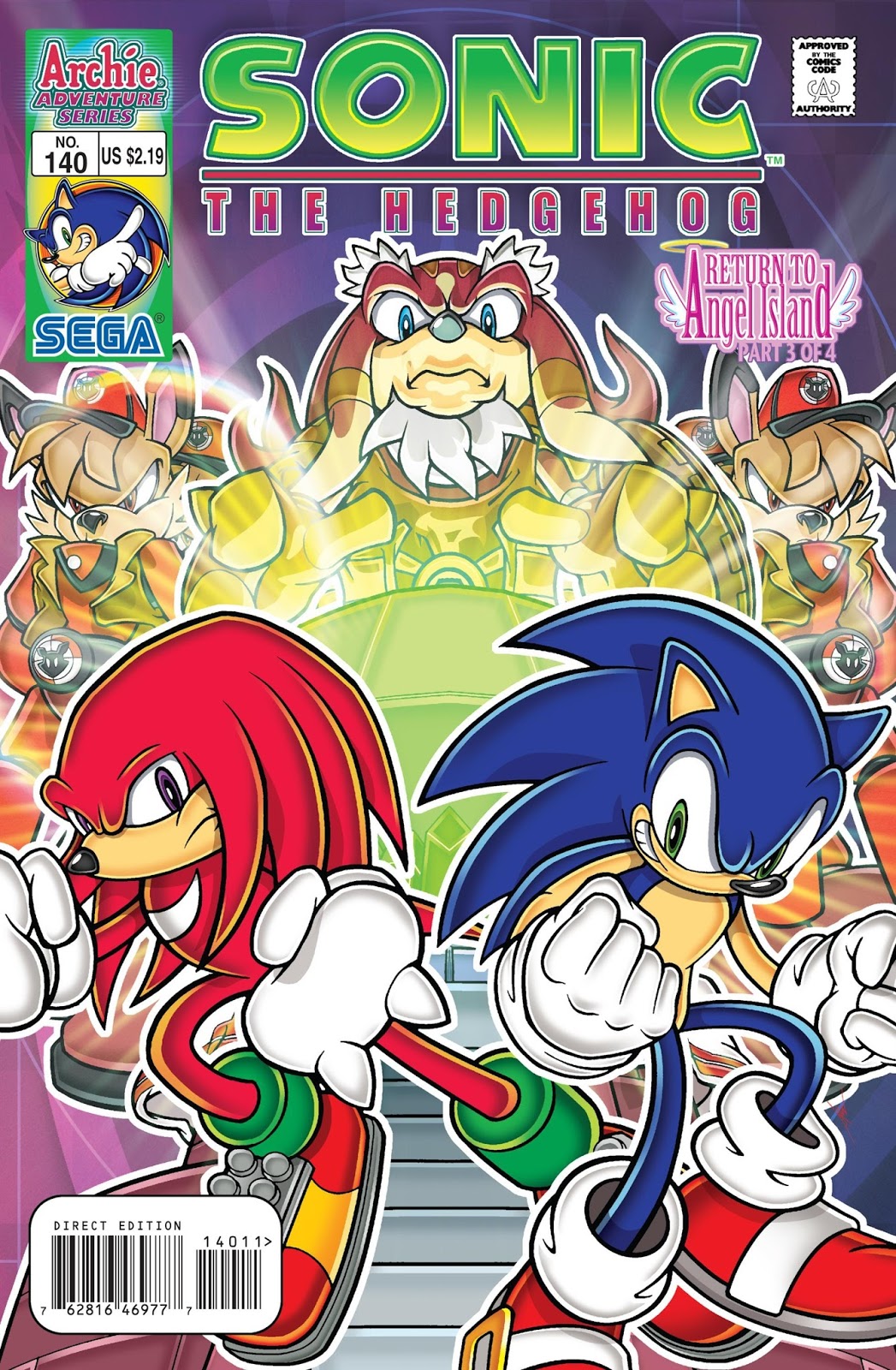
Sonic the Hedgehog: Issue 140
Publication Date: September 2004
It seems like Archie considered “Return to Angel Island” the big “Sonic” event of 2004. “Home,” after all, began in 2003. The return of Tommy the Turtle was only deemed big enough to occupy three issues. For some reason, Knuckles' liberation of his home land got four roomy issues to explore its story. That's more than Knuckles' original mini-series got! Well, let's get on with this shit.
Having been reunited with his mom, Knuckles goes about reuniting himself with his dad. Combing the equal forces of Sonic, the Chaotix, and the Dark Legion, they storm the Dingos' stronghold. Making short work of Kage von Stryker's forces, Locke is rescued. Enraged by his general's failure, Robotnik pulls a villain out of cold storage.
“Return to Angel Island” has been skirting the issue for a while now. The story arc has presented plenty of moments for Knuckles to get emotional but has managed to bungle each one almost every time. In part three, the troubled young Guardian almost gets through a touching moment without being interrupted. Kneeling before the Master Emerald, he confesses how impotent he feels, especially when compared to what those who believe in the Avatar think he is. Even this revealing moment has a few derailing elements. Knuckles has to pause and explain the claws and sunglasses he's wearing now, two objects taken from “Sonic Adventure.” The scene ends with a bizarre panel of Archimedes, looking very ominous, saying everything is going according to plan. By the way, this moment is totally unrelated to everything else that happens in this story.
Yet this moment is one respite from the constant action that makes up “Return to Angel Island.” The rest of the issue is made up of action sequences. Sonic leaps around quickly from the Dark Legion's floating platforms, a moment that gets a whole page devoted to it. Jon Gray devotes nearly an entire page to the Chaotix raiding Kage's fort. This is, notably, the only moment the Chaotix appear in this one. The issue seemingly builds up towards a confrontation between Sonic and Stryker. When that fight comes, it ends extremely quickly. Which is either a deliberate comment on how much Kage sucks or just a seriously underwhelming moment.
Locke does get rescued, by the way. Knuckles and his dad share a weary exchange, the teenager getting teary-eyed. Yet Locke is mostly just a prop to drive the heroes. The story is seemingly over at this point. For some reason, it continues pass this logical conclusion. Robotnik, realizing Kage is incompetent, sends another agent to the Angel Island. What fearsome former villain has Eggman pulled out of obscurity to get a second chance...? Hunter. Yep, that lame Kraven rip-off from the final “Knuckles” comic arc. Yeah, you can tell I'm real enthused to see this jack-ass again.
If the cover story is, arguably, moving too quickly, the back-up is arguably moving too slowly. “A Difference of Opinion” has Sonic and Knuckles finally talking to each other in private after dinner. This allows the two heroes to level with each other. Before discussing the forthcoming apocalypse, the two look back on the reason why their friendship is so strained these days.
“A Difference of Opinion” should've been about two guys who were once close friends coming together for the first time in years and figuring out what when wrong. It's not an uncommon scenario, as even the best friends drift away or come to blows. Instead, “A Difference of Opinion” heaps exposition on the reader. Not-so-casually, Sonic and Knuckles detail past events. Apparently, at some point in the past or future, depending on how you read this, Knuckles becomes a living Chaos Emerald again. He then flat-out murders Robotnik, who was trying to steal the Master Emerald again. Power mad, Knuckles went about rewriting the world, prompting Sonic to blast him with some sort of doo-hickey. This restored Knux to normal, at the cost of blowing his eye out. Hence the fancy cyborg deal he sports in “20 Years Later.”
You're probably tired of hearing me doing this. Let's rake Ken over the coals once more for his most common writing flaws. Why is he telling us these past events, instead of showing us? Would a full-blown flashback have been too much to ask, instead of having the characters awkwardly bring up this information? Then again, maybe this summary saved us from having to see Knuckles go all green again, a change that was super tiring when it first happened and we only recently got rid of. Yes, one must point out how odd it is that Knuckles is the one to definitively defeat Robotnik, Sonic's archenemy. Once again, Ken does nothing to dispel his obvious echidna favoritism.
Flaws and all, there are a few decent lines of dialogue in “Difference of Opinion.” I do like the palatable tension the story has, as the conflict between Sonic and Knuckles is something this entire story arc has been building towards. Steven Butler's artwork is as top-of-the-line as usual. His strength for facial expressions gets a good workout here, since the story is primarily devoted to two guys standing around and talking. Though Butler's involvement does kind of make me wish Knux and Sonic weren't authority figures in the future and could beat the shit out of each other, for old times' sake.
As for Jon Gray's art on the cover story... Well, I'm still not a fan but I think I'm getting use to it. Gray does make interesting use of lighting and shadow. He frequently places a character in partial darkness in order to emphasize their expression. As for his action scenes, some of his visuals are striking while others just look like shit. Sometimes on the same page! Ray leaping over enemies, smashing their heads together, looks quite cool. Lien-Da's legs flying into the air like limp noodles, on the other hand, looks awful. This suggests that Gray isn't a bad artist so much as a sloppy one.
Anyway, issue 140 ain't terrible but is still far from good. That's a [6/10], for you.
Labels:
25 years later,
archie,
comics,
jon gray,
julie-su,
karl bollers,
ken penders,
lien-da,
sonic on-going,
steven butler,
the chaotix
Friday, June 16, 2017
Sonic the Hedgehog: Issue 139
Publication Date: August 2004
Issue 139 has got to be one of the most Knuckles heavy issues of “Sonic” Archie ever published. Sonic barely features in this one while the Freedom Fighters are nowhere to be seen. After the "Knuckles" book, mostly thanks to Ken Penders, built up the echidnas and the Floating Island to be such a pivotal part of Mobian history, it was inevitable that the series would have to deal with Angel Island again, even after Knuckles' solo book got canned. I'm not complaining, as I've got no beef with Knuckles' corner of the universe. It's just surprising to see Sonic reduced to a supporting character in his own book.
I guess I didn't mention this but the first part of “Return to Angel Island” ended on a cliffhanger. After wrecking a Dingo prison camp and freeing a number of echidnas, the heroes were ambushed by the Dark Legion. After scuffling with the Legionnaires, Knuckles receives some upsetting news. The Dark Legion, the still missing Brotherhood, and the regular echidna citizens all formed a truce, in hopes of deflecting the Robotnik backed Dingo army. There is an up-set to this: Knuckles is reunited with his mom, his stepdad, and his new baby brother, Knecapion.
Part 2 of “Return to Angel Island,” subtitled “The Avatar,” is not as action heavy as the first installment. Yes, the issue opens with a big fight between the heroes and the Dark Legion but eventually it settles into a calmer groove. Knuckles' reunion with his mom could've been a big moment. So could've his discovery that he has a new little brother, which is pushed into the back as a bit of comic relief. (Knuckles' biggest emotional reaction occurs after he hears Dimitri has died. His cries of anguish are weird, considering Uncle Dimitri sure spent a lot of time trying to kill Knuckles.)
These moments are pushed aside in favor of this whole Avatar business. Many of the echidnas Knuckles rescues, including his stepdad, bow to him. They praise him as the Avatar, the hero prophesied by the Ancient Walkers. Maybe the story's best moment occurs when a couple with a blinded child comes to Knuckles, hoping he'll heal the sick little girl. Knuckles, of course, denies being their messiah and bemoans the continued loss of his powers. This is fine, I guess. Knuckles' interior conflict over his destiny has always been a big deal for him. Yet the stuff with his family is a little more pressing for me.
The supporting cast continues to mostly be players in the action scenes. However, the script does make room for one interaction among the Chaotix. While Knuckles and Sonic are given a tour of the Hidden Palace Zone, Vector and Julie-Su get into one of their classical scuffles. Vector is incensed that Julie-Su is willing to accept the Dark Legion's help, as the crocodile clearly doesn't abide by the old “enemy of my enemy” adage. Sure, we've seen Julie-Su and Vector argue before, lots of times. Yet at least Karl provides a more concrete reason for their words, aside from Vector's general misogyny. This is more than Sonic or the other Chaotix get. They each only have a few lines.
“The Avatar” does spend a lot of time setting up the changes the Floating Island has undergone. The Master Emerald Shrine has been moved into the Secret Palace Zone, undoing the nice Sega-accurate Emerald Shrine the book cooked up not too long ago. This fits in with the game accurate redesign the Secret Palace Zone has undergone, including the tapestry of Sonic fighting Robotnik, which seemingly has no meaning now. Lien-Da has assigned herself leader of the Dark Legion, claiming Dimitri is dead. (Though his presence in the “20 Years Later” back-up story immediately reveals this as a lie.) The Brotherhood is missing. Most prominently, a mysterious new echidna named Dr. Finitevus, with an evident grudge against Knuckles, puts in his appearance. The book would try to build up Finitevus as Knuckles' arch-enemy, following Dimitri's rehabilitation. I never quite bought that but Finitevus' ranting and raving are amusing.
It's a slight improvement over the first part but there's still one serious problem. Jon Gray is still drawing it. Gray's ridiculous cartoon style pitches the emotions to the roof. When Finitevus yells at someone, his jaw unhinges as if he's a snake ready to swallow an egg. When Knuckles mourns Dimitri, his reaction is similarly over the top. Everyone is a loose collection of squiggles and circles. Lien-Da looks awful. Knecapion's appearance at the end is especially comical, banging Knuckles on the head with his rattle. Maybe Gray's artwork would've suited a lighter story but it jives badly with “Return to Angel Island.”
“Mobius: 20 Years Later” brings us back down to earth while remaining on the Floating Island. In “Slumber Party,” as the title suggests, is focused on Knuckles and Sonic's kids retiring for the night. Manik attempts to play Spin the Bottles with the girls but they rebuff him. Instead, they relax to a board game and Manik joins his dad in a game of pool. Knuckles broods in another room.
Some people bitch about “Slumber Party” because it doesn't advance the plot any. Which is a fair criticism. Even Dan Drazen, a fan of the “20 Years Later” setting, expressed frustration with this one. The Royal Family has just been informed that a planet shattering cataclysm is coming. What's their reactions? To play a bunch of games. Sure, that's probably not the most appropriate response. Then again, how many times has Sonic and Sally faced down an apocalypse? You'd probably react in a laid back manner after enough of those too.
Having said that, I still like “Slumber Party.” It works as a character piece. Letting the character sits back and unwind for a bit is worth doing, especially when the book has been so plot heavy recently. It gives some further character development to Lara-Su, her friend Salma, and the future versions of their parents. There's a cute moment, where Lara-Su reveals Salma's relationship to Rutan. Now to be fair, Prince Manik is still rather obnoxious while Princess Sonia remains a thin sketch at best. And Lara-Su's friend Riki-Le, who looks nearly identical to Julie-Su, doesn't even get that much. Still, I sort of like this one. (And it's not just because Steven Butler draws all the girls in slinky pajamas.)
I'm still not feeling the “Return to Angel Island” arc but issue 139 is, admittedly, superior to the issue that proceed it. There's little flecks of character development and emotion amid the absurdly drawn fight scenes. The back-up is seriously flawed but I still enjoyed it. In 2004, I'll take what I can get. [6/10]
Labels:
25 years later,
archie,
comics,
jon gray,
julie-su,
karl bollers,
ken penders,
lara-su,
lien-da,
sonic on-going,
steven butler,
the chaotix
Wednesday, June 14, 2017
Sonic the Hedgehog: Issue 138
Publication Date: July 2004
My memories of the year Archie's “Sonic the Hedgehog” series had in 2004 are not, shall we say, positive. I remember it being awfully shitty. This opinion extends to the “Return to Angel Island” story arc, which begins in issue 138 and would run through the next three installments. For reasons I can't elaborate on, certain sections of the Archie Sonic fandom actually like this story arc, considering it a highlight of the book's dark years. I'll be the judge of that!
King Acorn, Queen Alicia, and Uncle Chuck leave Knothole for a diplomatic tour around Mobius. This puts more pressure on Sally and Sonic, as the Princess assumes de-facto rule of the kingdom. Around the same time, a beaten and exhausted Charmy Bee and Saffron arrive in Knothole. After recuperating, they inform Sonic and Knuckles that Robotnik and the Dingoes have taken over Angel Island, turning it into a dystopia. The Freedom Fighters and the Chaotix, minus Sally and Bunnie, jump in a plane and head towards the Island, looking to liberate Knuckles' people.
What exactly has been happening with the Floating Island has been a mystery since Sonic has gotten back to Mobius. We knew Robotnik took over the Island but, beyond that, we haven't learned very much. At the very least, the first part of “Return to Angel Island” finally answers this question. Turns out, the Dingoes immediately aligned themselves with Robotnik and helped him take over the island. In exchange, the doctor outfitted the dingoes with high-tech weapons and suits. All the echidnas have been rounded up into interment camps. Except for Knuckles' dad, Locke, who is being imprisoned and tortured by Kage Von Stryker, Helmut von Stryker's cyborg son. This last point pisses Knuckles off, who loves his dad despite Locke being a massive tool.
A big problem with “Return to Angel Island” is that it has a huge cast. Sonic teams up with the Chaotix. With Charmy and Saffron rejoining the team, that brings the total number of heroes up to nine. Keep in mind, Saffron and Ray the Stuttering Squirrel have still received zero character development. Espio and Julie-Su are reduced to cameos, while Mighty and Vector are reduced to spouting one-liners. Instead, the focus is on the moving plot and the heavy action, with most of the pages devoted to Sonic and the Chaotix barging into the prison camp and fighting back the Dingoes.
A focus on action isn't exactly a problem, usually, as I enjoy some head-smashing as much as the next guy. However, there's something else preventing me from enjoying even that. Jon Gray has returned to pencil the issue. As last time, Gray's pencils are totally cartoonish. The expressions he draws for King Acorn and Sally when they're angry are hideous, the characters' jaws unhinging as they scream. All the expressions are exaggerated to extreme degrees, stretching far pass acceptability. The action suffers especially bad. It's hard to take the fight scenes seriously when Gray draws everything like a Loony Tunes cartoon. This is displayed when we see Espio strangle a Dingo with his tongue or the bees stinging another one in the ass.
There's no room for emotion in this story. Remington, traumatized by his time in the prison camp, has led a new religion hailing Knuckles as the savior, a prophesied avatar. Knuckles' reaction is pushed to the margins. Charmy's grim statement about what's happen on the island occupies one panel. As for the continuing turmoil between Sonic/Sally, I continue to hate how the book is handling this. The Princess continues to scream hatred at Sonic, demanding that he stop caring and that their relationship can never work, as long as Sonic insists on being a hero. Which is, as I've pointed out before, complete bullshit. The two fought on the battlefield together for years, for fuck's sake. Why are you toying with our emotions, Karl?
We stay on Angel Island for the second story, another “Mobius: 20 Years Later” installment entitled “My Dinner with Sonic.” Disappointingly, Wallace Shawn is a no show. Instead, the story focuses on the tension between Sonic and Knuckles. Despite being older and wiser, the two still don't get along. These tensions arise over the dinner table. The wives convince the two guys to put aside their differences long enough for Knuckles to explain how fucked the world is, unless immediate action is taken.
Ken Penders, let we never forget, sometimes writes his heroes as assholes. King Sonic gets the worst of it in this story. We learn that, for some reason, Sonic has isolated himself from his friends and loved ones. When Tails moved to Downunda – disappointingly, not to marry Barby Koala, as he's paired up with Mina now – Sonic didn't even bid him goodbye. Early on, he dunks his son's head under the pool water for hogging the volleyball net. (Not that I can blame him too much for that one, especially since Manik attempts to grope Lara-Su later.)
While Sonic and Knuckles are friendly in the current timeline, something has happened in the future to force them apart. The two argue cattily a few times. Sonic makes fun of Knuckles for learning about food. They argue about some past conflict, an Overlander uprising, that Knuckles didn't assist Sonic with. While I don't know why Ken is writing Sonic as such a jerk, I do like the two rivals sniping at each other. After all, there's a history of Sonic and the Guardian not exactly getting along swimmingly. Some of Penders' more natural dialogue is on display here. It leads up to a nice payoff, with Sally and Julie-Su insisting the two put aside their macho pissing contest and get along. That's funny.
While I have been enjoying “20 Years Later” more than the cover stories recently, I'll admit the story has been moving at a snail's pace. In this installment, the story finally circles back to the conflict at hand. Mainly that Mobius is on the verge of tearing itself apart, via some dimensional instability or something, which is manifesting as shitty weather. Knuckles grimly delivers this news over the dinner table, asking the Kingdom of Acorn for its assistance. From what I remember, this point still isn't resolved for quite some time, what with Penders being who he is. But it's nice to see some movement around these parts.
The beast that is 2004 continues to roll forward. The back-up is okay – Steven Butler's pencils are up to his usual excellent standards – though it has its problems. The cover story is another weak addition from Karl Bollers, who I once claimed was a good writer. [5/10]
Labels:
25 years later,
archie,
comics,
jon gray,
julie-su,
karl bollers,
ken penders,
sonic on-going,
steven butler,
the chaotix
Monday, June 5, 2017
Sonic the Hedgehog: Issue 134
Publication Date: March 2004
There are a number of infamous issues throughout the long run of Archie's “Sonic” book. Some are notorious for their lack of quality, like “Sonic Live!” or “Naugus Game.” Others are infamous for the events they depict, like Sally's apparent death in issue 47. Or this one, for example. Issue 134 contains what some fans have taken to calling “The Smack Heard Around the Fandom.” As a die hard Sonic/Sally shipper, it shouldn't come as a shock that I fucking hate that widely loathed event. Is the story around this controversial decision worth salvaging?
The epilogue of “Home” - subtitled “Say You Will,” because what Sonic book is complete without a Foreigner reference? - is exactly that. This issue is directly concerned with the fall-out of the “Home” arc. Sonic spends some time around Knothole, reconnecting with old friends and discovering some of the events that have changed.
“Say You Will” could've had a similar function as the first part of “Home,” an emotional story devoted to Sonic reconnecting with his friends and love ones. And technically it is, though in the most awkward way possible. For most of the page count, the hedgehog regurgitates things the readers already know. Such as explaining to his parents why Jules is still a robot while all the other Robians are now organic. Or telling Tails that his parents still live, though on the other end of the universe. (Of course, the answer to both of these questions is the rather uninspiring “aliens.”)
“Say You Will” does attempt to explain some of the changes that have occurred while Sonic was away for a year. Bunnie and Antoine have naturally drifted apart, the war with Eggman apparently changing the coyote. That's not a very satisfying explanation but, okay, sure. It'll do until the actual, far more insipid answer is revealed. As for the new changes: Dr. Quack is now sporting an eye patch, after stepping on a landmine. Mina now has a boyfriend, her asshole manager Ash, despite still singing songs about Sonic. Knuckles explains why the hell he's hanging out around Knothole. Turns out Robotnik took over Angel Island a while ago.
It's all fine and good, I guess, but not the thing anyone remembers about this issue. In “Say You Will,” Karl Bollers finalizes the despicable character derailing Sally Acorn has suffered for a while. On Mina's stage, in front of all of Knothole, Sally gives Sonic an ultimatum. Either retire from field duty and stay with her in wedded bliss or say goodbye to their relationship. Sonic refuses to quit fighting Robotnik, causing the Princess to smack him in the face and terminate their engagement.
This is absolute bullshit, you guys. Complete bullocks. Total fucking horse dookie. Why the fuck would Karl break up Sonic and Sally after finally letting the two officially become a couple just a few issues ago? And, if he had to break them up, why do it in such a stupid fashion? It could've been more natural. Maybe after thinking he was dead for a year, Sally is afraid of loosing Sonic again. Instead, it makes the Princess seem clingy and manipulative. Sonic so easily making this decision also makes him look like a callous asshole.
And it's so hard to believe. Once upon a time, Sonic and Sally would fight side-by-side on the battle field. The two risking their lives wasn't a problem back then! What the fuck happened, aside from bad writing? The Dork Age has been upon us for quite some time but this slap signaled the comic's most extreme downward spiral.
So how about that back-up story? Ken Penders' “25 Years Later” keeps going with “In Transit.” Knuckles and Rotor's meeting in the park is interrupted when he spots Lien-Da's son spying on them, the kid coming upon the secret meeting while making out with his girlfriend. Concerned about what he might have learned, Knuckles returns to Haven, spying on his enemy instead of his daughter. Meanwhile, Rotor and Cobar continue to hint ominously towards upcoming bad juju.
Once again, the plot is the least interesting thing about this story. Instead, “In Transit” is full of cute moments between parents and children. In Haven, we see Grandfather Sabre is infirm while Spectre and Sojourner are seemingly unaged. This leads to an especially hilarious panel, perhaps unintentionally. When Knuckles mentions that Julie-Su insisted he never spy on Lara-Su, Sojourner expresses bafflement. Invading people's privacy is such an ingrained part of the Brotherhood, that they literally can not understand why anyone would object to it. It sort of seems like Ken is poking fun at his own writing here but who's to say? I also like Lien-Da's continued characterization as a doting mother, who is more interested in her son getting to second base with his girlfriend than in any pertinent information he may be carrying.
In addition to being a fun story, “In Transit” also looks amazing. It might have been this point that Steven Butler surpass Manny Galan as my favorite Knuckles artist. What about the cover story? It's drawn by newcomer Jon Gray. Some folks love Gray's artwork. I, personally, can't stand it. I was in high school when this issue came out and, reading it, Gray's pencil couldn't help but remind me of the shit girls I knew doodled on their notebooks. It's extremely loose, characters bending in all sorts of ridiculous, exaggerated ways. There's no interior cohesion to Gray's work, the cast members sloppily changing shape at a moment's notice. Gray's ridiculous artwork also undermines what should've been a fairly serious story. That's another reason the slap is so notorious. Gray draws it with the biggest, most oversized emotions possible.
For the first time, I think I have to rate the cover story and the backstory on different scales. “In Transit” is my favorite edition of “25 Years Later” thus far, a funny, charming story. It gets a [7/10.] The cover story would just be another mediocre Karl Bollers joint, awkward plotting choking out the smoothness, it if wasn't for the odious treatment of Sally. For totally assassinating everything lovable about the People's Princess, “Say You Will” gets a [2/10.]
Friday, June 2, 2017
Sonic the Hedgehog: Issue 133
Publication Date: February 2004
Despite an emotional beginning that was soundly praised by most every one in the fandom, except for those fuckheads who don't like the pre-boot verse at all, the “Home” story arc soon became more focused on driving action. Which wouldn't have been a problem if the plot heavy action was less interesting than just seeing the characters interact with each other. Especially since Karl continues to dole out tiny details about the changes Mobius underwent during the year Sonic was tossed in space.
“Home: Part 4,” which is simplistically subtitled “Finale,” continues to split the plot among different locations. Sonic fights Mecha. Tails fights A.D.A.M., the sentient computer virus still in control of the Tornado. Knuckles and the Chaotix, with assistance from Rouge and Amy Rose, faces down Robotnik's mechanical army. The threads slowly connect, leading Sonic and the Freedom Fighters to a temporary victory.
“Finale” is mostly focused on the big action sequences. The problem is that too much of the action is kind of dull. M, Robotnik's statuesque robotic daughter, isn't the most invigorating of enemies. She shoots laser beams from her eyes, which Sonic dodges until he can't. After a punch from Bunnie and a grenade from St. John, the depths of M's unoriginality is revealed. She exits the fire as a robotic skeleton. Yep, Mecha is a rip-off of the Terminator. More specifically, Kristina Loken's Terminatrix from “Terminator 3.” Considering “Rise of the Machines” had just come out a year before this comic, the resemblance probably isn't a coincidence. Sadly, Mecha isn't even as captivating a threat as that character. After humbling Espio and Hershey, Sonic easily defeats the fembot by dropping her into some sewer water, shorting her circuits. Robotnik coated his killbot in human flesh but didn't water proof it?
In fact, both of Robotnik's “children” prove underwhelming. As soon as A.D.A.M. controls of the Tornado, the virus probably should've crashed the plane into a mountain side. It might not have killed Tails – the fox is, after all, well known for his ability to fly even without a biplane – but it at least would've minimized that threat. Instead, Tails stumps A.D.A.M. by telling him riddles. Thus another element of Robotnik's flawed design work is revealed. He didn't think to program A.D.A.M. with a sense of humor. Tails' warmed-over witticisms, which includes such chestnuts as “What's black and white and red all over?,” is enough to temporarily send ADAM off-line! Christ, it's a good thing Tails didn't ask the A.I. to comprehend love.
There are a few nuggets of character development that makes the finale of “Home” slightly more compelling than its prior two parts. Despite never displaying an aptitude for heath care before, Fiona Fox now acts as the team medic, giving her some reason to be here. After Rouge offers Knuckles some help, Julie-Su squints at them in jealousy. It's a cute moment, acknowledging the sexual tension Knuckles and Rouge shared in “Sonic Adventure 2.” (This potential attraction would never be furthered developed, which is fine since this book probably didn't need another love triangle.) Most importantly, after Sonic asks Bunnie and Antoine to go on a mission together, it's revealed the former couple haven't been together for months. This plot point would develop in a stupid direction eventually but it certainly catches the reader's eye here.
Not all the character development here is satisfying. Karl continues to drop the ball concerning Princess Sally. Despite not long being kept away from the action by her parents, the Princess has once again been reduced to pining for her hedgehog love. After Sonic is injuried on the battle field, Sally runs away weeping. Is this the same Sally that was dropping backkicks on robots years earlier? Meanwhile, Karl's characterization of Shadow the Hedgehog remains simplistic. The black furred hog confronts Robotnik, threatening to murder the mad scientist for reasons I can't remember now. This is consistent with Sega's characterization of Shadow at the time. (After all, the next year would bring his solo video game, with its machine guns and motorcycles.) But, after Shadow's cute reaction to Hope in “Sonic Adventure 2.5,” it seems like a step back.
In the back pages, Ken Penders' “Mobius: 25 Years Later” arc continues. Knuckles and Rotor meet in the park at night. There, the walrus informs the Guardian that something creepy is happening with the skies, hinting at a forthcoming cataclysm. Meanwhile, Julie-Su and Lara-Su have a heart-to-heart, in the wee hours after her unveiling.
Once again, Ken Penders has presented a vague, forthcoming ecological disaster as the main adversary of his story. This is at least the second, maybe third, time he's pulled that shit. Was he traumatized by a hurricane as a kid or something? Ken's attempt at witty dialogue between Rotor and Knuckles, amid loose warnings about what's to come, aren't very interesting. The scene between Julie-Su and Lara-Su is a little better. Julie-Su seems to have developed into a slightly overprotective mother. Lara-Su continues to be annoyed that she can't have solo adventures. Julie-Su assures her that mom and dad know best. It's a bit awkward but think about this. Both Knuckles and Julie-Su believed themselves to be orphans until they were fifteen. Being slightly clingy towards their daughter makes sense, as both understand what it's like to live without parents.
After Ron Lim and Dave Manak took uninspired shots at the “Home” arc, Steven Butler returns to draw all of issue 133. Butler's strength for drawing sexy females is especially noticeable. Whether it's Bunnie's cleavage, Fiona's heaving bosom, Rouge being Rouge, or Julie-Su and Lara-Su lounging around in skimpy nightgowns, this issue has no shortage of fan service. Beyond T&A, Butler's gift for action and detail also shines here... For the most part. There's an occasional weird panel. The open two page spread shows Sonic leaping over a laser blast, which looks awkward. A later panel shows Shadow running over a body of water, displaying some weird perspective work. Yet every weak panel is overpowered by an especially strong one. Such as Bunnie triumphantly wrecking Robotnik's battle ship or Knuckles and the Chaotix heading into battle against Robotnik's robot army.
“Home” started really strong but started to falter almost immediately afterwards. There's a crumb or two of something more interesting in this issue but Sonic's grand return to Mobius could've been better handled. “Mobius: 25 Years Later” remains refreshingly low-key in comparison. Gee, does that balance out to a [5/10] or so? Sure does.
Subscribe to:
Comments (Atom)