Showing posts with label ken penders. Show all posts

Wednesday, October 31, 2018

Archie & Friends: A Halloween Tale


Archie & Friends: A Halloween Tale
Publication Date: September 1998

Happy Halloween, Hedgehogs Can't Swim readers! If you've been reading this blog for a while, you know that I love this day. Halloween isn't just my favorite holiday, it's my favorite time of year. This spooky, scary festival means a lot to me. Sadly, the “Sonic the Hedgehog” franchise doesn't indulge in the macabre or morbid very often. I've bemoan the lack of existence of a “Sonic” Halloween special before.

Except... I was wrong. There is a “Sonic” Halloween special. It's even a part of my beloved Archie-verse! But you'll be forgiven for not knowing this existed. “Archie & Friends: A Halloween Tale” is a short, ten page comic book that was published strictly as a promotional gimmick in September of 1998. I had never heard of the book before reading about it on the Mobius Encyclopaedia. Though super obscure, it's not especially rare and can be bought fairly cheaply online. I'm happy to present my thoughts on this weird bit of “Sonic” lore to you on this happy Halloween.


The book is also another one of those ill-conceived crossovers Archie was attempting around this time. “A Halloween Tale's” sole story is entitled “A Festival of Fantasy.” It depicts Sabrina the Teenage Witch meeting Sonic before their crossover in Sonic Super Special #10.

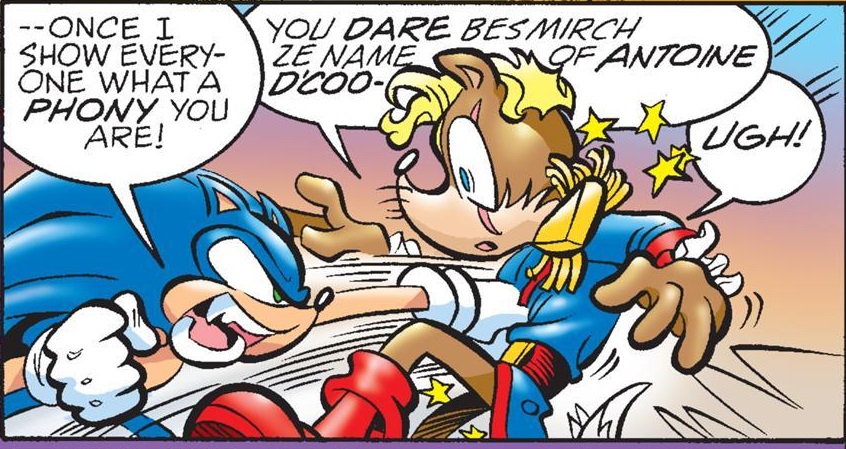
“A Festival of Fantasy” has Sabrina's talking cat Salem, weirdly depicted primarily as live-action photos from the then-relevant TV sitcom, tasking Sabrina with picking up his comics. The smarmy clerk, who can't believe a woman would be interested in comics, quickly strikes up a conversation with her. Confused, Sabrina accidentally recites a spell over the long boxes. This zaps her and Stevie into the world of Archie's “Sonic” book, where Sonic and Knuckles are currently fighting with Dr. Ivo Robotnik. Desperate to escape, Sabrina zaps herself, Stevie, and Sonic and Knuckles back out of the comic and into her world. Strapped for time, Sabrina is forced to drag Sonic and Knuckles to Cheryl Blossom's Halloween party. There, the Mobian heroes get into a scrape with Archie and Jughead before Sabrina successfully zaps them away.


Aside from the mere existence of a “Sonic” Halloween special being cool, “A Halloween Tale” is  interesting to me for another reason. I had always assumed that Archie begrudgingly tolerated the “Sonic” series' success. I imagined Archie was far more proud of the stupid teen comedy series that gave the company's its name. That they dismissed “Sonic” as a lame licensed book, of little interest. They might still be true but “A Halloween Tale” has Sonic happily standing alongside Archie's titular characters and his supporting cast. At one point, Ken Penders' script even refers to “Sonic” and “Knuckles” as best-selling books! So that's nice.

Then again, Ken Penders' might have been serving his ego some with that line. “A Halloween Tale” also has someone excitedly grabbing the first issue of “The Lost Ones.” (Which wouldn't actually come out until the year 2000.) The issue also ends with Salem, atop a pile of comics, calling the story great and imploring the reader to pick up more comics by Penders and friends. Real subtle, Ken.


“A Festival of Fantasy” is primarily a piece of cross-corporate promotional synergy. Archie packs the thing full of cameos. Aside from Sabrina and Salem, Archie himself, Jughead, Cheryl Blossom in a Playboy bunny outfit, Betty, Veronica, and Reggie all appear. There's a spread showing a crowd at the Halloween party. That includes Josie and the Pussycats and Sabrina's archenemy Enchantra. Some of those vintage superheroes Archie likes to bring back occasionally appear too: The Shield, the Web, the Comet, Black Hood, Blackjack, Steel Sterling, and the Jaguar. (And Stevie's Halloween costume is of Pureheart, Archie's superhero alter-ego.) Even further in the backgrounds are non-Archie characters like Shadowhawk, Astal, Charlie from “Street Fighter,” and Penders' Particle.

You'll notice I'm talking more about “A Halloween Tale's”  status as a novelty than as an actual story. The plotting is pretty fucking thin and lousy. The jokes, as seems to be in keeping with the “Archie” titles at the time, are pretty lame. The characters are broad and annoying. Reggie is an unreasonable asshole who tries to pick a fight with Sonic and Knuckles. For no particular reason, Jughead's Halloween costume is Robotnik, leading to an especially contrived confrontation. Robotnik's presence is a continuity error, as the classic version of the character was dead by this point. If you think Archie Sonic fans overlook this, you severely underestimate their nerdiness.


The script is exactly as lame as you'd expect a ten page long crossover to be. Ken probably wrote this fucking thing in half an hour. Artwork wise, “A Halloween Tale” is a little more interesting As in “Some Enchantra Evening,” the Archie characters and Sonic characters are drawn by different artists. Dan DeCarlo draws the Archie crew and does slightly better than the later work of his I saw. He obviously enjoys drawing sexy girls like Cheryl or Betty. None other than Patrick Spaziante handles the “Sonic” cast. They look pretty damn great, expressive and stylized. The contrast between the two styles are extreme but it's always fun to see Spaz draw the Sonic crew.

As a Halloween special, “Festival of Fantasy” is pretty underwhelming. There's nothing spooky, scary, creepy, eerie, or even spoopy about this particular book. Still, it's mere existence is delightful to me. It's a mediocre comic book but the sheer novelty factor goes a long friggin' way. If you're a fan of stupid bullshit, like me, I'd recommend you try and find a copy. [5/10]

Friday, August 18, 2017

Sonic the Hedgehog: Issue 159


Sonic the Hedgehog: Issue 159
Publication Date: February 2006

Well, guys, we are here at last. Issue 159 is the final issue of “Sonic the Hedgehog” that Ken Penders would work on. With his exit, one era of Archie Sonic history – with, admittedly, wildly divergent ups and downs – was about to end. Another era, one widely regarded as the comic's best, was about to begin. As far as transitional issues go, 159 hardly wraps up any of Ken's lingering plot points. In fact, it sets up a few more! This suggests that his departure from the book was rather sudden. If I didn't know for a fact that he left willingly, I would assume he was fired.


So let's get to “System Reboot.” During their attack on Knothole, Hope is injured by a Metal Sonic Trooper. This forces Shadow and Sonic to work together, grabbing the girl and running her to safety inside of the King's castle. Afterwards, the two continue to work together to defeat the Metal Sonic horde. Robotnik, meanwhile, sits back and watches, actually hoping his enemy saves the day, since the troopers threaten both of them.

You know how the previous comic's cover trumpeted the fight between Sonic and Shadow as if it was a big deal? And then ended by setting up the brawl? Yeah, that lasts all of two pages. Granted, the reasoning for the fight – Shadow blames Sonic for Hope's injury, for some reason – is as thin as you can get. Instead, “Reboot” is devoted to the two rivals actually finding common ground. They work together to rescue Hope. They fight along side each other to stop the Metal Sonics. In a moment that's very nearly touching, Sonic even extends a branch of friendship towards his gruff rival. And Shadow smiles back! It's not exactly organic but at least it's a little more interesting then the two just wailing on each other all the time.


Sadly, every step forward is a step back. For reasons I can't remember now, Knuckles and the Chaotix are in town, fighting off the robots. When Shadow uses his Chaos Control powers to teleport Hope to the castle, Knuckles witnesses it. Later, Shadow uses the same ability to deactivate a whole fleet of machines. Knuckles confronts the hedgehog about it, realizing Shadow can tap into the Chaos Force, an ability previously limited to Guardians. So that's how you can tell Ken was starting to care about Shadow. He wrapped him up in the convoluted mythology revolving around Knuckles, his dad, and the Floating Island. That's one plot point I'm happy was dropped. That particular strain of bullshit wasn't needed at this moment. Or ever, for that matter.

Truthfully, “System Reboot” is a little more character oriented then you might expect. After arriving at the castle, Sonic announces how pissed off he is. How he thinks the Metal Sonic Troopers were an obviously bad idea and wonders why the King ever approved them. The moment doesn't go much further then that. Elias informs Sonic that he wasn't King then so there's no reason to yell at him. The story has to move on from there, getting Sonic to fight the machines. Still, I appreciate the writer for letting the hedgehog expresses these thoughts. I was thinking the same thing. I'm sure other readers were too.


The action nearly gets pushed totally aside. There's the brief Sonic/Shadow fight in the beginning. The last half features three whole pages of Sonic fighting the Troopers. He tackles a few, gets shot with an eye beam, and then whips up a tornado that blows most of them away. (Shadow and his special powers then arrive to finish off the rest.) It's pretty underwhelming. Ron Lim's pencils are as lackluster as ever. Then again, I wasn't very invested in that plot line anyway. Might as well blow it away quickly and cleanly.

Throughout the last two issues, Ken kept pausing for these really weird moments where Jules and Bernie worried about their son. These scenes barely connected with the other things going on in the story. This incredibly awkward subplot concludes here in an incredibly awkward manner. After saving the day, Elias awards Sonic a medal and a royal designation. Jules and Bernie are overwhelmed with pride, realizing their boy has truly grown up. What makes this weird is Sonic's parents barely interact with him during this story. Wouldn't some conversations with Jules and Bernie have handled this plot point in a more compelling manner? Does Ken know that parents are suppose to talk to their kids? (If he truthfully didn't know that, it would explain so much.)


Dr. Robotnik took a backseat throughout the cover story. I guess to make up for this, the back-up story stars him. It's called “Insidious” and, sadly, no lipstick-faced demons appear. Instead, the story revolves around A.D.A.M. explaining to Robotnik that they still have partial control over the nanites inside Knothole. Tommy Turtle is already infected. Using the remote link, A.D.A.M. gets the nanites to infect Bunnie's cybernetic limbs and Nicole, hoping they will take down the Freedom Fighters from within their own base.

“Insidious” is a very bland story devoted to setting up future stories. The conversation between Eggman and A.D.A.M is heavy on the exposition, making it a snore to read through. Penders draws the story himself. His pencils are not as grotesque as they sometimes were. Only Bunnie looks off-model. Instead, the illustrations are just boring to look at. Which is fitting, I suppose, since the story is devoted to a conversation between a mad scientist and his computer. Not the most compelling stuff and Ken isn't strong enough a writer to make it compelling.


Like I said, both stories leave some dangling plot points, as if Ken was expecting to continue his tenure. What of Shadow's connection with the Chaos Force? What about A.D.A.M. using the nanites to infiltrate Knothole? The next writer would only pick up one of these plot points, likely taking it in a very different direction then what Penders intended. Having said that, there is something like a point of finality to Ken's final issue. Sonic getting a medal of honor and being elevated to Gentleman-at-Arms status is a decent stopping point, as is Shadow's growing humanity. If the comic had ended with Penders' exit, it certainly wouldn't have been a satisfying conclusion. Yet it almost feels like an ending.

Good-bye, Ken Penders. His tenure on “Sonic” has been a long, usually frustrating ride. For all his flaws – his many, many flaws – I can't hate Ken's work. For better or worst, he built most of the comic's early history. He created a lot of characters I like, even a few I love. The weird world that Archie Sonic inhabited is mostly his doing. And I like that world. Towards the end of his run, Penders' writing skills really fell apart. If he had left a year or two earlier, the book would have been better off for it. Even on his best days, he was a frustrating writer. Yet, at the end, I'm still almost, sort-of, kind-of a fan. (This issue also marks Ron Lim's final Archie credit. I'm less conflicted about his departure.) His last issue wasn't entirely terrible and that's okay. Bring on Ian Flynn. [6/10] 

Wednesday, August 16, 2017

Sonic the Hedgehog: Issue 158


Sonic the Hedgehog: Issue 158
Publication Date: January 2006

2006 would be the year that Archie's “Sonic the Hedgehog” book would finally pull itself out of the pit of mediocrity it had been simmering in for quite a few years. Soon, enough, a new creative staff will come on board and revitalize the title. But we're not there, not quite yet. We still have two more issues before Ken Penders' reign comes to an end. Though Ken would leave for other reasons, you can't help but wonder if he was running out of ideas. Issue 158 promises yet another fight between Sonic and Shadow. Don't these guys do anything else? The book hasn't been this fight crazy since the early days, when Knuckles was still a new character. Anyway, let's get on with the show.


“System Reconfiguration” continues where we left off. A group of Metal Sonic robots has invaded Robotnik's city. The doctor assumes Snively is behind this but the true culprit, the mysterious force hacking his system, remains unidentified. He quickly gets Mecha back on his side. Just as the machines look like they'll overrun the villain's lair, they instead head out for Knothole City, destroying everything in their path. Sonic and Shadow just escape the chaos, heading into the forest to fight the invasion for different reason. Both hedgehogs will soon learn some startling information.

Besides old dog faithfuls like me, I don't know who the hell else was reading the comic book in 2006. Maybe the younger Sonic fans, driven to the comic by a mania for “Sonic Adventure 2” and “Sonic Heroes,” wanted to see Sonic and Shadow fight each other once again? If that was the audience Archie was targeting at the time, I bet they were disappointed in this story. Despite the cover promising a title bout between the blue blur and his latest rival, Sonic and Shadow do not fight in this issue. In fact, they are even working together – kind of – throughout part of it. Shadow spends about a third of the issue unconscious!


But covers always lie. What of the actual content? To his credit, Ken does make an effort to develop Shadow a little as a character. Robotnik attempts to manipulate the so-called ultimate life form. Robotnik points out his familial relation with Shadow's creator, making the hedgehog a nephew of sorts to the villain. Interestingly, Shadow doesn't buy it. Instead, he's driven to protect Hope. Considering his connection with Hope has been his sole humanizing element, I don't mind Ken returning to that one. It doesn't amount to much. Mostly, it's a story excuse to get the anti-hero fighting the horde of Metal Sonics. But it counts for something.

The robotic threats, called the Metal Sonic Troopers, are also potentially interesting. They sport the dorky black leather loincloth design from “Sonic Heroes.” They don't display a flick of personality. Instead, the troopers act like a zombie horde. They don't eat flesh but they do descend as a crowd, destroying everything around them. We learn their origin. Rotor and Uncle Chuck built them as a robotic police force while Sonic was in space. Once the hero came back, the Troopers were shelved. Sadly, both of these points are wasted. Sonic spends a little too much time relaxing after the robots are set loose, making them seem less dangerous. Our hero, meanwhile, has no reaction – good or otherwise – to learning that his uncle and friend are responsible for this new threat.


Among all this chaos, Ken once again makes an attempt to sneak in some pathos. Before the Troopers attack Knothole, Jules and Bernie have another conversation about their son. Bernie wonders if they've gone wrong, letting Sonic march into danger like he does. Once again, Jules recommends giving the boy some distance, that he's not a child anymore. This can't help but remind me of how Locke treated Knuckles, spying on him while refusing to actually father him. Maybe it's just residual annoyance with that plot point that makes these scenes stick out to me. Or maybe they really just don't have a place in this current story.

I know I bitch about Ron Lim's artwork all the time. In “System Reconfiguration,” Lim does some especially lousy work, just when he was showing some improvement too. The Metal Sonic Trooper look too much like a collection of pointy edges. When attacking as a crowd, Lim just draws a big blue, squiggly shape. His character work is okay in a few panels. Uncle Chuck and Shadow look okay, at least by the standards of Ron Lim's pencils. The action artwork, however, is dire. It's lifeless, messy, and shapeless.


For the back-up story, Archie forces us to suffer through another shitty “Off-Panel” comic. Mike Gallgher's script even admits that no one is actually interested in reading this. A gag claims Hugh – apparently the guy who changes the print cartridge – demanded another one of these. Anyway, the plot: Sonic and editor Mike Pellerito meet in a back alley for some reason. There, they are attacked by Blackstage, some Phantom of the Opera looking motherfucker who threatens to expose a bunch of behind-the-scenes footage to the fans, expecting this info to destroy sales. It doesn't work because fans enjoy stuff like this. So the villain essentially defeats himself.

It's so dumb, you guys. The script is derivative of “Better Read Than Dead” from 126, with a lame villain appearing to threaten the editorial staff in a really dumb way. Like in that story, Sonic is benched for most of the plot, making Pellerito the hero. (Because that's what people reading a “Sonic the Hedgehog” comic book wanted to see: The adventures of the editor.) Blackstage's plan doesn't even make sense. Why would behind the scene footage destroy a comic book's credibility? It's a comic, not pro-wrestling! Is Blackstage unaware of the popularity of DVD special features?


I guess that's to be expected, as this is a gag comic. Sadly, the gags aren't funny either. Blackstage's incriminating footage includes stunt doubles, camera tricks, special effect shots, and King Acorn being in a make-up chair for six hours. (I've always suspect Mike Gallagher stopped paying attention to the book years ago and this proves that, as all these story events are from the pre-100 days.) When the bad guy is informed that his plan is stupid and sucks, Sonic tears his clothes off, puts the mask on, and sings a bar of Andrew Lloyd Webber. Jeeeezus. Is this what Archie's comedy books were like at the time? No wonder nobody read them back then. I'll give the story this much though. It's slightly less embarrassing then “The Edge of Parodies,” the previous Off-Panel five pager.

The cover story is slightly better then most of the “Sonic” stories Archie published in 2005. This is faint praise, as it's still a stiflingly mediocre affair. Ken isn't exactly going to go out on a high note but he could've done a lot worst. We all know that. I'm willing to totally ignore that fucking terrible back-up story and just stick this one with a [6/10.] I'm feeling generous.

Wednesday, August 9, 2017

Sonic the Hedgehog: Issue 157


Sonic the Hedgehog: Issue 157
Publication Date: December 2005

Do you see what's up ahead? It's the light at the end of the tunnel. Issue 157, in addition to ending a lousy year for the book, would begin head writer Ken Penders' final story arc for Archie's “Sonic the Hedgehog.” After wrapping up this story, Ken would leave Archie once and for all, allowing a new writer to come in and yank the series out of the creative rut it has been in for years. But we're not quite there just yet. Let's get through these next three issues together.

Even though he's only been gone for a few issues, Shadow's return to the comic is trumpeted on the cover. (I'm sure Sega's ill-conceived “Shadow the Hedgehog” video game coming out around the same time was a big factor in this decision.) The so-called ultimate life form feels drawn to a mysterious laboratory on the edge of Station Square. Inside, he finds a video of Doctor Gerald and a new version of Metal Sonic. The two synthetic hedgehogs wail on each other until they both collapse.


Ken's departure from the book, reportedly, was due to his frustration with Sega insisting he write stories featuring Shadow the Hedgehog. Maybe that reluctance might explain why “The Good, the Bad and the Unknown” and this story were so lame. The untitled cover story for issue 157 raises a bunch of underwhelming plot points. “Sonic Adventure 2” is reportedly part of Archie cannon, by this point. Despite this, Shadow is still shocked when the recording of Dr. Gerald informs him that he was created to take revenge on the government.

If Ken was hoping to give Shadow some development with this story, he squanders it by devoting the rest of the story to a fight with Metal Sonic. That's a thoroughly underwhelming spectacle too.  Shadow takes a rocket punch to the face. A Mega Man looking hand blaster is traded back and forth between the combatants. Liquid nitrogen and an electric live wire are utilized in unimpressive ways. The battle concludes with both fighters unconscious, making all five pages of this thing seem like a wasted endeavor.


In truth, the back-up story is actually the main drawl of this issue. “System Shutdown” begins with Robotnik, still in his bathrobe, getting a rude awakening. Someone has hacked into his computer system, threatening to completely take down his network. He's so concerned by this that he travels to Knothole, hoping to create a truce with Sonic. After the required fight, the hedgehog flies to Megatropolis, uncertain if he's entering a trap or not.

There's an interesting idea at the root of “System Shutdown.” Robotnik coming to Knothole as a diplomat, looking to forge a temporary partnership with the Kingdom of Acorn has potential. The book has bandied a similar concept around from time to time – such as in issue 19 – but never took it very seriously. Granted, I'm not very impressed with the panels devoting to Rotor and Tails standing back while Robotnik waltz into town. That seems unlikely. But the idea has merit.


Sadly, Ken doesn't exploit this premise for much. Instead, “System Shutdown” dissolves into one of the silliest fight scenes in the comic's history. Sonic rushes out at Eggman, only for the mad doctor to judo toss him to the ground. After some kung-fu posing, Robotnik even flips Sonic over his shoulder. This is ridiculous for a number of reason. Robotnik has never been a physical threat to Sonic, instead utilizing robotic devices and henchmen. Suddenly gifting the fat man with fighting prowess only baffles and annoys the reader. The justification for this sudden change – something to do with holograms – is equally awkward.

After the mandatory fisticuffs, Robotnik gets Sonic to work with him by promising to turn Jules organic again. This presents several issues, most of which is nitpicking, I'll admit. It's been established by this point that Jules can't be reverted to a flesh-and-blood state, because he'll die. Later, Eggman asks Jules if Uncle Chuck still feels guilty for “Helping him robotocize millions” and mentions how Sonic has been a thorn in his side for a decade. Hold on a minute, Ken. This Robotnik isn't the one that helped Chuck build the robotocizer. This Robotnik has only been feuding with Sonic since issue 75. That original Robotnik is still dead. I know this is the nerdiest type of pettifogging but you'd expect Ken – who has been working on the book nearly the whole time, after all – to keep track of these things.


That dramatic reveals that follow are hardly worth talking about. Once in Robotnik's city, Sonic, Rotor, and the others are attacked M, who has been seemingly taken over by some outside influence. At the end, she invites an army of Metal Sonics into Robotnik's lab. (They are drawn with the “Sonic Heroes” design, which is the closest this book would ever come to adapting that game.) There's some bullshit about the warning the doctor received having a twelve hour delay, which is a major ass pull. It's all a bunch of underdeveloped plot points crashing into each other, leaving the reader little reason to care.

The only real reason to read this one is for a handful of panels concerning Sonic's emotional state. Apparently, the boy has been staying up at night, strumming his guitar and pining for Princess Sally. This information almost justifies why Sonic has been behaving so badly lately. He's not screwing around with Fiona and Bunnie because he's horny. He's just trying to fill the void Sally left. There's two problems with this angle though. First off, Sally doesn't even appear in this story, making Sonic's situation seem rather one-sided. Secondly, Jules insists Bernie doesn't ask any questions. Because Ken just doesn't know how to write likable, honest parents that actually care for their kids.


Ron Lim draws the whole issue, by the way. He's showing some minor improvement. That fight between Shadow and Metal Sonic looks okay. But his work is still characterized by stiff movement and overly loose character work. As 2005 comes to a close, things are still sucking pretty bad. But the worst of it is behind us now so let's keep moving forward. [4/10]

Friday, August 4, 2017

Sonic the Hedgehog: Issue 156


Sonic the Hedgehog: Issue 156
Publication Date: November 2005

How many times has Archie's “Sonic the Hedgehog” series threatened to marry Sally off? Issue 18 is the first example that comes to mind for me, where Sonic and Sally were drawn as husband and wife on the cover. Even that wasn't the first time, as the two were married in a fantasy sequence in issue 16. Considering alternate futures and that period where King Acorn was demanding Sally marry Antoine, the comic has constantly dangled the idea of marriage in front of our faces. Issue 156, despite its non-indicative cover, is doing yet another matrimonial fake-out. Probably not the last either.


Before the ink is even dry on the paperwork, Sally and Antoine are marching down the aisle. Sonic is seriously upset, certain something funny is going on. He crashes the ceremony. Some help from Elias keeps him from getting thrown out, the Prince accepting his right as King. Simultaneously, Anti-Antoine plans to kill King Acorn, completing his evil plan. Luckily, Sonic can see through the impostor Antoine's treachery.

Despite working on the book for over a decade, in this story, Ken is showing a total inability to grasp these characters. Even though they've been separated for a while, Sonic declares that Sally “should be with him.” Which paints our hero as possessive and entitled. Further misunderstanding Sonic, at the end he happily walks off with Fiona, a character he still has no connection with. (I also doubt that Sonic would willfully hurt his best friend, as Tails is clearly bothered by this relationship.) Sally, meanwhile, treats Sonic very coldly, even though she's also opposed to the wedding. It's just bad writing, you guys.


Once again, in a year as shitty as 2005, even a story arc as bad as “Line of Succession” presents some positive attributes. Evil Antoine emerges as a surprisingly ruthless villain. He revels in his villainy. During his wedding reception, he leaves just so he can deliver the killing blow to the king. He delights in throwing Sonic in the dungeon. When Elias appears to take the crown, he schemes to kill him in front of everyone. It's an old fashion style of villainy, very over-the-top, only missing the twirled mustache to be complete. But it entertains. Considering before this arc, he was just another generic member of Evil Sonic's gang, he proves a compelling nasty foe.

Perhaps more importantly, “Line of Succession” wraps up the entire impostor story line, almost as an afterthought. In the final pages, quickly, Sonic punches out Evil Antoine. He quickly surmises, somehow, that Antoine was replaced by his villainous double quite some time ago. Using the device Rotor built for him a few issues back, Sonic smoothly and easily returns the Bad Antoine to his world and the Good Antoine to Mobius. It's rushed and pretty sloppy but, considering the book had been stretching out this dumb story for a while now, nevertheless satisfying. Watching Evil Antoine get punched in the gut is also pretty satisfying.


Oh yeah, Prince Elias is back too. It's another example of how poor Penders' grasp on these characters is. (Which is especially ridiculous, considering he created Elias.) Elias' previous defining characteristic has been his unwillingness to rule. How many panels did he spend whining about not wanting to be king? I really didn't mind Elias hanging out on that farm, staying out of everyone's way and out of the comic's ongoing plot. Yet in this story, he rushes back to Knothole and, within a few minute, assumes the throne. I know he does it to save his sister but it still comes off as a rash decision, one at odds with his previously established personality.

In the back pages, Dulcy's solo story “The Price of Flames' continues. Even though the underground dragon city of Vesuvio is under attack by Robotnik's roboticized dragons, the community's leader still has time to punish Dulcy for returning. She's thrown in a lava bound pit, chained by her nose ring. One of the robot dragons collide with, breaking the chain and removing the nose ring. Her fire breathing ability renewed, Dulcy leads the attack against the robots, saving the day and being accepted back into the community.


“The Price of Flames” features some serious writing problems, which I'll address momentarily, but it remains a satisfying story. After spending all of last month on set-up, Mike Gallagher gets to the point here. Within a few pages, Dulcy faces the people who rejected her, regains her fire breathing abilities, saves the day, and redeems herself in her enemy's eyes. It doesn't leave much room for character development. The other dragons in Vesuvio are loose sketches, at best. But it is satisfying to see these events play out in such a neat fashion.

I'd probably give the story high marks if it wasn't for one serious problem. After regaining her fire breath, Dulcy incinerates the Robian dragons. She tearfully points out that these Robians were once normal dragons, brain-washed and roboticized by Robotnik. In other words, Dulcy just murdered her Mom, among other innocents. But don't worry! Mike Gallagher has an ass-pull that absolves Dulcy of the crime. See, dragons have souls that live forever. They'll just be reborn in new bodies. This presumably means Dulcy's reincarnated mother will remember that time her daughter burned her to death. It's a really dumb, last minute plot turn that ruins an otherwise decent story. It feels like Gallagher forgot what Robians were exactly until the last minute, throwing in the immortal soul business to cover his ass.


Aside from making Dulcy a cold-blooded killer, “The Price of Flame” is notable for another reason. It would be Art Mawhinney's final credit on the book. I've written a lot about Mawhinney's art since beginning this retrospective. So it should be known that he's one of my favorite “Sonic” artist. As far as final bows goes, “The Price of Flame” is a decent one. The characters are expressive, the lines are crisp, and the action is dynamic. I just wish the script was up to Art's standards. As far as I can tell, Mawhinney has mostly retired from working on comics, with his most recent work being on kid's Look-N-Find books. (James Fry draws the cover story and does a decent job, by the way.)

I can't really give issue 156 a good review, considering the obvious problems both the cover story and back-up has. Mike Gallagher's work has always been full of sloppy elements while Ken's skills seriously atrophied near the end of his run. But at least that dumb Evil Antoine business is finally resolved. Just when he was beginning to become a decent bad guy too! All and all, it's another middling issue in a series clearly running out of steam. For those who own the print edition, I hope you enjoyed that five page long HeroScape ad in the middle of the book. [5/10]

Wednesday, August 2, 2017

Sonic the Hedgehog: Issue 155


Sonic the Hedgehog: Issue 155
Publication Date: November 2005

With Karl Bollers bullied out of the book, Ken Penders was allowed to claim Archie's “Sonic the Hedgehog” comic as more-or-less his own. For some reason, for his first act as sole head writer, he returned to the childish romantic melodrama that characterized the awful Anti-Sonic switcharoo. Penders' continued bumbling through the love lives of Sonic and company is baffling, for a few reasons. But mostly because the love story between Knuckles and Julie-Su was actually one of the better aspect of Ken's “Knuckles” series. Maybe Ken's obvious echidna favoritism played a role in that or, perhaps, his skills have just degraded with age? Either way, “Line of Succession,” the story arc beginning in issue 155, is another notorious stinker.


The story begins with King Acorn and Queen Alicia returning home, following their long trip abroad. Instead of doing something interesting with that, the failed diplomacy trip is brushed aside with a few lines of dialogue. Anyway, it turns out that Antoine – or rather Anti-Antoine, still masquerading as the real deal – has been poisoning the king. His health failing, the King informs Sally that the time has come for to ascend to the throne. And she can't do that unless she's married, with Antoine being chosen as her suitor. Which is all according to the villain's plan. When Sonic hears this news, he's pretty upset.

We've known Antoine's evil double has been living in his shoes for at least five issues now. Antoine's gradual asshole-ification has been going on for at least a year, inside and outside the book. After all that, the comic has finally gotten around to providing some insight to Anti-Antoine's master plan. Essentially, he's been planning to murder the king and take the crown for himself. Which is admittedly a more nuanced plan then Anti-Sonic's scheme to score with as many chicks as possible. Anti-Antoine even gets a decent action beat, when he pins Sonic with his sword and kicks him into a river. But I'm not sure why it took so long for the wicked coyote – or the writers, for that matter – to get around to doing this.


Sadly, most of “Line of Succession” is devoted to brain dead romantic melodrama. Of all the book's misbegotten love triangles, the Sonic/Sally/Antoine triangle has been dead and buried for the longest period of time. Even that bullshit about the King insisting Sally marry Antoine has been a moot point for a while. Remember when Max flat-out told Sally he was fine with her dating Sonic? That character development goes out the window here, as the King dismisses Sally's relationship with the hedgehog as a silly bit of juvenilia. At least Anti-Antoine doesn't actually feel anything for Sally, wanting to marry her strictly for the sake of power. But it's still dumb.

Give credit where it's due. At least Princess Sally gets a smidgen of agency. After her dad informs her that she'll marry Antoine, Sally is understandably aghast. After the required amount of hand-wringing and tears that has sadly become typical for Sal, she thinks the situation over. She decides to go through with the marriage, not because she's forced into it, but because it's her duty as the People's Princess and the leader of Knothole. Yes, some nudging from Antoine helps her come to this conclusion. But it's something. She's not entirely a pawn in the plot, pushed around by the whims of the writer.


Sadly, the melodramatic shenanigans do not end there. The issue opens with Tails walking in on Sonic and Fiona making out. As the fox is still crushed on Fiona, from his encounter with the robotic version so long ago, it's a harsh moment for him. The Tails/Fiona thing has been simmering for a while so it's disappointing that it ends so curtly. Especially since Sonic and Fiona have never previously been an item. Furthermore, I'm not a fan of the book continue to push Sonic as a lady's man. Later in the issue, he refers to Bunnie as “babe,” suggesting there's still some sexual tension between them. I don't know why Ken wrote Sonic as such a cad. That was Anti-Sonic that was screwing around on everybody, right? Why is the real deal still doing this?

Just as Sally and Antoine are walking down the aisle, we head to our back-up story. Dulcy the Dragon takes center stage in “The Price of Flame.” At some point in the past, the Freedom Fighters asked Dulcy to light a ceremonial fire. The dragon flies away, tears in her eyes. In flashback, Dulcy reveals her past and how she lost her ability to breath fire.


Dulcy the Dragon has long been a much neglected part of the “Sonic” supporting cast. So it's nice for her to get a story arc to herself. Further more, in all this time, we've never learned much about Dulcy's background. Mike Gallagher finally fills us in. After her family was robotocized, Dulcy lived in an underground colony of dragons called Vesuvio. Contact with the outside world was forbidden. When it was discovered that Dulcy had been sneaking out to fight Robotnik, she's punished with exile. Her fire breathing abilities are also stymied, by switching out her black “scorch ring” with a power inhibiting gold Power Ring. Now, she's returning home for the first time in years.

It's as decent a backstory as any and explains why we've met so few other dragons. But Mike Gallgher's approach could've been better. As Dulcy flies back to Vesuvio, she explains her past in detail. Which amounts to a series of panels, large narration boxes overhead. It's doesn't feel much like a story, working more like an encyclopedia listing. In other words: it's another heaping load of exposition.

Worst yet, I'm pretty sure Mike wrote this story just to clear up a minor continuity error. In the past, Dulcy's nose ring has been colored as either gold or black. This is explained as Dulcy painting her golden ring black sometimes, in shame over loosing her powers. Really, Mike, we don't care about coloring errors. You don't have to devote a whole story to justifying them.


At least there's no stinky Ron Lim or Al Bigley artwork this time. James Fry draws the cover story. Fry's artwork is confident, full of expression and anime-style movement, but he's having a bit of an off-day. He even utilizes some Jon Grey style big, cartoony emotions a few times, to mixed affect. Art Mawhinney draws the back-up story. Dulcy, being a very cute character, looks good in his style. I really love the flashbacks to Dulcy's early days with the Freedom Fighters, which really brings us back to the SatAM years. Of course, lending such a cute style to a horde of multi-colored dragons does have the side effect of making this story feel like an episode of “Dragon Tales” sometimes. That's not Art's fault. Probably.

The cover story is less outright bad then it's just mostly mediocre and unnecessary, with several really obnoxious writing flaws. The back-up shoves too much info, awkwardly, into too small a place. It's pretty lame and another example of how badly this book dragged in 2005. But let's appreciate small miracles. At least the real Antoine will be back soon. This other guy is a prick. [5/10]

Friday, July 28, 2017

Sonic the Hedgehog: Issue 154


Sonic the Hedgehog: Issue 154
Publication Date: October 2005

I didn't mention it last time, as I was too busy discussing Karl Bollers' in-coming retirement from “Sonic,” but Archie has drafted a new artist to work on their covers. Sanford Greene would draw a few covers for the book before gracefully disappearing. Greene's brief tenure as cover artist is probably due to his underwhelming – some would say garish or “ass ugly” - artwork. Patrick Spaziante would quickly return before soon-to-appear regular artist Tracey Yardley would mostly take over cover duties, with Spaz occasionally putting in an appearance. Anyway, on with the show.


The second part of “Songoose” begins with Mina being informed that Sonic and the Freedom Fighters will be acting as her bodyguards. This does not sit well with Ash, Mina's boyfriend/manager. He quickly butts heads with Sonic, believing that his girlfriend still has feelings for the speedy hedgehog. He's not entirely wrong. Personal matters are put aside when Robotnik sends new versions of Heavy and Bomb to attack the concert, endangering everyone's lives.

Ash's doubts aren't without good reasons. As I've pointed out, it's obvious that Mina still has a thing for Sonic. Of course, the problem is that Ash expresses these concerns in the worst way imaginable. Upon hearing that Sonic is going to be Mina's bodyguard, he immediately jumps down the guy's throat. He then confronts Mina in a passive-aggressive fashion, breaking up with her afterwards. As if that wasn't bad enough, he then picks a fight with Sonic. Keep in mind, this happens after the robots attack the concert. When Mina expresses her annoyance with Ash's antics, he starts dropping the love bomb. None of this changes my earlier impression of Ash Mongoose. He's an overly macho, emotionally manipulative asshole.


Of course, Ash just being left an asshole wouldn't be enough for Karl. He has to give the guy a redemptive moment. He ends up saving Mina's life. After an individual Bomb appears in her dressing room, he leaps on the explosion. This seems to prove to Mina that Ash really does loves her. They reconcile in the hospital. (Too bad for Mina that Ash will still be an asshole when he wakes up. That's what abusive boyfriends are like.) Sonic looks on sadly. If you're keeping count, this is roughly the ten thousandth time the comic has buried the Sonic/Mina romance. I think it does stick this time though, thank Christ.

As an action story, “Mongoose” is pretty underwhelming. The army of Bombs are mostly dealt with off-panel by Bunnie, Amy, and Tails. This doesn't make the collection of robotic suicide bombers seem very effective, do they? Heavy doesn't do much better. The bell-shaped 'bot tangos with Sonic briefly. The hedgehog dodges all the attacks easily, further undermining any tension. Sonic utilizes an old trick to defeat Heavy. He spins around, drilling a hole into the ground, dropping the robot into what appears to be well water. It's a move we've seen before, against one of the more uninspired enemies we've seen recently.


The conclusion of “Songoose” makes it clear that the assassination attempts were never the main point of the story. After his second attack is deflected, Robotnik simply gives up on this particular mission. Karl tries to wring some humor out of this, with Robotnik dismissing Mina's second album songs as inferior. It still comes off as a cheap, lazy conclusion. I can gleam the truth. This two-parter was more about squeezing more drama out of the Sonic/Mina romance, not about Eggman trying to kill the pop princess.

In the back pages, we greeted to a Ken Penders' joint named “More Than Meets the Eye.” The Knothole Brain Trust – Tommy, Rotor, Tails, Uncle Chuck, Snively, Fiona for some reason – are studying a sample of nanites. Tommy ponders on the meaning of life before taunting the nanites into attacking him. The microscopic machines then bond with the back of the turtle's shell. Somehow, he forms a neurological connection with the nanites. Tommy discovers that, just by thinking something, the machines will make it, allowing him to sprout wings or a jet pack from his shell or some such bullshit.


By this point, the fandom remained hostile to Tommy Turtle's return. The simple fact was the character had no reason to be in the book. Instead of just killing him off again, Archie's own brain trust insisted on keeping Tommy around. First, they tried to turn him into Rotor's neat freak partner. When that failed to make him interesting, Penders touched upon a far dumber idea: Turn the Turtle into a fucking Transformer. It's a bad idea, as Tommy's problem wasn't his lack of superpowers. Giving him new abilities does nothing to resolve the character's biggest issue. That he has no business being in the book in the first place. Setting up this new ability – in a very awkward, borderline nonsensical manner – is all “More Than Meets the Eye” accomplishes.

Art wise, all of issue 154 looks pretty shitty. I said Ron Lim was getting better last time. Any ground he gained previously, he looses once more. “Songoose: Part 2” is probably Lim's worst pencils in quite some time. His crowd shots are embarrassing, as the collection of Mobians look totally blank-eyed. Sonic, Sally, and Mina seemingly spend the entire story with static, “annoyed” expressions on their faces. The action is incredibly sloppy, with Sonic and Heavy bending off-model several times. Penders draws “More Than Meets the Eye” himself. As usual, his pencils are stiff, disproportionate, and blank faced. Ken really doesn't know how to draw turtles, as Tommy's appearance changes from panel to panel. The late in the story action is as lifeless as always.


It's fitting that Karl Bollers' final contribution to the book would revolve around Mina, by far his most enduring addition to the “Sonic” cast. I guess he wanted the final word on a character that clearly meant something to him. Karl's legacy on the book is a mixed one. He wrote some of my favorite stories and some of my most hated. At his best, he was probably the most ambitious, insightful writer “Sonic” ever had. At his worst, he wrote pointless plot twists and frustrating romantic melodrama. Either way, I am sad to see him go.

(Though the story has a happy ending. Unlike some former Sonic writers, Karl would go on to bigger and better things, eventually earning an Eisner Award nomination for “Watson & Holmes,” his modern update of Arthur Conan Doyle's famous detectives. He has also, thus far, not sued Archie for anything.) [5/10]

Friday, July 21, 2017

Sonic the Hedgehog: Issue 152


Sonic the Hedgehog: Issue 152
Publication Date: August 2005

Ken Penders' decision to turn Sonic into a philandering Lothario, romancing every single girl in Knothole except his ex-girlfriend, was not well received by fans. Unsurprisingly, the die hard “Sonic” nerds did not enjoy seeing their hero portrayed as a double-dealing sleazeball. Despite the reveal that it was Sonic's mirror universe counterpart behind the seductions, fans were still pissed. So what did Archie do? Have Spaz draw up a cover seemingly celebrating Sonic's newfound status as a womanizer, encouraging “the playa” to play on. Readers were not amused. Most insultingly, the cover has little to do with the actual content of this issue. For one thing, Rouge is on the cover, despite being absent in the comic.


Issue 152 actually begins with the back story, “Engage!” Robotnik, growing increasingly frustrated that Sonic continues to foil his plans, inadvertently gives A.D.A.M.'s full reign to do whatever he sees fit. The computer virus decides to unleash a collection of nanites. The grey goo spreads across the countryside, encroaching on the Great Forest and endangering Lupe and the Wolf Pack.

I don't know why Ken decided to designate “Engage!” as its own story. The five pager plays out as nothing but a prologue to the issue's main story. All it really does is set up the Nanites as 152's main threat, explaining why they're in the book. (It doesn't explain why Robotnik had a collection of nanites lying around, though I've always theorized that roboticization involves nanite technology.) Ken throws Lupe and the Wolf Pack into the story in an attempt to add a human element. All it really does is remind us that Lupe is still around, organic once more, roaming the countryside but not contributing to the story.


With that out of the way, we move on to the main event, a story seriously entitled “Sonic's Angels.” Rotor and the rest of Knothole's brain trust immediately recognize the nanites as a seriously threat. A team composed of Sonic, Bunnie, Mina, Fiona, and Amy are sent to investigate. What they find is a massive nanite construct on the edge of the forest. After exploring the building, they discover the previously M.I.A. Snively is already there, looking for a solution. The situation turns grimmer when the nanites attempt to absorb Bunnie.

The very dumb gimmick behind “Sonic's Angels” is evident in the title. For whatever reason, this story features Sonic's collection of romantic conquests going on a mission with him. There's no in-universe reason for this. Mina has been retired from Freedom Fighting for quite some time, instead focusing on her musical career. Amy and Fiona at least have field experience, though I'm not sure why they were singled out over Tails or Antoine. Only Bunnie, as the resident bruiser, makes much sense. If Penders was trying to play up the romantic tension between the group, he must've forgotten that the real Sonic didn't screw around with all these women. For some reason, Sonic hasn't informed Sally or the others that he unwillingly traded places with his evil doppelganger recently. You'd think that conversation would've come up at some point.


That's all very dumb but it's not the most egregious thing about issue 152. Bunnie is captured by the nanites. Not understanding that half her body is organic, they attempt to adsorb the cyborg. The abduction is framed like a horror movie. Black, greasy arms grab Bunnie and drag her off. What happens next brings more unnerving connotations to mind. Bunnie is pinned to a table. Her cybernetic limbs are melted into goo. Robotic probes touch her body, including her swimsuit areas. Her left eye disappears mid-way through the book. Most disturbing are the silent tears streaming down her face, the obvious torment and anguish she's feeling. Does this remind you of anything? Introducing a metaphorical, practically literal rape into a kids' book is in questionable taste. Subjecting Bunnie, one of the series' most beloved characters to this, is especially awful.

Maybe if the story was actually about Bunnie's cybernetic assault, this would have been more excusable. But Ken's script brushes off what happens to Bunnie. Instead, he uses this as an opportunity to boost Sonic. Since the micro robots only understand organic and inorganic, Bunnie's status as both confuses the machines into inactivity. Bunnie could've accomplished this but the script robs her of agency. Bunnie's assault only happens so Sonic can play hero. That may genuinely be the most offensive thing Ken has ever written.


That the rescue is capped off with Bunnie smooching Sonic makes it feel sleazier. Apparently Sonic still hasn't told Bunnie that he's not the one she got cozy with recently. Yet he's all to willing to accept her romantic overture. The kiss is drawn as passionate, accepting, not confused and shocked. (Penders claim that's not how he wrote it, that artist Al Bigley misunderstood but that still doesn't excuse Sonic just going with it.) It's almost as if the hero has intentionally been withholding information because he enjoys the attention the women are giving him. This is, for lack of a better word, incredibly gross.

Does “Sonic's Angels” contribute anything pleasant to the comic's universe? While the nanites would become minor bits of the Archie Sonic lore, their presentation here is confusing. A grey goo scenario would threaten everything. The story runs with this at first before later shifting gears, saying that the nanites only consume mechanical stuff. However, the story does bring Snively back. He's been absent since the “Home” arc and has apparently been working against Eggman. The story ends with him tentatively teaming up with the Freedom Fighters. That's an interesting plot point but one sure to be underutilized. That's the way the book has gone recently.


Issue 154 also has some artwork problems. The usually reliable James Fry draws “Engage!,” after a long absence from the book. Maybe he lost a step or two during his time off. The story's not bad looking but the characters and shading do look slightly off. Jon Gray draws part of “Sonic's Angels.” Gray has improved slightly from the “Return to Angel Island” arc, as the characters are less exaggerated, but I”m still not a fan. Gray's most baffling decision is to draw an American flag in the background of one panel for no reason. Al Bigley, who draws the second half, also showed some improvement recently but his work goes back off the rails this time. His characters frequently appear as disconnected globs of limbs and squinting faces.

Conceptually, this is just another mediocre Ken Penders' joint from one of the comic's worst years. With dumb romantic melodrama, a plot that meanders without much point, and story turns seemingly throw out at random. What happens to Bunnie, and especially how the book handles it, forces me to be much harsher on this one. The biggest insult? The original print version included a five page advertisement for Lego Bionicle in the middle of the book. I know that isn't Ken's fault but it just seals the deal for me. “Sonic's Angels” has earned its title as a legendarily shitty issue. [2/10]

Wednesday, July 19, 2017

Sonic the Hedgehog: Issue 151


(Yes, I've read the news today: Archie's "Sonic the Hedgehog" comics have officially been canceled. Since I've already eulogized the book on this blog, I don't have too much say. Click over to the Hedgehogs Can't Swim Tumblr for my latest thoughts about this development.)


Sonic the Hedgehog: Issue 151
Publication Date: July 2005

There’s no getting around this one: Evil Sonic switching places with his heroic counterpart primarily so he could get his dick wet is one of the worst premises for a “Sonic” story Archie would ever publish. It’s certainly one of the most embarrassing. But here’s how bad things were for the book in 2005: This is actually one of the year’s more readable arcs. Especially coming off the epic suck-fest that was “The Good, the Bad, and the Unknown,” even something as lame as Anti-Sonic’s philandering ways reads as entertaining. Let’s dissect this one a little further, shall we?

Last issue concluded with a horny Anti-Sonic getting a look at Ms. Fanservice Rouge and immediately deciding he needed a slice of that. The bat falls for the line that Sonic knows his way around the Floating Island. The two high tail it for the Chaos Chamber. While Rouge distracts Locke by making out with him, Anti-Sonic sneaks towards the Master Emerald. There, the real Sonic confronts him. The hero hedgehog defeated the Anti-Freedom Fighters in the Mirror Universe and talked them into sending him home. Inevitably, bad guy and hero trade blows. Guess who wins?


“Chaos Emeralds Are Forever” – yeah, that’s another Bond reference from Penders that barely connects – doesn’t do much with its premise. Wouldn’t it have been cool to see Sonic do the same thing to Anti-Sonic’s gang that the evil copy did to his? Sneak among them and manipulate the others towards his goal? (A story about how the evil double’s selfish actions affect the real deal would be nice too.) Instead, Sonic quickly reveals his true identity and goes about stomping the Freedom Fighters’ bad equivalents. Which, by the way, include an Anti-Bunnie, a character previously unseen.

Yet at least good ol’ action is worth a little more then undercooked soap opera antics. I know it was Evil Sonic that the previous issue focused on but, after seeing a blue hedgehog act like such a tool, this issue’s opening sequence – where the Anti-Freedom Fighters beat the shit out of Sonic – is somewhat cathartic. That opening barrage also causes the good hog to turn the tables on his attackers to be a little more satisfying. Sonic’s headbutts, flips, and discombobulating cyclone spins are old tricks but there’s something to be said for that. Half the fight also features him in just his socks, which is sort of funny.


Annoyingly, the story dangles a conclusion to the similar plot concerning Antione before ignoring it. During his fight with the reverse Mobians, we see Antoine’s thoughts bubbles, commenting on how he’s been living in his doppleganger’s place. You’d think this would set up the real Antoine’s return to Mobius. Instead, Sonic cold cocks the coyote and leaves him where he lands. It would be a few more issue before the book got around to resolving that one, even if the opportunity was right there.

The big conclusion is the Sonic-on-Sonic fight at the end. Again, you’d think this would be a good chance to do something mildly clever. What if we were watching a fight where we weren’t sure who the hero was? That would be interesting! Instead, Ken identifies which Sonic is which with some typically thudding dialogue and a few visual clues. But, again, it’s not a bad fight. I’m especially fond of the panel of Evil Sonic doing a handstand into Regular Sonic’s face.


If Archie spent several of the year’s issues forcing Shadow into the book, it seems there was some weird mandate to include Rouge the Bat in this one. Her role in the story is negligible. She essentially gets Evil Sonic onto Angel Island, so that fight can commence. (Of course, there’s no reason that showdown had to take place in the Chaos Chamber.) Otherwise, Rouge’s subplot is vague at best, the character’s objective getting pushed to the point of obscurity. I’m sticking with my theory that Penders wanted Locke to have a hot girlfriend. In this issue, the elderly echidna and the sexy bat get to second base, it appears. Rumor has it that Ken thought Rouge was a little closer to Locke’s age, though that still doesn’t change how kind of gross that particular pairing is.

After a cover story that gets a begrudging, barely passable recommendation from me, let’s move on to “Stargazing,” issue 151’s back-up feature. After awakening in the middle of the night, Princess Sally notices that Nicole’s screen is blank. She walks outside the castle to see a strangely dressed lynx looking up at the night skies. This, she soon discovers, is Nicole. After the computer got a taste of the fleshy life in issue 146’s “Circuit Me,” Nicole decided to create herself a hologram body that would allow her to interact with the physical world. Sadly, she only has the power to project the hologram for a short time. After Nicole’s Mobian form disappears, Sally is left stargazing all by herself.


“Stargazing” is a short tale that would, unexpectedly, end up being an important part of the Archie Sonic mythos. After years as simply Sally’s handheld computer, showing bits and pieces of personality at times, Nicole would soon graduate into a full-fledged characters. And it started here. “Stargazing,” written and drawn by Tania del Rio, is a sweet, quietly observant tale. Nicole’s appreciation for the simple things is touching, especially how it makes Sally regain that appreciation for the blessings she does have. I also like the story’ bittersweet tone. Nicole’s ability to project a body for herself, what it allows her to experience sensation, is wonderful. Yet it’s a short lived experience, giving it more meaning.

Art Mawhinney continues to draw the cover stories and does a pretty good job. The Anti-Freedom Fighters look fittingly comical in his style. While his Rouge still looks a little off, especially in her clashing “Sonic Heroes” outfit, Anti-Bunnie is a welcomed addition to this collection of rogues. As I mentioned, Tania del Rio draws “Stargazing.” del Rio was brought over from the then-anime inspired “Sabrina the Teenage Witch” book. It’s clear she doesn’t quite have a grasp on how to draw the “Sonic” cast. Sally and Nicole have similar, anime-esque eyes and faces, which is a bit off-putting. del Rio’s also gets Sally’s body proportions off several times. Still, it’s serviceable work and doesn’t distract from the story.


I guess “Stargazing” proves that there were a few worthwhile stories published in this book during 2005. The cover story in issue 151 is fairly weak yet I can’t entirely hate it, despite being a disposable plot over all. The back-up story is one of the more touching ones to be published in this book in quite some time. I don’t feel like figuring out what that would even out to, so I’ll split the score again. “Chaos Emeralds Are Forever” barely gets a [5/10.] “Stargazing” gets a [7/10.] I hate to do that but some times these things happens.