Monday, April 2, 2018
Sonic Universe: Issue 8
Publication Date: September 2009
I hope you like Argyle hanging out on the cover like that, because that's the most interaction he has with the actual team throughout this whole comic book. Anyway, “Mobius: 30 Years Later” wraps up with “The Freedom Fighters of the Future.” As Tikhaos rampages through the city of Portal, Sonic officially dubs the team of teenagers the new Freedom Fighters. While the youngsters hope to hold off the giant monster, Sonic runs off to rescue his family. Lastly, Silver is also doing stuff.
The giant water monster rampaging through a major city supersedes all other crises, it would seem. I wish Ian Flynn had given Lien-Da's quest of vengeance against King Sonic a little more room to breathe, before killing her off last issue. It would've been nice if we could've gotten a panel of Rutan reacting to Tikhaos' appearance or something. Instead, Flynn more-or-less cans all the other arc's story lines in favor of heroes-vs-monster theatrics. In the face of Tikhaos' rampage, the Dark Presence even form a temporary truce with the Kingdom, freeing Tails and Mina. I sorta feel like I signed up for one arc and got a different one instead.
King Shadow doesn't even get much to do in this issue. He gets a whole page devoted to a monologue, where he explains his motivation for unleashing a hyper-destructive kaiju. And it's actually fairly impressive, as he apologizes to Maria for failing to bring peace to the world. It helps crystallize Shadow's thought process. He has a very literal interpretation of “peace.” Disappointingly, this is King Shadow's only appearance in this comic book. You'd think after unleashing a watery destructive god, the royalty would be interested in tracking him down. Instead, Sonic and the new Freedom Fighters conclude this issue by posing.
If it wasn't clear already, from the title on down to everything else I've said about this issue, Flynn is using Universe 8 to establish the Future Freedom Fighters. On one hand, this does lead to some decent moments. Lara-Su taking on a leadership role, successfully containing a giant monster, is a logical conclusion to her path towards being a guardian. Manik and Sonia saving the day, delivering the killing blow to Tikhaos, is a nice touch. However, most of the characters remain pretty underdeveloped. Jacques and Belle are mostly defined by their various abilities. Skye and Melody have a handful of personality treats. Skye is shy, Melody loves her super speed. But that's about it. That action scenes are neat, which involves our heroes weaving around plenty of lashing tentacles, but there's not very many reasons for us to care about these new characters yet.
You might have notice above, how I mentioned two toddlers take out Tikhaos. That's not really what makes the conclusion so underwhelming. It's just that things are wrap up so quickly. It seems like Tikhaos reeks havoc for a few minutes before being defeated. The script constantly reminds the reader that Tikhaos isn't as powerful or stable as Perfect Chaos. Yet just a single tap to the brain finishing the beast off doesn't make for the most dramatic conclusion. Shadow was really counting on this monster decimating the world, or at least the Floating Island. That it fails so easily undermines his villainous scheming abilities quite a bit. Once again, it seems to me Flynn was shoving two different story arcs into one.
During all the action, the most likable moments emerged between the parents and their kids. After Sonic swoops into the castle to rescue Sally and his children, Manak and Sonia get super excited by the prospect of running down the side of the building. It's amusing to see an older, wiser Sonic react to his son and daughter's enthusiasm for adventuring. Later, Mina is reunited with Skye and Melody and seems deeply grateful that they are unharmed. Again, the genuine love she has for her kids shine through, even if those kids aren't the most developed. The book needed a little more stuff like that.
As further proof that this story got a little bloated near the end, Flynn still has to give Silver something to do. He finally awakes from his stupor early on and then holds Tikhaos back for a few minutes with his psychic powers. During that sequence, Silver promises not to fail again, which brings some maturity to his bumbling personality. Sadly, as with Shadow, Silver doesn't have too many other appearances in this issue. In fact, I'm not quite sure his inclusion in this story line was warranted, considering he spent most of it unconscious. Still, what's there of Silver is decent. I just wish he was given a little more to do.
As far as I can remember, this was the only appearance of the Future Freedom Fighters, as well as the last story set in the 30 Years Later setting. Considering Sega didn't like Sonic to be seen aging, a corporate mandate might've put the kibosh on further stories in this timeline. Which is something of a shame. This storyline was just overcrowded. I would've liked to have seen more adventures revolving around these new characters, seeing how the next generation of Freedom Fighters settle into their row. Alas. As it is, the second “Sonic Universe” arc had a strong start but tried to do too much in its second half, weakening the overall story. That's how it goes sometimes, I guess. [6/10]
Labels:
25 years later,
archie,
comics,
ian flynn,
lara-su,
shadow,
silver,
sonic universe,
tracy yardley!
Friday, March 30, 2018
Sonic the Hedgehog: Issue 204
Publication Date: September 2009
I guess, in the world of comics, the appeal of two friends seemingly turned against each other is evergreen. Issue 203's cover seemingly featured Bunnie betraying the Freedom Fighters. Issue 204's cover shows Sonic and Monkey Khan about to fight it out. The difference is, issue 204's cover is far less misleading. “Heavy is the Head: Part 2” picks up with Monkey Khan totally under the Iron Queen's control. The simian cyborg wages war on Mobotropolis, until Sonic can grab a replacement Power Ring. Even afterwards, Khan's conscious continues to weigh on him.
In the past, I've criticized Ian's love of fight scenes. In 2008, his obsession with having various characters duke it out nearly disrupted the book. Yet, sometimes, a huge fight scene is just what you need. Flynn utilizes Monkey Khan's former status as Frank Strom's Gary-Stu very well here. Khan's over-the-top strength is especially dangerous, now that he's a threat. The scenes devoted to the cyborg tearing through the Freedom Fighters are effective. Vector and Mighty are tossed through the air. He even nearly stomps the orphans. Which is pretty fuckin' evil. It helps that the entire fight scene takes place under heavy storm clouds, giving these panels a foreboding atmosphere.
In order to make the fight even more compelling, Flynn draws attention to the Freedom Fighters' emotions. Sally's still-growing crush on Monkey Khan – still am really not sure how I feel about that – makes her pleas to the ape, to fight the Queen's control, more meaningful. Even better is Antoine's reaction. The coyote is super pissed off about Bunnie's injuries last issue. He takes that rage out on Khan, facing off against a super-strong cyborg with just a sword. Pretty ballsy. (After the fight is over, Sonic jibs Antoine about his once cowardly ways, which is a nice way to show how far he's come as a character.) Just adding some emotional stakes to the action makes all the difference.
This is also a fairly well paced issue, as the big fight scene only occupies about half of the cover story. After Sonic fishes a Power Ring out of the lake, he immediately slips it on Khan's head. Once he's restored to normal, we learn why the simian has had so much self-loathing here of late. This isn't the first time the Iron Queen has taken control of him. Apparently she pulled the same shtick in Dragon Valley, forcing Monkey Khan to destroy his own kingdom. Well, geez, I guess that is a good reason to feel a little sorry for yourself. Ian plays this reveal subtly too, simply through dialogue, without any flashbacks to the destruction.
Ian's focus on emotion might actually weaken the story a little though. After Khan is restored to his normal self, Sonic and the other Freedom Fighters come to assure him that he can still make wrongs right. Sonic tries to reassure him. Sally gives him a big hug, which is dripping with connotations I'd rather not entertain. Things get a little too earnest when the trio of orphans that threw rocks at Khan last time let him know that everyone is here to help each other. Yeah, the lisping little kids probably took this too far. Antoine's initial reaction – to yell in Khan's face, pissed that he didn't inform the Freedom Fighters he was a liability – seems the most realistic reaction.
The Iron Queen is starting to grow on me. The ruthlessness she displayed last time continues here, as she cackles while Khan tears through Mobotropolis. The joy she takes in watching her enemies fail certainly is entertaining. And this two-parter has, if nothing else, established how flexible her powers are. She still suffers from Brain-Dead Villain syndrome. After Sonic restores Monkey Khan, Regina and Snively just leave. Gee, wouldn't that have been the best time to attack, when the Freedom Fighters were exhausted and demoralized? These Dragon Valley villains have a weird sense of honor.
During the last two pages of the cover story, Flynn gives us another peak at Dr. Robotnik. Yes, the doctor is still confined to a padded cell, babbling incoherently to himself. Among the random math equations and total nonsense are a few references to the book's past. He says “hate that hedgehog” a few times, as well as mentioning his brother Colin, Warlord Kodos, Crabmeat, and the Ultimate Annihilator. Which, I suppose, confirms what Flynn has been insisting for a while: That this Robotnik, formerly known as Robo-Robotnik and mostly known from now on as Eggman, is more-or-less the same character as the Robotnik that died during Endgame. Being the stickler I am, I'll always consider them separate characters.
So how 'bout that back story? “Friend In Deed” also picks up from last month's cliffhanger. Espio still has Knuckles dangling off the edge of Shrine Island. The ninja chameleon is totally ready to kill him before saying he has “conflicting orders.” The two then discuss the specific phrases the Archie-verse's ninjas use, such as “Bride” and “Four Houses,” before Espio slinks away. Knuckles is left with more questions than answers.
“Friend in Deed: Part 2” has exactly one sequence that justifies its existence. While Espio has Knuckles by the dreadlocks, tittering on the edge of the island, the chameleon asks if the Guardian truly is willing to die to protect the Master Emerald and the island it keeps afloat. Knuckles, without missing a beat, calmly, tersely admits he is. It's not new information. Knuckles' devotion to his duties as Guardian is well understood. But it's still a striking moment. Otherwise, “Friend in Deed” is devoted to nailing down the specific terms the ninjas use and telegraphing Espio's eventual return to the good guys.
Well, at least the artwork is nice. Jamal Peppers' pencils remains sharp and clear. He makes good use of the island's wide-open setting, building visual tension between the characters. Everybody continues to look as if they could've step right out of official Sega artwork. Steven Butler's work on the cover story is also bitchin'. He makes Monkey Khan, all lit up by Regina's magic, actually look intimidating even if it should be a ridiculous sight. His handle on the action scenes are, of course, excellent. The more I look at his art, the more I realize how much Butler's work defined my conceptions of these characters and their world.
So the cover story is mostly pretty good. The back-up could've used a little more work, even if it has one really effective moment. The artwork is roundly great and there's some stuff in this that really sticks in my mind. I guess I'm feeling generous tonight because I'm thinking this one is a [7/10.]
Labels:
archie,
comics,
ian flynn,
iron queen,
jamal peppers,
julie-su,
monkey khan,
sonic on-going,
steven butler,
the chaotix
Wednesday, March 28, 2018
Sonic Universe: Issue 7
Publication Date: August 2009
During my previous “Sonic Universe” review, I expressed some concern over whether King Shadow re-entering this story would derail it. Up until his release at the end of last issue, the “30 Years Later” arc had been about the Dark Presence trying to sabotage the peace King Sonic has established over the planet. Shadow butting back into the plot changed the arc's priority. Now, it's another story about the evil future version of Shadow and his tendency to rule the world with an iron fist. Which is fine but Flynn already told that story, during the last future set arc. Well, turns out the writer's entire objective for this story was different from what I was expecting.
In “What's Old is New Again,” Lara-Su and King Sonic seek out Vector's son, Argyle. Skye and Melody, Mina and Tails' kids, tag along. Afterwards, Argyle introduces Jacques and Belle, the cyborg children of Antoine and Bunnie. Sonic immediately christens the group the Freedom Fighters. They race off to the Castle, sneaking inside and successfully beating up some Dark Presence's agents. Meanwhile, in the castle's depths, King Shadow unleashes a terrible threat that totally derails Lien-Da's plot and endangers the entire world.
Yep, turns out this story arc wasn't about how peace is hard to keep in the long term, how the past is never really done with the present. Instead, “30 Years Later” is about forming the Future Freedom Fighters. Yes, there's something irresistible about the kids of the current Freedom Fighters forming a new team. I mean, “Sonic the Hedgehog: The Next Generation” is a fan fiction just begging to be written. I guess, in my elderly dotage, blatant fan-baiting like this is less interesting to me than exploring the sociopolitical ramifications of the good guys actually winning.
Sadly, the introduction to this new team is very rushed. We're just getting to know Melody and Skye at this point, though both seem promising. We already know Argyle but, like too many of Ken Penders' creations, he wasn't developed much during his last appearance. Here, Ian Flynn turns Argyle into the Smart Guy of the group, a computer hacker and an expert in surveillance. The writer than dumps Belle and Jacques on us. No, he doesn't explain why Bunnie's children would also be cyborgs. (Or how Bunnie, whose reproductive organs have presumably been replaced with machinery, can even have children.) From the little we've seen of Jacques and Belle, they're basically clones of their parents. I just wish Ian would've introduced these two sooner, instead of dropping them in the last third of an already busy story arc.
Really, the only character development of the Future Freedom Fighters we get are romantic in nature. It's already been hinted that Lara-Su and Argyle have feeling for each other, an idea Flynn runs with. Flynn hints at a potential love-square or something when Jacques makes goo-goo eyes at Lara-Su and Belle suggestively rubs Argyle's chest, making the others jealous. Later, Jacques swoops in and rescues Melody Prower, making the mongoose swoon. And least we forget that it's already been established that Skye has a little crush on Lara-Su, a point Flynn can barely bother to include this time. I've got no problem with shipping but let's actually develop the characters before we give them a half-dozen potential pairings, please.
Future, pissed-off Lien-Da made for a strong villain for this arc. Reintroducing King Shadow essentially removes Lien-Da's purpose from the story. Then Flynn has Shadow literally remove Lien-Da from the story. He crunches the special bracelet that keeps Lien-Da in this time line or something, wiping her from existence. I'm going to miss Lien-Da with extra evil but this move is so ruthless, so sudden, that it reestablishes Shadow as a hardened, threatening villain. It's rare that we see a character outright murder another person in this comic, so the scene certainly makes an impression on the reader.
The horrible, world-threatening monstrosity that Shadow unleashes in the castle's basement is also a new character... Kind of. In an amusing panel, Queen Sally references dangerous objects Sonic and the gang encountered at some point in the future. Such as an Anarchy Beryl Bomb and E-107 Theta. But the most dangerous artifact is Tikhaos. Yeah, at some point, Tikal and Chaos were merged into a drippy villain that hungers for Chaos energy and turns into a giant monster when it gets too much. No, this doesn't make too much sense. However, I'm a sucker for stuff like this, obscure references to long past stories. The idea that Sonic and the others have trophies or artifacts from previous, unseen adventures – like Batman with his giant penny and robot dinosaur – is irresistible. And Tikhaos, with a body half-way between a liquid and a solid, is a memorably grotesque enemy.
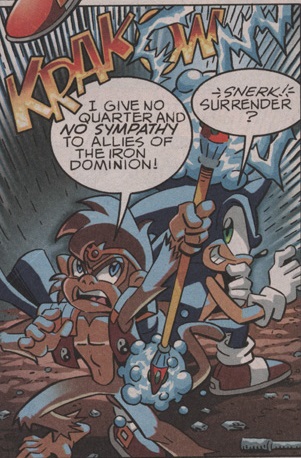
If you're just reading this story for action scenes, “Sonic Universe: Issue 7” does satisfy. There's a pretty cool bit where Skye, still trying to control his tails, is unleashed on some Dark Presence soldiers. He spins around the room, like the Tasmanian Devil, and knocks everyone unconscious. There's also some neat panels, displaying the Future Freedom Fighters' various super powers. Yes, Jacques and Belle can fly. And have a sword and blaster hand, for some reason. Melody has super speed, obviously inherited from her mother. I guess Mobian genetics, which obviously make no damn sense anyway, work that way.
I guess I should be happy that Flynn manages to juggle so many characters and not totally loose the reader. In addition to the multiple villains and new heroes, Sally, the kids, and Silver are still floating around the plot. Sadly, this quartet spend the entire issue hiding in a panic room beneath the castle. This obviously serves two purposes. To get the really young kids out of danger, so Flynn doesn't have to write the uncomfortable inevitability of toddlers being shot at. The other purpose is to remove Silver from the main story for a while, since the time traveling hedgehog's psychic powers could probably resolve the plot in a few minutes. This is awkward but it does lead to one good moment. While Sally is getting the kids the panic room, she uses special language so her children don't get too scared. That's nice parenting.
I was mostly with the “30 Years Later” story arc up to this point but Flynn starts to slip a bit with this one. I like a couple of the individual scenes, especially that shocking moment when Shadow callously exterminates Lien-Da. However, the script is just trying to do too many things. Flynn is shoving a story into four issues that probably should've been told over six or eight. That would've given us time to get to know Belle and Jacques more, at the very least. [6/10]
Labels:
25 years later,
archie,
comics,
ian flynn,
lara-su,
lien-da,
shadow,
sonic universe,
tracy yardley!
Monday, March 26, 2018
Sonic the Hedgehog: Issue 203
Publication Date: August 2009
It's been a while since we've had a really misleading cover. I don't think anything will ever top issue 41. That cover made the comic look like it was about Sonic, Sally, and Geoffrey St. John fighting off a white void full of monster arms. Instead, it was a totally incoherent jaunt through the Phantom Zone or something. Issue 203's cover isn't that bad but it does come close. The cover makes it look like Bunnie has betrayed the Freedom Fighters and is about to murder Sonic. This is, needless to say, a gross exaggeration of the comic's actual contents. This kind of thing fooled me in 1996 but not so much in 2009.
203 begins a two parter named “Heavy is the Head.” The story begins with a nice day in New Mobotropolis, Rosie's orphans teasing and throwing rocks at Monkey Khan because he sucks. Sonic's attempted pep talk to Khan is interrupted when Snively and the Iron Queen sneak into the city. The Freedom Fighters immediately counterattack. Which turns out to be a bad idea because the Iron Queen uses her technomagik to take control of Bunnie's body. Sonic and friends' priority changes to protecting their dear friend. When Monkey Khan swoops in to save the day, his robotic implants make him a liability as well.
You read that right. Issue 203 begins with Rory, Snaggle, and Sasha pelting Monkey Khan with stones. At this point, Flynn has made Khan's status as a lame character a running gag. See, he's such a fucking joke that even kids know it! The constant abuse achieves the impossible: You actually feel bad for Monkey Khan. Flynn uses this plot point as a launch pad for an odd scene. When Sonic attempts to cheer the guy up, he freaks out, screaming once again about how badly he has screwed things up. At this point, Ian has made Khan such a chronic looser that he's gone from pathetic to self-loathing. That constant moping is starting to ware on the reader a bit. When part of the comic depends on Monkey Khan getting out of his funk and actually doing something, it makes the character look inactive and up his own ass.
Luckily, “Heavy is the Head: Part One” does get readers to care about what happens. The Iron Queen's technomagik puts a character we're deeply attached to, maybe even love, in direct danger. When Bunnie's robotic limbs go crazy, it's against her will. She's forced to attack her friends and loved ones, a nightmarish scenario. Yes, this is the second time Flynn has used that situation, after A.D.A.M. infected Bunnie's cybernetics in “Order from Chaos: Part One.” But, shit, when it works, it works. It makes this a gripping tale.
It also forces our heroes to rethink the situation. Instead of just beating the enemies into submission, Sonic and the others have to think of a way to stop Bunnie without hurting her. The rabbit's life is directly put in danger, since the Iron Queen forces her to constantly attack, draining her life force. This leads to some cool action sequences too. The panel of Bunnie clocking Tails in the stomach is fittingly startling. Later, Tails gets blasted in the face but Bunnie's jets. She takes swipes at Amy and even Antoine. Really the only thing that saves Bunnie and the Freedom Fighters is the Iron Queen letting her go, instead of just killing her when she had the chance. Then again, the villains in this book do that kind of stuff all the time.
That's hardly the only plot hole in what is otherwise a decent little story. Honestly, the Freedom Fighters never should have brought Bunnie to a battle with the Iron Queen anyway. It's not as if Sonic doesn't know what the villain can do. He's fought her once before. Monkey Khan should've known better than to barge into this fight too, even with his magical crown protecting him. Then again, the only reason Snively and Regina made it into the city is they somehow made it past Nicole's defenses. Not sure how that would've happened. Then again, how come Regina didn't realize the entire city around her was made of microscopic robots? Well, that doesn't happen because Ian wanted to save that dramatic moment for later in the arc. Like I said, these holes drag down what is otherwise a decent story.
Steven Butler is back on penciling duties. The slight bumps I noticed in his art last time are totally gone now. This is a great looking story. Butler draws the entire second half under cloud-strewn skies. This not only implies Khan's lightning abilities, which become important later, but cast an eerie glow over the proceedings. Mostly, Butler's character work remains incredibly strong. Sonic's expression of exacerbation after talking to the orphans is hilarious. Monkey Khan's looks of rage and self-doubt are touching. The sheer panic on Bunnie's face during the attack really sells her fear and loss of control. I also love how determined and focused Sally looks while barking orders on the ground. It's good stuff.
The back-up story is a two-parter as well. “Friend in Deed” begins with Knuckles on the Shrine Island, thinking over the news of Espio's betrayal. Right on cue, the chameleon leaps onto the island. The two trade some terse dialogue about how valuable a power source like the Master Emerald could be to a budding dictator like the Iron Queen. That's when a fight breaks out, Espio turning on his closest friend.
In my review of 203, I mentioned how Espio's betrayal would've been more powerful if made before Knuckles. Well, “Friend in Deed: Part One” is more-or-less devoted to that very confrontation. Of course, Knuckles already knows Espio is a turncoat, making his sudden violence far less shocking to the Guardian. So, instead of being about a hero betrayed by a close friend, “Friend in Deed” is about the tension of waiting for Espio to strike. Which, sure, is fine. The dialogue the two trade before attacking is mildly tense. Yet I can't help but wonder if this would've been a more powerful story if Knuckles had no idea Espio couldn't be trusted anymore.
For its flaws, “Friend in Deed: Part One” at least looks awfully nice. Jamal Peppers returns to draw another back-up story. His pencils remain incredibly smooth and on-model. Knuckles and Espio practically look right out of Sega stock art. Peppers' panel construction is also really interesting. He foregrounds Knuckles and Espio's conflict by drawing them in opposing panels, visually illustrating the psychological struggle between the two characters. The inking and coloring is really strong too, bathing the fight in some fading sunlight.
203's cover story has some narrative flaws but has a strong enough grasp on the emotions of the characters that it almost makes up for it. If nothing else, this issue certainly makes the Iron Queen more of a threat then ever. The back story I'm less sold on, since it follows a recent plot thread I'm no fan of. But, hey, at least the artwork is all-around good looking. I'll give that a [7/10.]
Labels:
archie,
comics,
ian flynn,
iron queen,
jamal peppers,
monkey khan,
sonic on-going,
steven butler
Friday, March 23, 2018
Sonic Universe: Issue 6
Publication Date: July 2009
It recently came to my attention that, at least among certain corners of the Sonic Tumblr fandom, that the future set story lines are not well regarded. Consider me surprised. Back in the day, I remember Archie Sonic fans generally enjoying “25 Years Later.” When Ian Flynn revisited the setting with the “Sonic Universe: 30 Years Later,” I wasn't hanging out on Sonic forums very much. But I enjoyed it at the very least. That story line would continue to roll along solidly in issue 6.
“Dark Siege” is densely plotted, as far as these things go. It concerns the Dark Presence's multi-pronged attack on Sonic's kingdom. Tails and Mina are attacked in their hotel room, the kids barely escaping. Lara-Su leaps into action just as Silver, who was trying to explain his mission to King Sonic and Queen Sally, gets knocked unconscious by an undercover agent. Lara-Su, Sonic, and the Prower kids run off to fight against the attack just as Lien-Da digs into the castle's bowels and frees Shadow. That's quite a lot of story for a short comic book.
In 2009, Silver the Hedgehog was still regarded by most fans as an unfortunate symptom of the widely loathed “Sonic '06.” The time tossed, telekinetic hedgehog's previous appearance in the ass end of the “Hedgehog Havoc” story line did little to change the image fans had of him. He was another self-serious, super powerful, ambiguously allied character. With issue 6 of “Sonic Universe,” Flynn begins his rehabilitation of Silver. After announcing his serious goal, saving the world from some catastrophe brought about by a traitor, Silver immediately stumbles. He's not certain he's in the right era. When he questions Sonic about the mechanics of time travel, the King tells him not to worry. Later, he's face-palming, realizing he's screwed up. In other words, Silver is an inexperienced kid, uncertain what to do and prone to frequent mistakes. This humanizes the superpowered character, suddenly making him likable.
Something Flynn did well during his last stop over in the “25 Years Later” setting was establishing the bond Sonic and Sally have as husband and wife. You certainly got the impression that they loved each other, unlike the clear resentment that boiled under their conversations when Penders wrote the couple. One of the highlights of “Dark Siege” is a conversation Sonic and Sally have in the middle of the book. Sonic insists Sally take the kids and flee. She is resistant to this idea, refusing to be the damsel in distress. This leads to a brief argument that ends with a big kiss. Awwww. They argue because both are worried about each other's safety, their frustration is based in love. That's how you do it.
We don't have as much of a bead on Tails and Mina's relationship but Flynn still handles their one scene together in this issue well enough. After Tails is gassed by a Dark Presence agent, Mina grabs the kids and speeds out of the hotel room. (Which is a nice reminder that Mina has super speed.) It says a lot about Mina that her first instinct is to make sure her children are safe. Mina also shows some strength when heading back to rescue Tails. She still gets knocked unconscious but angry and driven are moods that fit Mina surprisingly well. I kind of wish Flynn brought that same attitude to modern day Mina a little more often.
There's some decent action sequences in this one too, mostly devoted to showing that King Sonic still has it. After the family maid reveals herself to be a double agent, Sonic slams her into the wall with surprising ferocity. Seems he doesn't appreciate someone endangering his wife and kids. Later, he teams up with Lara-Su. She's already taken some soldiers out off-screen but Sonic spin-dashes the sole remaining agent into unconsciousness. This leads to a potentially absurd moment. The Dark Presence has hacked the castle's security system. Which includes, for some reason, laser cannons in the wall. It's a silly sequence but watching Sonic and Lara-Su dodge some red laser blast of death is, admittedly, an arresting visual.
The second part of “30 Years Later” rolls along very nicely. Except for one detail. We still don't have much of a bead on the story's enemies. Yes, it's established that Lien-Da's grudge against the royal family is entirely personal. Yet the rest of the Dark Presence seems to be acting evil strictly so the story can have a villain. The closing scene, where Lien-Da awakens King Shadow, is strictly perfunctory. However, the Dark Legion subplot does produce one scene I like. After the assassination attempt, Lara-Su immediately confronts Rutan, Lien-Da's son. The argument between cousins is defused when Dimitri enters the scene, talking some reason into Lara-Su. I continue to like Future Dimitri's characterization as a mellow elder, whose days of villainy is far behind him.
The second “Sonic Universe” story arc isn't balancing character development and action as deftly as the first did, thus far. Still, I like the little details we've seen and generally enjoy how lived-in this universe feels. It's clear that Flynn is so comfortable with the “Sonic” cast by this point that he has no problem writing older, more mature versions of them. Will King Shadow's reemergence derail this story line? Well, I guess we'll find out. Until then, I'm sticking with the positive score. [7/10]
Labels:
25 years later,
archie,
comics,
ian flynn,
lien-da,
mina the mongoose,
silver,
sonic universe,
tracy yardley!
Wednesday, March 21, 2018
Sonic the Hedgehog: Issue 202
Publication Date: July 2009
There's a moment late in issue 202 of “Sonic the Hedgehog,” the issue where the Iron Dominion event really got rolling, where Sonic admits to the council of Knothole that the Iron Queen has adsorbed Robotnik's forces. The face of their villain has changed but, otherwise, Mobotropolis remains as under threat as always. This points out my serious problem with the Iron Dominion story. Yes, there's a certain novelty to seeing another villain replace Robotnik as the book's reigning Big Bad. Yet, for the most part, the book's world remains unchanged. Compare this to the direction Archie took “Sonic” in post-”Endgame” and maybe you'll understand my disappointment. The phrase “Meet the new boss, same as the old boss” has never been truer.
Anyway, the plot. “Dangerous Territory” picks up where 201 left off, with Sonic and Monkey Khan heading towards Megaopolis. Their entrance into Robotnik's former city is not as gentle as they hoped. The two are attacked by, in succession, the Dark Egg Legion, the Iron King, and a group of ninjas, including Espio and Lightning Lynx. Sonic and Khan remain totally unprepared for this attack and slink back to Knothole after getting their asses kicked.
As that plot synopsis suggest, issue 202 is primarily composed of a long action sequence. The book gets right to it, with a pretty cool panel of Monkey Khan deflecting laser fire with his staff on page two. In fact, Khan's various powers are well utilized. He tosses Lien-Da back with a lightning blast and later shocks Lightning Lynx right in the crotch. He also uses the staff as a projectile in one eye-catching panel. There's also plenty of leaping, punching, kicking, and spin-dashing throughout. The fist fights with Lightning Lynx, Espio, and the bat ninjas are all neat visuals.
And a cool fight scene is all well and good. What makes the extended action theatrics more meaningful is the conclusion to the fight. Sonic and Monkey Khan don't win. They get beat badly. The only reason they walk – or rather fly away, on Khan's magic nimbus – is because the Iron King refuses to kill his enemies when they're down. (He does it because he wants to see them humiliated. We all know the real reason is because comic book villains are dumb.) Considering Sonic's cocksure attitude, and he's extra snarky throughout this adventure, seeing him get trounced so totally makes for a compelling turn of events. It certainly establishes the Iron Dominion as a serious new threat, even if they are just taking Robotnik's place.
The conclusion of the battle isn't the only thing that gives this fight scene actual meaning. The self-doubt Sonic feels once he realizes he's outnumbered is a good moment. More powerful is when Espio walks up to Sonic, seemingly gives him a helping hand, before socking him hard in the jaw. Espio's betrayal would certainly have more meaning if Sonic and the chameleon were closer friends. Imagine how shocking that punch would be if Knuckles were on the receiving in. Still, it's a good moment and almost justifies Espio's convoluted reasons for switching sides. (Less interesting is Flynn heaping exposition on the reader, Khan letting us know about the various Brides and Clans found in his home country. It's a yawn.)
Even if I could care less about the mythology surrounding Monkey Khan, I do admire Ian Flynn's continued attempt to humanize Frank Strom's formerly perfect hero. First off, Sonic's loss is Khan's too. Again, I can't imagine Strom allowing his self-insert to be so totally bested. After informing the Council of their defeat, Khan confesses that this is just the latest in a long string of failures for him. (He also admits that his real name is Ken, another humanizing touch.) I continue to have mixed feelings about Flynn hinting at a romance between Khan and Sally. However, making the monkey a pathetic loser certainly goes a long way towards actually making the reader invested in him. At the very least, he's not an unstoppable badass who spews lame catchphrases.
“Dangerous Territory” sees Steven Butler return to pencil the main book. If you discount his occasional contributions to “Sonic X,” this is the first time Butler has illustrated the comic in quite some time. And it's clear he's a little rusty. You can tell Butler is trying to fuse his grittier, sexier style with Tracy Yardley's more cartoony pencils, which have become the default look for the book by this point. This results in a few panel where it looks like a super-cute head is stuck on a more detailed body. (He still manages to make Sally and Lien-Da look curvier than Yardley ever has.) Still, Butler finds his footing pretty quickly. The action scenes look great. The ruined city setting certainly leaves plenty of room for Butler's love of grimy detail. It's still a really great looking comic, even though Butler has done better work in the past.
So we get a back-up story too. “A Lonely Girl's Story” begins with Snively and the Iron Queen lounging on a couch somewhere in New Megaopolis. Presumably before getting down to some disproportionate nooky, Snively asks Regina about her childhood. She regales him of a childhood within a “technomagic” cult, where she was taught how to manipulate robotics and electronics with magic. She also reveals that such practices were outlawed by the Overlanders, leading to Regina's family being executed and her being exiled from the city. She wandered the world, honing her abilities, before arriving in Monkey Khan's corner of the world and taking it over.
Flynn has made an effort to expand on the backstories of various obscure characters. Since the Iron Queen is going to be an important character within the book's next year, it's certainly a good idea to provide some context for her actions. The quasi-tragic beats of Regina's troubled youth seem like standard attempts to give the villain some complexity. Considering the Iron Queen is still a cackling she-beasts in the present, that doesn't count for much. What I ultimately like about this peak into Regina's past is the insight it gives us into Overlander society. That all magic was banned in their city certainly makes sense, further contrasting him with the mystical Kingdom of Acorn.
“A Lonely Girl's Story” is also the debut credit of Jamal Peppers. Handing this story to a new artist might've been a deliberate move. This one mostly revolves around non-furry people, something Tracy Yardley is just passable at. Whatever the reason, it's a good debut for Peppers. The panels devoted to a young Regina mastering control of a goofy looking robot is cute. Peppers conveys Regina's emotions nicely. A panel which shows her smiling evilly upon discovering Khan's valley is awfully atmospheric.
It's a good, not great, issue. The opening story features some nice action and a few decent emotional beats, though none of it is as powerful as perhaps it could've. The Iron Dominion story remains a little overly invested in its own mythology. The back-up story has a few decent moments but still can't quite get me to care about the Iron Queen. The artwork is pretty good though. Eh, I'll take it. [7/10]
Labels:
archie,
comics,
ian flynn,
iron queen,
jamal peppers,
lien-da,
monkey khan,
sonic on-going,
steven butler
Monday, March 19, 2018
Sonic Universe: Issue 5
Publication Date: June 2009
I have no idea how popular the “25 Years Later” setting was when it first appeared in the Archie “Sonic the Hedgehog” comics. Now, of course, the story line is regarded very poorly, as the internet hates everything Ken Penders has ever done. Even I have mixed feelings about it and I liked it a lot more than anybody else did. The fact that Archie kept revisiting the setting suggests to me that the “25 Years Later” period must have been popular. The second “Sonic Universe” story arc would take place in this possible future, focusing primarily on Lara-Su.
Flynn has skipped the clock ahead five more years, which makes this the “30 Years Later” setting, I guess. After usurping King Shadow, Sonic and Sally have ruled in peace. Lara-Su is fully established as Angel Island's Guardian. Yet the peaceful period means she's got so much free time, she can babysit Sonic and Sally's kids, Sonia and Manik. All is not well, however. The Dark Presence, led by Lien-Da, is plotting a comeback. Just as Lien-Da puts the king in her sights, an unexpected visitor saves the day.
One of the elements of Penders' original “25 Years Later” plot I wasn't too crazy about was Prince Manik and Princess Sonia. Sonia was a complete non-entity, an identical copy of her mother. Manik, meanwhile, was an obnoxious asshole and budding sexual predator. Flynn completely revamps the royal children. Due to the timeline getting rejiggered by Sonic's time travel shenanigans, the kids are only five years old now. (Which suggests Sonic and Sally got right to continuing the royal bloodline.) So now Manik and Sonia are hyper-active kids, with active imaginations and more energy then they know what to do with. This, too, could've come off as annoying but the writer manages to keep the kids cute, rather than irritating.
Truthfully, opening “Five Years of Peace” with Lara-Su babysitting the prince and princess is a nice way to ease readers back into the setting. “25 Years Later” had a slice-of-life style that was badly bungled by Penders' typically glacial pacing. Flynn does the same thing much better here. The kids dancing and singing when Lara-Su walks through the door is sweet. Getting the kids in bed is such a task that Lara-Su has to employ her Guardian superpowers to restrain them. Later, she interrupts a pillow fight and gets whacked in the face for her troubles. It manages to endear the children and Lara-Su to the reader.
“Five Years of Peace” also builds on a previous pairing that was established in this future setting. It was previously mentioned that Tails and Mina got married at some point. We actually get to see the future mongoose now, who is sporting a super cute paigeboy haircut. We also meet their offspring: Melody the Mongoose and Skye the Fox. We don't get much more than an introduction to the kids, though Melody appears especially sassy and Skye seems shy and insecure. (And might have a crush on Lara-Su.) Sonic shippers being who they are, some dislike the Tails/Mina pairing but, honestly, I can't be bothered to be bothered. These two are together in the future. Get used to it.
In a not-too-subtle example of exposition, Flynn opens this story with a news reporter filling the reader in on what's happen over the last five years. (In a cute touch, the reporter is an adult version of Sasha the Cat, one of the orphans Rosie takes care of.) In Penders' “25 Years Later,” King Sonic was so precarious as to come off as a real jerk. Flynn shows Sonic enjoying his royal status a little more. His general love for the world lets him rule with a balanced hand. We get a peek at his orating skills during a big speech he makes in this issue's back half. This is a more mature Sonic, one who has accumulated to ruling the free world.
Lien-Da's assassination attempt provides the big action set piece for this issue. But there's a little more to it than that. The sequence of Lara-Su gliding around, stopping a pair of assumed assassins, only to realize they're decoys too late, is mildly suspenseful. What makes this scene really work is the real anger and resentment Lien-Da feels towards the king. Apparently, as part of King Sonic's restructuring of the world, Lien-Da has been separated from her son. That's a pretty good reason to be pissed off. The assassination isn't motivated just because of politics or because Lien-Da is naturally evil. That adds some much appreciated depth.
“Five Years of Peace” concludes with Silver dropping in, being the deus ex machina just needed to save Sonic's ass. I don't remember where Flyyn goes with that one or how this story turned out. I do think this first part is quite good, balancing the details of this future world, moving along nicely, and making you actually care about the characters. Hey, man, that's all I really ask from this book. [7/10]
Labels:
25 years later,
archie,
comics,
ian flynn,
lara-su,
lien-da,
silver,
sonic universe,
tracy yardley!
Subscribe to:
Posts (Atom)