Monday, October 8, 2018
The Complete Sonic Comic Encyclopedia
Publication Date: October 2012
Over this retrospective, I have talked about my childhood belief that, if a comic book reached 100 issues, it was a legitimate and serious force. By 2012, Archie's “Sonic the Hedgehog” comic book had run over 200 issues. However, perhaps a better measure of a comic book's worth is when the series' continuity grows so convoluted and unwieldy that a guidebook must be published to keep track of everything. Numerous such source books and encyclopedias have been published by Marvel and DC to track their respective universes. In October of 2012, Ian Flynn and Archie would collect all the various bits of lore and character histories into one 191 page tome. Outside of fan wikis like Mobius Encyclopedia, it was about as comprehensive a guide to Archie's “Sonic”-verse as you could expect
And it couldn't have come at a better time. The Encyclopedia was first announced in 2009. It was originally going to be entitled “Sonic the Hedgehog Who's Who” and published over several volumes. It was repeatedly delayed. I suspect Ken Penders' lawsuit probably had something to do with that. I also suspect Ken's suit probably had something to do with the book being rushed out as one volume in October of 2012. The speedy release is apparent in quite a few typos and editing errors in the book. By this point, it was clear that Archie wasn't going to win the case, so they popped this thing out before they no longer had the rights to 90% of the material referenced inside of it.
This release date came only a few months before the comic's entire history would be wiped clean and rebooted. So, in a way, the Complete Sonic Comic Encyclopedia became the definitive guide to the old Archie Sonic-verse. The book covers the history of practically every character and concept up until the end of the original universe. Everything before this is everything the comic ever was and, more-or-less after this, none of that stuff exist anymore.
The Encyclopedia allows Ian Flynn to participate in one of his favorite activities: Reorganizing the book's lore into something that makes a little more sense. Or, at least, makes things look like they weren't entirely made up as they went along. To facilitate this, he splits the book up into several sections. We run through the core characters, the history of Mobius, all the bullshit involving Knuckles and the Brotherhood of Guardians, and then the smaller Freedom Fighter organizations. The next section is devoted to the book's villains and their associates. Other worlds, dimensions, and bits and pieces of magical and scientific doodads comprise the next section. The encyclopedia wraps up by talking about the possible futures of the universe. Put it all together and you have something resembling a fictional universe.
For hardcore Archie Sonic nerds, the most useful part of the Complete Encyclopedia takes up the last few pages. Flynn includes a definitive timeline of the entire series. It begins during the last days of Earth, runs through the birth of Mobius, the planet's prehistoric days (which clarifies the existence of dinosaur-like creatures called mobosaurs), and summarizes every war, conquests, and civilization that would follow. After that, it begins to recount the major adventures seen in the comics, which get a bit tedious. However, if you read no other part of the encyclopedia, definitely read the timeline. Flynn essentially reorganizes the book's hugely convoluted mythology and history into something actually coherent, while also filling in quite a few blank spaces.
Throughout the various encyclopedia entries, Flynn expands greatly on the background of the world and many of its specific characters. He runs us through the entire lineage of the Acorn Royal Family, filling us in on huge parts of the Acorn Kingdom's history. If you ever wanted to know who Sally's great-great-great-grandfather was and what he was all about, now you know.
He also takes this time to fill in little details on various character's background. So you learn about what Rotor's and Bunnie's parents did during the Great War, where Antoine's silly accent comes from. Or that Vector was raised by a mysterious, unnamed adoptive father. We even learn more about characters we do not care about. G.U.N's Abraham Tower was raised in the Overland before migrating to the United Federation. Warlord Kodos comes from Efrika. Nic the Weasel is still out there, somewhere. We learn the specifics of the Dragon Kingdom's “free people.” (Flynn even details the background of the Tasmanian Devil race, spoiling a portion of the then-upcoming “Endangered Species” arc.) Ian even seems to make fun of his habit of expanding lore slightly, by presenting a series of increasingly unlikely origins for Bean the Duck.
By spending so much time on Mobius' history, Flynn naturally has to talk a lot about the echidnas. Flynn is probably just following Ken Penders' lead but he makes the echidnas basically the most important creatures in Mobius' history. Throughout Albion's existence, they made several attempts to colonize the outside world. More often than not, they just made things worse. We discover there was a Forgotten War between the Ixis Order and Albion's forces. Similarly to his expansion of the Acorn royal line, we get a similar rundown through the Brotherhood of Guardians. We learn more about the relationship between the Fire Ants and the Brotherhood, the convoluted history of the dingoes, and Remington's even more confusing personal background.
We discover that there have been four Enerjaks in total. The original's history is intertwined with Aurora's, who began life as a normal echidna before becoming a goddess. That the original Enerjak had his consciousness spread throughout the Chaos Force. So Enerjak went from being Dimitri's evil alter ego to a malevolent, immortal force that every Guardian in history has been at risk from. That's pretty cool.
In order to reorganize the “Sonic”-verse's history, quite a few retcons are deployed. Some of these are pretty minor. At some point, Sonic legally changed his name to “Sonic,” dispensing with that Maurice Ogilvy Hedgehog business. Mighty is a “Eastern” armadillo, which is why he looks so different from Arlo, a “Western” armadillo. Knothole was originally a retreat for Acorn royalty. Vector's bulky “Sonic Heroes” redesign is explained by him hitting the gym with Mighty, after apparently growing insecure about Knuckles' physical strength. Which is pretty funny.
Some of this stuff is so minor, it's hard to care about it too much. O'Knux's sunken island from Moebius is renamed Demon Island and he has an unseen team called the Orderix. Apparently Walt Wallabe has an unrequited crush on Barby Koala. How Hugo Brass got legionzied is detailed. The Iron Queen's brand of technomagik is actually a degraded version of Mogul's Ixis magic. Trey Scales of the Original Freedom Fighters betrayed the team because of his loyalties to the Southern Baronies. I'm not sure any of that was important but thanks for the clarifications, Ian.
Some of the retcons are more serious business. Tails' status as the Chosen One is basically dismissed, the encyclopedia explaining that he supposedly resolved that stuff several times. We learn that, when Amy Rose wished on the Ring of Acorns, she actually absorbed its magic. Which is why she can produce her Piko Piko Hammer out of nowhere. Flynn justifies Rosemary Prower's “House of Cards” behavior by saying she was an activist before becoming a mother. The flickie inside E-102 Gamma was the mother of the flicky that befriend Amy. Julie-Su's adoptive parents died in the Egg Grapes. It's confirmed that Moritori Rex actually did perform acts of sabotage while undercover in the Brotherhood, including murdering Athair's wife.
The information can be such nerdy little details, that they don't amount to much more than nitpicks. We discover Snively got his nickname from his dad, due to his sniveling behavior. The exact differences between Mobians and the Mobinis, or Auto-Automatons and Infiltrators, are detailed. We see Robotnik's family tree and discover that his grandmother had the matron name of Vasquez. Which suggest our favorite egg-shaped mad scientist has some Spanish ancestry. By far the most useless tidbit we learn is the existence of a group of Nerb Freedom Fighters, patterned after the original SatAM cast. Some of this stuff is so minor – the Arctic Freedom Fighters began as activists, New Megaopolis was the Overland capital, Rotor's walrus live in an inverted city called Iceborough – that I honestly can't even remember if it's new information or not.
The Encyclopedia also takes the opportunity to incorporate some video game-specific elements into the comic book's universe. So now the Nocturnus Clan, the bad guys from “Sonic Chronicles: The Dark Brotherhood,” are ancient Albian precursors to the Dark Legion and co-existed with them inside the Twilight Cage. The exact motivation of the Black Arms, from that shitty “Shadow the Hedgehog” game, are revealed. (They eat people.) Blaze and Silver's previously unseen super forms are shown. A little more information about Eggman Nega and the Sol Stones are provided. My favorite choice morsel is the reveal that Little Planet from “Sonic CD” exists in the Archie-verse. And its watched over by Nicholas O'Tyme, the owl-shaped time traveling entity from SatAM. By far the dumbest inclusion is the reveal that the events of “Sonic '06” happen at some point in the comic's future but retcon themselves out of existence before they're through. So Princess Elise is running around somewhere on Mobius. Good to know.
Ultimately, “The Complete Sonic Comic Encyclopedia” will only be of interest to a niche audience. Even as a hardcore fan of the comic book, who had been reading it since I was a little kid, some of the stuff here made my head spin. Trying to parse out the exact history of Robotnik/Eggman or the Echidnas of Albion is enough to make you go cross-eyed. However, I'm happy this short book exist. Immersing myself in the bullshit lore of this stupid comic book, especially right before all of it will be wiped out, is a lot of fun. It's not essential reading for Archie Sonic fans. You'll understand most of the books even if you don't know any of this shit. However, it sure is fun to dig into this stuff. [7/10]
Friday, October 5, 2018
Sonic the Hedgehog: Issue 241
Publication Date: October 2012
Don't you just love a misleading cover? Issue 241's cover makes it look like the big conclusion to the comic's recent events, when it only sort of wraps some things up. It also features several characters on the cover who do not appear in the book. The Secret Freedom Fighters, while Robotnik's role is pretty minimal. However, there's something bittersweet but this usual comic book shenanigans. This comic marks the final appearance of several of those characters before the reboot. Many more minor Archie exclusive cast members take their final, unknowing curtain bow in this issue.
“Unraveling” follows two story lines. Somewhere across the continent, Team Fighter follows the Death Egg. Eggman is on the run until he cooks up a last minute scheme that distracts Sonic and friends for a while. Meanwhile, in Mobotropolis, more stuff is going down. Naugus continues to loose control of his body. Mina puts on a benefit concert to un-exile Nicole. Mina's mom takes over Rotor's seat on the Council of Acorn. This news upsets Naugus and further exacerbates his condition.
Yes, the villain's scheme might be “Unraveling” but Flynn is undoing many of the dumb-ass plot points he's introduced over the last year. This issue sees Geoffrey St. John finally betray Naugus, rejecting the evil wizard and the stupid decision to turn him into a traitor in the first place. Mina uses her music to encourage the community to welcome Nicole back, doing away with the stupid decision to write her out of the book for a few issues. (Mobotropolis' populace still remains far too easy to manipulate, via the power of song.) This all prefaces the city as a whole turning on King Naugus. Say what you will about Mecha-Sally but that was a plot mix-up that created new story opportunities. Making St. John Naugus' apprentice, Naugus becoming king, and having the city turn on Nicole were unnatural story decisions that existed more to push through ideas than to naturally move the story forward. I'm glad we're done with them.
Flynn doesn't seem to admit that he's unfucking his own mistakes here. Instead, these story turns fit into the issue's theme of forgiveness. Mina admits to her mistakes and apologizes to them. This allows the city's citizens to do the same. Nicole, in turn, forgives the Council for exiling her. One of the aspects that marks Naugus as a villain is his inability to change and move on from past transgressions... Which makes his constantly transforming physical state a rather ironic twist. I don't know if Flynn did that on purpose.
Naugus cracking up does give Steven Butler an excuse to draw some fucked-up monsters. And it's clearly something he enjoys. The wizard spends most of the issue in a state of high stress, his body mutating. His metal claw repeatedly morphs into a lobster claw. Smaller crustacean claws sprout from his torso. A big, red, bumpy tail falls out of his ass. Naugus is constantly drooling and sweaty. In a book whose cast is primarily made up of cute animals, you can tell Butler is really relishing the chance to draw a hideous mutant. As you'd expect, Butler's artwork is extremely strong in general.
There's a fair bit of humor to Naugus' breakdown. The wizard touches upon the idea of possessing someone else's body, in order to get his consciousness out of a physical form that is going beserk. First, he attempts to talk King Acorn into entering into a magic pact with him. Despite Max being almost entirely senile by this point, he still has the strength of will to reject the King's plan. Next, Naugus attempts to trick Jules into giving up his body. Sonic's parents bring up everything bad Naugus has ever done to them and their son before telling him to get the fuck out. The way Butler draws Jules and Bernie's annoyed faces, even including Muttski growling at the wizard, makes this scene even funnier. Naugus' skills are degenerating to such a degree that he can't even get old men to fall for his bullshit.
Continuing the trend that started with issue 240, Sonic barely appears in issue 241. Sonic, Amy, and Tails are many miles away from Mobotropolis. The action beat feels perfunctory. Eggman discovers a sprig of the Krudzu Hybrid Hydra on the Death Egg. Running low on options, he combines the plant-machine with the busted-out shell of a Titan Metal Sonic. Yet it only takes Team Fighter a few pages to take down this kaiju-sized threat. It's pretty evident that Flynn is more invested in what's happening in Mobotropolis and only includes these scenes to give the hedgehog hero and his Sega-approved co-stars an obligatory appearance. It's a decent fight scene but has little reason to be in this comic book.
Geoffrey St. John is among the characters to make his last appearance in this issue. That's a shame, since the comic wraps up on an tantalizing plot point with him: Naugus possessing the body of his apprentice. The ending also teases the start of the “Endangered Species” storyline, which would write out most of Ken Penders' echidna characters even before the reboot would come along and blank-slate nearly the entire universe. So I guess it's a good thing that this is a pretty strong issue, since this era of Archie “Sonic” is coming to an abrupt close very soon. [7/10]
Wednesday, October 3, 2018
Sonic Universe: Issue 44
Publication Date: September 2012
In retrospect, it's pretty sad that Ian Flynn spent so much time setting up the Secret Freedom Fighters. After several months, and endless stories it seems, of build-up, the new team finally got their four issue arc in “Sonic Universe.” And then, in a few months, all but one of them would be wiped out by the reboot. I guess that just goes to show that the reboot really was sprang on Ian Flynn and his team at the last minute. Then again, there were some plot lines that got set-up and didn't even get as much payoff as this one. Guess we should've been lucky this story was delayed a few months.
Part four of “Unsung Heroes” is clearly a Public Enemy fan as the subtitle implores you to “Fight the Power.” Naugus' plan to bend the Council of Acorn's collective minds to his will is ready. The Secret Freedom Fighters interrupt the ritual and take the fight to the wizard. Meanwhile, the Council attempts to assemble above. Luckily, Larry the Lynx is there, his bad luck constantly preventing the meeting from going forward.
“Fight the Power” is primarily an action story. It should probably not be surprising that the main way the Secret Freedom Fighters disrupt Naugus' magic spell is with punching. Silver and Shard fight Naugus. Elias and Silver fight Naugus. Lyco and Leeta fight Geoffrey. Elias fights Geoffrey. Pretty much every combination you can think of plays out. As a fight scene, it is pretty cool. There's so much going on that it's hard to get bored. Despite outnumbering the enemy, Naugus and St. John are formidable enough to keep the tension high.
In fact, the stakes get more and more high as the issue goes on. The subplot concerning Naugus loosing control over his own body continues to build here. Even after seemingly winning the day by exploding his magical altar, the Secret Freedom Fighters aren't out of the woods yet. Naugus freaks out, grows more monstrous, and attempts to trap the team in the tunnels. It's a neat trick on Flynn's behalf, keeping the drama going even after the plot is more-or-less resolved.
Luckily, this isn't just a punching and kicking orientated issue. Flynn wraps the comic up with a surprisingly bittersweet series of panels. In narration boxes, Harvey Who talks about how the Secret Freedom Fighters' good deeds can never be publicly acknowledge, how they most operate from the shadows and give up the things they want most. Flynn contrasts these words with shots of Elias looking in on his dying father and Larry watching the other members of the Substitute Freedom Fighters leave the Council building. The last two shows Shard watching Uncle Chuck, Jules, and Bernie have a pleasant dinner together. This page was probably meant to emphasize the personal sacrifices the characters are making by becoming spies. What it actually ends up doing is giving us insight into the sadness and dissatisfaction each member feels with their lives. Which is actually a far more noble goal.
Speaking of Larry! Harvey Who smartly realizes that someone who generates bad luck shouldn't be around during the big fight. Instead, he puts Larry's jinxing to good use. The scenes of the Council of Acorn's meeting being repeatedly interrupted by stupid bullshit – the new bill of rights they've come to sign going missing, the power in the building going off – are pretty funny. It's amusing to see that, even in an action book like this, people can still be inconvenienced by stupid bullshit. These moments also provide decent comic relief to the big fight scene happening underground.
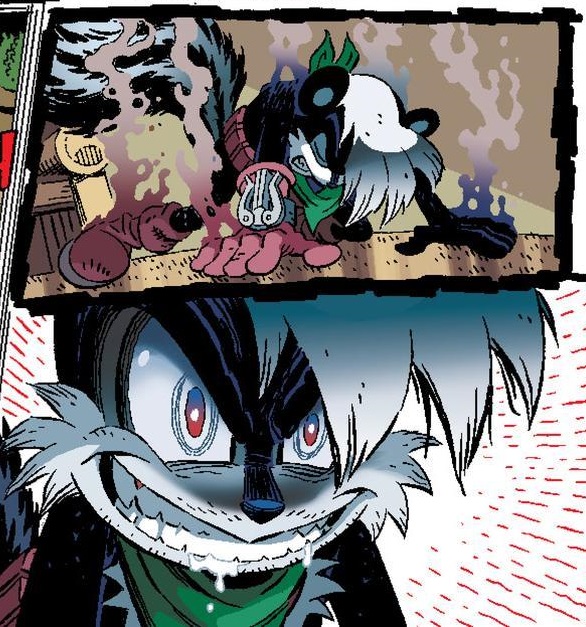
Geoffrey St. John's character arc in this story line has been one of its most promising elements. We got some pay-off to that development here. St. John is still serving his master but not in the most enthusiastic manner. When the Secret Freedom Fighters pop in, he uses the fight as an excuse to not help Naugus. He even rather literally tosses Elias a hint that he's going back over to the side of the angels. In a surprisingly chilling panel, St. John outright leaves Naugus to die in the explosion. Of course, the wizard survives and Geoff has to backtrack but it's still a surprisingly nasty turn of events. It seems St. John really is fed up with his boss' bullshit.
Issue 44 wraps up by promising a conclusion to Silver's quest for the traitor. For those who are reading through these books for the first time, I'll just say the resolution to that is super underwhelming. The Secret Freedom Fighters arc was pretty uneven. However, even its weaker issues managed to be pretty entertaining. If nothing else, it's a fun idea, even if Flynn had to jump through way too many hoops to get it rolling. [7/10]
Labels:
archie,
comics,
geoffrey st. john,
ian flynn,
larry the linx,
naugus,
shard,
sonic universe,
tracy yardley!
Monday, October 1, 2018
Sonic Universe: Issue 43
Publication Date: August 2012
Issue 43 has Ian Flynn addressing some of the issues I've had with the Secret Freedom Fighters story arc. Part three of “Secret Heroes,” subtitled “Occupational Hazard,” fuses the two story lines of the arc thus far. Silver and Elias' teams escape their missions by the skin of their teeth. They regroup in Mobotropolis, reporting their failures to Harvey Who. Meanwhile, Ixis Naugus explains his latest plan, a magical spell to take over the mind of the Council of Acorn, to Geoffrey St. John... And the skunk is not entirely okay with that.
Usually, I address the artwork at the end of these review but I'm doing shit backwards today. Since I've looked at hundreds of his illustrations over his years on the comic, I feel qualified to speak about Tracy Yardley's artwork. Though he's done lots of great work over the years, he has his flaws too. A same-y quality can fall into his work and he frequently gets sloppy. It sometimes feel like he's phoning it in. And his work on issue 43 has that quality. The facial expressions can be identical or uninspired. Everyone's on model but a little lifeless at times. Yardley has done so much “Sonic” art over the years that it starts to blend together at times.
Anyway, that aside, let's talk about the plot. Flynn uses this issue to expand on the mythos of the Ixis wizard tribe. The issue begins hundreds of years ago during the Forgotten War, showing Mammoth Mogul and a previously unseen bird-wizard named Ixis Vale. This is a callback to a very obscure bit of lore. All the way back in issue 53, Naugus used “Vale's bones!” as an exclamation. Now, years later, we actually see Naugus retrieve the bones of Ixis Vale to use them in an incantation. This also further defines the Ixis order as something that's been around for a very long time.
But what's most interesting about “Occupational Hazard” is the development we get on Geoffrey St. John. From the moment it was revealed that Geoffrey was a traitor, and an apprentice of Naugus, I felt like Flynn was kind of screwing over the character for no reason. However, that attitude snaps back some with this issue. Upon hearing that Naugus plans to use magic to instate total tyranny over Mobotropolis, St. John gets seriously pissed. He signed up to protect his kingdom, not to serve the mad whims of a control freak.
Honestly, I'm not sure why Geoffrey St. John hasn't noticed before that Naugus is a bad guy. However, the skunk having a crisis of conscious about his mission is refreshing. Yardley's panel here I like the most is a slow zoom on St. John's panicked face. Later, Silver has a conversation with the skunk where he sells out his master's plan. It doesn't undo all the bullshit damage Flynn has done to St. John's personality but it's a step in the right direction.
I guess it's weird that I found the antagonist of the story way more interesting than the heroes. One of the things I like the most about this issue is a passing detail, a bit of backstory. Upon seeing Shard's power crystal, St. John recalls that his team – as in the Majesty's Secret Service – retrieved Metal Sonic's melted remains out of the Mt. Mobius' caldera. Apparently there's a slight continuity error here, as Valdez wouldn't have been on the team at this point, but whatever. It feels a small gap in the backstory out and that's the kind of bullshit lore I appreciate.
As for what's the Secret Freedom Fighters are up to in this issue, we don't see much of them in action. There's a cute bit where, after Silver ends his talk with St. John, the team pops out of little hiding places around the area. I like the interaction between Harvey Who and Elias, which shows the young prince growing into more of a strategist. I also like the little bit where Harvey gets pissed at the team for their screw-ups. Apparently he didn't foresee the inexperienced fowling on their first mission.
Issue 43 is mostly set-up for the big finale, as it's most preoccupied with explaining what a threat Naugus truly is. It's a slower paced issue, focusing more on character development, which is a nice change following the action-packed last two issues. Mostly, I like this slightly sloppily-plotted comic for centering Gefforey St. John's personality. I don't recall that plotline really getting a conclusion before the reboot so this is probably the closest we'll come. [7/10]
Labels:
archie,
comics,
geoffrey st. john,
ian flynn,
larry the linx,
shard,
silver,
sonic universe,
tracy yardley!
Friday, September 28, 2018
Sonic the Hedgehog: Issue 240
Publication Date: August 2012
Look, there's another Greg Horn cover and it's exactly as boring as his last cover! Granted, at least the image of Amy making a little heart with her hand tells us something about her personality, as opposed to the utterly generic image of Sonic he created last time. And I'm thankful Horn didn't resort to his usual techniques when portraying female characters and make Amy into an impossibly posed, half-naked, pouting porn starlet. I guess Archie just couldn't resist getting a big name like Horn involved in their silly, funny animal book. Could've been worse, I guess. Could've been that other Greg.
But let's talk about the actual comic book. “Heroes Part Two: For the People” has Team Fighter rushing to inform Mobotropolis of the Death Egg's approach. Their communique only partially gets through by the time Robotnik is directly over the city. It's up to Rotor and his team of misfits to save the day. Despite Eggman's sabotage and army of robot weapons, the team manages to fight off the invasion. They do, however, get some help from Harvey Who's now fully formed Secret Freedom Fighters. Also, Naugus continues to loose control of his own body to the voices in his head.
Issue 240 is an issue of “Sonic the Hedgehog” that barely has Sonic in it. And, honestly, it might be all the better for it. Though I have nothing against Sonic and friends running around the world, my heart is in Mobotropolis with the Knothole crew. Team Fighters' adventures have been so transient that I've felt a little adrift with this book recently. Returning home and focusing on the fate of the Acorn crown – even if Sally, Bunnie, and Antoine are out of the picture at the moment – is refreshing. By going back home, it reminds us what's at stake and why we care in the first place.
Part two of “Heroes” is mostly devoted to giving Team Freedom a chance to shine. Though I was initially very underwhelmed by the line-up of Rotor's team, their adventure here is pretty effective. Everyone's personality is given a chance to shine. Rotor accommodates himself to the role of leader fairly well. Cream is eager to help but still childish enough that she gets frightened. Heavy is overly analytically, even in the heat of combat. (And he still sounds like Baymax in my head.) Flynn mostly writes Big the Cat as a big dumb pet, staring dumbly and speaking simply while also smashing robots with his super-strength. It's not an all-star line-up or anything but the characters seem to work together well.
Of course, the only reason Robotnik's army can get into the city in the first place is because of Operation: Deadly Cuddles. Let's talk about that. During the assault on Mobotropolis during issue 231, Eggman dropped a Tails Doll out of the sky. Cream, assuming it was a simple toy, adopted it. Of course, the Tails Doll is actually an Eggman drone that can disrupt nanites and spy on the Freedom Fighters.
For those not in the know, Tails Doll is a very obscure Sega character that is something like Tails' counterpart to Metal Sonic. It was introduced in “Sonic R,” the glitchy racing game that came out on the Saturn in 1997. There's an obvious reason Flynn introduced this forgettable character into the comic fifteen years after his first appearance. Due to his creepy doll face and uncanny ability to float, somebody wrote a lame creepypasta about the character. And, because Sonic fans love stupid bullshit, this led to Tails Doll actually becoming kind of popular. Flynn hints at Tails Doll's internet fandom by making him a figure of suspicion, and eventually weirdly vivid body horror, in the book. As an in-joke unlikely to be caught by those unaware of the online fandom, I guess that was an okay decision.
The fine print at the start of the book says “Heroes” is the prelude to the Secret Freedom Fighter arc, currently playing out in “Sonic Universe.” Never mind that we were two issues into that story by the time this book came out. In their first in-continuity appearance, the Secret Freedom Fighters accomplish more than they have thus far in their own story. They make short work of the new Metal series robots Robotnik deploys. Larry's bad luck generation actually comes in handy, destroying two EggSWATS. Moreover, they actually act in a stealthy manner, helping out Team Freedom without alerting them to their presence. You'd think Flynn would've led with this, instead of having this issue come out after the “Universe” arc started.
After taking a one issue break and letting Jamal Peppers draw things, Steven Butler is back on penciling duties. Once again, I'm partial to Butler's work. His action is great. His character work is expressive and detailed. It's all good stuff. The second half of “Heroes” is much stronger than the first, managing to balance character development and action better. It also includes the Secret Freedom Fighters in a way that's far less distracting. Good on you, Flynn. [7/10]
Labels:
archie,
comics,
ian flynn,
larry the linx,
mecha sally,
naugus,
silver,
sonic on-going,
steven butler
Wednesday, September 26, 2018
Sonic Universe: Issue 42
Publication Date: July 2012
I guess I should've mentioned this earlier. With issue 41, “Sonic Universe” became the longest running “Sonic” spin-off book, beating “Sonic X's” 40 issues and “Knuckles'” 32 issues. It sure feels like we got to this point a lot faster than we did, doesn't it? Maybe it's because of nostalgia, as time just runs faster when you're in your twenties (which I was when “Universe” was being published) than when you're a kid. (Which I was when “Knuckles” was being published.) Or maybe Flynn's fast-paced, interconnected plotting just made “Universe” go by a lot quicker, more-so than the frequently snail-slow “Sonic X.” Whatever the reason, this was book was now going where no “Sonic” spin-off title had gone before.
“Unsung Heroes Part 2” is given the vaguely Lovecraftian subtitle of “The Terror Below.” It back tracks slightly to before the previous issue's story. Apparently King Naugus has made a daily ritual of flying down into the huge hole that, thanks to the Battlebird Armada, is the former location of Castle Acorn. At the behest of Harvey Who, Elias, Lyco, and Leeta follow Naugus down into the pit to see what he's up to. The team has to work through their own struggles as they discover an unnerving secret about Naugus.
“The Terror Below” is a much more tense story than the first part of “Unsung Heroes.” A lot of this has to do with the setting. Half of the Secret Freedom Fighters are crawling through a series of underground tunnels. Naugus is much closer and far more dangerous than St. John was last time. If this wasn't claustrophobic enough, after Naugus is alerted to their presence, all three heroes remember that the wizard can control the elements. He re-directs the tunnels, trapping the three in a labyrinth. He then causes huge crystals spike to burst through the ground, nearly skewering all of them. (Of course, Naugus could've just use his elemental powers to collapse all the tunnels or suck all the air out, killing the spies instantly. But he doesn't do that because, you know, comics.) It's a taut set-up and used fairly well.
Last time, I pointed out that none of the Secret Freedom Fighters seem especially well-chosen for the job. Issue 42 has Elias commenting on that very concern. In narration bubbles, he says that this motley gang wouldn't even have been his fourth choice. Flynn doesn't justify this decision but he does use it to develop Elias a little more. Deep in the tunnels, the former King reflects on his own failures and mistakes, realizing he has no right to judge anybody else for their inexperience. Which is a nice character beat, even if being in a dangerous situation with incompetent or fledgling co-workers is actually a really good time to start judging people.
Leeto and Lyco are growing on me. The twins are showing some quirks I like. Leeta has a fear of heights. Both sisters seem to be having some fun, despite being on a crazy and potentially deadly adventures. Without undermining the seriousness of the threat, Flynn allows them to bring a little levity to the adventure. Both girls are strong-willed and ready for adventure, which is displayed in the otherwise unnecessary flashback that shows Who recruiting them personally.
Also interesting is the way Naugus is cracking up. It seems the voices in his head are having more and more influence on him. To Elias and the twins, it just looks like the wizard is talking to himself. When he thinks he's alone, the spectres of the Order of Ixis convince Naugus to reveal his uglier, more troll-like true form. (This is officially known only as “Ugly Naugus” and was a bit of a precursor to Flynn literally making him a troll in the Post-Genesis Wave 'verse.) What exactly the villain is up to still isn't known but his instability is making him more of a threat than ever before.
As a spy story, “The Terror Below” is still pretty lacking. Once again, Flynn has this new Freedom Fighter team reveal itself to the person they're tracking. That's like the number one thing a spy isn't suppose to do. However, Flynn is clearly having fun with the trappings of the high-tech spy movie. The gliding suits the three are given are pretty cool looking. The action sequences, involving escaping Naugus' fiery form, are pretty solid too.
Tracy Yardley's art is a bit on the loose side this time. Lyco and Leeta are a little too cartoony at times. However, this issue is still a lot of fun and a big improvement over the first part of this story line. (I also like the Bond inspired cover art, even if the story really has nothing in common with a James Bond movie.) Focusing more on the seriousness of the threat and less on the cast bickering made for a better, more tense comic book. [7/10]
Labels:
archie,
comics,
ian flynn,
naugus,
sonic universe,
tracy yardley!
Tuesday, September 25, 2018
Sonic the Hedgehog (IDW): Issue 9
Publication Date: September 19, 2011
Now that we’re well into September, we are coming up on the end of the first year of IDW’s “Sonic” books. Though my feelings about the series are still very mixed, I will continue to point out that Ian Flynn learned some lessons during his years at Archie. At least at the moment, he’s not needlessly dragging shit out for forever. The mystery around the new villain was answered quickly. Now, it looks like we are already heading towards the climatic confrontation between Sonic and his new end boss. After the first four issues, I was really worried we were heading back into “Shattered World Crisis” territory.
We head into the “Battle for Angel Island” arc here, which looks like it’ll occupy the rest of 2018. Amy rallies the Resistance, including Shadow and Rouge. Neo Metal Sonic has taken over Angel Island, the Master Emerald is under his control, and the good guys figure that’s probably bad. After heading towards the Island, the group breaks off into several teams. While most of the gang fight off Metal’s army of Badniks, Sonic and Knuckles take the fight right to the big man himself.
There’s been some debate in the Archie Sonic fandom recently about whether or not Flynn actually liked the Freedom Fighters. Which is a totally asinine argument, as Flynn did more than anyone to build those characters up and fought for their inclusion in the reboot. In fact, I actively suspect that Flynn misses the Freedom Fighters even now. The Resistance in the new comic play a similar role. They operate out of an underground but high-tech base. They have a female leader, Amy slotting into a Sally-esque tactician role surprisingly well. The gang even have a spiffy airship they can pile into, though the Battleship lacks a catchy name like the Freedom Fighter Special. Most importantly, Sonic and his friends remain underdogs, fighting against a villain with more power and more resources.
While Flynn’s previous four-parter was devoted to repeating the same formula four times in a row, it looks like he’s actually using the space afforded to him by that length this time. The first part of “The Battle for Angel Island” isn’t just set-up for the rest of the story. We see the Resistance talking and hanging out on the ship, as they head into battle. Sonic and Tails make chit-chat, that reemphasizes their bro-ship and the anxiety they feel over the forthcoming conflict. Shadow wonders if Whisper can be trusted. Most charmingly, we see Silver, Tangle, and the Chaotix play some cards, in hopes of taking their minds off the possibility they could die today. (Tangle displays some shifty playfulness here, the lemur continuing to be a highlight of the new book.)
Little character moments like this makes the cast look more like real people. It gets us more invested in the conflict to come. Flynn, in fact, focuses a lot on the character’s doubts and fears here. Knuckles spends most of the trip brooding. The echidna really feels like he fucked up. He left his Island behind to assist the Resistance and now Metal Sonic has control of the planet’s most powerful plot device. And I’ve gotta agree with Knux on this one. He did fuck up. See, this is why it helps to have a supporting cast to Emerald-sit while you’re out cracking open cold ones with the boys. Still, I like that Flynn is allowing Knuckles some depth and angst.
He gives Blaze a similar treatment, for reasons I’m still not sure of. Similar to Knuckles, she’s worried about leaving her home dimension to assist her friends. An extraneous page is devoted to her asking if she can just go Burning Blaze and just melt Metal’s army to slag. Tails has to explain why they can’t do that, for convoluted reasons. That moment really feels like Flynn beating nit-picky fans to the punch. I really hope he’s going somewhere with this, a theme of being pulled between friendly loyalties and personal responsibilities, and not just setting up some dumb plot turn involving the Sol Emeralds. The little moments, where Blaze reflects on how she lacked friends once or swallows her fear of heights before jumping out of the Battleship, are way more compelling.
When Neo Metal Sonic was re-introduced, I actively wondered if a new(-ish) villain determined to slavishly follow the old villain’s schemes was worth it. However, Flynn has made some steps to distinguish Metal Sonic from Eggman. Lacking the Doctor’s eccentric personality, Metal Sonic comes off as much more ruthless. When Sonic and Knuckles confront him here, he calmly explains how he’s going to turn them into black marks on his floor. That’s a genuinely intimidating moment and it builds towards a solid cliffhanger. I like Metal Sonic’s insistence on physically breaking his greatest rivals personally.
Tracy Yardley provides the pencils this time. I wonder if the long-time “Sonic” artist was actively jealous of the critical praise Adam Bryce Thomas has received on this book. Because Yardley really steps up his game here. He adopts a more cinematic style than usual. He opens with two impressive double spreads, showing Metal Sonic’s grip on Angel Island and the entire Resistance at HQ. The shots of Blaze flaming on are given a lot of moody attention. In fact, a focus on shadows here really helps distinguish this issue visually. Especially in panels devoting to Knuckles’ angst or a possibly “Dark Knight Returns” inspired panel of the Resistance, silhouetted by a flashing lighting bolt, as they leap towards the Island. It’s a really good looking issue.
While I’m not sure where Flynn is headed with Blaze’s concerns, or if he’ll continue to balance character and action so well throughout the rest of this arc, I liked this one a lot. Taking the time to let everyone’s personalities breath a little, especially right before they head into war, was a really good idea. Matched with some above-average artwork and an effective villain, this proved to be a good read. I hope the rest of the arc is just as strong. [7 10]
Subscribe to:
Posts (Atom)