Monday, July 15, 2019
Sonic Universe: Issue 84
Publication Date: April 2016
With the first part of “Eggman’s Dozen” having established the conflict, the next part can leap ahead to assembling the team and sending them on their mission. “Power Meeting” is smartly split into two parts. The first has Eggman gather his Egg Bosses around a table, telling them what they need to do and why. Flynn wastes no time after that. The second half has the Dozen split into eleven teams, each with specific objectives. Instead of showing the characters being deployed, each leaps right into action while Eggman explains what they should do in narration boxes. That keeps things very speedy, pulling the readers right into the action.
And by “action,” I don’t necessarily mean monster bashing and robot smashing. The main attraction of “Power Meeting,” for me anyway, is the orderly way Flynn organizes these duos for maximum conflict. The hyper loyal Thunderbolt teams up with Clove, immediately noticing that the deer does not share her intense love of the Eggman. Flynn quickly establishes that Tundra and Ahklut are tribal rivals, as orcas and walruses apparently have a bloody history of fighting over the frozen wasteland. While Tundra is content to do his job, Ahklut just has to keep pushing his buttons until a fight explodes. Conquering Storm believes in survival of the fittest, while Lord Hood believes in a sneaky, opportunistic seizing of power. It certainly makes these characters going about their business fun to watch.
Such character based writing allows Flynn to develop his cast, many of which are still new additions. Maw and Abyss are completely new characters. Maw is apparently an Eggman true believer, thinking the doctor will save the world by subjugating it to his rule. Teaming him with Nephthys, whom we already know works for the doctor to decrease the bloodshed, is a smart decision. Abyss is a pirate, in it solely for the thrill of the catch. She’s teamed with the Battle Kukku, a parrot driven by a belief in his own royal legacy. Reboot Ahklut already shows more personality than the original orca, who was largely defined by his anger. His baiting let’s us know that Tundra takes his wife’s death and son’s betrayal very personally. In other words, none of these guys are cackling villains. They each have their own motivations and personalities.
In fact, I’m beginning to wonder if his Egg Bosses don’t have more complexity than Eggman. Beyond his megalomaniacal thirst for power and years of resentment towards Sonic over thwarting his plans, what exactly drives Eggman? It’s another example of how Sega insisting everyone’s pasts stay vague weakens them as characters. But “SatAM’s” Robotnik, and his early Archie counterpart, often showed a sadistic side. Flynn reminds readers of that in this issue. In order to convince the Egg Bosses to obey him, Eggman trots out the Foreman from issue 255, whom he derisively names “Tassel Boy.” As punishment, he’s locked up all the guy’s cybernetics, trapping him in his own body. Eggman seems to especially relish this torment. I guess that’s the rest of Eggman’s personality: He sees everyone as machines he can control, take apart, or break.
Another reason I like “Eggman’s Dozen” is that it’s basically a heist story. It gets together a bunch of people, each with their own skills, sneaking into an isolated location. In his narration, Eggman describes the details of his plan. But, if you know the heist genre, you know that the best laid plans will inevitably go awry. That occurs here, as Eggman and Axel are riding into the base. The doctor predicted that Dark Gaia Monsters wouldn’t be a problem. Instead, they are a big problem, as the beasties swarm the villain and his toady. This leads us to our cliffhanger, which is among the issue’s least interesting aspects. But you gotta draw in those seven year olds, I guess.
The Naugus siblings, weirdly, have a very small role here. In fact, they only appear in the opening flashback. But I like that sequence a lot. It shows Naugus having captured both Eggman and Sonic, encasing them in crystal. He rants at Robotnik, showing Naugus’ rebooted past is not that different from SatAM origin. Eggman promised him the throne during his coup and instead tossed into the Special Zone. The wizard is pretty pissed about it. This flashback takes place during the events of “Tails’ Skypatrol,” showing Flynn’s smart decision to stick pivotal background information into the largely forgotten Game Gear titles.
There’s another reason to like that opening flashback. It’s beautifully drawn by Adam Bryce Thomas, who seems to especially love trying his hand at the SatAM style. Thomas handles the book’s first ten pages and they look fucking great. He even makes me like Thunderbolt, during the scene where she comically tries to sneak her giant battle armor through the confines of the refinery. Or her pure fan girl glee at Eggman acknowledging her. His takes on Tundra and Clove are similarly detailed and expressive. Thomas’ illustrations are so strong that you really notice when Yardley, whose work is way looser, takes over halfway through.
I have something of a weakness for “men on a mission” stories which, as the title’s riffing on “The Dirty Dozen” makes clear, this is obviously an example of. That might another reason I like this one so much. However, I think Flynn tends to do his best work when building up previously underwritten elements. And sometimes that means fleshing out and defining his own creations. While we are obviously headed for some mindless action, part two of “Eggman’s Dozen” gets joy out of simply letting its cast members interact. [8/10]
Labels:
adam bryce thomas,
archie,
comic,
ian flynn,
naugus,
sonic universe,
tracy yardley!
Friday, July 12, 2019
Sonic the Hedgehog: Issue 280
Publication Date: April 2016
While reading issue 280 of Archie’s “Sonic the Hedgehog” comic. Since the reboot started in November of 2013, it never felt like the plot was moving much. The heroes would, from time to time, grab one of the ten thousand magic MacGuffins they need to save the day. But the World remained Shattered and the Freedom Fighters took on a lot of side-missions. With issue 280, it finally feels like we are moving towards a conclusion. And it only took Flynn two years and five months to make the plot progress in a meaningful way!
“Keys to Victory” has Sonic, Tails, and Chip hanging out on the Efrika continent which is, go figure, basically Africa. Sonic gets Axel and his team of bikers to chase him around a tree. Meanwhile, Tails and Chip sneaks into the local Gaia Temple. The two locate the second-to-last Gaia Key. Chip also flies into a glowing green doorway and a floating ball of light informs him of his duty in life for the first time.
“Keys to Victory” is another one of those rare Archie “Sonic” issues that Sonic barely features in. While Tails and Chip are doing the actually plot relevant stuff, Sonic leads Axel and his men on a wild goose chase around a big-ass tree. This allows Flynn to get the required action beats in, as Sonic slaps around some of the bikers and gets slapped himself. I could nitpick here and point out that Axel probably should’ve realized something was up, especially after Sonic casually leaves at the end. But mostly I’m amused by the way the writer constructs the story that barely features the star character.
Instead, this issue is focused on Chip. Since his introduction, I’ve had a lot of mixed feelings about Chip. On one hand, he’s a sweet kid. His confusion about his own origins was occasionally semi-touching. However, he rarely contributed to the actual plot and was mostly just another small, cute, flying thing in the book’s universe. Here, Chip finally learns about his special purpose, in an amusingly psychedelic sequence. Its not that seeing Chip reach some self-realization means much to me but it is nice to see this plot point finally start to come around.
A lot more touching is the interaction between Tails and Chips. See, the two have something in common. Before he met Sonic, Tails felt like an outcast. It’s all of one panel but his reminiscence about their friendship is pretty cute. So is the way Chip, who still feels like an outcast, extrapolates from there. Remembering the interactions he’s had with the Freedom Fighters since coming aboard the Sky Patrol. It’s a little bit of emotion but it makes this story stronger than it would’ve been otherwise.
Issue 280 continues the recent trend of sticking stories focusing on the Freedom Fighters into the back pages. In “A Special Occasion,” Sally and Rotor have taken Professor Pickles to the university in Spagonia, that vaguely Mediterranean part of Sonic's world. The professors put them in contact with Lucia, the young woman who protects the latest Gaia Key. Lucia, however, has other matters on her mind. Tonight is her mom's birthday and getting a reservation at her favorite restaurant is proving impossible. Sally decides to help the girl, using her royal status to pull some strings.
Over the course of “A Special Occasion,” Professor Pickles and his diminutive rival get into a petty argument. Rotor shouts “Hey old guys!” – is that a “Men in Black” reference? – and later expresses his frustration to Sally that people are still letting their petty differences get in the way when the world is literally in pieces. While I find myself agreeing with Rotor, Flynn makes a good case for the little things with this one. Watching Sally and Rotor go about helping normal folks, doing small favors to make sure people are happy and healthy, is pretty cute. Lucia also strikes the reader as a likable character, a forgetful girl with a lot on her mind. It's a nice way to cover up another story about retrieving some magical object.
Honestly, a tale with deliberately low stakes like this doesn't seems pretty uncharacteristic of Ian Flynn recently. Though Flynn gets credit for this one, I suspect Aleah Baker helped out a lot. This is further evident in the story's conclusion, where the emotional heart is revealed. While having dinner with Lucia and her family, Sally mentions that her mother died when she was young, that she only has the vaguest memories of her. This causes Rotor to have a flashback to his own mother, laying sick in bed. It's a small moment but it provides a lot of heart to a cute, more character focused story.
It's a decent issue but there's one small thing about it that still bugs me. Sonic and the gang really are going to be hanging out with normal humans for the rest of the reboot, aren't they? While my grievances with this are pretty well known by this point, I have another issue with this factoid. Why are they all so damn ugly looking? Lucia is kind of cute but Pickles has those awful eyebrows. His professional rival looks like some sort of hideous hobgoblin. The African tribesman they meet in Efrika have weirdly giant heads. You know, Mobians interacting with regular people is weird enough but must they be so visually unappealing as well?
Still, this is a minor nitpick. Truthfully, issue 280 is a pretty good one. Though the back-up stories have been strong recently, this is the best overall issue in quite a while. It got that way by focusing on characters over action and finally moving the plot forward. (The solid artwork, from Jamal Peppers and Jennifer Hernandez, certainly doesn't hurt any.) [7/10]
Labels:
archie,
comics,
ian flynn,
jamal peppers,
jen hernandez,
sonic on-going
Wednesday, July 10, 2019
Sonic Universe: Issue 83
Publication Date: March 2016
When I first started reviewing “Sonic Universe,” my memories of the series certainly overvalued its quality. I recalled “Universe” being a light in the Archie Sonic books even when the main line was lacking. The truth is, “Universe” was an incredibly uneven publication. Its highs were very high but its lows were pretty damn low, especially right after the reboot started. “Sonic Universe” would start to find its footing again with “Spark of Life” and the series’ last year featured two story lines I’m especially fond of. In fact, “Eggman’s Dozen” might be my favorite story out of everything in the reboot.
A couple of stories recently have ended with Eggman summoning some of his generals for a previously undisclosed mission. Part one of “Eggman’s Dozen,” “Hostile Takeover,” provides the reason for that. Eggman and Metal Sonic arrive at Eggmanland, his amusement park/power refinery, only to see it encased in magic crystals. He immediately realizes the Naugus siblings – Wally and Wendy – must be responsible. Empowered by some Master Emerald shards, Naugus quickly takes out Metal Sonic. Robotnik realizes he needs a team of organic henchmen if he hopes to retake Eggmanland.
“Hostile Takeover” is basically a comedy issue about Eggman being increasingly flummoxed by the events happening around him. He’s annoyed to see his masterpiece covered in crystals. He bitches under his breath about Snively. When the Witchcarters – Wendy’s trio of enforcers – show up with impressive new abilities, he’s comically baffled. By the time Naugus is ruining his inventions, he’s graduated to a full-blown temper tantrum. Eggman is usually pretty cocksure so there’s definitely value in seeing him undermined and unprepared. If he can be caught off-guard or even slightly childish, it makes for a more rounded, compelling villain.
Though we got a brief look at him at the reboot’s beginning, this issue is truly our reintroduction to Naugus. Since most of his backstory was from previous writers, Flynn had to largely rework the character. Now he’s a rat-tailed troll, instead of a bat/rhino/lobster. He’s been given the humiliating first name of Wally, because Bollers invented the Order of Ixis and to give him alliteration with his new sister, Wendy. She’s based off Witchcart, the villain from obscure handheld title, “Tails’ Skypatrol.” (I guess she was different enough to skirt Sega’s “game characters can’t have blood relatives” policy. Or even Sega forgot she existed.) The video game Witchcart was a stereotypical, cackling witch in a minecart. The only personality Flynn adds to her thus far is mocking her brother and being sexually attracted to Eggman. Eww.
Witchcart brings with her a trio of henches. While the witch herself is loosely defined, Flynn slots her servants into easily understood archetypes. Bearenger is the big aggressive bruiser type, who has to be reigned in by his bosses. Carrotia reclines seductively and fires her magic fireballs as if she’s blowing kisses, putting her in the same area of Rogue as a vampy female.
As much fun as this is, the first part of “Eggman's Dozen” is ultimately an act of extended set-up. The comic ends by collecting together what will be the principal players for the rest of the arc. Most of these faces are familiar. Tundra, Axel, Thunderbolt, Lord Hood, Clove, and Nephthys are all summoned. Some of these characters are even lingering cast members from before the reboot, like the Battle Kukku and Conquering Storm. There's also our first glimpse at the rebooted version of Akhlut, now a bipedal Mobian, instead of a proper orca. (A change I have issue with and will talk about more soon enough.) There's also totally new characters here, a plucky squid named Abyss and a mysterious thylacine named Maw. There's even some humor in these moments, as Eggman gets increasingly tired from having to repeat the same information to each new recruit, most of whom respond with bemusement and confusion.
It's an amusing issue overall but Tracy Yardley's artwork is a little off. His character seem just a little too loose at times, everyone's outlines bending in overly cartoonish ways. The Witchcarters seem to get it the worst, somewhat generic designs only looking more unimpressive when paired with Yardley's underwhelming pencils. The actions scenes are a little too rubbery as well. Now, once again, I'm not saying it's a bad looking book. Yardley's work is always solid. But you can tell he was either rushed or phoning it in a little with this one.
Still, “Eggman's Dozen” is off to a fun start. An issue that's fifty percent set-up probably shouldn't be this amusing but Flynn throws in lots of colorful characters and decent comic relief. That gets a plus from me. [7/10]
Labels:
aleah baker,
archie,
comics,
ian flynn,
naugus,
sonic universe,
tracy yardley!
Monday, July 8, 2019
Sonic the Hedgehog: Issue 279
Publication Date: March 2016
With issues 278 and 279, the cover artists for Archie’s “Sonic” book was doing something clever. The two covers compliment each other. They show nearly identical images, except the first has Sonic in his natural state in the center. The second still has Sonic in the center but now he’s in his Werehog form. The surrounding faces in the background are different but are still contained in the puzzle pieces that make up the Shattered World. Matching covers was a clever idea... That was somewhat undermined by the books coming out three months apart, due to the mysterious delays at the start of 2016. In that time, it was easy to forget what issue 278’s cover looked like.
Luckily, the book begins with a reminder of the previous issue’s events, in case you forgot. Werehogged Sonic, Antoine, and Big, accompanied by the local Freedom Fighters team, have sneaked into the desert Gaia Temple. They are here to rescue Ehsan, a scholar who has the next Gaia Key. Upon arriving, they are ambushed by Badniks and the Egg Army, led by Nephthys the Vulture. Since it’s night, a group of Dark Gaia Monsters are also attacking. Out of this chaos, the Freedom Fighters still manage to escape with Ehsan. They leave with the Gaia Key, totally unaware of the secret the Desert Raiders are keeping from them.
As with the last issue, this is largely a fairly mediocre action story focused on grabbing the latest magical MacGuffin. Despite being ambushed by two separate groups of enemies, our heroes don’t struggle much. Big is freaked out by a monster and Antoine is startled by a Flamer but both quickly dispatch these enemies. Later on, Spike makes short work of another Dark Gaia Monster. Sonic tangos with Nephthys but is never in any real danger. You don’t really feel like the good guys earn this victory. Flynn throws in one or two cute character moments - Chip being scared, Big quickly recovering from a shock - but not much else defines this story.
She briefly appeared in the last issue but this is the true introduction to Nephthys the Vulture, a colorful Egg Boss based off the gold-crested Egyptian Vulture with a needlessly difficult to spell name. While she never attracted the following of some of the post-rebot Egg Bosses, Nephthys was fairly well received. (Most likely due to her design, which is admittedly very spiffy.) She is characterized here by the philosophical debate she has with Sonic while fighting him. The vulture believes that fighting Robotnik's reign will only lead to more death and destruction. Sonic believes that injustice must be fought everywhere. The final panel certainly suggest that she has her own reasons for believing in these things. This certainly gives her more personality than some of the other recent introductions.
The most distinguishing thing about this particular story is how it ends. After rescuing Ehsen, the Freedom Fighters leave with the Gaia Key. The Desert Raiders go off on their own ways, returning home... And reporting back to Nephthys. The enthusiastic band of Freedom Fighters are, apparently, double agents. This is an intriguing turn of events! Sadly, Flynn would never get a chance to expand on the Desert Raiders' motivations or whether their fandom of the O.G. Freedom Fighters is genuine. The most interesting plot development Flynn has introduced in a while and it would end up going to waste.
In the back pages, Aleah Baker wraps up her “Hidden Costs” story line. Cassea and some goons has Bunnie nailed down but the rabbot soon escapes, grabbing the emerald. She soon meets up with Sally, the two discussing the things they've learned about their enemies today. Immediately afterwards, while Cassea is recovering from her injuries, Clove learns just how big of a scumbag Dr. Eggman is.
Baker brings her mini-epic about understanding your enemy to a close here. Through their interactions, a mutual respect has formed between the two factions. Cassea lets Bunnie fly away at the end, even though she has the Chaos Emerald. Later, Sally and Bunnie discuss how they realize not everyone working for Eggman is bad. How they are simply good people in a bad situation. This level of nuance and gray morality is really appreciated, especially in the reboot, which has sometimes felt a little thin as far as heart goes. Everyone being a little more complex certainly makes for a more interesting comic book.
To this already appealing mixture, Baker adds a total emotional gut punch of an ending. We learn that whatever the malady affecting Cassea is, Eggman's cybernetics hasn't completely cured it. She'll need on-going check-ups and modifications if she's going to live. So Eggman has got Clove on the hook, the deer willing to do anything for him just so he'll keep her sister alive. This climaxes with the heartbreaking final panel, showing Clove hugging a hopeful Cassea, who doesn't know the true details of her situation. Shit, man, it just got dusty in here.
Helping tell this emotional story is Evan Stanley's artwork. Stanley proves especially good with facial expression here. The close-ups on Clove or Bunnie's faces helps keep the story's emotional heart in clear view. That final page works as well as it does largely because of Stanley's pencils. Adam Bryce Thomas continues to draw the cover story. This also plays to Thomas' strengths, as the actions scenes are energetic and dynamic. Take a look at the panels where Antoine swats away the Badnik or Spike successfully gets the jump on a Dark Gaia Monster.
Once again, for what feels like the twentieth time since the reboot started, I'm finding myself preferring the back story significantly to the cover story. Just like with its first part, I'll be splitting the rating again. The last part of “Hidden Costs” is the best of the three, Aleah Baker crafting an effectively emotional conclusion. It gets a [9/10.] The cover story I can not recommended as highly, as most of the interesting things about it are what it sets up, things that happen off-panel. It gets a [5/10.] Never say I wasn't consistent.
Friday, July 5, 2019
Sonic Super Digest: Issue 15
Publication Date: January 2016
From the moment I started talking about them, I’ve bitched about how annoying I found Archie’s decision to slot the Sonic Comic Origins stories into the Sonic Super Digest side series. Providing important information about largely pivotal characters is the sort of thing that definitely should’ve been in the main book. Well, you won’t have to hear me rehash the same complaint again after this. Number 15 is the last issue of the Sonic Super Digest I’ll be reviewing. Two more digests would be published in 2016 but they were comprised entirely of reprinted material. Like every other Archie “Sonic” title, the series would cease publication at the end of the year.
This time, the origin story is for Razor the Shark, the first exclusively post-reboot character to get this treatment. “Castaway” features no blood-smeared volleyballs but does begin with Sonic and Razor surfing, during some downtime in the Shattered World Crisis. The shark soon reveals how he came to reside in Meropis. How he was part of a crew of pirates. How some sort of disagreement led to him being stabbed and tossed overboard. How his unconscious body drifted into Coral’s temple and how she nursed him back to health. In order to repay her kindness, he decided to stay and protect this kind, young girl.
It’s pretty evident why, out of all the post-reboot characters Flynn could have written an origin for, he choose to do Razor at this time. “Castaway,” in several little ways, sets up what would be the very last “Sonic Universe” arc. That band of pirates, and Razor’s personal connection to them, will be expanded on soon enough. Meanwhile, Coral mentions the missing Princess Undina, who will provide the plot motivation for the same upcoming story. (And also had a few background cameos in the previous issues of the main “Sonic” book.) So Flynn didn’t cover Razor’s origins now because of fan demand or because the character really called out for it. It was just another step in this long-running, thought out far in advance story he’s writing here.
But “Castaway” does have some value as a narrative. I like the insight into Razor’s personality it gives us. Though he’s largely been characterized as the kind of stubborn tough guy this franchise has plenty of, he definitely has a soft side. While describing his past with the pirates, he uses misleading words. Either because he’s ashamed of his past or simply afraid people will dislike him if they knew the truth. I also like the expansion we get on his relationship with Coral. How he repaid kindness with kindness, the type of tenderness he obviously didn’t see a lot of before. Sonic picks up the romantic connotations of this, teasing the shark about it. This ends the story on a graceful note, as Razor exits by wondering out loud if Coral could care for him the way he cares for her. The character’s vulnerable side is, by far, his most endearing quality.
Art wise, Adam Bryce Thomas provides some solid pencils. There’s not much action in this story, aside from the early surfing scenes and Razor’s brief scuffle with Captain Striker’s men. Instead, it’s Thomas’s strength for personable characters that makes this a good looking story. The hurt Razor feels over his past and the clear concern he has for Coral are shown primarily through his face, which goes along way towards establishing the story’s heart. There’s also some nice use of shadow as well, in the panel where Razor debates whether he wants to stay with Coral or not.
As always, this story only takes up the first five pages of the digest. The rest of the book is filled out with reprints. And since this is after the Pendersing, the material is largely drawn from the post-reboot material. Some of the reprints are as recent as “Sonic Universe: Issue 79’s” “The Silver Age: Part One.” We’ve also got “Sonic” 276’s “Cold Hearted,” the back-up story from the same issue, the cover story from “Sonic Boom” #4, and the third part of “Spark of Life.” The only pre-reboot material is the first part of “Babylon Rising,” a story you’ll notice features no Penders’ elements. Otherwise, this digest only offers us some “pin-up art” - textless cover art - and some coloring pages, which look like Sega stock-art.
Up until this point, the “Sonic Comic Origins” stories had provided background info on new versions of old characters. I imagine Flynn or the editors in charge started these stories to sate reader curiosity. Obviously, hardcore fans would want to know about the Freedom Fighters’ pasts in this new continuity. Or learn what’s different with the revamped version of a fan favorite like Snively. Issue 15 could’ve signaled a shift in direction, allowing Flynn to expound on the histories of the new characters he’s introduced without devoting page space in the main book to them. Presumably, Honey the Cat, the various Egg Bosses, Madonna, and Dulcy’s supporting cast would’ve been the subjects of future Sonic Comic Origins. (Along with lingering pre-boot characters, like Naugus and Conquering Storm.) Honestly, I would’ve rather seen any of those over Razor the Shark’s origin. I like Razor well enough but any of the above would’ve been much more interesting to me.
Looking back at the “Sonic Super Digest” series, it mostly frustrates me. If the series had just been a reprints collection, with the occasional out-of-continuity game adaptation thrown in, I would be utterly ambivalent to its existence. The decision to shove the Comic Origins in here, to me, exposes one of the main problems I had with the reboot. Instead of incorporating this integral information into the new on-going arc, Flynn decided to focus the main book solely on the on-going story. As if its mere existence was enough to make us invested in the gutted book.
But, whatever, it’s over now. “Castaway” is a decent expansion on a fairly minor character’s backstory. [6/10]
Wednesday, July 3, 2019
Sonic Universe: Issue 82
Publication Date: January 2016
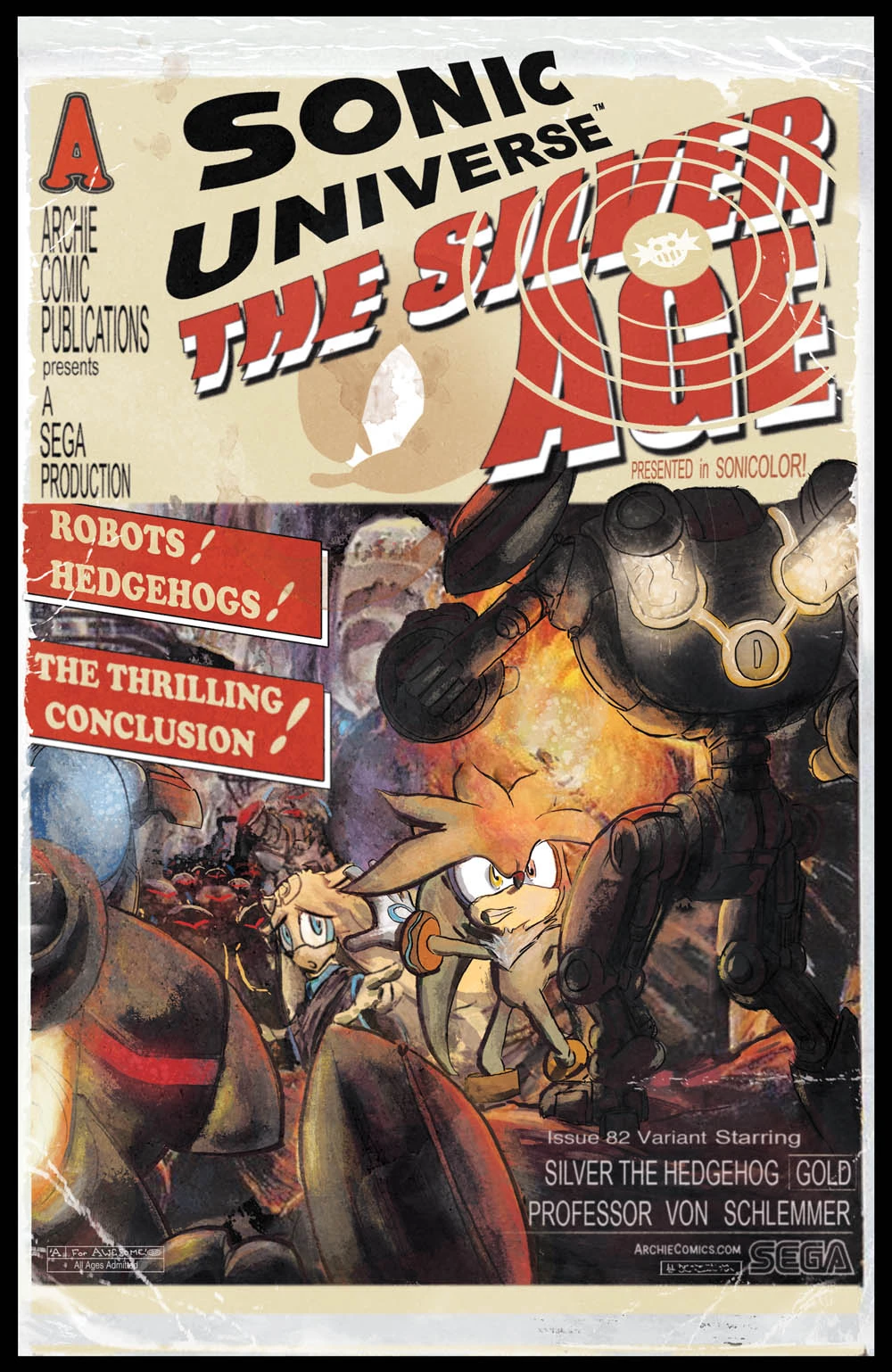
Talking about issue 82 of Archie’s “Sonic Universe,” I could open with a few different thoughts. About how this was the only issue of “Sonic Universe” we got in a five month period. Or how this was the first issue of 2016, the last year the Archie “Sonic” title would exist. Instead, I want to talk about that variant cover. It is, for no particular reason, patterned after the poster for the 1960 film version of “The Time Machine.” I guess both stories are set in the future? Whatever the reason, it’s a baller cover and I fully support it. If Archie wanted to pay homage to more classic sci-fi/monster movies, I obviously would have loved that.
Here we are at part four of Evan Stanley’s “The Silver Age.” With the Second Devourer unleashed on the future metropolis, things look grim for Silver and Gold. That’s when Prof. Von Schlemmer remembers a random device he introduced earlier in the story arc. Chekov’s Bigger-Maker Machine is deployed to grow Silver to giant size. His power grows proportionally to his size, giving him the boost necessary to drive the Second Devourer back through the dimensional glory hole it tore through.
My general indifference to “The Silver Age” hasn’t really changed in any positive way as the story has continued. This issue is technically better than most of the proceeding ones. There’s not much in the way of plot contrivances or annoying supporting characters. Von Schlemmer, and his absolutely agonizing accent, is still around but not as front-and-center. Stanley reintroducing the Bigger-Maker Machine is rather clumsy, as is Silver getting the inspiration necessary to push the monster back. But it’s all rather painless to read. It’s also not especially involving. The good guys best the bad guys pretty much how you’d expect. Give us your four dollars and fuck off.
Having Silver pull an Ultraman and grow to enormous size to fight a giant monster is, if nothing else, sort of fun. It’s not the first time an Archie “Sonic” title has tried a Power Rangers but the story decision is used rarely enough to make an impression. Stanley briefly considers the impractical aspects of suddenly growing to massive size. Silver is understandably disoriented by the change at first, allowing the Second Devourer to get the jump on him. Later, he has to work hard not to accidentally crush random citizens, something I wish the story focused on a little more. It would be a good visual metaphor for the weight and responsibility of being a hero if Silver had to struggle not to hurt people around him. But, nah, we get one panel devoted to this challenge and then its back to giant sized fisticuffs.
The lesson Stanley wishes to impose is much hoarier. This is, you see, a story about the power of friendship. When the Devourer has seemingly got Giant-Size Silver down for the count, he remembers that Von Schlemmer and Gold are counting on him. This gives him the anime power-up needed to save the day. To further nail this message, Stanley has the three heroes - plus a couple of those Bits - hold hands and form a psychic link earlier. Never mind that Silver has only known these two characters for about a day. Or that Von Schlemmer doesn’t even know his name, a factoid revealed near the story’s end. Moments like this is when wiping out a comic’s entire history, and quickly introducing a bunch of new people, really hurts things.
The issue then ends on a note that’s so abrupt, it becomes sort of hilarious. The Second Devourer is vanquished and Silver reverts back to his normal size. Everyone hugs it out and then... A Genesis Portal opens under their feet and sucks everyone down to God knows where. Since this arc is set before “Worlds Unite,” we know Silver is okay. He’s tossed back to Sonic’s time, fights that pizza sauce demon, and then ends up in Mega Man X’s world. But what about Von Schlemmer and Gold? Due to the comic’s fast encroaching cancellation, we never found out what became of those two. So these two were tossed into a hole, rather literally, and never seen again. Once again, Stanley shows a weakness for random bullshit happening suddenly to people.
Yardley is still doing the pencils for this. As always, his artwork is of a baseline level of competency. At the same time, he does seem a little bored with the proceedings. You can imagine Stanley herself or Adam Bryce Thomas making the Second Devourer look really bad-ass, while Yardley's looks more like a Pokemon than a dimension eating eldritch abomination. And it might just be me but Yardley's backgrounds look weirdly flat and uninteresting on this go-around. You never really feel any weight from the destruction the two giant characters reek on the city around them.
I know, of the post-reboot story arcs, this one seems to be pretty well regarded. Once again, I find myself diverting from wider opinion. I can't help but feel Stanley makes a lot of rookie mistakes with this one. Gold is an alright character but I fucking hate Von Schlemmer, while this new version of Silver isn't as lovable as the old one. There were one or two moments I dug but, over all, I'd say “The Silver Age” definitely gets the bronze from me. [5/10]
Labels:
archie,
comics,
evan stanley,
silver,
sonic universe
Monday, July 1, 2019
THE 2015 SONIC THE HEDGEHOG COMIC BEST/WORST LIST
2015 marked the second complete year of the Post-Genesis Wave continuity, the Shattered World Crisis rolling on. Opinion continued to be sharply divided on whether the reboot. It found passionate fans of their own, was accepted by some long-time readers, but other life-long fans continued to bitch and grouse about all the differences. Even if we expand beyond “Reboot sux/preboot was never good” rhetoric, it seems to me that the book was still being torn in different directions. Flynn was using this on-going plot as a way to set up the new world, which had the effect of dragging the on-going plot out for way too long. At the same time, he was showing us how the comic was now a mixture of game elements, stuff from the old DiC cartoons, and new/old comic stuff.
And then there was another massive “Mega Man” crossover in the middle of the year, disrupting the flow of whatever was happening otherwise. Even if you are a fan of the reboot, I think you can agree that this was not an ideal set-up for a comic book recovering from having its entire continuity wiped clean. None of us knew it either but the book was barreling towards canceltation too, the first signs of which would appear in 2015 if you were paying attention.
Nevertheless, it’s my job to look back on the year and declared the best and worst stories, art, and new characters for the year. Let’s get to it. The issues covered in this retrospective are:
Sonic the Hedgehog: Issue 268-278
Sonic Universe: Issue 72-81
Sonic Boom: Issue 3-11
Sonic Super Digest: Issue 11-12
Mega Man: Issue 50-52
Mega Man: Worlds Unite - Battles: Issue 1
Sonic the Hedeghog: Worlds Unite - Battles: Issue 1
Sonic/Mega Man Free Comic Book Day 2015
BEST COVER STORY:
Ian Flynn, "Worlds Unite! Part Six: Fire in the Sky" (Sonic Boom: Issue 9)
Is “Fire in the Sky” truly the best “Sonic” story that was published in 2015? Is it the most dramatically sound? The most emotionally resonant? The most satisfying narrative? Well, probably not. However, the sixth part of “Worlds Unite!” is by far the most fun I had reading a “Sonic” comic in 2015. An entire issue devoted to a huge action sequence between Sonic’s gang, the two “Mega Man” crews, the Deadly Six and Sigma’s army, it’s a series of delightfully fun escalating fight scenes, the book utilizing the various crazy superpowers of its mixed cast in a creative way. It was somehow the highlight of a crossover that also featured Chun-Li and Princess Sally sharing page-space together.
WORST COVER STORY:
Evan Stanley, "The Silver Age: Part One" (Sonic Universe: Issue 79)
Though Evan Stanley is a perfectly cromulent “Sonic” artist, as a writer she was still getting over her metaphorical sea legs with “The Silver Age.” The first part grapples unsuccessfully with a number of problems. It introduces the immensely unappealing Professor von Schelemer, who immediately proceeds to do uncomfortable things. Stanley fails to make her future setting distinct or interesting in any meaningful way. Worst, the plot relies overly on coincidence and contrivance, with a portal opening up under the characters’ feet just when the story needs Silver to show off what he can do with portals. Sadly, it’s not just the first part that has this problem but the entire story line.
BEST BACK STORY:
Aleah Baker, "Hidden Costs: Part Two" (Sonic the Hedgehog: Issue 278)
There weren’t a lot of back stories published in 2015, leaving the pickings pretty slim for this category. However, Aleah Baker continued to show her strength for emotionally driven narrative and interaction between female characters with the second half of “Hidden Costs.” What might’ve been a senseless fight between Bunnie and Cassea in her husband’s hands becomes a story about empathy and finding common ground with your enemy. It’s nice to see these themes acknowledged, especially in a year that was overwhelmingly characterized by characters punching their ways out of problems.
WORST BACK STORY:
Joel Enos, "Sonic vs. Three of the Armored Deadly Six!" (Sonic the Hedgehog: Worlds Unite - Battles: Issue 1)
Since it’s a compilation devoted to side stories, really every story contained in the “Battles” one-shots are back stories. And, by far, the worst of the lot was Joel Enos’ oh-so-elegantly entitled “Sonic vs. Three of the Armored Deadly Six!” In Enos’ first and last contribution to Archie “Sonic” lore, he shows no ability to see these cast members are actual characters. Instead, he reduces everyone to their thinnest personality traits and has them barf up dialogue so bad, that it sounds like pre-canned Sega advertising lines. Stories like this represent the worst of what a “Sonic” book can be, when the series functioned as nothing more than facile advertisements for corporate product.
BEST STORY ARC:
Aleah Baker, "Spark of Life" (Sonic Universe: Issue 72-74)
Technically a cheat, as the first installment was published in 2014, but “Spark of Life” is the sole universally agreed upon classic of the post-reboot continuity. Strengthening Sally and Nicole’s relationship like never before, Aleah Baker makes the connection between the two more meaningful than half of the preboot romances. It’s this bond that makes the story truly special, as it’s not free of the typical last minute power-ups and cheesy plot reveals that have characterized the series too much here of late. But, damn, those flashbacks and little meaningful moments are so good, you guys.
WORST STORY ARC:
Ian Flynn, "Champions" (Sonic the Hedgehog: Issue 268-271)
“Champions” is by no means a bad story arc. There’s actually a number of things about it I really liked. However, I found myself unable to get over the central contrivance of this one. That the world would gather around for a celebrity fighting tournament when the planet was literally being torn into pieces. Not to mention that the fight scenes are often the least interesting thing about this series and here’s an arc completely devoted to them. Really, shit like this is why the Shattered World Crisis felt so damn long. Instead of actually working towards resolving the problem, Flynn would take months to screw around on nonsense like a fighting tournament arc. The characters and the readers have better things to do, man.
BEST COVER ART:
Mega Man: Issue 51 - Spaz
The cover game was super strong all throughout 2015, with the “Worlds Unite” event in particular bringing with it a number of neat images. However, Spaz’ cover for issue 51 of “Mega Man – that would’ve been part eight of the story – emerged as my favorite. Honestly, whoever the colorist was deserves a lot of points for that. The moody colors, mixing night blues and spacey purples, really draw the eye. Painting Chun-Li and Ryu in that shade almost causes them to fade into the background, which makes their appearance feel like something of a surprise.
WORST COVER ART:
Sonic Universe: Issue 73 (Extreme BFFs Variant) - Agnes Garbowska
While the regular cover to issue 73 of “Sonic Universe” featured a totally fine image of Nicole being menaced by Phage, the variant cover was handed over to another artist who has never worked on Archie's “Sonic” titles before or after this. Agnes Garbowska's cover could only be described as extremely awkward. Sally poses uncomfortably on a hoverboard, while Nicole punches forward in such a way that it looks like her fist is eat her face. The crowd of villains in front of them are overly static, each one wearing the same facial expressions and several being quite off-model. The colors are flat and weirdly splotchy, as if they were done with colored pencil. Top it off with that embarrassingly “LOOK AT HOW HETEROSEXUAL WE ARE!” “Extreme BFFs” logo and we've got a stinker of a cover.
BEST STORY ART:
“Worlds Unite! Part Six: Fire in the Sky” – Edwin Huang (Sonic Boom: Issue 9)
“Worlds Unite” was a real well-spring for the book's artwork. Several sort-of big names were invited to contributed to the crossover and they all did excellent work. Tyson Hesse's illustrations in the back third of the event and Ben Bates' work on the “Mega Man: Battles” book were all highly recommendable. However, Edwin Huang provided my favorite artwork in the crossover. The epic action scenes he got to illustrate in part six were especially well done. Yet, as impressive as Huang's action work is, I think his character work is just as strong. Everyone always looks so alive, so sharp and energetic, when Huang draws them. Really fantastic stuff.
WORST STORY ART:
“Sonic the Hedgehog vs. Three of the Armored Deadly Six” – Tracy Yardley (Sonic the Hedgehog: Worlds Unite – Battles: Issue 1)
Just as the Best Cover Story winner also snagged Best Story Art, the Worst Story Art category also lines up with the Worst Cover Story “winner.” Tracy Yardley contributes some of the worst pencils I’ve ever seen from him here. The characters look weirdly blocky and undefined. The Zetis’ facial expressions are utterly lifeless. The action is routine and lacks energy. Not that I can blame the guy for phoning it in so hard on this one, considering how deeply lackluster the writing was. Either way, it’s some truly disappointing work.
BEST NEW CHARACTER:
Breezie the Hedgehog
Here's another category this time were I'm technically cheating. Breezie the Hedgehog made her first appearance – at least as far as the Archie books are concerned – on the very last page of issue 267, which was published in December of 2014. If we are to truly count this and Breezie becomes a 2014 character, I am forced to give this award to Gemerl, Cream and Vanilla's delightfully suburban-dad-like robot who first appeared in issue 273, from June of 2015.
But, come on, one panel cameos don't really count, do they? Breezie would actually be introduced and developed throughout the first half of 2015. While I wasn't a fan of the “Champions” arc over all, Breezie was a delightful addition to the book. She's a villain but not the usual world-conquering type. Instead, as a brutal capitalist that only cares about her own bank account and position in the world, she can almost convince people she's not a bad person. Yet there is something charming and stylish about her, an older woman who knows what she wants and is determined to get it at all costs... A charm that can turn into viciousness that minute she thinks you've crossed her. She was cool, is what I am saying.
WORST NEW CHARACTER:
Professor Von Schlemmer
Y'all probably saw this one coming. From the minute I laid eyes on Professor Von Schlemmer – ironically, another rescue from the “adventures of Sonic the Hedgehog” cartoon – I had a viscerally negative reaction to him. There's something deeply unappealing about his design. That green skin, the orange hair with the yellow lightning bolt running through, the weird bolt-like additions to his flesh... He looks like an unnaturally revived corpse of some sort. And my problems with the character do not end there. From his obnoxiously loud German accent, to his tendency to spout nonsensical exposition, to his complete disregard for Silver's personal space, everything about this creep rubs me the wrong way.
BEST IDEA:
Outsourced Casting
With most of the comic exclusive characters rendered unusable, Ian Flynn had to get creative when it came to re-populating the book's world. While this brought with it a ton of new comic exclusive characters, it also meant the series started drawing from unexpected sources. As I mentioned above, Breezie was a re-utilized version of an obscure “Adventures of Sonic the Hedgehog” character. 2015 would also see the book re-introducing Lupe, a cast-off from “SatAM” that was a regular supporting player in the original continuity. (And the characters that did come from the games, like Gemerl or Honey the Cat, were pretty damn obscure.) And I would say “Worlds Unite!” eventually rolling other Sega and Capcom games – including the totally unexpected and greatly welcomed “Street Fighter” cast – was a part of this as well. 2015 was the year of deep cut character introductions and I loved it.
WORST IDEA:
Corporate Mismanagement
And the end begins here. While it seems like we'll never know why exactly Sega and Archie parted ways, bringing the comic to an unexpected end, it's clear Archie's inability to run a comic company without massive amounts of bullshit was a contributor. 2015 saw the abrupt cancellation of “Sonic Boom,” easily the most promising of the “Sonic” titles at the time, because the company simply didn't have the funds to relaunch the “Archie” books and publish this fun comedy spin-off. The year would end with several long delays, the comic not being seen again for several months. This was supposedly due to Archie switching printing facilities but come on. Turns out, 2015 was the year the writing was put on the walls, though we didn't truly see it at the time.
Subscribe to:
Posts (Atom)