Friday, February 5, 2016

Sonic the Hedgehog: Issue 10


Sonic the Hedgehog: Issue 10
Publication Date: February 1994

Before we get on with issue 10 of Archie’s “Sonic the Hedgehog” series – which is really as average an issue as you’re likely to see, with one high-light – let me take a minute to complain about the covers. In these early years of the comic, the covers frequently did not relate to the comic’s story. There were mostly just dumb jokes, like Issue 7’s dumb speed-reading joke or Issue 4’s even dumber dark and gritty joke. Only two issues so far, 6 and 8, have anything to do with the content. Issue 10 seems to promise an interesting story, where Robotnik uses a freeze ray (which is not a death ray or an ice ray) to stop Sonic in his tracks, taking away his greater advantage. Yeah, that would be cool! But no, instead, we have stupid stories about Nerbs and hot air balloons. Sigh.
 

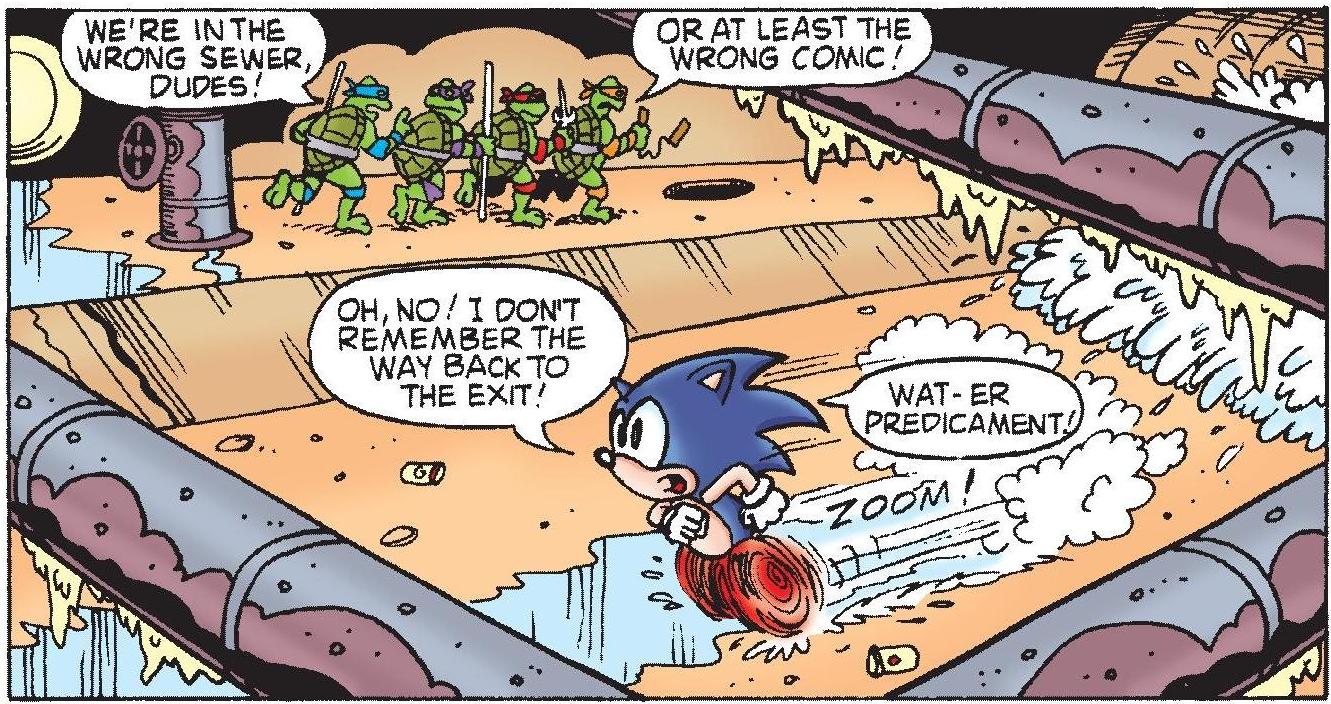
Anyway, the plot. In the first story, Sonic and the Freedom Fighters are searching the outskirts of Robotropois for landmines. Instead, they yank up a power line and are trapped in a force field. Digging below, they discover the secret underground civilization of ill-tempered creatures called Nerbs. Despite being assholes, Sonic and friends still endeavor to save them from Robotnik’s digging, which involves a trip through the Mobian sewers.


Let’s just get this out of the way. The Nerbs are annoying. First off, their names are an obvious play on the term “nerd,” back when it meant a socially awkward smarty-pants instead of just someone who is enthusiastic about something. In case the readers missed the subtle wordplay at work there, the Nerbs also wear button down shirts, glasses, pocket protectors, and funny hats. (I also always thought they looked a little bit like Nerds candy but that may just be me.) Their personality is abrasive, as they reject all outsiders. One of those annoying editor’s boxes even asks if anyone would want to be friends with either a nerd or a Nerb. Considering nerds are the people who buy comic books, maybe Archie shouldn’t have been so wiling to buy the hands that feeds them.


The story could have been about how exclusion and prejudice is bad. The Nerbs scorn outsiders, until Sonic and friends save their asses, at which point they learn to be more open to people. And, yeah, technically it is about that. In truth, the story is mostly about Sonic being a speedy badass. He zips around the sewer tunnels, avoiding Robotnik’s totally sweet dragon machine, and saws some pipes here and there. This has its pleasures too but the story remains fairly light-weight and slightly irritating. (For some reason, decades later Ian Flynn would declare the Nerbs canon, despite them being completely fucking useless.)

The seconds story begins with the Freedom Fighters floating in a hot air balloon, surveying the area for a good place for their annual picnic. Considering they’re in a fucking war, you’d think picnics wouldn’t be a concern but never mind that. Antoine, who declares the superiority of hot air balloon travel, gets his pretensions deflated when some Buzzbombers pop the balloon. Later, the picnic is interrupted by Robotnik’s army… Until Antoine sweeps in with his refurbished balloon and saves the day. Okay sure.


The back-up story is only slightly better then the main story. Angelo DeCesare’s script is full of lame puns and the plot is generally silly and light-weight. However, the tale does give Antoine some character development. Up until this point, Antoine has been characterized as a wet blanket, a braggart, and a coward, frequently bullied and ridiculed by his friends. Here, Antoine saves the day, proving himself useful for the first time in the comic’s run. Considering he would eventually evolve into a perfectly cromulent Freedom Fighter, I guess this is the start of his long journey towards character development and usefulness.

More importantly, the back-up story introduces a new artist into the Archie Comic fold. Art Mawhinney worked as a storyboard artist for SatAM. Thus, he shows more fidelity to the source material. Robotnik hangs out in an urban, dystopian hellscape, instead of a few industrial factories. He even sits in the same throne, petting Cluck! (Snivley and Antoine’s French accent are back to, which may or may not be Mawhinney’s work.) The characters look like they stepped right out of the cartoon. His lines are crisp and clean. The characters are expressive and life-like, with the action being exciting and animated. Really, I don’t hate Dave Manak’s work. But Mawhinney blows him out of the water. There’s a reason Art would be the definitive Sonic artist for years. His artwork, along with a slightly better script for the back-up story, notches this entire comic up another grade. [7/10]

Wednesday, February 3, 2016

Sonic the Hedgehog: Issue 9


Sonic the Hedgehog: Issue 9
Publication Date: January 1994

In an earlier review, I mentioned my fondness for the comic’s ability to mash together different elements of different Sonic continuities. This is, after all, a comic book made to sell video games, based on a cartoon show but with the style and tone of an entirely different, if related, cartoon show. Though the comic has changed a lot over the years, it’s always been a weird mishmash of various different Sonic media. A few times in the comic’s history, the series would directly adapt an episode of the SatAM series, usually to disastrous results. Only once, however, did it ever adapt an episode of “Adventures of Sonic the Hedgehog.” In issue 9, with the cover story “Pseudo-Sonic.”

Now it’s a loose adaptation, fitting the AoStH character of Pseudo-Sonic into the comic’s world, which more resembles SatAM. However, the general outline is the same. Sonic accidentally enters a poison sumac field and blows up to massive size from hives. Meanwhile, Robotnik sends a robotic doppelganger named Pseudo-Sonic to attack Sonic’s friends. The details are different. In the cartoon, Pseudo-Sonic is meant to discredit the real deal with acts of villainy. The robot is not autonomous, being piloted by a small mouse inside. Sonic gets poisoned by accidentally stumbling into the field. In the comic, the robot’s goal is to infiltrate the Freedom Fighters’ secret base. Pseudo-Sonic has artificial intelligence. Sonic is searching for flowers for Sally’s birthday when he becomes infected. Yet the general outlines remain very similar.

As for the story, it has ups and downs. The tone remains very comical, as you’d expect. Despite robotic doubles of Sonic becoming a valuable part of Sonic mythology, Pseudo-Sonic is no Metal Sonic. He’s far too goofy to be threatening. More importantly, even the characters in the book recognizes him as a robot. Sonic ballooning to huge size from the sumac and the presence of a random butterfly pushes pass my acceptance for goofy, cornball bullshit. Like many of these early stories, it ends with Pseduo-Sonic directly pleading with the audience, asking for letters from readers if they want to see him again. Considering he wouldn’t appear again until issue 170, I’m going to guess they didn’t get too many letters.


However, there are elements to this story that I like. That the Freedom Fighters immediately realizes Pseudo-Sonic is a copy is a nice subversion of how these stories usually progress. Tails’ makes him self useful by easily defeating Pseudo-Sonic, via the power of static electricity. The end of the story finally fulfills some of Bunnie’s potential, as she kicks the ever-loving shit out of Robotnik with her super strength. If she can do all that, it sort of makes you wonder why the Freedom Fighters even need anybody else…


The back-up story has a similar tone. While out gathering flowers for Sally again, Sonic discovers a rare Mobian Needle Bird, a spiny breed of bird endangered by Robotnik’s pollution. He names the bird Thorny and takes him back to HQ. Unfortunately, the Freedom Fighters have a history of bringing home pets that are secretly robotic spies. Also, Thorny eats Sally’s birthday cake, pissing her off. Anyway, you can see where this is going. After kicking the bird out, Sally gets captured by a robotic tree and Sonic and Thorny save the day, after which she forgives the bird of his crimes.


It’s a basic, simple story that doesn’t make much of an impression on readers. Thorny, like Pseudo-Sonic, is promised a return at the end of the story, being made an honorary Freedom Fighter. Unlike Pseudo-Sonic, he would never return again. What thing I do mildly like about the story: There’s a degree of conflict. It’s not just so-many pages of silly gags. It involves the characters’ interacting, coming to conclusions, changing their minds, and showing off their personality. (It also has one funny moment, when a baby deer bombardier is referenced.) The standard may be low but surpassing them counts for something. [6/10]

Monday, February 1, 2016

THE 1993 SONIC THE HEDGEHOG COMIC BEST/WORST LIST!


For me, the undisputed king of Archie Sonic comic reviewers – if such a thing can be said to exist at all – is Dan Drazen. Drazen first began publishing his thoughts on the comic on an e-mail news letter, beginning at least as far back as 1995. Afterwards, the reviews began appearing on his personal website. For a long time, he was the old man in the fandom and, in addition to his reviews, wrote a number of respected fanfics. Dan’s position in the fandom was such that, for a brief time, he was the official comic reviewer for Archie, receiving the books earlier and posting his reviews on the company website.

Drazen was probably the first person I ever saw who examined this goofy comic series I love so much in any sort of critical way. As the years went on, he set up his own style of review, where he would rate the stories on Brains (narrative), Eyes (artwork), and Heart (emotional resonance.) The book was obviously never going to be what Dan wanted it to be. Going back and re-reading the old reviews, he sometimes comes off as a grumpy old man. Our opinions vary wildly, as opinions tend too. Either way, his reviews still strike me as a definitive take on the series and are a big inspiration for Hedgehogs Can’t Swim. My attachment to his work is such that, when he stopped publishing reviews last March, amid a growing disillusionment with the series, I actually got bummed out.

Perhaps what I’ll miss the most from Drazen’s reviews are his yearly Best/Worst List. Every year from 1996 to 2013, he would write-up his favorite and least favorite stories, artwork, and other aspects from the book’s previous year. As an extended homage to Dan’s work, as I work my way through the comic’s run, I plan on doing the same as wrap up a year’s worth of comic books. I’ll be using most of the same categories Dan laid down.

Without further ado, here is:
 

THE 1993 SONIC THE HEDGEHOG COMIC BEST/WORST LIST!

I’ll be covering the following issues during this retrospective. (I’m fudging slightly to include all of the original mini-series.):

Sonic the Hedgehog (Original Mini-Series): #0-#3
Sonic the Hedgehog: #1-#8


BEST COVER STORY:
Mike Gallagher, “A Crowning Achievement” (Sonic the Hedgehog (Original Mini-Series) Issue 2)

At this point in the series’ history, the book wasn’t much more than a collection of goofy, one-shot comedy stories. The material was pretty dire, for the most part. However, I managed to really like one story from this first year. “A Crowning Achievement” has some decent stakes, actually putting Sonic on an adventure and having him use his brain as well as his speed to out-wit his enemies. Out of the extremely silly original mini-series, this may be the most serious story as well. (Which means there’s still plenty of goofiness in it.)


WORST COVER STORY:
Mike Gallagher, “The Spin Doctor” (Sonic the Hedgehog: Issue 6)

Unlike many big titles from the big companies, Archie’s “Sonic” series was usually written by no more than two or three people at a time. As we go through these flashback retrospective, you will frequently see the same name winning both the best and worst awards in the writing category.

Though Gallagher would eventually write some good stories for the book, much of his earliest work is typified by lame puns, broad characterization, and corn ball humor. “The Spin Doctor” doesn’t even attempt to get an eye-roll out of the reader. An eight page advertisement for Sega’s “Sonic Spinball” video game, it heavily condenses the plot of the game, tosses in some lame gags, and calls it a day. No attempt is made to retrofit a video game’s plot to the comic format. No attempt is made to build something more from this story. You’d get more out of reading the Wikipedia article about the game. It’s hella’ lame, you guys.


BEST BACK STORY:
Mike Gallagher, “Rabbot Deployment” (Sonic the Hedgehog: Issue 3)

It’s weird to think that Bunnie Rabbot, a beloved member of Sonic’s supporting cast who was a part of the Saturday morning cartoon show from its first episode, wouldn’t appear in the comic until issue 3 of the on-going series. Like most of the early stories, “Rabbot Deployment” is goofy, full of jokes, and relatively light on the drama or menace. Despite that, it’s a decent page-turner, featuring some fun action and properly introducing Bunnie into the book’s world.


WORST BACK STORY:
Angelo DeCesare, “Sonic’s Christmas Carol” (Sonic the Hedgehog: Issue 6)

Issue 6 strikes again. Doing a spin on “A Christmas Carol,” with a series’ characters in the place of Charles Dickens’ various archetypes, was old hat even back in 1993. (The Muppets did the same thing just a year earlier for one example.) The Sonic version contains no laughs or pathos. It does not comment on Dickens’ work. By placing the “Sonic” cast members into this familiar story, it does not deepen or challenge the characters as we know them. Using Robotnik as a Scrooge stand in doesn’t even make any sense. It’s not only the worst “Sonic” story of 1993, it’s still one of the worst stories to ever appear in the book, period.


BEST STORY ARC and WORST STORY ARC:
N/A

In the fast-and-loose early days of the comic’s history, there was no such thing as story arcs. Every plot was contained to the singular issue. Continuity was very loose back then, as characters and concepts would disappear from issue to issue. Forget it, Jake. It was the early nineties.


BEST COVER ART:
Sonic the Hedgehog: Issue 1 – Dave Manak

Dave Manak’s artwork is uneven on the best days. It’s angular, loose, cartoony, and frequently ugly. Despite that, I still kind of like some of his artwork. The cover for the first issue of the on-going, for example. Showing the Freedom Fighters beset on all sides by Robotnik and his minions, it does a decent job of quickly establishing the team’s personality and what they’re up against. It’s also pretty cool looking, with more detail and action then Manak usually featured.


WORST COVER ART:
Sonic the Hedgehog (Original Mini-Series): Issue 2 – Scott Shaw!

Scott Shaw’s vibrant, colorful artwork is superior to Manak’s in every way. Despite that, Shaw’s covers were always somewhat lame and generic. Issue 2 of the original mini-series has maybe the most generic. A static shot of Sonic fleeing from a rocket, eye-piercing black-and-yellow speed-lines make up the background. Sonic is high-lighted against the word “ZOOM” in huge letters. Sonic himself seems slightly off-model and, as was frequently the case in the first year, the cover does not reflect on the story in any way. In other words, not Shaw’s best work.


BEST STORY ART:
Scott Shaw!: “Run, Sally, Run!” (Sonic the Hedgehog (Original Mini-Series): Issue 1)

His covers might have been a little rough but Shaw’s panel artwork was a lot of fun. The reason I single this story out is because it probably shows off Shaw’s talent for capturing motion the best. There are many scenes of Sonic and Tails flipping through the air or running around. The facial expression are also clear, funny, and detailed. Despite the overall silliness of the story, Robotnik and his robots are still mildly threatening looking.


WORST STORY ART:
Dave Manak: “Vertigo A Go-Go” (Sonic the Hedgehog: Issue 2)

As I said, even on a good day, Manak’s work was slightly rough. This short back-up story truly shows off the limitations of his pencils. The perspective work is seriously off, as Sonic is shown from multiple, unflattering angles. Verti-Cal and horizont-Al have generic designs and most of the story takes place against a swirling vortex of color. It sucks.


BEST NEW CHARACTER:
Bunnie Rabbot

There was no contest here. Bunnie, as depicted in the comic at this point, doesn’t resemble the sweet, empathetic but quietly tough character from the cartoon much. She shows an obsession with hair-dressing and making embarrassing Southern-fried puns. That’s just where the book was in 1993. Still, there’s a reason Bunnie remains a fixture in the series to this day. The superstrong cyborg rabbit added something to Sonic’s supporting cast that wasn’t there before.


WORST NEW CHARACTERS:
Verti-Cal and Horizont-Al

In the book’s early, comedy-centric days, many one-shot characters and villains would be introduced, many of them based on puns. Verti-Cal and Horizont-Al should have been one-shot adversaries. Mister Mxyzptlk-style all-powerful imps, the two play goofy pranks in an alternate dimension where they have total control over all motion and direction. Despite the duo being nothing but annoyances, and their location in another universe making the odds of Sonic crossing their path again unlikely, Al and Cal would put in a few scattered appearances in the book over its long run. I don’t know why.


BEST IDEA
The crumbs of an on-going mythology

When I say “on-going mythology,” what I really mean is “the thinnest wisp of continuity.” In the first year, we saw a prototype version of King Acorn’s magical crown, the origin of Sonic’s rings, and a little exploration of the weird world of Mobius. It’s not much but, even in these early issues, you can see the signs of what a weird, fascinating book Archie’s “Sonic” series would eventually become.


WORST IDEA:
Slapstick and Bullshit

What else? In order to make it through these early issues, one has to have a high tolerance for sophomoric comedy, puns, Fourth Wall leaning gags, unearned and undeserved potshots at more popular comics, random references to pop culture, and characters acting out in service of lame jokes. To say the series gets better is slightly misleading, as the quality has always fluctuated wildly between the two poles, but the series will certainly change a lot over its long run.

Friday, January 29, 2016

Sonic the Hedgehog: Issue 8


Sonic the Hedgehog: Issue 8
Publication Date: December 1993

Let me tell you a story. Back when I began this project at the beginning of the month, I mentioned how issues 17 and 18 of Archie’s “Sonic the Hedgehog” comic were the first issues I ever read of the series. I got lucky, as it wasn’t much longer before the series actually started to get decent. For years, I wondered about the content of those first 16 issues. Trade collections are common place now but, back in the mid-nineties, hadn’t become everyday practice for all comic companies. It wasn’t until 2006 when Archie started to reprint these early issues in the Sonic Archives collections. That is the point when I was first exposed to the truly inane, incredibly silly early days of the series. Out of all the stories I read, I think issue 8’s “’Bots All Folks” struck me as the dumbest. Maybe it goes to show how my taste has involved because, nearly a decade later, I re-read the story and kind of enjoy it.


So what’s “’Bots All Folks” about? Robotnik becomes enraged when he spots Crabmeat reading a collection of comic books. (Which, inconceivably, includes “Sonic the Hedgehog” comics.) However, the superhero comics inspire Robotnik to build a series of superhero-inspired robots as his latest plan to crush that pesky hedgehog. In the back-up story, “A Little Sonic Goes a Long Way,” Sonic and friends discover a hidden cache of musical instruments. Enraged by the music, Robotnik heads after them with his new shrink ray.


Now, don’t get me wrong. Both of these stories are dumb, dumb as hell. “’Bots All Folks” trades in the most obvious kind of parody. Sonic battles Bot-man, a barely connecting riff on Batman. He fights robotic parodies of Magnus - Robot Fighter, Captain Marvel, and Mighty Mouse. Unlike a lot of the dumb parodies in the comic’s early years, there is some free-wheeling absurdity to this story. While Robotnik ordered a robot version of Wolverine, instead he gets a robot version of Steve Urkel. (The comic then ruins the goofiness of this gag by pointing out that both Urkel and Sonic are played by the same actor, esteemed thespian Mr. Jaleel White.) Probably the dumbest yet somehow amusing gag in this strip is the appearance of SPAWNMOWER, a lawnmower version of Todd McFarlane’s definitive nineties anti-hero. Something else that’s great about this story is that, unlike a lot of other early silly Sonic comics, this one was still canon!

Mike Gallagher also peppers the stripe with jokey references to these comics. While Archie’s constant finger-pointing at what was popular on shop racks at the time can go a bit far, a few of these lines made me chuckle. Such as Spawnmower stopping every couple panels to pose dramatically or a sight gag about “McFar Lane.” Or dialogue mentions of “Valiant” or “Image.” Har har. There’s no threat to this story, as Sonic easily demolishes each of the machines but it’s mildly amusing.


The second story is not as good. It is notable for remembering, once again, that Bunnie exist. It’s also the first time we see Snivley actually acting as Robotnik’s assistant, which is nice. Mostly, the back-up story shows off the wild divergence in quality of Dave Manak’s artwork. Manak really is getting better. His action scenes are a little more dynamic here and the characters go off-model far less often. A few panels even make it look like Manak had been studying the official Sega art of the time. Yet, in the same story, it also shows the major flaws of Manak. When the Freedom Fighters are shrunken down, it’s frequently difficult to tell how small they are. They more-or-less look the same size as they always are. It’s weird that an artist can create some compelling action images yet struggle with something as basic as perspective.

Maybe I’m developing Stockholm Syndrome. I actually slightly enjoyed this issue while acknowledging that it’s still not very good. I’m allowed. It proves that, when it comes to the early, goofy days of the comic, Michael Gallagher wasn’t exactly a good writer. But he was slightly better then Angelo DeCerse. I’m sure that helps him sleep at night. [6/10]

Wednesday, January 27, 2016

Sonic the Hedgehog: Issue 7


Sonic the Hedgehog: Issue 7
Publication Date: November 1993

With the seven issue of “Sonic the Hedgehog,” things roll along as usual. We get a goofy pun-tastic cover, in which Sonic displays an interesting selection of classic literature. Angelo DeCesare contributes two silly story with predictable endings and very simple jokes, with a handful of one-page gag strips to pad the book out to an appropriate length. That’s the way things were in the early days of Archie.
 

In the first story, a seesaw related accident leads to the Freedom Fighters uncovering Uncle Chuck’s treasure map. This leads them to Mobius Natural Park, which has been reduced to a toxic wasteland due to Robotnik’s pollution. The cybernetic tyrant and his henchmen are quick behind them, also searching for the treasure. In the second story, Sally dresses up as a witch for Halloween, mistakenly assumes she has magical powers, and receives romantic gestures from Robotnik, who doesn’t realizes this sorceress he’s fallen for is one of the Freedom Fighters.


Before I go on about all the lame things I dislike about Issue 7, I should probably mention the handful of things I mildly enjoy about it. To begin, this is the first issue in quite a while to mention Uncle Chuck. It’s nice when the comic nods towards the characters that would become way more important later. Robotnik’s pollution turning the park into a radioactive doom zone is another example of the ecological themes present in early “Sonic” media. Lastly, I like that the second story is set on “the annual Fright Night,” presumably an analogue for Halloween, and has the characters dressing up in costumes. That’s soon forgotten, as the story goes off in a wildly different direction, but I like the effort.


Now the stupid shit. Thus far, Angelo DeCesare’s writing is really making me miss the comparative subtly of Mike Gallagher. Both of the main stories follow well-trodden comedy clichés. In the first, everyone seeks a treasure that is then revealed not to be riches, gold, or a powerful new weapon. Instead, it’s a personal memento with absolutely zero practical value. From the first panel, I saw that one coming. The second story functions on a ridiculous case of mistaken identity – really, a hat and dress is all it takes to fool Robotnik? – and incredibly unlikely coincidence. Sally and Robotnik are both believe that she has magical powers because a freak geyser just happens to toss a rock into the air when she points at it. Lastly, DeCesare piles on the puns. Look at these things:

“That’s the first seesaw I’ve seen since I saw…” “The natural park looks more like a supernatural park!” After being shot, “I think he’s trying to pin the “BLAM” on us!” “You shouldn’t stick your nose where it doesn’t belong cause it won’t be long anymore!” “Too bad, walrus! Tusk! Tusk!” ‘That’s swat you get, SWATbots!” “Hey Buzzbomber! Your family tree has hives!” “It was mighty slick of me to use this oil spill to escape!” “I knew Buzzbomber couldn’t take a little needling!” After scooping something up in a net, “This is what is meant by a net gain!”

Holy shit, dude. You think you’ve got enough there?


After the comic has made Sonic look like a bullying asshole throughout these early issue, issue 7 decides its time to make Princess Sally look like a total bitch. When Sonic and Antoine offer to be her bodyguards while she’s out exploring, she yells at both of them to leave her be. Okay, reasonable if slightly prickly. After Sonic rescues her from Robotnik, after disobeying her order and secretly following her, Sally beats him over the head with a stick. (Which leads to another pun. “Witch way did she go?”) It doesn’t help that Sally, characterized as an independent and capable woman on the cartoon show, needs a man to rescue her after stumbling into stupid peril. One of the one-page gags has Sally reading Antoine the riot act for him daring to name a boat after her. Somehow whizzed in her cereal that morning…

It’s going to get better eventually, right? [4/10]

Monday, January 25, 2016

Sonic the Hedgehog: Issue 6


Sonic the Hedgehog: Issue 6
Publication Date: October 1993

Throughout the history of Archie’s “Sonic the Hedgehog” comic, occasionally Mother Sega has called on the company to publish a story promoting whatever the new video game may be. In the early years of the series, when the stories were non-serialized and mostly self-contained in nature, this wasn’t much of a problem. As the comic developed on-going plots and its own convoluted mythology, sometimes the video game tie-ins would drop in the middle of a story line, interrupting its pacing and flow. However you feel about the game tie-ins, the very first one technically occurred here. Right on the cover, Issue 6 declares itself an advertisement for “Sonic Spinball.”


Despite getting the cover, the version of “Sonic Spinball” that appears here is heavily abbreviated. The game is a nostalgic favorite of mine, as its colorful levels and inventive control gimmicks kept me coming back despite the sometimes steep difficulty. In the comic, Sonic and gang march on Robotnik’s lair only to discover that he’s instead shacked up inside a hollow volcano, dubbing it the Veg-o-Fortress for some reason. For some other reason, the base has been outfitted with pinball-style rails, flippers, and bumpers. Sonic quickly rushes through the four levels, encountering a handful of the games’ enemies and giving us a vague idea of what each stage is like. Then he leaves, the volcano erupting for ill-defined reasons.


This first story is barely a “story.” It really exists only to advertise Sega’s new game. It doesn’t even do that good of a job of it. We meet Rexxon and Scorpius, the main enemy and boss of the first level, briefly encounter some characters and themes from the next two levels, and the final stage is skipped over entirely. Aside from a few random ass appearances from Hip and Hop and Scorpius way down the line, this story would never be referenced again. Robotnik nor Sonic achieve nothing here. It’s weak stuff.


The first story is bad and largely pointless. The second story is content with merely being bad. Even though the Mobius Encyclopaedia tells me this issue was published in October, otherwise known as the Halloween season, the entire second half of the book is devoted to Christmas. An especially dire adaptation of Charles Dicken’s “A Christmas Carol,” at that. Robotnik is recast as Scrooge, Rotor as Bob Cracket, the rest of the Freedom Fighters as Crachit’s starving family, with Sonic occupying the roles of the three ghosts. The comic fusion of the then-current Sonic style with Dicken’s tale is awkward, to say the least. The novel’s moral lesson is ejected entirely, as Robotnik learns nothing from his visions of the past, present, and future. That could’ve been a funny subversion but the book barely has time to acknowledge this. Mostly, it’s an excuse for more lame slapstick, like teenage Robotnik falling face-first in some porridge or Sonic delivering an exploding turkey bomb. And in the end, it’s all a dream. It’s over quicker then “Sonic’s Christmas Blast,” which I guess is something.


The best story in this issue is a one-page gag comic in which Sonic receives an enthusiastic fan letter about Antoine. This one-pager continues to show Sonic acting like kind of a dick towards Antoine for next to no reason. The letter refers to the coyote as “brave and loyal,” which annoys Sonic. Ironically, later in the series, Antoine actually would be characterized as brave and loyal.

The story also introduces Snivley, Robotnik’s much-loved lackey from “SatAM.” He plays the Jacob Marley stand-in during the Christmas Carol riff and, unfortunately, wouldn’t become a reoccurring character in the comics for a few more issues. Michael Gallagher and Angelo DeCesare at least remember that Bunnie exists this time, even if she only appears in a handful of panels, doing nothing.

Archie’s “Sonic” series is still highly disposable at this point. No issue, thus far, is more disposable then this one. Issue six fails at telling a good story, advertising “Sonic Spinball,” or putting on a funny or interesting variation of “A Christmas Carol.” Bah humbug indeed. Merry Christmas, assholes. [3/10]

Friday, January 22, 2016

Sonic the Hedgehog: Issue 5


Sonic the Hedgehog: Issue 5
Publication Date: September 1993

Michael Gallagher’s goofy scripts, with their focus on obvious puns and low-brow slapstick, would define the early years of Archie’s “Sonic” title. But they wouldn’t do it alone. With issue five, Angelo DeCesare would begin penning stories. DeCesare would write for “Sonic” on-and-off for years, contributing a handful of minor elements to the mythology without ever making much of an impression. You’d be mistaken for assuming Gallagher wrote the stories this time, as DeCesare does little to distinguish himself from the series’ primary writer up to this point. Despite some minor movement forward over the last two issues, number five has “Sonic” slipping back into sophomoric silliness.


Once again, the comic is broken up into two stories. In the first, Robotnik invites the Freedom Fighters to an Olympic Games-style sports tournament of his own devising. If the Freedom Fighters can achieve victory in even one of the events, the dictator will spare their lives. If Robotnik’s goons win every event, he will roboticize the rebels. This should be an easy victory until Robotnik switches out Sonic’s sneakers with a pair of shoes that saps his energy. Later, the villain sends a robotic termite – obviously called the Termite-Nator – to Freedom HQ, where the cybernetic insect begins to eat the rebels out of house and home.


DeCesare doesn’t show much strength for narrative clarity. I know the series is still a light-weight gag comic at this point, but these two stories push the audience’s suspension of disbelief. Why in the hell would the Freedom Fighters ever agree to Robotnik’s tournament? Why would they put themselves within arm range of their enemy? The story also seems to imply that Sonic gets his super-speed from his sneakers. The comic has already established at this point that Sonic’s shoes merely protect his feet from air friction. The comic, once again, forgets the Bunnie Rabbot is supposed to be a regular cast member at this point. Her super-strength certainly would’ve come in handy during the weight-lifting competition. Throughout the early years of the comic, Robotnik’s goal would be to locate the Freedom Fighters’ secret lair. In the second story, he sends a package to Freedom HQ. I guess the Mobian Postal Service doesn’t communicate with the mad dictator in control of the planet? Even a screwball comedy has to have some interior logic. Issue 5 definitely stumbles in that regard.


The first story is a fairly basic variation on the sports episode every nineties kids cartoon had to do. There’s little to recommend about it. I like the taunting SWATBot that makes an early appearance. I like that Tails’ becomes angry at the machine too. At this point, Tails is still mostly defined as an in-awe fanboy for Sonic so any display of other emotions from him is welcomed. There’s also a bit of novelty in watching Sally attempt to out-swim a robotic octopus. Considering Sonic’s fear of drowning lent this blog its name, I can’t imagine he would’ve been much help in that round. The Termite-Nator is a minor villain that’s always stuck in my brain for some reason. I don’t know why, as the story he’s in is fairly goofy, the villain has no personality, and he would never appear again. He is defeated by swallowing Sally’s super-thick pancake batter, a non-glamorous way for any bad guy to be disposed of. Speaking of minor contributions to the lore, this comic also marks the first appearance of Splats, a Sega-style badnik that never actually appeared in any of the Sega games.

Maybe I always remember the Termite-Nator because of his colorful, amusing design. This issue both shows off the strengths and flaws of Dave Manak’s art. He’s great at cartoony character designs and goofy facial expressions. I like Sally’s look of regret after her pancake batter is used to defeat the enemy. I like the Freedom Fighters’ expressions of righteous indignation during the Olympic games. Manak’s action scenes, however, frequently come off as flat or lifeless. When Antoine attempts the long jump, it just looks like he’s going for a pleasant stroll.

Once again, I have to remind myself that the comic gets better. Issue five is yet another step back to the inconsequential slapstick comedy that sadly defined the series’ first year or so. [4/10]