Monday, May 22, 2023

Sonic Boom, Episode 1.47: Fuzzy Puppy Buddies


Sonic Boom, Episode 1.47: Fuzzy Puppy Buddies
Original Air Date: October 10th, 2015

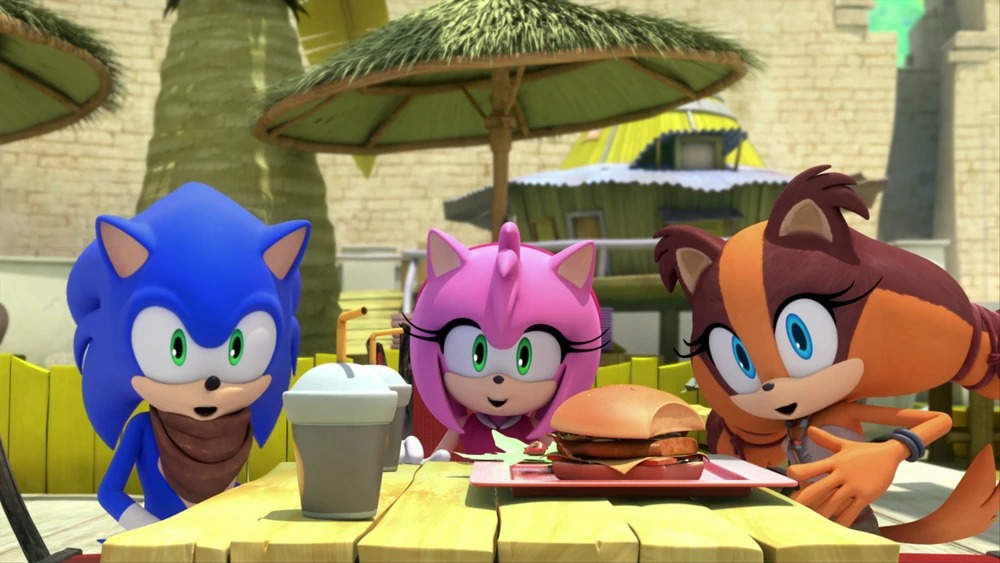
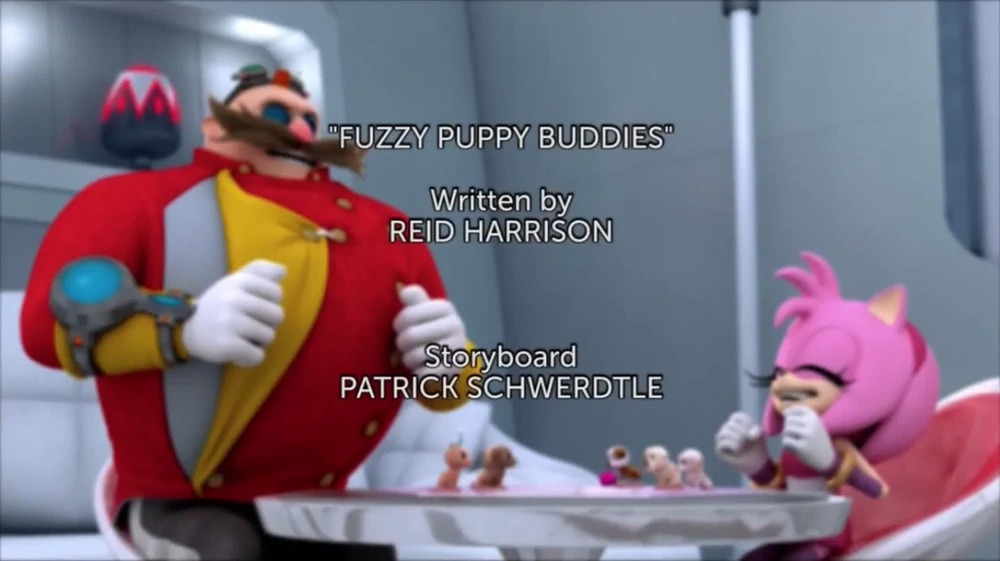
Five episodes out from the end of "Sonic Boom's" first season and they throw another Amy centric episode at us. This time, Amy has become a fan of a collectible tabletop game called Fuzzy Puppies, in which adorable puppy game pieces are pitted against each other. At a local meet-up, Amy discovers that Eggman is also a Fuzzy Puppies player/collector. The two soon begin a secret friendship, meeting up at odd hours to play together. This raises suspicion in Amy's friends. At a local Fuzzy Puppies convention, Eggman's villainous nature and his new friendship with Amy come into conflict. 

It's easy to see what "Boom" is doing with "Fuzzy Puppies." When "My Little Pony: Friendship is Magic" debuted in 2010, it quickly garnered an unexpected fan base of adult men. There's been multiple papers and whole documentaries made about this phenomenon. At the time, the so-called "brony" community was a source of fascination and novelty. Adult men being way too into a cartoon and toy line for little girls was mocked and derided as "cringe." Bronies, not always unfairly, were widely considered to be weirdos and creeps. It was also examined as challenging gender norms and as an embracing of sincerity and wholesomeness among an older generation. 


The brony concept was also an act of irony by terminally online edge-lords. The fandom has its roots on 4Chan, after all. "Oh, look at how funny it is that we're into this girly show" was the thought process behind many of these guys. That had an obvious downside. A full decade after the fact, we've seen a whole swarth of toxic fanboys, perverts, and literal Neo-Nazis co-opt a program designed for young children. Right-wing shitheels taking over whole corners of geeky fandoms have had horrible ramifications for the whole world. That makes it hard to consider the "Brony" movement as anything but a negative force in the history of the internet and nerd culture.

In 2015, that wasn't obvious yet. Or, at least, it wasn't to people who only had a surface familiarity with the "brony" concept. Such as the "Sonic Boom" writers. They were clearly just happy to riff on the idea of a grizzled adult being invested in a cutesy, frilly hobby. Two years earlier, "Teen Titans Go!" made nearly the exact same joke and I'm sure there are other examples out there of shows spoofing "Bronies." So the concept was already a bit overexposed by this point but, like always, "Boom" was a few years behind the zeitgeist. At least Fuzzy Puppies is not a direct "Friendship is Magic" spoof. It's clearly also inspired by "Littlest Pet Shop," "Pound Puppies," (which have much smaller brony-like fandoms of their own) and the frenzied fan base for tabletop gaming in general. 


"Boom" did not make an episode about fascists infiltrating internet fandoms in order to radicalize vulnerable nerds. Instead, "Fuzzy Puppy Buddies" builds comedy around a much more easily understood concept. Amy is sneaking behind her friends' backs to spend time with someone else. Sonic and the others slowly pick up on this and become concerned. Amy, on the other hand, is exhilarated by finding someone to embrace her geeky passion with.  This leads to the potent comedic premise of conversations with two meanings, of Sonic mistaking Eggman appearing at Amy's hut as an attack. And the villain being forced to play along. Classic sitcom stuff. 

Even though this is an Amy episode, Eggman still emerges as the show's most interesting character. Eggman's oft-noted insecurities appear in him wanting a friend to enjoy Puppy Buddies with, to teach him to play. Amy fills that niche. This episode also has fun with another idea this show often returns to. Despite being sworn enemies, Eggman is basically friends with the heroes. He even refers to his battles with the Boom team as a "job" and his bond with Amy over Fuzzy Puppies as an off-the-clock activity. When Eggman's inherent villainous qualities emerge, that powers the conflict in the last third. Which is a pretty juicy little character arc and I'm satisfied with the place the show ends it at. It wouldn't be easy being friends with a would-be world conqueror like Eggman but maybe there's hope for him yet. 


I'm also glad that this episode doesn't build all its jokes around big, burly Eggman being into a cute little puppy game. Or Amy embarrassing herself with her indiscreet passion. That's definitely the source of some of the jokes but "Fuzzy Puppy Buddies" finds more fruitful avenues. The sequence devoted to Amy sneaking away from her friend is amusing. The biggest laugh comes when Tails determines, via process of elimination, that Amy must be the main character this week. Sticks unfurls an amusingly baroque monologue afterwards based around misunderstanding the word "con." The dialogue is pretty sharp here, with Sonic and Knuckles getting some solid one-liners in. Knuckles putting on sunglasses or cracking a line about "overwatering" got snorts out of me.

It also amuses me that the writers and animators of this episode clearly put some thought into how "Fuzzy Puppies" work. The rules are discussed and they generally make sense. I don't know how fun a game like this, with so many varying rules, would be to play. But I hate any tabletop game more complicated than "Monopoly," so I'm not the person to ask. If nothing else, it's obvious the animators enjoyed designing the little puppy figurines. They are genuinely cute. I can totally see people actually collecting them, just to have them. I say this as an adult man with a nearly complete Super Hero Squad collection. Anyway, this episode probably could've been something a little deeper but I enjoyed it nevertheless. [7/10]


Friday, May 19, 2023

Sonic Boom, Episode 1.46: No Robots Allowed


Sonic Boom, Episode 1.46: No Robots Allowed
Original Air Date: October 3rd, 2015

"No Robots Allowed" is one of those "Sonic Boom" episodes with an amusingly rambling plot, that starts in one place before ending up someplace else entirely. A terrible heatwave is gripping the whole island, making everyone miserable. Since his electric bill is already sky-high, Eggman refuses to turn on the A.C. Instead, he installs solar panels on his lair, the excess sunlight soon giving him a surplus of power. This causes his robot army to go into overdrive and act out on their own, causing one of the machines to land on the lap of the Archipelago Homeowners Association. Under their rules, robots are strictly forbidden and they threaten the villain with eviction unless he can convince them otherwise. Eggman attempting to throw a pleasant party for his guest is interrupted by the hyperactive machines. 

Whew, that's a lot for an eleven minute cartoon! In fact, I kind of wonder if this episode isn't an example of the writers mashing together two separate premises they have. "Sonic and friends deal with a heatwave" and "Eggman has to hide his robots from snooty island officials" really are two unrelated ideas. This is further evident in the episode's structure: The Sonic Boom heroes and Eggman barely interact in this one. Even at the very end, when they fight some Badniks and then follow them back to Eggman's lair, that feels like a pretty unnecessary addition. The story resolves itself without much help from Sonic and the gang at all. I guess there's no way for the heroes to solve global warming in eleven minutes, causing the plot to deviate in a totally different direction from where it started. 


Yet the mashed-up script really isn't an issue. "Boom" sets out to make its audience laugh and this episode is packed full of wacky slapstick gags. "No Robots Allowed" begins with a delirious sequence of Sonic and the others, desperate to alleviate the heat, attaching the fan of Tails' hovercraft to the hut's door. The resulting airflow turns the inside of the home into a wind tunnel, everyone and everything inside swirled around in the air. It's a moment of extended physical comedy that amuses me with its silliness, such as a totally random "E.T." shout-out. That level of anarchic absurdity continues in a later scene, where Knuckles has repeated hallucinations about an ice cream vendor. That builds in a nice way, concluding on a suitably "Looney Tunes" level of goofiness. 

The second half of the episode continues this theme of well-timed slapstick. Someone trying to hide a presence in the home from an important visitor is a stock sitcom premise and "Boom" embraced that with absurd aplomb. Eggman is kicking MotoBugs through doors, cranking the music up, and doing everything he can to disguise the robot uprising happening around him from the homeowners association. The biggest laughs come from a montage of Orbot and Cubot attempting to hide the other machines in impractical ways, including throwing each other back-and-forth into the bathroom. 


Aside from a procession of solid gags, what's my main takeaway from this episode? Eggman hated his dad. See, early on, there's a line from the doctor about how "this heatwave is more oppressive than my father." It's a tossed-off line – har har, the villain has daddy issues – but is actually the secret key to understanding both the character and this whole episode. If Eggman was raised by an authoritarian father, it explains his desire to rule the world. He doesn't want anyone to tell him what he can do. Yet his dad, no matter how much he resents him, is also the person who taught Eggman how to interact with other people. This is why he treats his henchmen like shit. This is why he wants to rule the world, exerting his authority over everyone. (It also explains the self-loathing and wafer thin ego he's shown repeatedly.)

As much as Eggman hated his dad ordering him around, as much as he's doomed to become an authoritarian himself, he's also compelled to please authority figures. Eggman giving a shit what the local HOA thinks about him is obviously an example of wacky sitcom logic. In a proper "Sonic" story, Eggman would just blow them up and do whatever he wants. Yet an oppressive dad who rarely handed out approval and affection created a son who wants to please official bosses. Again, this is why Eggman wants to become the biggest boss in the world. He respects organized authority and power more than anything else. That's another reason why a rebellious little punk like Sonic, who does what he wants as it suits him, drives Eggman up the walls. He demands order and obedience to order. 


This also ties in nicely with the title-lending thrust of the episode. The oppressed will always rise up. Eggman's Badniks, his slaves, do not revolt against their master. Instead, they just go nuts and lash out randomly in all directions. Yet the image of Eggman shoving a horde of unruly robots back behind a door, while polite society tried to function on the inside, seems potent nonetheless. Authority will also try to push down those it deems rowdy and they will always fight back and refuse to be controlled. Thus is the nature of things. If nothing else, the racist against robots HOA get what's coming to them. 

It's a shame an episode with a secret potent side ends on such a flat note, everyone just agreeing to let things continue the way they are. Still, this one made me laugh and gave me some substance I can read too much into. There's also some sharp dialogue in this episode, like Knuckles' reaction to being told the heatwave is strong, an exhausted Sonic's inability to think up good insults, and a meta radio announcement. It all adds up to a fun eleven minutes. Good job, "Sonic Boom" writers! [7/10]


Wednesday, May 17, 2023

Sonic the Hedgehog (IDW): Issue 60


Sonic the Hedgehog (IDW): Issue 60
Publication Date: May 17th, 2023

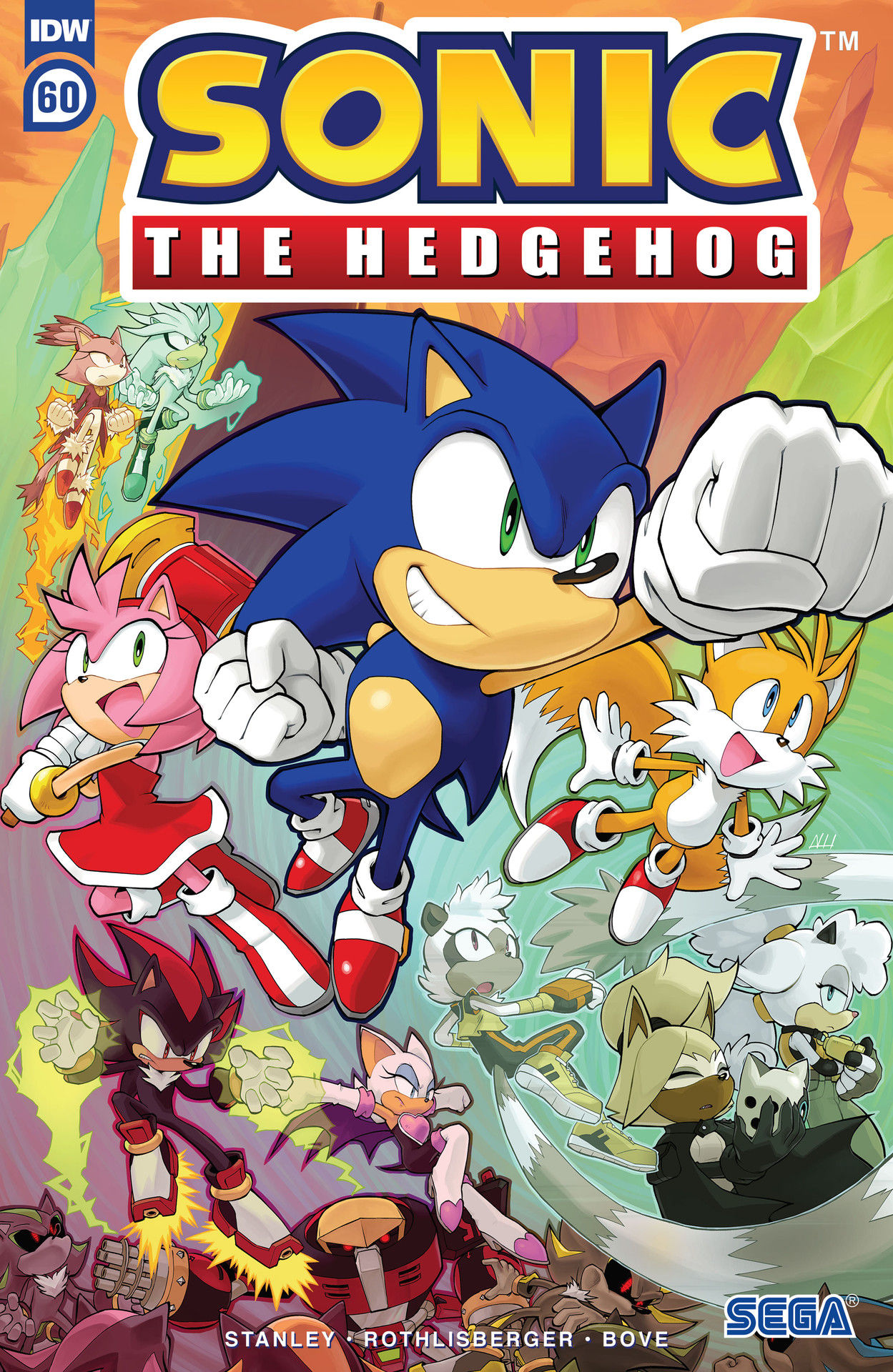
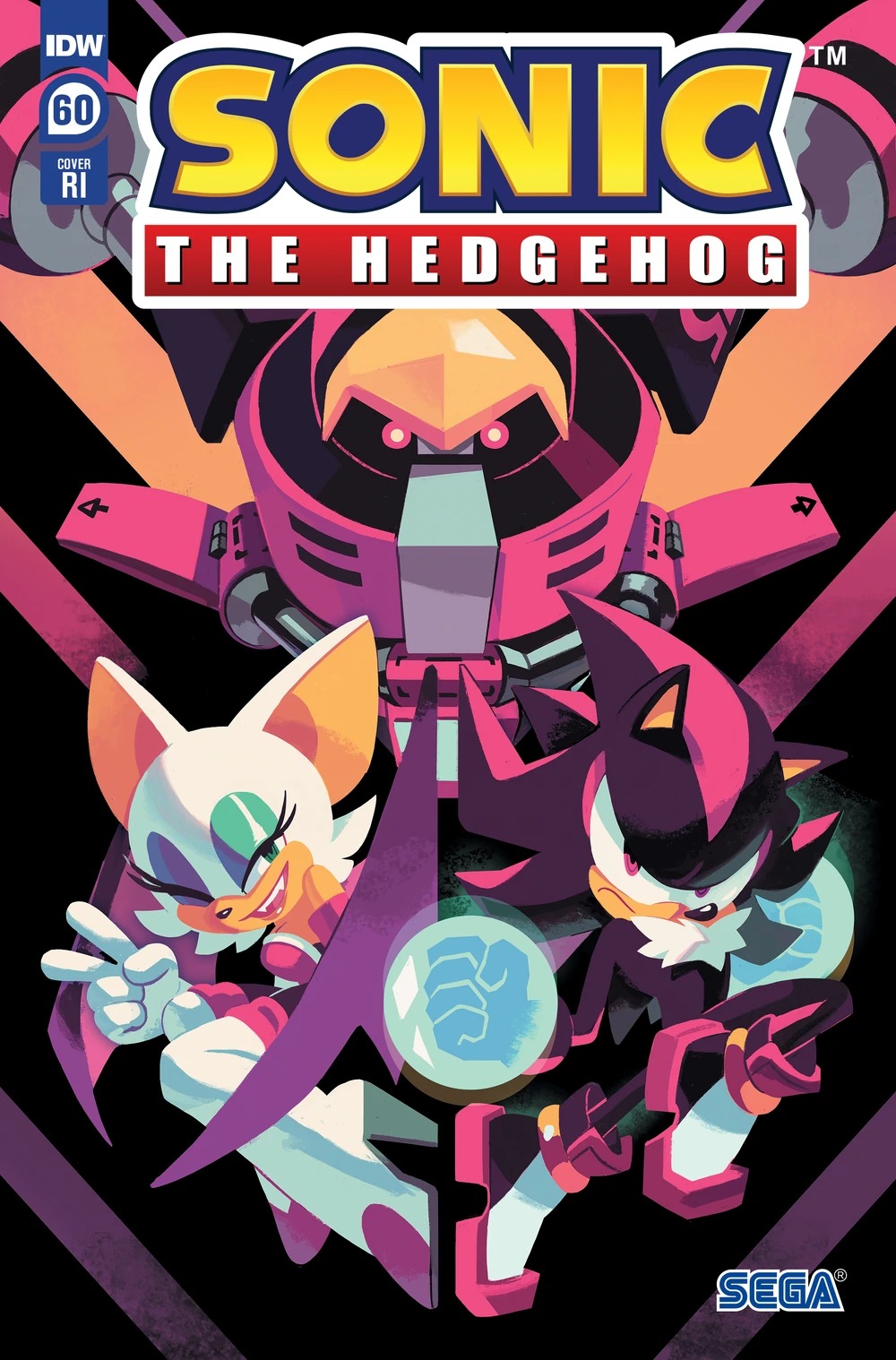
There's lots to talk about with this month's issue of IDW "Sonic," so let's get right into it. "Urban Warfare" continues into its fourth part with our heroes in a perilous scenario. Lanolin and Whisper are still trapped in Eggman's pocket dimension thing. Tangle is plummeting to her death but saved thanks to suddenly being intangible. Metal Sonic is right on her trail though, as she unwittingly leads him right to Sonic and the others. The group quickly formulates a plan. Sonic, Tails, and Amy will head to Eggman's tower, in hopes of stopping the fail-safes that keep Eggperial City running. Meanwhile, Blaze, Silver, and Rouge head off to rescue Shadow and Omega. All of that is easier said than done. 

"Urban Warfare Part 4" is one of those action comics that feels relentless in its pacing. Pretty much not a page passes without some new threat being tossed at our heroes. Oh no, Tangle is falling to her death! Oh wait, now Metal Sonic is here! Ack, Amy smashed Tails' computer! Oh jeez, Metal and the pocket dimension gateway/Ten-Sided Die of Agony has arrived! We just rescued Shadow but, holy guacamole, the fake Chaos Emeralds won't stop growing! And there's Shadow Androids here too! Metal Sonic cut the rope holding up elevator and... Watch your back, Amy! Eggman's got a gun!!!


It just goes on like that. It's exhausting! Reading this comic doesn't feel like a roller coaster ride so much as it does being suddenly strapped to a rocket sled while asked to recite the multiplication table. I can't say it isn't compelling. Every time I thought I had figured this issue out, some other wacky shit was happening. Yet it left my head spinning a bit. This is scheduled to be a five-issue story arc, which is fairly long by the standards of this series. The constant escalation of the action feels like there was enough story developments here for five more installments though. It's jam-packed with incident. 

This kind of unending thrill ride has an obvious downside: If the heroes are constantly having to deal with some new threat in their way, it doesn't leave much room for other necessary stuff to happen. There's several drastic events going on here. Tangle has somehow been turned into a ghost-like entity that can communicate with other people but just phases through any solid matter she tries to interact with. She was never at risk of falling to her death, because she inexplicably has a new superpower. This is a rather sloppy turn-of-events. It really feels like Stanley loved the cliffhanger of Tangle getting dropped to her doom but couldn't think of a reasonable way for her to survive. Instead, she's experiencing some bizarre new phenomena that will be explained eventually, I guess. 


That's not the only example here of an extraordinary happenstance being ignored because the barreling locomotive can't slow down. I'm still not entirely sure what's going with Eggperial City and the fake Chaos Emeralds Eggman has built. Okay, so Shadow's Chaos Control has overpowered them? But Eggman has fail-safes programmed into the city's infrastructure exactly to prevent this. Which is what the heroes are trying to disrupt, so the power supply will run out? And Shadow is stuck inside an ever growing net of emeralds for some reason too... Jesus Christ, slow down a minute! This story is starting to depend on so much technobabble nonsense that I'm loosing my bearings on what's happening. 

This particular issue is, to say the least, convoluted. I guess Stanley keeping the plot moving forward at an almost unbearable pace is a better solution than boring the reader with ever-more tedious descriptions of the why this crazy shit is happening. Yet at a certain point, my eyes start to gloss over. You see this style of plotting from time-to-time in video games, sci-if anime, and superhero comics. The obligation to include as many action scenes as possible run into a double-stuffed plot full of events. Eventually, the breathless delivery of yet more sci-if plot devices gives the reader whiplash from trying to wrap their brains around each new turn of events. 


I think rushing through the mechanical needs of the story, in order to immediately get to the next fight scene, is the main reason why this issue struck me as unsatisfying... But how did it get that way? Part of it is Stanley and Flynn getting too invested in how Eggman's new super weapon works. I don't actually give a shit how Eggperial City operates. What matters is that it's this ever-growing city that is consuming the countryside, not that there's a bunch of fake Chaos Emeralds charging it that come with their own set of rules. "Keep it simple, stupid" should always be the rule of thumb when it comes to explaining the "how" of the New Doomsday Device of the Month. Sci-fi and action comic writers frequently forget this though, bogging the story down in contrived explanations for how some plot device or supernatural MacGuffin operates. 

Another problem is that there's too many people to juggle here. This is a story arc with nine central characters. And that's not counting Whisper, Lanolin, and Shadow, who exists simply as damsels-in-distress to be rescued at this moment. (And I also excluded Omega from that count, since he doesn't show up until the issue is half over.) To balance out such a large cast, Stanley's maneuver is to have everyone split up into teams. Sonic, Tails, Amy, and Tangle the Ghost of Christmas Past are off on one quest. Rouge, Silver, and Blaze are off on another. I feel like this would operate a lot smoother if the number of characters involved had just been cut in half. This is the sort of writing you see a lot in superhero comics and fanfiction, where the nerds behind the keyboard are more concerned with what superpowers they'll have access to than whether what's happening flows in a satisfying manner. 


And yet... As frustrating and relentless as I found this particular issue, I didn't hate it either. Even in a story as overstuffed and convoluted as this one, Stanley doesn't forget the main reason we read this shit: We love these characters. We care about them. She includes just enough personality that I felt like I was reading a real narrative and not a bunch of chess pieces being moved around the 4D board. Such as Tangle's final thoughts before she expects to hit the ground: "Whisper, I'm sorry." Jeez, doesn't that tug on your heartstrings? Tangle is, as far as she knows, about to die and the last thing on her mind is that she let down someone she cares about. 

Soon afterwards, Tangle feels overwhelmed by everything that's happening. She pushes her doubts aside because she knows that saving the day is what's most important. That's the kind of never-say-die attitude I love about my favorite lesbian lemur! Silver gets a moment like that too, where he feels like there's nothing he can do to stop the bad shit that's happening, that his abilities are at their limits. A nod of encouragement from Blaze is enough to remind him to keep moving forward. (Now I see why people ship these two.) As corny as it sounds, seeing my favorite fictional heroes keeping fighting when the odds are stacked against them, to see them push pass their own doubts, reminds me to do the same. 


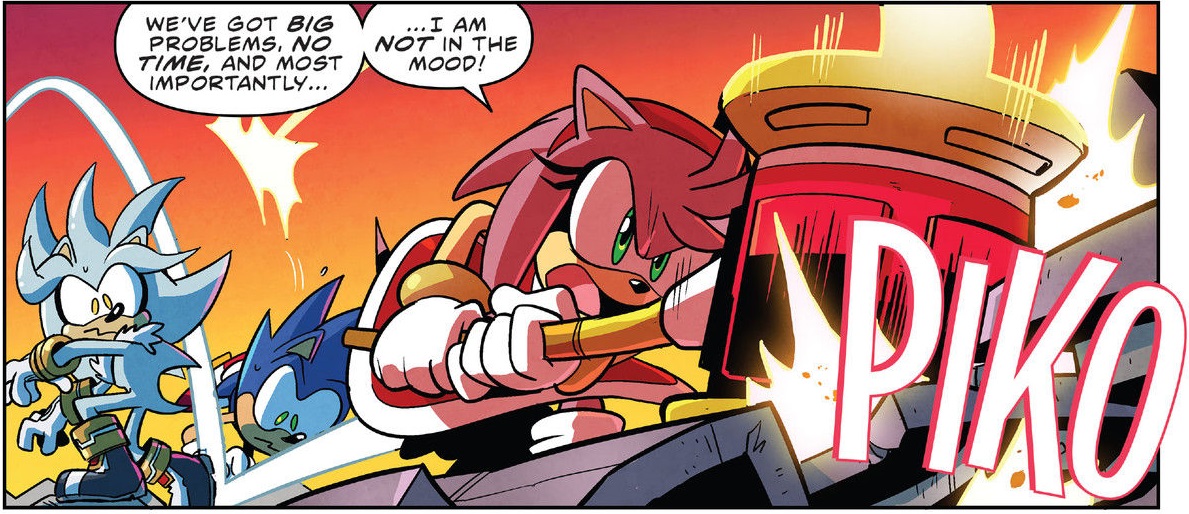
Stanley even includes a little humor. When Tangle ghosts her head through Tails' computer, Amy instinctively slams her hammer down. She apologizes for smashing Tails' handheld device, explaining it was just a mistake. That shit is funny. So is Tails weaponizing his, well, tails against Eggman during an intense moment. Or Amy admitting she's fed up with this shit when Metal Sonic first attacks. Humor doesn't just keep things light. It reminds us that these cartoon characters have personalities and histories. It makes them seem more alive. And that's really important in an issue so weighed down by Stuff Happening as this one. 

I could probably ramble on some more but I'll wrap it up here. Sorry if this review was as breathlessly assembled as the comic book was. I guess it just put me in that kind of mood. But one more thing: Thomas Rothlisberger's artwork is pretty good, with a lot of broad facial expressions and eye-catching sense of motion... Though I do think Rothlisberger's work is a little better when it's more detail oriented than leaning on the cartoony side of things, like he does here. Anyway, this issue gets a [6/10] from me. 


Wednesday, May 3, 2023

Sonic Boom, Episode 1.45: Robot Battle Royale


Sonic Boom, Episode 1.45: Robot Battle Royale
Original Air Date: September 26th, 2015

When reviewing "Sonic X," I talked a bit about the required fighting tournament arc all shonen anime must do. Yet this desire to see everyone fight it out is hardly a strictly Japanese obsession. American pop culture does these sort of competition stories with some regularity. You see it every once in a while in comic books. "Sonic Boom" writers had to cook up a hundred scripts for this show so I'm not surprised they touched on a battle royale premise after a while. This show being what it is, it not only squeezed an entire tournament into eleven minutes but it also did it entirely as farce. 

Not that the big robot fighting event is the starting point for this episode. Instead, "Robot Battle Royale" kicks off with Tails inventing an antenna that picks up broadcast from the past. Knuckles decides this item is more useful as a backscratcher, giving the echidna the idea that he's an inventor like Tails. The fox is annoyed by his friend's ego and incompetence. When the village holds a robot fighting tournament, Tails decides to teach Knuckles a lesson. But when Eggman steals Tails' machine – a robot that can take control over other robots – chaos ensues. 


This episode has good structure and, honestly, I didn't expect it. The conflict between Tails and Knuckles drives the first third of the episode. Once the robot fighting begins, that seems to derail the tension between the heroes. Knuckles' robot is taken out due to his own incompetence, with Eggman's scheme emerging as the main antagonistic force here. Yet Tails and Knuckles find a way to resolve their disagreement that also saves the day from the bad guy. Tails learns to appreciate his idiot friend while also defeating Eggman. It's screenwriting 101 but you don't always get that in a show this gag-centric and short. Good job, writers. 

Yet this episode is solid for other reasons too. There's a nice dry absurdity to the jokes here that made me chuckle. Such as a lengthy scene where the Mayor wastes everyone's time by firing a cannonball into the sea, which passes with so little comment that I didn't even know if it was a gag at first. You also see this commitment to the bit in the scene where Tails and Knuckles are arguing, their friends egging them on in the most juvenile way possible. Or Sonic cheering random during the robot battle, only for the reveal to show he's actually excited about buying a chili dog. Good, silly stuff that's executed with strong timing. 


As I watch more of "Sonic Boom," it's becoming increasingly clear that Travis Willingham as Knuckles is the MVP of this cast. How often has his delivery made stupid little lines of dialogue sing? Maybe the biggest laugh here came from his first invention – a stick with a rock tied to the end – and the perfect pomposity with which he presents it. His Muskian habit of “inventing” concepts that already exist leads to a number of perfect line-readings from Willingham. I especially like his melodramatic speech at the episode's end, which circles back around in an amusing fashion. 

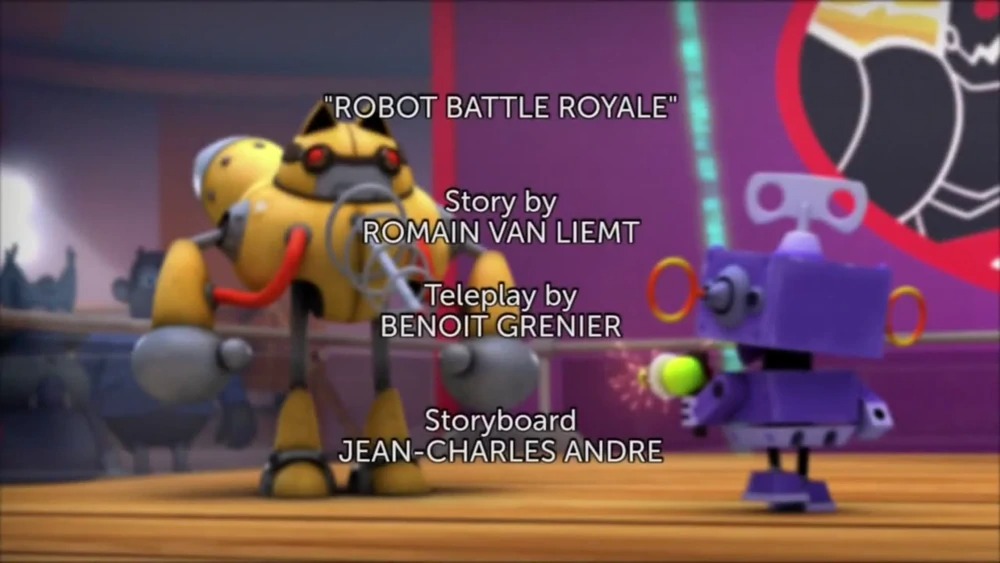
You might not be surprised to read that the robot fights here are not especially impressive. This is obviously by design. Most of the robots are goofy little things, such as the Goat Lady's little poodle bot or Comedy Chimp's cymbals clashing monkey. Most of the matches are hilariously uneven. Such as Eggman's six foot tall murder-bot going up against a cute little fella that looks like a toy attached to a skateboard. I do like the fighting game style split-screen image that appears before every match-up. That was a nice touch. 


While "Boom's" meta gags can sometimes be uneven, this episode begins and ends with two strong examples. The first scene has Sonic and Amy watching a movie, with him commenting that the beginning was slow. Amy says movies and TV shows always have "a little filler material" before the inciting incident gets things rolling. That's Tails' cue to bust in with the antenna. The episode concludes with Sonic commenting that Tails' Hypnobot is essentially a plot breaking invention, that renders all future Eggman machines a non-threat. Hypnobot is then destroyed in abrupt fashion, resetting the status quo. Nice. 

Also, there's a dance number and who doesn't love that? "Robot Battle Royale" is exactly what I think of when I consider the average episode of "Sonic Boom." It's not mind-blowingly hilarious or extra-incisive satire. However, it is consistently amusing, with solid writing and strong comedic timing. Moreover, the cast really knows what they're doing and help sell everything. As the end of the first season approaches, "Boom" has proved itself to be an efficient little comedy machine, a sturdy sitcom that is generally well-executed. [7/10]

Monday, May 1, 2023

Sonic Boom, Episode 1.44: It Wasn’t Me, It Was the One-Armed Hedgehog


Sonic Boom, Episode 1.44: It Wasn’t Me, It Was the One-Armed Hedgehog
Original Air Date: August 30th, 2015

While dusting his evil lair, Eggman is aghast to see that his particle accelerator has been stolen. He immediately calls in the cops, who uncover the remains of chili dogs and shoe prints that perfectly match Sonic's feet. The hedgehog is accused of the crime, causing him to flee town. The townfolks form a posse, with Knuckles leading it, to track him. Sonic, living under an assumed life as a humble crate stacker named "Bob," seeks to find the real bandit and clear his name. The crook turns out to be a familiar face, at least to fans of the "Sonic" franchise. 

In the annals of classic action/adventure storylines, there aren't too many more common than the hero being framed for a crime he didn't commit, causing him to go on the run and seek out the real perpetrator. I think just about every superhero comic in existence has done this one before. The responsible party almost always turns out to be a villain, often one specifically created to copy the good guy's appearance. This is, in fact, the entire modus operandi of baddies like Reverse Flash. Sometimes, a whole series based itself around this "wrongfully accused man runs from the law" premise, such as "The Fugitive." (The inspiration for this episode's title, which otherwise makes little sense.) Alfred Hitchcock called it "The Wrong Man" trope and it was the basis for several of his films. 


This is such a common premise that the "Sonic" franchise has, in fact, done it multiple times in the past. It was the set-up for Archie's Endgame story arc and the starting point of "Sonic Adventure 2's" narrative, though both stories quickly rambled off to other plot points. Maybe that's because the idea has its limitations. Yes, the hero having to run from the law, to clear his name and find the real evildoer, is dramatic. The trust his friends have in him being shattered, and those that supported him turning against him, is a juicy development. Yet it also makes everyone around the good guy look like easily swindled fools. Obviously, it would be out-of-character for a superhero to just break the law like that. It also strains believability that all his friends would turn on him so easily. The reader, of course, knows the protagonist is innocent, making the drawn-out development of uncovering the real culprit tedious after a while. "Sonic Boom" squeezes the entire story into eleven minutes and that's about as far as it could have taken it. 

"Boom" is obviously a farce, allowing it to get away with some of the more irregular elements of this stock story type. Noted supervillain Dr. Eggman working with the police is ridiculous, from the get-go. The set-up is utilized for silly gags, like extremely incriminating evidence against Sonic being right in the open. The episode avoids the awkwardness of Sonic's friends turning on him by... Just not featuring them. We never see what Tails, Amy, or Sticks think of this. The only member of Team Sonic featured in this episode is Knuckles, who is enough of a goofball that it's to imagine him getting caught up in a panic like this. And even he is actually covering for his friend. Yes, this deception is so easily seen through that even Knuckles doesn't buy it. 


Instead, the focus is on the citizens of the village, who the show continues to depict as the most gullible and easily swayed group of maroons possible. How many times have they turned on Sonic and/or his friends? Honestly, makes you wonder why Sonic protects them all the time. But I guess that's what heroes do. This is probably why a small portion of this episode focuses on Sonic, in the persona of "Bob," seeking to help an accident-prone co-worker of his. That points towards the "Fugitive" inspiration some more, as that show was all about the hero helping random folks as he fled from town to town, in pursuit of the One-Armed Man. That subplot is fairly disposable though, making this short episode feel a bit padded out.  

Who is it impersonating Sonic? Obviously, Eggman is behind the deception but the actual doppelgänger's identity did catch me off-guard. The "Sonic" franchise features multiple evil lookalikes of the hero but "Boom" rarely delves into the extended cast, so the sudden appearance of a regular cast member from the games surprised me. Spoiler alert for a seven-year-old cartoon: "Boom" randomly introduces Metal Sonic in this episode with zero foreshadowing. Sonic acts like he's an old adversary too, really making this reveal come out of nowhere. Admittedly, it's a neat answer to the mystery here.


I have no doubt that Metal Sonic fans were pleased with his guest role here. The robot does not get "Boom"-ified in appearance or personality, looking and acting how we'd expect. He is generally silent and intimidating. Yet the showdown he has with Sonic has to be among the most underwhelming fight scenes in a show notorious for its underwhelming fight scenes. Metal sluggishly floats around, slowly shooting laser blast out of his chest. Sonic, in slow-mo, runs around and avoids the attacks. As far as a showdown between two characters known for their speed, this does not display much frantic speediness. It's less Stardust Speedway and more "Sonic's Schoolhouse." 

Then again, "Boom" is not really an action show. The jokes are the main appeal here. Since this is a Reid Harrison episode, the script is packed full of snarky dialogue and absurd comic set pieces. Some of these work really well. The opening musical number from Eggman delighted me. As did the truly random segment of Orbot leading a group of tourists through the evil lair, like it was a theme park or something. Knuckles' buffoonery leads to a few amusing bits, involving doors, spit-covered sticks, baskets, quick-sand, and an amusing shout-out to "Jaws."


Overall though, this episode does suffer a bit from sitcom-itis, in terms of all its dialogue being snappy comebacks. An exchange Sonic has with the doctor helping his co-worker definitely feels unnecessarily sarcastic. Some of the running gags are a bit belabored as well. Such as a crowd repeatedly gasping in shock or the reoccurring appearance of horse shoes knocking someone in the head. Those are the kind of gags you can only really do once and, instead, this one runs them into the ground. 

"It Wasn't Me, It was the One-Armed Hedgehog" – is that seriously the best title they could come up with? – definitely ranks as mid-tier "Boom." It has enough funny ideas and zingy timing to not make me regret wasting my precious time watching and writing about it. Yet it's not extraordinary funny and, with the exception of that surprise villain, feels largely uninspired. Still, I bet some hardcore Metal-heads get a kick out of this one, since it's only the second time ever Sonic's robotic counterpart has appeared in animation. [6/10]


Friday, April 28, 2023

Sonic Boom, Episode 1.43: Fire in a Crowded Workshop


Sonic Boom, Episode 1.43: Fire in a Crowded Workshop
Original Air Date: September 12th, 2015

1950 saw the release of Japanese director Akita Kurosawa's film, "Rashomon," in its home country. Though popular at the native box office, Japanese critics were largely unimpressed with the movie. The following year, it played at the Venice Film Festival, where critics and other filmmakers were wowed by the movie. "Rashomon" would go on to become a critical hit with international audiences, becoming the first winner in the foreign language film category at the Oscars. Not only did the movie establish the global careers of Kurosawa and star Toshiro Mifune, it largely opened the gates for Japanese cinema to be taken seriously all around the world. Today, "Rashomon" is regarded as one of the greatest films of all time

Perhaps the film owes its popularity and success to the universal theme present in its story: the inherent subjectivity of the truth. "Rashomon" is about the murder of a samurai and the assault of his wife, as recounted by three different people. Each person gives their own version of events, coming to different conclusions and presenting themselves as the real victim in each telling. The movie presents all three recollections, leaving it up for the viewer to decide what really happen. The film is a great testament to the malleability of human memory, how our own emotions and ego influence our perception of events. 


Why am I talking about classic Japanese cinema on my "Sonic the Hedgehog" blog? That's because "Rashomon's" structure – an event told from the perspective of different people, each recollecting different outcomes – has become a stock story type across all media. The same set-up has been used in countless TV episodes, comics, movies, and plays. There's even an understood sociological phenomenon called "The Rashomon Effect." It's especially common in sitcoms, who often tack a definitive telling of events on at the end. This isn't even the first time I've brought this up, as there's a classic Archie "Sonic" story that does the same thing. So it should come as no surprise that "Sonic Boom" would put their own spin on this classic structure, with typically irreverent result. 

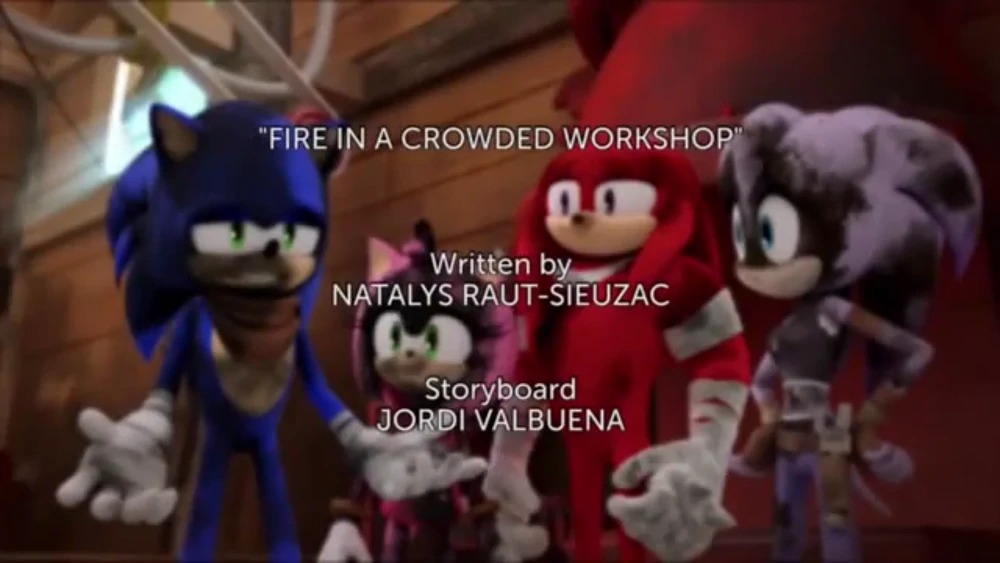
Which brings us to the plot synopsis for "Fire in a Crowded Workshop." Tails arrives at his workshop to see Sonic, Knuckles, Amy, and a new girl named Perci covered in soot and ash. The workshop is in disrepair from a fire. Each person presents their own version how they arrived at this point, their own egos served by each rendition. The general facts are: After leaving Meh Burger, the trio came across Perci, who had fallen off her bike and hurt her arm. The parts of the broken bike splattered into a puddle and splashed Perci's scarf with mud. They returned to Tails' workshop, where Sonic attempted to fix the bike with a blowtorch, while Knuckles washed the scarf and Amy tended to Perci's wounds. A pillow might have been involved. The fire was either caused by Knuckles putting the scarf in an industrial strength kiln, Amy dropping a heating pad onto some old newspapers, or Sonic leaving his torch unattended. Tails attempts to uncover the truth. 


What makes the "Rashomon" premise so mutable is that it allows a story with an ensemble cast to explore each character's perception of themselves and their perception of their friends. It's popular on sitcoms especially because each telling can usually be exaggerated for comedic effect. We see this keenly in "Fire in a Crowded Workshop." Sonic's tale – which the episode launches right into, so as to squeeze as much into its eleven minute runtime as possible – begins with Amy flying into an unreasonable rage at Meh Burger. Later, in one of the episode's funniest moments, she scolds Perci on proper bicycle safety. Perci is immediately impressed with Sonic. Knuckles is a total idiot who is entirely dependent on Sonic's care. 

This reflects Sonic's perception of himself as a super cool ladies' man who is there to protect his friends. Knuckles is too much of a simpleton – Sonic even calls him that – to function without him. Amy is an oppressive sourpuss without Sonic there to balance her out. Being a protector is admirable though it also causes Sonic to have an ego, which is why he remembers Perci catching the vapors upon meeting him. It's also pretty funny to see Knuckles as a subservient dum-dum and Amy as an overly emotional, perpetual buzzkill. Hearing the cast deliver such precise, absurd dialogue adds to the amusement. 


"Boom" has already established Knuckles as prone to exaggerated recounting of events, as a childish buffoon with a very strange perception of reality. This means his segment is when "Fire in a Crowded Workshop" gets nutty. It's surprising how much comedic value there is in Knuckles talking as a self-assured authority on everything. It's especially amusing when contrasted with Sonic as a whining, wimpy manlet who is always trying to be as impressive as his mentor, Knuckles. The script is very strong here and really bites into some goofy dialogue, Knuckles' version of what he thinks smart people sound like. The more deranged the recollection grows – the way the fire is put out is especially amusing – the better this version gets. 

Amy is alternatively depicted as a buzz kill or an idiot in the previous flashbacks but her own memory is equally unflattering. She imagines Perci as a floozy with a Southern Belle accent, who either intentionally seduces the brain-dead men in order to get them to complete tasks for her or lacks the initiative to do these things herself. This positions Amy as a woman with who perceive other women as inferior because they rely on men or as rivals for her romantic interests. She even calls Perci, who is a perfectly reasonable and nice person throughout, a "wicked siren" with a "damsel-in-distress act." Damn, Amy, maybe dial back the internalized misogyny a bit. 


And speaking of Perci! The episode seems to position her recollection of events as the objective truth. Yet even her telling seems to favor her as the hero of this story. The bike injury was just a minor scrape, not a big deal. She could've fixed it herself, if she had some tools. The guys rush around trying to impress her, which Perci seems totally neutral about, while Amy negs her as not a self-reliant woman. I guess the only reason we don't know whether this reflects the actual events or is Perci's own prejudices clouding her memory is because we don't know Perci at all. Aside from a few cameos, this is essentially her first appearance in the show. 

So that weakens the end of "Fire in a Crowded Workshop." Maybe some security camera footage that showed an unjudging eye of what happened would've been the best conclusion. (The aforementioned Archie story did something similar.) Especially since there's a clever little twist mere minutes before the end that removes all wrongdoing from everyone. I wouldn't expect a kids cartoon to do a Kurosawa style embracing of ambiguity but I still think the way it presents what I assume to be the "truth" could've been handled a little better. Having said that, I do think the very final scene of this episode is absolutely adorable. 


But let's talk about Perci a little more. Of the minor characters exclusive to the "Boom" setting, she's definitely the most popular. This might be because she was the most prominent NPC in "Rise of Lyric." Yet I think her likable design probably has more to do with. The oversized shit-kicking boots and patched-up blue jeans she wears gives the impression of a tomboy. Yet her bangs and the ribbon in her hair add an undeniable feminine quality too. Plus she has an exposed midriff and smoky eyes. Since Rouge was never in "Boom," that makes Perci the closest thing the show had to a "sexy" female character. And it doesn't hurt that she has certain superficial similarities to Julie-Su and Mina. (And she looks as much like a bandicoot as those two do an echidna and a mongoose.) I like her too and would've liked to have seen more of her. 

By the way, Sticks appears briefly in each segment, spouting off a different conspiracy theory just for one of her friends to say she's "actually very nice." In Perci's version of events, she just screams incoherently. It would've been funnier to me if Sticks' rant was the same in each memory, her craziness being the one event everyone can agree on. I mean, I guess that's still the intended message of this running gag. I suppose each changing ramble from Sticks also reflects the teller's persona, as Amy's memory puts some libertarian insanity in Sticks' mouth about our "tax dollars benefiting others." That made me chuckle. 


Nevertheless, this episode is quite funny. It's definitely the sharpest episode Natalys Raut-Sieuzac has written herself, full of the clever dialogue and keen understanding of the cast members that were lacking in her previous scripts. If nothing else, this one feels more fully formed than a lot of episodes. These eleven minutes are packed. It all adds up to a pretty good episode that would've been one of the series' all-time best with just a few minor adjustments. [8/10]

Monday, April 24, 2023

Sonic the Hedgehog: 5th Anniversary Special


Sonic the Hedgehog: 5th Anniversary Special 
Original Publication Date: April 5th, 2023

Time is a crazy fucking thing. It’s hard for me to believe that IDW “Sonic” is officially five years old now. It doesn’t seem like that long, especially since Archie “Sonic’s” road to this point felt like it took forever. Is that because Archie was utterly determined to launch a spin-off to the hedgehog book in its early years, putting out so many miniseries and “48-page specials?” Or simply because the days are longer and the summers seem to stretch on forever when you’re a child? I can figure out which of those solutions is more likely. I’m a middle-age man now with a bad back, who works twelve hour shifts, and takes medication for my debilitating mental illnesses. Five years isn’t nearly as much time as it used to be, ya know what I mean?

Either way, one thing hasn’t changed since the early nineties: Five years is still a really good run for a comic book, a licensed book especially. Even well-known superhero titles can’t go that long without being relaunched and renumbered. A hundred things are different since Archie reached this milestone but this is consistent: “Sonic” fans are loyal and will follow the blue hedgehog anywhere. IDW doesn’t have any plans to slow down either. Will this series someday surpass Archie “Sonic’s” five hundred issue-plus run? I mean, it seems unlikely. But so did any “Sonic” book reaching that point. Anything is possible with this franchise. I feel like there’s a decent chance I’ll still be reading about these characters in another twenty years, when I’m fifty-five goddamn years old, and publishing these reviews directly from my brain to the mass-consciousness psychlonet we’ll all be hooked up to 24/7. I bet Blogger’s interface will still be the same then too. 


Anyway, the point of this rambling review is this: IDW is more than entitled to celebrate their series running this long. Anniversary specials and gimmicky one-shots were common in the Archie day, so I’m glad IDW is keeping that tradition alive. The “5th Anniversary Special” is mostly just a reprint of issue 1’s “Fallout: Part One,” but it does include a short back-up story that’s new. In “Familiar Territory,” Sonic returns to the village of Vista View from that first issue. It’s under attack by Badniks yet again. Sonic runs into the same wispon wielding canine that he rescued back then. The guy seems more battle savvy now. He regales Sonic with what he’s been up to recently before the two fight back the enemy robots together. 

In the name of professionalism, I actually did re-read the first story here. Going back to the very first IDW “Sonic” story does highlight the ways this series has changed in the five years since its inception. I first reviewed “Fallout, Part One,” I give it a middling rating. My opinion hasn’t changed much since then. This story is still pretty thin broth. It reintroduces Sonic and Tails to readers while briskly establishing the new comic’s world, which followed directly in the path of “Sonic Forces.” Other than that, it’s basically a simple action sequence, devoted to Sonic and Tails smashing some Badniks and saving a town from invaders. 


Since then, the strengths of IDW’s title have become apparent. This series is at its best when exploring the relationships, and psychological baggage, between its characters. In the time since then, original characters like Tangle, Whisper, Belle, and Surge have become generally beloved for their rich characterization. In fact, the comic-exclusive characters have often proved more complex and nuanced than the Sega-created cast were ostensibly here to read about. While the Archie comics were celebrated for their expanded world and wide cast, IDW “Sonic” is at its best when showcasing detailed personalities and story arcs that foreground conflict and interpersonal struggle. 

You see little of that in the first story. Other than a brief moment of Tails being angsty over Sonic’s presumed fate in “Forces,” it’s mostly devoted to smashing and banter. I guess that’s what the average reader expects from a “Sonic” title anyway. At the time of that first review, I expressed concern that the new comic would just tow the Sega corporate line and not allowed the characters to expand beyond shallow mascots, designed to promote Sega’s new games. That’s still what this first story feels like, right down to its insistence that Sonic be a free agent roaming the globe and with few roots. It’s thanks to the work of the passionate writers and artists who run this series that IDW “Sonic” became more than that in time. 


Alright but enough about the reprint. What’s my thoughts on “Familiar Territory,” the primary reason I’m talking about this comic book in the first place? Well, it’s okay. There’s not much to it. This is primarily a story about how heroism inspires heroism. Sonic rescuing Hammer Guy at the beginning of the series pushed him to help other people. He masters his wispon – the “bootleg Mjolnir,” as I called it – and uses it to defend his fellow countrymen from the threat of robots and robot zombies. Well, that’s nice, I suppose. Though it doesn’t give us much in the way of insight into this guy’s life or personality. (We don’t even learn his name, which is why I’m still calling Hammer Guy.) The best moment is when Sonic allowing them to team-up makes tears prick up in Hammer Guy’s eyes. Aww, his hero is letting him tag along. 

The truth is, I halfway wonder if “Familiar Territory” isn’t meant to be an extremely abbreviated recap of sorts for potential new readers. Aside from die-hards like myself, this special is most likely to be picked up by people who are newly interested in “Sonic” comics. What better place to start than the first issue? That the back-up story provides a very brief run-through of the Metal Virus saga almost feels like IDW admitting that fans can skip that lengthy, divisive story arc if they want to. “Here, jump right into the story with Belle’s introduction, that’s when the series really found its footing anyway.” (Which is more-or-less true.) 


At only five pages long, this one ends just as it’s starting to get good too. After Hammer Guy runs through his history, it looks like Sonic and him are going to thrash some Badniks together. And that’s where things wrap up, which furthers my theory that this story is meant to function more as a recap than a stand-alone tale. I’ll give Ian Flynn’s script this much: I genuinely wanted to see Sonic and Hammer Guy team up together. Perhaps there’s some plans to bring the character back some day as a more experienced member of the Restoration, the way Lanolin evolved from literal background player to cover feature. Maybe Hammer Guy will even get a real name next time too. (The Sonic Wiki just calls him “a local” and doesn’t even have a page for him as of this writing.)

Reading the very beginning of IDW “Sonic” back-to-back with the latest tale highlights another evolution too: The quality of artwork has really gone up over the years. Not that this series has ever looked bad, especially not when compared to the Archie low points of Many Hands or Ron Lim. Yet Tracy Yardley's work early on definitely seemed a little exhausted. I got the impression that maybe he was a little burnt-out on “Sonic,” after being one of the primary artists during nearly Flynn's entire Archie run. His subsequent work on IDW has been better, more artistic and refreshed. His panels on the back-up story are much more expressive and fluid than the occasionally sketchy work on the reprint. It seems to me that Yardley only showing up every once in a while, as opposed to being the go-to “Sonic” artist, has allowed him to grow and evolve as an illustrator. 


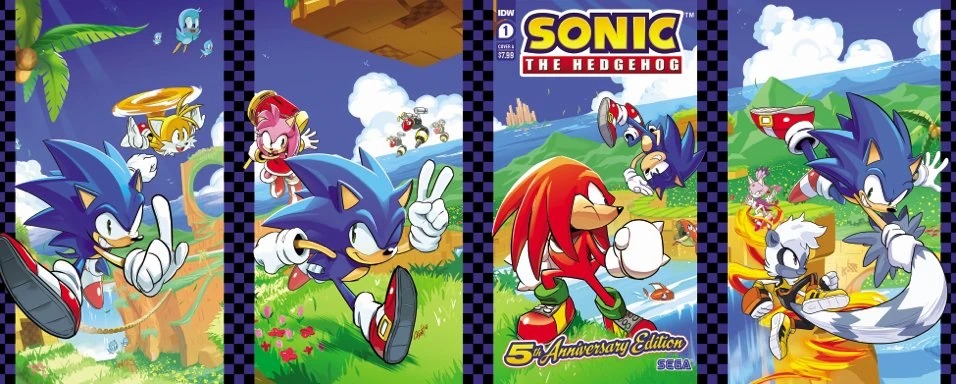
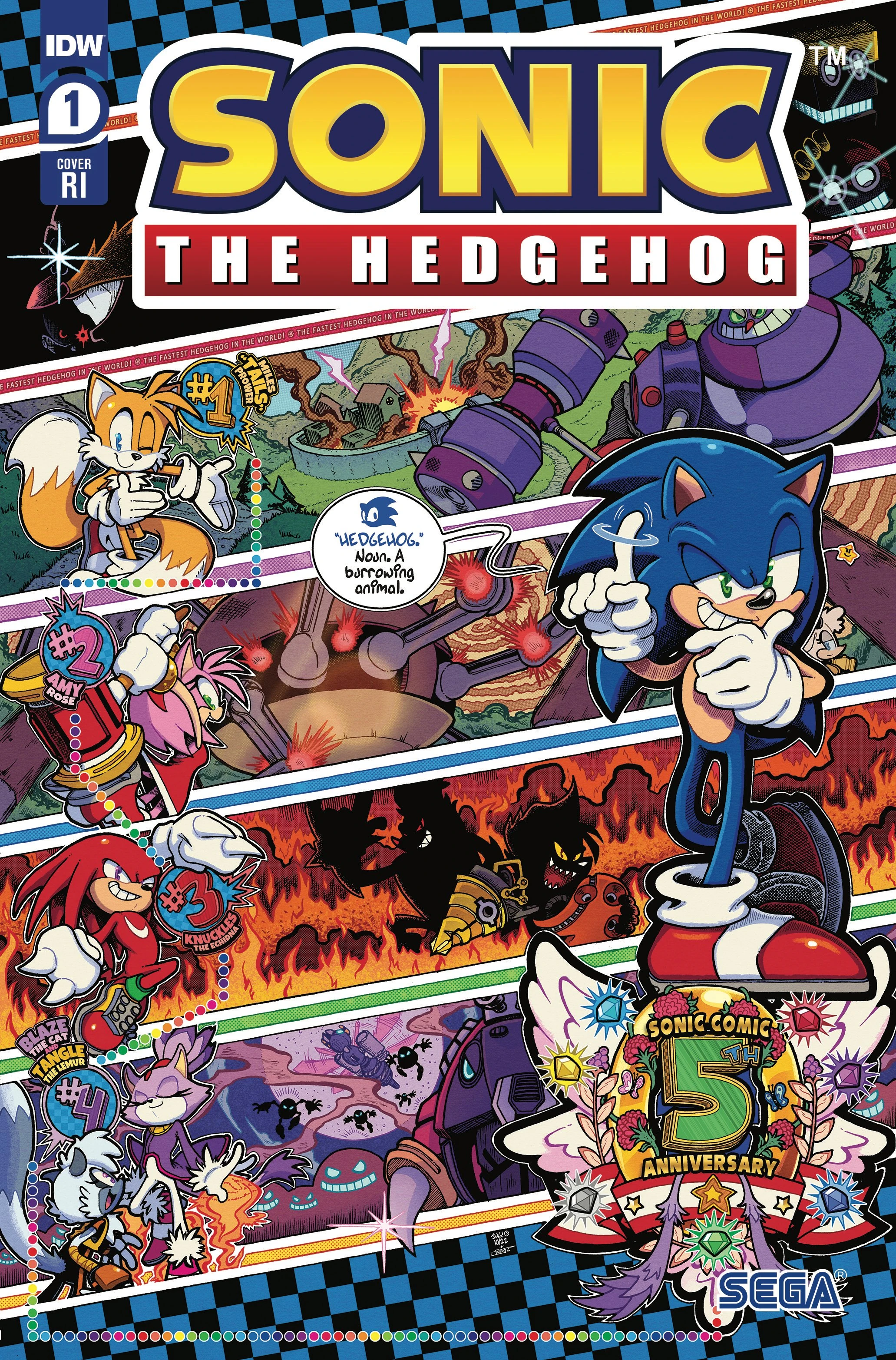
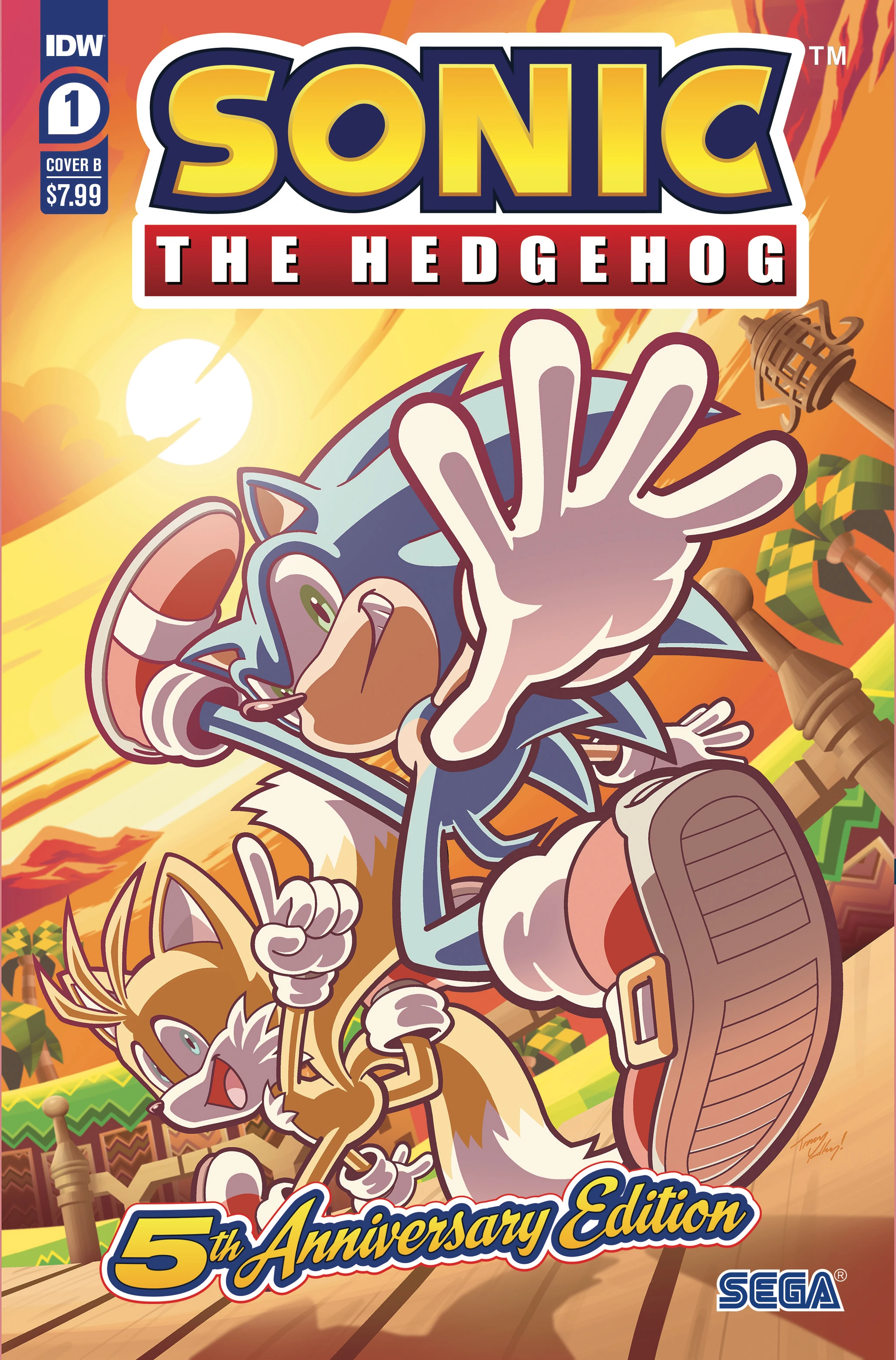
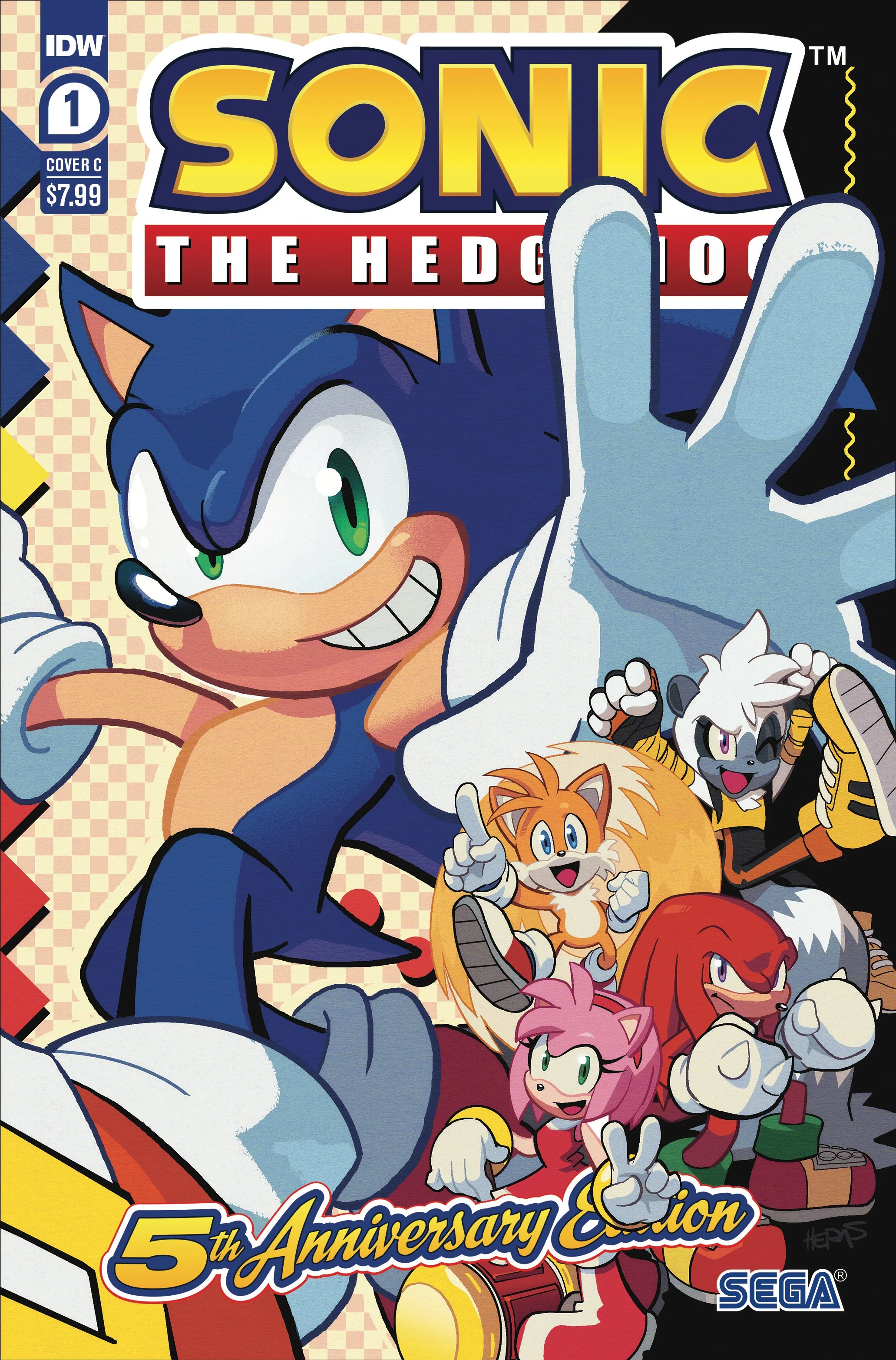
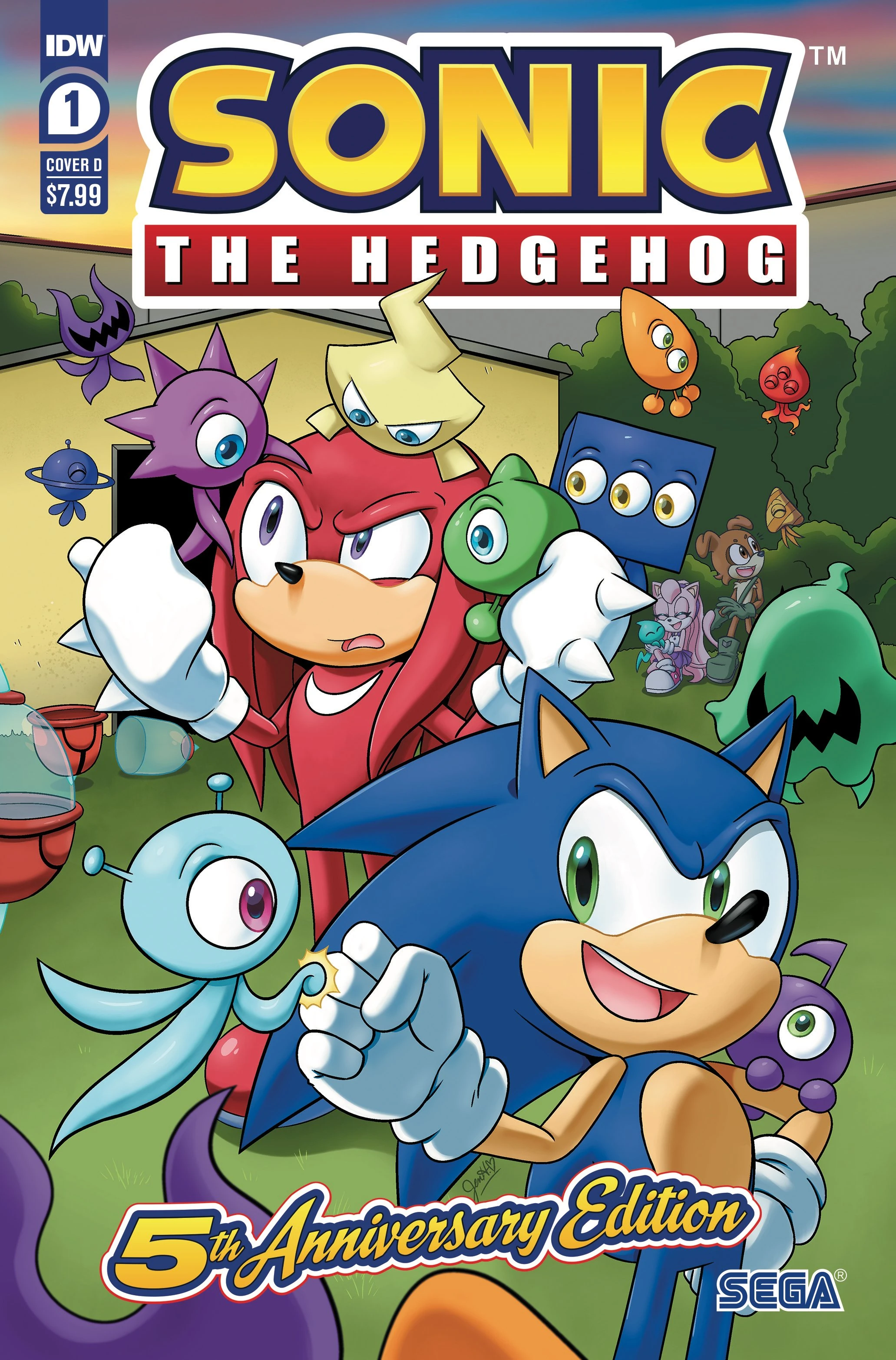
IDW, with their love of variant covers, made sure this special came with a wide variety of options for collectors. There's three separate retail incentive covers, for example of that. The Evan Stanley cover, showing Sonic chilling with Blaze and Tangle, is probably my favorite. And at least Jon Gray resists temptation to pack his cover full of as many faces as possible, stopping at a reasonable (for him) collage of Sonic and friends. The main cover is a gate-fold of Tyson Hesse's four covers for the series' initial story arc. Which is pretty neat, if uncreative. I don't really love any of the regular covers, to be honest. Yardley's cover, of Sonic and Tails posing at sunrise, is dramatically lit but pretty generic otherwise. The same is true of Matt Herms' cover. Jen Hernandez at least puts a little personality into her cover of Sonic and Knuckles interacting with some wisps. I guess a little more eccentricity is what I hoped for from these covers, instead of just classic images of Sonic and the gang looking marketable. 

I definitely said way too much about a glorified reprint like this. I guess I can't help but get long-winded when going into retrospective mode. I don't know if the back-up story is notable enough to make this whole comic worth picking up, unless you're an absolute “Sonic” completest like me. I'm doubtful this story will be all that important going for. But it is an interesting walk down memory lane, to revisit the first issue and then read a brand new story. Really puts into sharp focus how far IDW has come since its launch. [6/10]