Friday, January 11, 2019
THE 2013 SONIC THE HEDGEHOGE COMIC BEST/WORST LIST
Comic books like to trumpet that, after this particular event or what have you, “things will never be the same.” Usually, whatever changes happen are undone eventually, more often than not very quickly. However, following a major event, Archie's “Sonic the Hedgehog” book really was never the same again. 2013 is the year I've been dreading the most throughout this retrospective. It's the year the comic was rebooted and twenty years of history was completely wiped out.
Sonic fans being the contentious lot they are, fandom opinion is utterly divided on the reboot. Some love it, some hate it. While “hate” is a strong word, I'd agree that the reboot really yanked the heart out of the comic. Moreover, the way it happened and was presented especially rubbed me the wrong way.
But I'm not here to bitch about the reboot yet again. Not yet anyway. I'm here to consider the best and worst stories, art, characters, and idea Archie's “Sonic” books presented in 2013. The material covered in this retrospective includes:
Sonic the Hedgehog: Issue 244-255
Sonic Universe: Issue 48-59
Mega Man: Issue 24-27
Sonic: Lost World (Halloween Comic Fest)
Sonic Super Digest: Issue 5
BEST COVER STORY:
Ian Flynn, "All For One - Part Four: Friends, Foes & Family" (Sonic Universe: Issue 49)
Here's a really weird thing: The first half of “All for One” are among the worst stories to ever be published in “Sonic Universe.” The second half of “All for One” are among the best stories to ever be published in “Sonic Universe.” It's amazing what a change of location and cast can do for a book.
Mostly, what makes “All for One: Part Four” is the emotion it summons up. The story arc of Mighty searching for his lost sister Mathilda is finally brought to a conclusion, the two being reunited, broken up, and then reunited again. We really feel Mighty's pain and relief here in this story, which also gives Ray the first meaty role he's ever had in the comic's entire history. There's also some awesome action scenes in this story, even if its emotional weight is what really makes it so good.
WORST COVER STORY:
Ian Flynn, "At All Costs: Part 2 - A New Lease on Life" (Sonic the Hedgehog: Issue 252)
My problems with issue 252 begins with the title on down. This is not a conclusion to issue 247's story, “At All Costs: Part 1.” Instead, it's the introduction to the Post-Genesis Wave continuity, the realm we'll be spending the rest of this retrospective in. Really, no story would be able to shoulder the weight of the entire comic being rebooted. However, Flynn handled the switch-off in the most awkward fashion possible. Sonic and Tails are dropped down into a world that looks like their old world but isn't, living lives that are similar to but aren't their old lives, defending people who look like their friends but really aren't. I can't give a shit about a routine story arc based around fighting a giant, mutated Tails Doll with all the other concerns buzzing around in my head.
BEST BACK STORY and WORST BACK STORY:
N/A
Here's a first: There were no back stories published in 2013. The back-up features would return in 2014 but, in-between “Worlds Collide” and the reboot, Archie just couldn't find any room for five-pagers this year.
BEST STORY ARC:
Tracy Yardley, "Pitrate Panic Plunder" (Sonic Universe: Issue 55-58)
Tracy Yardley showed a lot of improvement from his first story arc as writer to his second. Here's the facts: “Pirate Panic Plunder!” is fun. Blaze is grown to a fully fleshed out character. Marine's wackiness plays well against the other cast members. Bean the Duck is not too wacky and Cream the Rabbit is not too sickeningly sweet. The villain is awesome. The story hits most of the dramatic beats at the right time and ends in a satisfying way. Part two of this story was really weak, relying on some truly awful humor, but otherwise I really enjoyed this one.
WORST STORY ARC:
Ian Flynn, "When Worlds Collide" (Mega Man: Issue 24-27, Sonic Universe: Issue 51-54 , Sonic the Hedgehog: Issue 248-251)
I have a lingering dislike of the “Worlds Collide” crossover with Mega Man because it birthed the reboot. However, even taken on its own merits, the crossover event is seriously uneven. Having the story take place in some weird zero continuity zone was a cheap way to bring in casual readers that also robbed the story of any deeper meaning. Moreover, the set-up was strangled, occupying far too many issues. Flynn also awkwardly justified a lot of fight scenes strictly to include them.
BEST COVER ART:
Sonic Universe: Issue 51 - Patrick Spaziante
However, some bad ass artwork did emerge from “Worlds Collide.” My favorite of which is the cover to issue 51 of “Sonic Universe.” A homage to the character select screen from the original “Marvel vs. Capcom,” that's exactly the right level of fanboy excitement this crossover should have been operating on the entire time. Beyond the awesome homage, it's just an exciting and beautifully put-together piece of work on its own.
WORST COVER ART:
Sonic Universe: Issue 55 - Tracy Yardley
There were a lot of jumbled and badly organized covers in 2013. Lamar Wells' cover for issue 247 and Yardley's cover for issue 245 both stuck competing images in too little space. However, I ultimately gave this dishonor to issue 55 of “Sonic Universe.” The majority of the cover is taken up by a goofy looking Pirate Sonic head, a character that doesn't even appear in the story. The actual cast members are shoved to the side, their faces distorted over gold coins. A tacky tagline takes up far too much of the rest of the cover.
BEST STORY ART:
When Worlds Collide: Part Nine - All-Out War - Ben Bates (Sonic the Hedgehog: Issue 250)
The runner-ups in this category includes Steven Butler's work on part three of “Endangered Species,” from issue 245 of “Sonic,” and Yardley's work on “Forged in Fire” from issue 50 of “Sonic Universe.”
Ben Bates, however, really brought his A-game to “Worlds Collide.” In issue 250 of “Sonic,” he gets to draw one epic battle between the Sonic cast members and various evil Robot Masters after another. He piles on the dynamic action and expressive faces, creating a book that is a sugar rush of a read, at least on a visual level.
WORST STORY ART:
Sonic: Lost World - Ryan Jampole (Sonic: Lost World)
Because of the big crossover, we got some artists drawing characters they weren't that familiar with this year. Such as Tracy Yardley's somewhat awkward looking renditions of the Mega Man cast in part five of “When Worlds Collide.” Ryan Jampole previously handle some similarly off-model Sonic artwork earlier in the same crossover. However, he got an entire issue of “Sonic” with the “Lost World” one-shot. Jampole's take on Robotnik and the Zetis are actually fine. It's his illustrations of Sonic and friends that feel lifeless and gawky.
BEST NEW CHARACTER:
Captain Metal
We'd get a wave of new characters next year, as the reboot really rolled into effect, and “Worlds Collide” saw many “Mega Man” characters making their debut in the “Sonic” book this year. However, there were very few meaningful new cast members added to the book this year.
Which is why, for the third time, I'm giving this award to some variation on Metal Sonic. Now, don't get me wrong, Captain Metal is awesome. While a pirate version of Metal Sonic sounds like a corny-as-fuck idea on paper, Captain Metal is actually an intimidating and effective villain. He doesn't mess around, has no problem violating his enemy's safety, and is dangerously focused on completing his goals. Despite the farcical concept, the bad guy is mostly taken entirely serious which is just the way I like it.
WORST NEW CHARACTERS:
Spider Troupe
Oh, fuck these guys. Introduced just at the very beginning of the reboot, Spider Troupe are the generic-ass space marine guys that accompany Shadow and Team Dark onto the Dark Arms' meteor. And they fucking suck. They spend all their page time mocking Shadow and his friends. Yet their bragging is totally unfounded, as they mostly get their asses collectively kicked by the aliens. More important than any of that, these guys just do not feel like they belong in this book. They are a half-hearted attempt to emulate edgier properties. Elements like Spider Troupe is when I feel truly disconnected from the modern iterations of the “Sonic” franchise.
BEST IDEA:
The Freedom Fighters Surviving the Reboot
In a year full of truly bad decisions, I wracked my brain for some deeper meaning or good idea I could draw from the year's worth of comics. Maybe something about the value and meaning of family, reflected in Mighty's reunion with Mathilda, Knuckles' loss of the echidna race, and Sonic reconnecting with friends post-reboot?
I mean, I probably should've gone with that but the idea I'm most thankful for in 2013 was the comic allowing the Freedom Fighters to survive the reboot. If the entire point of the Post-Genesis Wave revamp was to bring the comic more in line with the game, the SatAM cast should have obviously gotten the axe. But Flynn loved these guys enough, and knew fans would riot hard enough, to keep them around. They all got flashy redesigns instead, along with revamped origins, not all of which I liked. But at least they lived. I definitely would have dropped the book in 2013 if they hadn't.
WORST IDEA:
The Reboot
Simply put, Archie rebooted the comic in the most awkward way possible. Ending the old universe without any amount of resolution was bad. Dropping us into the middle of a new universe without any introduction was bad. Giving us the false lead of the Freedom Fighters regaining their old memories, which were quickly discarded anyway, was bad. Replacing twenty years of unique comic lore with Sega's shitty excuse for game-to-game continuity was bad. Basing the entire comic in a half-assed mixture of game lore and the few comic elements left standing after the Penders lawsuit was bad. Archie not paying its old writers' residuals and drawing up sketchy contracts was bad.
And then there was bullshit that just bothers me for the most petty reason, like Sonic and the Freedom Fighters now peacefully cohabiting and casually interacting with humans. Or maybe the Werehog being such a front-and-center part of this new story arc. Which, by the way, goes on for three fucking years.
Need I go on? Your opinion may vary on whether or not the reboot ever found its footing but I think even fans of the second continuity will admit that its beginning was a serious mess.
Wednesday, January 9, 2019
Sonic Universe: Issue 59
Publication Date: December 2013
As a spin-off, “Sonic Universe” always had a delicate balance to maintain. It seems to me that Sega and/or Archie would rarely approve a storyline if it didn’t star a character from the video games. Over the course of its 94 issue run, only four arcs starred characters primarily from the comic. It seems crazy to me that the fucking Babylon Rogues got a “Sonic Universe” arc before Bunnie or Lupe or someone we actually give a shit about like that. (A Freedom Fighters-centric arc was announced right before the book was canceled, of course.)
Only one of these Archie-centric arcs was published after the reboot. I have no proof that Sega demanded “Universe” focus more on their product after the reboot or if Archie was just hedging it’s bets after a shaky reboot. Either way, it sure seems like we’re going to see a lot of Shadow and Knuckles within the next year. The first of these arcs was “Shadow Fall” published through issue 59 to 62 of “Sonic Universe.” Fans seem to like this one well enough but, guess what?, I fucking hate it.
Part one of “Shadow Fall,” “Into the Unknown,” begins with G.U.N. deploying Team Dark and a bunch of random humanoid soldiers on a secret mission. It seems the Black Arms, those nasty aliens that helped Dr. Gerald create Shadow, are back on their way to Earth or whatever the fuck this planet is called now. The team’s goal is to plant a nuke on the Arms’ comet and blow the shit out of it, before the planet’s populace even notices. As the group enters the craft, Shadow begins to suspect they could be walking into a trap. Uh-duh, he’s right.
Upon opening this comic book, the main thought in my head is “What the fuck am I reading?” This is a “Sonic the Hedgehog” comic book?! Within the first couple pages, we see a bunch of generic space marine types fighting really badly designed alien creatures aboard some sort of bio-organic comet or something. There’s a huge mech thing there too. Shadow, Rouge, and Omega could not look more out of place with these guys. It’s like the “Sonic” gang was suddenly picked up and dropped into a shitty adaptation of “Gears of Wars” or the “Doom” movie. It reads more like sloppy fan fiction, a crossover throw together by an overly enthusiastic fanboy with little care for whether it made sense or not. This is very far removed from the general aesthetic of the series, especially post-reboot, and the contrast stings badly.
See, this is the problem with abandoning twenty years’ worth of comic book lore and replacing it with whatever the fuck stupid garbage Sega had been vomiting up over the last decade. Previously, the Black Arms were some mysterious, off-panel alien race. Prior to this, the “Shadow the Hedgehog” game was considered such a toxic misstep that Sega forbid the comic from giving its plot points anything but a passing mention. And I was perfectly fine with this. The “Shadow” game was a poopy piece of poop that I played for twenty minutes and then immediately returned to Blockbuster. Shadow didn’t need to be a half-alien creation that rode a motorcycle and wielded machine guns. I was content with the kind of interesting character the comic had turned him into in its place.
Now, the comic has had its history suddenly torn away from it. With nothing else to build on, the comic has to acknowledge the previously off-limits video game stuff. So I hope you’re an expert in the lore of the “Shadow the Hedgehog” video game, because this entire story line is build upon it. This is not a continuation of the comic I’ve been reading almost my whole life. It’s a sequel to a video game I can barely remember playing, one that almost everyone can agree wasn’t very good. Once again, it’s just another example of how slap-dashed and poorly planned the reboot was. I can’t have been the only long time reader of the comic that was totally ambivalent to what Sega has turned the “Sonic” franchise into in the intervening years. But storylines like this, that banked hard towards the video game crowd, completely alienate me and everyone like me.
I mean, that’s fanboy bitching about how the comic changed and we fear change. More pressingly, the Black Arms and G.U.N.’s soldier boys just fucking suck. First off, the Black Arms are badly designed. They’re these brown and red muscle monsters with goofy, pudgy little heads shoved onto their beefy shoulders. They wield swords and rocks against enemies with machine guns and nuclear bombs. There’s no consistency across the species, as other members of the race are flying bat things or floating humanoids. Their master plan - paralyze an entire planet and then eat everyone on it - is the sort of simplistic motivation you’d expect a child playing with their action figures to come up with. They’re a watered down, warmed over versions of the alien villains that have appeared in various sci-if video games, like “Halo” or the aforementioned “Gears of Wars.” Which, in turn, were basically rip-offs of “Aliens” and Robert Heinlein’s “Starship Troopers.”
As for the space marines, they are assholes to Shadow. They constantly refer to him with derogatory nicknames. This suggests something sort of interesting, that Mobians or whatever we call the furry animal people now, face prejudice from the humans they share their planet with. Except we will see no further evidence of this anywhere else in the reboot. (And I just really fucking hate to see “Sonic” characters interact with actual humans but that’s a topic I’ll rant about more at a future date.) Generally speaking, most of the soldiers have no personality, providing the reader with no reason to give a shit about any of them. I’ll say the same thing about the named Black Arms members we see here, like Black Death, who is just a generic evil thing.
Also, the plot for this one just sort of sucks in general. After the G.U.N. ship lands on the Black Comet, there’s a very underwhelming action sequence of the heroes quickly clipping through the aliens. It’s really obvious that Flynn is not comfortable writing this kind of stuff, as there’s no passion or urgency to these scenes. (They are also, of course, curiously bloodless.) After that, Shadow spends the rest of the issue telling everyone they’re walking into a trap. The team then walks into a trap. Simply put, there’s no tension here. It just feels like the plot is going through the motions. After that, Flynn introduces Eclipse the Darkling, his attempt to give Shadow an arch-enemy, making the proceeding nineteen pages feel like limp set-up for the story the writer actually wants to tell.
With such a drought of anything resembling compelling conflict, interesting characters, or even fuzzy nostalgia to hook the readers, what does this issue give us to latch on to? Well, Shadow is going through some stuff. Despite dedicating himself to protecting the world a while ago, he still feels a lingering connection to the Black Arms. This is exacerbated by the increasing isolation he feels from the humans and his team mates and a failed attempt to bond with the alien ship. When the soldiers hull out the thermo-nuclear butt plug, Shadow wonders if committing genocide against the Black Arms isn’t too extreme a measure. A hero being torn between two warring factions is, I guess, something kind of juicy for the reader to chew on. But that’s about it.
I hope you’re not reading this book because you’re a fan of the other members of Team Dark. Rouge and Omega get next to nothing to do. Omega is mostly comic relief, his love of destruction and explosives used for a few one-liners. He isn’t even seen that much in the action scenes, which seems like a real wasted opportunity. Rouge gets even less to do. She chitchats with Shadow a little about the aliens and delivers some exposition. I don’t even really understand why she’s here. I love Rouge but I can’t imagine she’d be that useful on an cosmic trip to destroy a horde of cannibalistic aliens.
The artwork is pretty good, I guess. Jamal Peppers knows his story stuff. However, once again, it feels like he’s aping Yardley instead of doing his own thing. I much preferred his earlier illustrations. As for the issue, it’s just bad, man. Oh, and did I mention this is part of a twelve issue “trilogy” of stories that takes up practically all of 2014? This part of the retrospective is going to fucking suck. [4/10]
Monday, January 7, 2019
Sonic the Hedgehog: Issue 255
Publication Date: December 2013
The start of 2019 also begins the fourth year of my Archie Sonic comic retrospective, if you can believe that. Assuming Trump doesn’t declare himself Eternal God Emperor and starts putting dissidents up against the wall, I will wrap up this project before the year is over. Once again, we join our cartoon animal friends during a time of transition. As 2013 came to a close, Ian Flynn was still establishing the new continuity, reintroducing old characters and showing how the world had changed and stayed the same.
Part three of “Countdown to Chaos” is subtitled “The Rabbot,” leaving no doubt about who this comic is reintroducing. Sonic and Tails rush into the Megaopolis Zone, which has seemingly replaced Robotropolis as Robotnik’s industrial city base. Bunnie went undercover in the city months ago but hasn’t contacted the Freedom Fighters recently, causing them to fear that she’s been captured. Sonic and Tails quickly locate her and she’s fine. However, the heroes are now in the center of a heavily armed city where everyone wants to kill them.
“Countdown to Chaos: Part Three” is a fast paced action story. It’s largely devoted to Sonic, Tails, and Bunnie grabbing a force field generator meant for the Death Egg and then escaping the city. As you’d expect, that means the story is primarily focused on everyone going fast, dodging laser blasts and occasionally tackling some goons. Flynn throws an earthquake into the middle, another reason for our heroes to get the hell out of there. I feel like the issue is a little too fast paced, a little too action packed. The more meditative tone of the last issue was more effective, considering the wounds the book is still dealing with. The non-stop action makes it feel like the book is either compensating for the previous issue’s slower pace or it’s just uncomfortably putting off the emotional conclusion.
But Bunnie is back and that makes up for a lot. Last time we saw Bunnie, she was grieving for a more-or-less dead husband and struggling with feelings of inadequacy due to becoming fully organic again. Now, she’s been rebooted back into a cyborg. Moreover, her upbeat and ass-kicking attitude is back too. And that’s, admittedly, a relief. Bunnie’s new look is also probably my favorite of the redesigned Freedom Fighters. Her new design is basically the same as her old one, just streamlined to fit into the new comic-wide aesthetic.
And while this issue is mostly devoted to action, it does save room for an emotional moment at the end. Sonic and Tails wait until they are out of enemy territory, and Antoine is there for emotional support, to hand Bunnie Nicole. After her old memories are triggered, she looks at her robotic arm and collapsing. What’s sadder? Bunnie getting her dream of becoming normal again before realizing it makes her less of a fighter? Or Bunnie realizing she achieved that dream in an alternate universe and can never achieve it in this one? Either way, I’m glad the book pauses for this powerful moment.
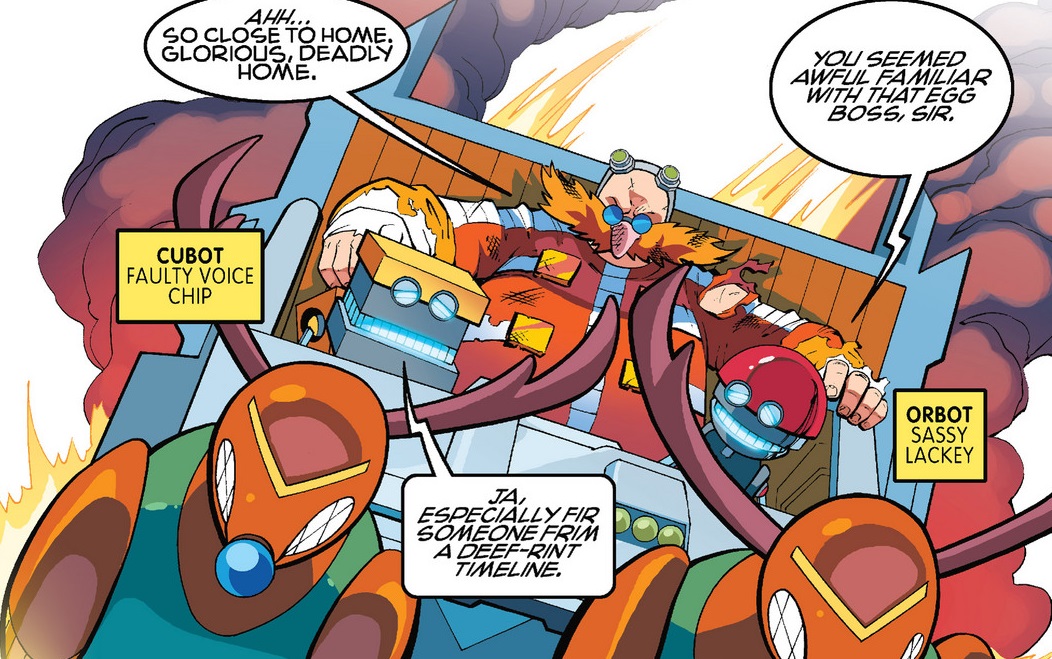
The way Flynn is handling the divide between the old universe and the new one is still bugging me. During the scene were Eggman and Orbot/Cubot arrive at the Arctic base, the scientist explains to his lackies that their memories of the old world will eventually be absorbed by their memories of the new one. So why are Sonic and Tails going to the effort of restoring the Freedom Fighters’ personalities? The comic just admitted this plot point will no longer matter soon! Once again, I wish Flynn and the editors had found a smoother way to bridge the two continuities or just dropped Sonic and Tails into this new world as if they had always been there. We’re never getting Mobius back so why tease us with lingering recollections? Just rip the band-aid off.
Issue 255 introduces a new artist to Archie Sonic audiences. Jerry Gaylord draws this issue. As far as I can tell, this is also Gaylord’s only Archie Sonic credit. You can definitely tell Gaylord doesn’t have much experience drawing these characters. Everyone looks slightly off, their limbs a little too long, their hands a little too big. Gaylord’s facial expressions are also rather samey. Sometimes, this artwork comes off as very flat. When Eggman meets with Tundra, the Egg Boss that will soon be revealed to be the new Rotor’s father, the walrus appears to be occupying a different dimension than everyone else. Gaylord probably would’ve gotten better if he had stuck with the book, as everyone looks somewhat correct, but I can also see why he wouldn’t return.
That’s not the only artwork in this issue that’s seriously off. Someone named Tyler Capps draws the variant cover and it’s really bad. Sonic and his friends pose blankly in a void. Their heads are cramped awkwardly on to their shoulders. Sonic lurches forward in a half-assed attempt at a run. Their bodies and limbs are so elongated and noodley, I’m having Ron Lim flashbacks. I don’t know who Tyler Capps is but it’s obvious he’s also deeply unfamiliar with how to draw these characters. I don’t know why Archie would give such an obviously inexperienced artist a cover gig though.
So I have pretty mixed feelings about this one. It’s great to have Bunnie back, acting like her old self again. However, the issue itself has some pacing problems and is still handling the transition from one ‘verse to another fairly poorly. Sadly, I don’t recall that problem going away after the Freedom Fighters are reunited next issue. [6/10]
Labels:
archie,
comics,
ian flynn,
jerry gaylord,
sonic on-going
Sunday, January 6, 2019
Team Sonic Racing
Team Sonic Racing
Publication Date: December 5, 2018
As someone who read Archie’s “Sonic the Hedgehog” comics from a very early point in their history, I remember the excessive number of spin-offs the company would put out in the early nineties. The comics industry was booming at the time and the “Sonic” franchise was at its peak popularity. So it only made sense that Archie was putting out a lot of “Sonic” content. Aside from several three-part mini-series, the publisher regularly put out various one shots. These were usually promoted “48 Page Special” and, believe me, that was a big deal for kid-me.
So I was happy to see IDW, the “Sonic” franchise’s new home in comics, is continuing this tradition of occasional stand-alone books. Of course, there’s a downside to this. Those Archie one-shots were usually done to promote whatever Sega’s new game was. This is also true with IDW’s new spin-offs. Except new Sega games are usually pretty shitty. Not to say that “Triple Trouble” or “3D Blast” were exactly masterpieces but they certainly provided more storytelling opportunities than another lame racing game. (For all their many, many mistakes, at least Archie knew better than to try and wring a narrative out of “Sonic R.”)
“Team Sonic Racing” hasn’t even come out yet. Originally scheduled for a Christmas 2018 release date, around the time this comic tie-in was released, the game has been pushed back to May of 2019. This is probably good, as Sega has become notorious for churning out half-finished, broken “Sonic” games. At the same time, it’s hard to get too excited about another racing game. This won’t be another “Sonic-Mania.” It’ll probably be closer in quality to “Sega All-Stars Racing” or something. If we’re lucky.
So what is the excuse plot for this new racing game? It seems a tanuki named Dodon Pa - who, disappointingly, does not have a giant, malleable nutsack - has invited Sonic and his friends to race on the Wisp’s home world. The exact reason why is never revealed, though Mr. Pa sure seems happy to have everyone there. He’s outfitted the gang with special race cars and littered the racetrack with various Wisps power-ups. Eggman, being an asshole, decides he just has to crash the party. He arrives in his own vehicle and attempts to spoil the race. Sonic and pals put aside temporary victory to crush Eggman together.
There was really one thing I was looking forward to with the “Team Sonic Racing” one-shot. The book introduced a new writer to IDW’s “Sonic” books. It’s not that I dislike Ian Flynn. While the quality of IDW’s new book wasn’t all tip-top in its first year, Flynn at least guarantees a certain degree of consistency. At the same time, it would be nice to have another writer providing input into things. (It would be nice if IDW brought Aleah Baker aboard.) So I was perfectly happy to welcome Caleb Goellner aboard the “Sonic” ship, even if I know nothing about him.
So how does the new guy do? Pretty poorly! “Team Sonic Racing” reads a lot like someone ticking off a checklist of items. The characters explain the game mechanics and various power-ups in excruciating detail. About ninety percent of this book’s dialogue is straight-up exposition. It’s exactly as clunky and unnatural sounding as you’d expect. The plot is a farce, Eggman being reduced to a buffoon and no actual motivation ever being provided for Doodah Poon. The majority of the “Sonic” characters show no personality at all. Those that do are reduced to their most basic components. Tails is the smart guy, Shadow has a rivalry with Sonic, Silver comes from a bad future. This reads less like an actual comic and more like an advertisement. Which, of course, is exactly what it is.
I would be willing to forgive a lot of that, if the book was funny. Sadly, Goellner’s skill for comedy are about as strong as his ear for dialogue. Most of the humor here is composed of a character boasting they can do one thing before being immediately humiliated. There’s exactly two decent jokes. The first is when Sonic asks Shadow if he’s cracking too many speed puns. The second comes at the end, when Dada Pooh can’t declare a winner because he can’t tell Sonic and Shadow apart. Other than that, the jokes are bad. Just like the rest of the writing is bad.
Does the book at least look good? Well, yeah. Adam Bryce Thomas provides pencils. While Thomas has created some of the best artwork to appear in the new book, it doesn’t seem his heart is in this one. (Or maybe he just does his best work when he’s his own inker.) The character details are very good. I like Knuckles’ frustrated glowers, Rouge’s looks of annoyance, Eggman’s grotesque gloating. The details on the vehicles - which Thomas, of course, didn’t design - are pretty nice. I like the Omochao piloted bubble car and Vector’s crocodile-shaped Cadillac. However, Thomas’ action scenes are a little hard to follow. The vehicles zip around each other in a way that doesn’t seem coherent. Maybe this is a result of the shaky script, as the way the vehicle’s superpowers function is never very clear.
While I barely think of them as canon, the various “Sonic” racing games have occasionally introduced enduring concepts into “Sonic” lore. That’s where the Babylon Rogues and Tails Doll got their starts and they’re sort of beloved. So what of Doodoo Pee, the mysterious founder of this race? Like I said, we learn almost nothing about the guy. He seems to have organized this race strictly for his own amusement. There seems to be something sinister about him. He’s connected to every vehicle, via a screen in their dashboards. He seems way too excited by the dangerous aspects of the trail. He just lets Eggman race, when the villain shows up unannounced. Considering he floats around in something resembling an Egg Mobile and has a mustache, I’m just going to assume he’s connected with Eggman, if not an android built by the villain. I guess we’ll have to play the game to find out for sure. (You can play it, I’ll read the Wikipedia synopsis in a few months.) Either way, Deedee Ping becoming a beloved member of Sonic’s rogues galley strikes me as unlikely.
As I said, the old Archie game adaptations were hardly great. But at least they usually added something new or interesting to the comic’s world. “Team Sonic Racing” reads more like one of Ian Flynn’s “Another Time, Another Place” stories. It’s a quickie product, thrown together presumably to appease Sega’s demands for a tie-in to a new game no one will remember in six months. While Flynn at least got those stories over with as quickly as possible, Caleb Goellner makes this incredibly tedious to read. I don’t know if the script’s quality is necessarily Goellner’s fault, as I’m sure Sega insisted certain information be included in this comic. But it certainly doesn’t make a great first impression. At least this didn’t interrupt the main book’s storyline. Here’s hoping that Annual goes better. [4/10]
Labels:
adam bryce thomas,
caleb goellner,
comics,
idw,
one-shots,
rouge the bat,
shadow,
silver
Friday, January 4, 2019
Sonic Super Digest: Issue 5
Publication Date: November 2013
In 2011, the Archie brass realized they had published a shit ton of “Sonic” comic stories. The comic had been running for practically twenty years, by that point. Including all the various spin-offs, that’s a lot of hedgehog tales. So Archie cashed in. In October of that year, they started publishing “Sonic Super Special Magazine,” a quarterly full-sized magazine comprised primarily of reprints of old stories. The next month, the company launched “Sonic Super Digest.” This series was also primarily devoted to reprints but the book’s were pocket-sized and were published bi-monthly.
Digest-sized reprints have a long history at Archie. I can recall, as a kid, seeing digest collections of old Archie – as in the company’s perpetually teenaged mascot – stories on magazine racks at grocery stores. I imagine the “Sonic” reprint collections served a similar purpose, to reach out to audiences outside of comic shops. The ideal situation was probably a bored kid picking up a digest or magazine at a book store, shopping center, or pharmacy. The stories would hooked them, leading to new subscriptions and digital back issue purchases. I guess this strategy worked, as Archie continued to publish the digest and magazines until they realized you can’t re-publish old stories without paying residues to their writers.
With them mostly being made up of reprints, I don’t normally feel the need to talk about the magazines or digests. However, starting in 2013, Archie would begin to slip new stories into these books. The first of which was “Sonic Jump,” from Digest #5. The story begins with Sonic wandering Green Hill Zone, when he spots Eggman up to his old tricks again: Gathering up defenseless animals for presumably nefarious reasons. Sonic smashes the Doc’s Egg-Mobile but the doctor escapes by flying upwardly. Sonic leaps off the zone’s floating platforms, attacking Eggman again and again, until he finally relents and lets his people go.
If it isn’t immediately obvious, “Sonic Jump” is another video game adaptation/advertisement. This time, Ian Flynn was called upon to adapt the mobile game of the same name. Remember that time, when stuff on your cellphones were going to revolutionize video gaming? I guess you can blame the massive popularity of shit like “Angry Birds” or “Candy Crush” for that. While extremely popular for a time, and undoubtedly still profitable, most mobile games being lazily designed garbage or “freemium” scams led serious hobbiests to abandon mobile gaming quickly. (As of this writing, free-to-play games with pricey add-ons like “Fortnite” are what’s currently popular. Some other fad might have eclipsed that by the time this is actually published.)
The video game “Sonic Jump” was an endless vertical platform jumping fest, in the vein of “Doodle Jump.” (Though the original version of “Sonic Jump,” released for T-Mobile phones, apparently predates it.) As you’d imagine, that set-up leaves little room for story. So the comic book “Sonic Jump” revolves around a hugely simplistic series of events. The height of this one’s tension involves Eggman using a force field to rotate rock debris around his ship. Naturally, Sonic just smashes the shit out of this as well. The plot is all-but nonexistent and the characters are reduced to their simplest versions. Flynn does throw in one moment of decent banter, when Sonic and Eggman criticize each other for their mutually predictable nature. That made me chuckle a tiny bit.
This five page advertisement does have one other thing going for it. The artwork is pretty nice! This story was drawn by Jennifer Hernandez, who previously penciled several “Off-Panel” stripes. Hernandez would quickly graduate to regular comic stories and is currently working on IDW’s “Sonic” book. She shows a lot of talent. Her character work is bright and cartoony. Her sense of action is decent. Hernandez’s stuff looks similar to Tracy Yardley but is rounder and cuter, perhaps more anime influenced than Yardley’s American cartooning style.
As for the rest of volume five of “Sonic Super Digest?” Like I said, it’s mostly reprints. The book contains a mixture of old stories and newer ones: “Olympic Trials” from “Sonic 242,” “Way Way Past Cool” from “Sonic 26,” “The Day Robotropolis Fell” from “Sonic 37,” “Heart to Heart” from issue 237, “Foundation Work” from issue 238, “Fairytale” from 153, the last part of “Endangered Species” from 246, and “Hide and Seek and Destroy” from the 2010 FCBD special. All of them are identical to their original forms except for the “Endangered Species” installment, which edits its dialogue slightly to remove further references to Ken Penders’ ideas.
Aside from that, the digest contains a few uninspired extras, such as colorable versions of old covers or “pin-up” art, which is just title-free versions of other old covers. Unless you really want to read the new story, there’s no reason for long time Sonic devotees to look at this. “Sonic Jump” is barely worth a look either, ranking around a [4/10], maybe a [5/10] if I focus solely on Hernandez’ artwork, on the old Hedgehogs Can’t Swim scale.
Labels:
archie,
comics,
ian flynn,
jen hernandez,
reprints,
sonic super digest
Wednesday, January 2, 2019
Sonic Universe: Issue 58
Publication Date: November 2013
Issue 58 of “Sonic Universe” boldly declares the appearance of Burning Blaze. Blaze’s super form was mentioned in the Sonic Comic Encyclopaedia but this is the first time she’s actually shown up in the comic. Would you believe Blaze is the only female Sega character with a super form? The closest the comic has come before was when Sally fused with the Sword of Acorn. Later, Nicole would get a super form of sorts. But nothing else in the comics. Gee, Sega, doesn’t Amy or Rouge deserve to go Super Saiyan too? Seems a little sexist to me. Anyway...
The final part of “Pirate Panic Plunder” has our heroes surrounded. Captain Whiskers and his crew attack from one side while Captain Metal appears on another. Blaze goes off to face the blue robot pirate but is quickly subdued. Taking her aboard the Egg O’ War, he grabs the last Sol Emerald and prepares his imminent takeover of the world. Luckily, Amy and Cream pitch in to help out. Grabbing the last gem, Blaze transforms into Burning Blaze and quickly deals with Metal. But the fight’s not over yet, as the robotic pirate becomes one with his warship.
While I think “Pirate Panic Plunder” is a pretty fun story arc, I’ve seen some fans bitch about it. The main complaint seems to be that Blaze spends most of the arc getting beaten up or captured. Which, okay, is fair. She’s bested in the first part, in a cage for most of two, and begins this issue by getting walloped by Captain Metal. Is this out-of-character for her? If it is for her video game counterpart, I have no idea. As for comic book Blaze, despite her massive powers, the vulnerability she’s shown in the past is my favorite aspect of her. So I’m fine with watching her get the shit beat out of her.
Watching her struggle like that also makes her very self-assured victory more satisfying. After getting piled on for three issues, we want to see Blaze win. And, boy, does she ever. Once transformed into Burning Blaze, she’s pretty much unstoppable. She burns Captain Metal down to molten slag in seconds. Once his consciousness is inside the Egg O’ War, he comes at her from every direction. She deflects this with a wave of her hand. She busts the massive warship with a giant fireball before kamehameha-ing a huge hole through it. That’s got to make her one of the most powerful super forms in the Sonic-verse, right? It’s certainly an impressive display and one hell of a note to end on.
As super-charged as Burning Blaze is, she never would’ve gotten there without Amy and Cream’s help. In fact, the girls have repeatedly helped Blaze out of jams throughout this arc. It’s almost as if the only thing stronger than the Sol Emeralds is... Friendship. In all seriousness, the bond this little group forms is cute and touching. Watching them bounce off each other and coming together to defeat a powerful enemy is fun. At the end, Blaze explains that the Sol Stones were aware of her bond with Amy and Cream and intentionally drew them here, to help her complete her mission. Is that kind of a bullshit plot justification? Yeah, maybe. But I’m still glad Amy and Cream were along for this ride.
The only real disappointment I have with the conclusion to “Pirate Plunder Panic” is how Yardley casually discards most of the characters and plot points he set up. After Metal grabs the stone, Captain Whiskers and his crew immediately skedaddle. Captain Metal’s crew also quickly abandon ship. Makes you wonder why they were brought into the story in the first place. Despite the prominent roles they played up to now, Marine, Bean and Bark are sidelined for the end. They stay on the submarine, watching the Egg O’ War go up in the flames. Kind of wish Yardley could have included them in the big fight.
“Pirate Plunder Panic” ends with a few sequel hooks. Blaze might have melted his regular form to red hot goo and then destroy the Egg O’ War but it’s implied Captain Metal’s consciousnesses survives. That teaser was a smart decision, since he was far too good of a villain to toss after one story. Before using the Sol Emerald’s power to teleport them back home, Blaze assures Amy and Cream that they’ll see each other again. Sadly, none of these would be paid off on. The “Sonic” books would be far too preoccupied with building up its new world over the next two years to ever visit Blaze’s again. This is her and Marine’s last major appearance in the book.
Which is a shame, as I was just starting to grow fond of them. The books will soon return to the grind of throwing away the world we love and establishing its less interesting replacement. This actually begins in the last few pages of this comic. Upon returning to the planet formerly known as Mobius, Amy immensely realizes something is off. So it goes. “Pirate Panic Plunder” isn’t perfect, as it’s second part was quite week. Overall, I enjoyed this one. The villain was fun, the cast was cool, and the action was solid. That’s a success. [7/10]
Labels:
archie,
bark and bean,
blaze,
comics,
cream the rabbit,
sonic universe,
tracy yardley!
Tuesday, January 1, 2019
Sonic: Lost World
Sonic: Lost World
Publication Date: October 2013
I know what you’re thinking. “Zack, tonight is New Year's Eve. Why are you reviewing a comic book with the word “Halloween” on the cover? Do you really start planning for your favorite holiday the day at the end of the year?” To answer your question, haha, I start planning for next Halloween on November 1st. As for this comic book, “Sonic: Lost World” was Archie’s entry into 2013’s Halloween Comic Fest, which is kind of like Free Comic Book Day except in October and also you have to pay for the comics. (As far as I can tell, this is also the only time Archie participated in Halloween Comic Fest.)
As for why I’m reviewing this comic in the ass end of December, it really doesn’t have anything to do with Halloween. There’s some monsters in it, but they are generic, Pokémon looking things and not remotely spooky. So nothing about it especially jives with the Christmas holiday. I’m also reviewing these comics roughly in the order they came out and this special appeared at this point in the series’ chronology. So, fuck it, it’s the last day of the year and I’m reviewing a sort of, kind of Halloween special. Deal with it.
Anyway! “Sonic: Lost World” begins with a Eggman discovering a continent floating in the sky. It’s neither Angel Island nor Little Planet but a new world called Lost Hex, because the Sonic-verse is overrun with floating landmasses. Eggman decides to exploit this new location, like he always does. He’s countered by Zavok, the leader of Lost Hex’s native species, the Zeti. Eggman quickly subdues the technokinetic beast with a magical conch shell he literally pulls out of nowhere. Utilizing the Zetis as his new shock troops, Eggman begins rounding up animals for his takeover of Lost Hex. Sonic and Tails follow the fat man to the new world, setting up an adventure you’ll have to buy the video game to see the rest of.
Yes, “Sonic: Lost World” is another one of the those comic stories produced solely to advertise Sega’s new video game. An exclusive to the Wii and 3DS, the game was apparently not very good, saddled with an awkward control mechanic and a dumbass story. The comic basically plays out like one of Flynn’s “Another Time, Another Place” stories, the quickly thrown together script acting as a prequel to the game’s plot. Despite that, Flynn has said this story is canon to the comic’s main plot, taking place at an undetermined point in the future. Presumably, he had plans for the Zetis after he wrapped up the Shattered World Crisis. That never came to be but he did use them in the next “Mega Man” crossover.
Those Zetis were “Lost World’s” primary contribution to Sonic lore. Like all new additions to Sonic’s cast, fan reaction was divisive. Most found them to be lame but a few immediately clung to them. (Years later, only the disconcertingly curvy female, Zeena, seems to have made much of an impact. For obvious, pervy reasons.) I’m utterly ambivalent to the Zetis. They have boring designs that barely fit the “Sonic” style. Each one gets some gimmicky superpower, such as Zevok’s ability to control machines. Besides that, their personalities are one-note, easily deduced from their appearances. Zavok is the only one we really meet in this issue and he makes no impression on me whatsoever.
The only time Zavok is interesting at all is when Eggman forces him to grovel, following his use of that inexplicable conch shell. The proud Zeti doesn’t take this indignity well. The bad guy formally known as Robotnik is unusually sassy in this outing. Finding a new world to subjugate and exploit puts him in a very chipper mood. Even after Sonic gets on his trail, he remains grinning and chuckling. It’s fun to see the villain in such an upbeat, hammy mood.
Eggman’s glorious villainy is pretty much the only thing this comic has going for it. Sonic and his friends are reduced to their most basic versions here. Sonic is fast and quibby. Tails does machines and responses to his friend’s sarcasm. Knuckles is short-tempered and prone to punching. Amy is super girly and bonds with the animals. The world they live in blank and nondescript. This is the broadest, blandest version of Sonic’s world possible. Which, sadly, makes it pretty in line with Sega’s vision at the time and possibly even now.
The artwork is from Ryan Jampole, whose only prior “Sonic” artwork was during “Worlds Collide.” Jampole’s Eggman looks pretty great. The artist gives him a dignified air until his temper gets the best of him, at which point he twists into a crazy cartoon figure. His Zetis are fine, like right out of the Sega artwork, and his Badniks look really cute. However, his depiction of Sonic and friends are super lifeless. Their facial expressions are bland and his action scene lack any energy. So it’s a split decision in the artwork department.
And, like I said, “Lost World” lacks any zip as a holiday special. I think Archie dropped this thing when it did strictly because it lined up with the release of the video game. The comic itself is forgettable and lacking meat, much like the video game it’s based on. One or two funny Eggman moment is pretty much the only thing entertaining about it at all. By the way, if you missed this one-shot when it first came out, it was reprinted in issue 9 of “Sonic Super Special Magazine.” Its cover says it’s a “super collector’s issue!” [5/10]
Oh yeah, by the way, happy New Year. See you in 2019, true believers.
Labels:
archie,
comics,
ian flynn,
one-shots,
ryan jampole,
spooky scary,
the deadly six
Subscribe to:
Posts (Atom)