Friday, November 15, 2019

Sonic the Hedgehog (IDW): Issue 17


Sonic the Hedgehog (IDW): Issue 17
Publication Date: May 22nd, 2019

As a big horror movie fan, I certainly love me a good zombie movie. I also think that zombies are pretty overexposed at the moment. Following the theatrical revival of undead flesh-eaters at the end of the 2000s, I’ve seen the shambling corpse premise becomes its own metaphor as the horror fad that just won’t die. A lot of blame for the zombie genre’s refusal to go away for a few years is owed to “The Walking Dead.”  Even though ratings are declining and fans agree the show is past its expiration date, AMC’s zombie soap opera is still among cable’s most popular shows.

Here’s the thing: Despite being a huge horror nerd, I don’t give a shit about “The Walking Dead.” I like zombie stories that have the good sense to wrap up in under two hours, not drag on for over ten seasons, a spin-off series, and an upcoming motion picture. So it never even occurred to me until someone pointed it out recently that the Zombot story arc in IDW’s “Sonic” comic might be Ian Flynn’s late-in-the-game attempt to cash in on “The Walking Dead’s” popularity. And maybe so. But while I’m sick of zombies in most every other area, putting them in a “Sonic” comic is still a pretty fresh idea at this moment. So considered me hooked, as of this writing.


Which brings us to issue 16 of IDW’s “Sonic,” entitled “Plague!” As teased in the previous issue, Eggman’s Metal Virus soon spreads from the countryside to the more metropolitan areas of Sonic’s world. Seaside City is soon overwhelmed by mindless Zombots, programmed to do nothing but spread their condition to every living thing they can find. The Chaotix are caught right in the middle of this. The detectives try to protect the innocent and hold off the violent Zombots. Sonic is soon sent into the city to help out but he’s still fighting off his own infection. Inevitably, not everyone makes it to safety.

Something that’s really compelling about putting the “Sonic” cast in a zombie movie scenario is that it forces the characters to make hard decisions. As the Zombots descend on the city, the Chaotix quickly realize they can’t save everyone. A cat lady is infected. As the virus spreads through her body, she screams and begs someone to help her. Vector, instead of trying to save her and endanger the rest of the group, corners her in a ring of cars. Despite the heroes’ best efforts, they still only manage to rescue a fraction of the city’s population. This is after a grim panel of the Chaotix exiting the office to see the city in flames, people fleeing in terror from roaming crowds of rabid Zombots. This comic is shockingly grim for a kids comic.


Yes, Flynn tries to lighten things up with occasional bits of comic relief. Just as Vector says their next client will be coming through that door any minute now, a Zombot bursts into the office. Later, Charmy eggs some zombies on with goofy facial expressions. But this is still a pretty downbeat issue. Especially in how it ends. Childish Charmy is angry that Vector left a citizen to be consumed by the Virus. He flies back to rescue the girl, only to be attacked by Zombots and pulled under. Yes, this issue ends with one of its youngest characters being seemingly turned into a zombie.

As grim as that moment is, it actually shows Flynn’s hand a little too early. Up to this point, only a pair of villains and unnamed background characters have been fully infected. With Charmy being dragged down by Zombots, a Sega character has been claimed by the Virus... Which means a full anecdote and eventual snap-back is forthcoming. There’s no way Sega would allow one of its characters to be de-facto killed off. I’m not shocked by this. I assumed all the Zombots would be returned to normal eventually. This is still technically a kids’ book. But it’s a little disappointing for Flynn to basically confirm that so early on in the story arc. (Though I totally get him going for the shock value inherent in seeing Charmy pulled into a crowd of ravenous zombies.)


However, this issue does see Flynn pulling off something I thought was impossible. He makes me like Vector. Minutes after the Zombots rip through the city, Vector is hefting up a Stop sign and whacking the zombies away. After that, he’s strategizing and barking orders at people. He’s making hard decisions that need to be made and marching forward, putting the needs of the many over the needs of the few. Vector is... Acting like a bad-ass? How is this possible? I’m as shocked and surprised as you. Maybe detaching Vector from his Archie characterization as a woman-hating wannabe hip-hopper was, it turns out, a good idea.

Oh yeah, Sonic is in this comic book too. Admittedly, the hedgehog doesn’t do too much here other than rush in and fight off some Zombots. However, our blue hero continues to grow increasingly desperate. After sending some kids to safety, Sonic pauses for one minute to consider his next course of action... Which causes the Virus to creep a little further up his body some. He then goes rocketing off, trying to run off his condition, and get back to the others faster. It’s clear this stress, of fearing for his own soul and saving others during this new crisis, is weighing on him. The novelty of seeing Sonic pushed to his limit hasn’t run out yet. It’s still pretty neat.


By the way, Tracy Yardley’s artwork is pretty good, even if I wish maybe someone with a grittier style was drawing this. Imagine what Steve Butler could have done with this story! Anyway, “Plague!” is another pretty strong issue, if not quite as impressively grim as issue 16. IDW’s series is still showing some amazing improvement in its second year. [7/10]

Wednesday, November 13, 2019

Sonic the Hedgehog (IDW): Issue 16


Sonic the Hedgehog (IDW): Issue 16
Publication Date: May 8, 2019

So where were we? The last regular issue of IDW’s “Sonic” series I reviewed detailed Eggman testing his new Metal Virus, turning Rough and Tumble into “Zombots,” and Sonic finding out he’s been infected. In the months since then, the Metal Virus story arc has continued to play out. I’ve seen fans go from embracing this new direction to growing sick to proclaiming that IDW “Sonic” has never been good. Ah, so the cycle continues. Now I get to experience this on-going myself and see whether it’s the greatest thing ever or if it blows more than your mom at a truck stop.


“Infection!” begins with Sonic and Tails hopeful they’ve beaten the mechanical virus infecting Sonic, via the hedgehog’s trademark speed burning through it. This is what they tell Tangle, who is visiting Tails’ workshop. However, Sonic soon realizes running it off is only a temporary fix. He’s still infected, can still spread the virus with a mere touch, and is still at risk of becoming a Zombot. Meanwhile, Eggman unleashes the Virus via his new airship on the unsuspecting Windmill Village. The Zombots are unleashed on the countryside.

Sonic is having a moment of self-doubt in “Infection!” and I like that. Initially, he’s enthusiastic as Tails tells him the virus has been beaten back. Upon realizing he’s still a carrier, he has a self-reflective moment. Flynn’s script has Sonic outright say it, via internal monologue. Usually, Eggman builds a machine Sonic can smash and that’s it. Now, he’s faced with a threat he literally can only outrun for so long. He’s a danger to his own friends. (Flynn smartly draws a parallel to the Werehog, though it looks like the Metal Virus won’t eventually become a superpower upgrade Sonic can use...) It’s a pretty bold place to put our usually carefree hero. Sonic is uncertain of his own victory, for once. He’s scared. and that’s really interesting to read.


Up to this point, the IDW version of Eggman hasn’t done much besides scheme in the background. This issue has him really cut loose as a villain for the first time in this series. For ground zero of the Metal Virus, he chooses the idyllic village that cared for him during his days as Mr. Tinker. It’s clear that a Eggman takes a real sadistic glee in destroying his wholesome former home. Flynn also provides some insight into Eggman’s motivation here in a way Archie weirdly never really got into. It’s an interpretation of Robotnik I’ve put forward myself over the years. He sees the world as chaotic, impractical, wildly out-of-control. Eggman longs to smooth the world out, bring it into order... Which also means making it utterly subservient to him, which appeals to his intense egomania. It’s certainly more nuanced than the Archie version, which never got much further than “he wants to take over the world because he’s evil.”

While Flynn is expanding Eggman’s personality, I’m still not too sure about Dr. Starline, the closest thing to a Snively we’ve got now. Previously, I was certain Flynn was taking Starline in a particular direction. As an eager fanboy to Eggman that is disappointed by the reality, either finding his eccentricities intolerable or being disgusted by his cruelty. In this issue, as Eggman bukakes Windmill Village with the Metal Virus and infects the countryside, Starline is ecstatic. He loves that his new boss is so brutal and efficient. So I guess Starline is just Eggman’s fawning toady? Hopefully, Flynn is going somewhere with this guy because that schtick will get old real fast.


After a somewhat eerie introduction last time, Flynn gives us a clearer view at what the Metal Virus can do this issue. And it’s pretty damn bracing, as far as a comic book starring a blue hedgehog who runs fast goes. As a tidal wave of hot metallic goo is puked over the village, we get a series of panels of the goat mayor trying to outrun the downpour and protect a child... he fails, both of them awakening as Zombots on the next page. We see a random citizen cower hopelessly as his friend is overcome and turned into a soulless automaton. Most shocking is when a mother watches the chaos from her window, hugging her child. Soon, the Zombots break down the door and tear child from mother, infecting them both. Shit, man, that’s pretty intense.

Flynn can’t depict the gut-munching gore of the zombie genre but he seems to understand why it’s such a powerful horror trope. It’s the sudden and irreversible breakdown, watching things you love and rely on — friends, family, neighbors, and the orderly structure of polite society — turn on you violently. Usually the zombie horde is a slow, creeping metaphor for the inevitability of death. Here, the Zombots are symbols of unerring conformity at the hands of an authoritarian dictator. But it still works pretty well. It’s a really well done sequence.


Honestly, issue 16 is so grim that we definitely need some comic relief. Luckily, Tangle is here to provide. She rides into Tails’ workshop on a dirt bike in the first page, enthusiastically ready to share her latest adventure. Her bafflement at Sonic running on a giant hamster wheel is amusing, as is her quick acceptance of it. When she goes in for a high-five, Sonic has to quickly dive out of the way, leading to a cute pratfall. Overall, Tangle’s high energy and unending upbeat attitude continues to make her an utter delight. There’s also a good joke when Eggman reveals his latest airship, which is essentially a giant flying version of his face, is called the Face Ship. Starline’s deadpan reaction to that is priceless.

Featuring some wonderfully energetic artwork, Diana Skelly and Jack Lawrence trading back and forth, issue 16 may be the strongest issue of IDW “Sonic.” Sonic and Eggman’s characters are allowed to evolve, Tangle remains delightful, and the Zombot sequence is pretty damn great. It is, I think, the closest we’ve ever gotten to a full-blown “Sonic” horror comic and I really appreciate that. I didn’t know Flynn has that in him, to be totally honest. [8/10]

Monday, November 11, 2019

Sonic the Hedgehog (IDW): Annual 2019


Sonic the Hedgehog (IDW): Annual 2019
Publication Date: May 1, 2019

Long time readers of Hedgehogs Can’t Swim might have noticed I haven’t reviewed an issue of IDW’s “Sonic” comic since May. In fact, I know some of you have noticed, as I’ve gotten several annoyed comments from readers wondering when I was going to pick up the series again. I wish I could say I had taken a deliberate hiatus from the new on-going but the truth is, as too often happens, I’ve just drifted away from the series. Right when it seemed like it was getting better too! Well, now that Halloween is over and the end of the year looms, the regular animation reviews are going on hiatus so I can catch up with IDW’s blue hedgehog adventures.

So, anyway: In the world of comic books, “annuals” are a regular occurrence. For those of you who might now know, annuals are special, double-length issues published once a year — duh — that usually contain multiple stories from different writers and artists. Annuals have separate numbering from the main book, usually just being referred to by the year they are published. The stories contained within are usually a bit detached from whatever is happening in the main series at the time too. Weirdly, in the twenty-plus year’s Archie was publishing “Sonic,” they never once did an annual, opting instead for various one-shots and specials. IDW, however, clearly has different plans. Their first “Sonic” annual rolled out this past May.


We begin the annual with “Bonds of Friendship,” from the ever-reliable Ian Flynn with art by Jennifer Hernandez. The story has Tangle the Lamar returning to her home village, with Whisper in tow. The two eventually end up at the Mineral Museum (largely filled with treasure Tangle has gathered during her adventures) which is run by Tangle’s oldest friend, a nervous beetle with a glittery shell named Jewel. After introductions, the Babylon Rogues — making their first appearance in this continuity — bust in and steal everything... Including Jewel, which the dim-witted Storm mistakes for a large gemstone. Tangle and Whisper leap into action to save their friend.

“Bonds of Friendship” is clearly a prequel to the “Tangle & Whisper” mini-series IDW would begin publishing a few months later. It establishes the lemur and the wolf as a duo, while building up Tangle’s history and home town some. The boisterous Tangle and shy Whisper are cute together. Tangle’s stretchy tail and Whisper’s versatile Wispon leads to lots of creative bounding and flipping. It seems Tangle collects nervous types as Jewel — who seems likable enough, even if we only get a glimpse at her personality here — is also rather anxious. I was apathetic about Flynn utilizing the Babylon Rogues, as I never cared for them in the Archie series. However, here Flynn characterizes the self-obsessed Jet and the principled Wave as a bickering couple, which makes the Rogues way more neurotic (and therefore way more interesting) than previous iterations. Storm is still just a big dumb guy though. In general, it’s a cute story with some fun character interactions and some okay action sequences. Its cuteness is further bolstered by Hernandez's extremely adorable artwork.


Our second story, “Jet Set Tornado,” comes from Caleb Goellner, who was invited back to write after that awful “Team Sonic Racing” one-shot for some reason. Obviously set a few issues prior, it concerns Sonic and Tails testing out a new rocket booster for the Tornado. Sonic is allowed to drive, which Tails quickly regrets. The hedgehog activated the rocket booster carelessly and threatens the structural fortitude of the plane. That’s when the duo spots a heavily modified Balkiry, hauling stolen Resistance supplies. They chase the bird-bot into a volcanic region, destroy it without the wrecking the plane, and drop the cargo into some lava which I guess isn’t a big deal.

“Jet Set Tornado” is, admittedly, slightly better than “Team Sonic Racing.” There’s a bead of emotional truth to Sonic and Tails’ decisions, as Sonic makes the choice to risk himself to save Tails’ latest invention. But the story is still pretty bad. Goellner’s dialogue remains, at best, awkward. He fills the word balloons with technical phrases like “straightaways” and “volatile” and lots of talks of unscheduled landings, volcanic vents and geysers, boosters and payloads. Goellner still seems more preoccupied with the special abilities of vehicles than the characters’ personalities or a narrative with any tension or resonance. Jack Lawrence’s energetic pencils are wasted on this nothing of a story.


“Victory Garden” sees Evan Stanley returning to the writer’s chair for the first time in a while, co-scripting with newcomer Gigi Dutreix. Blaze is looking for Silver around Resistance HQ. It seems the futuristic hedgehog has taken an interest in gardening, amazed by how green the planet is now when it’s totally desolate in his time. However, he hasn’t had any luck getting anything to grow. Blaze scorches the Earth and informs Silver on some general rules on gardening, helping a bountiful crop grow in time.

“Victory Garden” is really just as technical as “Jet Set Tornado.” Blaze spends several panels explaining the role ashes play in gardening. The difference is this technical stuff reflects the characters’ personalities and interests. Silver’s dopey attempts at garden are adorable, continuing to show what a lovable klutz he is. As is his enthusiasm at how green and fertile the present timeline is. Blaze taking the time to teach him shows she likes the kid, thinks his interests are worthwhile, and wants to help him grow, figuratively and literally. It’s a really cute story, is what I’m saying. Stanley also provides some wonderful artwork. I love how warm and painterly her work has gotten recently.


Cavan Scott, a British writer best known for his work on “Doctor Who” but new to “Sonic,” contributes “Curse of Eggman’s Pyramid.” Rough and Tumble decide to break into a pyramid Eggman built a while ago, sure it’s full of treasure. Tumble is concerned about a rumored curse though. Soon, they run into Rouge, who is also supposedly looking for treasure. A “curse” makes itself known but not everything is what it’s seems.

Rough and Tumble are characters I have nothing against but probably never would’ve thought to build a story around them myself. However, “Curse of Eggman’s Pyramid” is largely a work of goofy comedy, which is a fine fit for the dim-witted skunks. Both are repeatedly caught off-guard by the pyramid’s traps. The more superstitious Tumble slowly converting the more assured Rough is worth a chuckle. Scott thankfully keeps the rhyming to one panel. Rouge’s intrusion into the story is worthwhile. It leads a genuinely cute ending, where we discover Rouge was acting on a behalf of a community of fennecs that have taken up residence in the pyramid. (And seeing Rouge dressed as a mummy is amusing too.) Diana Skelly’s cartoony artwork is especially well suited to this material.


The annual concludes with James Kochalka and Jon Gray’s “Sonic Fan Club.” It concerns a group of enthusiastic young Sonic fans, none of whom appear to be named. The club president, a snooty blonde deer/dog?, is soon challenged for leadership by another member of the club, a red fox in a purple pillbox hat. They decide to have a contest to determine the president, based on who is the most like Sonic. They have a foot race, test their rolling skills, and end up fighting a Badnik. That’s when Tangle appears and offers to help but just ends up tangling herself in her tail.

There’s not a lot to this one. At first, you assume the condescending club president will be humbled by story’s end. When they encounter the Badnik and he is clearly intimidated, it certainly looks like that’s where we are headed. Instead, Kochalka goes for that non-sequitur of an ending. A really poor touch is that Sonic affects the story — racing through and smashing the Badnik while Tangle is distracted — without ever actually appearing on-panel. It reflects on the story’s depth that none of the characters are actually named. Instead, Gray’s artwork and character designs do most of the talking. The butterfly girl, who looks a lot like Dot Warner, is my favorite. I’m sort of hopeful they’ll bring back some of these kids, just to keep expanding the still relatively new book’s cast. I’m on record as not being much of a fan of Gray’s highly exaggerated artwork. However, he’s gotten a lot better with time and wacky comedy like this is obviously where he’s best utilized. (Though his Tangle is noticeably off-model.)


Of the five stories in the Annual, only one is truly a dud. Ironically, this is the only one that actually stars Sonic. Evan Stanley’s “Victory Garden” is definitely the best if the bunch, with the latter two leaning towards wacky comedy in an amusing way. I hope IDW continues with the Annuals, to make room for the young series’ growing supporting cast. I guess, over all, I’d give this one a fairly high score as long as you ignore that stinky Caleb Goellner story. [7/10]
Friday, November 8, 2019

Sonic the Hedgehog (1993), Episode 2.01: Game Guy


Sonic the Hedgehog (1993), Episode 2.01: Game Guy
Original Air Date: September 14th, 1994

The “Sonic the Hedgehog” franchise was probably at its peak popularity in the early nineties. At least, that's how I remember it anyway. I'm sure some spoil sport is out there, waiting to “well, actually” me about how “Sonic Adventure” or “Sonic X” or something was a bigger deal. But the point is, this was the only time in my childhood when I can remember other kids my age being as interested in “Sonic” as I was. “SatAM” obviously rode this popularity to some degree of success. ABC gave the greenlight to a second season... But not without some changes.

For “Sonic the Hedgehog's” second year, the network would demand some changes. Even though ABC had requested a darker, edgier “Sonic” show during pre-production, apparently “SatAM” gave them too much of what they wanted. Executives would ask for more comic relief in the second season. At the same time, Ben Hurst and Pat Alle would take more control over the series' overall direction. This would result in season two being more serialized than the first, with reoccurring new characters and a few plot points running through the season.


These wouldn't be the only changes. Season two would see some visual changes to “SatAM” as well. Sally would receive her trademark blue vest, the character taking the form I remember so vividly. For unexplained reasons, Rotor would be completely re-designed, becoming squatter and chubbier. Cam Brainard would take over voicing the characters, though his vocal delivery was not horribly different from Mark Ballou in season one. Some new musical cues would be introduced. You can tell that the production team had slightly more money in season two, as character designs would become slightly more detail and the animation a little livelier.

The first episode of the season is “Game Guy,” though it would actually air as another example of the network's needless tinkering. While Sonic, Sally, Antoine, Tails, and Dulcy – more on her in a minute – are out salvaging old Robotnik machinery to build a de-roboticizer, they encounter a new Freedom Fighter on the run from SWATBots. He calls himself Ari and claims that he's the leader of a seperate team. He tells Sonic that Robotnik has captured his Freedom Fighters. Sally is skeptical but Sonic is eager to help. It turns out to be a trap. Ari was telling the truth about Robotnik capturing his Freedom Fighters but he was being blackmailed into leading Sonic into a trap. It's up to Sally and Dulcy to save Sonic before it's too late.


Before we go any further, we need to talk about one of season two's most divisive elements. The season would introduce a previously unseen Freedom Fighter, a child-like dragon named Dulcy. Dulcy is not well liked by fans, widely being considered the Scrappy-Doo of “SatAM.” It's not a totally unfair accusation. Dulcy has a very cute and rotund character design, in addition to being a dragon, a highly marketable creature. (I guess Mobius has both dragons and dinosaurs now.)  She's prone to bouts of goofy comic relief. Throughout this episode, Dulcy hits her head multiple times and makes repeated pleas to an unseen mother. She inflates herself with air and holds it for a while, much to her annoyance and discomfort. She then blows freezing air over Robotnik and Snively, which doesn't seem to slow the villains down any. I had nothing against Dulcy as a child but, admittedly, she is a little annoying in this episode. We'll see how my opinion evolves as I continue my way through season two.

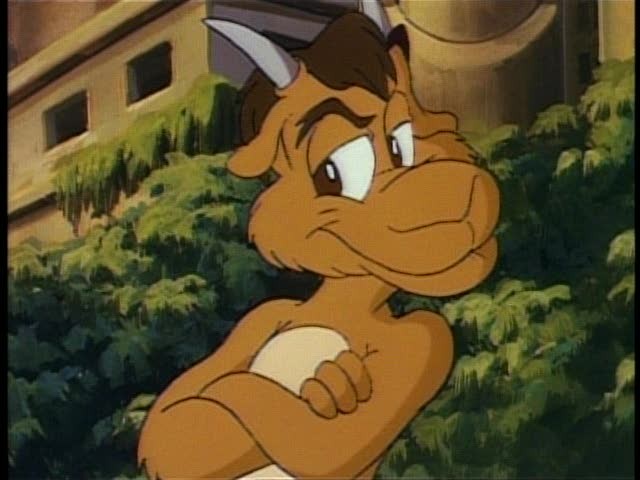
But let's discuss a character that actually affects the plot of “Game Guy.” What do we think of Ari? His design is kind of cool, being a less creepy-looking goat man than Griff. (Though his legs being so wooley they look like sweatpants takes some getting use to.) Unfortunately, Ari's character arc plays a lot like Griff's. He's introduced as a friend, revealed to be a traitor, but gets redeemed at the end. As a character, Ari seems a bit like a blank. He shows up, back-flips out of harms way, and immediately starts glad-handing Sonic. His change of heart happens so quickly, that was don't really have time to see what he thinks or feels about it. He's a cool ~man~ goat of action and has a certain degree of principals but he's still pretty thinly developed.


In general, I wish Ari's eventual betrayal of Sonic was a little less heavily foreshadowed. Sally, who was perfectly friendly to Griff and Baby T, is deeply skeptical of Ari. This instinct, of course, is entirely right. A few minutes after Sally makes that statement, we cut to Robotnik and Snively spying on the conversation, confirming Ari to be a double-agent. It's weird that the episode immediately confirms that instead of waiting a bit, after Ari leads Sonic to an Aztec-style pyramid that turns out to be a Robotnik-shaped fortress. That would've been a better time to dropt hat reveal, I think.

Ben Hurst's guiding principal as a writer, at least as far as “SatAM” is concerned, was always “There must be losses.” No matter how much the Freedom Fighters gain, it must always come at a price. This is true of “Game Guy.” Ari ends up sacrificing himself to rescue Sonic, getting drawn into the inter-dimensional portal meant for the hedgehog. I fully expected Sally and Dulcy to activate the powerful magnet they recovered earlier in the episode and pull Ari out. But, nope, the Ram is trapped inside a particular void, at least for now. Sonic is pretty distraught over it. Even if Ari wasn't a character we were especially attached to, I still like it when “SatAM” would force Sonic to actually feel things, to struggle with failure and mistakes.


So I guess I should talk about why this episode is called “Game Guy.” See, Robotnik's trap for Sonic involves a very specific design. The hedgehog is trapped inside a giant glass sphere and flung around an enormous pinball machine, which Robotnik controls. Every point Robotnik earns grows a giant vortex at the back of the game board.  Every point Sonic earns shrinks the portal. (Robotnik describes the portal as a “Void,” pretty blatantly setting up some events later in the season.) I suspect the pinball premise was chosen to tie in with “Sonic Spinball,” which was still a relatively new game at the time. Sonic being trapped inside a see-through glass ball also, coincidentally, ends up resembling “Super Monkey Ball,” a future Sega franchise.

Though it's a cool idea, the pinball concept is not as interesting in execution. While “Game Guy” is pretty well animated, at least by the standards of this show, the pinball scene does not look so hot. Honestly, the sequences of Sonic getting flung around the arena is rather sluggishly portrayed. You'd think the show would really emphasize the chaos of Sonic bouncing around bumpers and flippers. Instead, he just sort of floats between one and the other. At least the writers had the foresight to have Snively ask Robotnik why he doesn't just kill the hedgehog, since he has him trapped. The tyrant admits he would rather toy with his archenemy, instead of just crushing him. Okay, sure.


There's lot of flirty banter between Sonic and Sally. All of the Freedom Fighters get a scene here. Tails is on look-out duty in the first scene, Rotor helps take apart one of the captured SWATBots, Bunnie is... Just hanging around Rotor's workshop. Antoine attempts to compose a love poem to Sally and nearly gets her crushed to death, because Antoine acting like even more of a buffoon will be a reoccurring theme in season two. Even if not everyone is treated the best – and Sonic and Sally are still clearly the stars of the show – it's nice to see everyone show up. As always, the voice cast is an absolute delight. Jalleel White and Kath Soucie both sound so natural in this parts already.

For whatever reason, “Game Guy” would be referenced throughout other “Sonic” media made around this time. One of the juvenile reader “Sonic” novels put out by Troll would directly adapt this story. Funny enough, the very first issue of Archie's on-going comic would also feature the premise of Robotnik sticking Sonic in a giant pinball machine. Keep in mind, that comic was published in May of 1993. So either the cartoon drew inspiration from the comic or this idea was in development for quite a while. Or maybe making Sonic the center of a pinball game was just too obvious an idea to be resisted. That's probably it.


As for the episode itself... It's fine. It contains some ideas I really like, some I'm indifferent to, but the whole thing probably could've been done a lot better. Yet it's not a bad season debut either, setting up some of the concepts that would be explored more later and still containing a fittingly emotional conclusion. [6/10]

Wednesday, November 6, 2019

Sonic the Hedgehog (1993), Episode 1.12: Sonic Past Cool


Sonic the Hedgehog (1993), Episode 1.12: Sonic Past Cool
Original Air Date: December 4th, 1993

And just like that, we are wrapping up the first season of “SatAM.” Boy, reviewing a season of a cartoon show sure takes a lot less time than reviewing a year's worth of comic books, doesn't it? As for “SatAM's” first season finale, it doesn't end on an especially well-rounded note. Though 1993's “Sonic the Hedgehog” can be lauded for many reasons, its continuity is not among them. Bunnie would disappear from episode to episode, Robotnik never seemed to learn from his schemes, and elements introduced in one episode were rarely referenced again in future episodes. So don't expect “Sonic Past Cool” to wrap up any lingering plot points or to bring up much in the way of previously introduced events.

“Sonic Past Cool – another one-off script from the writing duo of Kayte Kuch and Sheryl Scarborough, whose other credits include “Dino Riders,” “Adventures of the Gummi Bears,” “My Little Pony Tales,” and the “New Kids on the Block” cartoon that apparently existed – begins in Knothole. Everyone is too busy to play with Tails, so the lonely fox wanders off into the forest. He finds and befriends a juvenile terrapod, a tapir-nosed protoceratops-like creature. It's soon discovered that the migrating terrapods have been diverted from their regular path by Robotnik, who is seeking to roboticize the powerful animals. The Freedom Fighters band together to save the critters.


Once again, the environmental themes of “SatAM” make themselves more than apparent. Instead of focusing on saving the trees, like most episodes of the show do, “Sonic Past Cool” focuses on saving the animals. The plot, after all, concerns the heroes dropping everything to protect some slightly less anthromorphic animals from being exploited by the evil industrialist. It's no doubt intentional that the Terrapods resemble the perpetually endangered elephant. Of course, they mostly look like dinosaurs... Which adds yet another bit of fantastical content to the stew that is “SatAM's” worlds. Funny animals, robots, wizards, mysterious ruins, underground monsters, and now fuckin' dinosaurs all exist on Mobius. Wild, man.

After being ignored for most of the season, “Sonic Past Cool” is also an episode that focuses on Tails. Well, sort of. Befitting his role as the token little kid, Tails wants to play dirt hockey – because that sounds like so much fun – when the heroes are busy doing more important stuff. While Tails can be credited with discovering Little T and the other terrapods, he mostly doesn't do much for the rest of the episode. Still, we get those admittedly adorable scenes of him bonding with Little-T. At times, the scenes of the little fox and the blue-eyed dino bonding border on the sickening sweet. As if the show is targeting the really young kids in the audience a little too much. But I can still enjoy it. The moment when Tails has to bid Baby T good-bye is even sort of sweet, though the show messes up slightly by playing the moment for comedy instead of pathos.


However, the introduction of a new character does mildly fuck things up. At least twice during this episode, Sonic is made a fool of. While out in the forest with the terrapod herd, Sonic gets grabbed by some randomly appearing predatory vines. He's dangled above a bubbling pit of something unpleasant. Instead of simply spin-dashing out of the vines, like he's done a thousand times before, Sonic stays bound... All as an excuse to give Mama T a heroic moment. Later, Sonic is briefly knocked unconscious after spin-dashing into a metal crate, just so Tails can wake him and get his heroic moment. Despite these humbling experiences, Sonic still acts like a cocky prick at the end of the episode. I definitely feel like these moments, designed to build up Tails and his dinosaur friends, could have been inserted more organically.

In general, “Sonic Past Cool” features several lapses in narrative logic. When Sonic is tangled up by those psycho vines, everyone immediately decides pushing a tree over the bubbling pit is the best solution. Despite having a super-strong cyborg on their team, all the Freedom Fighters struggle to accomplish this, forcing Mama-T to help. Considering every episodes' opening credits feature a shot of Bunnie twisting a large sewer grate out of a wall with her robot arm, I'm pretty sure she could've uprooted a rotting tree. Later, Robotnik has all the Freedom Fighters surrounded by a force-field. Once again, the Eggman suffers from kid's cartoon villain syndrome. Instead of raining hot hell down on the rebels in that moment and ending the conflict once and for all, he focuses solely on capturing the terrapods. I guess I should just stop complaining about shit like that but the tree thing is still really dumb.  (Also, the Power Ring is once again used to get our heroes out of a jam, another plot point I need to just adapt to.)


Still, there are reasons to like “Sonic Past Cool.”  The very beginning of the episode, in which Rotor struggles to perfect Bunnie's telescoping “ladder legs,” is really cool. I just enjoy seeing these characters hang out and interact, so getting a peek at their regular life in Knothole is wonderful. And it's also really nice to see Bunnie again, spouting off adorable Southern aphorisms, after so many episodes without her. The required belligerent arguing/flirting Sonic and Sally conclude the episode with is also appreciated, even if Sonic declaring himself “way past cool” and Sally merely “past cool” does make him seem like a genuine jerk.

After being absent last time, we also get some good moments between Robotnik and Snively. Robotnik's decision to roboticize the Terrapods seem based entirely in spite. I don't think he needs anymore big strong mechanical minions. He merely wants to claim the rare species for his own. When Snively has to gingerly correct his boss' incorrect assumption, the condescending, barely-contained anger Robotnik responds with is delightful. Later, while chasing the heroes through the woods in their ship, Robotnik continues to heap scorn on his henchman in that delightful way. As always, Jim Cummings' fantastically acerbic delivery goes a long way.


There's also a kind of weird plot point where Sally invents a collar that allows the Mobians to communicate with the Terrapods, which really seems more like Rotor's area of expertise. While “Sonic Past Cool” is hardly a great episode, it's an okay one to take the first season of “SatAM” out on. There's enough cute character beats and decent action sequences – such as the climax, where Robotnik's not-so-stealthy StealthBots are flown into a dense forest – to make up for some awkward writing decisions. For what's it's worth, Baby T would become something of a fan favorite, despite only appearing in this one episode. I guess fans couldn't resist the cool factor of Tails having a pet dinosaur. [6/10]

Monday, November 4, 2019

Sonic the Hedgehog (1993), Episode 1.11: Sub-Sonic


Sonic the Hedgehog (1993), Episode 1.11: Sub-Sonic
Original Air Date: November 27, 1993

Since “SatAM” takes up a large piece of mental real estate in my brain, you'd think I'd horde trivia about it and remember every last detail about the show. The truth is this retrospective is probably only the second time I've done a complete watch-through of the series. Despite my best efforts to be as huge a classic “Sonic” nerd as possible, there are facets of the franchise – and even this very program – that have gotten away from me. Such as “Sub-Sonic,” the eleventh episode of “SatAM.” Going into this episode tonight, I had absolutely no memory of it. I might as well have been watching it for the first time. I'm old now so I just forget shit sometimes, I guess.

“Sub-Sonic” is written by Barbara Slade, another one-and-done “SatAM” scribe who is probably best known as the creator of the animated “Angelina Ballerina” adaptation. The episode begins with Robotnik drilling deep into the Mobian earth for oil. Instead, his Snake Probs drill into a subterranean world, inhabited by a giant purple walrus monster. This puncture causes a strange green water to flow into the Great River. Accidentally and through a convoluted series of events, Sonic discovers that this green water can magically regrow the trees devastated by Robotnik's pollution. As Sonic, Sally, Antoine and Rotor – I guess Bunnie is watching Tails back at home – seek the source of this water, they stumble into the purple monster's underground world.


As I've mentioned roughly a hundred times since starting this retrospective, “SatAM” had a strong environmental element, as was trendy at the time. “Sub-Sonic” pushes this theme even further than the forefront than usual. After the infamous Exxon Valdez oil spill in 1989, the devastating effects of such an event were common topics in the nineties. So, inevitably, Robotnik goes drilling for oil. It's surprising that the dying trees in the Great Forest are never directly connected with this. That subplot seems to also teach kids about regular gardening habits, as Tails has to instruct Antoine on what the purpose of fertilizer is.

Yet “Sub-Sonic” obviously doesn't think its environmental themes all the way through either. The exact origins of the magical green water from the underground world are never addressed. It just... Exists, capable of doing extraordinary things for no particular reason. At the end of the episode, Sonic and friends use this magic liquid to restore the trees to their former glory and instantly clean out the river. But, ya know kids, in real life, there are no short cuts like this to save the environment. Not only is this mysterious magic water instantly saving the forest a cheap narrative short-cut, it's also a troubling message to send to the little ones in the audience. (Or, at least, the little ones who were in the audience in 1993.) Underwritten plots like this are a stark reminder that this is a 22 minute long kid's show that only has so much time to introduce and resolve its plot points. But maybe you shouldn't tackle such heavy themes if you're not prepared to properly resolve them, early nineties Saturday morning cartoon writer's room.


However, “Sub-Sonic” is still a half-decent episode. A subplot focuses on Rotor. While the Freedom Fighters are tracking the green water to its source, Rotor starts to feel a little down on himself. He doesn't think being a mechanic is as cool as being a bad-ass action hero like Sonic. While the hedgehog agrees – of course he does – he still encourages Rotor not to be so down on himself. This is resolved when Rotor ends up saving the gang from a sinking pit of stinking slime. He does so rather courageously, fighting off an invading tentacle by whacking it with a wrench. By the end of the episode, Rotor has come to the conclusion heroism is too exhausting for him but, presumably, he has a little more confidence in himself. It's not a lot but it does add some more emotional content to the episode and I really appreciate that.

The episode also has some mild suspense in it that I like. When the Freedom Fighters first encounter the tusked giant creature – officially, this guy is known as the Kraken but is never actually referred to by name in the episode – you can't help but wonder how they'll react. It doesn't go well, initially anyway. The establishing shot of them in the quicksand-like bog pit is pretty cool, as it shows some sort of monster living in the muck too. While there's never any doubt Rotor will rescue them in time, there is a moment of mild suspense as you wonder if the walrus will get to his friends in time. Owe this to those shots of the gang slowly sinking into the gunk, up to their necks.


Though Mobius itself is already a bizarro fantasy world on its own, dropping the Freedom Fighters into an even weirder underground world is fun too. The sequence of the water changing color as the gang float down the river is borderline psychedelic. Another moment, involving large carnivorous plants – Barbara Slade also wrote an episode of the “Little Shop of Horrors” cartoon, I must point out – attacking Sally, is also amusing. As for Robotnik's machine of the week, I do like the mechanic design of the Snake Probes. They tunnel via lasers, which seems practical, and have very neat steel trap-like jaws. Over all, I'm really finding myself admiring the mechanical design of this series this time.

Still, I'm probably going to rate “Sub-Sonic” on the lower end of things. There are other things that bug me about the script, aside from the fairly serious aforementioned issues. Antoine's tendency to mix up his phrases is pushed a little too far here. Even when the heroes are about to drown, the script is still playing Antoine's verbal dyslexia for humor. And what of the Kraken? His craggly voice is hard to underground. His lumpy, garish design – which brings a walrus and an elephant to mind, more than the many-tentacled beast of Norse legend – doesn't exactly work for me. We learn he was once the ruler of an underground kingdom, which has been destroyed by Robotnik's pollution. He initially assume the Freedom Fighters are responsible, hence his desire to kill them. A simple explanation from Sally is enough to change his mind, which is a bit underwhelming. In general, we learn so little about the Kraken and his world that he comes off as largely inexplicable. Just this weird monster hanging out in his weird monster world underground, never mentioned before and never to be mentioned again. (Save for a brief shout-out in the Archie Sonic Comic Encyclopedia, where Flynn integrated the Kraken in with the Nerbs.)


After the animation highs of “Warp Sonic” “SatAM” slides back in quality here. By no means is this a bad looking episode. The painted backgrounds are gorgeous as always. Except for some shots where Sonic's legs look weirdly thick, everyone is on-model. However, there are several noticeably choppy moments. While floating down the boat, there's a shot of Sonic and Rotor's arms repetitively swaying back and forth. An action scene of Sonic pushing the boat back up a waterfall is awkwardly assembled. The boat just floats back up the waterfall, a sense of motion and speed – much less danger – never being felt. When Rotor hands the quicksand-bound Sonic a Power Ring, the blue guy just shoots up into the air automatically.

And then Sonic saves the day with the Power of Rock. Earlier in the episode, we see the hedgehog jamming on his guitar and warbling out a Jerry Lew Lewis-esque number. (This leads to a manic episode of Sonic being dragged behind a large fish up the river, another uninspired action beat.) This is an important plot point, it turns out. Once he discovers the control panel to the Snake Probes, Sonic starts pressing the buttons as if they were piano keys and sings his song again. This activates the self-destruct sequence – convenient how Robotnik installed one of those, isn't it? – but instead of exploding, the Probes simply vanish in a pink mist. Which was, undoubtedly, another way for the animation team to cut some cost. It's, uh, something, that's for sure.


“Sub-Sonic” has enough weird moments like that to make me wonder how I could ever forget this one so totally. Yet the fact that it features so few elements that would reoccur throughout the series – you'd think that magical healing water would come in handy at some point – probably contributes to the episode's forgettability. I suppose the Kraken is comparable to Lazaar and the random fantasy elements this show introduce from time to time. But I wouldn't say he's even that memorable. I wish I liked this one more. Rotor's character arc is cute, as he even gets a kiss from Sally, but this one just didn't work for me enough. [6/10]

Friday, November 1, 2019

Sonic the Hedgehog (1993), Episode 1.10: Warp Sonic


Sonic the Hedgehog (1993), Episode 1.10: Warp Sonic
Original Air Date; November 20th, 1993

“Warp Sonic” is the episode of “SatAM” I’ve maybe seen more than any other. Unlike most of the other series’ episodes, I can vividly recall seeing this one on TV as a kid. “Warp Sonic” was the second episode included on the “Hooked on Sonics” VHS tape I had as a kid. I was lying earlier when I said “Sonic Racer” was my favorite of the batch of episodes DiC released on that format back in the day, because it’s actually this one. I watched that tape over and over again and this is the episode that got burned into my brain. And it continues to resonate with me. I mean, shit, when I happened to catch a random episode of “SatAM” on Starz a few years back, it ended up being this one. So, even though it’s a fairly minor episode that doesn’t seem to be a particular fan favorite, “Warp Sonic” can't help but stand in my mind as one of the most iconic “Sonic the Hedgehog” stories.

So what is it actually about? As you might’ve guessed by now, the episode has nothing to do with Sonic going faster than light, as the title is yet another catchy but meaningless pun. Instead, we begin — once again — with Sonic, Sally, and Antoine sneaking into Robotropolis to sabotage a massive new computer of Robotnik’s. Afterwards, they are cornered by SWATBots and only rescued when a mysterious goat-like creature named Griff pulls them to safety. Griff lives in Lower Mobius, a subterranean community of Mobians. Their peaceful existence is threatened by Ratbots, abandoned creations of Robotnik that roam the underground tunnels, and their finite power source. When Griff gets a look at Sonic’s Power Ring, he realizes he might’ve solved his city’s energy crisis. And that means trouble for the Freedom Fighters.


“Warp Sonic” comes to us from Matt Uitz, his only “SatAM” credit. Uitz probably got hired because of his work on other video game-based cartoons, like “Saturday SuperCade,” “Captain N,” and “The Adventures of Super Mario Bros. 3.” (And he would go on to “Mega Man” and “Where on Earth is Carmen Sandiego?,” so I guess this was his niche.) Yet Uitz’ work here suggest he was better than shows he previously worked on, like “Mister T,” “Turbo Teen” and “Lazer Tag Academy.” There’s a nice amount of moral ambiguity to “Warp Sonic.” Griff is a somewhat shifty figure from early on, as he clearly has a talent for manipulation. I mean, it’s right there in his name. Yet his community is full of innocent people, that deserve to be safe, making his theft of the Power Ring Generator somewhat justifiable. Sonic realizes this too, gifting him a piece of the core at the end of the episode. A character that probably would’ve been a simple villain in another series is more complex here, as is our hero’s reaction to his betrayal. It’s a little more sophisticated than the “good guys vs. bad guys” writing you’d expect to see on a kids’ cartoon.

Moreover, I think the idea of Lower Mobius is pretty cool. As a sun-hating vampire who has always related to the Morlocks a little too much, I’ve always been fond of the idea of subterranean living. I find it kind of cozy, ya know? And aside from the threat of attack by giant robot rats, the writers seem to agree with that. Though we don’t see much of Lower Mobius, the residents there seem to look out for each other. There’s even small businesses, in the form of a small dinner Sonic gets a heaping helping of chili dogs from. (Though never mind the question of how there’s any money to exchange for goods down there. Or where a restaurateur would get ingredients for his food. Or what hot dogs and chili sauce are even made from on a planet occupied by anthromorphic animals...)


I like the Rat Bots too. It’s notable that Robotnik and Snively never actually appear in this episode. (Neither do most of the Freedom Fighters for that matter.) So the Rat Bots are our primary threat, outside of the SWATBots at the beginning. Making rats the size of Volkswagen would be enough to make some people squirm, even if the creep factor is lessened somewhat by them being robots. The way they corner our heroes in a tunnel in one scene, before infiltrating Lower Mobius in the last act, is fairly intimidating. They have electrified tails that they use as whips, which is a nice touch. Weirdly, Griff refers to the largest Rat Bot as a “mutant,” which is not a quality one really associates with robotics. But let's just assume the goat guy doesn't know much about robots and not that Robotnik is engineering bio-mechanical rat monsters.

And what of Griff? While “Sonic” fans never forget, it would seem Griff is not especially popular. When I see the character mentioned at all, which isn't often, it's usually in a negative context. And maybe that's because his character design is rather awkward, with his camel-like snout, weirdly humanoid face, hooves, and multiple segmented legs. Personality wise though, I think Griff is interesting. You can never totally trust the guy, which is fun from a perspective of generating narrative tension. When his loyalties are revealed as ultimately kind, and he proves his courage by fighting back the Rat Bots at the end of the episode, it's a satisfying turn of events. Like I said, it would've been so easy to write him as just a villain. He has a little more depth than that.


(If Griff is a forgotten character, his buddy Dirk is even more overlooked. A warthog and the only other resident of Lower Mobius we truly meet, he wears a uniform that is similar to Antoine's. This is in no way commented on, even if it suggest something interesting about both characters' past. Since he looks older and more serious, you'd expect Dirk to have a grizzled or deeper voice. Instead, he's voiced by the youthful-sounding Jason Marsden, a face/voice actor who would play well-known characters like Goofy's son Max, “Young Justice's” Impulse, and the talking cat from “Hocus Pocus.” He also sounds rather similar to Charlie Schlatter, the voice of Griff. Schlatter also has a number of notable voice and face roles, including also playing an iteration of the Flash. At the time this episode aired, he was probably best known for starring in the short-lived “Ferris Bueller” TV show.)

Maybe another reason fans dislike Griff is that he's yet another romantic prospect for Sally. As soon as he realizes the potential of the Power Rings, he starts to aggressively flirt with Sally. She seemingly returns his flirtiness, even inviting him to stay the night in Knothole. (Which has connotations that probably were not intentional.) However, it's pretty clear no serious romance was in the air. Griff is simply after the Power Rings. Sally, meanwhile, enjoys making Sonic and Antoine jealous. The scene where Griff brings Sally some flowers leads to an amusing interaction where Sonic and Antoine attempt to one-up him unsuccessfully. Sonic's attempt at romantic poetry is all about himself, while Antoine is only slightly better.


I would even argue this sequence taught me, as a child, about how women do not appreciate egotistical guys, though I doubt that was anything the writers intended. See, I'm not kidding when I say what a profound effect this show had on me as a child... By the way, there's a later scene where Antoine is mumbling and stirring in his sleep about Sally. That probably wasn't intended to come off as suggestive either but my perverse adult eyes can't help but wonder about the details of Antoine's dream... I guess what I'm saying is “Warp Sonic” is, mostly accidentally, one of the horniest episodes of “SatAM.”

In general, this episode has several moments of dialogue and character interaction that I found charming, cute, or funny. Antoine's tendency to mispronounce words  - I'm genuinely starting to think it's not Antoine's accent but some chronic form of aphasia or something – is played for goofy laughs a few times. Quick lines of dialogue about where bears go in the woods, Sonic asking for a “square” of applaud, or some confusion over going right are quick-witted and made me chuckle. In general, I would Matt Uitz' dialogue is a little more quippy than usual and that's appreciated.


This is one of the better animated episodes of “SatAM” recently, with more fluidness and fewer animation errors than in the past few episodes. Though the action scenes are slightly underwhelming. Sonic takes a dive through a force field early on, leaping through various square shaped openings, another scene likely meant to invoke the video games. Once again, Sonic defeats his enemy, the Rat Bots this time, simply by letting them attack and then diving out of the way, the rats shocking themselves. I'm getting a little tired of seeing that trick.

All things considered, it's a strong episode. It's fair to say I have more affection for this than perhaps most. I do wish the show, or the comics, had explored the Lower Mobius again or brought back Griff at a different time... Especially since another goat-like Freedom Fighter with uncertain loyalties would be introduced in the second season. I guess that was just the nature of the beast, before serialization came to most TV shows, much less children's animation. Anyway, I'm giving this one an [8/10].