Wednesday, June 9, 2021

Sonic Underground, Episode 1.01: Beginnings


Sonic Underground, Episode 1.01: Beginnings
Original Air Date: August 30th, 1999

I've begun each of these "Sonic" cartoon retrospectives by talking about the show's opening theme, a tradition I shall continue here. "Sonic Underground's" theme song is the type that explains the show's premise. Through music and images, it explains how Sonic, Sonia, and Manic are children of a queen, who put them in hiding after a prophecy of dreadful events. Once this – Robotnik taking over the world – came to past, the Queen vanished. Sonic and his siblings are taught from a young age to battle Robotnik's regime, while also seeking their missing mother. It's a theme designed to set up the series every episode, since this show aired in syndication in a really fucked-up order. (I'm watching the show in the "DVD order," the only one that makes any sense.)


More important than that, "Sonic Underground's" opening is the only time I can recall its fusion of hedgehog hero antics and music actually working. This, unironically, rocks. The singer is pouring every fucking drop of emotion he has into the ridiculous lyrics. The guitars are wailing. The images, of Sonic and siblings crushing robots with motorcycles or the pure power of rock, is the closest to genuine heavy metal thunder this show would ever get. It's also insanely catchy, insuring you the viewer will remember the goddamn name and premise of this cartoon. I don't think I've ever thought about a single episode of "Sonic Underground" in the last twenty-two years but I think about this theme song at least once a month.


The opening minutes of "Beginnings" further elaborates on the back story the theme song presents. We see the Oracle of Delphius warn Queen Alena about Robotnik's impending coup and what to do with her triplets. We see Sonic adopted by a red headed couple that live in the woods, Sonia delivered to a noble lady, and Manic stolen by street urchins from the prosperous family he was intended for. After a raid by Robotnik, Sonic goes to live with his Uncle Chuck. He's been using his super speed to sabotage Robotnik's resources, much to the tyrant's frustration. After a visit from the Oracle, Sonic is instructed to listen to his "heart's song." This musical moment alerts the siblings to each other and they soon meet for the first time in a club. Yet Robotnik, with help from two bounty hunters, has also determined who the royal triplets are. (The prophecy also foretells that the siblings' bond will be Robotnik's downfall.) He captures their guardians. Now, Sonic, Sonia and Manic are on-the-run and only have each other to depend on. 

What strikes me the most about the first episode of "Sonic Underground," which I don't think I've ever seen before, is how much it resembles "SatAM." Elements like Mobotropolis becoming Robotropolis are maintained, as is the threat of Roboticization. We even get a shot of Robotnik's warship passing over the city, immediately draping it in smog, similar to the "SatAM" opening. A shot of a fountain drying up after the coup is, I'm pretty sure, taken directly from "Blast to the Past, Part 2." Even some of the design work is exactly the same. Such as the egg-shaped tower Robotnik operates out of or the hidden door in a pile of junkyard scrap Uncle Chuck lives behind. Even though Sally is nowhere to be seen, there's a puzzling shot of a statue of King Acorn – seemingly wearing his armor from the comic??? – crumbling apart. Indeed, the royal triplets trying to find their missing parent recalls Sally's search for her dad.


And yet, for all the ways "Underground's" set-up is derived from "SatAM," it's also completely different. I'm not even talking about Sonic having siblings or the absence of the Freedom Fighters. Surprisingly, in some ways, "Underground" is more dystopian than "SatAM." Roboticization doesn't just turn you into a fully functional robot. It makes people into painful looking cyborgs, mechanical parts jutting out of their fleshy bodies. In a sadly realistic touch, the noblemen class of Mobius are left untouched by Robotnik's reign. While "SatAM" did this too, "Underground" forefronts this world's mixture of magic and science. The Oracle teleports all over the place, spouting his prophecy and performing spells. The triplets are linked by their magical medallions. All of this co-exists alongside robots and force fields.

The scenes I like in "Beginnings" are the ones focused largely on an origin story. The scenes where Uncle Chuck instructs Sonic on how to sneak into Robotnik's new facility, where Sonic pushes himself to new speed levels in order to break through the force field, are actually pretty neat. The idea that Robotnik doesn't even realize Sonic is a living thing at first, assuming this tremendously fast blue blur must be a machine, is a nice touch. And while we never get a chance to know the triplet's guardians before they are captured, I do like the moment where Manic shows Ferral, his weird bug-looking dad figure, how good of a pickpocket he's become. Uncle Chuck also cries when talking about Sonic, suggesting a molecule of emotion was invested in this story.


Even though there's positive elements here, there's something about "Sonic Underground" – this first episode and, as I recall, the whole series – I just can't shake: It feels so fucking corny. SWATBots capturing Sonic's foster parents and burning their house down should be harrowing but the emotion in their departure is so overwrought. Especially in the use of silly, kiddy language like "rev" in such a serious moment. The idea of a magical prophecy directing the whole story, delivered by a Yoda-like wizard figure, feels utterly routine. As do the platitudes about "listening to your song's heart." Moreover, it just bugs me that Sonic is actually a prince here. Sonic hanging out with royalty is one thing. Sonic being royalty is against his ethos of freedom and scrappy determination in the face of authority. How can you fight tyranny when you're descended from fucking tyrants? 

Nothing sums up the episode's corniness like two things: The show's guitar logo spinning on-screen during scene transition, a hoary visual cliché that was discredited even by 1999. And, of course, the fucking song. Compared to the swaggering, wailing butt-rock of the opening, the show's musical number is wimpy as shit. "Someday" is a low-key, vaguely synth-y ballad about being with the people you love and everything working out at some undetermined point in the future. It's a nice sentiment but the lyrics are maudlin, the melody is forgettable, and the delivery is both lazy and overwrought. (Sonic develops a throaty rock-dad voice when singing.) I feel like these are criticisms I'll be giving about the songs every episode. 


While the show has shallow similarities to "SatAM," it's just simply not as charming. It's nice to have Uncle Chuck back but Maurice LaMarche adopts a hokey country bumpkin/grandpapppy voice when playing him. LaMarche voices multiple characters in this show, including Robotnik's robotic assistant and Sleet, the dingo bounty hunter who Robotnik calls in. (Sleet gets a Peter Lorre-style voice.) None of these toadies are as interesting or memorable as Snively. Garry Chalk graduates from Grounder to Robotnik here, providing a bellowing growl for the villain that lacks the sinister intent of Jim Cummings' Robotnik. It is interesting that Jaleel White sounds noticeably different here as Sonic. His voice is deeper and a bit huskier, which actually works just fine. Yet letting Urkel play two separate characters pushes Jaleel's talent to the breaking point. The high-pitch, wilting tone he adopts as Sonia is annoying and I don't know what the hell he's going for as Manic. 

Lastly, "Underground" simply doesn't look as good as "SatAM." The character designs are ugly. Mobius seems to be populated largely by weird looking aliens. Ferral is an oddball bug thing and the creatures in the bar the triplets play in are similarly grotesque. The more furry residents of Mobius are usually depicted as indeterminable animals of some sort, like Sonic's foster parents or the weird dog/cow lady Sonia lives with. But even the main character look unappealing. Sonia's mini-skirt/Starfleet uniform outfit is a cramped, busy design. Manic being bright green with spiky hair is awkward too. The dingoes are, by far, the ugliest characters. Sleet wears a gaudy cape and some sort of weird robot armor, his exaggerated dog head not matching his body. Dingo, his dim-witted sidekick, is this bright orange mash of muscles, yellow hair, bandages, green shorts, and tiny sunglasses. Nothing coheres. It's all an ugly mishmash of parts that don't go together. 


That may prove to be an accurate description of the entire series but we'll see, I guess. "Beginnings" isn't the worst thing I've ever seen but it doesn't inspire a lot of confidence. The show is off to a very awkward start. Am I sure I want to do this? The thought of hearing 39 more of those songs is really crushing my spirits. [5/10]

Monday, June 7, 2021

Sonic Underground: Introduction


When you're a kid, six years feels like a long time. I did a lot of growing up in-between 1993 and 1999. There's a big difference between five-year-olds and eleven-year-olds and "SatAM" and "AoStH" felt like distant memories by the time I started middle school. As I discussed previously, the middle nineties were a lonely time to be a "Sonic" fan. After the franchise's peak years, and before I got online near the end of the decade, I had pretty much nobody to discuss my favorite franchise with. This is why I clung so much to the comic back then. (And I guess still do.) It kept "Sonic" alive during a time when it felt nearly dead. 

As the millennia neared its conclusion, all of that was set to change. Sega was readying the launch of their new console, the Dreamcast. Learning their mistakes from the Sega Saturn, they made sure a new "Sonic the Hedgehog" title would be available at launch. "Sonic Adventure" would be an ambitious new game that would, for better or worst, push the "Sonic" franchise in a completely new direction. I can't tell you how hyped I was when I saw that opening animation on a preview monitor at my local Toys R' Us, ahead of the Dreamcast's release. Sonic was fucking back and looked better than ever.


Eager to promote the relaunch of their star franchise, Sega decided to produce a "Sonic" cartoon. That's right, Sonic wasn't just getting a hot new video game but he was going to be back on TV as well. Despite "Sonic Adventure" being radically different from previous iterations, Sega looked to the past for the new animated series. They would once again reach out to DiC to produce the show. Eventually, a French-American co-production known overseas as "Sonic le Rebelle," but called "Sonic Underground" in America, would emerge. 

Conceptually, the program had a promising start. "SatAM's" reputation as the best "Sonic" cartoon had grown by 1999 and, for fans like me who hadn't seen the show in years, it had morphed into this towering bit of nostalgia. "Underground" would take many elements from "SatAM." It maintained the premise of Sonic working as a guerilla revolutionary, trying to free a planet called Mobius from a despotic Robotnik with the help of a band of rebels called Freedom Fighter. Robotnik's reign was enforced by Stormtrooper-like robot foot soldiers called SWATBots. The new series would even maintain Robotnik's "SatAM" design and Sonic's Uncle Chuck. And, yes, Jaleel White was back as the voice of everyone's favorite hedgehog. 


Yet production soon got messy. Ben Hurst, Pat Allee, and Len Janssen would also work on "Underground," further suggesting the link between the old cartoon and the new one. Hurst spoke frankly about his experience working on "Underground" and there wasn't a lot of fond memories there. He described a production that frequently changed story editors, with a large writer's pool made up of industry lifers and inexperienced newbies. Ben and the other "Sonic" veterans were not allowed to change the very different new premise for the series. DiC insisted on a frenzied two-episodes-a-week production cycle, which left little room for fine-tuning. Lastly, DiC also demanded each episode feature an original song. See, residuals from song rights can be a big money-maker and, I guess, DiC hoped "Sonic Underground" would spin-off a pop hit. All of the above seriously restrained the creative minds behind the show. 

I didn't know any of this in 1999. All I had heard was internet rumblings of a new "Sonic" cartoon. The show would not get a heavily promoted Saturday morning time slot. Instead, "Underground" was syndicated, often airing at obscure times on random networks. Around here, it played in a six o'clock on weekday morning time slot on our local W.B. affiliate. After discovering this, I got up early before school one day to check out the new "Sonic" cartoon that I still knew little about. 


Immediately, I was disappointed. Despite the shallow similarities, the new series had nothing to do with "SatAM" or the Archie comic. In fact, the show had little to do with any previous version of "Sonic." Sonic and Robotnik were the only established elements to be included, with even Tails left out. In place of his familiar supporting characters, Sonic had two siblings with annoying voices. (Jaleel White's attempt at a female voice, when acting as Sonia, was especially ear-splitting.) Worst yet, the show was saddled with an extremely lame rock band gimmick, Sonic and his siblings outfitted with magical pendants that turned into magical instruments that doubled as magical weapons. Each episode contained an awful original song and I often found myself cringing heavily into my cereal bowl every morning as I watched it. 

This was some sub-"Jem and the Holograms" level shit and, even as someone far more willing than most to accept deviations from Sega lore, the bizarre differences were a lot to handle. "Sonic Underground" never felt like "Sonic" to me. To this day, I think it's the official spin-off to be most distant from the Sega games. Moreover, as a kid, I was embarrassed to watch "Sonic Underground." I stuck with it, because my devotion to the brand was that great, but it was often a regretful experience. The jokes were stupid, the animation was bad, the plots were childish, and the songs... The fucking songs. I forged young friendships over "SatAM" and "AoStH." As a pre-teen desperate not to get his ass kicked by roving bands of bullies every day, I didn't dare tell a single soul I watched this cartoon. And I can still recall some bitch on the school bus, teasing me, asking me if "the "Sonic Underground" theme was my favorite song." Ugh, middle school. 


The overall fandom reaction to "Sonic Underground" wasn't too dissimilar from mine. "Sonic" fans agree on little but "Underground" seems to be the consensus pick for worst "Sonic" cartoon. The show didn't exactly disappear after its forty-episode run was up. It continued to show up in reruns, from time to time, even to this day. It also got a DVD release long before any of the other "Sonic" cartoons, for some reason. But the series never attracted a cult following comparable to "SatAM" or even "AoStH." 

Of course, "Underground" has its defenders. Every corner of the "Sonic" empire, no matter how misbegotten, has passionate fans. Each cartoon was somebody's first exposure to this franchise. Ian Flynn is apparently among those fans and sought to publish a conclusion in "Sonic Universe."  "Underground" mostly seems to survive as shitposts and out-of-context clips, its often error-riddled animation repurposed for ironic laughs. My recollection of the show is negative but I accept it as another weird relic that makes up the overall fabric of this weird franchise.


I guess it's clear that I have not been looking forward to this particular retrospective. But, as always, I will attempt to go in with as clear a head and as few biases as possible. I have few memories of "Sonic Underground," so it'll mostly be like I'm experiencing this show for the first time. Maybe it'll be better than I remember? Let's hope so. And, if not, at least it isn't 65 episodes long. Hedgehogs Can't Swim is going underground for a while... 

Friday, June 4, 2021

Sonic the Hedgehog: The OVA - Part 2


Sonic the Hedgehog: The OVA - Part 2
"Sonic vs. Metal Sonic"

Japanese Release Date: February 4th, 1996
U.S. Release Date: September 7th, 1999

As a young developing weeb, it took me a while to get my brain around the concept of an Original Video Animation. We had direct-to-video cartoons over here but the release strategy was largely associated with cheap animation and questionable artistic merit. In Japan, OVAs had bigger budgets and higher quality animation than televised anime, sometimes equal to theatrically released films. Moreover, I think the idea of releasing one episode on a single, full-priced VHS tape really blew my mind. In the U.S., we only got a few episodes of a series on a single VHS and even that seemed extravagant. I guess the point of this introduction is that A.D. Vision made the right decision releasing the "Sonic" OVA as a single movie. Ain't no way my mom was ponying up forty bucks in 1999 for two VHS tapes just so I could see one hour of content. 

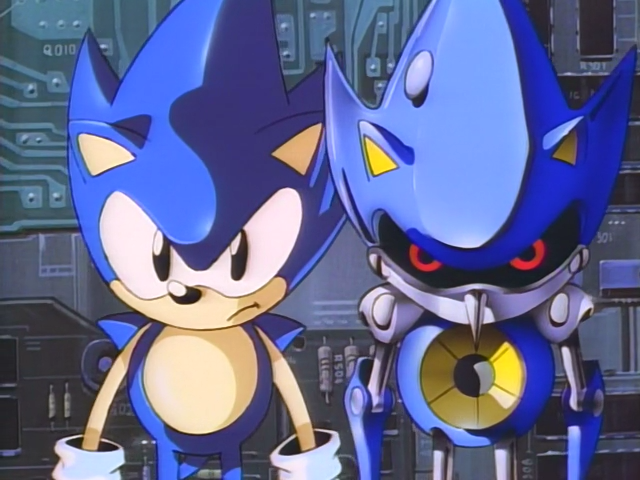
Anyway, let's get on with the review. The second part of the OVA, "Sonic Vs. Metal Sonic," is about exactly that. The ploy of Metal Robotnik and the overloading generator was just an excuse to get Sonic into Eggman's base and to copy his brainwaves. Those are immediately downloaded into Metal Sonic, a robotic hedgehog that is just as fast as Sonic and can predict his every move. Sonic immediately gets his ass beaten. Tails and Knuckles soon deduces that Eggman's scheme is to have Metal Sonic activate the volcanos under Planet Freedom's frozen North Pole. This would release the magma underneath and melt the glaciers that keeps the elevated Kingdom of the Sky in the, uh, sky. (Leaving Eggman to rule over the devastated world and take Sara as his teenage child bride, I guess.) When Sonic overhears Tails telling this to the President, Metal Sonic learns it too. Everyone heads off for a rumble at the North Pole, which will determine the fate of the entire world. 


I've often questioned why "Sonic" fans are so enamored of Metal Sonic, beyond the fact that he looks cool and he's in the actual video games. I've never found him any more special than Robotnik's other robot Sonics. (In fact, I generally prefer the "Sonic & Knuckles" version to the default Metal Sonic.) The OVA presents us with a Metal Sonic that's genuinely intimidating. Within minutes of going online, he's beaten Sonic into submission. He moves so fast that the animation becomes a stylized laser light show to show how quick he is. After karate kicking Sonic off a peak above the planet, it seems like Metal has actually killed Sonic. Within a few minutes, this Metal Sonic has already accomplished more than any other version of the character. 

My main issue with canon Metal Sonic is that he doesn't have much of an actual personality, beyond a pre-programmed desire to best his flesh-and-blood counterpart. The anime fixes this too. This Metal Sonic shares a telepathic link with the original, which doesn't just mean he knows every move Sonic makes before he makes it. It means Sonic's personality starts to rub off on the robot. He shares some of his body language, for example. Finally, in the end, Metal starts to display some of Sonic's heroic traits. He rescues the President and Old Man Owl from an explosion and allows himself to melt in the lava, so Robotnik can't use him again as a weapon. Sonic feels a sense of sadness in the movie's final moments, because his enemy didn't have to be evil. That's pretty interesting and makes for a more compelling antagonist. 


But let's talk a little bit more about this version of Eggman. I think this might be the closest adaptation of Eggman, as he appears in the video games. The contradictions baked into the character is on full display. On one hand, he's a total goofball. He harbors a childish crush on Sara and is often humiliated. His eventual defeat doesn't come from Sonic but from a turtle shaped missile he deployed earlier in the episode, which crawls back to him and explodes. As he lays twitching in agony, the good guys all laugh like it's an eighties sitcom. 

At the same time, Eggman also desires the complete destruction of society as the characters know it. If his scheme had succeeded, it would've tossed entire continents into space, killing millions of people. His ultimate goal is to rule over a largely dead world populated mostly by robots. But, sure, the heroes go on a joy ride with him at the end. This is probably why most early Western versions of Robotnik focus on either his tyrannical goals or goofy appearance, as having him do both at once is a bit disorienting. 


But weirdo tonal shifts are more tolerated in Asian pop culture than they are over here. Another thing more tolerated in Japanese children's media is gratuitous fan service. (Or maybe the entire "Sonic" franchise is just horny-on-main, considering how perverted "AoStH" could get...) The second half of the OVA has a mildly concerning focus on Sara. She first appears in this installment via a lingering shot of her ass up in the air. Robotnik makes her change into an equally revealing wedding dress outfit early on. Which leads to a fantasy where Sara is breastfeeding one of a whole horde of little Eggmen. Later, Metal Sonic looks up Sara's skirt, Tails accidentally gropes her boobs, and her kisses give Knuckles the strength to dig next to lava. 

I've referred to Sara as a love interest of Sonic's in the past, which is actually wrong. Seemingly everybody except for Sonic wants to fuck her in this cartoon. I obviously have no issue with sex appeal in "Sonic" media but, considering Sara both looks and acts like a teenage girl, it feels a little weirder than Steven Butler drawing Sally with curves or whatever Rouge gets up to at any given moment. I guess you just couldn't sell an OVA in the nineties without some scantily clad jail bait. 

For what it's worth, there's a lot less goofy comic relief in this half... Save for a baffling sequence where Metal Sonic forces Old Man Owl to wear Sonic's clothes. Which includes a backwards baseball cap, a skateboard, and a pink t-shirt. For twenty years, I've been trying to figure out the motivation behind that particular joke. Oh, also, Sonic smashes his balls after landing crotch-first in Robotnik's little shuttle. 


Perviness and weird humor aside, "Sonic Vs. Metal Sonic" is overall stronger than the first half of the OVA. Probably because it's mostly one long action scene. We begin with a really nicely animated sequence of Sonic, Tails, and Knuckles rushing into Eggman’s base and avoiding shots from a Snail Blaster. Once Metal Sonic shows up, we get a couple gorgeously animated scenes of his turbines whirling around and such. (The mechanical designers really had fun on this project.) After a brief, plot centric scene to determine what the rest of the movie will be about, it's off to the Arctic for another fight. 

What makes these action sequences good, aside from the nice animation and stylish direction, is how the script constantly ups the stakes. Metal Sonic is wrecking some cities and then the entire world is in danger. When the destruction of the glacier that holds the planet together is prevented, the story has the President crash his ship right into the same glacier. Now our heroes have to save someone and keep an explosion at bay. For a film about a super-fast character, it's fitting the pacing rarely lets up and the story keeps striving for more and more excitement. This would probably be exhausting for a feature but for an hour-long two-parter, it works just fine. 


For this review, I watched a couple of different sources of the OVA: My old VHS tape of the English dub (yes, I still have a working VCR), an HD rip of the hour-long cut with the original Japanese audio and English subtitles, and a heavily pixelated upload of the separated OVA release with no subtitles. (Seemingly the only way to watch the original two-part presentation these days.) The difference between the latter two cuts is negligible. Basically, you're missing out on two credit sequences and some Japanese lettering. 

As for the dub... It's not great. A lot of the English actors affect nasally, high-pitched voices for the characters. Sonic sounds like a haughty brat, Knuckles has a perpetually jokey tone to his voice, and Tails seems to have a head-cold. Gravelly Edwin Neal makes an okay Robotnik and Sasha Biesi, Sara's V.O., is a little less annoying than her Japanese counterpart. Tails sounds equally grating in either version but the Japanese audio is overall much better. I especially like how tough Masami Kikuchi makes Sonic sound. The audio mix is slightly different between the two versions but the awesome score is maintained. My copy includes the boob-grabbing, middle finger, and breastfeeding, though supposedly some copies don't. 


The Japanese audio is preferable but you're doing fine watching either cut. Honestly, considering how most of the OVA's joys are visual and the plot is pretty simple, a dialogue-free/isolated score cut would probably work great too. Overall, I really like the "Sonic" OVA. Like all "Sonic" media, it has some peculiar quirks and some of the changes work better than others. Yet it's great to look at, is a fun to watch, and really captures the spirit of classic Sonic. It's not as good as the "Sonic CD" opening but few things are. There was a recent "fan recreation," which hopefully brought a little more attention to the original. I hope it gets license rescued eventually and winds up streaming somewhere. Or at least receives a nice Blu-Ray release. It's a brief but entertaining chapter of "Sonic" history that doesn't deserve to be forgotten. Now lets rock out to the Engrish filled theme song! [7/10]


Wednesday, June 2, 2021

Sonic the Hedgehog: The OVA - Part 1


Sonic the Hedgehog: The OVA - Part 1
"Welcome to Eggmanland!" 

Japanese Release Date: January 26th, 1996
US Release Date: September 7th, 1999

In 1996, there wasn't much in the way of official "Sonic" lore. Each pop culture spin-off of the game brought with it their own takes on things. By this point, the comics had already built up pretty elaborate universes. Yet the games, far more focused on gameplay than plot, still left a lot of details up to fans' imaginations. This might have been why "Sonic" was attractive to an anime studio at the time. You got the prestige of working with famous characters but still had a chance to, more-or-less, make up your own world. Which is exactly what Studio Pierrot did with their two-part OVA. Though drawing some loose inspiration from "Sonic CD" and featured multiple familiar faces, the OVA stands on its own as a unique take on the "Sonic"-verse. 

The first half, "Welcome to Eggmanland!," has a dotting old man owl bring an urgent message to Sonic and Tails, who were trying to enjoy themselves on the desert island they live on. The president of Planet Freedom has invited Sonic to the White House. There, our heroes discover that Eggman has taken the president and his teenage daughter Sarah hostage. Eggman then explains that Sonic's help is needed. An eviler doppelgänger called Metal Robotnik (called Black Eggman in the Japanese) has taken over Eggman's city. If he's not stopped, an out-of-control generator may destroy the whole planet. Sonic reluctantly agree to help and, after traveling to the ruined city Eggman operates out of, battle Metal Robotnik. Knuckles appears to help them out. Neither of them know it's all been a trap engineered by Eggman... 


In a lot of ways, the OVA presents a unique take on Sonic and his world. Planet Freedom is made up of two "dimensions." The Land of the Sky is composed of continents floating above the world atop icy structures. The Land of Darkness below is seemingly a post-apocalyptic Earth, with Eggman operating out of a ruined Manhattan sinking into the ocean. This fuses together reoccurring elements from various corners of the franchise, like floating islands and grim urban sprawl, to make a far-out sci-fi vision. This anime is also notably the first animated appearance of Knuckles, who is characterized as a traveling treasure hunter who can levitate in the air. A translation error apparently made the Japanese animators think he was a mole too, which is probably why he's introduced digging out of the ground and has a dislike of sunlight. (He also has a cool Crocodile Dundee hat, presumably because the character designer thought it would look neat. It does!) 

It's not just the world here that is radically different from the video games. The OVA also introduces several characters exclusive to this anime. (Who are also owned by Studio Pierrot, which is why Sega got pissed when Archie gave them cameos in the comic.) Old Man Owl is an absent-minded foul who is introduced flying a burning aircraft. Eggman has a small armor of spiky, vaguely SWATBot-like robot warriors, who look pretty cool. There's also the incompetent president – humanoid-shaped but with elf ears – and Sara, his daughter. Sara is a traditional anime cat girl, with big ears and tail atop a traditional human body. She, and the tiny mini-skirt and crop top she wears, was introduced presumably because someone decided the "Sonic" franchise needed a little more sex appeal. 


The problem with these new characters is... They're mostly pretty annoying. Old Man Owl is such a fool that he doesn't even notice his plane is on-fire. Later, he talks to a flower, mistaking it for Sonic, while rambling off an unrelated anecdote. Sara, meanwhile, represents a high-pitched style of comic relief not unknown to children's anime. Even though she's Eggman's hostage, she repeatedly threatens to leave him. She cries and throws a fit when she looses the fighting game she plays with the villain. Eggman, meanwhile, puts up with these temper-tantrums because, I guess, he thinks she's hot. I'm not sure a fumbling old man and a spoiled little rich girl were character types "Sonic" really needed. 

But that points towards an issue the entire anime has. The characters are kind of obnoxious. Tails is introduced building a rocket-powered surfboard, while Sonic chills on the beach. The hedgehog doesn't show much interest in his friend, which gets him yelled at. In fact, Sonic selfishly ignores his little body up until he's in actual danger. Later, after Robotnik asks Sonic to help save the world, he blows the whole thing off at first. Nineties Sonic was defined by his 'tude and this would sometimes result in him being written like a massive asshole, which is clearly what happens here. Anime Eggman is certainly more sinister than his "AoStH" counterpart, as he threatens Sara with a spike at one point. He's still kind of a joke, often comically underminded by the people around him. 


These are all indications that, even in Japan, "Sonic" is mostly for kids. Yet the contrast built-in into the franchise – cutesy characters and goofy humor existing alongside a ruined environment and killer robots – is present here too. The enormous Metal Robotnik, with his intimidating design and machine gun hands, is certainly a threatening presence. He repeatedly tells Sonic he's going to kill him and the hedgehog is almost drowned at one point. This divide is represented in the anime's slightly edgy, but also juvenile, elements. I'm not just talking about sexy little Sara. Sonic extends his middle finger to Metal Robotnik, among a couple other milder but still somewhat rude gestures. In response, the evil robot fires sticky globs of mega-muck.... From a chute in his backside. Yeah, I'm pretty sure that's a poop joke. Metal Robotnik took a shit on Sonic. This gesture is returned when Sonic points a missile at Metal Robotnik's ass. 

While these elements are certainly interesting, this stuff probably isn't why I returned to this tape so much as a kid. The truth is the "Sonic" OVA" is definitely the coolest looking iteration of the character up to this point. There are several beautifully animated sequences. Sonic racing along the side of this island's cliffs to rescue Tails and Old Man Owl has the same style and attitude as the beloved "Sonic CD" opening. The stand-out moment of the film is definitely when Sonic and Tails enter the Land of Darkness. They sail through protruding rocks, leap on springs, running along valleys, and smash a Crawlton. There are other notable sequence, such as a pretty cool POV shot of Sonic racing through the tunnels of NYC while Metal Robotnik chases them. The sequence where the Tornado takes off features a lot of detailed animation of a runway deploying, showing that the mechanical designers had fun on this project. 


Despite the obvious flaws, the first half of the “Sonic” OVA is a satisfying watch. Tails' body-boarding skills come back in the second half, as he improvises a surfboard out of some wreckage and uses it to help rescue Sonic. Sonic, despite his ego, still relies on his friends to help him win the day. Even though he's not exactly treated seriously, Metal Robotnik still makes for a creditable villain. In the last third, where Sonic gets an assist from Tails and Knuckles and spin-dashes the big metal baddie in two? Yeah, that shit is satisfying to watch. Also, the score is really good as it invokes the classic Genesis sound and style without the compression or directly replicating any of the games' music.

Clearly, “Welcome to Eggmanland!” leaves me with a lot of things to think about. I'm sure I'll have even more to say about the second half, which we'll get to soon enough. While it's a sometimes obnoxious, or idiosyncratic at the very least, take on the familiar characters, the things I like about it far outweigh the things I find annoying about it. [7/10]


Monday, May 31, 2021

Sonic the Hedgehog: The OVA - Introduction


There is a chapter in “Sonic the Hedgehog” history that I fear is close to being forgotten. Younger fans weren’t there but the Sega Saturn era of “Sonic” was a near desolate one. While it did better in Japan, the Saturn was more-or-less a flop in America. It never developed a hit game library and was quickly overshadowed by the far more popular Nintendo 64 and Sony PlayStation. While everyone my age knew someone who had a Genesis/MegaDrive, the Saturn never reached that level of success. To give you an idea of how much Sega had fallen by this point, I knew more people who had a Sega CD than a Saturn. 

There's a lot of reasons why the Saturn failed in America, which I'm not really prepared to discuss. But a big reason was the lack of the company's star franchise. Ultimately, only three "Sonic" games were released for the Saturn. They were a boosted port of a title meant for the Genesis, a wonky racing game, and a compilation game. None of them made much of an impact and this would go a long way towards solidifying the theory that Sonic could never breach the polygon ceiling. Along with the lack of a popular new "Sonic" game, both "Sonic" cartoon series had ended by this point. This is why so many older "Sonic" fans rallied around the comic books, as that's what really kept the fandom going during these near-famine years. 

Within a few years, Sonic went from being a phenomenon to, at best, a cult favorite and, at worst, a has-been. And the franchise's reputation never really recovered.


I mention all of this because you have to understand the environment of the time for the rest of my point to make sense. It was during these post-Saturn, pre-Dreamcast years that stories of a new "Sonic" production started to filtered out over this recent invention known as the Internet. At the time, anime was just beginning to creep into the American mainstream. This was before even "Pokémon" started to blow up. Anime was still perceived as an edgier, more mature alternative to American animation. So news of a "Sonic" anime was received with intense interest by fans. 

Yes, for those of you who might not know, a "Sonic" original-video-animation (anime mini-series released straight-to-video) was released in Japan in 1996. The two part series was released on two VHS tapes, the first arriving on January 26th and the second on February 4th. There's very little behind-the-scenes information on the series. One assumes Sega commissioned the show to promote the Saturn and its flagship series. We know "Sonic" creators Yuji Naka and Naoto Ohshima had approval over the series and were, to some minor degree, involved in its production. 


This is what I can gleam from Wikipedia and IMDb: It was produced by Studio Pierrot, a company that has worked on mega-franchises like "Naruto," "Bleach," "Urusei Yatsura," and "Yu Yu Hakosho." Its director, Kazunori Ikegami, and writer, Masashi Kubota, have few other credits. (Kubota's most notable other credit is "Those Who Hunt Elves," a fantasy series whose name is familiar but I know nothing about.) Its animation team, however, include people who have worked on various iterations of "Pokémon," "Digimon," "Gundam," "Evangelion," "Cardcaptor Sakura," “Trigun," and "Lupin the 3rd." Key animator Fumie Muroi would go on to direct some of the beloved, and decidedly not-kid-friendly, "Black Lagoon" series. 

But that doesn't really tell the story of the "Sonic" OVA, at least as I remember it. In the days before streaming or file-sharing, it was really hard to get ahold of certain anime titles. Unless you were one of the lucky souls included in the convention tape trading or fan-subbing scene, you only saw what was on TV or in the anime section of your local Suncoast or Sam Goody. Something like the "Sonic" OVA, which was not especially popular or well-received in Japan, was hard to get ahold of for a long time. Screenshots and rumors were all we had to go on. What we did see looked a lot like the "Sonic CD" opening, which was the then-pentacle of "Sonic" animation. (And, you know, might still be.)

Source

Fans like me were intensely curious about this "Sonic" anime. How did it differ from the versions of "Sonic" we knew in America? Since "Sonic" is a Japanese series, there was this assumption that the anime must be truer in spirit, if not content, to the games. Or would the "Sonic" anime match the then-perception of format and have our hero killing bad guys and ogling big titty schoolgirls? There were rumors that Sonic said bad words or that there was some other naughtiness involved. Either way, we knew the two-part show would look a lot cooler than the American cartoons.

For three whole years, that's really all we had to go on. Some fans had watched the OVA but I'd wager more "Sonic" fanatics had read about the series then actually seen it. I first got a good look at the anime on an early iteration of abusive scumbag/Sonic fan-artist Psyguy's website. He had pictures, clips, and sound bites available for download. Since this was the days of dial-up, it took hours for me to download a two minute long trailer. I really wanted to see this thing, you guys. 


After "Pokémon" hit American shores and video game anime became huge business, the "Sonic" OVA would see an official Region 1 release. A.D. Visions, one of the biggest U.S. distributors of Japanese cartoons in the nineties and early 2000s, picked up the OVA for American release. It came out over here a few weeks before “Sonic Adventure,” A.D.V. surely hoping to capitalize on the more high-profile release. For U.S. audiences, the two installments were fused into a single hour-long presentation and sold as "Sonic the Hedgehog: The Movie." Rumors persist that some U.S. releases of the movie had content cut out. Yet the distinctive white VHS tape that I vividly recall buying from my local mall's GameStop had minimal tampering and no censorship.

Finally watching the anime after years of reading about it, my reaction was more bemused than impressed. The much ballyhooed "adult content" amounted to some brief scatological humor, a cat-girl damsel in short-shorts, and one blink-and-miss-it rude hand gesture. Like every "Sonic" adaptation, there was a lot of bizarre deviations from established Sega lore. The English dub was frequently ear-piercing. Mostly, my disappointment in the anime was in its tone. I was hoping for a serious story with a lot of high-stakes action. There was some of that but the movie was also badly hampered by childish humor, annoying side characters, and weird story logic that might've been the result of the shitty dub. 

Source

Despite my reservations about "Sonic the Hedgehog: The Movie," I watched it a lot. Growing into my teen years, I was still a "Sonic" dork and there still wasn't a lot of easily accessible hedgehog media at the time. The anime movie had bursts of bad-ass animation and Knuckles wearing a cool hat, which still put it above "Sonic Underground" in my mind. That tape spent a lot of time in my VCR. I can recall one slightly inebriated night where I popped the movie in for me and my college friends, a good time being had by all. I never loved "Sonic: The Movie" but it had a big novelty factor. Over time and via repeated viewings, I grew fond of it.

In the years afterwards, the "Sonic" franchise and the fandom it spawned would change in countless ways. A proper "Sonic" anime series would eventually arrive and reach a far wider audience than the OVA ever did. In time, A.D.V. would go out-of-business and their VHS and DVD releases of "Sonic the Hedgehog: The Movie" would go out-of-print. (Used copies still sell for a hundred bucks or more.) Weirdly, despite being part of a iconic game franchise with a devoted fandom, it has never been re-released by another company. The OVA survives via YouTube uploads but is available for official streaming absolutely nowhere. 

Source

This lack of availability is why I fear the "Sonic" OVA is on the verge of being forgotten or overlooked. I've talked to younger "Sonic" nerds who didn't even know the anime existed. I will always think of the OVA as the third "Sonic" cartoon but the wider fandom have reduced it to a footnote. And maybe a footnote is all it is. Yet I, nevertheless, recall what this short anime meant to the "Sonic" fandom once. 

And with that, I bring this meandering introduction to an end. I'll be reviewing the OVA in two parts, to give myself more room to ramble about it and to preserve the original Japanese structure. It's time to scrap some knuckles and catch some tails – whatever the fuck that means! – and look back at this retro relic. 

Friday, May 28, 2021

Adventures of Sonic the Hedgehog: Conclusion


For a couple of days now, I've been wracking my brain, trying to think of eloquent things I can say about "Adventures of Sonic the Hedgehog" as I put it in the rear-view mirror. It took me almost four years to review all of the Archie "Sonic" comics, which evolved a lot over the course of its extensive run. I had a lot of feelings about that series. Similarly, "SatAM" was a show I was really attached to as a kid and my thoughts on it have shifted a few times as I've revisited. 

"Adventures of Sonic the Hedgehog," on the other hand, is a show I'm not sure I've watched in its entirety before. I enjoyed it as a kid but it never stuck much in my mind. Moreover, the opinion I had of the program going into this retrospective remains more-or-less unchanged. I guess this conclusion has been hard to write because I don't have a relationship with "AoStH" the way I had a relationship with the comics or "SatAM."


So, what is that opinion that's stayed mostly consistent throughout these reviews? Going into this retrospective, I recalled "Adventures" as obnoxious in its humor, cheap in animation, and deeply childish in its writing. This is still an accurate description. If "AoStH" revealed any hidden depths to me during this watch-through, it's how freaky the show got. The stretchy animation style often veered towards unintentional(?) body horror. The absurd humor of the series sometimes extended past amusing and into the nightmarish. Mostly, the show's gags often seemed to (barely) disguise a fetishic quality that managed to make even a full-blown freak like me pretty uncomfortable. 

I want to say that "AoStH's" deeply weird qualities made it interesting but, the truth is, this show was mediocre and forgettable more often than not. In a year, if you asked me what episodes like "The Robotnik Express" or "Sno Problem" were about, I doubt I could tell you without re-reading my reviews. The show relied upon deeply repetitive writing, often repeating the same gags several times in the same episode. Sonic putting on a disguise to fool Scratch and Grounder or Robotnik getting humiliated at the end of every episode weren't exactly rock solid jokes to begin with, much less when repeated over and over again. The writers themselves were clearly hindered by this reliance on formula, which is why so many episodes were based around introducing some new bozo for the static characters to bounce off of.


The show's commitment to overbearing wackiness, a brute force attempt to wrangle laughs out of the tiny children in the target audience, was usually incredibly annoying to this old man's old eyes. Once again, I'm forced to acknowledge that I am not the target audience of a "Sonic"-related product. If you were wondering why so many of these reviews degraded into grasping-at-straws psychological readings of the characters or world, it's because there was so little for me to latch onto.

Still, I have read defenses of "AoStH," that it was consistently amusing in a sub-"Looney Tunes" style fashion. The amount of memes the program has spawned is certainly evidence of how durable some people find its style of humor. Considering the show's long afterlife in reruns and syndication, I'm guessing it had the most reach of all the early "Sonic" cartoons. If nothing else, "Adventures of Sonic the Hedgehog" definitely has its place in "Sonic" history. 


There are, I suppose, episodes and moments were I enjoyed this show. A couple stick out in my memory as of higher quality than most. The Quest for the Chaos Emeralds four-parter was inconsistent but, at its best moments, showed this program was capable of a little more than its usual antics. "Mass Transit Trouble" and "The Mobius 5000" are other episodes that suggested this show had more dramatic potential than most of its installations seemed to entail. I've commented before that the Tails-centric episodes – "Tails' New Home," "Full-Tilt Tails," and especially "Tails Prevails," which is probably my favorite episode of the entire series – seemed to have a little more dramatic gristle than most. 

Looking back at my reviews, I think "Robotnik's Rival" and "The Little Merhog" are the episodes that made me laugh the most. (I also gave positive scores to "Pseudo-Sonic" and "Subterranean Sonic" but I think I overrated them in my early hope this project would be less painful than I knew it would be.) But that's only 11 out of a 65 episode run, which does seem to prove my theory that most of this show was forgettable, mediocre dross. Besides, when I think back to "AoStH," I'm not going to remember the "good" episodes. I'm going to remember the terrifying ones: The complete abandonment of reason in "Boogey-Mania," the baffling cartoon logic of "Too Tall Tails," the disturbing psychological trauma of the Momma Robotnik arc, and the full-bore kinkiness of "Zoobotnik." These are the gifts/curses this program bestowed upon me. 


With little else to say about this series, let me resort to the pop culture writer's last defense: Raw data. Ya see, as I've been watching this show, I kept track of certain reoccurring aspects. I did this to satiate my own curiosity but maybe you'll be interested. So, in case you wanted to know: 

Sonic says "I'm waiting" 25 times throughout the show. Tails says the catchphrase in “Best Hedgehog.” Robotnik says it in “Magnificent Sonic” and “MacHopper.” Sonic's identical ancestor, Masonic, says it in “Robotnik's Pyramid Scheme.” I was surprised this wasn't more common, as I seem to recall him saying this in every episode as a kid. His other catchphrases – "up, over, and gone," "let's speed, keed" – were probably just as commonly reoccurring but I didn't think to count those.

Less surprising is this next statistic: Robotnik says "I hate that hedgehog," or a close variation on it, 65 times. He doesn't say it in every episode. “Best Hedgehog,” “Robolympics,” “High-Stakes Sonic,” “Blank-Headed Eagle,” “Momma Robothink's Birthday,” “So Long Sucker,” “Trail of the Missing Tails,” and “Coachnik” are the episodes were he doesn't say this phrase. But sometimes he'll say it more than once in other episodes, making up for lost time. (His mummy ancestor says the phrase in "Robotnik's Pyramid Scheme" and “Prehistoric Sonic.”) 

How about this one? Sonic is shown eating, or is heavily implied to have eaten, 29 chili dogs throughout the course of this show. In “Robotnik Jr.” and “Sonic's Song,” he eats a hot dog without chili. There are actually far more episodes that reference chili dogs without actually depicting Sonic eating any. For example, he orders 2 chili dogs in “Robotnik's Pyramid Scheme” but is never shown eating them. It seems his love of meat-sauce bathed beef tubes is more informed than shown.

Lastly, I kept a running tally of all the many disguises Sonic wore throughout “Adventures of Sonic the Hedgehog.” He wore 85 different disguises and costumes in total. His favorite get-up seems to be the firefighter, construction worker, and highway patrolmen, which he all donned three times. Other repeat offenders include a doctor, a cook, an old time-y beat cop, a military general, a pizza delivery boy, a generic artist, a little old lady, and the weirdly specific “Dr. Pimento.” 

There's also some borderline examples, such as Sonic's identical ancestors. The only episodes Sonic doesn't wear some sort of costume or disguise in are “Submerged Sonic,” “Robolympcis,” “Trail of the Missing Tails,” “The Last Resort,” “The Magic Hassle,” “Baby-Sitter Jitters,” “Road Hog,” “Fast and Easy,” “Tails' Tale,” and “Hero of the Year.” If you're curious what everyone of these looks like, the Sonic News Network Wiki has got you covered.


And so I close the book on "Adventures of Sonic the Hedgehog," at least for now. Good-bye Long John Baldry and Scratch's annoying laugh. Good-bye educational segments of dubious merit. Good-bye Momma Robotnik, Professor Von Schlemmer, and Wes Weasly. I'll, uh, miss you, I guess. Before returning to the doldrums of DiC-era "Sonic" animation, I'll be making a brief stopover in Japan. Look for that soon. Thanks for reading, guys. 

Wednesday, May 26, 2021

Adventures of Sonic the Hedgehog, Episode 1.60: Hero of the Year


Adventures of Sonic the Hedgehog, Episode 1.60: Hero of the Year
Original Air Date: December 3rd, 1993

Here we are, kids, at the last episode of "Adventures of Sonic the Hedgehog." The entire series played out over the course of only three months, though it continued to air in syndication and various other time slots for years to come. Despite the brief period it took the show to premiere, it took me about a year and two months to review the entire series. Granted, that's largely because of the seven month hiatus I took in the middle there. Yet it still feels like it took forever to work my way through this show. And now, finally, I am done. Let's roll that beautiful bean footage one last time.

"Hero of the Year" begins with Wes Weaselly riding in a fancy limo, seemingly having struck it rich. After an attempted carjacking by Scratch and Grounder, Sonic and Tails rescue the former con artist. Wes then suggests to Tails they throw an honorary dinner celebrating Sonic's heroism, inviting as many of his friends as possible. It turns out Wes isn't done conning though. It's all a trap set up by Robotnik, Wes being promised his own television shopping channel as a reward for screwing over Sonic. After the hedgehog and all his bodies are gathered on a cruise boat, Robotnik sticks him in a cage and sinks him to the bottom of the ocean. Surely someone will have a change of heart and save Sonic?


When the collection of Sonic's friends are gathered on the boat, they share memories of everyone's favorite spiny smartass, which somehow play out as video clips on a projector. Which means, yes, "Hero of the Year" is a clip show. A way to save money and pad out a season order by building an episode around footage from earlier episodes, clip shows have long been the bane of television fans. Ya know, you tune in for a new episode of your favorite show, only to be greeted with largely recycled scenes. You feel ripped off. They're increasingly rare now but were common place for years. Animation, being even more costly than regular television, was certainly not exempt from this. For what it's worth, I'd say that less than half of "Hero of the Year" is built around pre-existing scenes, so you don't feel too cheated. 

One does have to ask the question of why these particular characters and scenes were chosen for revisiting. Aside from Wes, Breezie, Robotnik Jr., Sgt. Doberman, and Robot from the previous episode are asked to present clips. Da Bears and Von Schmerler – big sigh – also show up for short scenes while a small horde of characters have cameos. That includes Spelunk, Rocket the Sloth, Sketch Lampoon, Bert Whoo, Roxy, Professor Caninestein, Miss Possum, and a miscolored MacHopper. Some of these were obviously favorites of the writers but others seem to be picked at random. Sgt. Doberman could hardly be called a friend of Sonic, considering he tried to betray him in "Attack on Pinball Fortress." None of the featured episodes are among the series' best. Later, Robotnik presents even more clips and they are equally random. "The Robotnik Express" is highlighted as his greatest defeat, when literally any other episode would have worked just as well. 


Aside from providing set-up for old footage, none of the returning characters do too much. Breezie says every line as a near-orgasmic moan and Robot's story moves the audience to tears. You'd think that, if this was one final chance to see old friends, the writers would've given them more to do. However, at the very least, Wes Weasely gets something like a proper redemption arc. Having been screwed by Robotnik, he decides to jump in the submarine he has for some reason and save Sonic. Afterwards, he promises he's done scamming. Granted, this is not convincing at all. Wes' motivations are entirely self-interested and he already seems to be sliding back into bad behavior by the final scene. But at least one of the reoccurring cast members has an effect on the episode's plot and undergoes some sort-of, kind-of, almost meaningful change. (Also, Wes spends nearly the whole episode in just his boxers with a giant cigar in his mouth, presumably because the animators just had to prove how freaky they were one more time.)

Taken on its own merits, "Hero of the Year" does not prove to be an especially memorable episode. There's one joke that made me laugh. After Robotnik insists he get his own celebratory ceremony, Scratch and Grounder invite all his friends... Which results in an empty theater. Otherwise, it's the same sort of loud slapstick you've come to expect. It's also kind of bullshitty that Sonic doesn't even do much, in this episode devoted to his heroism. Wes Weasly saves him. Also, they bring back a bunch of characters nobody gives a shit about but Coconuts is nowhere to be seen. Balderdash! I demand justice for my stupid robot monkey son. 


Even though it was the sixtieth in the "official" order, "Hero of the Air" was the last episode produced as well as aired. It doesn't have the closing minute of finality that "Sonically Ever After" did, nor the world-saving stakes. (It does have a mildly bizarre Sonic Sez segment devoted to the dangers of alcohol.) Robotnik is still at large, Mobius is still a place of chaos and madness, and Sonic and Tails' aggressively wacky adventures continue onward. However, a premise that more-or-less celebrates the entire series and a bunch of familiar faces returning at least feels like a good point to end on. I can't say I'm disappointed in this final episode, because that would imply I ever have any expectations for this show. 

But, at least I'm done. Come back next time for my closing thoughts on the entire series. As for "Hero of the Year," I must bequeath it with a meager [5/10].