Wednesday, August 16, 2017

Sonic the Hedgehog: Issue 158


Sonic the Hedgehog: Issue 158
Publication Date: January 2006

2006 would be the year that Archie's “Sonic the Hedgehog” book would finally pull itself out of the pit of mediocrity it had been simmering in for quite a few years. Soon, enough, a new creative staff will come on board and revitalize the title. But we're not there, not quite yet. We still have two more issues before Ken Penders' reign comes to an end. Though Ken would leave for other reasons, you can't help but wonder if he was running out of ideas. Issue 158 promises yet another fight between Sonic and Shadow. Don't these guys do anything else? The book hasn't been this fight crazy since the early days, when Knuckles was still a new character. Anyway, let's get on with the show.


“System Reconfiguration” continues where we left off. A group of Metal Sonic robots has invaded Robotnik's city. The doctor assumes Snively is behind this but the true culprit, the mysterious force hacking his system, remains unidentified. He quickly gets Mecha back on his side. Just as the machines look like they'll overrun the villain's lair, they instead head out for Knothole City, destroying everything in their path. Sonic and Shadow just escape the chaos, heading into the forest to fight the invasion for different reason. Both hedgehogs will soon learn some startling information.

Besides old dog faithfuls like me, I don't know who the hell else was reading the comic book in 2006. Maybe the younger Sonic fans, driven to the comic by a mania for “Sonic Adventure 2” and “Sonic Heroes,” wanted to see Sonic and Shadow fight each other once again? If that was the audience Archie was targeting at the time, I bet they were disappointed in this story. Despite the cover promising a title bout between the blue blur and his latest rival, Sonic and Shadow do not fight in this issue. In fact, they are even working together – kind of – throughout part of it. Shadow spends about a third of the issue unconscious!


But covers always lie. What of the actual content? To his credit, Ken does make an effort to develop Shadow a little as a character. Robotnik attempts to manipulate the so-called ultimate life form. Robotnik points out his familial relation with Shadow's creator, making the hedgehog a nephew of sorts to the villain. Interestingly, Shadow doesn't buy it. Instead, he's driven to protect Hope. Considering his connection with Hope has been his sole humanizing element, I don't mind Ken returning to that one. It doesn't amount to much. Mostly, it's a story excuse to get the anti-hero fighting the horde of Metal Sonics. But it counts for something.

The robotic threats, called the Metal Sonic Troopers, are also potentially interesting. They sport the dorky black leather loincloth design from “Sonic Heroes.” They don't display a flick of personality. Instead, the troopers act like a zombie horde. They don't eat flesh but they do descend as a crowd, destroying everything around them. We learn their origin. Rotor and Uncle Chuck built them as a robotic police force while Sonic was in space. Once the hero came back, the Troopers were shelved. Sadly, both of these points are wasted. Sonic spends a little too much time relaxing after the robots are set loose, making them seem less dangerous. Our hero, meanwhile, has no reaction – good or otherwise – to learning that his uncle and friend are responsible for this new threat.


Among all this chaos, Ken once again makes an attempt to sneak in some pathos. Before the Troopers attack Knothole, Jules and Bernie have another conversation about their son. Bernie wonders if they've gone wrong, letting Sonic march into danger like he does. Once again, Jules recommends giving the boy some distance, that he's not a child anymore. This can't help but remind me of how Locke treated Knuckles, spying on him while refusing to actually father him. Maybe it's just residual annoyance with that plot point that makes these scenes stick out to me. Or maybe they really just don't have a place in this current story.

I know I bitch about Ron Lim's artwork all the time. In “System Reconfiguration,” Lim does some especially lousy work, just when he was showing some improvement too. The Metal Sonic Trooper look too much like a collection of pointy edges. When attacking as a crowd, Lim just draws a big blue, squiggly shape. His character work is okay in a few panels. Uncle Chuck and Shadow look okay, at least by the standards of Ron Lim's pencils. The action artwork, however, is dire. It's lifeless, messy, and shapeless.


For the back-up story, Archie forces us to suffer through another shitty “Off-Panel” comic. Mike Gallgher's script even admits that no one is actually interested in reading this. A gag claims Hugh – apparently the guy who changes the print cartridge – demanded another one of these. Anyway, the plot: Sonic and editor Mike Pellerito meet in a back alley for some reason. There, they are attacked by Blackstage, some Phantom of the Opera looking motherfucker who threatens to expose a bunch of behind-the-scenes footage to the fans, expecting this info to destroy sales. It doesn't work because fans enjoy stuff like this. So the villain essentially defeats himself.

It's so dumb, you guys. The script is derivative of “Better Read Than Dead” from 126, with a lame villain appearing to threaten the editorial staff in a really dumb way. Like in that story, Sonic is benched for most of the plot, making Pellerito the hero. (Because that's what people reading a “Sonic the Hedgehog” comic book wanted to see: The adventures of the editor.) Blackstage's plan doesn't even make sense. Why would behind the scene footage destroy a comic book's credibility? It's a comic, not pro-wrestling! Is Blackstage unaware of the popularity of DVD special features?


I guess that's to be expected, as this is a gag comic. Sadly, the gags aren't funny either. Blackstage's incriminating footage includes stunt doubles, camera tricks, special effect shots, and King Acorn being in a make-up chair for six hours. (I've always suspect Mike Gallagher stopped paying attention to the book years ago and this proves that, as all these story events are from the pre-100 days.) When the bad guy is informed that his plan is stupid and sucks, Sonic tears his clothes off, puts the mask on, and sings a bar of Andrew Lloyd Webber. Jeeeezus. Is this what Archie's comedy books were like at the time? No wonder nobody read them back then. I'll give the story this much though. It's slightly less embarrassing then “The Edge of Parodies,” the previous Off-Panel five pager.

The cover story is slightly better then most of the “Sonic” stories Archie published in 2005. This is faint praise, as it's still a stiflingly mediocre affair. Ken isn't exactly going to go out on a high note but he could've done a lot worst. We all know that. I'm willing to totally ignore that fucking terrible back-up story and just stick this one with a [6/10.] I'm feeling generous.

Monday, August 14, 2017

THE 2005 SONIC THE HEDGEHOG COMIC BEST/WORST LIST!


This may seem like a hot take but, in my opinion, 2005 was the worst year for Archie's “Sonic the Hedgehog” comic book. I know 2001 and 2004 were previously regarded as some of the series' lowest points. And, yeah, those years were rough. As bad as they were, neither of them almost caused me to quit the series. 2005, on the other hand, was the dullest of the Penders/Bollers years, full of bullshit story turns, out-of-character writing, and ill-conceived ideas. This was such a bad year for the comic that I considered not even doing a Best/Worst list. Instead, I thought about employing one of those “From Bad to Worst” list that Dan Drazen was so fond of. However, in the end, there was juuuusssst enough positive material to scrap together a rounded list. It wasn't easy.

This was, it most be noted, the first year in quite a while where more than one “Sonic” series was under consideration. The “Sonic X” book launched in the last quarter of 2005. True, “Sonic X” has yet to impress (or annoy) me enough to grab any of the below honors. But it does feel nice to be mixing things up again.

The “Sonic” material covered in this retrospective is as follows:

Sonic the Hedgehog: Issue 145-157
Sonic X: Issue 1-4


BEST COVER STORY:
“Songoose: Part 1” - Karl Bollers (Sonic the Hedgehog: Issue 153)

With “Songoose,” we bid adieu to Karl Bollers. The writer managed to leave “Sonic” on something of a high note. While the second half of this two parter was disappointing enough to keep “Songoose” from earning the Best Arc distinction, the first half was one of the few decent cover stories this year. Robotnik targeting Mina because her music annoys him is a funny touch. While I wasn't a fan of the Sonic/Mina romance being resurrected yet again, it was nice to see all the characters working together for once. Karl even manged to sneak in some character development for Fiona Fox and Antoine's dad. It's not a lot but in a year as stinky as 2005, it's what passes for Best Cover Story.

(For the record, “Field Trip of DOOM!” from “Sonic X: issue 3” was the clear runner-up in this category and even that story was just decent.)


WORST COVER STORY:
“Sonic's Angels” - Ken Penders (Sonic the Hedgehog: Issue 152)

This fucking thing... An issue of “Sonic” hasn't pissed me off this much since 134's “Say You Will.” From the central concepts on down, this one is rotten. Sonic's love interests – with the notable exception of Sally – gathering around him for a mission was a brain dead idea, especially since Mina is no longer a field agent. Despite that set-up, there's little romantic tension in the air, making the premise even more of a waste.

Yet that is far less obnoxious then the infamous quasi-rape that Bunnie suffers in this issue. Abducted by the Nanites, her limbs are melted into goo while probes explore her private areas. The rotten cherry on this shit sundae was Sonic rescuing her with some flawed logic and getting a big kiss for his troubles. In that instant, any reasoning for Bunnie's torment is swept away, making room for Sonic playing hero.

This kind of thing never should have happen and it especially shouldn't have happened to Bunnie, the one character even Archie Sonic fans can agree on.


BEST BACK STORY:
“Stargazing” - Tania del Rio (Sonic the Hedgehog: Issue 151)

The only story from 2005 that could genuinely be described as a fan favorite is 151's “Stargazing,” a back-up feature from newcomer Tania del Rio. Not only did it introduce Nicole's wildly popular lynx form, it's actually a quite touching story. By taking physical form, Nicole can see, feel, and hear in ways she never could before. Adding a pleasant whiff of melancholy, it's ultimately an ephemeral experience for her. Sally, who did not have a great year, gets a chance to realize the little blessings in her life. A quietly observant tale like this was something the book needed more of this year.


WORST BACK STORY:
“The Edge of Parodies” - Michael Gallagher (Sonic the Hedgehog: Issue 147)

There were no shortage of candidates for this one in 2005. What about the utterly useless refresher course in 145's “Training Day?” Or maybe Tommy the Turtle's latest, lamest transformation in 154's “More Than Meets the Eye?”

Both were bad but, yet again, another one of those stupid fucking Off-Panel stripes emerges to grab the title. “The Edge of Parodies” is an obnoxious dose of self-indulgence from Mike Gallagher and Dave Manak, recasting each other as omnipowerful superheroes, trying to one-up each other. Sonic becomes a supporting character in his own comic, desperate to end this buffoonery. The reader can relate to his pain. It's another pointless, masturbatory bit of nonsense from the “Off-Panel” team, who keep getting five page stories for some reason.


BEST STORY ARC:
“The Chosen One” - Romy Chacon (Sonic the Hedgehog: Issue 149-150)

It's with some reluctance that I give “The Chosen One,” Romy Chacon's two parter from 149 and 150, the Best Story Arc prize. This is, after all, the story that gave us Titan Tails, one of the most embarrassing bits of Archie Sonic lore.

If you're able to overlook that unfortunate creation, this emerges as an okay story. The “Tails is the Chosen One” plot point is finally laid to rest after literally a decade of build-up. Mammoth Mogul graduates to an actual threat for the first time, before once again being shuffled out of the book. It's not just Tails' power that proves him as a hero. It's his choice to give up that power that makes him really special, a surprisingly insightful idea. And Tails' heroic acts are ultimately motivated by his love for Sonic, giving this one some grounding emotion. I'll take it.


WORST STORY ARC:
“The Good, The Bad, & The Unknown” - Ken Penders (Sonic the Hedgehog: 146-149)

This was an easy choice. “The Good, The Bad, & The Unknown” has to be one of my most hated story arcs from the book's entire history. What should've been a simple fight between Sonic, Shadow, and Metal Sonic is stretched on for four agonizing issues. Several plot points that would never be resolved are raised. Not that we cared about them anyway, as they are truly dull, dumb stuff. A random selection of Freedom Fighters rush around the story, contributing little to it. Lastly, most of the third part is devoted to brain-meltingly dull exposition. This is one I couldn't wait to toss in the recycling bin.


BEST COVER ART:
Sonic the Hedgehog: Issue 151 – Patrick Spaziante

Spaz continued to adopt a more Sega-like style for this year's cover, which I wasn't a huge fan of. Some were, admittedly, pretty eye-catching. 146 and 157 were both devoted to Shadow posing like a bad-ass, against striking black backgrounds. 149 is probably my second favorite cover of the year. Shadow being cast as Sonic's, well, shadow is a nice visual while the red and black color scheme draws the eye.

Yet the only cover this year that really felt like a classic Spaziante illustration was issue 151. The sight of Sonic floating shoulder deep in water is the kind of classic “hero imperiled” imagery that makes you want to pick up the book. I also like the look of astonishment and panic on Sonic's face. The title graphic is distractedly cheesy but otherwise I dig this one a lot.


WORST COVER ART:
Sonic the Hedgehog: Issue 153 – Sanford Greene

Presumably because Spaz began to do the covers for “Sonic X,” Archie brought in a new artist to draw four of this year's covers. And, boy, did they miscalculate. Sanford Greene's hideous, garish covers are some of the worst out of the series' entire run.

And his worst is issue 153. Sonic makes a stink-eye worthy face, as if he's suddenly become aware of his own hideousness. His body awkwardly bends around a series of laser beams, criss-crossing in a bunch of random directions. His hand poses weirdly and his tail seems enormous. Add in coloring that is both too muted and too bright and you've got one ugly ass cover.


BEST STORY ART:
“Fairy Tale” - Art Mawhinney (Sonic the Hedgehog: Issue 153)

One of the rare bright spots in 2005 was Art Mawhinney drawing so many stories. (Steven Butler also did some consistently good work, the sole positive attribute of the “Good, Bad, Unknown” arc.) Sadly, this would be Art's last year on the book.

Probably my favorite of his contribution in '05 was “Fairy Tale.” A fairly disposable back-up story, where Rosie re-imagines the Freedom Fighters as fantasy heroes in a bedtime story for the orphans, it features some classical, beautiful Sonic artwork. Feeling like lost 'SatAM” story boards, we see Pirate Sally and Sonic the Blue Knight adventure through some forest and fight some monsters. The characters are perfectly cute and the details are rich. A gorgeous sepia coloring job makes an otherwise forgettable story pop fantastically.


WORST STORY ART:
“Sonic's Angels” - Jon Gray and Al Bigley (Sonic the Hedgehog: Issue: 152)

Again, there was no lack of viable options for this category. Ron Lim drew several stories, with 146's “Out of the Shell” and the second half of “Songoose” easily being his most flat, most tired work. Ken Penders stepped up to draw 154's “More Than Meets the Eye” and what met the eye was ugly.

But I'm not done bitching about “Sonic's Angels” yet. Jon Gray's overly cartoonish artwork is wholly inappropriate for the story's first half, especially that horrifying panel of Bunnie and a bizarre scene draped in an American flag for no reason. Al Bigley takes over for the second half and it's clear that Bigley doesn't know how to draw these characters. Snively is grossly off-model, Sonic's limbs jut out in all directions, and Mina suddenly has a college girl's physique.


BEST NEW CHARACTERS:
Nicole the Holo-Lynx

Yes, Nicole is a character that has been in the book since nearly the beginning, first appearing in issue 17 and on SatAM before that. For the eleven years she's been part of the cast, Nicole has rarely been anything more then Sally's personal computer. An occasional sassy one-liner was the only thing that made Nicole more than a prop.

With the introduction of her Holo-Lynx form, Nicole makes the belated evolution into an honest-to-God character. Her brush with humanity pushes her towards actual person-hood. She suddenly has thoughts, feelings, observations, fears and doubts, experiencing these things for the first time. Future writers would run with this, allowing Nicole to blossom into such an essential cast member that you wonder what the book did before her. That is the one truly lasting contribution 2005 made to Sonic's legacy. (Though, yes, she still sounds like Kath Soucie doing a robot voice in my head.)


WORST NEW CHARACTERS:
Isaac

Isaac, on the other hand, is a character I couldn't be more eager to get rid of. A rather literal recolor of E-102 Gamma, as he looks just like him but painted gold, the character does nothing but deliver reams and reams of exposition.  It gets to the point where the robot is actually talking over the other characters, indulging in a snore-inducing history lesson. Visually and personality wise, the character is as mind-numbingly boring as possible. The story arc ends by promising another appearance from Isaac. Thankfully, that would never come to pass.


BEST IDEA:
Resolving Long Lingering Plot Points

There weren't very many good ideas in 2005. But, as the book would do from time to time, the writers did wrap up some long lingering plot points. The most prominent of which was Tails being the Chosen One. After ten years of build-up, Romy Chacon tagged and bagged that one in ten pages.

Antoine's sudden transformation into a massive ass-wipe wasn't floating around for nearly as long. But was just as annoying. That one got resolved too, albeit in a clumsy manner involving a look-a-like from another dimension. At least we have the real Antoine back. That counts for a lot.


WORST IDEAS:
Shadow-Mania!
Sonic the Playboy!
How Do You Solve a Problem Like Tommy Turtle?

The bad ideas, meanwhile, piled up to such a degree that there was a three-way tie in this totally imaginary competition of mine. Where does one begin?

Was the worst idea of the year the book shoving Shadow into so many stories? One of two things happened. Maybe Archie was eager to capitalize on Shadow's soaring popularity. Maybe Sega forced them to do it. Either way, Shadow took over so many of 2005's stories that he practically became a main character. All this overexposure did was display the limits of the so-called ultimate life form's personality. Shadow would bungle into things, trying to learn more of this past without ever giving the reader any real reason to care. (Rouge the Bat, to a lesser degree, was also forced into a few stories that didn't need to feature her.)

That was dumb but far more offensive was the comic's bizarre decision to turn Sonic into a “playa.” At first, his evil double got the blame. Despite that, the real deal continued with this caddish behavior. The hedgehog would seemingly hook up with Fiona, Bunnie, Mina, and Amy over this year, grossing the reader out more and more as the hero continued to act like a philandering pick-up artist.

Lastly, but just as annoying, was the book's insistence on forcing Tommy the Turtle into stories. The turtle just showing up and being himself wasn't enough to make him interesting. Then they tried making him Rotor's hyper-efficient lab assistant. When that didn't work, they had the Nanites bound to his shell, giving him transformative abilities. None of these desperate pleas fixed the most obvious problem: That Tommy contributed nothing to the team and, considering he was created to die, had no reason to be there anyway.

Friday, August 11, 2017

Sonic X: Issue 4


Sonic X: Issue 4
Publication Date: December 2005

Archie's original plan was to simply grant the “Sonic X” comic four issues, as a test run mini-series, and take it from there. Apparently, the reaction to the book was so overwhelmingly positive that “Sonic X” got the green light for an on-going series before even hitting number four.  This one ends with a preview with a fifth issue, showing that this was a done deal by now. So it looks like we'll be going faster-faster-fucking-fucking-faster for a while now.


Picking up where we left off last time, issue four's “Boisterous Bot Battle!” has Sonic and his friends cornered by Eggman's quartet of kill-bots in the air/space museum. Before smashing them, Sonic is informed that his human friends are inside the machines. They are being forced to pilot the robotic executioners. So the hedgehog has to think on his feet, finding some other way to topple his arch-enemy's latest villainous scheme. Luckily, he's got some people backing him up.

As covered last time, Dr. Eggman's latest act of villainy is a little more devious than his first two tries. I just wish the book handled it a little better. Several panels are devoted to Chris Thorndyke, inside the robotic shell, being forced to attack his close friend. His dialogue balloons talk a lot about how upsetting this is for him without really showing it. Later, Chris somehow manages to disobey the mechanical straps controlling him, allowing Sonic a chance to escape. How he pulled this off isn't expounded on. Moreover, we never get a peak at how the other unwilling pilots are feeling about this. If anything, the President seems to be relishing his chance to attack Sonic, judging by his catty dialogue.


Then again, I have to remind myself that “Sonic X” isn't meant to be taken entirely seriously. This issue makes it clear that writer Joe Edkin mostly saw this comic as a chance to tell goofy jokes. Some of these work better then others. Eggman informing his henchman that he built his latest robots just by robbing the local hardware store is amusing. Rouge flirting with Knuckles after his sudden arrival, only for Amy to remind her that now isn't the time for such things, is a cute gag. However, “Boisterous Bot Battle!” is a little heavy on the goofy puns. The heroes quote  “Grease” in one scene, for some reason. Topaz' evil robot constantly sings ho-down songs while attacking the heroes. The constant quibs really undermine any dramatic tension in these scenes.

The action, over all, isn't much to write about. “Boisterous Bot Battle” continues to maintain the “Sonic X” formula with only one or two variation. Sonic and friends spend most of the book getting their asses kicked. The beating goes on for so long that the heroes' agony almost becomes comedic. There's really only one or two change of pace here. Sonic grabbing a power ring doesn't solve all his problems. Later, after a robot grabs Tails and takes to the skies, there's an airplane chase. Otherwise, it's business as usual. Robotnik's robots beat on Sonic for a while before he gets up the strength to smash 'em all. He then lets the bad guy get away, so the villain can scheme another day.


At least Joe Edkin finds a role for the whole crew in this story. Chris Thorndike and his grandpa play major roles in the story. Knuckles gets a few action beats, dodging a missile and riding in on an airplane. Rouge is bouncing around, contributing to the fight. Even Cream's chao, Cheese, gets in on the action. The little chao helps deactivate one of the robots, freeing the human inside. The “Sonic X” cast is still fairly small, compared to the cast of thousand in the main book, but it's nice to see Edkin do a decent job of balancing everyone's roles.

I've criticized Tom Smith 3's artwork as slightly flat in the past. It continues in that direction in issue four. These are the most inert action scenes to be featured in “Sonic X” so far. The characters are getting more simplistic. Far too much of this issue is composed of the robots grabbing somebody, shaking them around for a while, and starting over again. The air chase is especially lifeless. More and more, the backgrounds are nothing but single colors, contributing to the book's overall blah visual presentation. Smith's work is always competent but it's not very interesting.


I've been saying this the whole time but “Sonic X” is going to have to start shaking things up if it expects to hold my attention. How many times will field trips be interrupted by Eggman attacks? How many times will Sonic grab a Power Ring and save the day? Once again, I have to reiterate that it's not bad. It's just so simplistic that it borders on boring. One or two funny gags and the burning sexual tension between Rouge and Topaz is turning out to be the main reason to read this series. I doubt that'll be enough to sustain a forty issue run. [5/10]

Wednesday, August 9, 2017

Sonic the Hedgehog: Issue 157


Sonic the Hedgehog: Issue 157
Publication Date: December 2005

Do you see what's up ahead? It's the light at the end of the tunnel. Issue 157, in addition to ending a lousy year for the book, would begin head writer Ken Penders' final story arc for Archie's “Sonic the Hedgehog.” After wrapping up this story, Ken would leave Archie once and for all, allowing a new writer to come in and yank the series out of the creative rut it has been in for years. But we're not quite there just yet. Let's get through these next three issues together.

Even though he's only been gone for a few issues, Shadow's return to the comic is trumpeted on the cover. (I'm sure Sega's ill-conceived “Shadow the Hedgehog” video game coming out around the same time was a big factor in this decision.) The so-called ultimate life form feels drawn to a mysterious laboratory on the edge of Station Square. Inside, he finds a video of Doctor Gerald and a new version of Metal Sonic. The two synthetic hedgehogs wail on each other until they both collapse.


Ken's departure from the book, reportedly, was due to his frustration with Sega insisting he write stories featuring Shadow the Hedgehog. Maybe that reluctance might explain why “The Good, the Bad and the Unknown” and this story were so lame. The untitled cover story for issue 157 raises a bunch of underwhelming plot points. “Sonic Adventure 2” is reportedly part of Archie cannon, by this point. Despite this, Shadow is still shocked when the recording of Dr. Gerald informs him that he was created to take revenge on the government.

If Ken was hoping to give Shadow some development with this story, he squanders it by devoting the rest of the story to a fight with Metal Sonic. That's a thoroughly underwhelming spectacle too.  Shadow takes a rocket punch to the face. A Mega Man looking hand blaster is traded back and forth between the combatants. Liquid nitrogen and an electric live wire are utilized in unimpressive ways. The battle concludes with both fighters unconscious, making all five pages of this thing seem like a wasted endeavor.


In truth, the back-up story is actually the main drawl of this issue. “System Shutdown” begins with Robotnik, still in his bathrobe, getting a rude awakening. Someone has hacked into his computer system, threatening to completely take down his network. He's so concerned by this that he travels to Knothole, hoping to create a truce with Sonic. After the required fight, the hedgehog flies to Megatropolis, uncertain if he's entering a trap or not.

There's an interesting idea at the root of “System Shutdown.” Robotnik coming to Knothole as a diplomat, looking to forge a temporary partnership with the Kingdom of Acorn has potential. The book has bandied a similar concept around from time to time – such as in issue 19 – but never took it very seriously. Granted, I'm not very impressed with the panels devoting to Rotor and Tails standing back while Robotnik waltz into town. That seems unlikely. But the idea has merit.


Sadly, Ken doesn't exploit this premise for much. Instead, “System Shutdown” dissolves into one of the silliest fight scenes in the comic's history. Sonic rushes out at Eggman, only for the mad doctor to judo toss him to the ground. After some kung-fu posing, Robotnik even flips Sonic over his shoulder. This is ridiculous for a number of reason. Robotnik has never been a physical threat to Sonic, instead utilizing robotic devices and henchmen. Suddenly gifting the fat man with fighting prowess only baffles and annoys the reader. The justification for this sudden change – something to do with holograms – is equally awkward.

After the mandatory fisticuffs, Robotnik gets Sonic to work with him by promising to turn Jules organic again. This presents several issues, most of which is nitpicking, I'll admit. It's been established by this point that Jules can't be reverted to a flesh-and-blood state, because he'll die. Later, Eggman asks Jules if Uncle Chuck still feels guilty for “Helping him robotocize millions” and mentions how Sonic has been a thorn in his side for a decade. Hold on a minute, Ken. This Robotnik isn't the one that helped Chuck build the robotocizer. This Robotnik has only been feuding with Sonic since issue 75. That original Robotnik is still dead. I know this is the nerdiest type of pettifogging but you'd expect Ken – who has been working on the book nearly the whole time, after all – to keep track of these things.


That dramatic reveals that follow are hardly worth talking about. Once in Robotnik's city, Sonic, Rotor, and the others are attacked M, who has been seemingly taken over by some outside influence. At the end, she invites an army of Metal Sonics into Robotnik's lab. (They are drawn with the “Sonic Heroes” design, which is the closest this book would ever come to adapting that game.) There's some bullshit about the warning the doctor received having a twelve hour delay, which is a major ass pull. It's all a bunch of underdeveloped plot points crashing into each other, leaving the reader little reason to care.

The only real reason to read this one is for a handful of panels concerning Sonic's emotional state. Apparently, the boy has been staying up at night, strumming his guitar and pining for Princess Sally. This information almost justifies why Sonic has been behaving so badly lately. He's not screwing around with Fiona and Bunnie because he's horny. He's just trying to fill the void Sally left. There's two problems with this angle though. First off, Sally doesn't even appear in this story, making Sonic's situation seem rather one-sided. Secondly, Jules insists Bernie doesn't ask any questions. Because Ken just doesn't know how to write likable, honest parents that actually care for their kids.


Ron Lim draws the whole issue, by the way. He's showing some minor improvement. That fight between Shadow and Metal Sonic looks okay. But his work is still characterized by stiff movement and overly loose character work. As 2005 comes to a close, things are still sucking pretty bad. But the worst of it is behind us now so let's keep moving forward. [4/10]

Monday, August 7, 2017

Sonic X: Issue 3


Sonic X: Issue 3
Publication Date: November 2005

The third issue of Archie's “Sonic X” series raises some interesting questions. Part of the script takes place at an air/space museum. Tails mentions John Glenn, Neil Armstrong and the Lunar Module. This suggests that “Sonic X” takes place on our world or at least some place nearly identical to it. (If the original “Sonic X” cartoon covered this, please excuse my confusion.) On one hand, this makes the book slightly more interesting. The implication is that Sonic and friends are now part of a history that includes George Washington, Albert Einstein, Elvis Presley and Adolf Hitler, just to name a few. This is also disappointing because there's no way the comic is going to explore this at all.


I bring this up in the introduction because it's a tiny tidbit that in no way affects the rest of the issue's story. Instead, the joyfully entitled “Field Trip of DOOM!” concerns another Eggman plot. While Sonic is distracted hero-ing, Eggman sends booby trapped gifts to a number of the hedgehog's allies. A collection of new robots attack Sonic and friends while at the museum. Instead of being powered by animals, they're powered by people. Specifically, Sonic's friends, trapped by Eggman and forced against their will to attack Sonic.

Robotnik's previous plans in the “Sonic X” comic have been... Well, not great. They've mostly amounted to the mad scientist attacking a specific location – a bank, a sunken pirate wreck – with some sort of new animal-themed robot. His plan in “Field Trip of DOOM!” is practically identical. He sticks new life forms in robots and attack Sonic and pals while they're at a new location. But it does show a little more cunning than usual. By distracting Sonic with a standard fetch quest, and targeting the hedgehog's friends, it makes him seem like a more competent villain. It's a step forward.


The biggest problem with Joe Edkin's script is that it makes Sonic's acquaintances look like complete idiots. A robot – some little blue thing called Bokkun that I remember seeing in a lot of 4Kids' advertisements – comes to Sam Speed's door. Sam knows Bokkun is affiliated with Eggman but still accepts his gift of a new fuel injection system. The people who receive the gifts are Chris, Topaz, the President, and Thorndyke's school teacher Mr. Stuart. (Who is also a government agent, an info box informs us.) All of them accept the gifts without asking a single question. You'd think a known Eggman target, an active field agent, an undercover spy, and the fucking President would show a little more caution when accepting gifts.

The museum-set action sequence doesn't present much to write about. Tails and Amy participate in the battle, which presents one or two cute moment. Like when Tails attempts to dissemble the robots with his screwdriver. Amy gets some hammer time in. (Though Edkins still provides her with a thought balloon, expounding on her obsession with Sonic, showing how shallow his characterization of Amy is.) The action scene escalates to a fairly uninvolving chase. After some kids are shoveled into an armored truck, Sonic and Sam Speed take chase. Sam proves totally useless, driving his car off a cliff, while Sonic quickly rescues the kids.


However, I do kind of like the action sequence that opens the issue. As a distraction, Eggman has captured Cream's chao Cheese and placed him at the end of an obstacle course. As with everything else in this book, Sonic's constant quibbing keeps the stakes from getting very high. But this scene does feature some fun throwbacks to classic Sonic elements. He's chased by an orca, as in “Sonic Adventure.” Badniks like Buzzbombers and Relief appear. Sonic mentions the Green Hill Zone by name and sings his own theme song. (Sadly, it's the super lame “Sonic X” theme song, instead of the awesome SatAM theme song.) At the end, he leaps on a giant container and frees a bunch of cute animals. There's not much to it but it's catnip to classic Sonic nerds like myself.

Tim Smith 3 – the third entry in the Tim Smith franchise – continues to draws these. “Field Trip of DOOM!” shows some of Smith's limitations. Some of the action scenes are very flatly drawn, especially Sonic and Sam Speed's foot chase. His total adherence to the “Sonic X” cartoon house style produces some awkward results. Sonic in the opening scene looks a little funny. So does the President and Topaz in the a mid-book sequence. Still, Smith's work is almost stiflingly competent. It's good. Fine. But it doesn't really impress or linger in the memory.


Issue 3 of “Sonic X” ends on a cliff hanger, Sonic facing off against one of the robots containing his friends. Considering the series has been strictly episodic before this point, that's nice. I'm doubtful “Sonic X” will ever grow to a point of sophistication of Archie's main “Sonic” book but the series is showing a little more promise. Hopefully, it'll continue to improve, especially if I'm going to read all forty of these damn things. [6/10]

Friday, August 4, 2017

Sonic the Hedgehog: Issue 156


Sonic the Hedgehog: Issue 156
Publication Date: November 2005

How many times has Archie's “Sonic the Hedgehog” series threatened to marry Sally off? Issue 18 is the first example that comes to mind for me, where Sonic and Sally were drawn as husband and wife on the cover. Even that wasn't the first time, as the two were married in a fantasy sequence in issue 16. Considering alternate futures and that period where King Acorn was demanding Sally marry Antoine, the comic has constantly dangled the idea of marriage in front of our faces. Issue 156, despite its non-indicative cover, is doing yet another matrimonial fake-out. Probably not the last either.


Before the ink is even dry on the paperwork, Sally and Antoine are marching down the aisle. Sonic is seriously upset, certain something funny is going on. He crashes the ceremony. Some help from Elias keeps him from getting thrown out, the Prince accepting his right as King. Simultaneously, Anti-Antoine plans to kill King Acorn, completing his evil plan. Luckily, Sonic can see through the impostor Antoine's treachery.

Despite working on the book for over a decade, in this story, Ken is showing a total inability to grasp these characters. Even though they've been separated for a while, Sonic declares that Sally “should be with him.” Which paints our hero as possessive and entitled. Further misunderstanding Sonic, at the end he happily walks off with Fiona, a character he still has no connection with. (I also doubt that Sonic would willfully hurt his best friend, as Tails is clearly bothered by this relationship.) Sally, meanwhile, treats Sonic very coldly, even though she's also opposed to the wedding. It's just bad writing, you guys.


Once again, in a year as shitty as 2005, even a story arc as bad as “Line of Succession” presents some positive attributes. Evil Antoine emerges as a surprisingly ruthless villain. He revels in his villainy. During his wedding reception, he leaves just so he can deliver the killing blow to the king. He delights in throwing Sonic in the dungeon. When Elias appears to take the crown, he schemes to kill him in front of everyone. It's an old fashion style of villainy, very over-the-top, only missing the twirled mustache to be complete. But it entertains. Considering before this arc, he was just another generic member of Evil Sonic's gang, he proves a compelling nasty foe.

Perhaps more importantly, “Line of Succession” wraps up the entire impostor story line, almost as an afterthought. In the final pages, quickly, Sonic punches out Evil Antoine. He quickly surmises, somehow, that Antoine was replaced by his villainous double quite some time ago. Using the device Rotor built for him a few issues back, Sonic smoothly and easily returns the Bad Antoine to his world and the Good Antoine to Mobius. It's rushed and pretty sloppy but, considering the book had been stretching out this dumb story for a while now, nevertheless satisfying. Watching Evil Antoine get punched in the gut is also pretty satisfying.


Oh yeah, Prince Elias is back too. It's another example of how poor Penders' grasp on these characters is. (Which is especially ridiculous, considering he created Elias.) Elias' previous defining characteristic has been his unwillingness to rule. How many panels did he spend whining about not wanting to be king? I really didn't mind Elias hanging out on that farm, staying out of everyone's way and out of the comic's ongoing plot. Yet in this story, he rushes back to Knothole and, within a few minute, assumes the throne. I know he does it to save his sister but it still comes off as a rash decision, one at odds with his previously established personality.

In the back pages, Dulcy's solo story “The Price of Flames' continues. Even though the underground dragon city of Vesuvio is under attack by Robotnik's roboticized dragons, the community's leader still has time to punish Dulcy for returning. She's thrown in a lava bound pit, chained by her nose ring. One of the robot dragons collide with, breaking the chain and removing the nose ring. Her fire breathing ability renewed, Dulcy leads the attack against the robots, saving the day and being accepted back into the community.


“The Price of Flames” features some serious writing problems, which I'll address momentarily, but it remains a satisfying story. After spending all of last month on set-up, Mike Gallagher gets to the point here. Within a few pages, Dulcy faces the people who rejected her, regains her fire breathing abilities, saves the day, and redeems herself in her enemy's eyes. It doesn't leave much room for character development. The other dragons in Vesuvio are loose sketches, at best. But it is satisfying to see these events play out in such a neat fashion.

I'd probably give the story high marks if it wasn't for one serious problem. After regaining her fire breath, Dulcy incinerates the Robian dragons. She tearfully points out that these Robians were once normal dragons, brain-washed and roboticized by Robotnik. In other words, Dulcy just murdered her Mom, among other innocents. But don't worry! Mike Gallagher has an ass-pull that absolves Dulcy of the crime. See, dragons have souls that live forever. They'll just be reborn in new bodies. This presumably means Dulcy's reincarnated mother will remember that time her daughter burned her to death. It's a really dumb, last minute plot turn that ruins an otherwise decent story. It feels like Gallagher forgot what Robians were exactly until the last minute, throwing in the immortal soul business to cover his ass.


Aside from making Dulcy a cold-blooded killer, “The Price of Flame” is notable for another reason. It would be Art Mawhinney's final credit on the book. I've written a lot about Mawhinney's art since beginning this retrospective. So it should be known that he's one of my favorite “Sonic” artist. As far as final bows goes, “The Price of Flame” is a decent one. The characters are expressive, the lines are crisp, and the action is dynamic. I just wish the script was up to Art's standards. As far as I can tell, Mawhinney has mostly retired from working on comics, with his most recent work being on kid's Look-N-Find books. (James Fry draws the cover story and does a decent job, by the way.)

I can't really give issue 156 a good review, considering the obvious problems both the cover story and back-up has. Mike Gallagher's work has always been full of sloppy elements while Ken's skills seriously atrophied near the end of his run. But at least that dumb Evil Antoine business is finally resolved. Just when he was beginning to become a decent bad guy too! All and all, it's another middling issue in a series clearly running out of steam. For those who own the print edition, I hope you enjoyed that five page long HeroScape ad in the middle of the book. [5/10]

Wednesday, August 2, 2017

Sonic the Hedgehog: Issue 155


Sonic the Hedgehog: Issue 155
Publication Date: November 2005

With Karl Bollers bullied out of the book, Ken Penders was allowed to claim Archie's “Sonic the Hedgehog” comic as more-or-less his own. For some reason, for his first act as sole head writer, he returned to the childish romantic melodrama that characterized the awful Anti-Sonic switcharoo. Penders' continued bumbling through the love lives of Sonic and company is baffling, for a few reasons. But mostly because the love story between Knuckles and Julie-Su was actually one of the better aspect of Ken's “Knuckles” series. Maybe Ken's obvious echidna favoritism played a role in that or, perhaps, his skills have just degraded with age? Either way, “Line of Succession,” the story arc beginning in issue 155, is another notorious stinker.


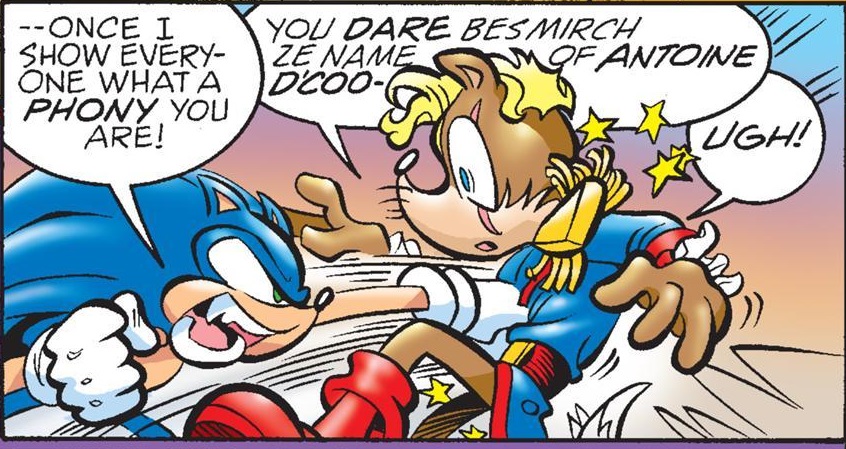
The story begins with King Acorn and Queen Alicia returning home, following their long trip abroad. Instead of doing something interesting with that, the failed diplomacy trip is brushed aside with a few lines of dialogue. Anyway, it turns out that Antoine – or rather Anti-Antoine, still masquerading as the real deal – has been poisoning the king. His health failing, the King informs Sally that the time has come for to ascend to the throne. And she can't do that unless she's married, with Antoine being chosen as her suitor. Which is all according to the villain's plan. When Sonic hears this news, he's pretty upset.

We've known Antoine's evil double has been living in his shoes for at least five issues now. Antoine's gradual asshole-ification has been going on for at least a year, inside and outside the book. After all that, the comic has finally gotten around to providing some insight to Anti-Antoine's master plan. Essentially, he's been planning to murder the king and take the crown for himself. Which is admittedly a more nuanced plan then Anti-Sonic's scheme to score with as many chicks as possible. Anti-Antoine even gets a decent action beat, when he pins Sonic with his sword and kicks him into a river. But I'm not sure why it took so long for the wicked coyote – or the writers, for that matter – to get around to doing this.


Sadly, most of “Line of Succession” is devoted to brain dead romantic melodrama. Of all the book's misbegotten love triangles, the Sonic/Sally/Antoine triangle has been dead and buried for the longest period of time. Even that bullshit about the King insisting Sally marry Antoine has been a moot point for a while. Remember when Max flat-out told Sally he was fine with her dating Sonic? That character development goes out the window here, as the King dismisses Sally's relationship with the hedgehog as a silly bit of juvenilia. At least Anti-Antoine doesn't actually feel anything for Sally, wanting to marry her strictly for the sake of power. But it's still dumb.

Give credit where it's due. At least Princess Sally gets a smidgen of agency. After her dad informs her that she'll marry Antoine, Sally is understandably aghast. After the required amount of hand-wringing and tears that has sadly become typical for Sal, she thinks the situation over. She decides to go through with the marriage, not because she's forced into it, but because it's her duty as the People's Princess and the leader of Knothole. Yes, some nudging from Antoine helps her come to this conclusion. But it's something. She's not entirely a pawn in the plot, pushed around by the whims of the writer.


Sadly, the melodramatic shenanigans do not end there. The issue opens with Tails walking in on Sonic and Fiona making out. As the fox is still crushed on Fiona, from his encounter with the robotic version so long ago, it's a harsh moment for him. The Tails/Fiona thing has been simmering for a while so it's disappointing that it ends so curtly. Especially since Sonic and Fiona have never previously been an item. Furthermore, I'm not a fan of the book continue to push Sonic as a lady's man. Later in the issue, he refers to Bunnie as “babe,” suggesting there's still some sexual tension between them. I don't know why Ken wrote Sonic as such a cad. That was Anti-Sonic that was screwing around on everybody, right? Why is the real deal still doing this?

Just as Sally and Antoine are walking down the aisle, we head to our back-up story. Dulcy the Dragon takes center stage in “The Price of Flame.” At some point in the past, the Freedom Fighters asked Dulcy to light a ceremonial fire. The dragon flies away, tears in her eyes. In flashback, Dulcy reveals her past and how she lost her ability to breath fire.


Dulcy the Dragon has long been a much neglected part of the “Sonic” supporting cast. So it's nice for her to get a story arc to herself. Further more, in all this time, we've never learned much about Dulcy's background. Mike Gallagher finally fills us in. After her family was robotocized, Dulcy lived in an underground colony of dragons called Vesuvio. Contact with the outside world was forbidden. When it was discovered that Dulcy had been sneaking out to fight Robotnik, she's punished with exile. Her fire breathing abilities are also stymied, by switching out her black “scorch ring” with a power inhibiting gold Power Ring. Now, she's returning home for the first time in years.

It's as decent a backstory as any and explains why we've met so few other dragons. But Mike Gallgher's approach could've been better. As Dulcy flies back to Vesuvio, she explains her past in detail. Which amounts to a series of panels, large narration boxes overhead. It's doesn't feel much like a story, working more like an encyclopedia listing. In other words: it's another heaping load of exposition.

Worst yet, I'm pretty sure Mike wrote this story just to clear up a minor continuity error. In the past, Dulcy's nose ring has been colored as either gold or black. This is explained as Dulcy painting her golden ring black sometimes, in shame over loosing her powers. Really, Mike, we don't care about coloring errors. You don't have to devote a whole story to justifying them.


At least there's no stinky Ron Lim or Al Bigley artwork this time. James Fry draws the cover story. Fry's artwork is confident, full of expression and anime-style movement, but he's having a bit of an off-day. He even utilizes some Jon Grey style big, cartoony emotions a few times, to mixed affect. Art Mawhinney draws the back-up story. Dulcy, being a very cute character, looks good in his style. I really love the flashbacks to Dulcy's early days with the Freedom Fighters, which really brings us back to the SatAM years. Of course, lending such a cute style to a horde of multi-colored dragons does have the side effect of making this story feel like an episode of “Dragon Tales” sometimes. That's not Art's fault. Probably.

The cover story is less outright bad then it's just mostly mediocre and unnecessary, with several really obnoxious writing flaws. The back-up shoves too much info, awkwardly, into too small a place. It's pretty lame and another example of how badly this book dragged in 2005. But let's appreciate small miracles. At least the real Antoine will be back soon. This other guy is a prick. [5/10]