Monday, April 11, 2016

Tails (Mini-Series): Issue 1


Tails (Mini-Series): Issue 1
Publication Date: October 1995

Looking back, it’s impressive that Archie was so eager to launch a spin-off series out of “Sonic.” I guess Sonic was a still-hot property at the time, full of potential, and they wanted to take that to the bank. Earlier in 1995, they gave Princess Sally a three issue mini-series. Later that same year, Sonic’s sidekick Tails got a mini-series of his own. (It wouldn’t be until Archie’s next attempt, with the Knuckles series, that a spin-off would be successfully launched.) Released over the last three months of ’95, the “Tails” mini-series is perhaps less notable for starring everyone’s favorite two-tail freak and more for the ways it would continue to expanded the Sonic Archie-verse.

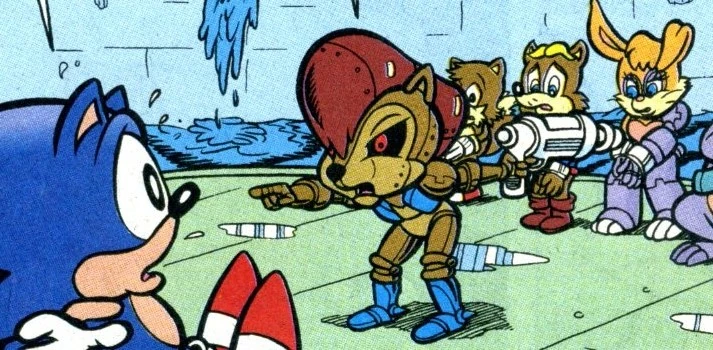
Still pissed about the way the Freedom Fighters infantilize him, and still smarting over having his heart broken by Fiona, Tails heads out on his own adventure. Jumping in the Sea Fox, he sails out over the island, headed towards Robotnik’s plan on the other end of the globe. Along the way, he stumbles upon the robotic dictator’s secret new blimp. Immediately afterwards, he swims into the path of Octobot. Luckily, a new team of aquatic Freedom Fighters come along to save his butt.


Tails slightly sucks at his job here… Which is precisely the point. He’s tired of being treated like a little kid but he’s really not ready to fight evil on his own. Upon discovering Robotnik’s stealth blimp, he’s immediately blind-sided by SWATBots. Afterwards, he falls directly into a trap laid by Octobot. Truthfully, the eight-legged robot has Tails’ goose cooked. He drags him underwater and chokes him out. This mini-series would’ve been a lot shorter if the Forty Fathom Freedom Fighters hadn’t intervened. Despite being slightly incompetent, Tails has some tricks up his sleeve. He manages to take out a few SWATBots with a neat (if implausible) trick involving a water spout. See, he’s got moxy but not the experience to back it up.


Mike Gallagher, despite his usually comical style, was surprisingly willing to add some darkness to the back-up stories leading up to this mini-series. In the first part of “Southern Crossover,” he leans back on that goofiness. “Tails” opens with a peak at a comic Tails himself has written, which recast the fox as Captain Super FoX-Man the Mutant Cyborg Clone. (Jabs at the other, more popular comics were a reoccurring gag that I had hoped this comic had abandoned.) Robotnik’s blimp is literally cloaked. It has a camouflage tarp over it and can only be seen from below. Tails knows what Robotnik is up to because he swiped his list at the end of the last story. When confronted by the missing list, Robotnik denies it and destroys the descending machine. If any of the other writers handled this story, the Forty Fathom Freedom Fighters probably would’ve been called the Aquatic or Underwater Freedom Fighters. Gallagher has to go for the pun.


Still, I do like the way the script continues to expand Sonic’s world. The comic moves away from Knothole Village and the Great Forest. Tails is on the open waves, headed towards Downunda, the Mobius version of Australia. Yeah, the Forty Fathom Freedom Fighters are goofy. The jellyfish is named P.B., the manta ray is Ray. The dolphin and whale don’t even get puns for names, as they’re just called Bottlenose and Fluke. (Bivalve the Giant Clam doesn’t even get mentioned by name.) However, I still like the team. I like the idea that underwater Mobians are just as intelligent as those on land but maintain their fish-like appearance, that form being better suited for living under the sea. The appearance of Fluke the Whale actually has a bit of awe and wonder to it.


Truthfully, the biggest problem with “Tails” Issue 1 is that it’s all set-up and not enough story. Tails’ adventure on the high seas doesn’t really set the plot moving. The actual plot development takes place in Robotnik’s scenes. These sequence introduce CrocBot, the story’s actual antagonist. Downunda’s boss, CrocBot intends on taking over Robotnik’s forces and toppling the dictator as soon as possible. That CrocBot immediately announces these intentions does not make for the smoothest writing. (That his plan seemingly involves sticking Crocodile Dundee hats on the SWATBots is more funny then anything else.) Visually, CrocBot is pretty cool though. You can’t understate the appeal of a robot crocodile guy.

Dave Manak’s artwork is loose and angular, as always. His weakness for differing angles comes up. “Tails” Issue 1 has some problems but it’s also a first issue. It’s got plenty of wheels to set spinning. Will the series get better as it progresses? I’ll guess we’ll find out soon enough. [6/10]

Friday, April 8, 2016

Sonic the Hedgehog: Issue 29


Sonic the Hedgehog: Issue 29
Publication Date: October 1995

By this point in the existence of Archie’s Sonic series, it started to form its own personality. Though with lots of SatAM, some of the video games, and an occasional burst of “Adventures of,” the team of writers had added enough of their own ideas to make the series kind of its own thing. However, there’s no doubt that SatAM was the biggest influence on the comic. This is made all the clearer in Issue 29, which introduces more SatAM element. Firstly, it adds Dulcy the Dragon to the comic’s cast. A character conceived for the show’s second season, Dulcy managed to become a fan favorite despite never doing much of anything. The comic also features one of the oval-shaped hoverpods that were a common fixture on the cartoon. After a bit of a break, Robotropis is back to looking like it did in the show. Most importantly, the issue’s story truly feels like a left-over SatAM script.


After Dulcy and Sonic smash a hoverpod, Sonic sneaks inside and steals a rare de-robotocizer. The Freedom Fighters immediately formulate a plan for the object. Sally will sneak directly into Robotropis, purposely being captured. Using a chip devised by Rotor, Sally will be robotocized and sabotage Robotnik’s plan from the inside. However, before throwing her in the device, the villain discovers the chip and removes it. Now, the Freedom Fighters head into the enemy base, not realizing that their plan has been compromised.

“Steel-Belted Sally” is a story with very high stakes. Sally is robotocized, her free will zapped away. She becomes an agent of the enemy. Meanwhile, some important technology is introduced. A chip that restores a Robian’s free-will and a device that can de-roboticize someone seem like a huge deals. Accordingly, the Freedom Fighters’ first instinct is to de-roboticize Bunnie. Despite these huge ideas, the story is a bit disappointing. By starting the issue with the discovery of the de-robotocizer, from the beginning we know Sally will be returned to normal. The device seems too tidy and neat. It really seems like writer Angelo DeCesare thought up the idea of Sally being turned into a robot and then back-tracked, making sure the readers wouldn’t be too upset by the concept. Considering the last issue featured Sonic being brainwashed and wailing on his friends, that’s surprising.


Truthfully, the story plays it so safe that we never feel like Sally is in any danger at all. In both SatAM and many of the comics, roboticization is shown as Robotnik’s greatest crime. And why shouldn’t it? He yanks an individual’s free will away and transforms their flesh into steel. It’s a human rights (animal rights?) violation of the greatest order. Look at the SatAM episode, “Sonic’s Nightmare,” where the thought of Sally being captured turns Sonic into a nervous wreck. By showing it as easily undone, something that can be changed with a single device, the idea is robbed of its threat factor.

Secondly, the Freedom Fighters never seem very concerned about their leader being changed into a soulless robot. Perhaps the story just moves too quickly to focus on that. Still, I’d expect Sonic and friends to be way more pissed, far more emotionally violated, by what happens. DeCesare’s script is a little too jokey in general for the subject matter. For a story that involves the theft of free will and a major character being seriously endangered, wrapping it up with an “Everyone Laughs!” ending seems insincere.


I’ve done so much praising of Art Mawhinney’s artwork since starting these reviews. Yes, issue 29 looks very good. Mawhinney’s strength for hugely expressive faces gets shown off. However, I do offer some criticism. Dulcy has always had a slightly awkward design and, even with someone as skilled as Mawhinney drawing her, she still looks kind of silly. Mecha-Sally, who years later would become a very important part of the mythology, looks really odd as well. The visible bolts and rivets in her body make the design seem slightly comical. Her modular body is just awkward. As a kid, I was always disappointed that the terrifying Mecha-Sally drawn by Spaz on the cover never appears exactly like that in the book.

The cover story seems to be want to be dark but kind of wimps out. The back-up story, surprisingly, doesn’t cheat on the darkness. The second part of “Growing Pains” picks up where last month's story left off. Tails is still imprisoned by Robotnik and the robotic Fiona. However, he makes a last minute escape. Now he has to fight off the girl he loves and the mad tyrant behind the scheme.


It’s odd. Mike Gallagher is never above goofy sight-gags or puns. His script here is typically free-willing. Despite that, he’s still written one of the darkest stories to ever appear in the pages of “Sonic.” Tails is betrayed by the girl he loves and shoved in a death trap. Even after escaping, that girl tries to murder him repeatedly. The story concludes with Fiona trying to drown Tails in the sea, shoving his face under the waves until he expires. Holy shit, right? I continue to like Gallagher’s characterization of Tails as an angry teen. He even seems genuinely tough after he clogs up Robotnik’s machine with his tails. He wakes the guy with a tree and gets in a fist fight with his love interest. At one point, Tails even announces that Robotnik has “robbed him of his innocence!” Again, I say “Holy shit!”

The conclusion is a bit of a cheat. Fiona, just before delivering the killing blow to Tails, rusts up. Apparently, Robotnik didn’t think to water-proof his Auto-Automatons. Tails places the rusted up model on the beach and notices that Robotnik left some papers talking about his plans on the other side of Mobius. This, naturally, sets up the “Tails” mini-series which debuted the same month as this book. However, the story ends on a surprisingly emotional image. The robotic Fiona, rusted stiff, stands on the beach and watches Tails leave. As he goes, a tear runs from her eyes. Does this suggest that the robot maybe did have feelings for Tails, that Robotnik’s creations are capable of free will and emotions? We’ll never know. When Fiona Fox appeared again, years later, it was the flesh-and-blood version the automation was based off. And though the book would occasionally reference Tails’ feelings for Fiona, her reveal as a villain would sink that ship forever. It’s a shame. Imagine a story about a robot learning to love and overcoming its programming. Could’ve been something.

In short, the cover story is a bit of a disappointment while the back-up story remains strong. [7/10]

Wednesday, April 6, 2016

Sonic the Hedgehog: Issue 28


Sonic the Hedgehog: Issue 28
Publication Date: August 1995

Issue 27 ended on a crazy cliffhanger. After spending a whole issue trying to get to Knothole, Sonic finally arrived, with a psychotic grin on his face, ready to whoop ass. Issue 28’s verbosely entitled cover story, “Saturday Night’s Alright for a Fight!,” doesn’t waste any time. The first five pages are devoted to Sonic beating the crap out of his friends. He lays a series of punches on Rotor, knocking him to the floor in seconds. Showing once again that she’s more then his equal, Sally tosses Sonic across the room. Even with the assistance of Bunnie and Tails, Sonic still successfully defeats all of his friends. Tails’ defeat seems especially cruel, as he knocks the kid out of the sky. Imagine reading this as a seven year old kid obsessed with these characters. The titular hero just beat the crap out of all his buddies. It was shocking.

(Though consider this: Sally easily performs a judo-toss on Sonic, dodges his super-speed punch, and nails him in the face with a kick. Minutes later, Bunnie grips Sonic with a leg-hold, in-between her robotic limbs. Really, if they weren’t fighting a dear friend and potential love interest, I think the Freedom Fighters easily could have subdued Sonic. Robotnik was right: They do hold back because it’s Sonic.)


The second chapter of the story has Antoine and the Substitute Freedom Fighters managing to defeat Sonic. Considering the super-strong cyborg couldn’t do it, how could the team’s coward and a bunch of D-listers do it? Well, this issue perhaps marks Antoine’s transformation from the butt of Sonic’s jokes to the honorable soldier that he would become in the book’s later years. Most importantly, the guys turn the lights off first, leaving Sonic fighting blind. Notably, Dylan the Porcupine tackles Sonic after he tires himself out beating the snot out of everyone else. So there’s your answer over who would win in a fight between a hedgehog and a porcupine.

After such as such as strong opening, “Saturday Night’s Alright for a Fight!” concludes on a pretty typical note. The second whack on the noggin restores Sonic’s memories and personality. He proceeds to mislead Robotnik’s fleet of tanks (referred to as tractors for some reason), eventually leading them off a cliff. This ending is a bit too similar to how Sally and her team defeated some robots in the first issue of her mini-series. And while Issue 28 is a very fast-moving story with lots of action, the segments devoted to Robotnik and Snivley are heavy on the techno-babble and Penders-riffic exposition. The ending, where Robotnik basically chalks this loss up to experience, is a bit disappointing. He should have at least yelled or somethin’.


Once again, Art Mawhinney contributes the artwork. As in the last issue, he continues to experiment with shadows. The section devoted to Sonic and the Substitute Freedom Fighters battling in the dark are primarily painted in black and red, creating a very dark and moody tone. Mawhinney’s fluid, dynamic artwork makes him an ideal pick for such an action-heavy story. The fight scenes are exciting, easy to follow, and carry a real sense of energetic violence.


Interestingly enough, the comic doesn’t let Sonic’s unintentional betrayal go without some consequences. The back-up story, “Growing Pains,” stars Tails. It begins with Sonic’s faithful sidekick fleeing the village, horrified that his mentor would ever beat the crap out of him, for any reason. Jumping in his Sea Fox submarine, he floats out until he reaches an island. There he finds Fiona Fox, a lady fox tied to a tree. Immediately smitten, the two foxes spend the evening doing G-rated romantic things, like frolicking in a lake, carving their initials into a tree, and drinking from a coconut. Of course, it’s all a scheme. Fiona is an Auto-Automaton made by Robotnik and leads the young fox directly into a trap.

“Growing Pains” is written by Mike Gallagher and thus contains a lot of goofy sight gags and some silly dialogue. Take, for example, Robotnik’s odd call-out to Alfred Hitchcock. Despite this, the story is full of emotion. Within the same day, Tails has his heart broken by his best friend and mentor, falls in love, and is then betrayed by that love. The kid is having a tough time and, accordingly, acts more like an angsty teenager then his canonical eight years of age. This is my favorite version of Tails. It’s better then the fawning Sonic fanboy he was in the early years or the precocious kid genius he would develop into in time. Instead, he has a sense of agency, frustrated with being treated like a kid. His feelings for Fiona are fairly shallow. After laying sight on her, he’s in wuv. Of course, he’s just infatuated, since this is probably the first female fox he’s ever seen that is close to his own age. In short, Tails acts more like an angry, horny teenager. Which makes him way more interesting then just being Sonic’s sidekick.


Fiona Fox, both the robot and the real version, would kick around the continuity for years without much personality before Ian Flynn turned her into an evil femme fatale. Here, she’s just a prop for Robotnik’s plan and Tails’ affections. Yet it works. Even Dave Manak’s typically exaggerated artwork works, considering this is a story of high emotions.

Though the cover story kind of peters out in a disappointing way, the momentum from the excellent first half and the very good back-up story makes Issue 28 another classic. [8/10]

Monday, April 4, 2016

Sonic the Hedgehog: Issue 27


Sonic the Hedgehog: Issue 27
Publication Date: August 1995

Reviewing these old comic books has been a huge exercise in nostalgia for me. While I recall so many of them fondly, there are certain issues that definitely stick in my brain more then others. 20 and 24 are two examples I’ve previously covered. Issue 27 is another one. As a kid, my local Martin’s briefly stocked comic books on a big wall-length stand in front of the pharmacy. It wasn’t uncommon for my mom to drop me off there while she went grocery shopping. At the time, I remember reading probably terrible Power Rangers and Jurassic Park comics from short-lived publishers like Hamilton and Topps. And this one, Sonic Issue 27, leaping right out at me. I still have that very comic. Luckily, the story and artwork inside are pretty good too.


“A Scrambled Hedgehog” is this comic’s spin on a well-worn literary story type: The hero gets the kind of bumped-on-the-head amnesia that only exists in old TV shows and comic books. Upon discovering this, the bad guy turns the hero against his allies. The book is seemingly aware of this, as its plot was likely inspired by the SatAM episode “No Brainer” and the cover art is a homage to Amazing Spider-Man #56. While running a routine mission into Robotropolis, Sonic gets conked on the head. Awakening with no memory of who he is, Robotnik convinces the hedgehog that the Freedom Fighters are terrorists, fighting to destroy the government through sabotage. (Which they are but that’s besides the point.) Sonic races into Knothole Village, suddenly with a mission to destroy his friends. Sally has to prepare some last minute stop-gaps in hopes of preventing this.


Like I said, “A Scrambled Hedgehog” is not an especially new or cutting edge story. However, it’s beautifully paced. We begin with an exciting race through Robotropis, Sonic narrowly avoiding detection. The early scenes of Robotnik and Snively realizing Sonic has no memory nicely play up the villain’s personality. The next scene, of Sonic decimating the Auto-Automatons of his friends, shows how easily our hero could murder his friends. The rest of the story is devoted to the amnesic Sonic trying to find Knothole, unaware that he is leading Robotnik’s death squad to the location of his friends. This actually builds up some decent suspense, as you truly wander whether or not Sonic will lead his greatest enemy to his closest allies.


This is emphasized by a long sequence of Sonic exploring the secret tunnels leading towards Knothole. Most times, this story line would have the heroes tricked and unaware that their friend has been brainwashed. Not our Princess Sally. She immediately recognizes that something is wrong with Sonic. She proceeds to lock doors in front of him, flood the tunnel, and send a force of soldiers to stop him. This is a story with real stakes and pressures. That is constantly emphasized by Robotnik repeatedly referencing the tanks that will roll into Knothole Village the minute Sonic reveals its precise location. “A Scrambled Hedgehog” ends on a hell of a cliffhanger too. Sonic has blasted through the defenses and walks into Freedom HQ, ready to murder the fuck out of his friends. Since the story is so fast-moving, there’s not even much time for Ken Penders’ stale, overly expository dialogue. This fucker moves.


Also boosting the story is some of the best artwork Art Mawhinney would ever contribute to the book. I’ve pretty much done nothing but praise Mawhinney’s work since I started reviewing these old books. However, he truly outdoes himself here. The use of shadow is especially notable. While spotted in Robotropis, Sonic is under a spotlight, the shadows around creating an eerie tone. Mawhineny repeats this gag several times. Once, on Robotnik’s face to show his villainy, and again at the end, when Sonic is about ready to pounce on his friends. The artwork, sharp script, and strong characterization makes this truly feel like an episode of SatAM and definitely one of the best issues of the series’ classic run. [9/10]


Before I wrap up, I guess I should mention the book’s sole back-up story. “Coming Soon: Sonic the Hedgehog Triple Trouble” is a two page advertisement for the “Triple Trouble” one-shot that I reviewed last time, by Gallagher and Manak. I only bring it up for one reason: One of the panels promises that the book will feature Sally in a “pink string bikini,” followed by Sally clipping the offending scene out of a film reel. As a young kid with a shaky grasp on sarcasm, I really did think this moment was drawn before being removed. That Sally isn’t in “Triple Trouble’ at all seemed to support my theory. Now, I recognize it as a dumb joke. Then, I thought my favorite comic book was potentially edgier but under a short leash from moral guardians. The moral of the story?: Kids are stupid. (And if you really want to see Sally in a bikini, a Google search turned up this, you pervs.)

Friday, April 1, 2016

Sonic Triple Trouble


Sonic Triple Trouble
Publication Date: August 1995

For a brief glorious period in the early nineties, Sega’s Genesis (Or Megadrive, to you limey bastards) was a genuine rival to the Super Nintendo. At one point, Sega was even outselling Nintendo. However, there was one area where Sega always trailed behind: The portable market. Yes, kids, before everyone had a phone that could play hundreds of games, we had to rely on batteries and hand-held systems if we wanted to carry our video entertainment with us. Despite being in color instead of gray and green, the Sega Game Gear never came close to matching the Game Boy in terms of sales or popularity. Some blame this on the shorter battery life and bulkier size. I think the lack of a solid game library had just as much to do with it. There were many Sonic games for the Game Gear, including ports of 1, 2, “Sonic Spinball,” and console-exclusive games like “Sonic Chaos” and “Sonic Drift.” However, the only one I can recall seeing much advertising for was “Sonic Triple Trouble.” I can definitely recall seeing a television commercial for it and, not long after that, Archie would publish a comic tying in with the new game.


Like most of Archie’s early game tie-ins, the 48-page special “Sonic Triple Trouble” doesn’t bother adapting the game’s plot very much. The game’s plot has Sonic and Tails on a fetch quest, trying to gather Chaos Emeralds formally owned by Robotnik. Meanwhile, the villain has duped Knuckles, once again, into fighting against the heroes. Nack the Weasel, a third-party mercenary, is also thrown into the mix. The comic does introduce Nack and has Sonic and Knuckles coming to blows but the similarities otherwise end there. The comic briefly tosses the game’s different areas into a mid-comic zip through a Game Zone.
 
Robotnik’s latest attempts to power a machine with a Chaos Emerald goes horribly wrong when the device explodes. The emerald is shattered in two. One shard is magnetically drawn to the Emerald on the Floating Island. If the two gems should met, a massive explosion with result. The mad scientist pays Nack to track down the emeralds. Sonic and Knuckles, meanwhile, both pursue the shards, each hoping to find them before the villains do.


This main story, obnoxiously entitled “Tttriple Tttrouble,” is fairly middling. However, I do like how it continues to expand the Sonic universe’s mythology. It introduces Nack into the Sonic rogue’s gallery. While the character would never become a major player, he continues to show up regularly to this day. In this issue, we even see the bounty hunter get the best of Sonic, knocking him out with a laser blast and shoving him in his truck. He’s a different sort of bad guy and a welcomed addition.

When one of the Chaos Emeralds crashes into the ground, we see the creation of a Game Zone, which is sort of neat. The issue also introduces the Ancient Walkers, a trio of mysterious sorcerers. While some fans dismiss these guys, I’ve always liked them. I mean, they’re dinosaurs in Tiki masks! How am I not supposed to love that? Here, they show up, drop some exposition on Knuckles, perform some magic juju, and then show up at the end to wrap up the story’s loose ends. They’re not great character or anything but they serve a purpose.


My least favorite element of this story is Sonic and Knuckles getting into another fight. At least the book doesn’t emulate the game and have Knuckles get duped by Robotnik for a third time. Instead, the fight the two get into it is simply a misunderstanding, the two hot-headed heroes colliding during a bad moment. Sure, there’s always a certain novelty in watching these two rumble. However, it’s beginning to lose its freshness. By this point, Sonic and Knuckles should recognize each other as good guys. Mike Gallagher’s script is actually fine from a story perspective, rolling along at a decent pace and keeping things focused. However, he continues to pack the dialogue full of cheesy puns. Sonic actually makes a quip about “The agony of de feet!” while kicking Knuckles in the face. Sheesh. Dave Manak’s pencils are okay but Knuckles definitely goes off-model in a couple of panels.


The two back-up stories follow the cover story’s lead by expanding the comic’s universe. “Submersible Rehearsal” stars Tails. Rotor has built Tails a small, personal submarine called the Sea Fox. (The vehicle appeared in the Triple Trouble game and would play a bigger role in the next year’s “Tails Adventure,” also on the Game Gear.) Tails is excited by the vehicle but, on Sally’s orders, Rotor refuses to give Tails’ fuel. Soon, the frustrated fox stumbles onto a Robotnik plot involving an underwater roboticizer base and a new henchman called Octobot.

“Submersible Rehearsal” is basically a test-run for the Tails’ mini-series Archie would be premiering soon. Like that series, the story mostly focuses on Tails’ frustration with his role on the team. Considering the fox’s earliest characterization revolved solely around a fawning admiration for Sonic, it’s nice to see him break out a little. Octobot is not an especially well-liked character. Even Ian Flynn would mock him in-universe years later. However, as an underwater adversary for Tails, he serves his purpose here. Tails’ preteen-age angst over his role as Sonic’s sidekick and the underwater angle adds some spice to what would otherwise be a standard story. Art Mawhinney draws and, as expected, does fine work.

The last story, “First Contact,” is another Penders’ penned tale about Knuckles. After rescuing the Floating Island’s resident jack-ass Vector the Crocodile, Knuckles discovers a strange name carved into a rock: Archimedes. He follows the signs, rumbling with a pair of robots, before stumbling into the Chaos Chamber where a mysterious voice speaks to him. That’s it.

“First Contact” is a direct follow-up to “Fire Drill,” the Knuckles’ back-up that appeared in “Sonic & Knuckles.” There’s not much to the story, as it revolves around Knuckles simply encountering a series of characters, some friendlier then others. (While Archimedes and Vector would become important supporting characters, the brainless cockatoo Catweazle thankfully would not.) Like “Fire Drill,” it’s merely more build-up and foreshadowing to the events and backstory Penders would expound upon in Knuckles’ solo books. It’s the kind of overly mysterious padding and narrative wheel-spinning that Penders’ critics frequently yell about. At least the dialogue isn’t too bad.

Ken also draws the story. The artwork is… Eeeeh, not bad. Knuckles definitely gets a little squishy in a few frames. Penders’ artwork has the bad habit of looking worst the longer you stare at it. His depiction of the Lumberjack robot is especially awful, the robot not being much more then a vague blue shape. His backgrounds continue to be flat. Still, it’s not awful. It serves its purpose. Looking at it doesn’t make me angry, like future work Penders would do does.

“Triple Trouble” is probably something Archie Sonic fans definitely need to read, as it introduces many characters and concepts that would become more important later on. It’s not a bad book but, where it not for the expansion of the cast, would probably be very forgettable. Just like the video game it was meant to promote, it’s not awful but certainly doesn’t feel like a big event. [7/10]


Wednesday, March 30, 2016

Sonic the Hedgehog: Issue 26


Sonic the Hedgehog: Issue 26
Publication Date: July 1995

I’ve commented before about the wild tonal shifts this series underwent in its early years. It still varies from issue to issue at this point. Last time, I reviewed the “Sonic & Knuckles” one-shot, whose tone was relatively serious and closely in line with the SatAM series. Now, here comes Issue 26 with a story that feels like its right out of “Adventures of Sonic the Hedgehog.” Heck, Robotnik even hangs out in a hill-top tower, like he did in that series, and Snively is reduced to a pun-slinging sidekick, recalling the role played by Scratch or Coconauts. At times, the constant back-and-forth between mostly serious and mostly silly can really give the reader whiplash.


In “Way, Way Past Cool,” Sonic and friends are enjoying a pleasant summer day down by the stream. That is, until a freak snowstorm blows in. Soon, the entire area is below zero and everyone is freezing. Naturally, Robotnik is behind this freak weather change. He has created a device to drastically change the weather, expecting to wipe out the Freedom Fighters with me. When the frost-bitten furries take coverage in a cave, they meet another group of Freedom Fighters which may help them turn the tide.

This is a fairly basic story. The bad guy cooks up a standard plot – a big ass freeze ray is not exactly the most original scheme – the heroes scramble for a while before regrouping and finding a solution. The early scenes of the Freedom Fighters wandering through the snowstorm is mostly devoted to goofy puns and threating about what’s happening. Robotnik is in pure silly mode, yelling and screaming in a mock-serious fashion, acting like a comic relief villain. Though freezing to death is a fairly serious threat, the story doesn’t treat it very seriously.

If Issue 26 has anything memorable about it, it’s the introduction of a new group of Freedom Fighters. I’ve always liked new teams being introduced, as it makes Mobius feel like a more fleshed-out world. It’s good to know that Sonic and his friends aren’t the only ones out there rebelling against Robotnik’s regime. However, this issue doesn’t get much time to develop the Arctic Freedom Fighter’s personality. Guntiver the Wolf is the blandly heroic leader. Augustus the Polar Bear is the big guy. Flip the Penguin is the carefree, fun-loving one. And Erma and Sealia are the girls. All Erma does is help chip Sonic and friends out of a block of ice later one. Sealia does nothing. The character designs are funny and interesting but the team is so thinly sketched, it’s hard to care much about them.


Still, there’s some okay moments in “Way, Way Past Cool.” The scene of Sonic sliding on the ice in the cave is mildly amusing, showing that his speed isn’t always enough to make it out of a situation. Seeing the two teams come together is mildly satisfying, as is the catapult the heroes build out of nowhere. Snivley is in groveling, suck-up mode here, doing his best to appease his boss, which is one of my favorite Snivley modes. Mostly though, I wish the story made better use of its snowy setting and its new cast. Dave Manak’s angular, goofy artwork doesn’t help matters much.

The back-up story, “Fortified,” is a lot better, if equally disposable. While exploring the woods, Sonic twists his ankles. This leaves the Freedom Fighters without their most valuable member. The group explores the woods before coming to an abandoned wooden fort. Robotnik is right on their trail, in a tree leveling bulldozer. With Sonic out of commission, Rotor builds Bunnie a suit of armor from the old scrap metal lying around the fortress.

First off, it’s always nice when this series remembers that Bunnie exist. I don’t think she’s contributed to a story since Issue 23. The comic was still finding a use for her at this point. In this story, the writers seemingly realizes that she is actually the most powerful member of the team. When Rotor whips her up some body armor, she easily shreds a whole team of SWATBots. The sudden appearance of an old fort really comes out of nowhere. However, the story is breezy and fun. With Art Mawhinney’s typically spot-on artwork, forested setting, and a focus on the ensemble, “Fortified” really feels like a lost episode of SatAM. Not a super memorable one but an entertaining one nevertheless.

So I guess what I’m saying is you can skip the cover story and go straight to the back-up. [6/10]

Monday, March 28, 2016

Sonic & Knuckles


Sonic & Knuckles
Publication Date: May 1995

Knuckles has been such an essential part of the Sonic cast for so long that it’s hard to remember a time when he wasn’t a part of it at all. The Sonic cast was still fairly small at the time. In the years since his first appearance, Sega has increasingly characterized Knuckles as dumb muscle, a strong doofus. This was not how it was originally. Though gullible, Knuckles was originally the mysterious bad-ass of the Sonic-verse, a character with an unexplored back story with links to ancient, mysterious legends. He was tougher then Sonic, more willing to strike first and ask questions later. His allegiances were initially ambiguous. Though he would soon be established as a good guy, his morals were obviously different then Sonic. This made Knuckles a big deal. (Shadow has largely usurp Knuckles’ role as the mysterious bad-ass of the series, which is probably why Knuckles has been recast as a dim-witted goofball.)

Despite that, Sega was slow to capitalize on his popularity. His developer, Takashi Yuda, never considered Knuckles anything but a supporting character. Though he got his own game in 1995, with “Knuckles’ Chaotix,” that was on the little-played Sega 32X system. It wouldn’t be until the “Sonic Adventure” days before Knuckles actually started to receive merchandising of his own. Fans wanted more Knuckles but Sega seemed reluctant to give it to them. Archie, on the other hand, understood fan demand. The 1995 one-shot “Sonic & Knuckles” was ostensibly made to promote the newest Genesis game, basically the second half of “Sonic 3.” In truth, the issue was designed to properly add Knuckles to the comic’s cast, develop his own mythology, and make him a major character that would eventually headline his own series.


The first of the annual’s three stories is “Panic in the Sky,” a very loose adaptation of the “Sonic & Knuckles” plot. Aside from some scenes in the Mushroom Hill Zone, an appearance by that lumberjack robot, and a brief sequence in a lava-filled area that we can assume is the Lava Reef Zone, the comic doesn’t resemble the game much. Instead, the plot concerns itself with the Floating Island flying wildly off-course. The Island is floating in-land, towards Knothole Village. Concerned, Sally sends Sonic and Tails to investigate. They discover Knuckles, who is still antagonistic to them, and an island fortified with automatic turrets and robot traps. Yep, Robotnik has taken over the Floating Island, utilizing it in his latest scheme to crush the Freedom Fighters.

“Panic in the Sky!” has a few plot hole issues. Robotnik’s idea depends entirely on him knowing where Knothole Village is. This runs counter to most every other Sonic comic Archie would publish in the near-future, where locating Knothole Village was Robotnik’s central objective. Knuckles and Sonic still being at odds, despite their previous team-up in “Sonic #13,” seems like an obvious excuse to get them to fight. Penders and Kanterovich really pull the conclusion to this one out of their ass. Knuckles smashes the Chaos Emerald that keeps the island afloat, forcing Robotnik to flee suddenly. Knux then immediately reveals that he smashed a duplicate, prepared for scenarios just like this. After seeing the Floating Island resume floating in his rear-view mirror, don’t you think Robotnik would have flown back and continued his plan? Truthfully, “Panic in the Sky!” is not Ken Penders at his strongest, as the story is fairly heavy on exposition and awkward dialogue. Such as a two page spread where Sonic talks exclusively in puns for no reason.

 
Despite its problem, I still like this story. Incorporating some of the “Sonic & Knuckles” elements makes the Floating Island seem like an even stranger, more mysterious location. Yes, Sonic and Knuckles fighting before teaming up to take down Robotnik is a plot we’ve seen before. However, there’s always something a little satisfying about it. If this story is meant to develop Knuckles more then anything else, it shows him as a flawed hero, someone who is brass and temperamental but also resourceful and quick-witted. Another thing worth liking about the story is Art Mawhinney’s once-again excellent artwork. The story begins with a gorgeous two-pager of the Floating Island looming over a happy Mobian beach. Dave Manak takes over in the second half and, though Dave does better then usual with the action, it’s still a noticeable drop in art quality.

This being a double-stuffed annual, “Sonic & Knuckles” features two further stories. Showing that this book truly was written to capitalize on Knuckles’ growing popularity, both are devoted exclusively to the echidna. “Fire Drill” was both written and drawn by Penders. It would lay the foundation of the mythology he would soon build around the character, for better or worst. In it, Knuckles pursues an unseen intruder on the island, stumbling into a series of different traps, surviving each by the skin of his teeth.


If there’s anything the internet has criticized more then Penders’ writing, it’s his artwork. And, yeah, over the years he would contribute some awful illustrations to this series. However, “Fire Drill” looks okay. The backgrounds are flat and simplistic. A scene of Knuckles exploring a temple features some odd-shaped buttons on the wall. However, Knuckles never goes wildly off-model like he would in later stories and there’s a generally okay flow of action here. Plot-wise, there’s not much to “Fire Drill.” It mostly exists to exert the Floating island’s mysteriousness again and show that someone is watching over Knuckles. Knuckles spends the entire story talking to himself. On one hand, this is probably because he spends a lot of time alone. On the other hand, it inflicts a lot of awkward Penders’ dialogue on the reading. The story is middling work but nothing bad.

“Lord of the Floating Island” is another Penders’ joint focused on establishing a part of the echidna’s personality. This story focuses on his role as the Floating Island’s protector. In it, a solar eclipse causes some strong winds to blow through the Island. Knuckles rescues a lost kangaroo joey, avoids a stampede of dingos, and returns the kid to his mom. That’s it.


Since the Floating Island has always been portrayed as desolate, it’s weird to see other character occupying it. It’s also weird to read Knuckles referring to dingoes as “harmless,” as later issues would establish echidnas and dingoes are eternal enemies. The kangaroo kid is slightly annoying and his mom’s sudden appearance at the end is anti-climatic. Hearing Knuckles proclaim himself protector of the island makes him sound egotistical. The story also features Harvey Mercadoocasio, who usually works as an inker, contributing some seriously awkward pencils. There’s no motion to Mercadoocasio’s work and the characters are slightly squishy, always on the verge of going off-model.

In short, none of “Sonic & Knuckles” is mind-blowing work. The lead story is fun, if unimpressive. And the back-ups are varying degrees of just-okay. Still, as a young kid eager to learn more about this Knuckles guy, I really appreciated this special. It was one I thumbed through constantly when I was young. For nostalgia reasons alone, I’ve got to bump this up from a [6/10] to a [7/10.]