Monday, October 10, 2022

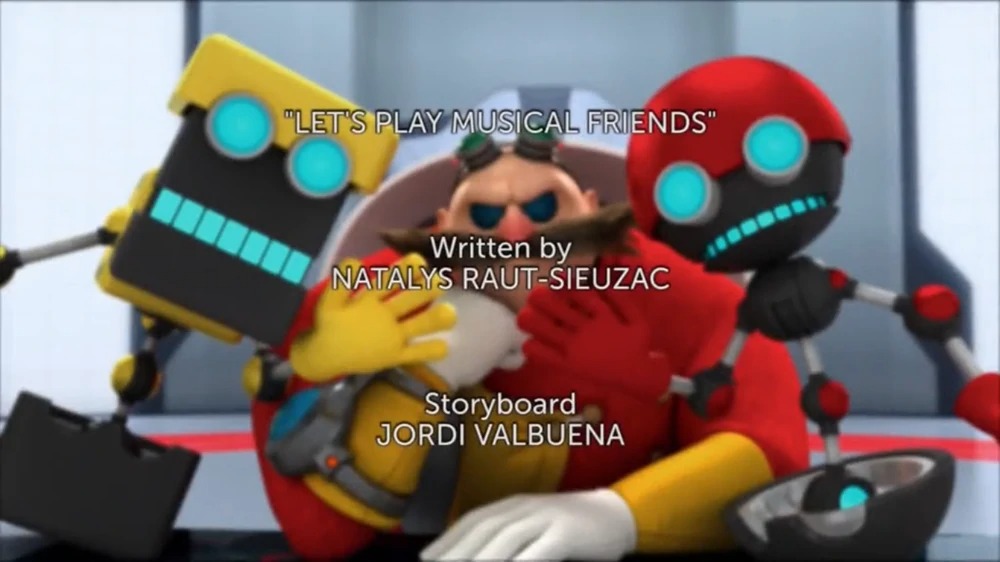
Sonic Boom, Episode 1.23: Let’s Play Musical Friends


Sonic Boom, Episode 1.23: Let’s Play Musical Friends
Original Air Date: April 25th, 2015

Here we have another episode of “Sonic Boom” that focuses mostly on Cubot and Orbot. The two lackeys are dismayed to see that Eggman is spending all his time with a new online friend, who calls himself Nominatus and hides behind a demonic looking avatar. The robots get so upset that their creator is ignoring them, they go live with the Sonic Team for a while. After playing around with Tails’ computer, they discover that this new friend is actually plotting to take over Eggman’s base and robots. This evil scheme soon goes into action. While Sonic and Eggman make a truce to fight off the corrupted Badniks, Cubot and Orbot head into cyberspace to fight Nominatus. 

“Let’s Play Musical Friends” is an episode where a lot of things happen for vaguely defined reasons. Presumably Eggman and Nominatus met online, even though there’s never been a reference to the internet existing in this show’s universe before. Nominatus is a sentient computer virus that seeks to conquer meatspace and destroy all life forms, though we have to assume some of that information. Cubot and Orbot discover the virus' plan when they drop Tails' laptop and it randomly shows them images of this new threat taking over Eggman's base. The two robots confront the villain after downloading themselves into a video game and I'm not really sure how that works either. We just have to take a lot of the events that go down here at face value. 


I know Nominatus reappears in at least one more episode, so maybe his origins and motivations are expounded on some then. But "Let's Play Musical Friends" does feel messy. Was this another example of a story that needed more than eleven minutes to be told? Natalys Raut-Sieuzac is the credited writer but she's usually a director. (In fact, she directed every single episode of "Sonic Boom.") Perhaps she's better at the visual parts of assembling a narrative than the coherent storytelling parts. She's also French, so maybe some things were just lost in translation. Even that title is kind of weird. I guess it’s comparing Orbot and Cubot swapping friends to a game of musical chairs. Which is kind of an obtuse metaphor and doesn’t relate that much to the episode’s premise. Perhaps I'm just overthinking a comedy cartoon for children. I do that often. Yet this one definitely feels off.

Nevertheless, there is a clear moral here. It's one that has been stated many times before but that young kids, in our modern age, probably can't hear too many times: Be careful who you trust online. Eggman seems to have just met Nominatus and immediately begins to tell him everything. He trusts this stranger, who turns out to have ulterior motives, because they seem trusting. That's because this so-called new friend knows exactly what kind of person Eggman is. (Hopelessly naïve and vulnerable to flattery, like a child would be.) He knows how to manipulate him to get what he wants. Of course, Nominatus is a living computer virus, instead of some random creep. He wants to take over Eggman's technology and use it to subjugate the fleshy world, instead of just getting him to send nudes or credit card numbers. I know this is a comedy show and the metaphor falls apart if you think about it too hard. Yet it's difficult to imagine this wasn't somewhat on the show runners' mind here. 


Writers may be able to clearly illustrate the message of "use caution when talking to people online." Still, even after it's been a major part of our lives for two and a half decades, lots of creative folks continue to struggle with how to make the online world cinematic. Lots of stories still depict cyberspace as another realm that we can simply download our physical bodies onto. "The Matrix" did it, "Digimon" did it, and "Sonic Boom" was still doing it in 2015. A tactic I've been seeing all the time lately — with "Ms. Marvel" being the latest guilty party — is shows and movies putting text messages and chats up on-screen as big animations. "Boom" does this too, as Nominatus has emojis pop around his head. (Even though he is capable of just talking too.) 

The truth is, our internet lives exist parallel to our real world lives. It's not a physical space, no matter how much some might wish it to be. The internet exists to trade information, not sensation, and we still haven't found a way to touch people through a cellphone or computer screen. This makes the "cyberspace as physical place we physically explore" concept seem increasingly out-of-date, a throwback to a time when we all thought virtual reality was going to be cooler than it actually turned out to be. As for flashing text and emojis on-screen, that's just a desperate attempt to make the deeply uncinematic act of sending words and pictures back and forth seem cinematic. I wouldn't expect the creators of a silly blue hedgehog show to figure this out, when actual pop culture geniuses like the Wachowski sisters are still struggling with it. Yet it's strange to me that we all live online 24/7 now and we still haven't figure out better ways to depict these ideas on-screen. 


The best "Let's Play Musical Friends" can do is just make it like a video game. Cubot and Orbot are transported into a pixelated landscape, which reflects the look and layout of '90s platformer. When they encounter Nominatus, it definitely feels like they've reached a boss battle. Even the way Cubot and Orbot doing things in the online world has direct actions in the waking world feels video-game-y. This is reasonable, I suppose. "Sonic Boom" is based on a video game after all. Yet it all feels pretty out-of-date too, reflecting an antiquated image of gaming. You can also see this in the gags that follow during these scenes: There's a cutesy reference to classic "Sonic" games, which is fair enough. I'll even allow Cubot to joke about 16-bits. Yet the shout-outs to "Your princess is in another castle" and the Konami Code couldn't have been hoarier in 2015. (And those games weren't even on the Genesis!) I guess kids watching a "Sonic" cartoon are more likely to be interested in early nineties gaming than most but this still feels like jokes conceived by and pitched at people who haven't picked up a controller since 1992.

Yet all the bitching I've done here is really besides the point. We don't watch this cartoons for cutting edge commentary and depictions of our digital lives. This is "Sonic Boom," not "Serial Experiments Lain." We are here for shenanigans involving lovable, simply understood cast members. And, despite its many flaws, "Let's Plat Musical Friends" does pull that off. I’m really growing fond of Cubot and Orbot. They are such goofy losers. When Eggman rejects them in favor of a shinier, newer friend, they march off to Sonic and the gang, the only other people they know. They pathetically beg to be included in this group. Of course, the heroes don’t really want to interact with the socially awkward sidekicks of their enemy. The episode’s funniest moment has everyone ditching the bots, until Tails ends up stuck with them. No matter how much they talk about wanting to escape Eggman, Cubot and Orbot — like all of this show’s sitcom stock roles — can’t imagine a life for themselves outside of the parts they’ve been assigned. They obviously hope Tails will take over as their new master, that they can be lackeys to a different inventor. When he also ditches them, the robots retreat into childish bickering between themselves. 


And that’s what I’m really starting to like about this show. It’s not the action scenes — there’s more forgettable Badnik bashing here — or it’s mostly lackluster additions to the greater “Sonic” lore. (Nominatus is a generic baddy, seemingly pulled from the same uninspired aesthetic as the Deadly Six.) It’s how the show zooms in on the comic book cartoon rivalries between good guys and bad guys until they become indistinguishable from mundane human interactions. At the end of the episode, after Nominatus is defeated, Sonic and Eggman decide they are too tired to fight today. They make plans to fight next week. Because, once you get meta enough about it, enemies are just friends in reverse and we’re all living in our own personal sitcoms. 

Maybe that’s why I kind of found myself kind of liking this one, even though it’s a complete mess and only a handful of the jokes really work. I guess I’ve gotten attached to these versions of the characters, or at least the dysfunctional friendship Sonic and Eggman have. The episode barely makes any sense and mostly approaches its premise in cliched and worn-out ways. But I like spending time with these goofballs and seeing their weird relationships play out. [6/10]


Friday, October 7, 2022

Sonic Boom, Episode 1.22: The Curse of Buddy Buddy Temple


Sonic Boom, Episode 1.22: The Curse of Buddy Buddy Temple
Original Air Date: April 18th, 2015 

In my last “Sonic Boom” review, I talked a little about how the “Sonic” franchise is extremely fond of ancient ruins. It began in the very first game, where Sonic has to navigate Greco-Roman structures filled with lava and a water-clogged labyrinth occupied by mysterious statues. The second game had a stage actually called “Aquatic Ruin” while the Mystic Ruins were one of the major hub areas in “Sonic Adventure.” In fact, off the top of my head, I can only think of one major “Sonic” game — “Advance 2” — that doesn't have an ancient ruins-themed stage. Even the racing games usually feature them. And it looks like “Sonic Frontiers” is going to continue this tradition. 

It’s easy to see why this type of setting would become such a trademark of the series. “Indiana Jones” still had a very prominent presence in pop culture in the early 90s, doubtlessly influencing “Sonic.” A temple full of death traps and puzzles is perfect for a platformer game. A setting like this makes it easy to vaguely hint at some sort of history for the game’s story without actually having to devote an entire cutscene to it. (Which certainly wasn’t practically for the 16-bit games.) Plus, they look cool. Accordingly, they are very common in the comics and cartoons as well. Unsurprisingly, the “Sonic Boom” cartoon would build a whole episode around this idea too.


The episode begins with a typical situation. Eggman is chasing Sonic through the woods while his friends fight off some Badniks. The two chase one another into a mysterious temple, that locks behind them as they enter. Sonic twists his ankle and Eggman’s Egg-Mobile is destroyed, meaning they have to find their way out of this place naturally. Soon, they are tossed into one death trap after another, which can only be escaped if they work together. Will these two enemies learn to put aside their differences and escape the fearsome Buddy Buddy Temple? Or are they doomed to bicker endlessly until they're crushed by a boulder or whatever? 

Just like it did with the lumbering rock monster premise last time, “Sonic Boom” has a somewhat sarcastic take on the temple of doom concept. Who built Buddy Buddy Temple is unknown but the purpose behind it is clear. Hieroglyphs of beavers working together decorate each room, making it clear that people have to cooperate if they hope to escape the generic death traps. (Which include such stalwarts as spiked walls closing in, the floor turning to lava, and arrows shooting out of random places. The show even throws in a mine cart sequence.) This gives me the impression that Buddy Buddy Temple was the equivalent of a team-building workshop for whatever ancient civilization erected it. The show essentially dispenses with any deeper purpose and makes this setting the plot device it is, building the temple around its story purpose.


I figured the main joke to this episode was Sonic and Eggman, two characters intrinsically opposed to one another, stuck in a situation where they have to work together but then refuse to do so. That they would mock, belittle, and undermine one another and just survive through sheer luck. A total subversion of the Enemy Mine premise, in other words. Instead, "The Curse of Buddy Buddy Temple" plays that element kind of straight. Sonic and Eggman snipe at each other plenty and the doctor does attempt to betray the hedgehog eventually. Yet, in the end, they come out of temple with more respect for one another. The show leans into one of its more intriguing ideas here, something the "Sonic" franchise has suggested from time-to-time: Sonic is the closest thing Eggman has to a pal. Fighting each other is their bonding time. It's a funny idea and leads to an almost cute ending. I guess the real curse of the temple is the friends we made along the way.

While Sonic and Eggman unexpectedly find harmony inside the temple, the rest of the gang fall into disharmony outside it. Sonic's friends bicker amongst themselves as they try and decide who should lead in Sonic's absence. This is when "Sonic Boom's" embracing of stock sitcom archetypes becomes really funny. Everyone in this group has a single-minded role. Amy is the reasonable straight woman, so of course she believes she's the best choice to lead. Knuckles is a big dumb child with an inflated sense of self, so he wants to lead and is completely unwilling to listen to the reasons why he shouldn't. Tails wants to be the middle man between these two uncompromisable viewpoints, which just leads to him getting yelled at. Meanwhile, Sticks' paranoid mindset means she's suspicious of all authority and won't trust anyone who leads. Is this a political metaphor of some sort? Is Amy Hilary and Knuckles Trump? Probably not. Either way, it's funny and a good use of the characters. 


It’s a pretty funny episode, all things considered. Most of the bickering made me chuckle. There’s a pretty good gag where, after Eggman is trapped in the temple, Cubot and Orbot celebrate. Apparently Cubot’s greatest goal in life is to live on a houseboat, just because he thinks houseboats are cool. Inside the temple, there’s a moment where Eggman asks Sonic to wear a harass, the kind pets and unruly children were, and the hedgehog’s reaction to that got me to snort. There’s still a lot of the limp sitcom one liners here that I dislike. The opening scene where Eggman sings a laser themed song or complains about birds, or later when he explains a pun to Sonic, are the kind of painfully overdone snarkiness that this show really struggles with. “Boom” needs to be wackier and less snide, I think. That’s where its strength lie.

I probably would’ve made more of a deal out of Sonic twisting his ankle, a plot point that is dismissed pretty quickly after it’s first brought up. You’d think a constant runner like Sonic losing the ability to put any weight on his foot would be more of a hinderance for him. Maybe all that sports tape act as compression stockings. Anyway, this is still a good episode, with a surprising payoff and enough decent gags and lines to amuse me. [7/10]


Wednesday, October 5, 2022

Sonic Boom, Episode 1.21: Sleeping Giant


Sonic Boom, Episode 1.21: Sleeping Giant
Original Air Date: April 11th, 2015

In "Sonic & Knuckles," the first part of the Sandopolis Zone concludes with a boss battle against a lumbering rock monster. You bop the stony guardian on the head until he falls backwards into a sandpit. This would begin a precedence in the “Sonic” franchise for humanoid threats made of granite. There was the Egg Golem in “Sonic Adventure 2” and adaptations in all of the above in the various comics. I’m guessing this is because living statues and monuments are a common action/adventure trope in general. In a series that freely mixes together robots and ancient ruins, it’s probably inevitable that Sonic would encounter some animated petrological life forms. Rock monsters show up in "Sonic Boom" as well and the cartoon show had a typically irrelevant take on them. 

Sonic and Knuckles are out parasailing through the rocky canyons of Southside Island. The echidna bashes his head on a big-ass rock which is no ordinary stone. It is a slumbering colossus made of stone and Knuckles has awoken the beast from his eons-long slumber. The craggy ogre goes on a rampage through town. Our heroes soon observe that the bouldery big boy is simply trying to get back to sleep. Sticks’ atonal screeching is the only thing that calms the petrified plunderer, a tricky situation of its own that is further complicated when Eggman decides to abduct the dozing humongous and make him into a weapon. 


I'm betting this is one of those episodes were the writers thought up a title and worked backwards from there. Yes, "Sleeping Giant" – a metaphorical great opponent that has been hastily engaged with – is about a literal giant who is sleeping. Har har. This goofy pun has some comedic potential. They could have just made an episode about a granite goliath wreaking havoc. That's a suitable set-up for an action/adventure cartoon. Yet "Boom" decides to subvert that by making its flinty fiend merely cranky from being awoken from his sleep. He just wants to get a nap and this presents challenges. But the jagged behemoth isn't a threat in and of himself. 

I was hoping the show would take this idea and run with it into some tragic monster territory. For a minute there, I thought "Sleeping Giant" was going to become a "King Kong" homage. The lapidarian leviathan abducts Sticks and climbs up a mountain. The episode even sets up Tails' airplane in the first scene. It would have been so easy to have our heroes flying around the hardened hulk's head, while he swats at the airplanes and holds a screeching maiden in his hands. Instead, Sonic and the others lure him away with more parasailing gear. Missed opportunity. I guess King Kong was not as relevant to kids in the mid-2010s as it was in the early nineties. (The "Sonic Boom" comics did feature a brief parody of everyone's favorite simian monarch though.) At Sonic and friends develop a fondness of sorts for the gravelly titan, even nicknaming him "Rocky." 


Without some "'twas beauty that killed the beast" shenanigans to add some pathos to the story, the drowsy brute is just a mildly goofy plot device. He yawns ducks and drinks from a well but the script definitely could've worked a little harder to imbue the big guy with some personality. The episode manages to exploit the "giant rock monsters just wants to get back to sleep" premise for a couple amusing moments. The lethargic gargantuan is depicted tossing and turning, using a building as a pillow. When he does get to sleep, it's in the middle of a busy road, which threatens to fuck-up the supply chain and ruin the village's economy. I also chuckled at the moment where the yawning Brobdingnagian disguises himself by curling up like a Rock Lord but I don't think that was an actual joke. 

There's a couple of good gags like that in this episode. Such as Sticks' sudden acquisition of a thesaurus or Orbot randomly appearing dressed as an old time-y airline stewardess. A reoccurring joke about Fastidious Beaver and lemons was cute. The opening scene features another jab at Knuckles' gliding ability and that made me grin. However, this is one of those “Sonic Boom” episodes that definitely feels overwhelmed by the desire to be as quippy as possible. Almost every single line here is some sort of one-liner or joke. Tails is talking about manufacturers' warranties and "you break it, you buy it" signs and his neighbor's Uncle Tannous. Eggman mentions rain gutters and a gazebo. Amy discusses a loveseat and dead jellyfish and yells at a bird. Knuckles throws out lines about bagpipes and potato salad and flower pots and snow cones. It's just non-stop. When I complain about sitcom writing, I'm talking about stuff like this. Where any chance to build personality or rhythm is squeezed by the constant desire to get a laugh. Everyone talks like they have a surplus of zingers to get rid of but all they really have are the writer's room scraps. 


I guess this one is still notable for being the first "Sonic Boom" episode to attempt to establish some lore. The "Boom" games – which, like most people, I have not played – had plots revolving around a mysterious race of Ancients. These guys left behind plenty of plot devices and at least one giant snake Sega forbid anyone from mentioning again for the heroes to tango with. Amy briefly name-drops the Ancients while talking about the somnolent kaiju. The suggestion definitely seems to be that Rocky is a leftover from the same long-gone advanced civilization, considering there's some glowing energy emerging from his sandstone skin. I'm doubtful "Boom" will build on that information too much. This isn't that kind of show. But it's kind of interesting. I guess it just wouldn't be "Sonic" without some sort of aged relics from a secret-filled, extinct culture. 

Ultimately, I didn't really like this one very much. I can relate to the jagged jock's inability to get back to sleep and tendency to pass out in weird places. Yet this is one of those times we're I'm definitely reminded that I'm watching a show for children. The barrage of subpar jokes may amuse a younger comedic palette but I just found it exhausting. They can't all be winners but at least I can stop looking up synonyms for "sleepy," "rocky," and "giant" now. [5/10]


Monday, October 3, 2022

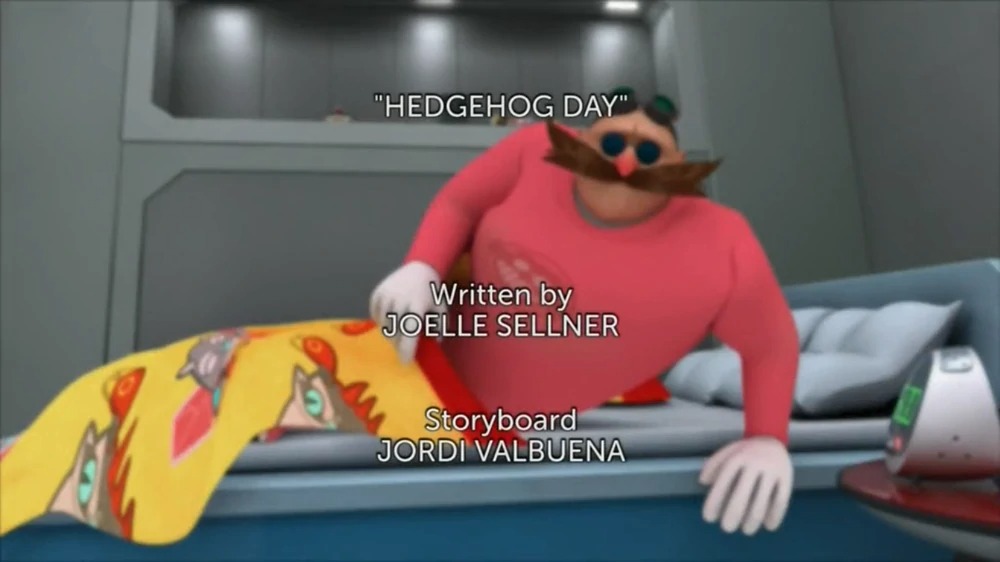
Sonic Boom, Episode 1.20: Hedgehog Day


Sonic Boom, Episode 1.20: Hedgehog Day
Original Air Date: April 4th, 2015

In 1973, prolific science fiction author and genre historian Richard A. Lupoff would publish the short story, "12:01 P.M." The story follows a man trapped in a time loop, relieving the same hour of the same day over and over again. Everyone around him is unaware of this, repeating identical actions every time, and he races to figure out what is happening before the loop inevitably begins again. In 1993, Bill Murray would star in Harold Ramis' "Groundhog Day," a movie about a Pennsylvanian weatherman who becomes caught in a time loop, repeating the same day over and over again. Everyone around him is unaware of this, repeating identical actions every time, and he races to figure out what is happening before the loop inevitably begins again. Though neither Lupoff nor Ramis invented the time loop story, the similarities were such that Lupoff attempted to sue Columbia Pictures over it. 

Yet the Murray film was far more commercially successful and culturally beloved than Lupoff's short story. That's why this story type is known as the "Groundhog Day Loop." It's such an elastic premise, with such endless possibilities, that you can insert it into nearly any setting or genre. So it's unsurprising that the "Sonic Boom" TV series would do their own spin(dash) on the "Groundhog Day" concept. In fact, the twentieth episode of the show isn't even the first time a piece of "Sonic" media riffed on the idea. Issue 167 of the Archie Comics series did something similar, the story also being entitled "Hedgehog Day." I guess both animals having the word "hog" in their names makes this too good of a pun to pass up.


Despite the title, this story isn't about Sonic. It follows Eggman, who has built a new Egg Tank to attack the heroes with. While fighting on the beach, after interrupting their movie night, Eggman fires a plasma fireball and a laser blast from the tank. When these energy attacks collide with a rogue lightning bolt, it cause an explosion... And then Eggman wakes up back in his bed, experiencing the day over again. The doctor soon realizes he's stuck in a time loop, which starts over every time the explosion goes off. He must convince Tails and the other good guys to help him, to prove what's happening, if he ever hopes to escape this endlessly repeating cycle.

Multiple people have attempted to do the math, to figure out how long exactly Bill Murray was stuck in the time loop in "Groundhog Day." People have come up with estimates ranging from 8 to 15 months to nearly 34 years. Either way, we're sure it's a pretty long time to be repeating the same day. That's also a lot of time to squeeze into one eleven minute cartoon. It seems certain that Eggman isn't trapped in this loop for more than a month or so. The episode definitely cheats a little bit too. It seems the loop will recur even if Eggman doesn't cause the same explosion. The exact point where the snap-back begins seems to be whichever moment will be funniest. I'm willing to accept that the writers had to use some shortcuts to make this premise fit into the standard "Sonic Boom" runtime. Yet it's another example where I wish this show was a half-hour and could go more in-depth with its ideas. 


The whole point of "Groundhog Day" is that Bill Murray is a jerk and he can't escape his purgatory of living the same day over again until he actually becomes a decent human being. This is the same approach copycat stories like "Happy Death Day" have taken. This is ultimately a philosophical story, of a person given endless time to overcome the personality flaws that hold them back. "Sonic Boom" doesn't really have the space to dig into Eggman's character arc that much though. And even if it did, it's not like the super villain could actually change any. "Sonic Boom" is a sitcom and sitcom characters are more-or-less static. The status quo is resumed at the start of each episode. Which must be just fine with Sega, since they usually insist these characters remain loosely defined and unchangeable, so as not to interfere with their roles as corporate mascots. 

None of these criticisms mean I dislike "Hedgehog Day." In fact, it's a pretty funny episode. The best of any "Groundhog Day" story is usually when the protagonist stops giving a shit and just begins to fuck around, the way any of us would if granted endless do-overs on the same day. This occurs about halfway into "Hedgehog Day.” He starts doing things like cutting off one side of his mustache or renting all the film reels from the video store, just to ruin Sonic’s movie night. On one of the endless days, he simply refuses to get out of bed. (“Boom” Eggman’s depression continues to be one of his most relatable aspects.) Most of the repeated days are spent trying to resolve the mystery, or win the battle on the beach though. Again, if “Boom” was a longer show, it would have more time to explore funny set-ups like this. 


Even if "Hedgehog Day" can't really get into the ramifications of its premise, writer Joelle Sellner still makes sure the gags come quickly. This episode made me laugh quite a lot. Cubot proves a good source of reactions in this episode, ranging from disappointment that a Eggman doesn't recognize his "egg tank" pun or glee when he realizes his daily actions no longer matter. The twist ending of the Comedy Chimp movie Tails rents is a good running gag. That leads to an oddball joke so loopy, I'm not sure anyone else but me would find it funny: Tails uses some sort of sound wave weapon built into the camera projector but it doesn't work when a silent movie – signified by a mime on the film can – is reeled into the player. Knuckles' various reactions to being asked to lift a super-dense shield is funny. The visual cliché of mathematical equations rolling by on-screen as a doctor ponders things is amusingly subverted. There’s clever moments about Amy shushing people or Sticks’ direct approach to dentistry. Once again, Mike Pollock's delivery as Eggman is responsible for several laughs. Just the way he mutters about not wanting ants or matter-of-factly predicts future events made me chuckle. 

The animation is still cheap and ungainly at times. Liquids look really fuckin weird in this style, which is most obvious when water runs off Eggman's face or Orbot fills a glass with orange juice. (An otherwise funny moment.) Once again, I just wish this show was traditionally animated. It would look so much better. That complaint aside, this is a good installment of “Sonic Boom.” Definitely not as good as “Groundhog Day” but certainly better than the comic book story of the same name. [7/10]


Friday, September 30, 2022

Sonic the Hedgehog (IDW): Issue 53


Sonic the Hedgehog (IDW): Issue 53
Publication Date: September 28, 2022 

Has anything fucked up suspense in the comic book industry more than solicitations for upcoming releases? Everyone can see the new covers and previews for titles months before they come out, meaning we all have a pretty good idea of where the stories are going before we even crack the books open. I mean, unless you are some sort of comic-reading luddite who doesn't look at the internet ever. But if you're reading comics, you're a nerd. So I feel like it's safe to assume you're probably online. 

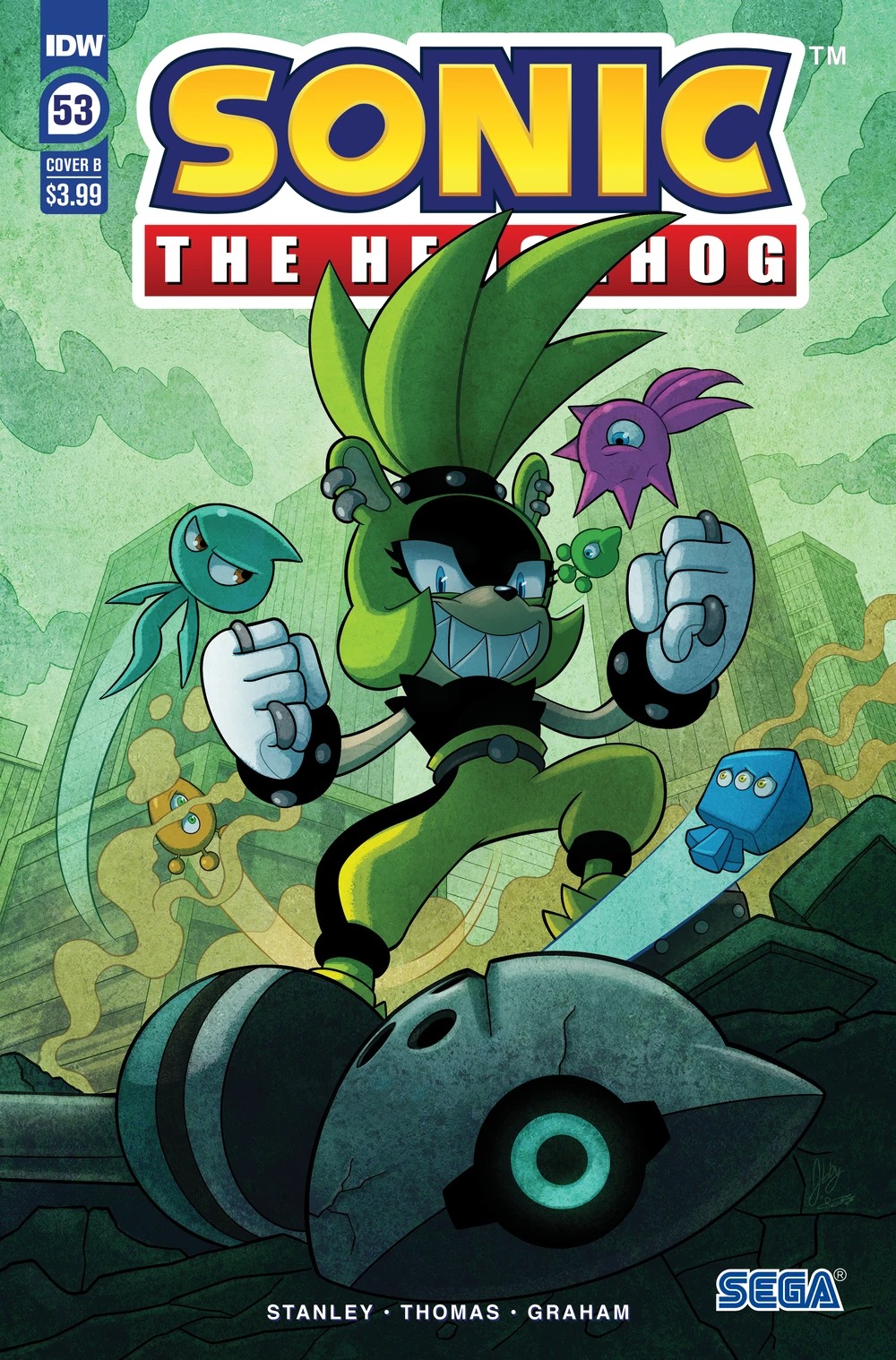
Anyway, all of this is a roundabout way of saying we knew issue 53 of IDW "Sonic" was going to feature a fight between Surge and Whisper, thanks to the main cover. We also knew Surge was going to win that fight, thanks to the variety cover where the villain is posing dramatically over Whisper's broken mask. I guess it's up to the writers and artists to make sure the issue is still worth reading even with this knowledge in our heads. (Or maybe the industry should just go back to wildly misleading covers. Preferably ones filled with apes.)


The previous issue made it look like a big confrontation between Surge and Eggman was coming. Instead, the Tenrec uses the Dynamo Cage to drain energy from some Egg-Pawns and then GTFOs from Eggperial City. Her logic is that Sonic is her target, not Eggman. She heads to Central City and starts terrorizing it, which draws the attention of Whisper. The fight turns when Surge realizes she can use the Dynamo Cage to absorb wisp powers. Before Sonic heads over to confront the villain, he has to break the bad news to Kit that his evil dad and evil sister/GF are presumed dead. The hydrokinetic kitsune doesn't take it well.

At first, I was worried about this issue. I've made it known in the past that my least favorite issues of "Sonic," regardless of which series I'm reading, are those that focus on characters trying to one-up each other with different superpowers. It reminds me too much of elementary school playground sessions, where friends would invent new powers to constantly turn the narrative in their favor. That shit is tedious. Surge really didn't need a power-up that allows her to steal energy and abilities from other characters to be a threat. We didn't need several panels to establish what Whisper's wisp can do, as we already know. Any time spent on such developments is just an excuse to escalate the action scenes in a way that feels artificial, instead of born out of the characters' conflicts. 


Action heavy issues also tend to be Evan Stanley's weakest. She's better at the emotional stuff. Luckily, this issue starts to turn in that direction quickly enough. When Surge absorbs the wisps' powers, she seemingly sucks up the weird little alien things into her person. (Which I guess tracks with how the wisps' weird physiology has always worked.) That means Surge isn't just taking Whisper's defensive abilities from her: She's taking her friends. And we all know that Whisper has a bit of a complex about losing the people and weird Pokémon-looking things she loves. You really fucking feel her anguish, as Surge sucks up more of her little buddies. The panel devoted to Whisper clenching her teeth and hissing out "I need them BACK." hits me right in the soft spot, man. 

Though this issue does change one aspect of Whisper's relationship with her glowy, multicolored sidekicks in a way that mildly bugs me. There's a panel that takes us behind Whisper's mask. That's when we learn she can understand what the little critters are saying to her. I think that's always been implied and, if not, I always assumed as much anyway. Yet the decision to show the wisp actually talking – including a gag of the orange one speaking in a verbose, precise manner – feels innately wrong to me. That would be like R2-D2 talking in perfect English. It adds more color to the word if they just remain jabbering little weirdos. Ya know, your dog doesn't speak but you can still communicate with it clearly. I kind of always assumed Whisper had a similar relationship with her buddies. 


Nerdy nitpicking aside, the Whisper part of this issue works really well. That's the most effective emotional gut punch this issues serves up but it's not the only one. Though now aligned with Sonic, Kit is shown falling back into the role of hyper-subservient sidekick. He has just switched his total devotion from Surge to Sonic. This shows that Kit is a long way from breaking the psychological conditioning Starline cooked into him. When Sonic tells the blue fennec that the two people he's always looked up to are probably gone, it shakes Kit to the core. He falls into a total, catatonic depression. Following Starline and Surge is literally the only thing Kit knows how to do. Without that, his entire personality is forfeit. This is why the issue ends with him dramatically heading off to help Sonic. If Kit isn't following a leader with a single-minded, sometimes disturbingly aggressive determination, he might as well not exists. 

That's good shit, man. The imposters have been, from the beginning, set up to be tragic villains, molded by circumstances outside of their control to do evil. Kit really seems to be the sadder of the two, as his pathetic desire to please others makes him seem even more like a lost little kid. Yet Surge's role is not done being defined either. After blasting out of Eggman's lab, with the Dynamo Cage charged up 100%, the tenrec sees Starline talking to her. At first, I took this as the book weaseling out of that villain's death already. Instead, it's quickly clarified to be a hallucination. Now, that's interesting. As much as Surge wants to let go of the destiny Starline designed for her, she can't. She still is driven to destroy Sonic. As much as she wants to turn her back on her creator, he's almost literally still inside her head. Not even death can remove the hold he has on her. 


That the Starline hallucination speaks directly to Surge's insecurity shows this even more as a nagging weakness she just can't rid herself of. People who have been abused often internalize that mistreatment as a self-loathing feeling, an inner voice that constantly tears down their achievements. "Negative self-talk" is what they call it now. But that self-talk might as well be in the voice of the people who taught you that maladaptive behavior. Stanley has found an interesting way to visualize that psychology process in what is now officially the comic's most complex villain. (And it's also a way to keep fan-favorite Starline around without immediately undoing his death, so that's clever too.)

Hopefully, this review has made it clear that this issue does a competent job of balancing action and character development. Adam Thomas Bryce does the pencils. We all know he's extremely good at creating stylized action scenes, alongside emotional faces. Whisper getting beaten by Surge is so meaningful because Bryce makes the wolf's pained cries so vivid. This is also clear in the panels devoted to Kit's ego death, which really make an impression.


Yet sometimes Bryce gets carried away. The action panels are so elaborate here that they become hard to follow. I'm still not clear if the Dynamo Cage allows Surge to turn into pure lightning or if she's just moving so fast that it looks that way. Once the wisp superpowers get involved, the fight becomes even harder to track. There's a moment where Whisper grabs up a shattered piece of her mask to stab at Surge – great visual way to convey her growing desperation, by the way – that is far more compelling than any of the panels of characters zapping colorful bolts of whateverium at each other. 

I also feel compelled to point out – and the fact that I've barely mentioned him in this review might already make this obvious – that Sonic is barely in this issue. It really does seem like the IDW comic is at its best when it relegates the blue hedgehog to a supporting role. I guess that's the best way to write around a corporation preventing you from giving the main character an inner life of any sort. You delegate all the heavy lifting in the series to supporting characters, with the title hero being an action guy that merely moves the plot forward. Honestly, I'm not complaining. If it works, it works. And Sonic has never been my favorite "Sonic" character. 


While it gets off to a lumpy start, issue 53 finds its groove quickly enough. Surge and Kit have grown into compelling characters. Their psychological problems are involving. And brutalizing poor Whisper is always a good way to tug my heartstrings. I'm genuinely excited to see what'll happen next, once Kit discovers Surge is still alive. Damn, I hate it when this book is actually good and hooks me for another month. I guess I'm not canceling that Comixology subscription after all! [8/10]

Monday, September 26, 2022

Sonic Boom, Episode 1.19: Sole Power


Sonic Boom, Episode 1.19: Sole Power
Original Air Date: March 28th, 2015

I guess it was only a matter of time before “Sonic Boom” did an episode that featured actual sonic booms. Sonic and Tails are chilling in his hovercraft one afternoon when the hedgehog runs off. A deafening ringing noise follows. Soon, the ear-splitting gonging happens every time Sonic runs. It irritates the hell out of his friends and forces Sonic to walk everywhere, which really bothers him. After Tails can’t find a cause, Sonic turns to an unexpected source for help. Eggman builds the hedgehog a pair of sound-absorbing sneakers that seem to resolve the issue. It’s not long afterwards the Sonic realizes that, duh, this has all been a trap engineered by the villain. 

Sonic's defining superpower, if not his primary characteristic, is his speed. Interpretations of the blue hedgehog have gone in all different directions over the years but he's always gotta be fast. Naturally, when running at supersonic speed is the main supervillain-fighting ability he brings to the table, the creative mind immediately turns to ways to take that away from him. What could challenge a speedster hero more than having to do things without his speed? Accordingly, multiple "Sonic" stories have used that as their set-up. "Sole Power" is among the more farcical takes on the premise – it's not that he can't run fast, just that doing so really bothers everyone – but its potency remains. If Sonic can't go fast, it's going to fundamentally changed the way he handles things. And that's a set-up that makes for good storytelling. 


Since "Sonic Boom" is a sitcom, the consequences of Sonic having to limit his speed are less life-or-death and more personal. A booming reverberation happening every time Sonic runs inconveniences his friends. It makes them not want to be around him. Sonic does his best to control his naturally speedy instinct but the affliction still ends up driving a wedge between him and his pals. I think Amy and the gang are a bit unkind to Sonic here. It's not like it's his fault that his feet make an overwhelming bong now. Yet putting the hedgehog at odds with his friends creates a compelling, and funny, thrust to this episode. If Sonic can’t run, he can’t be himself. And if he can’t be himself, he starts to act in weird and off-putting ways. This is most evident in a fairly amusing sequence, where the hedgehog has to sit out a battle with some Badniks. 

While a lot of episodes of "Sonic Boom" drops new characters into the stories, I find the strongest episodes build on the dynamic between the central six cast members. (Or eight, I guess, if you include Cubot and Orbot.) Sonic's friends do okay without his super fast ways, which is discouraging. In that depression, Eggman unexpectedly appears to bond with him. In the episode's funniest scene, the mad doctor acts as a therapist of sorts to the down-in-the-dumps hero. This is another amusing subversion to the two characters' expected relationship. And in general, it's just pretty funny seeing Eggman act in such a subdued, sympathetic manner. He even shares his popcorn with Sonic! Considering this version of Eggman legitimately deals with depression, he probably has a good grip on psychology. 


Obviously, Eggman extending this branch of empathy to Sonic is a trap. Anyone could figure that out. Yet the exact machinations of Eggman's evil scheme in this episode are clever, as far as these things go. The specially designed, noise-muting shoes Sonic slips on actually provide the power for Eggman's latest destructive giant robot. This means Sonic can't use his special ability without giving the death machine he's fighting more juice. It's a clever villainous ploy, though one with an obvious solution. Sonic soon figures out that, if he keeps running fast, the robot will be overloaded and exploded with excess energy. Yet, up until that point, turning your enemy's greatest strength against him is a good supervillain idea. Almost had 'em, ya know? 

An episode like this with a smart, funny premise might be enough, considering the short runtime of your typical “Sonic Boom” installment. This one has got some delightfully silly stand-alone gags of its own. Shortly after Sonic's noisy running begins, Tails takes him back to a lab for some test. What follows is a montage that is, for whatever reason, scored to a sound-alike to Paul Engemann's “Push It to the Limit.” Otherwise known as the theme from “Scarface.” The randomness of that made me laugh. Also, a gag that involves Sonic being forced to walk back to his bungalow or the direct way Eggman removes him from a tree got me to chuckle. 


Generally speaking, this is another episode where the voice cast really makes a big difference. Roger Craig Smith's take on Sonic is really starting to grow on me. Since a lot of this episode's humor is based around Sonic feeling frustrated or dejected, that really gives Smith a chance to sharpen his delivery. Travis Willingham also makes some lines from Knuckles, that really are just yet more jokes about how dumb the echidna is, into some absurd silliness. His odd statement about the opera got me. So did the back-and-forth argument he has with Sticks, about whether something is stupid or crazy. At this point, it almost goes without saying that Mike Pollick's Eggman steals the show. He manages to make some clunky lines, about Sonic referring to himself in the third person or the name of this week's giant robot, into delightful bits of silliness. 

While I wouldn't call it “good” exactly, the scene where the heroes fight some CrabBots on the beach without Sonic is a little better than the typical action sequences on this show. Maybe just because it's being played for laughs, instead of action. Overall, this an example of an episode that starts with a clever premise and elaborates upon it in several goofy and funny ways. It did not blow me away or anything but got a few laughs and I enjoyed watching it. As far as eleven minute cartoons go, that counts as a victory. [7/10]


Friday, September 23, 2022

Sonic Boom, Episode 1.18: Dr. Eggman’s Tomato Sauce


Sonic Boom, Episode 1.18: Dr. Eggman’s Tomato Sauce
Original Air Date: March 21st, 2015

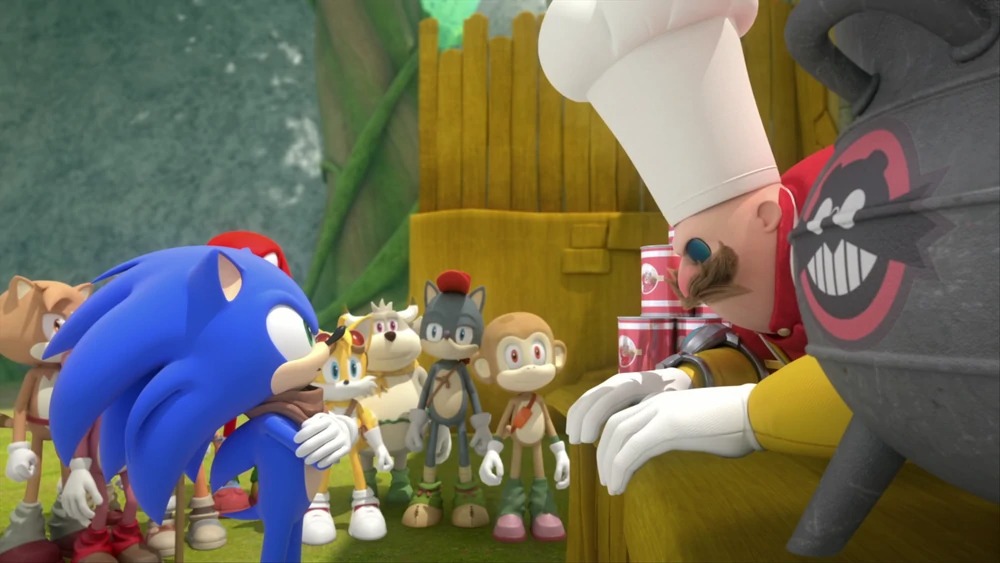
As the rather plain title of this episode makes it clear, the eighteenth installment of "Sonic Boom" concerns the blue hedgehog's archenemy branching out in a new direction. Eggman begins selling a canned tomato sauce. Everyone in town is eager to try it but Sonic and the gang assume the villain's newest venture to be some sort of evil scheme. To their shock, the tomato sauce is totally safe to eat and delicious to boot. This seems to redeem Eggman's image in the public's eye, much to Sonic's annoyance. That's when the mad scientist reveals the truth: The sauce is safe but the cans are evil robots. They awaken when no one is looking and reprogram household appliances to be evil Eggman robots. Now Team Sonic has to undo the villain's latest plan before he totally takes over the island. 

"Dr. Eggman's Tomato Sauce," at least at first, seems to return to one of "Sonic Boom's" funniest subversions of the superhero/supervillain relationship. Eggman's goals are far pettier than world domination. In the first half of this episode, it seems Eggman simply wants to hurt Sonic's ego. By reinventing himself as a celebrity chef, Eggman quickly becomes a beloved public figure. Soon, the rotund doctor has seemingly eclipsed Sonic's own level of celebrity. He mocks the hedgehog's appearance on television. While signing an autograph for a child that Sonic at first assumed was one of his fans, Eggman asks "whatever happened to that guy." None of this stuff is evil. It just wounds Sonic's sense of pride, greatly annoying him. A villain devising a scheme with no other motive than to simply irritate his archenemy is a pretty funny idea. 


Of course, that turns out to not be Eggman's goal. Or, at least, not his only goal. Once the reveal comes that the cans are actually the devious part of Eggman's latest plan, the episode shifts focus. Now, we get several sequences of common, household appliances coming to life and attacking people. A lamp entangled the person sitting next to it. A toaster sprouts spider legs and shoots toast at people. A vacuum chases off the woman using it. This is a much more standard supervillain scheme. In fact, it's so standard that Eggman has tried something similar before... On "Sonic X." The season two episode, "Huge Home Electronic Panic!," doesn't feature tomato sauce but it does have Eggman reprogramming everyday electric devices to be his evil minions and reek havoc on the public. 

I don't know how aware the "Sonic Boom" team, much less writers Alan Denton and Greg Hahn, were of "Sonic X." I imagine the similarities are probably coincidences. Yet this still results in an episode that starts out feeling like a subversion of traditional action/adventure cartoon premises and then becomes a fairly standard example of just that. There's definitely some absurd comedic value in watching people be terrorized by mundane household appliances. Yet the scenes of Sonic and the gang smashing machines, stopping the bad guy, and saving the day are played fairly straight. And once you factor in "Boom's" rural setting and the limitations of its CGI animation, it can't even feel as wide in scope as "Sonic X's" take on the same idea. 


Aside from the obviously goofy idea of Eggman using pasta sauce as a major element of his latest evil scheme, the other main joke of this episode concerns Tails. The engineering fox is introduced installing powerful speakers in his airplane. From there, it's made increasingly clear that Tails is infatuated with his airplane. When Knuckles teasingly asks if Tails loves his plane, he flatly responds that he does. Obviously, this is meant to poke fun at guys who baby their automobiles as if they were their girlfriends. When Tails starts talking about giving his plane "her propeller-to-tail fuselage massage," I was remind of the objectophilia episode of "Taboo" — the best ever episode of "Taboo" — and the guy who actually fucks his car. Who believed this inanimate object to have thoughts and feelings and that his car literally loved him the way a romantic partner would. Ya know, I don't assume the "Sonic Boom" team watch the same obscure cable documentary shows as me. Nor do I presume that they meant to imply Tails does anything non-PG rated with his plane. But I imagine the implications of their joke were similar. Some folks are really into their vehicles, in the ways the cross the traditional boundaries of human/inanimate object relationships. It's weird and that's funny. 

This set-up pays off at the end, when Eggman's evil cans have turned Tails' beloved plane against him. The fox has to confront his mechanical love, stop it from trying to kill him, and remove Eggman's evil programming. At that point, I began wondering why the writers led with the whole tomato sauce business. Shouldn't Tails' unnatural bond with his airplane have been the main focus of the episode? Wouldn't the expected arc of this story have Tails coming to understand that his plane is just an object and that his flesh-and-blood friends matter much more to him? Or, since this show is a comedy, a humorous subversion of that expected moral at the very least? Once again, I have to look at the short runtimes of the "Boom" episodes and wonder if it really gave the writers enough time to fully explore the stories they wanted to tell.


In fact, a lot of elements of "Dr. Eggman's Tomato Sauce" feel kind of incomplete. Some of the jokes trail off without a punchline. Knuckles makes a comment to Tails about something called "brainitis," Tails says that's not a real thing, and Knuckles responds by saying "Then how do you explain?" I get that the joke here is that Knuckles is stupid and doesn't understand what a brain is but it feels like the gag just kind of awkwardly stops. I feel similarly about a moment where Sticks' use of the phrase "who's laughing now?" leads to a brief, tense exchange with Sonic that doesn't really feel like a joke. The same is true of Tails' nostalgic montage of memories of his airplane, which moves Sonic to tears which has to quickly cover up. The timing is off. 

When the various objects from around the island assemble themselves into a robot, via the evil cans, Sonic says "Now I get it." But I genuinely don't get it. How does this clarify Eggman's scheme? Denton and Hahn's episodes are usually funnier than this. The episode changing premise midway through and the comedic pace being out-of-sync reminds me of “Aim Low.” We know that episode was among the first “Boom” scripts written and I theorized that maybe it was quickly cut down to eleven minutes, resulting in its awkward feel. (Or maybe the writers just hasn’t found their groove yet.) I wonder if “Dr. Eggman’s Tomato Sauce” wasn’t a result of the same situation. “Eggman becomes a celebrity chef” or “Tails is in love with his plane” are both premises that easily could’ve occupied episodes of their own. Seeing them jammed together like this does not do either idea justice. When combined with a lack of really strong joke — a pun on Meh Burger and mayonnaise got the biggest laugh from me here — you get an episode that isn’t very satisfying. [5/10]