Friday, August 10, 2018

Sonic the Hedgehog: Issue 231


Sonic the Hedgehog: Issue 231
Publication Date: November 2011

So now we arrive at the Mecha-Sally saga, the final super-arc Archie's “Sonic the Hedgehog” comic would attempt before the Ken Penders lawsuit forced a complete continuity reboot. Back in 2011, we had no idea that the comic book as we knew it would be ending suddenly in the very near future. We only knew that this storyline was an unusually grim and long one. If Ian Flynn could ever be said to “loose” it, in my opinion, this was that point. We've got a long journey ahead of us, my friends. Let's start.


“Lost in the Moment” begins with Sonic still aboard the ruined Death Egg, in the grasp of Mecha Sally. Eggman quickly learns that the Death Egg's power source is missing and his back-up plan – blasting Mobotropolis with a massive incinerating beam – is no longer possible. Instead, the villain luxuriates in his one victory: Turning Sonic's girlfriend into a totally obedient robot. Sonic is tossed out of the Death Egg, a Titan Mecha Sonic is sent to attack the city, the Tornado and the Freedom Fighter Special are both destroyed. And that's just the beginning of the Freedom Fighters' troubles.

A lot of shit goes down in “Lost in the Moment.” Ian Flynn, however, does not totally loose the emotional thread in all the chaos. The shock of Princess Sally being transformed into a ruthless robot weighs heavily on Sonic. He's crestfallen by this sight. He attempts to reach out to the Princess, hoping she's still somewhere inside the robotic shell. Instead, she throws him out of a space ship. Sonic has to face something he doesn't usually encounter: Loss. And not just any loss but the loss of probably the most important person in his life. He has to admit to Tails that he failed. In the latter half of the book, he shows a somewhat pathetic drive to save Sally, which Amy has to hold him back from. This is how Sonic is processing this loss. He's a runner, a hero, and a problem solver. But this problem can't be solved by running towards the problem. It's a surprisingly powerful moment.


Sally getting turned into a robot is not the only serious hit the Freedom Fighters take in this issue. Yes, the Tornado and the Freedom Fighter Special – longtime stables in the comic – are destroyed. A Titan Mecha Sonic drops out of the Death Egg and marches on Mobotropolis. (This leads up to a moment that does the impossible: Making Big the Cat likable. When he stands in front of Cream and Vanilla, keeping them safe, it's genuinely heroic.) The only thing that prevents the city from being totally destroyed is Naugus flying in quickly and crystallizing the giant robot.  Even this isn't a win though. Bunnie is caught in the blast and partially crystallized. Moreover, this big gesture makes the Mobians praise Naugus as a hero. Issue 231 leaves the heroes in a really bad place. Robotnik truly has the upper hand this time.

Ben Bates is also back at the pencils and his work is excellent here. As previously established, Bates' grasp of the character designs could not be stronger. The character look correct. Yet Bates also brings an incredible kinetic command of action to the book. The big action beats – the Titan Mecha Sonic falling from the Death Egg, Naugus spraying a magic beam at the robot, Bunnie getting caught in the blast – are brought to life fantastically. Even the smaller moments are pretty cool looking too. Every panel has a lot of energy and life-like jive to it. Such as Robotnik steaming in rage after learning he's lost some of his power. It's not just a good looking issue. It's a cool looking one as well.


The back-up story, “Haunted,” actually takes place at an earlier moment in the story. After Naugus lands on the ground outside Mobotropolis, he feels strange. Inside his head, he sees a vision of Agunus the rhino, Nusgau the bat, and Suguna the lobster. In case you've forgotten about these guys, “Haunted” helpfully recounts issue 66's “And Then There Was One,” which showed Naugus' origins. Apparently one of the Genesis Wave's unforeseen side-effects has been to awaken these long-thought vanquished spirits within Naugus' head. Naugus banishes these voices long enough to go about his mission but he is not resting well.

As a story, “Haunted” mostly just exists to let readers know this new information about Naugus. I had always assumed that, when Nusgau won the race to the sun in “And Then There Was One,” he simply took the powers and physical attributes of the other two. Now we discover that a new entity was formed, the three sorcerers existing as watching spectres locked within the mind. Okay, that works, I guess. Mostly, “Haunted” is interesting as an introduction to Evan Stanley's artwork. Though she'd soon become a reliable penciler, Stanley's work here is a bit rough. Naugus looks a little too anime-esque and the motion is a bit stiff. The opening panel – Naugus awakening from a white void – is pretty cool though. Stanley would get better the more she worked on the book.


Issue 231is a bit of a bummer. That's not a problem. Flynn keeps the stakes personal, rooting these events in the characters' emotions. I just wish there was a little more of that stuff here, more of Sonic reacting to Sally's transformation, than the plot rocketing forward at such a speedy rate. Whether or not Flynn ends up justifying all of these cruel plot turns – from what I remember, some of them are and some of them aren't – is yet to be seen. If nothing else, it's an exciting and interesting issue with some top-rate artwork. [7/10]

Wednesday, August 8, 2018

Sonic Universe: Issue 33


Sonic Universe: Issue 33
Publication Date: October 2011

“Sonic Universe” just came off one of my favorite story arcs for the comic, which revolved around one of the Archie-verse's most dastardly villains. Perhaps hoping lightning would strike twice, the next arc would also focus on characters that are not exactly heroes. The Babylon Rogues aren't as irredeemable as Scourge, though they are far from good guys. They also are nowhere near as interesting either. This story line would also be Tracy Yardley's proper writing debut for the book. At the time, I felt this factors combined to make a real snore of a story. Let's see if that opinion still holds true.


The first part of “Babylon Rising” – is that the first time a “Sonic Universe” arc had the same name on the front cover and in the actual book? – begins with the Rogues rushing into some sort of ancient temple. The temple contains a key that will lead them to the Babylon Gardens, a legendary location among the bird-like Mobians. The Battle Bird Armada has been trying to locate the Garden for generations and Jet the Hawk is determined to get there first. In-between deflecting the temple's booby traps, the trio flashback to the events that brought them together.

Yardley builds his first gig as a head writer around a rather uninspiring narrative troupe: The MacGuffin chase. One MacGuffin, an ancient book, has led the Rogues to the temple within the Gigan Mountains (Which probably isn't a Godzilla reference) and the key it contains. This MacGuffin will lead them to a map that will bring them to the story's final MacGuffin, the legendary Gardens. This kind of point-A-to-point-B writing is pretty dull on its own. Not helping matters are the vague status of the Gardens themselves. Literally no one knows what they are, what they contain, or why these bird-people have been chasing after them for hundreds of years. Where exactly yet another ancient but advanced civilizations fits into Mobius' convoluted history is another question left unanswered.


“Sonic Universe” has really gone crazy with expounding on characters' back stories recently. At least the Rogues haven't sat in the book for a decade without the audience learning any information about their past, the way the Fearsome Foursome did. It's already been confirmed that their origins are with the Battle Bird Armada. Here, we learn that Jet was once a promising young member of the Armada, specifically tasked with finding the Gardens. However, he wasn't interested in serving the Armada and set off on his own. His insubordination got him throw into the brig, where he met Wave and Storm. It's a pretty stock-parts origin, Jet's reasoning for rebellion and his resentment towards the Armada being left fairly vague.

In fact, Jet is the only member of the Rogues who gets much personality here at all. He's egotistical, motivated primarily by pride, and has a short temper. Which isn't a lot but is still more than Wave and Storm get. Storm is still defined solely as big dumb muscle. Wave spouts off some technobabble and historical exposition to make sure we know she's the smart one. Truthfully, Speedy – not even one of the issue's main characters – gets more development than either of them. When the Rogues deserted the Armada, he secretly begged to go with them. That's interesting! Perhaps the bird actually hates being in his father's shadow? But it's just one small moment in the comic.


When I first read “Babylon Rising,” I remember thinking it read like the kind of fanfiction written by kids who played too many video games and didn't read enough books. This game-leaning construction is still evident. In the Temple, Jet grabs the magical cube even though everyone tells him not to. This summons a sword-wielding genie, which is actually a hard-light hologram. The Rogues quickly deduce that they need to smash the projectors around the temple to defeat the djinn. This plays a lot like a boss battle from a “Sonic” game. Determining a pattern and a weak point may be fun to play through with a controller. In a comic book, it's monotonous.

In fact, Yardley does not show a lot of strength for writing in general here. His plot is stock parts. His character work is shaky. His action scenes are wonderfully drawn but dull conceptually. Even his dialogue is kind of weak. His attempts at comedic dialogue produces clunkers like “Yes, I can read ancient Babylonian” or “Sorry, your Kukkuness.” The genie's dialogue is rendered in some stiff, quasi-ancient sounding Thor speak, which is annoying to read. Chunky terms like “Divine wings,” “lightless black” or “extreme gear” are dropped throughout, thudding each time. Some of Yardley's dialogue straight-up doesn't read well. Jet says “I'm a bird! I don't need flying lessons!” despite always using a hoverboard to fly, instead of his wings. Storm saying “I don't like superior officers! I do like you!” just scans as awkward.


It's a perfect storm of mediocre ingredients. Yardley, someone clearly talented at drawing a comic but perhaps inexperienced at writing one, was given the chance to cook up a backstory with three of the least interesting characters the comic inherited from the video games. This combination does not result in the most compelling reading. I remember this arc being a tedious read so excuse me if I speed through the rest of these things. [5/10]

Monday, August 6, 2018

Sonic the Hedgehog: Issue 230


Sonic the Hedgehog: Issue 230
Publication Date: October 2011

And we're back. In the past, Flynn took his time in-between big story arcs, usually giving the world of “Sonic” some time to catch its breath for an issue or two. Because “Genesis” was essentially inserted into the last act of another storyline, he didn't have that option this time. Issue 230 brings us back to where issue 225 left off. So we're off and running from one big storyline into the next one. Get use to that breathless pace as the original Archie Sonic continuity heads into its final year.

Apparently when Sonic reset the universe at the end of “Genesis,” he pulled a “Galaxy Quest” and dropped himself and Sally back into the Death Egg... Several seconds before they left. This gives the hedgehog and the Princess a chance to avoid the machine gun that nearly killed her. They turn the fight against Robotnik, throwing a monkey wrench into his elaborate plan as it reaches its final stage. While Sonic wrestles with some robots, Sally realizes that she has to make a sacrifice in order to save all of Mobius.


Up until this point, the assumption was that Robotnik's master plan was to shoot a huge robotocizer ray at all of Mobius. It seems like, sometime before “Two Steps Back...” was finalized, someone either reminded Flynn or he realized his own mistake. While confronting Robotnik, Sonic reminds the doctor that those pesky aliens, the Bem, made it impossible to re-robotocize anything that had previously been turned into a robot. I would've forgiven Flynn for forgetting about this plot point, which came during the comic's notorious dork age. I sure as heck did. So, instead, Robotnik's plan gets what's clearly a sloppy last minute rewrite. He'll blast the world with a robot ray... Causing a lot of it to explode! Because, as a footnote helpfully reminds us, the events of Sally's mini-series show that you can't robotocize shit that's already metallic.

Got all that? It's a pretty jumbled bit of information to dump on the reader, especially in an otherwise very action heavy issue. Large portions of the issue are devoted to action, beautifully rendered by Ben Bates' smooth, cartoony, but precise pencils. It ends up dragging “Two Steps Back...” down quite a bit. The book hasn't tangled itself up in its own lore like since the Penders days.


That so much of the issue is consumed by technobabble double-talk is also disappointing, since there's some huge emotional stakes here. Issue 225 ended by nearly killing Princess Sally off,  which would've been the third time Archie threatened to murder her. The Princess' reprieve was destined to be short-lived, at least in her current form. She sneaks down into the guts of the Death Egg, using Nicole in the hopes of hacking Robotnik's master plan. The villain's infrastructure is too strong though. All Nicole can do is turn the ray back on the Death Egg. As everyone knows by now, this results in Sally getting robotocized.

I have... Mixed feelings about this. Once again, the emotional center of this story is underserved by more convoluted plotting. Why did Nicole turn the ray back on the Death Egg? She drops this as the only option, with zero other explanation of how that works or why. There's a nice emotional panel, where Sally grimly realizes she has to do this. She says goodbye to her memories, loved ones, and presses the button. Ultimately though, this decision feels more self-serving by the writer than anything else. Flynn wanted Mecha-Sally in the book, because it's the kind of big shock that sells comic books. And this was the best way he could think of to deliver this plot twist. But it bugs me. It bugs me, man.


Further undermining this serious plot is a lame back-up story shoved into the back of the book, eating up the cover story's page count. “Sonic Generations” is another one of those “Another Time, Another Place..” stories that exist solely to promote whatever new video game Sega put out. Instead of focusing on the team-up between modern Sonic and Classic Sonic – the entire reason people got excited for “Sonic Generations” – this story merely retells the game's prologue. Sonic's friends, which includes Rouge for some reason, throw him a birthday party with chili dogs wrapped up in bows. That's when a huge chasm opens up in the sky and sucks everyone into other dimensions. Then Classic Sonic shows up for a panel at the very end.

What is there to say about this one? There's no explanation of where the portals come from. We only get a brief glimpse of where they lead to: That fan favorite the Green Hill Zone. The artwork from Jamal Peppers is good but slightly below his usual standard, as the characters come off as a little jagged. (He also draws maybe the most unappetizing chili dogs I've ever seen.) Sonic and friends bonding around the birthday table is mildly cute. So is the tenacity the hero shows in rescuing his friends. Otherwise, there's absolutely nothing here. It's a completely hollow, empty, useless story.


I guess this review came off as pretty negative. I don't dislike “Two Steps Back...” The action scenes, such as the fight between Sonic and his various robotic doubles, are well done. The moment where Robotnik freaks out, because Sonic foiled his schemes yet again, before calming himself back down is really well done. As is the scene of the villain pulling himself out of the wreckage of the Death Egg and pointing a shiv at the hedgehog. However, it's an issue bogged down by exposition, brutalizing logic, and an emotional sacrifice happening for reasons that feel less than honest. It's a bit of a bummer, as far as epilogues to an otherwise amiable event like “Genesis” goes. [6/10]

Friday, August 3, 2018

Sonic Universe: Issue 32


Sonic Universe: Issue 32
Publication Date: September 2011

I'm just going to step back and give myself a little perspective. Back when first conceived, Evil Sonic or Anti-Sonic – whatever you want to call the character that would become Scourge – was little more than a gimmick. Dressed like an out-dated perception of what a bad boy thug looked like, he was never taken very seriously as a character and was quickly dealt with every time he appeared. Who would've thought that, seventeen years later, we'd still be reading about that character? Moreover, that he would be compelling enough to carry an entire arc by himself! That's what I mean when I talk about how Ian Flynn completely saved this comic book.


The last part of “Scourge: Lockdown” begins with the Zone Police prison in turmoil. The prison riot that ends every prison movie is in full effect. In the chaos, the Destructix hope to make their escape. Scourge goes about getting revenge on those that wronged him while Fiona and the other Destructix searches for the plot device that will give them their freedom. In the chaos, reveals and betrayals go down.

As I mentioned in my review of “Sonic Universe: Issue 29,” “Inside Job” has been an arc partially about making Scourge sympathetic. By getting dunked on by everyone else in supervillain jail, Scourge gained a humility previously beyond the ego-tastic baddie. From a writing perspective, it makes sense. This also puts Scourge back at zero, giving him an identifiable character arc for this story: Trying to regain his confidence and evil zeal. Which finally comes to pass here. By the end, Scourge is re-proclaiming his superiority over everyone. And just so you know he isn't that sympathetic, that he's still a bad guy, Flynn also has him cruelly screw over Al and Cal.


All of that is well and good, from a narrative level. But it's not the reason I liked this issue so much. At the issue's beginning, Scourge goes on a rampage through the prison, his evil mojo thoroughly reclaimed. He spin-dashes the buff Knuckles that tormented him earlier right in the guy. He tosses the Anti-Lupe that hassled him earlier off a bridge. He kicks a zone cop – possibly based off of Monkey Khan – right in the face. There's an awesome page half-way through entirely devoted to him kicking ass and taking names, both guards and prisoners alike. I enjoy this for the same reason I like to watch “Friday the 13th” movies. Sometimes, it's just fun to watch the bad guy make mince-meat of everyone around him, regardless of whether or not they're decent people.

Flynn probably could've devoted a whole issue to Scourge taking revenge and generally being an amoral bad-ass. However, he does pay off on several lingering plot points set up here. Some nice tension is inserted into the last act, when the Warp Ring Fiona counted on getting the gang out of here is stolen by Jeffrey St. Croix. This allows the not-entirely-interesting subplot about the evil King Maxx trying to escape space-jail a decent conclusion. We also get a justification as to why Horzonti-Al and Verti-Cal had to be in this story. Scourge removes their inhibitor collars, unleashing the robo-death-god versions of the imps last seen in issue 59 of “Sonic.” Which actually makes the annoying duo kind of intimidating, in addition to being a decent pay-off.


After spending the last two issues finally giving the Destructix a back story, Flynn partially devotes this issue to seeing them act as a team. It's surprisingly effective. Lighting's highly effective hearing comes in handy. Fiona's brains helps the whole operation work. Predator Hawk's flight and predatory instinct prove useful. Even Scourge shows himself to be a good leader. At one point, he rushes into danger to insure the escape plan works. Yes, he's doing it so he can reek more havoc and because he really wants to escape. But this also shows that maybe there's a molecule of honor among these thieves as well.

It's a really fun issue that also, unintentionally, ends up being rather bittersweet. Flynn ends the story by setting up future confrontations. The Zone Cops, Zonic especially, are dismayed by the break-out and name-drop all the threats they are juggling right now. Scourge and his boys return to Mobius. Fiona wants to work with Dr. Finnitevus but Scourge is more interested in regaining some serious power. Sadly, none of these events would come to fruition. This is the last time Flynn would write about Scourge before the Pendering forced a hard reboot on Archie's "Sonic" books, wiping out the entire multi-verse and Scourge's existence. At the very least, Scourge's final appearance would be a good one.


By the way, Flynn and Yardley continue to sneak in those fun little in-jokes I enjoy. What appears to be a purple kraken sticks its tentacles out in the bitchin' two-age spread that opens the book. In addition to the possible Zone Cop version of Monkey Khan, we also briefly see possible Zone Cop versions of Duck Bill and Mighty. In the evidence locker, we see Dark Enerjak's brass knuckles, Rosy the Rascal's hammer, and Knuckles' infamous hat from the OVA. Most bizarrely, a mob scene features an appearance from what appears to be a red Angry Bird and the snail from “Spongebob.” Which certainly raises some interesting questions about the multi-verse here.

This story does what a good story is suppose to do: It makes me want to see more. Scourge and his bandits may not be long for this four-colored world but at least their final adventure was a lot of fun. The whole arc was very good, probably one of my favorite “Sonic Universe” plots. [7/10]

Wednesday, August 1, 2018

Sonic the Hedgehog: Issue 229


Sonic the Hedgehog: Issue 229
Publication Date: September 2011

Here we are, at the end of the “Genesis” story arc. Ian Flynn has, at least once, has talked about how he was not satisfied with how this event turned out, despite its popularity with fans. Over all, I don't totally agree with that. Though not without flaws, “Genesis” flew along pretty decently. However, in its final issue – which ditches the game cover gimmick for a cool pic of Super Sonic – I can kind of see Flynn's point. But maybe I'm getting ahead of myself. Let's talk about the issue itself.


The last chapter of “Genesis” is subtitled “Reset,” a cute reference to the reset button on your Genesis or Mega-Drive consoles. After going their several ways at the end of the last issue, Sonic and Sally face off with Eggman in different ways. Sonic races through Metropolis Zone, eventually attacking the doctor directly. Sally and the Freedom Fighters sabotage the Ocean Oil Zone, cutting off the villain's energy source. In the end, Sonic and Eggman both head to the Death Egg to face off for the fate of the world.

Last time, Sonic and the Freedom Fighters splitting up was kind of an odd choice, contrived but in a way that I understood. Sadly, because of the limits of a four-issue story line, Flynn doesn't really have time to pay off. Sonic and Sally are left separated throughout this issue and never come back together. There's no resolution to this emotional fissure. Flynn tries to patch things up as best he can, having the characters speak to each across panels. It doesn't quite work though and the reader is left not entirely satisfied.


Another attempt Flynn makes to add an emotional heart to the story involves the story's status as outside regular continuity. All along, Sonic and the others have been receiving memories of their previous lives. As the world starts to shake apart more and more, more of these memories return. (Interestingly, he includes several shout-outs to “Endgame.” Since this was right before the Pendering started, that story was still pretty well regarded by Archie Sonic fans.) I like this touch, especially Robotnik's growing frustration with memories of his failures coming back. However, Flynn still can't quite sell the threat of the earthquakes tearing Mobius apart. It's mostly a few panels and one or two dialogue balloons that point this at. It certainly doesn't feel like the planet is about to be thrown into chaos.

Being a quickie adaptation of “Sonic 2,” issue 229 concludes with Sonic and Dr. Robotnik fighting it out inside the Death Egg. While Flynn had rushed through the second Genesis game, seeing this final boss battle play out is still neat. Moreover, Robotnik's growing frustration during the fight is a nice touch. He's so close to pulling off his plan and here's the hedgehog, once again, fucking his shit up. And he's pissed about it, letting us all know again how much he hates that hedgehog. Lastly, seeing the “Sonic 2” final boss rampage through the comic is pretty cool too.


Sadly, we conclude with practically a lame deus ex machina. After mentioning that the Death Egg is powered by Chaos Emeralds, Sonic grabs a wire and magically transforms himself into Super Sonic. After mopping the floor with Eggman, Sonic then uses the same power source to reverse the Genesis Wave's effect, returning Mobius back to normal. It all feels like an extremely rushed conclusion. More than ever, it's clear that the Chaos Emeralds can do whatever the plot demands. Lastly, the hedgehog magically turning himself into Super Sonic feels like a cheat. First off, Sonic didn't need to go super to beat Robotnik in “Sonic 2.” Secondly, the transformation really comes out of nowhere. It's a weak conclusion.

The artwork is interesting here. You can still see that Yardley was taking some influences from Spaziante, after working with him on the first parts of this series. Especially in the way he draws Sally or Eggman. However, even this quickly, Yardley is already slipping back into his standard style. Which is not a bad thing! I like Yardley's work, always have, always will. The panels of the Freedom Fighters running in the Oil Ocean Zone are nicely done. Eggman's facial expressions, increasingly annoyed, are funny. The fight with the robot sure is cool. However, the truth is I just prefer Spaz's more detailed, dynamic work over Yardley's cartoony work. Seeing the book slip back into the latter mold is a little disappointing. No offense, Tracy.


Ultimately, I would still qualify “Genesis” as mostly a success. The story line served its purpose, which was to nostalgically remind us of the first two classic games and see them brought to life in comic canon. The conclusion is awkward but I still enjoy this one. I also enjoy the hardcover collection Archie put out, which is handsomely put together and includes some cool extras. Honestly, if you had told kid-me that, one day, Archie's Sonic series would be published in a hardcover collection – like a real book! – I would've shit myself with excitement. So that's fun. [7/10]

Monday, July 30, 2018

Sonic Universe: Issue 31


Sonic Universe: Issue 31
Publication Date: August 2011

Looking at this cover reminded me of a little anecdote concerning this particular issue of “Sonic Universe.” Usually, I keep my pile of to-read comic books on the corner of my coffee table. Back in 2011, when the issue was new, my sister was visiting with my then-six year old nephew in tow.  I recall the kid picked up my “Sonic” comics, this issue specifically, and started leafing through it. My sister then asked me if the comic's content was appropriate for him, to which I said it was probably fine. I had completely forgotten about this until I saw the cover image just now. Anyway, on with the review.


Part three of “Inside Job,” subtitled “Inside Job,” follows Scourge as he continues to put together a team, for is upcoming escape from space jail. In this issue, he re-connects with Lightning Lynx and Flying Frog, allowing Flynn to expand on both characters' non-existent back story. After successfully convincing both of them, the escape leaps into action.

If nothing else, “Inside Job” has been a fun story line just for all the silly in-jokes Flynn has thrown in. He has frequently filled the margins with interesting sights. Last issue, Void and Mephilies the Dark showed up briefly. This issue introduces the Zero Zone equivalent of Rouge, who works as the prison's behavioral psychologist. Which is cute. Her therapy class features a robotic Tails, a entity composed entirely of fire, seemingly the Moebius version of Ray the Squirrel, and a bulky version of Amy Rose. (Maybe she's from the same realm as Hulk Sonic.) And if that wasn't fucking nerdy enough for you, there's also a blink-and-miss-it cameo from Silver Snively and Robolactus, the villains from that ill-conceived “Guardians of the Galaxy” parody, last seen a thousand years ago in issue 104 of “Sonic the Hedgehog.” I like this goofy shit.


As I said last time, one of the driving forces behind “Inside Job” was to finally expand on the Destructix's origins. Part three focuses on Lighting Lynx and Flying Frog. However, Flynn has already developed Lightning's back story a little bit. We know he's affiliated with the Raiju Clan ninjas from Monkey Khan's corner of the globe, that he has some connection with the Bride of Conquering Storm. The issue expounds on that a little bit more. Confirming what was hinted at previously, we find out that the lynx had a crush on Conquering Storm. Like some weird Red Sonja shit, courting rituals in the Raiju Clan dictate that a suitor must defeat his potential mate in combat. Lightning failed to do that, being rejected from the ninja brood. In other words: Lightning got friend-zoned and freaked the fuck out, as too often happens. Sort of sad but makes him look like a big creep.

Next comes Flying Frog's origin story. Turns out he was a court jester in that quasi-Arthurian area of Mobius, where Rob O' the Hedge hangs out. He's also a totally deranged murderer, who killed several people back in Murcia. That kind of came out of nowhere, didn't it? Flynn writes Flying very similarly to Bean and Rosy the Rascal, showing that his unhinged characters more-or-less come in one variety. Turning Flying into a straight-up serial killer, when he's only previously been shown to be a little goofy, was a fairly extreme change. It's the only character expansion Flynn goes through here that really bugs me. It seems like he had no idea what to do with Flying and just threw some random shit at the wall.


Once all of that is out of the way, the plot can start to move forward. To paraphrase George Pappard, it is satisfying to watch a plan come together. Within the last few pages, the break-out begins. Watching Lighting and Flying scale the side of the building, seeing Fiona break out, is gratifying to see. As the issue reaches its conclusion, Scourge gets his revenge on Smalls the Cat. Instead of straight up killing the dude, like would happen in an actual prison movie, he simply spin-dashes him into a wall. But the intent is clear. Scourge is done being anyone's butt monkey.

Artwork wise, issue 31 of “Sonic Universe” continues to show good work from Tracy Yardley. How he depicts the flashback are probably my favorite thing about this issue. Lightning's flashback is ringed in purple and green, seemingly the colors most associated with the Raiju clan. A painting of a dragon watches as he gets the shit kicked out of him. Flying's flashback, meanwhile, is depicted in a slightly shakier, more expressionistic fashion. Which invokes his more unstable personality, I suppose. Both are neat touches.


While not quite as strong as the previous two issues, “Inside Job” continues to be a pretty good story arc. I like the setting. I like getting a little more info on these obscure supporting characters, even if some of it gives me pause. I like seeing Scourge transform into a bad ass, reminding all of us why we liked him in the first place. It's a pretty good issue. [7/10]

Sunday, July 29, 2018

Sonic the Hedgehog (IDW): Issue 7


Sonic the Hedgehog (IDW): Issue 7
Publication Date: July 25, 2018

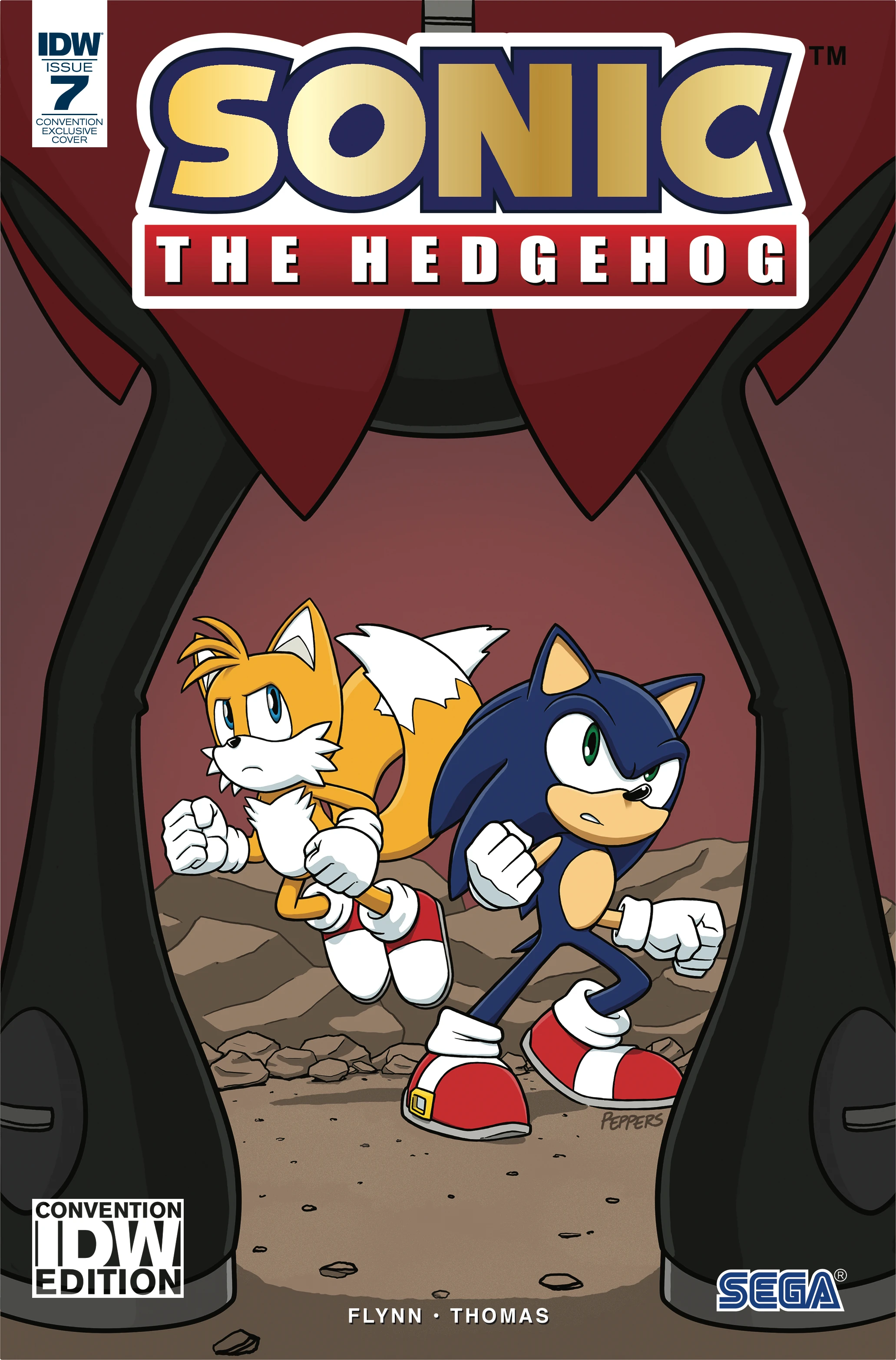
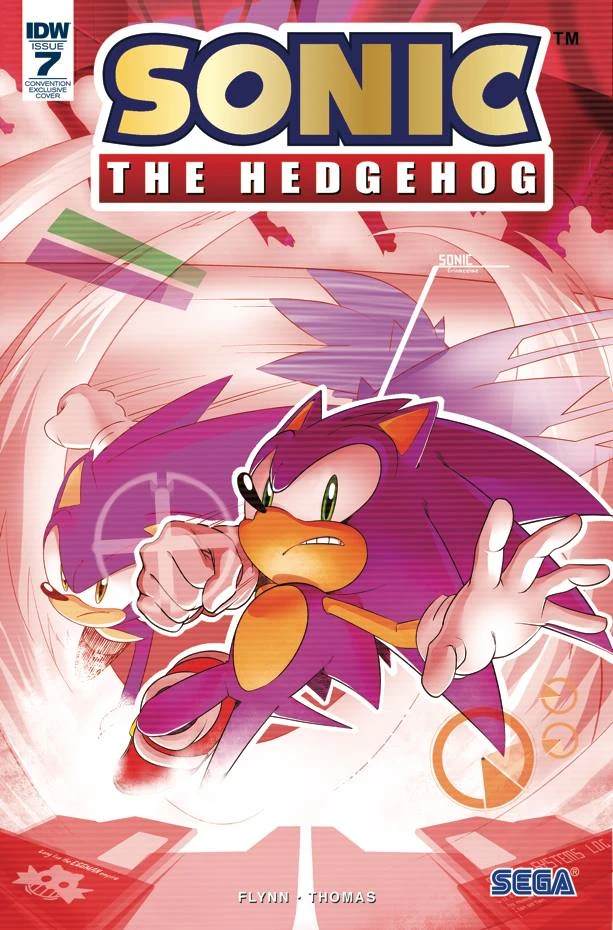
IDW has been publishing their “Sonic” comic for only four months now but one difference between Sonic’s new home and his old home at Archie is already apparent. The San Diego Comic Con was this month. Though now devoted to a hundred other forms of popular culture, actual comic book news is still frequently announced at SDCC. In the two decades Archie was publishing “Sonic,” I can recall exactly one occasion of them ever announcing any “Sonic” news there. IDW, meanwhile, had a big panel devoted to “Sonic.” They announced an upcoming one-shot devoted to promoting that new racing game that’s coming out. They showed off a new character - the terribly mysterious Whisper the Wolf - and released a version of this issue with two special covers exclusive to convention attendees. Whether or not IDW will still be putting this much effort into promoting the book after it’s been running for a few years remains to be seen. However, it already seems to me that IDW cares more about getting the word out than Archie ever did.


Though big shot comic con people got to read issue 7 early, we plebeians had to wait for its physical/digital release earlier this week. Contained within is “Meet the New Boss.” Hopefully, I wasn’t the only Who fan who Pavlovianly responded to that with “Same as the old boss!” This was likely Ian Flynn’s intention, as the issue begins with Sonic and Tails intercepting an Eggman Empire airship. Sonic quickly runs to the cockpit and sees Dr. Eggman inside. However, he quickly deduces this is a copy. The clone reveals its true identity: Metal Sonic. And the robotic hedgehog intends on carrying out his old master’s plans.

I’ll give Flynn this much. His double zig-zag plot twist did catch me off guard. After seemingly setting up Infinite as the new big bad, he reveals that it’s actually Metal Sonic behind the Badniks' activity. This is still disappointing, as Metal Sonic was everyone’s first guess as to the true identity of the new mastermind. So, after making it look like the book was going to go in a different, more interesting direction, it then heads in the direction that all of us were expecting. The big mystery that the first half of the book’s first year revolves around dissolves in the least interesting way possible.


Metal Sonic - who has relapsed back into his high school “Matrix” phase, as he’s wearing black leather and insisting people call him “Neo” - does not distinguish himself as a villain right out of the gate. In fact, Metal’s goal is to make sure Eggman’s plans run exactly as the doctor intended. I’m sure Flynn is going somewhere with this. A confrontation between Metal and Eggman’s newly benevolent persona is surely forthcoming. However, if a villain that was going to act exactly like Eggman was what he was going with, why didn’t he just use Eggman in the first place? The only differentiation Metal Sonic brings to this role is his laser-focused need to prove his superiority over Sonic. It’s just further proof to me that Metal Sonic is kind of boring.

Moreover, the book justifies Neo Metal Sonic’s reappearance in an awkward way. When the robot is revealed, he takes a minute to espouse on his origin. Using some very clunky “as you know” style exposition, he explains that something similar to this already happened, during the “Sonic Heroes” video game that I am now forced to acknowledge as canon. He then goes on to say that Eggman removed his rebellious tendencies before rebuilding him. Why Eggman would rebuild a robot that previously tried to kill him is not addressed. So, within a few panels, Flynn admits that this plot point is derivative and doesn’t make much sense.


But maybe I’m overthinking it. It wouldn’t be the first time. Because, like quite a few of his Archie issues, this one is heavily focused on action. The book skips right to Sonic and Tails flying over the new Egg Carrier, dispensing with any set-up whatsoever. He goes racing across the landing strip of the ship. He speeds pass explosive rounds being fired by cannons. Naturally, there’s a big fight scene with Metal Sonic, the robot proving more than capable of catching up to his organic counterpart. Some Egg Pawns get smooshed. I’m not really complaining, as it’s all entertaining, but Flynn’s desires to get to the fighting and exploding does seem to take precedence over character or plot some times.

It all looks really cool, which helps. After blowing the doors off with his work in issue 2, Adam Bryce Thomas returns to illustrate another issue. His work is not quite as graphically overwhelming this time. There’s even one coloring error, when Sonic grows a weird oval shaped mouth. (Like last time, Thomas does all his own inking and coloring, so that one is totally on him.) However, Thomas is still the best artist working on this book so far. He continues to handle action in a highly cinematic fashion. He truly conveys a sense of speed, as Sonic and Metal blur around each other during their fight. The artist is committed to making sure every image makes as much of an impact as possible. Which really pops in a book where, thus far, a lot of the art has felt a little phoned in.


The book’s best moment are not focused on punching and kicking though. After Metal Sonic catches up with the original, the two have a tense exchange. Holding Sonic by the throat, he gives him the option of telling him Eggman’s location or falling to his death. Sonic grins back and says he “never fears the fall.” He’s not just referencing Tails and the Tornado being right below, ready to whisk him to safety. He’s letting the villain know that not even the threat of death will keep him from doing the right thing. It’s a brag that doubles as a clear declaration of Sonic’s morals and heroic strength. And I like shit like that.

I also like the way the book concludes, with Sonic regrouping with Tails, Knuckles, and Amy. He informs them of this new info and they change their plans accordingly. Considering Sonic has been such a loner so far in this book, it’s nice to see him interacting with his friends as a team again. This just might be because I miss the Freedom Fighters but giving the hero a core group of friends, people he cares  about and depends on, makes him a more fully fleshed out being. Amy also says she’s going to call on the Resistance to help them. Hopefully, this means we’ll be seeing more of Sonic working with his friends (including Tangle) in the near future.


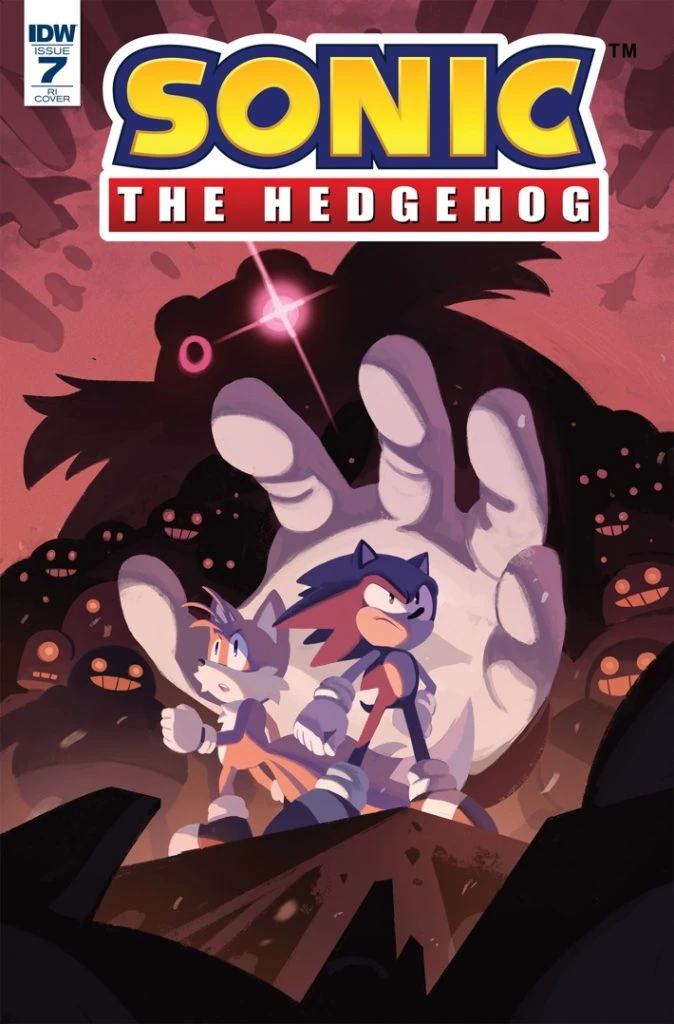
By the way, this issue has five variant covers and they’re all pretty nice. My favorite is the regular cover, which ominously depicts Sonic as a super fast wrecking ball racing up the deck of the Egg Carrier. The B cover, also from Bryce Thomas, is also pretty nice. The colors are pretty and the image is dramatic. Though the other covers aren’t as striking, they’re all pretty cool. As for the issue itself, I generally liked it while still being very disappointed in the villain’s true nature. [6/10]